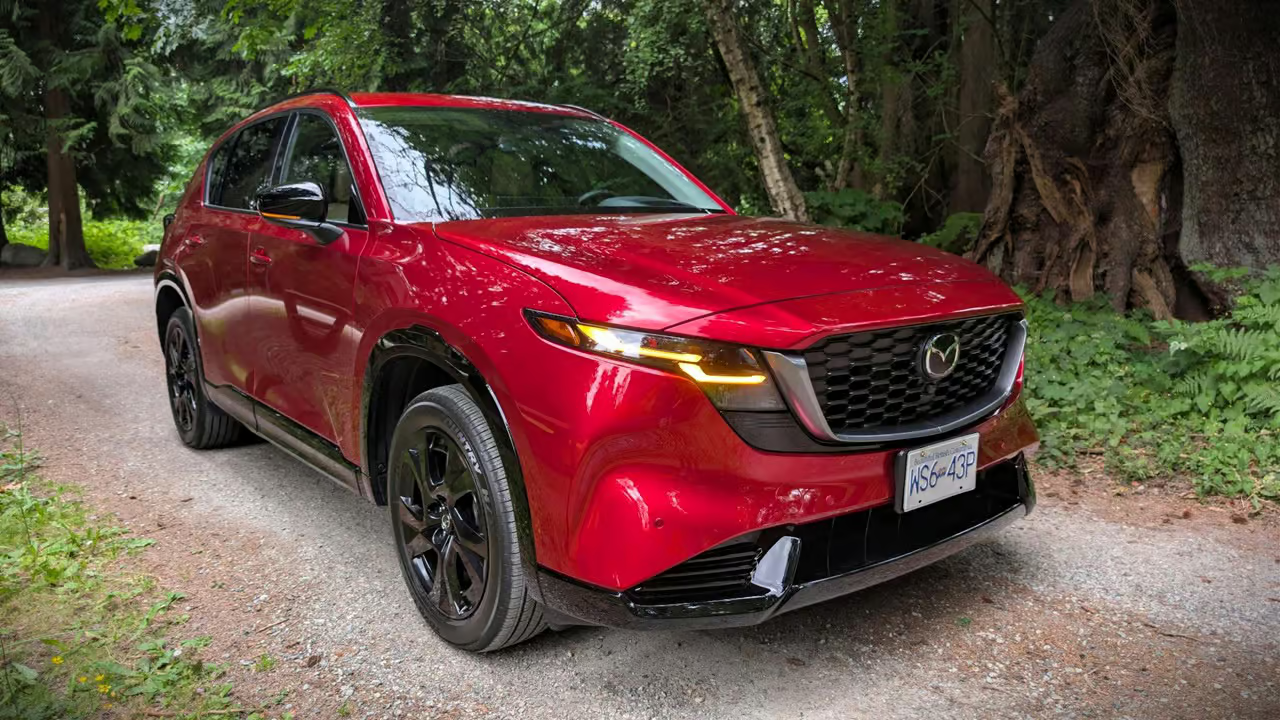
The 2026 Mazda CX-5 is finally the crossover it always should have been. Rear legroom increases by more than 50 mm (2.0 in) and rear headroom by more than 25 mm (1.0 in). Cargo space increases by 80 L without folding seats and 200 L with seats down. It looks fantastic in red, and with new shocks inspired by the MX-5 roadster and updated torque vectoring, it still drives better than anything else in this segment.
The engine—the same 2.5-liter four-cylinder they’ve been using for years—feels overmatched in a car this size. And the infotainment system, in a desperate swing away from the old buttons and rotary knob setup, is now a touchscreen-first mess that contradicts everything Mazda used to stand for.
Key Takeaways
The 2.5-liter four-cylinder (187 hp, 186 lb-ft) feels weak at low RPM and gets loud under hard acceleration—it’s near the bottom of the class for highway passing
Mazda removed physical climate and audio controls for on-screen sliders, while not hard to use, they still are not as simple as using buttons.
The CX-5 now has genuinely competitive rear seat room (2 inches more legroom) and cargo space (80 liters more seats up, 200 liters with them folded flat), finally fixing the old model’s biggest weakness
Table of Contents
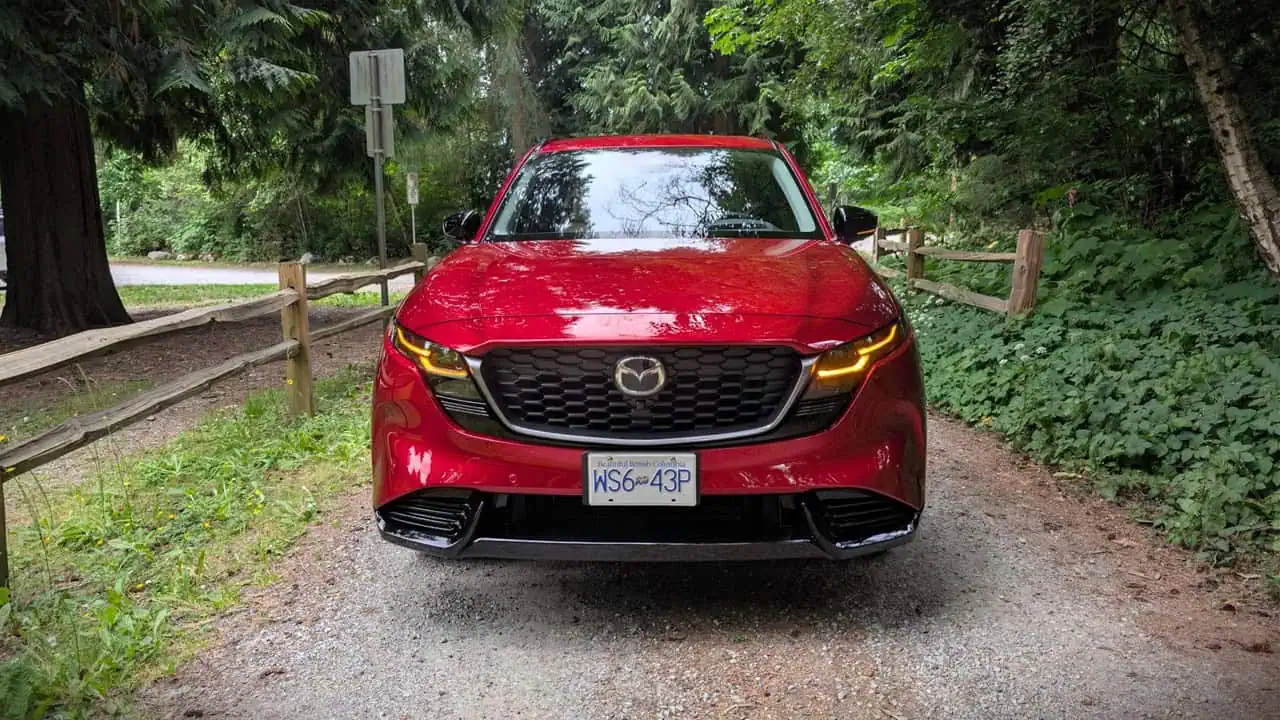
Pricing and Trims: The GT’s Value Proposition
Canadian pricing for the 2026 Mazda CX-5 start at $36,300 for the GX trim. The CX-5 GS starts at $39,200. The CX-5 GT—the trim I tested—starts at $42,200. These prices include an “Adminstration Fee” of $795, but don’t include options and Freight & PDI of $2,195.
The CX-5 undercuts the RAV4 and CR-V by several thousand dollars at every trim level. That’s a meaningful advantage if you’re shopping on budget.
On the GT trim, you can add a panoramic roof for $2,000. There is also the optional Premium package, which adds the panoramic roof and the 15.6-inch screen, along with other features, comes in under $50,000. These options add up quickly, but even fully loaded, you’re still spending less than a comparably equipped RAV4 or CR-V.
GT trim features: what you get for $44,395
The GT trim is the sweet spot for most buyers. Here’s what you get:
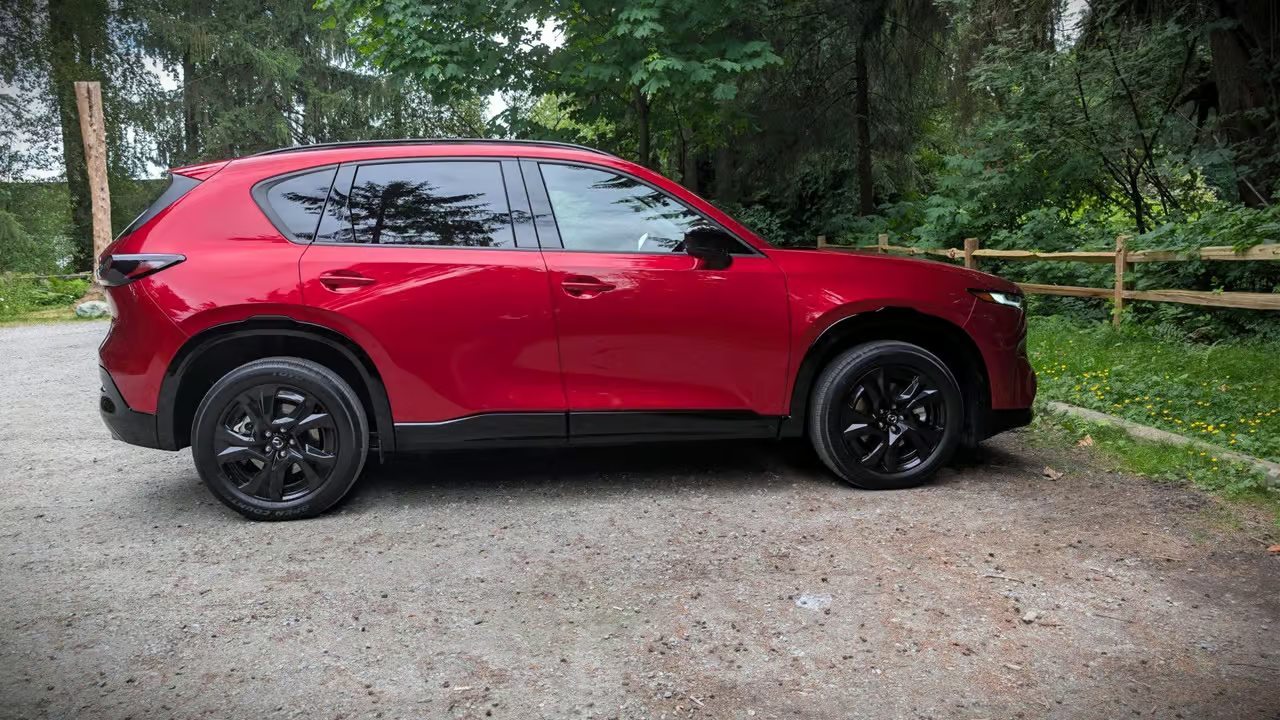
- 19-inch wheels with a different design
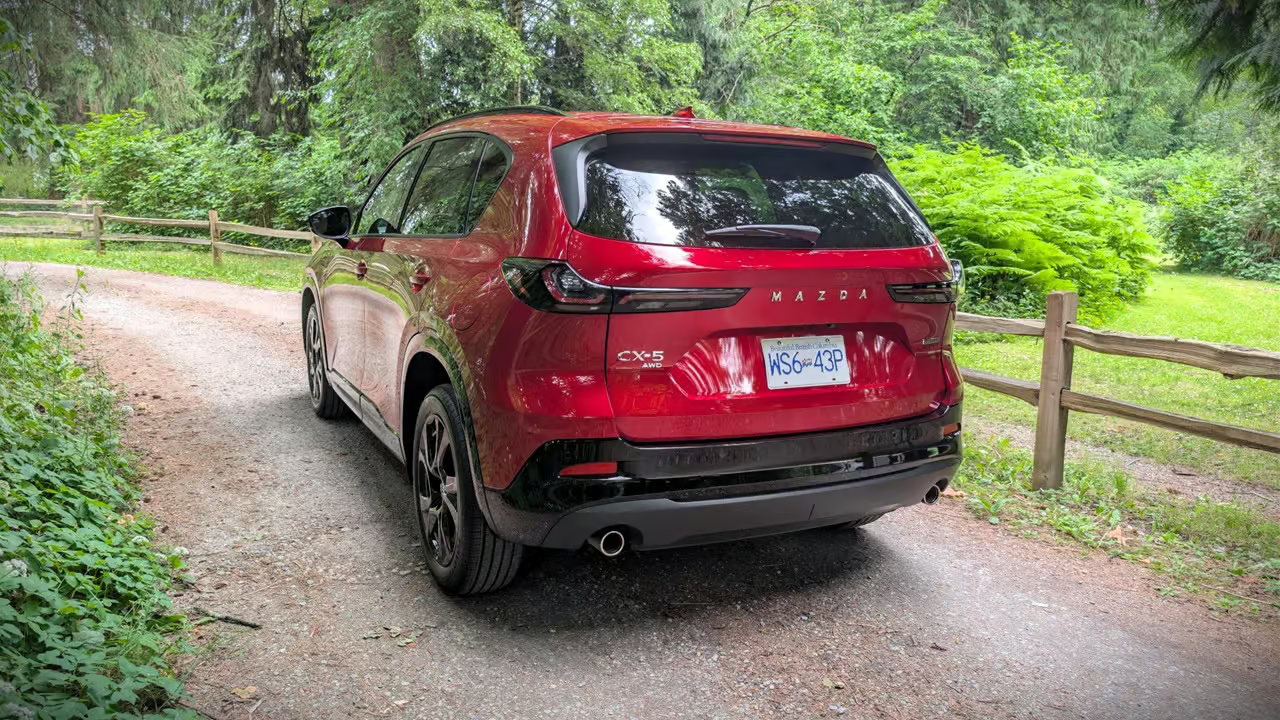
- LED lighting at the front and rear
- Gloss-black exterior trim
- 12-speaker stereo
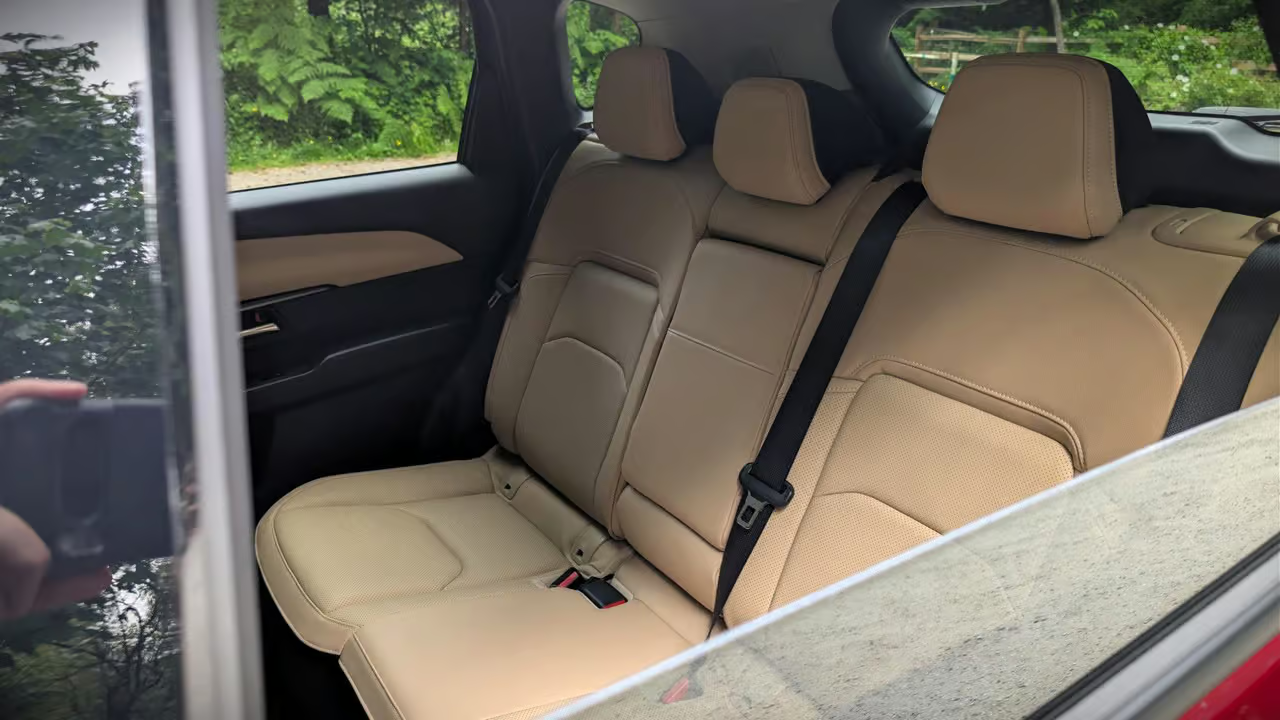
- Leather upholstery
- Ventilated front seats
- Heated rear seats
- Two additional USB-C ports in the rear
- Ambient interior lighting
- Adaptive headlights
The panoramic roof and the 15.6-inch screen are optional. If you can live without those, the GT at $44,395 is a solid value.
Related: Mazda Name Origin
Driving Impressions: Handling That Punches Above Its Weight
The CX-5 has always been the driver’s choice in the compact crossover segment, and Mazda hasn’t abandoned that. Same chassis (stretched) and suspension geometry from the old model. New shocks with tuning inspired by the MX-5 roadster. New wheel and tire package. Updated torque vectoring with G-Vectoring Control Plus that now incorporates an electronic brake limited-slip differential, as noted in a 2016 CX-5 review.
The result is a crossover that’s still genuinely fun to throw around a winding road. The steering is precise and responsive, with good feedback even though it’s slightly lighter than before. The brakes feel natural. The ride is softer than the outgoing model, which makes it more comfortable for daily driving, but you don’t lose the agility.
Three drive modes—Normal, Sport, and Off-Road—let you adjust the character. Sport sharpens throttle response and holds gears longer. I spent most of my time in Normal and didn’t feel like I was missing much.
The CX-5 is happy being thrown around a winding road in a way its competitors aren’t.
MX-5-inspired suspension: how Mazda kept the magic
The new shocks are tuned using lessons from the MX-5 roadster. That sounds like marketing copy, but on the road, you can feel it. The suspension manages body roll without feeling harsh. It absorbs bumps without getting floaty. The car stays composed through corners in a way that feels more like a sporty hatchback than a compact crossover.
Powertrain: The 2.5L Engine That Can’t Keep Up
Here’s the problem. The launch engine is the same naturally-aspirated 2.5-liter four-cylinder from the old model. 187 horsepower. 186 lb-ft of torque. A six-speed automatic transmission. All-wheel drive is standard, but for those wanting more torque from a diesel, the 2.2-liter SKYACTIV-D engine produces 168 horsepower and 290 pound-feet, which is not available anymore.
The engine is weak at low RPM. It only comes alive higher in the rev range, which means you’re constantly downshifting to find the power. It’s not dangerously slow—you won’t struggle to merge—but it’s near the bottom of the acceptable range for highway passing. When you need a burst of power to overtake a slow truck on a two-lane road, the engine strains and the cabin gets loud.
Mazda claims improved throttle response and transmission logic. The transmission downshifts more quickly than before and minimizes unnecessary shifts. But it’s still a six-speed in a world where most competitors have eight or nine, and it feels dated. The transmission is adequate but not refined.
It’s not competitive with the hybrid rivals. The RAV4 is hybrid-only now. The CR-V offers a turbo or a hybrid. The Tucson and Sportage both have hybrid options. Even the Mazda CX-5’s big brother, the CX-9 Kuro Edition, uses the same basic 2.5-liter turbo engine, yet against any of those competitors, the CX-5’s powertrain still feels a generation behind.
Real-world fuel economy: 8.2 L/100 km in mixed driving
My real-world fuel consumption over a mix of congested highways, open country roads, and coastal driving came out to 8.2 L/100 km, in about a 75/25 highway/city split. That’s competitive but not class-leading. The hybrid rivals will do better, especially in city driving.
According to Natural Resources Canada (NRCan) the 2026 Mazda CX-5 should consume 9.9/7.9/9.0 liters/100 kilometers in city/highway/combined driving.
The 2027 hybrid: why you might want to wait
Here’s the good news: a hybrid powertrain is confirmed for 2027. Mazda’s new Skyactiv-Z or a Skyactiv hybrid four-cylinder engine is in development, and it’s exactly what this car needs.
If that hybrid engine finds its way into the CX-5, this could become the crossover of the year. The chassis is already there. The space is finally there. All it needs is a powertrain that matches the rest of the package.
My honest advice: if horsepower and fuel efficiency matter to you, wait for the 2027 CX-5 Hybrid. The current engine holds the car back from being truly great.
Related: When Did Mazda Come to North America
Exterior Design: Familiar Silhouette, Refined Details
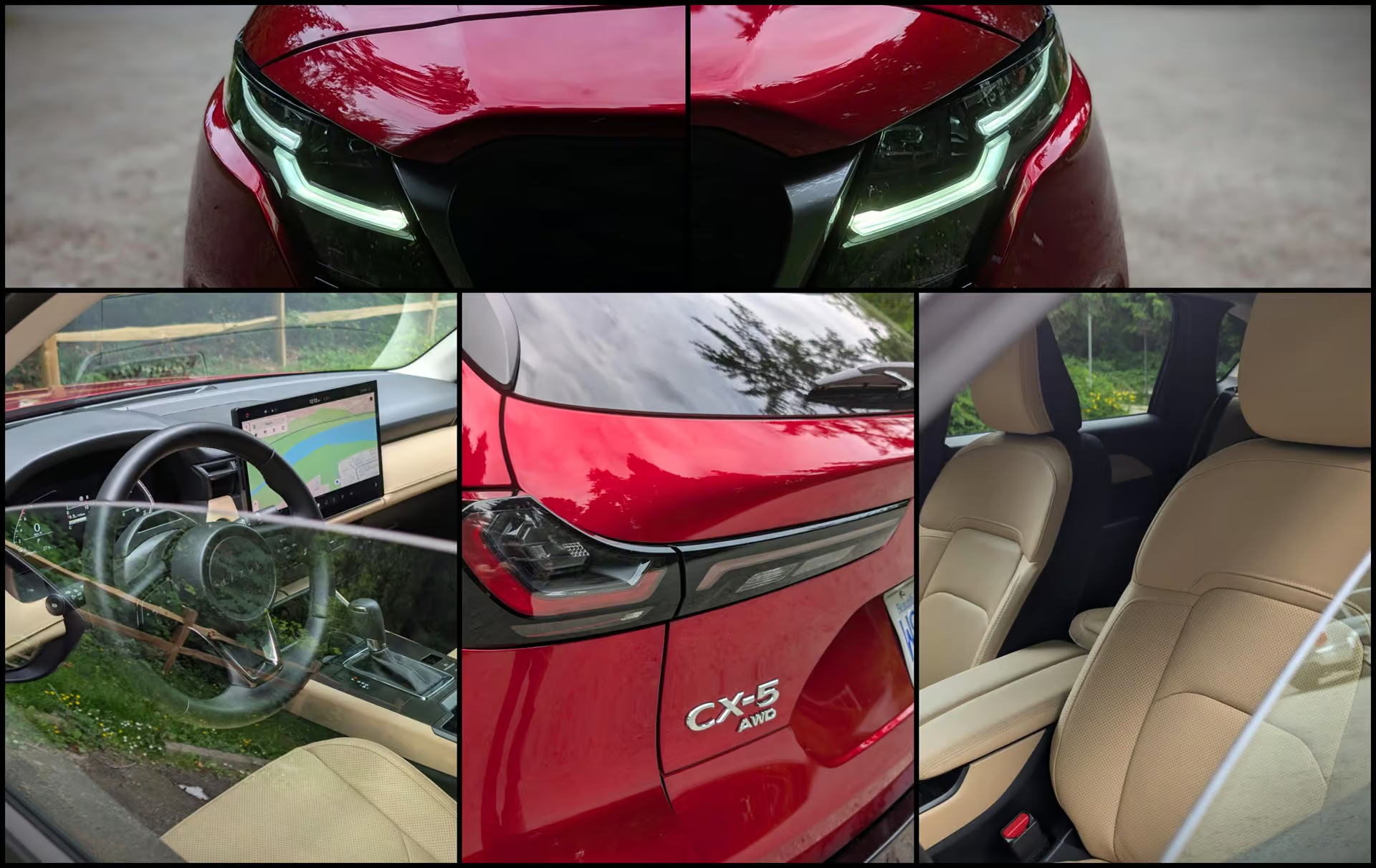
It’s 100 mm longer overall, with a hood that’s 5 cm higher, but it somehow still looks more compact than the outgoing model. There’s some visual trickery at work here—the proportions are just better.
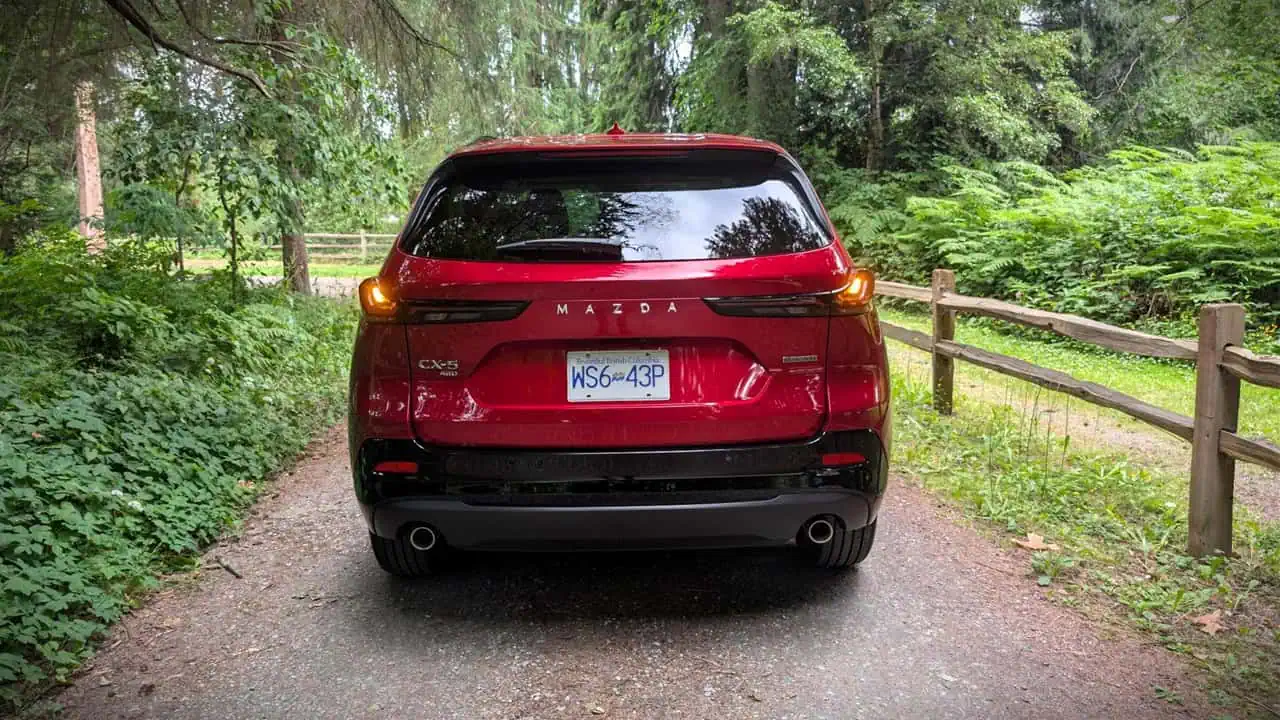
In person, it’s a handsome thing. My test car was red, and it looked really good. The thin light signatures are attractive, the Signature Wing grille carries over from the CX-90, and there are these kigumi-inspired fender garnish details that are a nice touch if you notice them. The Mazda wordmark on the tailgate gives it a premium-ish vibe. The LED headlights are standard across the lineup, and they’re bright and crisp—fits the refined look.
It’s not more aggressive or athletic than before. It’s just refined. The outgoing model was already one of the better-looking compact crossovers. This one stays in that lane.
Interior Quality and Design: Luxurious Feel Undermined by Cost-Cutting and Screen Overload
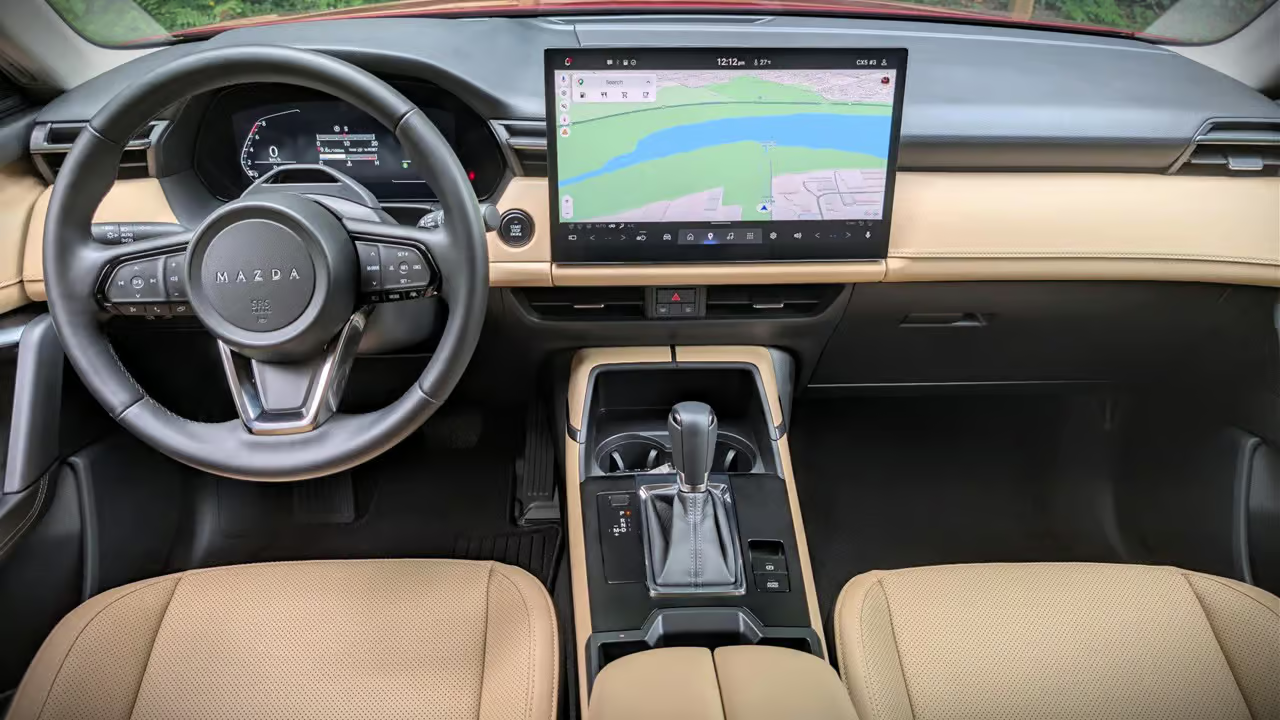
The cabin looks and feels premium at first glance. Good materials on the seats and dash. Clean layout. The gear selector is a completely normal physical lever, which is a win in an era where every manufacturer seems to be reinventing the shifter for no good reason.
But spend a few minutes looking around and the shortcuts appear. There’s hard plastic on the upper door panels—even on this GT trim. The stitching isn’t as nice as the old car’s. The single-button steering wheel controls (one per side, touch-dependent) feel like cost-cutting, plain and simple. And the cabin, especially in all black, feels austere rather than minimalist. Two-tone color options help, but the base impression is a bit stark.
The biggest problem, though, is what they did to the controls.
The touchscreen overcorrection: from rotary knob to on-screen sliders
Mazda was famously anti-touchscreen for years. They had a beautiful rotary knob and button system that was easy to use without looking away from the road. It was one of the things that made their interiors feel thoughtfully designed.
That system is gone. Completely.
Now you get a 12.9-inch touchscreen as standard (15.6 inches on the GT Premium) with everything controlled through the screen. Physical climate controls? Gone, replaced by on-screen sliders. Audio controls?
It’s a massive overcorrection, and it contradicts Mazda’s old ethos of keeping things simple and driver-focused.
I preferred the old system. I’m not alone. Using on-screen sliders for climate control while driving is a genuine pain. You have to take your eyes off the road, find the right spot on the screen, and drag your finger across a glass surface instead of just twisting a knob. It’s a step backward, and it’s hard to understand how Mazda approved this.
Google built-in: the software that almost saves it
The software itself is actually good. Google built-in runs the show, which means Google Maps works without your phone, Spotify streams directly, and voice commands via “hey Google” are genuinely useful. The interface is responsive, familiar, and easy to read. Wireless Apple CarPlay and Android Auto are available on the top trims.
The 10.25-inch digital instrument cluster is clear and informative. The head-up display, available on higher trims, works well.
So the technology is there. The problem is the interface philosophy. A responsive touchscreen with good software is still worse than a rotary knob you can operate by feel. Mazda spent years getting this right, then threw it away to chase the screen trend.
Practicality: Finally Competitive on Space, But the Panoramic Roof Disappoints
Here’s where the new CX-5 makes its strongest case. The old model’s biggest weakness was space. The rear seats were tight. The cargo area was small. If you were choosing between a CX-5 and a RAV4 or CR-V, you were making a real sacrifice in practicality to get the better driving experience—but for a larger family hauler, you might instead consider the 2026 Mazda CX-90 PHEV Signature.
That’s no longer true.
Rear legroom increases by more than 50 mm (2.0 in). Rear headroom is up by more than 25 mm (1.0 in). Mazda claims best-in-class rear seat room—I can’t verify that against the whole segment, but I can tell you that I’m 5-foot-8 and I had plenty of room in the back. The rear doors open almost 90 degrees, which makes a huge difference when you’re strapping kids into car seats.
Cargo space sees real gains too. The cargo floor is 50 mm longer and lower than before. You get 80 liters more space without folding the seats, and 200 liters more with them down. The 40/20/40 split rear seats fold completely flat now—the old model’s seats didn’t, which was genuinely annoying.
It’s an improvement. The CX-5 no longer has the practicality asterisk next to its name.
The panoramic roof: big glass, tiny opening
The panoramic roof is a $2,000 option on the GT trim. It’s a nice idea, and it lets in a lot of light. But there’s a catch that most reviews won’t mention: the opening itself is very small.
The glass panel is large. The portion that actually slides open is not. So you get the visual benefit of a bright cabin, but the open-air feel you’re probably expecting isn’t there. It’s more like a skylight than a true open-roof experience. If you’re buying this car specifically for the panoramic roof, you might be disappointed.
How the CX-5 GT Stacks Up Against the Competition
The compact crossover segment is as competitive as it gets. The main players are the Honda CR-V, Subaru Forester, Hyundai Tucson, Kia Sportage, and Toyota RAV4. Each has strengths.
The CX-5’s advantages are clear: it drives better than any of them, costs less than most, and finally has the space to compete. But it’s also the only one without a hybrid option at launch, and its transmission is a generation behind.
If driving dynamics are your priority, the CX-5 wins hands down. If fuel economy or outright power matter more, you’ll want to look at the hybrids.
CX-5 GT vs RAV4: price vs powertrain
The RAV4 is hybrid-only now, which completely changes the comparison. The CX-5 is several thousand dollars cheaper than an equivalent RAV4, but the RAV4 will get significantly better fuel economy and has more refined powertrain.
If you’re deciding between the two, it comes down to priorities. Want the car that handles better and costs less? Get the CX-5. Want the car that sips fuel and will probably hold its value better? Get the RAV4.
Verdict: A Good Crossover That’s One Engine Away from Greatness
The 2026 CX-5 GT is an easy car to like. It’s spacious now. It looks great, especially in red. The interior feels premium where it counts. And it still drives better than anything in its class, thanks to suspension tuning that genuinely feels inspired by the MX-5.
But it’s equally easy to be frustrated by. The engine is a generation behind. The infotainment system traded one of the best control interfaces in the business for a screen-first setup that’s worse to use. The panoramic roof looks impressive but doesn’t deliver the open-air experience you’d expect.
The pricing is competitive. The space is finally there. The handling is still class-leading. If Mazda gets the powertrain right with the 2027 hybrid, this car could be the crossover of the year.
Right now, it’s a good crossover that’s one engine away from greatness. If you can wait, wait. If you can’t, and driving dynamics matter more to you than peak efficiency, the CX-5 GT is still a solid choice.
Just don’t expect the panoramic roof to actually open very far.
2026 Mazda CX-5 GT Review Photo Gallery
People Also Ask
Is the Mazda CX-5 GT reliable?
Mazda has a strong track record for reliability, and the CX-5 GT carries that forward with proven mechanical components like the 2.5-liter four-cylinder and six-speed automatic. The main concern is the new touchscreen-first infotainment system, which introduces more complexity and potential failure points than the old rotary knob setup.
Is the 2026 Mazda CX-5 a good car?
Yes, but with a caveat. It finally has competitive rear seat room and cargo space, it still drives better than anything else in the segment, and it undercuts rivals like the RAV4 and CR-V on price. The problem is the engine feels underpowered for highway passing, and the new touchscreen controls are a step backward from the old rotary knob system.
What is the CX-5 GT premium package?
The GT Premium adds a 15.6-inch touchscreen (up from the standard 12.9-inch) and a panoramic roof. The panoramic roof alone costs $2,000 to $2,500, and the screen upgrade adds $4,500, so the package pushes the GT close to $50,000. Even fully loaded, it still costs less than a comparably equipped RAV4 or CR-V.