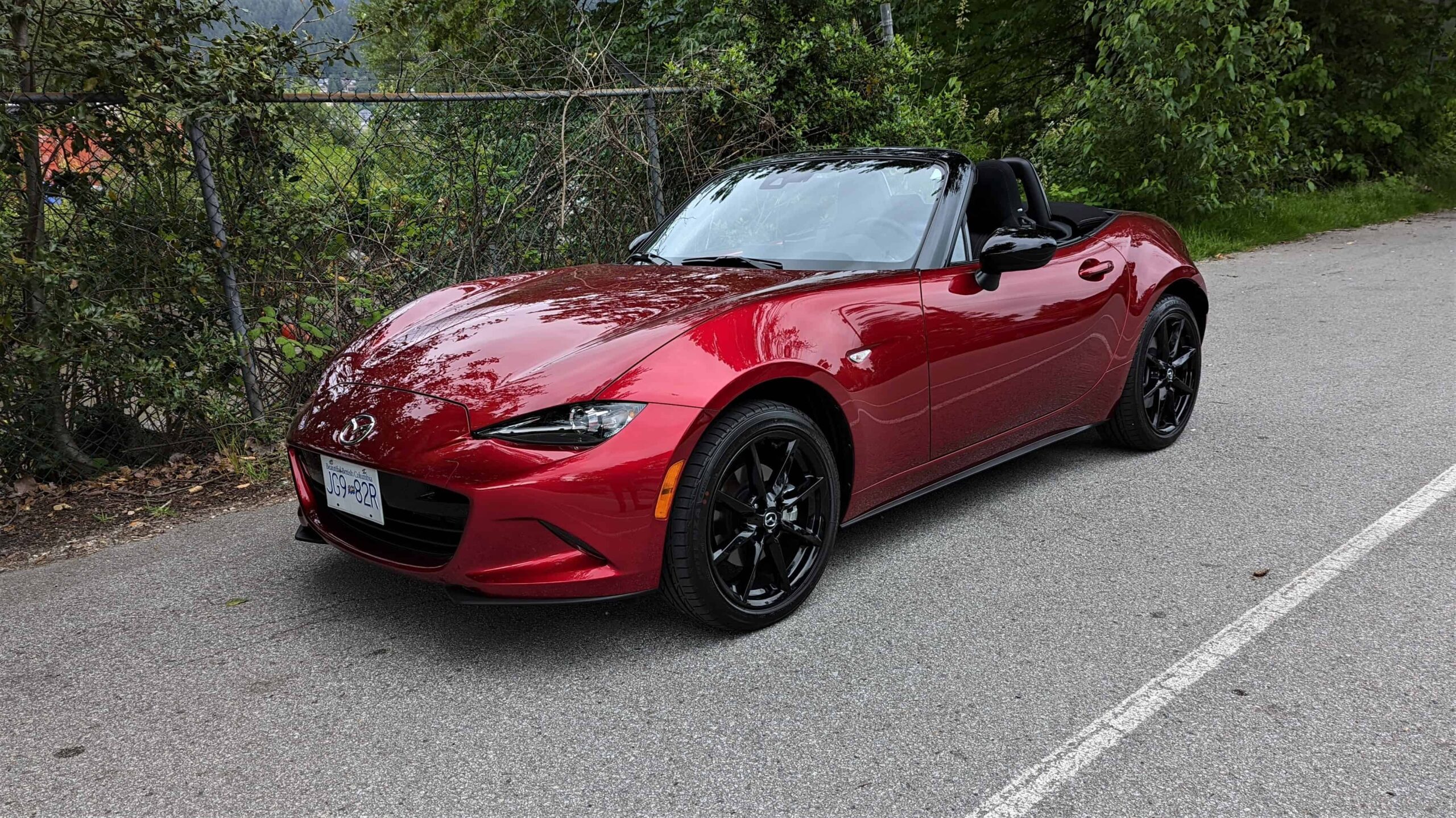
But Mazda isn’t only a car brand. Its name honors Ahura Mazda, the Zoroastrian god of wisdom, light, and harmony. That ancient influence didn’t stop at a logo — it shaped the company’s founding philosophy.
I’ll walk through the two intertwining stories — Jujiro Matsuda’s surname and the deity Ahura Mazda, plus the rejected names (Sumera-Go and Tenshi-Go), the theology, the official company statement, and how that meaning still shows up in modern Mazdas like the CX-5 and RX-8. By the end, you’ll see the name wasn’t a coincidence. It was a deliberate choice that still echoes.
Key Takeaways
The name Mazda comes from Jujiro Matsuda’s surname (phonetically romanized) and Ahura Mazda, the Zoroastrian god of wisdom, light, and harmony. The company officially endorses both origins.
Before settling on “Mazda-Go” for their first vehicle in 1931, Toyo Kogyo considered the names Sumera-Go (meaning “god”) and Tenshi-Go (meaning “angel”) — reflecting the founder’s interest in human faith.
Mazda used the name on vehicles for 53 years before formally changing the company name to Mazda Motor Corporation in 1984, and the Mazda logo (V-shaped wings) is not a reference to the Zoroastrian Faravahar symbol.
Table of Contents
The Founder’s Name: Jujiro Matsuda and the Phonetic Connection
This part is straightforward. Jujiro Matsuda founded Toyo Cork Kogyo on January 30, 1920, as a cork-making factory. By 1927 it was renamed Toyo Kogyo, and in 1931 they built their first vehicle: the Mazda-Go, a three-wheeled auto rickshaw.
“Mazda” is a direct romanization of “Matsuda.” That’s one of the two official origins.
What’s interesting is the gap. The Mazda name appeared on vehicles from 1931, but the company did not formally adopt “Mazda Motor Corporation” until 1984. That’s 53 years of selling cars under a name that wasn’t the corporate name. In the early days, the Mazda lettering even appeared next to the Mitsubishi emblem — because Mitsubishi handled sales of that three-wheeled truck.
So the phonetic link is real. But if that were the whole story, this would be a two-paragraph article. It’s the other half that makes it worth digging into.
The Rejected Names: How the Naming Process Unfolded
The team considered Sumera-Go and Tenshi-Go before landing on Mazda-Go. Sumera means “god” and Tenshi means “angel.” Those names didn’t make the cut, but they tell you something about the founder’s mindset.

Matsuda had a clear interest in human faith and spirituality. He wasn’t picking a brand name off a list of sons. He was reaching for something bigger — a name that carried meaning beyond the product.
Most automotive brand names come from founder surnames (Toyota, Honda, Ford) or acronyms (BMW, Nissan). Mazda’s process was different. And the name they chose doesn’t only sound like Matsuda — it also honors a Zoroastrian deity. That kind of double meaning is rare, and it wasn’t an accident.
Field note: The rejected names Sumera-Go and Tenshi-Go reveal that Matsuda was looking for spiritual resonance, not just a phonetic match.
Who Is Ahura Mazda? The Zoroastrian God Behind the Name
Ahura Mazda is the supreme god of Zoroastrianism, one of the world’s oldest monotheistic faiths. The name itself means “Wise Lord.” He’s associated with wisdom, light, harmony, truth, and justice — good attributes to attach to a car brand.
Zoroastrianism was founded by the prophet Zarathushtra (you might know him as Zoroaster). The dates are fuzzy — scholars put him somewhere in the 2nd millennium BCE, though some narrow it to around 628-551 BCE. His teachings are considered a direct influence on Judaism, Christianity, and Islam.
The religion’s core ethical principle is “Good Words, Good Thoughts, Good Deeds.” Its symbol is the Faravahar, a winged disc representing divine power and glory. Ahura Mazda is known by 101 names — including Yazad, Harvesp-tavan, Harvesp-agah, and Harvesp-khuda. You can see one of the earliest depictions of him on the Behistun Inscription, carved in 516 BCE under King Darius I, where Ahura Mazda appears as a winged figure aiding the king.
Zoroastrianism was the dominant religion of the Achaemenid, Parthian, and Sassanian empires for over a thousand years. After Islam became dominant in Iran in the 7th century CE, Zoroastrians became a minority. Some migrated to India starting in the 10th century, where they’re known as Parsis. Today, there are only an estimated 100,000 to 200,000 worshipers worldwide.
But for a car company founded in Hiroshima in 1920 to name itself after this Persian god? That’s a cultural bridge.
Why Mazda? The Official Philosophy
The company doesn’t leave this up to interpretation. Mazda’s official corporate history states that the name comes from Ahura Mazda — and I’ll quote it directly: “the Zoroastrian deity of harmony, intelligence, and wisdom from ancient West Asia.” If you’re looking for the best Mazda models you can buy in 2021, that same spirit of harmony and intelligence continues in their modern lineup.
Key members of Toyo Kogyo saw the name as representing the dawn of Eastern and Western civilization, as well as the rise of automotive culture. That’s not marketing spin. That’s the company position.
So the name wasn’t a gimmick. It was a mission statement. Mazda wanted its name to represent the unification of Eastern and Western cultures, and the advancement of human mobility through wisdom and harmony. That’s heavier than “Zoom-Zoom,” but it’s the foundation the brand was built on — a foundation first poured with the first Mazda car.
From Ancient Wisdom to Modern Design: The Name’s Thematic Resonance
I’m not saying Mazda’s design team sat down and said, that Let’s make a car that embodies Zoroastrian ethics. But look at what they’ve built.
Ahura Mazda represents wisdom, harmony, and unity. Mazda’s modern design language is called Kodo — “Soul of Motion.” It makes cars look like they’re moving even when parked. The driving philosophy for the MX-5 Miata is jinba ittai — “horse and rider as one.” The brand’s longtime tagline is Zoom-Zoom, meant to capture the joy of motion, and the History of Mazda Automobiles in North America shows how that philosophy, from the rotary-powered Cosmo to the Miata and CX-90, turned the brand into a defiant driver’s choice.
Then there’s SkyActiv — their engineering platform that prioritizes efficiency without sacrificing driving feel. High-compression gasoline engines (13:1 compression), lightweight chassis, and a focus on the human element of driving.
None of this is explicitly marketed as “inspired by Ahura Mazda.” But the thematic alignment is hard to ignore. Wisdom, harmony, unity, motion — those words show up in every layer of Mazda’s identity, from the name to the badge to the cars.
From Toyo Cork Kogyo to Mazda Motor Corporation: A Historical Timeline
Let me give you the fast version. The company went through a lot before it settled into the Mazda we know today.
- 1920 — Founded as Toyo Cork Kogyo (yes, cork).
- 1927 — Renamed Toyo Kogyo.
- 1931 — First vehicle: the Mazda-Go three-wheeled truck. The Mazda name appears.
- 1960 — First passenger car: the Mazda R360 kei car.
- 1967 — First production rotary engine car: the Cosmo Sport. The Wankel rotary engine, licensed from NSU, would become Mazda’s signature technology.
- 1974 — Ford buys 24.5% of the company.
- 1984 — Official name change to Mazda Motor Corporation.
- 1989 — MX-5 Miata launches, embodying the jinba ittai philosophy.
- 1991 — 787B wins Le Mans (first Japanese automaker, only non-piston car to win overall).
- 2000 — Zoom-Zoom campaign launches.
- 2011 — SkyActiv and Kodo design announced with the CX-5.
- 2015 — Ford sells its remaining shares. Partnership with Toyota begins.
- 2018 — Joint venture with Toyota in Alabama announced.
- 2022 — CX-50 built in the US at that plant.
The timeline matters because it shows the Mazda name was used on products for more than five decades before it became the corporate identity. That’s resilience. That’s a brand that grew into its name. Key models like the RX-8 and BT-50, along with joint ventures such as AutoAlliance Thailand and the Sumitomo Group’s historical ties, further illustrate Mazda’s global reach and engineering ambition.
What People Get Wrong About the Mazda Name
Two common myths need clearing up.
Myth one: The name comes only from the founder’s surname, Matsuda.
Fact: The company officially endorses both origins — the phonetic link and the Zoroastrian deity. It’s not either/or. It’s both.
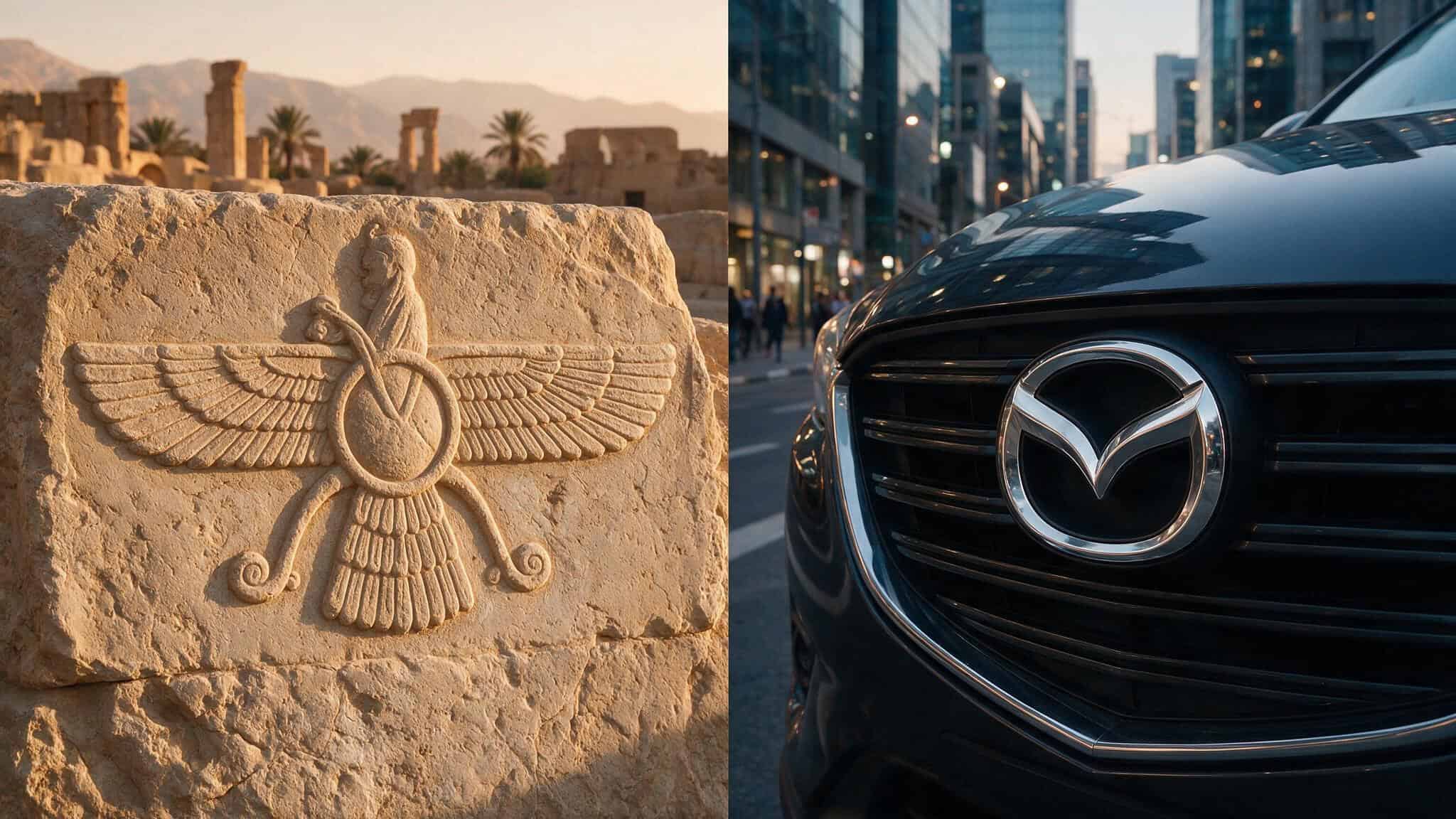
Myth two: The Mazda logo (the V-shaped wings) is derived from the Faravahar, the winged Zoroastrian symbol.
Fact: The V-wing logo was adopted in 1997 for reasons of “growth” and “improvement,” not for religious symbolism. Before that, Mazda used a sun-and-flame emblem starting in 1991. There’s no direct connection to the Faravahar.
And here’s what most articles miss: the rejected names (Sumera-Go and Tenshi-Go) and the deep Zoroastrian context like the 101 names and the Behistun Inscription. Those details are rarely mentioned, but they’re the story.
Why the Name Matters
Mazda isn’t only a car brand. Its name honors a Zoroastrian god of wisdom, light, and harmony. That ancient influence shaped the company’s founding philosophy — and it still shows in the cars today.
The name connects ancient Persia to modern Japan. It ties Toyo Cork Kogyo to the Mazda 787B, winner of the 24 Hours of Le Mans in 1991. It says a car company can be about more than moving people from A to B. It can be about moving ideas forward.
The next time you see a Mazda CX-5 or hear an RX-8’s rotary whine, remember: the name on the hood wasn’t pulled out of a hat. It was chosen with intention. And that intention — wisdom, harmony, unity, is still driving the company forward.
Frequently Asked Questions
What does the name Mazda actually mean?
Mazda has two official origins. It’s a phonetic romanization of founder Jujiro Matsuda’s surname, and it also honors Ahura Mazda, the Zoroastrian god of wisdom, light, and harmony. The company endorses both meanings.
Why did Mazda consider the names Sumera-Go and Tenshi-Go?
Before settling on Mazda-Go for their first vehicle in 1931, the company considered Sumera-Go (meaning ‘god’) and Tenshi-Go (meaning ‘angel’). Those rejected names show that founder Jujiro Matsuda was looking for spiritual resonance, not just a phonetic match to his surname.