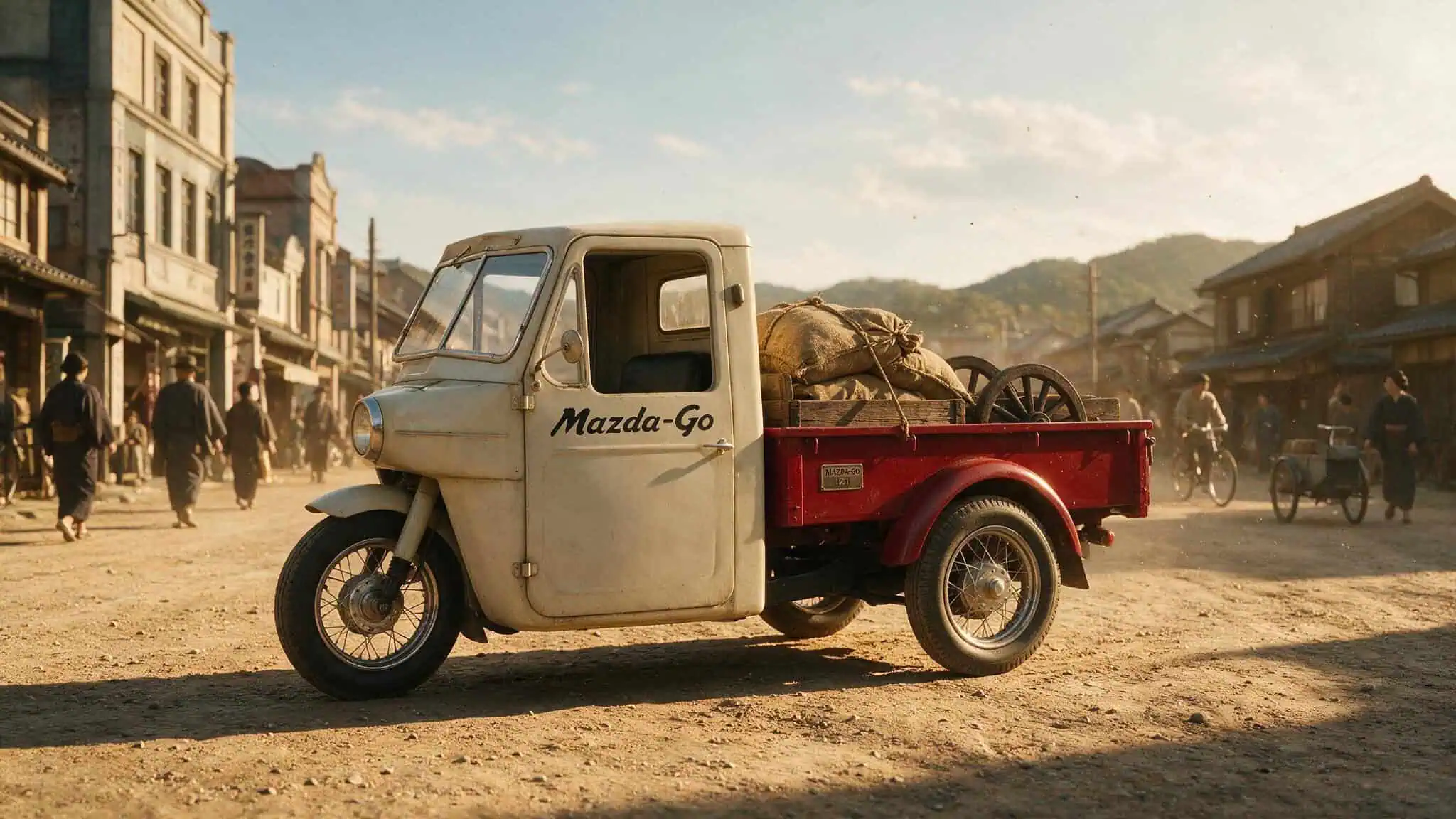
Mazda didn’t start as a car company. It started as a cork factory.
The company went through three official names over its 100-plus years:
- Toyo Cork Kogyo Co., Ltd. (1920–1927) – a cork and machine-tool maker in Hiroshima
- Toyo Kogyo Co., Ltd. (1927–1984) – the years when they started making vehicles, but the company still wasn’t called Mazda
- Mazda Motor Corporation (1984–present) – what we all know today
But the name “Mazda” itself showed up way before 1984. That’s where it gets interesting.
Key Takeaways
Mazda began as Toyo Cork Kogyo Co., Ltd. on January 30, 1920 — a cork factory and machine tool manufacturer, not an automaker.
The “Mazda” name first appeared on a three-wheeled truck called the Mazda-Go in 1931, chosen for its dual meaning: the Zoroastrian god Ahura Mazda and a nod to founder Jujiro Matsuda’s surname.
The company was never called “Matsuda” as a brand, and the 1984 name change to Mazda Motor Corporation was an administrative alignment — every vehicle sold since 1931 already wore the Mazda badge.
Table of Contents
Toyo Cork Kogyo Co., Ltd.: The Cork Factory That Nearly Didn’t Survive
Jujiro Matsuda founded the company in Hiroshima on January 30, 1920. The name on the door was Toyo Cork Kogyo Co., Ltd. — and yes, the core business was cork. They made cork products and machine tools. They even bought the Abemaki Tree Cork Company early on, doubling down on the cork angle.
The company nearly went under in the late 1920s. Bankruptcy was real. The Hiroshima Saving Bank and a group of local business leaders stepped in and bailed them out. That close call forced a pivot.
In 1927, the company dropped “Cork” from the name and became Toyo Kogyo Co., Ltd. — still not a car company, but the shift in direction was clear.
The Toyo Kogyo Years (1927–1984): The Name You Don’t Know
For 57 years, the company that built Mazda vehicles was legally called Toyo Kogyo. If you bought a Mazda in 1965, your paperwork said Toyo Kogyo up top. But the car itself said Mazda.
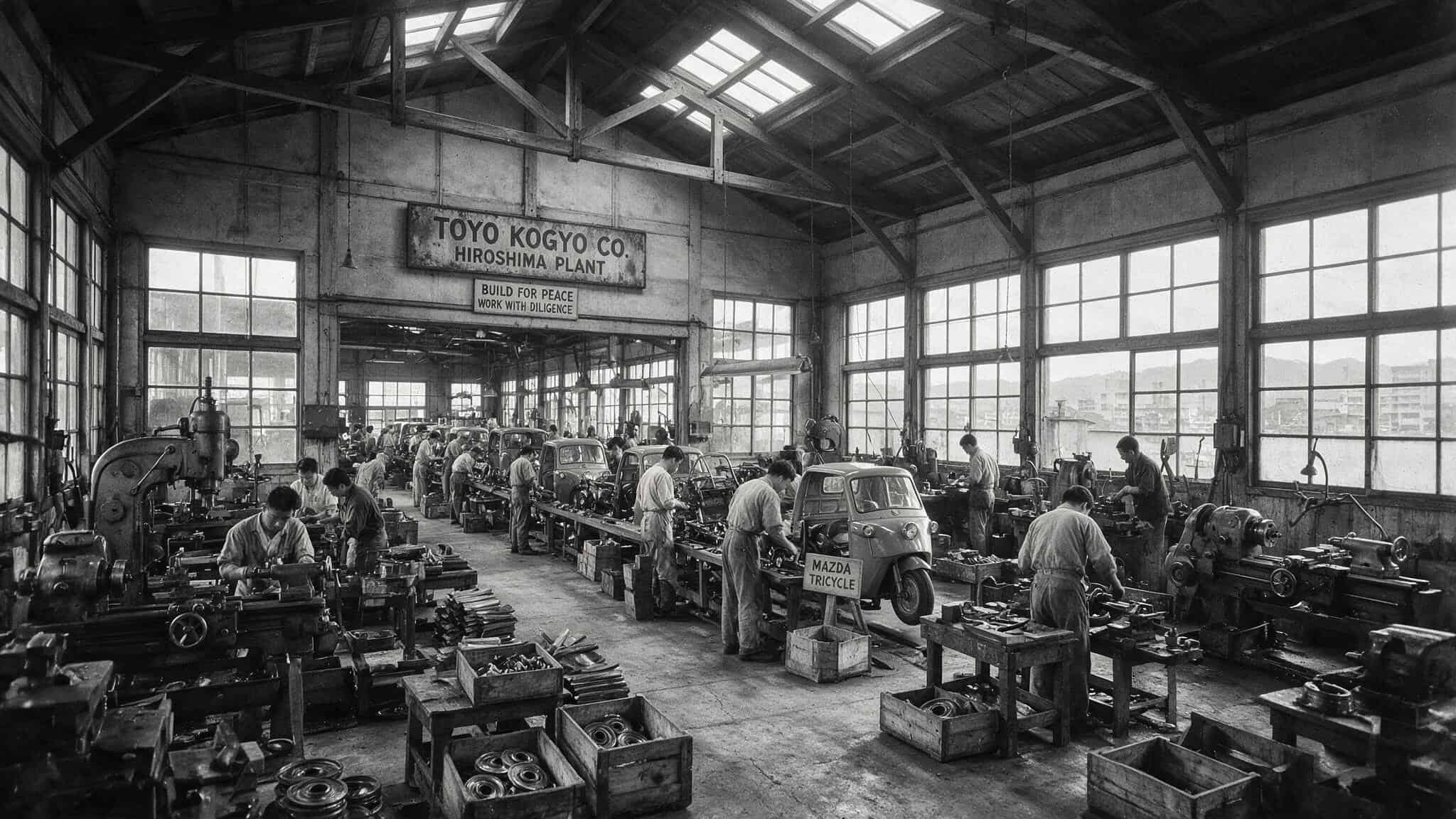
The first vehicle came in 1931: the Mazda-Go, a three-wheeled auto rickshaw. It was more truck than car, but it was the start. The Mazda name appeared on those little three-wheelers for the first time.
Then came World War II. Like a lot of Japanese manufacturers, Toyo Kogyo shifted to wartime production — they made Type 99 rifles for the military.
After the war, the company grew. But the 1975 oil crisis nearly killed them. Mazda had bet big on the rotary engine, which was thirsty, and when fuel prices spiked, sales collapsed. They were on the brink again. The Sumitomo keiretsu group — a powerful corporate network, stepped in and saved them.
Throughout all of that, every vehicle they sold wore the Mazda name. The company behind the scenes was Toyo Kogyo, but the brand was always Mazda.
If you want to see what those early cars and trucks looked like, check out this visual tour of classic Mazda models.
Field note: Mazda’s survival depended on outside rescues twice — once from local banks in 1927 and again from the Sumitomo group in 1975. Both times, the company was saved by organizations that saw long-term potential others didn’t.
The Birth of the Mazda Name: Wisdom from Persia, a Nod to the Founder
The Mazda name first appeared in 1931 on the Mazda-Go. But why “Mazda”?
The official explanation from the company is that the name comes from Ahura Mazda, the Zoroastrian god of harmony, intelligence, and wisdom. But it also sounds like “Matsuda,” the founder’s surname. What always gets me is that it’s a double meaning — a nod to ancient Persian wisdom and a wink at the guy who started it all.
The rejected name candidates tell you even more about the founder’s thinking. Other options considered were Sumera-Go (“god”) and Tenshi-Go (“angel”). Both show Matsuda’s interest in human faith. But Mazda won out — partly because of the founder’s name, partly because of the deeper meaning.
Formal Adoption of the Mazda Name (1984): A Legal Formality, Not a Rebrand
Here’s the part that trips people up: in 1984, Toyo Kogyo Co., Ltd. changed its name to Mazda Motor Corporation. That sounds like a big rebranding moment, but it wasn’t.
Every car they’d sold since 1931 already said “Mazda” on the badge. Customers had been buying Mazdas for 53 years before the company legally became Mazda. The 1984 change was just administrative alignment — the corporate name caught up to the brand name.
There’s one weird historical detail that drives this home: early Mazda-Go three-wheeled trucks carried both the Mazda lettering and the Mitsubishi three-diamond emblem. Why? Because Mitsubishi handled sales for Toyo Kogyo back then. Your first Mazda was sold through Mitsubishi dealers. That partnership didn’t mean Mazda was a Mitsubishi subsidiary — just a sales arrangement.
Common Misconceptions: What Mazda Was NOT Called
Several myths have grown up around Mazda’s naming history. The most persistent ones are worth clearing up directly.
“Wasn’t Mazda originally called Matsuda?”
No. The founder’s surname is Matsuda, and the Japanese legal name of the company (Matsuda Kabushiki Gaisha) is a technicality, but the brand name has always been Mazda. The company was never officially called “Matsuda” as a brand. You’ll occasionally hear people make that mistake, but it’s not backed by history.
“Did Mazda have a different name in the US?”
No. Mazda entered the American market in 1970 as Mazda North American Operations. Same name, same badge. The history of Mazda in North America is full of interesting twists, but the name isn’t one of them. It’s always been Mazda everywhere. This confusion likely stems from the Ford partnership and badge engineering—for example, the Ford Courier was based on the Mazda B-Series, leading some to think Mazda had a different name in the US.
“Does Toyota own Mazda?”
That’s a common one, and it’s wrong. Mazda is an independent public company. Toyota bought a 5.05% stake in 2017 as part of a mutual share swap — Mazda owns 0.25% of Toyota in return. That’s a strategic partnership, not an acquisition.
Who Owned Mazda and Who Owns It Now
Ford was the most significant outside shareholder. Ford initially bought a 24.5% stake in 1979, later increasing it to 33.4% by 1995. They gradually divested and were completely out by 2015. During those years, the two companies shared platforms and technology — the Ford Courier and Ranger were Mazda-based, for example.
Before Ford and after, Mazda also had alliances with Nissan, Isuzu, Suzuki, and Kia. But today, it stands on its own with Toyota as a minority partner. No one “owns” Mazda in the way a parent company would.
The biggest issues Mazda has faced in North America — including the rotary engine bet and late SUV entry, make more sense when you understand that Mazda operated as a scrappy independent with corporate lifelines, not as a giant automaker’s puppet.
A Quick Note on Toyota’s Origin Story (for Comparison)
Toyota followed a similar pattern. It started as Toyoda Automatic Loom Works in 1926 — a textile machinery company. It didn’t build its first car until 1936 and renamed itself Toyota Motor Co., Ltd. in 1937.
Both companies began in manufacturing, pivoted to vehicles, and eventually changed their company names to match the products they were already selling. It’s a pattern you see with a lot of Japanese automakers: the name on the factory floor and the name on the grille don’t always start out the same.
Mazda’s story is the deeper one of the two, though. Cork, near-bankruptcy, a name borrowed from an ancient Persian god, and a half-century gap between the product name and the corporate name.
Frequently Asked Questions
Why is it called Mazda and not Matsuda?
The Mazda name was chosen for its dual meaning: it references Ahura Mazda, the Zoroastrian god of wisdom, and it sounds like founder Jujiro Matsuda’s surname. The brand was never officially called Matsuda, even though the founder’s name is Matsuda.
What does the name Mazda mean?
Mazda comes from Ahura Mazda, the Zoroastrian god of harmony, intelligence, and wisdom. The name also serves as a nod to founder Jujiro Matsuda, as it sounds similar to his surname.