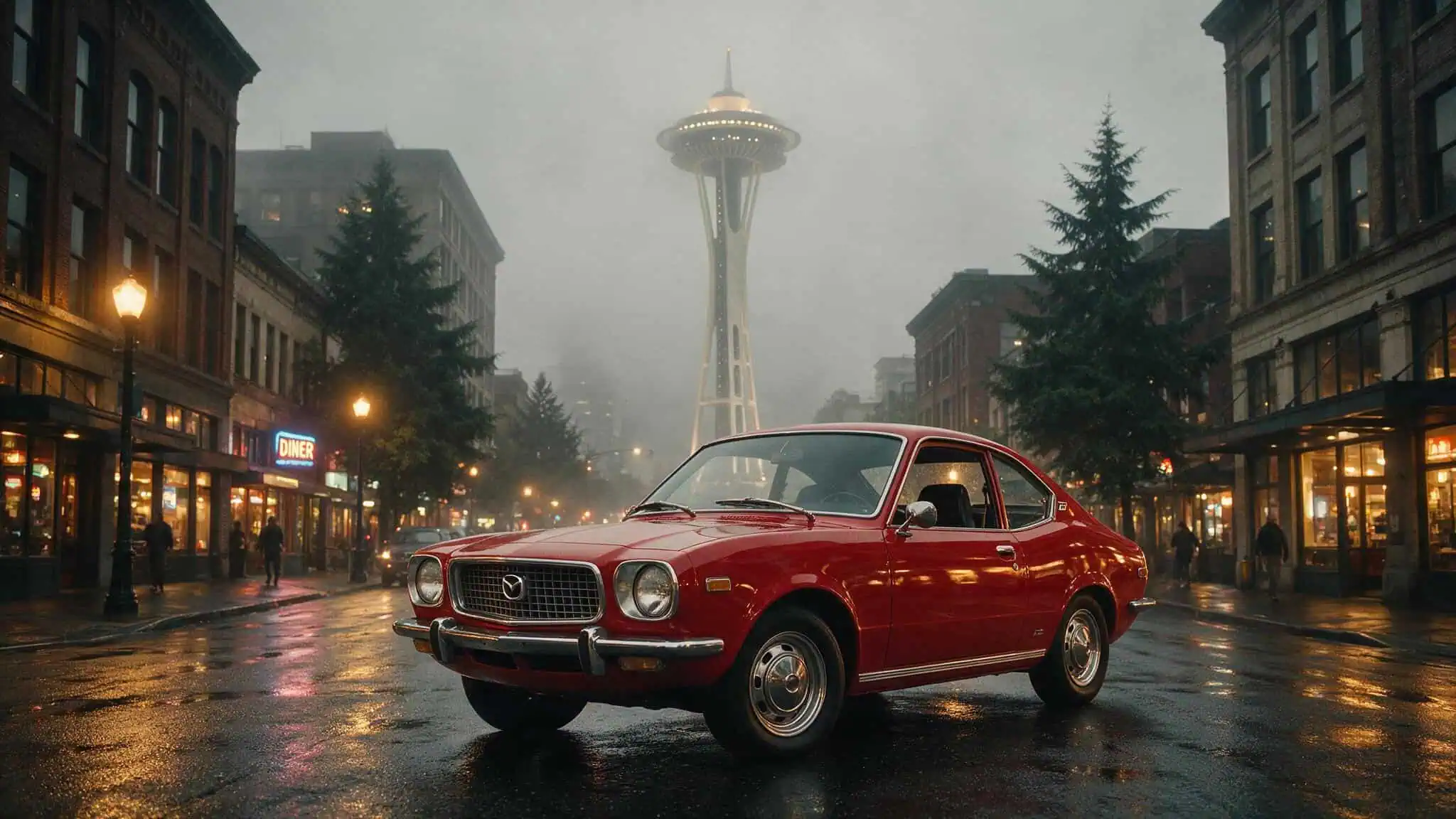
Mazda entered the U.S. market in 1970 with the R100 coupe — a car with a rotary engine that nobody knew what to make of.
The short version: Mazda’s first North American operation opened in Burnaby, British Columbia, on July 19, 1968. The U.S. arrival came in 1970 with the R100. The R100 wasn’t a sedan. It was a rotary-powered coupe that confused American drivers and delighted the ones who got it. And it nearly died a few times along the way.
Key Takeaways
Mazda’s first North American operations opened in Burnaby, British Columbia, on July 19, 1968 — two years before the U.S. market entry.
The first Mazda sold in the United States was the R100 coupe in 1970, powered by a 10A twin-rotor engine producing 100 hp (0–100 km/h in 10.8 seconds, top speed ~180 km/h).
A team of 47 Mazda engineers — the Shi-ju-shichi-shi (47 ronin), solved the rotary engine’s fatal apex seal wear problem in the 1960s, making reliable exports to North America possible.
Table of Contents
Before North America: from cork to the rotary bet
Mazda wasn’t born a car company. It started as Toyo Cork Kogyo, founded in Hiroshima on January 30, 1920 by Jujiro Matsuda. The name gives it away — cork products. During World War II it shifted toward machine tools, and in October 1931 it built its first vehicle: the Mazda-Go (Type-DA), a three-wheeled truck.
That three-wheeler is what got them into wheels and engines, but it took another three decades before they built a proper passenger car. Leadership passed to Jujiro’s son Tsuneji Matsuda, then to Kouhei Matsuda, while engineers like Shinhachi Kaizuka and Yoshiki Yamasaki drove key technical developments.
The first real car was the R360 Coupe, launched in May 1960. It was a kei car — 356 cc, 16 hp, 32 km/l, priced at 300,000 yen. It sold well in Japan but was never meant for export.
The NSU/Wankel partnership and the Cosmo Sport
In July 1961, Mazda signed a technical cooperation deal with NSU/Wankel for rotary engine development. The rotary — also called the Wankel, was a radical idea: no pistons, just a triangular rotor spinning inside a housing. Smooth, compact, and light. But it had a flaw: the apex seals that kept compression between the rotor tips and the housing wore out fast.
Despite that, Mazda pushed ahead. In May 1967 they introduced the Cosmo Sport 110S, the world’s first mass-produced rotary car. It was a two-seater with a 491cc x 2 rotary, 110 hp, and a top speed of 185 km/h. It was never sold in North America, but it proved the concept could work. The Cosmo showed Mazda’s own engineers that the rotary had potential if they could fix the reliability.
The 47 ronin and the fix
Other manufacturers who licensed the rotary (NSU, Citroën, GM, Mercedes) gave up because they couldn’t solve the apex seal wear. Engines would lose compression in roughly 30,000 miles. For a mass-market car, that is a deal-breaker.
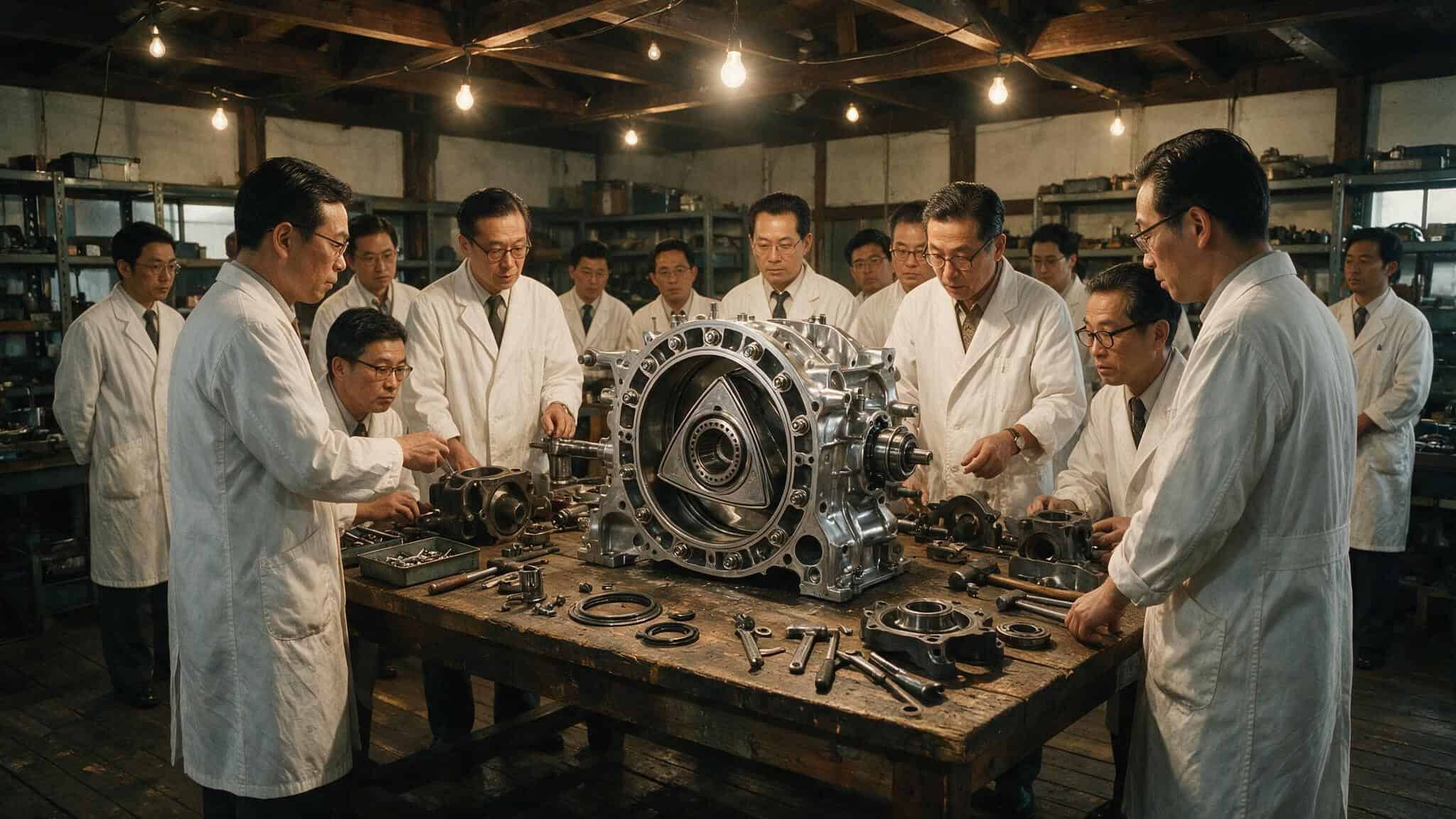
Mazda assigned 47 engineers to the problem. They called themselves the Shi-ju-shichi-shi — the 47 ronin, referencing the legendary samurai who avenged their master. They developed new seal materials, landing on a carbon-aluminum composite or ceramic-coated design that extended seal life to 100,000 miles or more.
Without that fix, the rotary stays a laboratory curiosity. Mazda’s North American entry doesn’t happen. The 47 ronin — a team of engineers working in a materials science lab in Hiroshima, are the reason you can buy a Mazda in the U.S. today.
The Canadian beachhead: July 19, 1968
Mazda opened its first North American operations in Burnaby, British Columbia, on July 19, 1968. That’s a suburb of Vancouver, a Pacific port city with a direct shipping route from Japan.
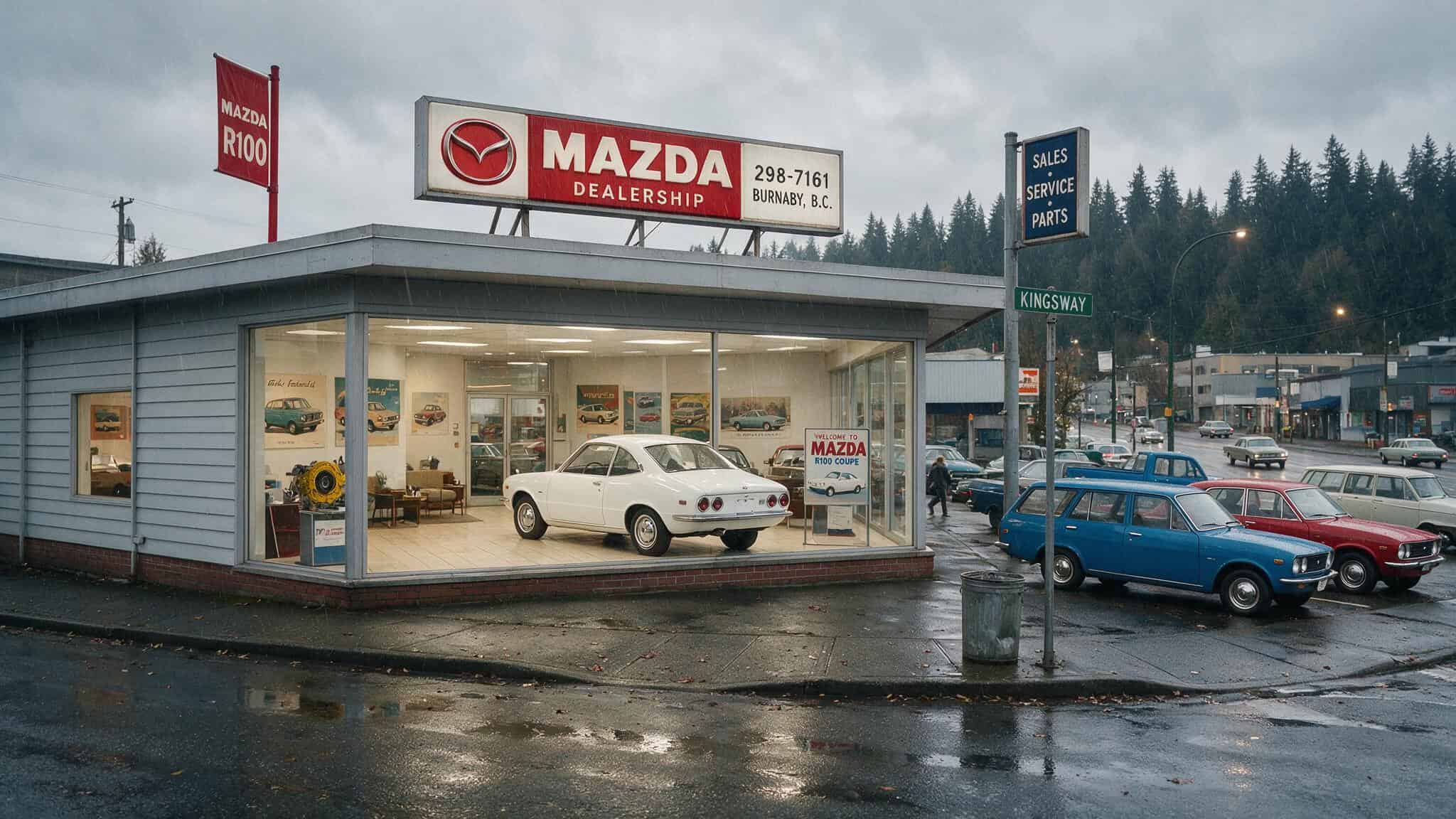
Why Canada first? Pattern for Japanese automakers of the era — start in a smaller, more forgiving market to build parts supply and service networks before taking on the U.S. Mazda’s first foreign market was Australia in 1967. Canada was the second. The first Canadian dealer was Denis Leclerc, who opened a Mazda franchise in Montreal.
The R100 (called the Familia Rotary Coupe in Japan) arrived in Canada in July 1968, making it the first rotary Mazda sold in North America. But it wasn’t the volume seller. Most of those early sales were the B-Series pickup and the 1200 sedan. A 1969 1200 sedan was priced at $2,295 — and that was without a radio.
The R100 was the halo car, the one that got people talking. For a full account of the brand’s journey from the rotary-powered Cosmo to the Miata and CX-90, see the History of Mazda Automobiles in North America.
First-year sales in Canada: under 1,000 vehicles. The ball was rolling. By 1970, dealerships had expanded to eastern Canada, including Quebec. That Quebec connection would become large later — Albi Mazda (Le Géant) near Montreal, founded in 1997 by Denis Leclerc, is today the world’s largest Mazda dealer, selling 5,500 new Mazdas per month.
The U.S. arrival: 1970 and the R100 rotary rocket
Mazda set up its U.S. sales office, Mazda Motors of America (N.W.), in Seattle, Washington, in January 1970. Same logic as Burnaby — a Pacific port, shipping from Japan. Then in June 1970, rotary engine exports to the U.S. began. The lead vehicle was the R100 Coupe.
What the R100 was
The R100 used a 10A twin-rotor engine — two 491cc rotors, total 100 hp. It did 0–100 km/h in 10.8 seconds and topped out around 180 km/h. That doesn’t sound fast today, but in 1970 it was punchy. More important: it was a coupe, and it sounded like nothing else on the road. No piston vibration, a smooth, high-revving hum.
Early U.S. buyers found the rotary confusing. It didn’t drive like a piston engine. You had to keep it on the boil, and it had that oil injection system that needed explaining. Dealers had to educate customers. And the fuel consumption was not great — a sign of things to come.
The R100 had something else going for it: racing cred. In April 1969 it won the Singapore Grand Prix. It also competed at the 24 Hours of Spa, where it finished sixth in class. Mazda chose the R100 as its first U.S. model specifically because it had proven its durability on the track. They needed the rotary to look tough, and the R100 had done that.
The engineering story: how the 47 ronin made the rotary reliable
The rotary engine’s flaw was the apex seals. These are the pieces that sit on the tips of the triangular rotor and seal against the housing wall. In early designs, they wore out. Engines would lose compression within 30,000 miles.
NSU abandoned the rotary for passenger cars. Others gave up. Mazda did not.
The 47 engineers assigned to the problem developed new seal materials — a carbon-aluminum composite or ceramic-coated seal that could handle sustained highway speeds and stop-and-go traffic without disintegrating. The tell for a rotary that would survive American driving conditions was that seal material. The breakthrough extended seal life to 100,000+, which made mass production and export viable.
Before the rotary, there was the Mazda-Go — a three-wheeled truck. Then came the R360 Coupe, Japan’s first kei car. Without that fix, the rotary stays a lab experiment. Mazda’s U.S. entry, built on the rotary, does not happen.
The company’s persistence with the engine, when every other automaker walked away, became its engineering trait, but the scrappy DNA that would later champion the rotary was first seen in the First Mazda car. They still build rotaries today (the MX-30 R-EV uses one as a range extender).
Building the U.S. presence: 1971 and the first decade of growth
Mazda formalized its U.S. operations in February 1971, establishing Mazda Motor of America (MMA) as the corporate entity — a legal structure that still exists, much like the enduring appeal of the 2014 Mazda MX-5 Miata reviewed by Unfinished Man.
Americans wanted convenience. In January 1971, the Capella (sold as the RX-2 in the U.S.) became the first rotary-engined vehicle with an automatic transmission — called the REmatic. It showed Mazda would bend its exotic tech to what the market wanted.
From there the lineup expanded: the Mazda RX-2 (Capella) in 1971, the Mazda RX-3 (Savanna) in 1971, RX-4 (Luce) in 1972, RX-5 (Cosmo) in 1975. In 1975 the Roadpacer became the first standard-size passenger vehicle to meet both U.S. and Japanese 1975 emissions standards — an engineering achievement for a rotary.
By February 1979, cumulative exports to North America hit 1 million vehicles. That is nine years from the 1970 entry. The growth was real.
The RX-7 arrives: Mazda’s rotary icon (1978)
The R100 was the proof of concept. The RX-7 was the payoff.
First generation Savanna RX-7 launched in March 1978. It used a 12A two-rotor rotary making 130 hp. The layout was front-midship — engine behind the front axle, which gave it weight distribution. Pop-up headlights (only Japanese car with them at the time). Quarter mile in 15.8 seconds, top speed 180 km/h.
It became a giant-killer in Canadian and U.S. racing. The RX-7 proved the rotary sports car concept could sell in volume and win races. It is the car most people remember from Mazda’s early years, but it does not exist without the R100’s gamble.
Challenges and setbacks: rust, fuel crises, and the Ford rescue
Mazda’s North American journey nearly ended before it got going.
Early Mazdas rusted. Especially in cold, salty Canadian winters. It wasn’t unique to Mazda — all Japanese imports had a rust problem in the 1970s, but it hurt the brand’s reputation for durability. You can find forum threads of owners ripping out floor pans.
Then came the fuel crises. Two oil price shocks in the 1970s. The rotary engine was smooth and powerful but wasn’t fuel-efficient. Mazda had bet its North American strategy on rotary engines, and that left them exposed.
Sales dropped. The company was financially strained.
In November 1979, Ford Motor Company bought 25% of Toyo Kogyo (Mazda’s parent company), increasing to 33.4%. That capital tie-up saved Mazda from collapse. The trade-off: shared platforms, badge engineering (the Ford Ranger and Mazda B-Series were the same truck, the Ford Explorer and Mazda Navajo were twins), and a 36-year partnership that diluted Mazda’s independence. The partnership ended in 2015 when Ford divested its stake. Mazda’s independent today.
The Miata era and beyond: how 1970 defined Mazda’s DNA
The MX-5 Miata (1989): Nearly 3,000 sold in its first year in Canada. By 2000 it was the best-selling two-seat convertible of all time, a Guinness record. The Miata is not a direct descendant of the R100, but it shares the DNA: lightweight, affordable, driving-focused.
Le Mans glory (1991): Mazda’s four-rotor 787B became the first and only rotary-engined car to win the 24 Hours of Le Mans. That is the R100’s racing bloodline taken to its logical extreme.
Brand philosophy: Zoom-Zoom (launched 2000) is the marketing expression of driving joy. KODO design language (Soul of Motion, 2010) and SKYACTIV technology (2011) — clean-sheet engineering for lightweight, efficient vehicles, all trace back to the 1970 decision to lead with a rotary sports car.
Modern Mazda is no longer a niche player. They sold 424,382 vehicles in the U.S. in 2024. The CX-5 is one of the best-selling crossovers. And Albi Mazda near Montreal — the dealer that started as a Quebec outpost, now moves 5,500 new Mazdas per month with a 350-person staff, a hair salon, and a body shop.
The underdog’s long game
Mazda’s 1970 entry with the R100 defined its underdog identity, leading to record U.S. sales of 424,382 in 2024 and a brand that still bets on driving joy. The company behind it had started as a cork maker in Hiroshima. They had bet everything on a German engine design that nobody else could fix.
The rotary lives on as a range extender in the MX-30 R-EV, generating electricity to power the electric motor. The Miata is still the answer when someone asks whether what’s the most fun you can have for $30,000?
Frequently Asked Questions
What year did Mazda get away from Ford?
Mazda’s partnership with Ford ended in 2015 when Ford divested its stake in the company. The relationship began in 1979 when Ford bought 25% of Mazda’s parent company, eventually increasing to 33.4%, which helped rescue Mazda from financial trouble during the fuel crises.
How did the 47 ronin fix the rotary engine?
Mazda assigned 47 engineers, called the Shi-ju-shichi-shi (47 ronin), to solve the rotary engine’s apex seal wear problem. They developed new carbon-aluminum composite or ceramic-coated seals that extended seal life from about 30,000 miles to over 100,000 miles, making the rotary reliable enough for mass production and export.