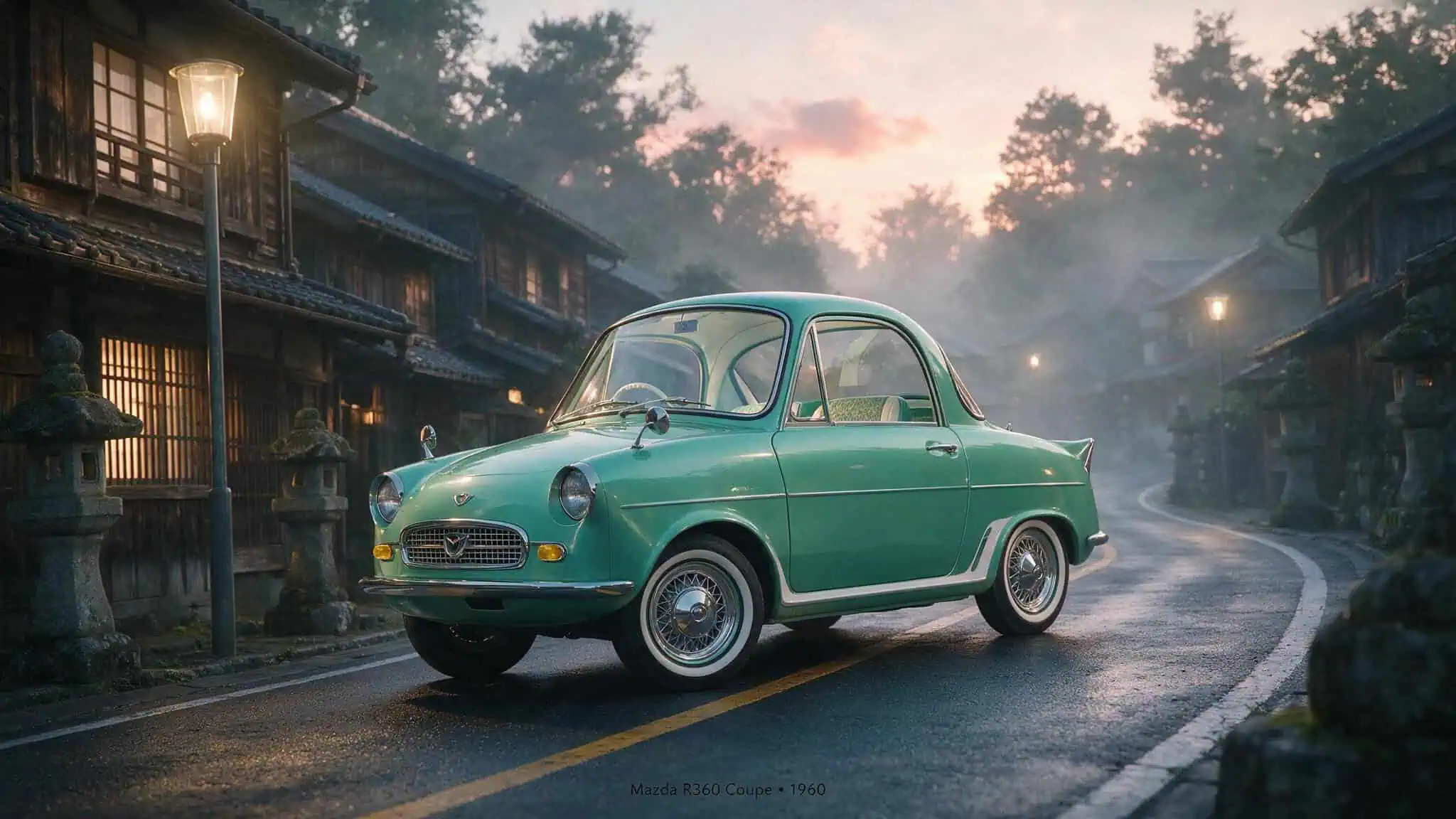
I started wondering what Mazda’s first car was, and the answer surprised me: the Mazda R360 Coupe. It wasn’t a rotary-powered sports car or a sleek sedan. It was a 380 kg microcar with a motorcycle engine, an acrylic rear window, and a dry sump lubrication system that belonged in a race car, not a budget commuter.
The Mazda R360 Coupe, launched on May 20, 1960, is the car that launched Mazda into the passenger car business. And the more I dug into it, the more I realized that this tiny, weird, wildly successful coupe already contained the engineering DNA that Mazda still runs on today.
Key Takeaways
The Mazda R360 Coupe (1960–1969) was Mazda’s first passenger car — a 380 kg kei car powered by a 356 cc four-stroke V-twin making 16 horsepower, and it captured 64.8% of its market in the first year
The car’s obsessive weight-saving approach — magnesium alloy parts, acrylic windows, dry sump lubrication, sliding side glass, established Mazda’s “gram strategy” philosophy decades before the MX-5
The R360’s fatal flaw was its 2+2 seating: the back seats were too small for adults, which let the four-seat Subaru 360 steal sales and forced Mazda to develop the Carol sedan by 1962
Table of Contents
What Was the First Mazda Car?
The Mazda R360 Coupe. That’s the simple answer.
Produced from 1960 to 1969 and built at Hiroshima Assembly, the R360 was a kei car — Japan’s microcar class, designed to fit government regulations that capped engine size at 360 cc and limited overall dimensions. It was a two-door coupe with a rear-engine, rear-wheel-drive layout and 2+2 seating. The R360 was 2,980 mm long and 1,290 mm wide, under three meters, about the size of a modern golf cart with a roof.
The number that stopped me cold: 380 kg. That’s 838 pounds. The R360, at 380 kg (838 lb), was the lightest car in Japan when it launched on May 20, 1960, lighter than a modern Smart Fortwo. And Mazda bet the entire company on it.
Before the R360, Mazda — then called Toyo Kogyo, built three-wheeled delivery trucks. Passenger cars were an entirely new gamble. The R360 was their first passenger car; it was their declaration that they weren’t going to stay a truck maker forever.
Before the R360: From Cork to Three-Wheeled Trucks
Mazda didn’t start with cars. It didn’t even start with vehicles.
The company was founded in 1920 as Toyo Cork Kogyo — they made cork products. By 1927, they’d shifted to machinery, and in 1931, they launched the Mazda-Go, a three-wheeled motorcycle truck that looks like a motorized rickshaw with a cargo bed. That was Mazda’s first vehicle, not the R360, and it established the company’s reputation for rugged, practical transport.
The name “Mazda” itself came from Ahura Mazda, the Zoroastrian god of wisdom, light, and harmony. Founder Jujiro Matsuda chose it because it sounded close to his own surname while carrying that deeper meaning of enlightenment and progress. (I’ve got more on this in the Mazda name origin piece.)
A prototype four-wheeled vehicle called the Auss Chin Seven appeared in 1940, but it never reached production. World War II and its aftermath delayed everything.
The real catalyst came in 1955, when Japan’s Ministry of International Trade and Industry (MITI) proposed a “People’s Car” concept — an affordable, efficient vehicle for a nation that was rapidly motorizing. That same year, kei car regulations formalized the 360 cc engine limit and tight dimensional restrictions. The All Japan Motor Show in 1954 had already shown growing public interest in small cars. Trade liberalization was coming, and Japanese manufacturers knew they needed to compete.
Mazda saw the opening. They had three-wheeler experience, a factory in Hiroshima, and an appetite for risk. The R360, launched on May 20, 1960, was their answer.
Engineering a Lightweight: The R360’s Clever Weight-Saving Tricks
Getting the R360 down to 380 kg (838 lb) wasn’t accidental. Mazda engineers made deliberate, sometimes radical choices to shed grams — and those choices came with real tradeoffs.
The most visible example is the rear window. Instead of glass, Mazda used acrylic (Plexiglas). It was lighter and cheaper. The downside?
Fifty years later, virtually every surviving R360 has a yellowed, cracked rear window. Restorers have to source reproductions or fabricate replacements because the originals didn’t age well. The side windows were sliding panes rather than roll-down units, which eliminated the weight and complexity of regulator mechanisms.
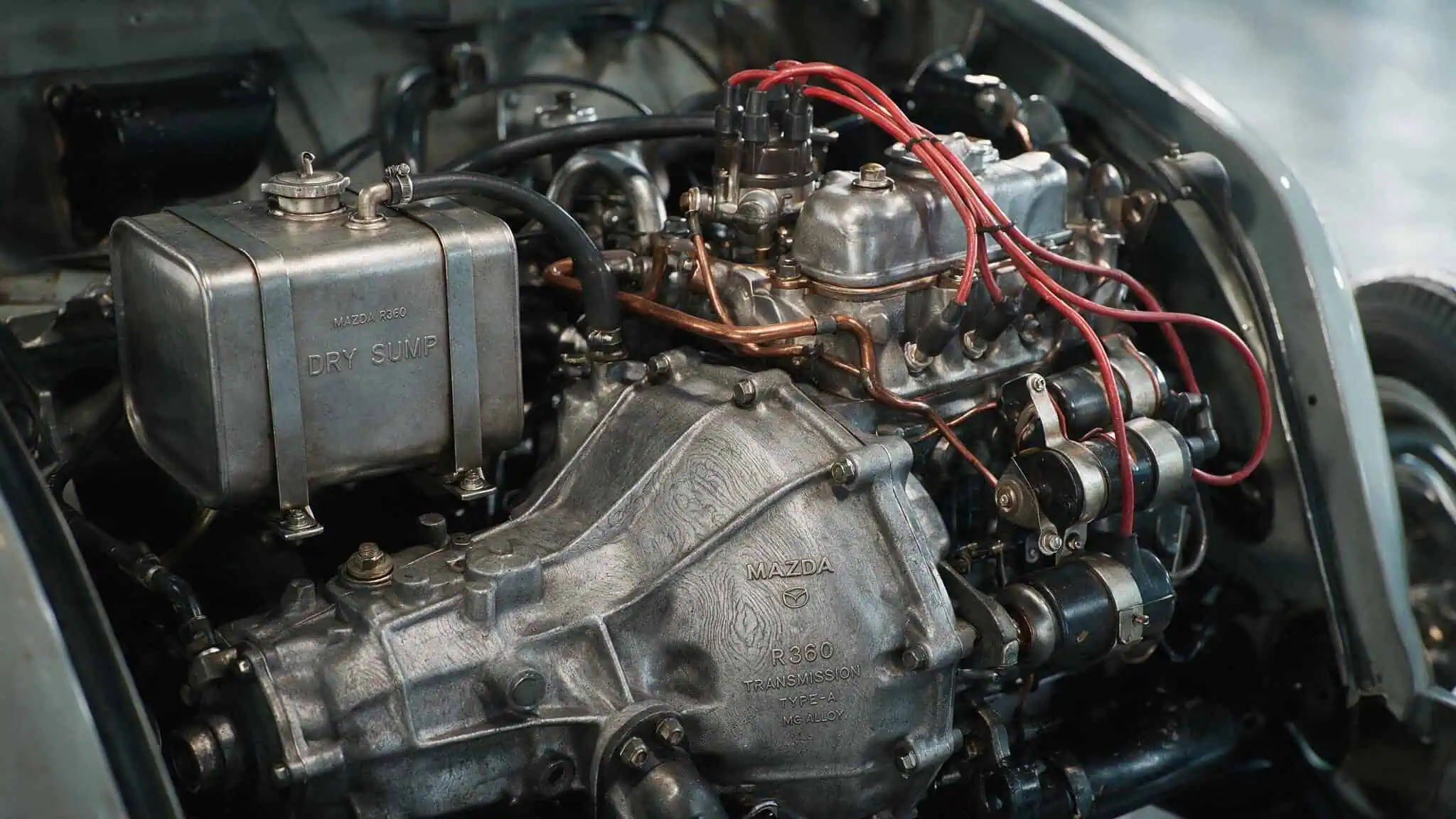
Under the skin, Mazda went even further. The transmission housing, rocker arm covers, oil pan, dynamo drive pulley, and cooling fan were all made from magnesium alloy — a material more common in race cars and aircraft than budget microcars. The bonnet, cylinder heads, headlight frame, and side window frames were aluminum, choices that would become hallmarks of the brand’s engineering philosophy chronicled in the History of Mazda Automobiles in North America.
Then there’s the dry sump lubrication system. In a normal car, oil sits in a pan at the bottom of the engine. A dry sump stores oil in an external tank and uses a pump to circulate it. It’s more complex and expensive, but it lets the engine sit lower in the chassis, which lowers the center of gravity. In the R360, this racing-derived technology was working in a car that cost 300,000 yen for the manual or 320,000 yen for the automatic.
The suspension used torsion rubber springs with trailing arms — four-wheel independent setup in a car that cost 300,000 yen (about $830 at the time). Rack-and-pinion steering gave it precise, direct feel.
Mazda chose a four-stroke 356 cc V-twin engine when most competitors ran two-strokes. Two-strokes were simpler and cheaper, but four-strokes offered better durability, cleaner running, and superior fuel economy. That choice alone showed Mazda was thinking beyond the spec sheet, a philosophy the company later carried into its first fully electric car.
Every material decision was a tradeoff. Aluminum saved weight but cost more. Magnesium saved even more but corrodes easily and is difficult to repair. Acrylic saved weight and money but doesn’t last.
Powertrain and Performance: The 356 cc V-twin and TORQ DRIVE Automatic
Let’s get the laughs out of the way: 16 horsepower. That’s what the R360’s air-cooled, 356 cc V-twin produced at 5,300 rpm, with 21.6 Nm of torque at 4,000 rpm. A modern lawnmower engine makes similar numbers.
The official top speed was 84 km/h (52 mph). Some sources say it could hit 90–95 km/h under ideal conditions — likely a difference in testing methodology or a typo that’s been repeated enough to look like a second data point. Either way, you weren’t passing anyone on the highway.
But speed wasn’t the point. The R360 was a city car, designed for the narrow streets and tight parking of post-war Japanese urban life. With a 4.0-meter turning radius, it could U-turn in spaces a modern sedan wouldn’t even attempt. Fuel consumption was 32 km/L — about 75 mpg with two passengers. That’s better than most modern hybrids.
The standard transmission was a 4-speed manual. The optional TORQ DRIVE was a 2-speed automatic with a torque converter, and it earned a genuine milestone: the first mini vehicle in Japan with a torque converter automatic. In 1960, it was a legitimate innovation for the class.
Braking from 50 km/h took 13 meters — acceptable for the era, not great now. But the car weighed 380 kg. It didn’t need massive brakes.
Who Designed the R360? Jiro Kosugi and Heiji Kobayashi
The R360 was shaped by two designers with distinct backgrounds and philosophies.
Jiro Kosugi handled the body and exterior. He studied at the Tokyo School of Fine Arts, served as a tank officer in the Kwantung Army during World War II, then opened his own design studio in 1947. Kosugi co-founded the Japan Industrial Designers Association (JIDA) in 1952 and served as its chairman from 1968 to 1969.
He also opposed the government’s Good Design Selection Committee — the G Mark system. Kosugi believed that government committees had no business telling consumers what good design was. The R360’s shape was his argument: clean, functional, and distinctive without asking for bureaucratic approval. A prototype called the Dongame preceded the R360 and shows Kosugi working through the same ideas.
Heiji Kobayashi handled the interior and tail lamps. He was an in-house Mazda designer who would later go on to design the Cosmo Sports — Mazda’s first rotary-powered production car. The R360’s cabin was minimalist but cohesive: seats, carpet, and door panels matched the interior color (red or blue), and the exterior offered Opal Green, Maroon Rouge, and Somerset Blue, with DeLuxe two-tone options of Blue and Cream or Red and Cream. So, when did Mazda come to North America? It officially entered the U.S. in 1970 with the R100 coupe.
Kosugi’s background — art school, tank officer, design activist, makes the R360 feel less like a corporate product and more like a personal statement. The car looks the way it does because a specific person with specific beliefs about design was given control.
A Meteoric Rise: The R360’s Market Triumph and Its Fatal Flaw
The R360 launched on May 20, 1960, priced at 300,000 yen for the manual and 320,000 yen for the automatic — about $830 at the time. That’s about $830 at the time, cheap enough that a working family could afford one.
The response was immediate: 4,500 pre-orders before anyone had driven the car. By August, they were building over 2,000 units per month. In the first year, they sold 23,417 cars.
The R360 captured 64.8% of the kei car market and 15% of all domestic automotive sales in Japan. December 1960 was the peak: 4,090 units in a single month.
For a company that had never built a passenger car, selling 23,417 units in the first year and capturing 64.8% of the kei car market was an extraordinary success.
But the R360 had a problem, and it was hiding in the back seat.
The 2+2 layout meant four seatbelts, but the rear seats were essentially unusable for anyone over the age of about ten. The R360 was a two-seater that technically had four seats. Families who needed to carry more than one child or an adult passenger in the back looked elsewhere.
The main competitor was the Subaru 360, which launched earlier and offered a genuine four-seat configuration. As Japanese families started wanting real four-seat capability, the Subaru 360 ate into R360 sales. Mazda responded by introducing the Carol (P360) in 1962 — a four-seat sedan with a 358 cc inline-four engine. The Carol replaced the R360 as Mazda’s kei car offering.
Full R360 production ended in 1966, with a total run of 65,737 units. The automatic version remained available as a special order for disabled drivers until 1969, but the R360’s moment had passed. It succeeded brilliantly at exactly the right time, then faded when the market changed.
Beyond the Coupe: R360 Variants and Global Reach
The R360 was not a single model. There were several variants, and some of them are genuinely obscure.
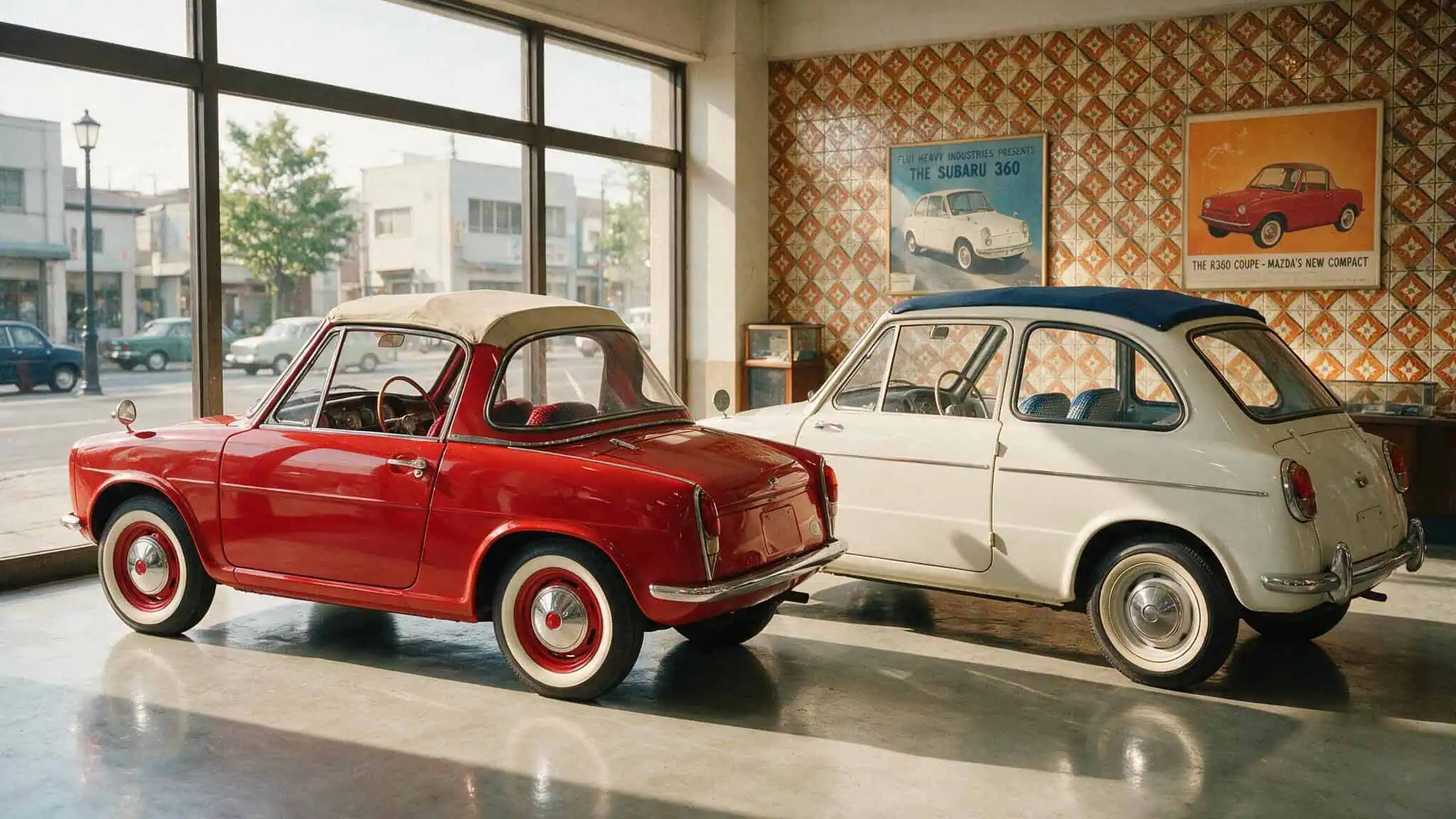
The standard production codes were KRBB (4-speed manual) and KRBC (2-speed TORQ DRIVE automatic). Within those codes, chassis number ranges track multiple specification changes across standard, deluxe, and handicapped variants. The handicapped model — equipped with manual control devices for drivers with disabilities, remained available as a special order until 1969, three years after regular production ended.
About 700 left-hand drive units were built for US servicemen stationed in Japan and Okinawa. These carried the KRBBL and KRBCL codes. Some of those cars made their way back to the United States, which is why you occasionally see an R360 at a US car show. Another 41 right-hand drive units were exported to Australia, making them extremely rare down under.
Mazda also leveraged the R360’s platform for commercial vehicles. The B360 was a front-engine pickup that started with the same 356 cc engine before moving to a 358 cc inline-four. The B600 was an export-focused pickup with a 577 cc V-twin — a bigger engine for markets that needed more hauling capacity. The E360 succeeded the B360 in 1967, closing out the R360’s commercial legacy.
The R360’s Lasting Legacy: From Gram Strategy to Collector Gem
Mazda’s famous “gram strategy” — the obsessive weight reduction philosophy that made the MX-5 Miata the lightest two-seat roadster of its era, started with the R360, not the sports car.
The same thinking that put an acrylic rear window in the R360 to save a couple of kilograms is the thinking that made the fourth-generation MX-5 weigh less than its predecessor despite adding safety equipment.
The Society of Automotive Engineers of Japan recognized the R360 as one of 240 Landmarks of Japanese Automotive Technology. Frey’s Classic Mazda Museum in Augsburg, Germany, exhibits a restored example.
If you want to buy one, bring money. Restored R360s in the UK go for £15,000 to £20,000. Left-hand-drive examples in the US can cost over $40,000. That’s more than a new Mazda3, and it’s a measure of how much collectors value the car that launched the brand.
Restoration is a headache. The acrylic rear window yellowed and cracked decades ago. Magnesium parts corroded. The torsion rubber suspension degraded.
Parts often require searching Japanese auction sites or custom fabrication. You’re not buying a car you can maintain with off-the-shelf parts — you’re buying a historical artifact that needs specialized care.
The R360 is a niche prospect outside Japan, with only about 700 left-hand drive units built for US servicemen and 41 right-hand drive units exported to Australia.
A 380 kg coupe with a motorcycle engine, a dry sump, and a 2+2 layout that nobody’s parents could sit in — that’s where Mazda started. And the DNA is still there, in every car they build today.
Frequently Asked Questions
What was the old Mazda in 1960?
The Mazda R360 Coupe, launched on May 20, 1960, was Mazda’s first passenger car. It was a tiny kei car weighing just 380 kg, powered by a 356 cc V-twin engine making 16 horsepower, and it captured 64.8% of its market in the first year.
How much horsepower did the first Mazda car have?
The Mazda R360 Coupe’s 356 cc air-cooled V-twin engine produced 16 horsepower at 5,300 rpm, with 21.6 Nm of torque. That’s comparable to a modern lawnmower, but the car weighed only 380 kg, so it was adequate for city driving with a top speed of about 52 mph.
Why did the Mazda R360 use a dry sump lubrication system?
Mazda used a dry sump system—typically found in race cars—to lower the engine’s center of gravity by storing oil in an external tank instead of a pan under the engine. This racing-derived technology helped the R360 achieve better handling despite being a budget microcar.
What killed the Mazda R360’s sales?
The R360’s fatal flaw was its 2+2 seating: the rear seats were too small for adults, making it essentially a two-seater with four seatbelts. The Subaru 360 offered genuine four-seat capability, stealing sales as Japanese families demanded more practical cars, forcing Mazda to develop the Carol sedan by 1962.