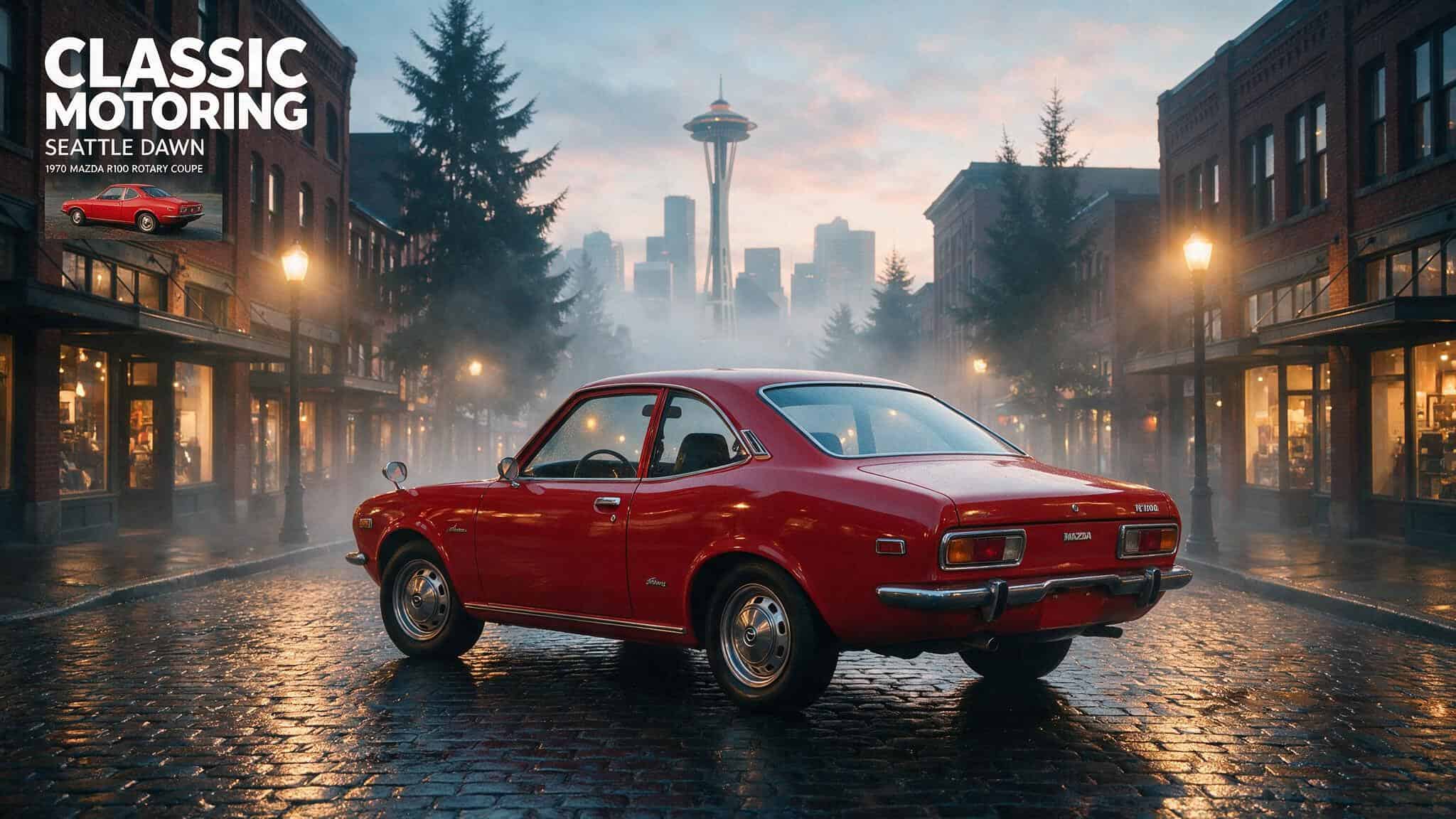
In 1960, Toyo Kogyo—the company that would become Mazda—built about 23,000 cars. By 1970, they were building about 230,000 cars. That’s a 10x increase in a decade. The rotary engine drove that growth.
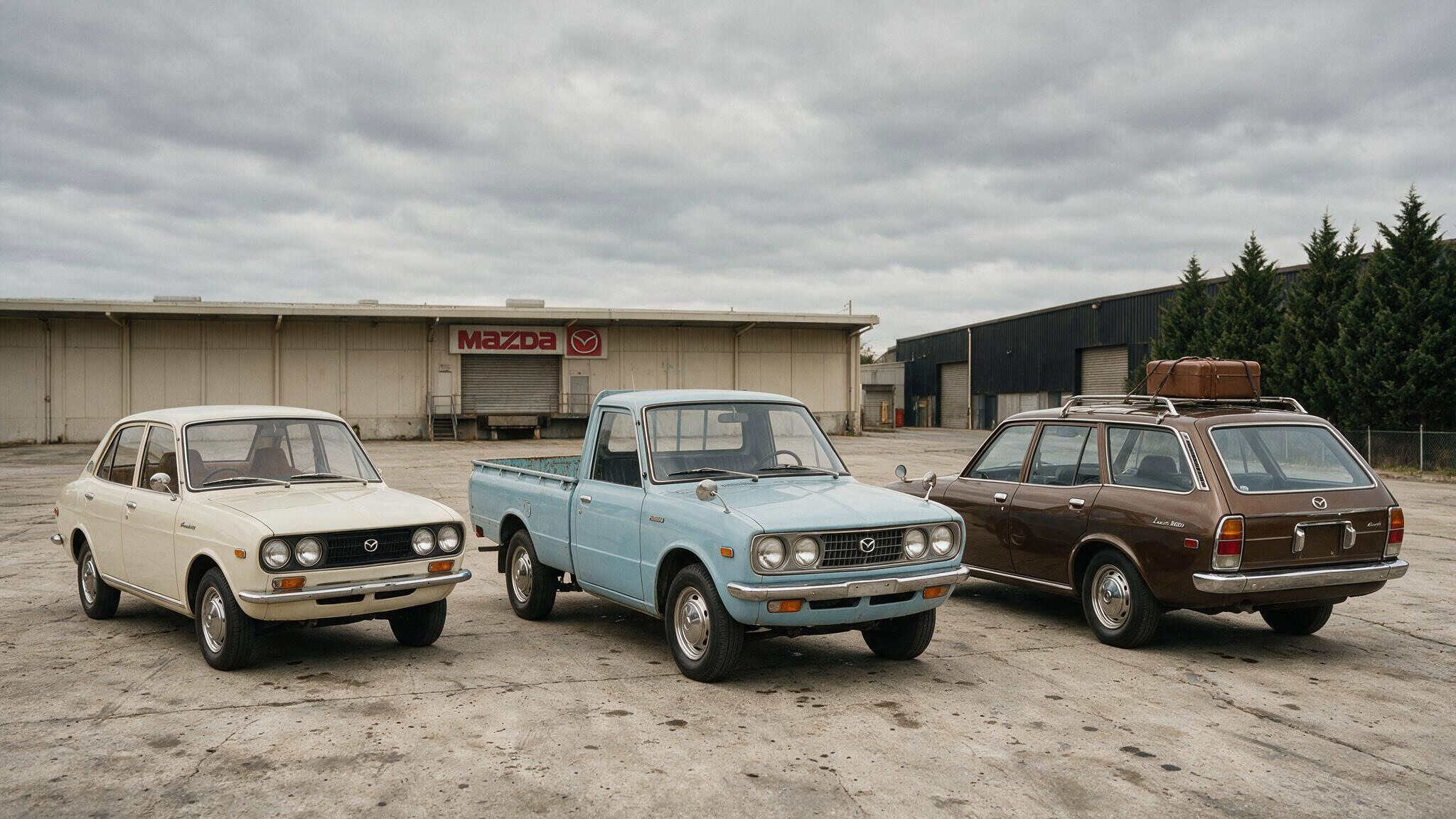
But here’s the part most people get wrong. They think Mazda entered the U.S. in 1970 with the R100 rotary coupe and immediately became the cool underdog. Mazda entered the American market in April 1970 with three piston-engined models: the Familia 1200, the Luce 1800 sedan and wagon, and the B1600 pickup. The Familia 1200.
The Luce 1800 sedan and wagon. The B1600 pickup. No rotaries. Not yet.
Then in July 1970, they dropped the R100 rotary coupe.
That two-phase strategy—establish the brand with piston models, then unleash the rotary—is the real story of Mazda’s 1970 models. They proved they could sell both piston and rotary models. And that dual capability made everything that followed possible.
Key Takeaways
The Capella (exported as the RX-2) was Mazda’s first midsize car, offered with either a 12A rotary or a 1.6L piston engine, and its Coupe GS variant rode 40mm lower to take on the Nissan Skyline GT-R on Japanese circuits.
Mazda entered the U.S. in April 1970 with three piston models (Familia 1200, Luce 1800, B1600 pickup) before the rotary R100 arrived in July—a deliberate “piston first, rotary second” strategy.
The rotary engine’s tradeoffs were stark: the RX-2 delivered 130 hp and 0–60 in under 10 seconds, but it drank 18 mpg and cost about 20% more than the piston version.
Table of Contents
The Star of 1970: Mazda Capella / RX-2
The Capella was Mazda’s first midsize car, offered with either a 12A rotary or a 1.6L piston engine. It defined the brand’s dual-engine strategy for years to come.
Its place in the lineup
The Capella launched in Japan in May 1970. It was Mazda’s first midsize car, slotted between the smaller Familia and the bigger Luce. You could get it as a two-door coupe or a four-door sedan. It was a sporty saloon, something you would drive to work but also enjoy on a weekend backroad.
The starting price was ¥696,000, which worked out to about $1,930 at the time. That was only ¥36,000 above the most expensive Familia. Mazda was pricing it to compete.
The car earned the nickname “Kaze no Capella” (Capella of the Wind) because it could hit 190 km/h. That was quick for a family sedan in 1970.
Rotary vs. piston
The Capella offered three engines: a 1,500cc four, a 1,600cc four (making 105 PS / 104 hp), and the 12A rotary. The rotary version was exported as the RX-2. The piston versions were called the Mazda 616/618.
The 12A made 130 gross horsepower and could push the RX-2 from 0–60 in under 10 seconds. That’s quick by any 1970 standard. But the fuel economy was 18 mpg overall. Owners were reportedly dismayed by the fuel consumption. And the rotary version cost about 20% more than the equivalent piston car.
So you had a choice: pay about 20% more for a car that was faster, smoother, and more exotic—or save the money and get better gas mileage with a conventional engine. It’s the same tradeoff Mazda buyers face today, just in a different package.
The Coupe GS
In February 1971, Mazda introduced the Capella Coupe GS. They dropped the ride height by 40mm. That’s 40mm for a factory car. The GS was built to compete with the Nissan Skyline GT-R on Japanese racetracks.
Functionally, it was a homologation special. Mazda took the fight to the Skyline. The source does not say they won, but the attempt shows the ambition behind the Capella platform.
The Existing 1970 Workhorses: Mazda’s Full Lineup
The Capella was the headline act, but Mazda’s 1970 lineup included many conventional cars. The rotary models were the glamour, but the company was still primarily a piston and commercial vehicle maker.
- Familia (2nd generation): The volume leader. It had a 987cc aluminum alloy four-cylinder. In March 1970, cumulative production hit 1 million units. Exported to the U.S. as the Mazda 1200. Available as a coupe, sedan, or wagon.
- Familia Rotary Coupe (R100): The rotary-powered Familia. It used the 10A two-rotor engine (491cc x 2), making 100 PS at 7,000 rpm. This is the car that won the Singapore Grand Prix in April 1969. Three R100s entered the 84-hour Marathon de la Route at Spa in 1969; one finished fifth. That fifth-place finish was the proof Mazda needed that the rotary could survive endurance racing.
- Luce (Mazda 1500/1800): The larger piston sedan and wagon. Exported to the U.S. as the Mazda 1800. Nothing fancy, just solid family transport.
- Luce Rotary Coupe (R130): The wild card. Japan’s first front-engine, front-wheel-drive passenger car. Styled by Giorgetto Giugiaro at Bertone. Pillarless coupe body.
Powered by the 13A two-rotor engine (655cc x 2), making 126 bhp. JDM-only. One of the best-looking coupes of the late 1960s, but you will never see one in the U.S. unless it has been imported.
- Cosmo Sport (110S): The rotary halo car. Still in production in 1970. Introduced in May 1967 as Mazda’s first rotary vehicle. Two seats, priced at ¥1,480,000.
Upgraded in 1968 to 128 hp and a 200 km/h top speed. The car that started it all.
- Commercial vehicles: Bongo van, B1500/B1600 pickups, B360 light van/truck, R360 Coupe (Mazda’s first passenger car), Carol 360/600 kei cars, D/E-series trucks, Kraft Truck, Light bus, Porter Cab, Boxer. These were the workhorses that kept the lights on while the rotary got all the attention.
US Market Entry: Piston First, Rotary Second
Here is the timeline most people do not know.
April 1970: Mazda opens dealer franchises in Oregon and Washington. The only models available are the Familia 1200, the Luce 1800 sedan and wagon, and the B1600 pickup. All piston. No rotaries.
May 1970: The first regional office opens in Seattle.
July 1970: The R100 rotary coupe finally arrives. That’s when Americans got their first taste of the Wankel.
December 1970: C. R. (Dick) Brown is hired from AMC as the first general manager of Mazda Motors of America. He sets up shop in Compton, California. He had almost total operational autonomy. His strategy: high initial franchise fees, offset by margins up to $600 per car. Within two years, Mazda was averaging more than 25 applications per new franchise.
Total 1970 model year sales: about 2,300 units. Tiny. But by 1971, that jumped to 21,000. By 1972, 53,000.
And by 1972, more than four out of five Mazdas sold in America had rotary power. Mazda expected that figure to reach 100% by 1975.
The Clean Air Act of 1970 set tough NOx standards slated for 1975. The rotary engine seemed like the surest way to meet those standards. That’s why Mazda bet big. The timing looked perfect.
Racing Credentials: Proving the Rotary
Mazda did not just build the rotary and hope it worked. They tested it in the most brutal way possible: endurance racing, and they are keeping things fresh on the Miata MX-5 line with a limited edition that follows a pair of concept Miatas.
The 1969 Marathon de la Route at Spa-Francorchamps was an 84-hour race. Three R100 coupes entered. Two retired. One finished fifth.
That fifth-place finish was the proof Mazda needed. If a rotary could survive 84 hours of flat-out racing, it could survive a commute.
The R100 had already won the Singapore Grand Prix in April 1969. And the Capella Coupe GS was taking on the Nissan Skyline GT-R on Japanese circuits. The racing was a reliability test that gave Mazda the confidence to export the rotary, and later the Mazda RX-7 became a popular sports car in the 1990s.
Concept and Future: RX500 Prototype
At the 1970 Tokyo Motor Show, Mazda unveiled the RX500. It was a prototype with forward-swinging butterfly-wing doors and a twin-rotor 10A engine. Mazda described it as a “mobile test bed for road safety technology.” It was never produced.
But it became a popular Matchbox diecast toy in the 1970s. If you had one as a kid, you remember it. The RX500 was displayed outside Japan only once: at the 2014 Goodwood Festival of Speed. It’s that rare.
Rotary vs. Piston: The Tradeoff Buyers Faced
Here is what the rotary offered in 1970.
| Feature | Rotary (RX-2) | Piston (616/618) |
|---|---|---|
| Price premium | ~20% more | Base |
| Power | 130 gross hp | 105 PS (104 hp) |
| 0-60 mph | Under 10 sec | Slower |
| Top speed | ~120 mph | Lower |
| Fuel economy | 18 mpg overall | Better |
| Visual ID | Quad circular headlamps | Rectangular headlamps |
The rotary was faster, smoother, and more exotic. It also drank fuel like a sailor on shore leave. Consumer surveys found owners dismayed by the fuel consumption. That’s a real tradeoff, not a minor complaint.
Visually, you could tell them apart easily: the rotary RX-2 had quad circular headlamps; the piston 616/618 had rectangular ones. Four round tail lamps on the piston version, oblong units on the rotary.
Technical Milestones: 12A Engine and REmatic
The 12A rotary engine and the REmatic automatic transmission were two key technical advances that broadened the rotary’s appeal. Together, they made the Capella more powerful and more accessible.
12A engine
The 12A was derived from the 10A. The rotor housings went from 60mm to 70mm. Total swept area: 1,146 cc (70 cubic inches). Output: 130 gross horsepower and 116 lb-ft of torque.
The 12A kept the dual spark plugs, twin distributors, and side intake/peripheral exhaust porting of the 10A. But it traded the 10A’’s single exhaust ports with three smaller ports per chamber, which reduced engine noise. The federalized version made 120 SAE gross hp. By 1972, SAE net ratings dropped it to 102 hp—emissions equipment reduced output.
REmatic transmission
In January 1971, the Capella became the first rotary-engined car with an automatic transmission. Mazda called it the REmatic. It was a conventional three-speed with a torque converter, made by JATCO—a joint venture formed in late 1969 by Toyo Kogyo, Ford Motor Company, and Nissan.
The clever part: a special high-stall converter and different shift points to match the rotary’s torque curve. It made the rotary accessible to people who did not want to shift their own gears.
The Foundation for What Came Next
The 1970 models were not just a historical curiosity. They set the trajectory for the next decade.
By 1972, four out of five Mazdas sold in America had rotary power. The RX-2 won Road Test magazine’s Car of the Year in January 1972. Sales jumped from 2,300 units in 1970 to 53,000 in 1972. The rotary became Mazda’s identity.
Then the 1973 oil crisis hit. The fuel economy weakness that had been a footnote in 1970 became a crisis. Mazda survived, but it was a close call.
Still, the 1970 models—the Capella, the R100, the Cosmo, the workaday lineup—established the DNA that still defines Mazda: engineering before convention, taking calculated risks, and being the underdog that is willing to bet the company on something weird. That’s the real legacy of 1970.
Frequently Asked Questions
What are the names of Mazda models?
Mazda’s 1970 lineup included the Familia (exported as the Mazda 1200), the Luce (Mazda 1800), the Capella (RX-2 with rotary, 616/618 with piston), the Cosmo Sport, the R100 rotary coupe, and commercial vehicles like the B1600 pickup and Bongo van. The lineup spanned everything from kei cars to sporty coupes.
What’s the rarest Mazda?
The Luce Rotary Coupe (R130) is one of the rarest Mazdas—it was a JDM-only, front-wheel-drive pillarless coupe styled by Bertone’s Giorgetto Giugiaro, powered by a 13A rotary engine. The RX500 prototype, shown at the 1970 Tokyo Motor Show with butterfly doors, is even rarer, with only one known display outside Japan.
What was the tradeoff between rotary and piston Mazda models in 1970?
The rotary engine offered more power and smoother performance—the RX-2 hit 0–60 in under 10 seconds with 130 hp—but it got only about 18 mpg and cost roughly 20% more than the piston version. Buyers had to choose between exotic speed and better fuel economy, a tradeoff that became critical during the 1973 oil crisis.