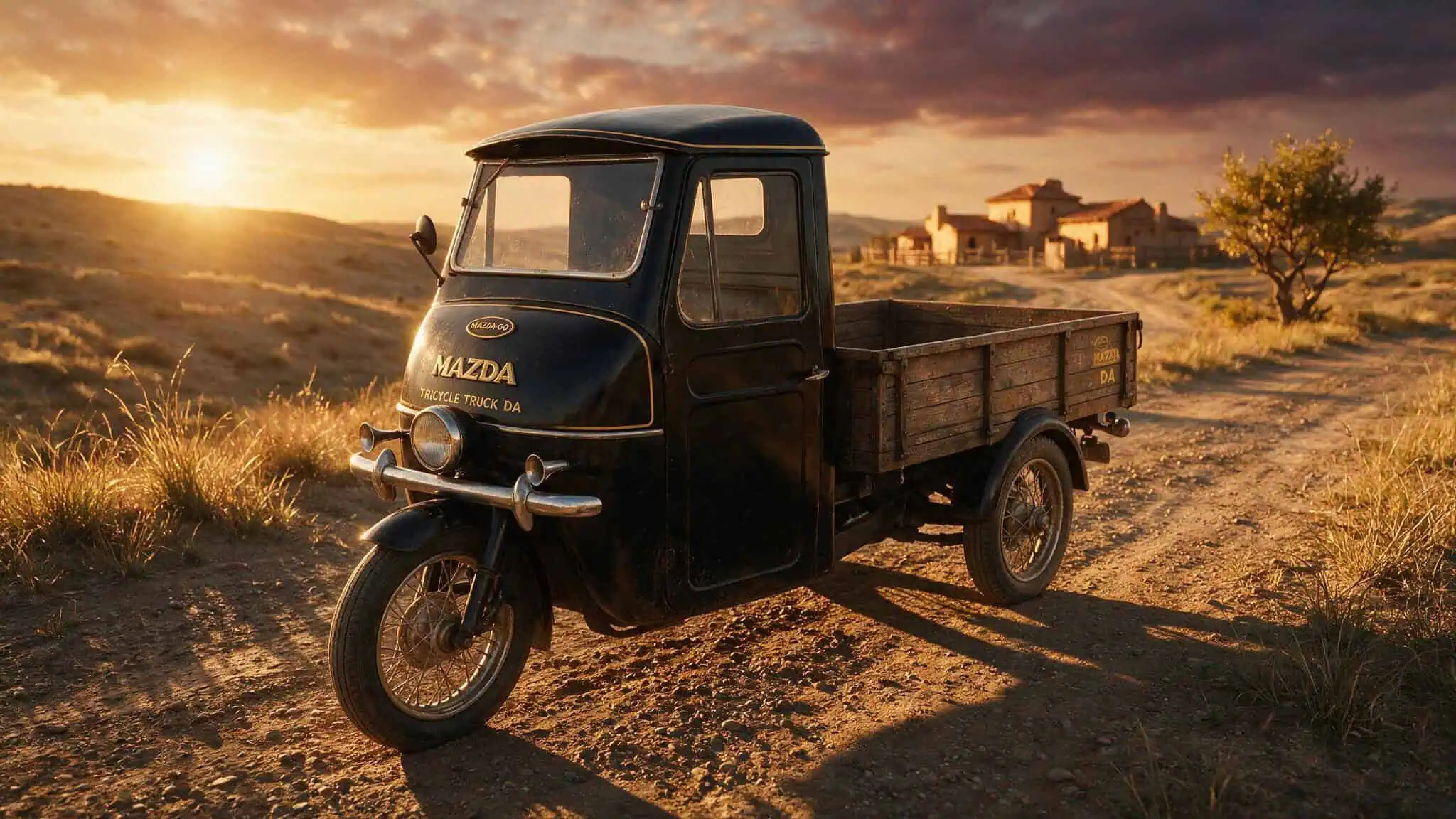
Mazda doesn’t make a lot of noise about its history, which is a shame because it’s one of the weirdest in the auto industry. Today they sell mostly crossovers — the CX-5, CX-50, CX-90, and the MX-5 Miata, which is the only non-SUV left in the lineup. But go back far enough and you’ll find a cork company that built three-wheeled trucks, then bet the entire company on a rotary engine that most engineers said couldn’t work, then won Le Mans, then nearly went bankrupt, then got rescued by Ford, and then somehow survived to become a mainstream brand with a cult following.
This is the visual tour of what came before. Some of these cars you’ll remember. Others you’ve never heard of. None of them are in production anymore.
Key Takeaways
Mazda’s first vehicle was the Mazda-Go, a three-wheeled truck from 1931 — a cork company building work vehicles before it ever made a passenger car.
The rotary engine, launched in the 1967 Cosmo Sports, defined Mazda’s identity but also caused a near-collapse when the 1973 oil crisis crushed demand for thirsty engines.
The MX-5 Miata (1989–present) is the only sports car Mazda still sells; everything else in the lineup is a crossover or was discontinued, including the Mazda6 (2025).
Table of Contents
Early Foundations — Three-Wheelers, Trucks, and the First Car (1931–1965)
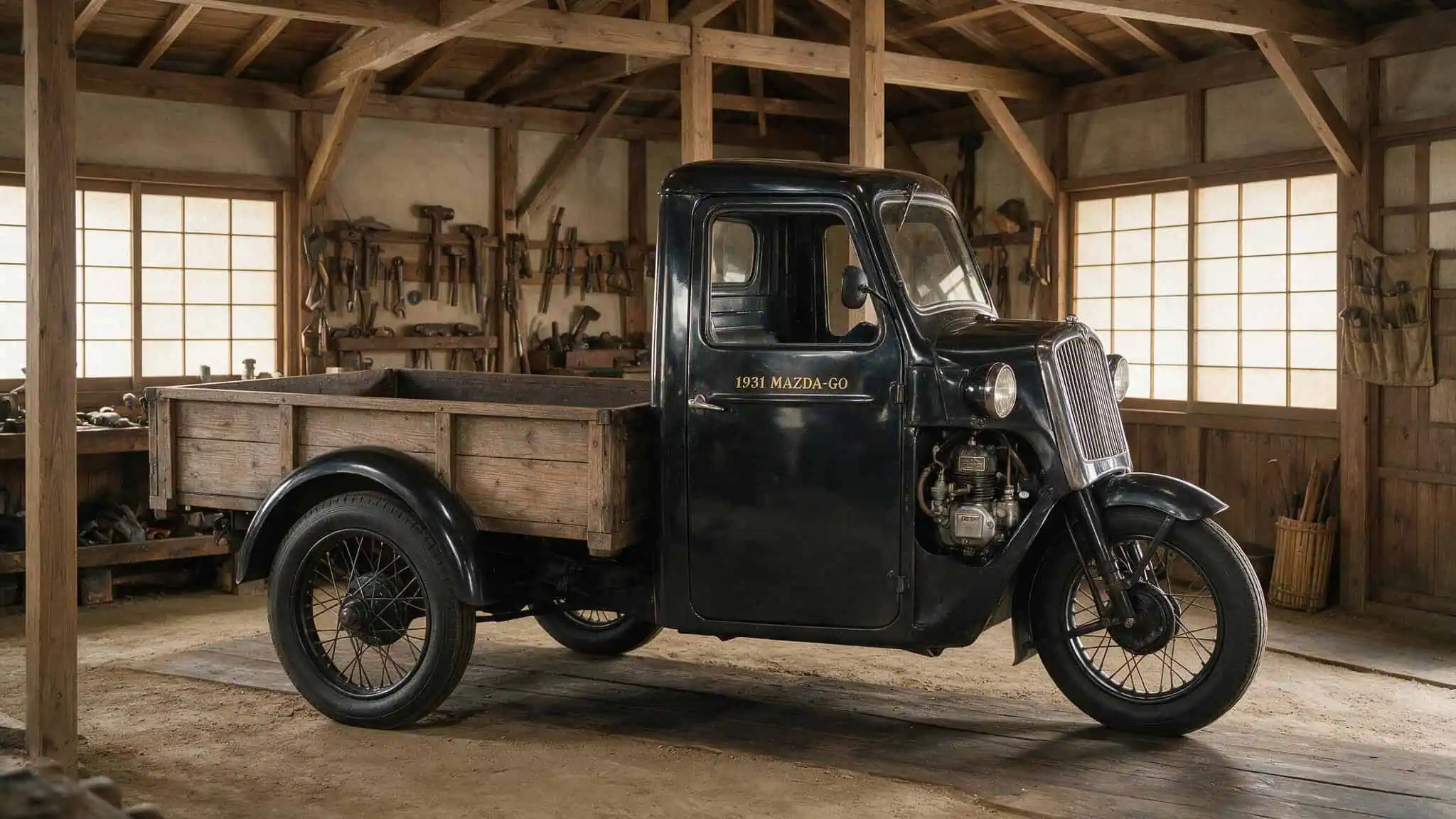
Most people don’t realize Mazda spent its first 29 years building only trucks. The company was founded in 1920 as Toyo Cork Kogyo — a cork manufacturer, and didn’t produce a vehicle until 1931. That first vehicle was the Mazda-Go, a three-wheeled truck that could carry about 200 kg. It doesn’t look like much today, but they exported it to China starting in 1932. That’s where the story begins.
By 1957, Mazda had built 200,000 vehicles total. By 1963, they’d hit a million. But all those were trucks and three-wheelers.
Mazda-Go (1931–?): Three-wheeled truck. First vehicle. Exported to China. That’s basically it.
Mazda Romper (1958–1965): This was Mazda’s first four-wheel vehicle — a light truck originally called the D-series before being renamed Romper in 1959. That’s the step from three wheels to four.
Mazda R360 Coupe (1960–1966): The first passenger car. Tiny — a 356cc air-cooled engine making 16 hp. But it had an optional automatic transmission, which was ahead of its time for a kei car. It achieved about 75 mpg (32 km/L).
Priced at roughly 300,000 yen, it seated two adults and two children, though those back seats were barely usable.
Mazda B360 (1961–1966): A light truck based on the R360 platform. Simple, cheap to run.
Mazda B-Series (1961–2006): A compact pickup that ran for 45 years. Later generations shared platforms with Ford Rangers. If you know someone who owned an old Mazda pickup, this is the one — tough, reliable, not fancy.
Mazda Carol (1962–present): Introduced as a kei car. The Carol 600 was Mazda’s first four-door passenger car. Important caveat: from the second generation onward, it became a rebadged Suzuki Alto. Only the early Carol 360 and 600 are genuine Mazda designs. The rest are Suzukis with a different badge, still sold today in Japan.
Mazda Familia (1964–2003): This is the car that made Mazda a global player. Available as a sedan, coupe, wagon, and van. Exported as the Mazda 323 (and “GLC” in North America). Shared its platform with the Ford Laser and Escort — the Ford partnership was already in play. Four generations over nearly 40 years.
Mazda Kraft (1965–1977): Light duty truck, 1 to 1.5-ton capacity. A workhorse.
Mazda Porter (1969–1989): Micro-mini truck and van — kei-class work vehicle. Tiny, like a golf cart with a bed.
Mazda Boxer (1969–1980): Mid-sized truck, 3.5 to 4 tons with a diesel engine. Also sold as the Kia Boxer — Mazda and Kia have a long history together.
Mazda Chantez (1972–1976): Kei car. Short run, small footprint.
Mazda Parkway (1972–1997): Minibus based on the Titan truck platform. Think Japanese school bus.
The Rotary Revolution — Sports Cars and Engine Innovation (1967–2002)
The Wankel rotary engine was smooth, high-revving, and compact — but most car companies gave up on it. Mazda went all in.
Mazda Cosmo Sports 110S (1967–1996): The first production car with a rotary engine. Two rotors, 491cc each, 110 hp. In a lightweight coupe, that was quick for the time. It proved the Wankel could work in a real car. Later renamed Eunos Cosmo in the 1990s when Mazda tried the multi-brand thing — it ended up as a luxury coupe with a 3-rotor engine.
Mazda Savanna / RX-3 (1971–1991): Known in Japan as the Savanna, exported as the RX-3. Rotary-powered sport coupe with serious racing pedigree — a giant killer on track against cars with much bigger engines.
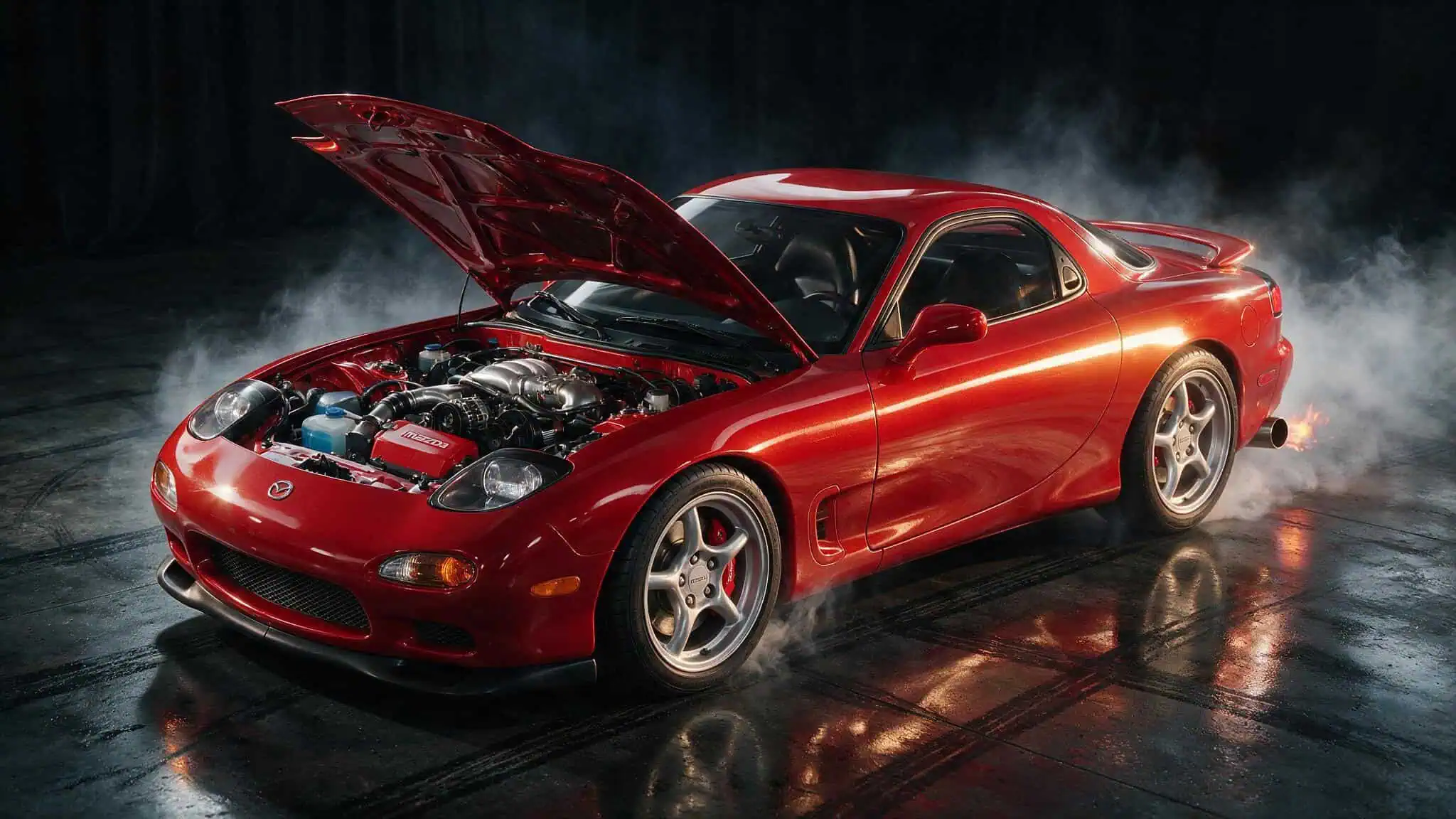
Mazda RX-7 (1978–2002): The icon. Three generations:
- FB (1978–1985): 12A rotary, about 130 hp, pop-up headlights. That’s the 80s sports car everyone remembers.
- FC (1986–1991): 13B engine, more refined, wedge-shaped. Still had pop-ups but a sharper look.
- FD (1992–2002): The most powerful and most collectible. Front-midship engine layout for handling. Cult following that hasn’t faded.
Mazda RX-8 (2003–2012): The last rotary production car. Four seats with suicide rear doors — a clever setup. Known for two things: a fantastic engine note and a habit of wearing out apex seals. A look at the best Mazda models you can buy notes this is the most accessible rotary to buy today, but you should budget for engine work. The tell is a “brap-brap” idle that becomes uneven as compression drops.
Mazda 787B (1991 race car): Quad-rotor R26B engine. Won the 24 Hours of Le Mans in 1991, making Mazda the first Japanese manufacturer to win. It’s still the only rotary-powered Le Mans winner ever. That’s an achievement for a small company.
Mazda MX-5 Miata (1989–present): Not rotary-powered — it uses a conventional piston engine, but this is the car that saved Mazda. An affordable, lightweight rear-wheel-drive roadster. Best-selling two-seat roadster in history. Still in production, and at this point it’s the only 2-door sports car Mazda sells. The rotary gave Mazda its identity, but the History of Mazda Automobiles in North America traces how the Miata gave it the profits that saved the company.
The 1973 oil crisis hit the rotary hard. Those engines were thirsty, and when fuel prices spiked, sales cratered. That financial hit led Ford to take a 27% stake in Mazda in 1979 (later increasing to 39.9% by 1997). But what did Mazda used to be called?
The company started as Toyo Cork Kogyo Co., Ltd. in 1920, making machine tools and cork. The rotary was brilliant, but it nearly killed the company.
Mainstream Workhorses and Ford Rebadging (1966–2025)
These are the cars that paid the bills — the sedans, coupes, and wagons you probably grew up with. The badge confusion is real; many of these were also sold as Fords in some markets.
Mazda Luce / 929 (1966–1991 / 1973–1997): Mid-sized luxury car, available with rotary or piston engines. The 929 badge appeared on three different cars: the Luce, then the Cosmo, then the Sentia. Confusing, but that’s how Mazda handled exports.
Mazda Capella / 626 (1970–2002 / 1978–2003): Sporty saloon with rotary and piston options. First car with the REmatic automatic transmission — a rotary-specific gearbox. Shared platform with the Ford Telstar.
Mazda Familia / 323 / GLC (1964–2003): Already covered above, but worth noting again — this was Mazda’s Corolla fighter. Available as hatchback, sedan, wagon. Basis for the Ford Laser and Escort.
Mazda Étude (1987–1989): Small coupe based on the Familia platform. JDM-only, two-year run. Rare.
Mazda MX-6 (1988–1997): Export version of the Capella coupe. Turbocharged variant available. Also offered with electronic four-wheel steering (the rear wheels could steer up to 5 degrees), making it one of the first production cars with that feature.
Mazda Persona (1988–1992): Luxury-oriented version of the Capella. Also sold as the Eunos 300. Not a huge success.
Mazda 121 (1986–2002): Two very different cars share this name. One is the 1977 121L notchback coupe (based on the Chevrolet Monza, never sold in the US). The other is the export version of the Revue, later rebadged as a Ford Fiesta. Confusing, but that’s the 121 for you.
Mazda Revue (1990–1998): Subcompact, sold as the Mazda 121 in export and also under the Autozam brand.
Mazda Sentia (1990–1998): Full-size luxury sedan. Successor to the Luce/929. Also sold as the Amati 1000 — it was intended as the flagship of Mazda’s canceled luxury brand.
Mazda MX-3 (1990–1998): Compact sport coupe with an available V6 — unique for its class. Also sold as the Eunos Presso/30X and Autozam AZ-3.
Mazda Lantis / Cronos (1991–1994): Sister car of the Familia. Also sold as the Efini MS-6. It had a short three-year run.
Mazda Millenia (1993–2002): Near-luxury sedan with an optional Miller cycle engine — a clever supercharged design that gave more efficiency. Originally intended for the Amati brand; when that was canceled, it became a Mazda. It’s a fascinating what-if.
Mazda Demio (1996–2019): Japan version of the Mazda2. Subcompact hatchback. Nameplate retired in 2019.
Mazda Axela (2003–2019): Japan version of the Mazda3. Name retired for global branding.
Mazda Atenza / Mazda6 (2002–2025): Mid-size sedan and wagon. Three generations (GG, GH, GJ). Discontinued in 2025, marking the end of Mazda’s sedan era. It was a good car — sporty, stylish, fun to drive, but the market shifted.
Forgotten and Obscure Models
These are the Mazdas most people have never heard of: the odd experiments, market-specific weirdos, and rebadges that went nowhere, unlike the best Mazda models you can buy in 2021.
Mazda Roadpacer (1975–1979): A rotary-powered sedan built on the Australian Holden HJ/HX Premier platform. Sold only in Australia and Japan. It used the 13B rotary engine from the RX-7 — in a big, heavy sedan. Less powerful than the V8 it replaced, and worse on fuel.
Built to meet 1975 emissions regulations. One of the strangest cars Mazda ever made.
Mazda 121L (1977): A notchback coupe that looked a lot like a Chevrolet Monza Towne Coupe. Never sold in North America. A styling experiment for other markets.
Autozam AZ-1 (1992–1993): Mid-engine kei car with gullwing doors. Produced for only two years — fewer than 4,000 built. It’s the only Mazda production car with gullwing doors. Tiny, crazy, and now a collector’s item.
Mazda MX-6 4WS (1989): Turbocharged coupe with electronic four-wheel steering. The rear wheels could steer up to 5 degrees. High-tech for its time.
Mazda Proceed Marvie (1991–1997): Mazda’s first in-house SUV, predating the CX-7 by 15 years. Based on Mazda’s own platform — not a rebadge.
Mazda Verisa (2004–2015): Subcompact hatchback/wagon based on the Mazda2/Demio platform. One of Mazda’s least-known models.
Mazda Proceed Levante (1995–1999): Rebadged Suzuki Vitara. Compact SUV for Japan.
Mazda AZ-Offroad (1998–2014): Rebadged Suzuki Jimny (third generation). Tiny, capable kei SUV. Still beloved.
Mazda AZ-Wagon (1994–2012): Rebadged Suzuki Wagon R. Kei-class wagon.
Mazda Laputa (1999–2006): Rebadged Suzuki Kei. Notable mostly because “laputa” means something unfortunate in Spanish.
Mazda Rustler (1983–2001): Rebadged Ford Bantam, sold only in South Africa. Unusual because it’s a Ford with a Mazda badge, not the other way around.
The Multi-Marque Experiment — Autozam, Eunos, Efini, and the Ghost of Amati
In the late 80s and early 90s, Mazda tried to split its lineup into separate brands — Autozam for kei cars, Eunos for luxury, Efini for performance. A fourth brand, Amati, was planned for North America to compete with Lexus, Infiniti, and Acura. It never launched. When Japan’s economic bubble burst, the whole strategy collapsed.
- Autozam: Kei cars like the AZ-1, AZ-3, Carol, Revue, and Scrum. Mostly Suzuki rebadges except the AZ-1.
- Eunos: Luxury — 300 (Persona), 500, 800 (Millenia), Roadster (MX-5), Cosmo. Competed with Toyota Soarer and Nissan Leopard.
- Efini: Performance — RX-7, MS-6 (Lantis), MS-8, MS-9 (929). Spelled “ɛ̃fini” with a tilde. It ran from 1991 to 1996.
- Amati: Planned for North America with three models (300, 500, 1000). Canceled in 1992 before any were sold. The Millenia is the physical evidence of what Amati would have been.
If you see an old Mazda wearing a weird badge, this is why.
The SUV Era and the End of the Sedan (1996–2025)
The CX-5 — launched in 2012, now sells more units in a year than the RX-7 sold in its entire 24-year run.
Mazda MPV / Mazda8 (1996–2016): Minivan, 20-year run. Also sold as Efini MPV in Japan.
Mazda Premacy / Mazda5 (1999–2018): Compact minivan with sliding doors. Phased out with declining demand.
Mazda Tribute (2000–2011): First modern Mazda SUV. Shared platform with the Ford Escape. Replaced by the CX-5.
Mazda CX-7 (2006–2012): Mid-size crossover with a turbo engine. Discontinued after one generation.
Mazda CX-9 (2006–2024): Three-row crossover. Discontinued and replaced by the CX-90.
Mazda CX-4 (2016–2025): China-exclusive coupe-style crossover. Recently discontinued.
Mazda Biante (2008–2018): Minivan based on the Mazda5 platform.
Mazda VX-1 (2013–2017): Rebadged Suzuki Ertiga for Indonesia.
What It All Adds Up To
Mazda started with a three-wheeled truck, bet everything on a weird engine, won Le Mans, nearly went bankrupt, partnered with Ford, and now sells mostly crossovers. The old models tell the story of a small company that took big risks and survived by adapting.
If you’re browsing this list trying to identify something you saw or remember a car you once owned, I hope it helped. These are the Mazdas that got us here — the weird ones, the workhorses, the ones that made the company interesting.
Frequently Asked Questions
What are some classic Mazda models?
Classic Mazda models include the RX-7, the Cosmo Sports 110S (the first rotary production car), the MX-5 Miata, and the Familia/323. The RX-7 is the icon, but the Cosmo is where the rotary story started, and the Miata is the best-selling two-seat roadster in history.
What was Mazda’s first vehicle?
Mazda’s first vehicle was the Mazda-Go, a three-wheeled truck introduced in 1931. It could carry about 200 kg and was exported to China starting in 1932. The company didn’t build a passenger car until the R360 Coupe in 1960.