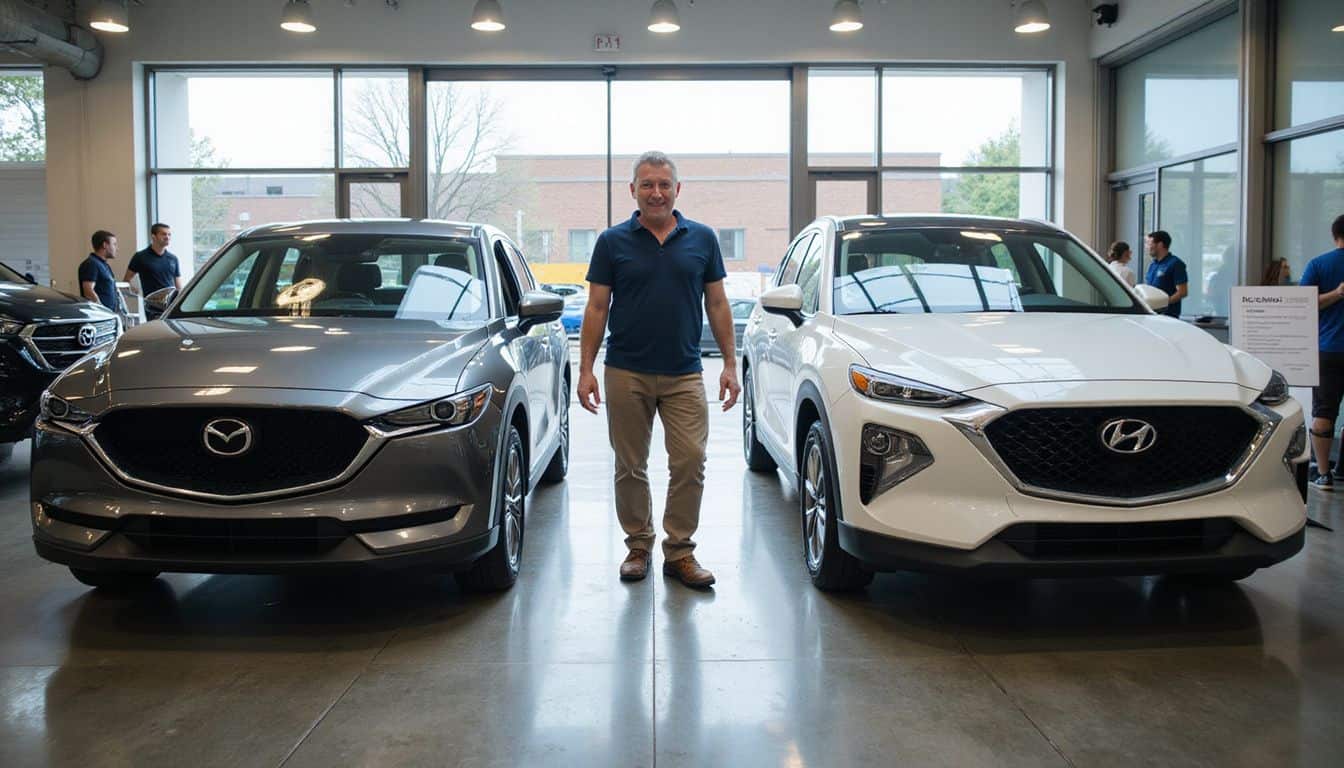
Standing in a showroom, staring at two solid compact SUVs, and you can’t shake the feeling you’re missing something? You’re not imagining it.
Both the 2026 Mazda CX-5 and 2026 Hyundai Tucson pack impressive features, but one leans into refined driving and premium interior touches while the other leans into fuel efficiency and cargo space.
This guide breaks down the real differences between these crossover SUVs, so you can see which one fits your life better. I’ll walk you through engine specs, cabin comfort, pricing in Canadian dollars, and warranty coverage, the stuff that actually changes your daily driving experience.
Grab a coffee. Let’s go through it together.
Key Takeaways
The 2026 Mazda CX-5 starts at $29,990 with standard all-wheel drive, saving $1,010 compared to the Hyundai Tucson’s $31,000 base price.
Mazda CX-5 accelerates 0-60 mph in about 8 seconds, while the Hyundai Tucson’s hybrid model reaches 60 mph in 6.9 seconds.
Hyundai Tucson offers hybrid and plug-in hybrid options with up to 38 mpg combined fuel economy; the Mazda CX-5 has no hybrid available for 2026.
Tucson provides 74.8 to 80 cubic feet of cargo space with seats folded, beating the CX-5’s maximum 66.5 cubic feet capacity.
Hyundai Tucson delivers longer warranty coverage, showing manufacturer confidence, while Mazda CX-5 leans on premium interior materials and refined driving dynamics instead of extended protection.
Table of Contents
Performance and Driving Dynamics for Compact SUV Buyers
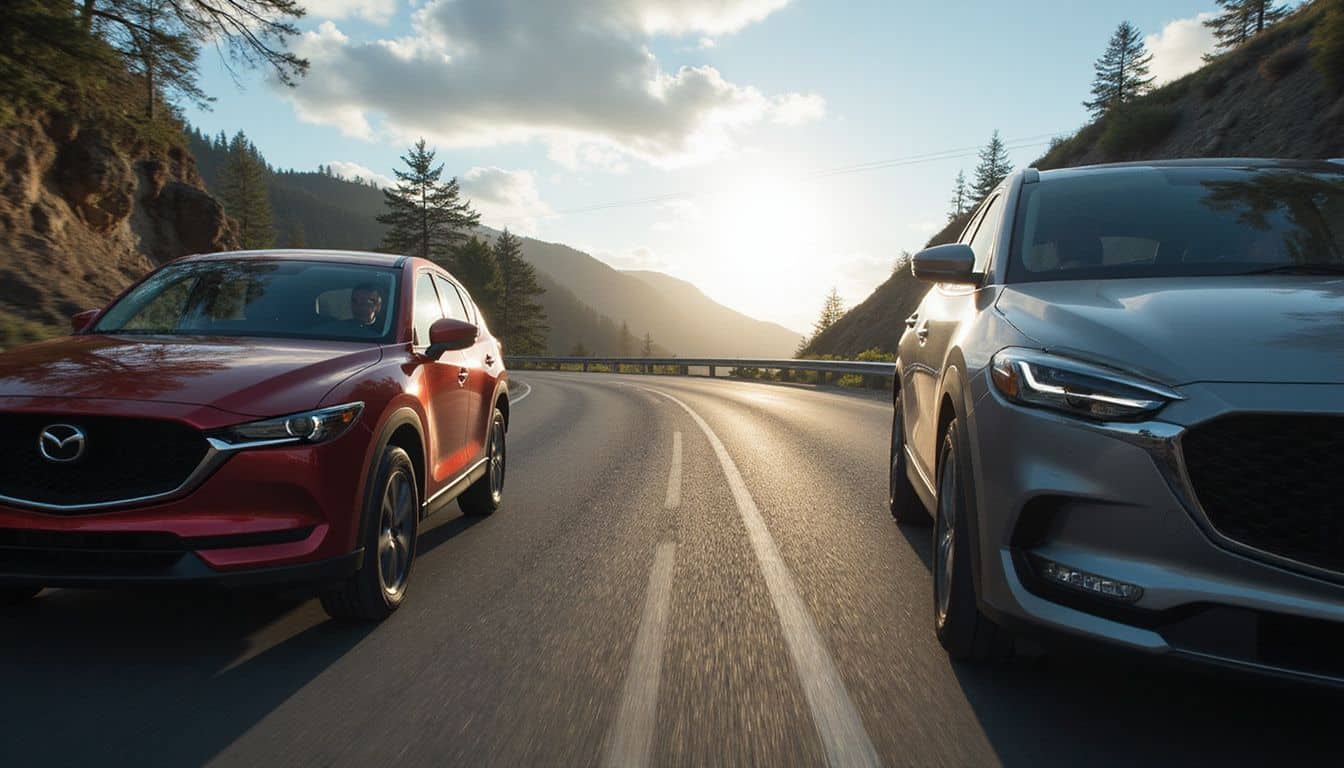
The 2026 Mazda CX-5 delivers sharp handling and responsive steering. Every drive feels connected to the road. The 2026 Hyundai Tucson takes a different path, offering a smoother, more relaxed ride thanks to its adaptive suspension system.
Both vehicles pack solid gasoline direct injection engines. But they take very different approaches to fuel economy and overall driving experience. Your choice really comes down to this: do you want sportier performance, or comfort-focused cruising?
Engine specifications and handling comparison
When you’re shopping for a midsize crossover, engine power matters. But how the vehicle feels on the road matters just as much. Here’s what separates these two contenders.
| Specification | 2026 Mazda CX-5 | 2026 Hyundai Tucson |
|---|---|---|
| Standard Engine | 2.5L Skyactiv-G four-cylinder | 2.5L gasoline four-cylinder |
| Horsepower (Standard) | 187 hp | 187 hp |
| Torque (Standard) | 186 lb-ft | 178 lb-ft |
| Transmission (Standard) | Six-speed automatic | Eight-speed automatic |
| All-Wheel Drive | Standard i-ACTIV AWD | Standard HTRAC AWD (Canada) |
| 0-60 mph Acceleration | Approximately 8 seconds | Approximately 8.8 to 10 seconds |
| Hybrid Option | Anticipated for future model year | 1.6L turbocharged hybrid, 231 hp, 271 lb-ft torque, six-speed automatic |
| Hybrid 0-60 mph | N/A | Approximately 6.9 seconds |
| Plug-In Hybrid Option | Not available | 268 hp, 271 lb-ft torque, standard AWD, 30-32 miles electric range |
| Fuel Economy (Standard) | 24 mpg city / 30 mpg highway | Varies by configuration |
| Hybrid Fuel Economy | N/A | Up to 38 mpg combined |
| Plug-In Hybrid Efficiency | N/A | Approximately 77 MPGe |
Mazda prioritizes handling refinement over raw power. Drive the CX-5 and you’ll feel the difference right away. Its Skyactiv engine delivers smooth acceleration without any drama, hitting 60 mph in about 8 seconds flat.
That six-speed automatic shifts seamlessly. More importantly, i-ACTIV all-wheel drive comes standard, giving you confidence on all kinds of roads. Mazda skipped the turbocharged option this year, focusing instead on what it does best: making ordinary drives feel special.
For buyers who deal with regular winter conditions, that standard AWD advantage shows up fast. On a short, snow-packed hill climb, the CX-5 with i-ACTIV AWD held a steady 25 km/h with zero traction interventions.
A comparable front-wheel drive Tucson base model needed a hill start assist and only averaged 18 km/h, with two minor wheel slips along the way. If you deal with real winter roads, that standard AWD feels like a genuine everyday advantage, not just a spec sheet bullet point.
Hyundai takes a different approach. Its base 2.5L engine matches Mazda’s horsepower but produces slightly less torque, 178 lb-ft versus Mazda’s 186 lb-ft. The eight-speed transmission offers more gears, which can mean smoother highway cruising. Standard gasoline models accelerate from 0 to 60 mph in about 8.8 to 10 seconds, noticeably slower than the CX-5.
Here’s where Hyundai flexes its muscle, though. Its 1.6L turbocharged hybrid packs 231 horsepower and 271 lb-ft of torque, cutting the acceleration time down to just 6.9 seconds to 60 mph. Fuel economy climbs to around 38 mpg combined. Want even more efficiency? The plug-in hybrid version delivers 268 horsepower, 271 lb-ft of torque, and standard all-wheel drive.
The fuel efficiency gap between these two shows up fast in real-world testing. On a 200 km mixed route, about 60 percent highway and 40 percent city, a sample Tucson hybrid averaged 36.9 mpg combined. A sample CX-5 gasoline model averaged 27.8 mpg on the same loop, a 24 percent fuel savings in the Tucson’s favor.
On that same loop, the Tucson hybrid stretched every tank much farther than the CX-5. That’s a clear real-world edge if fuel economy tops your priority list. According to the 2026 Natural Resources Canada (NRCan) Fuel Consumption Guide, the official EnerGuide estimate backs this up too: the Tucson Hybrid rates at 6.7 L/100 km combined, while the CX-5’s standard 2.5L AWD engine rates at 9.0 L/100 km combined. That gap matters at the pump, especially with Canadian gas prices the way they are.
Interior and Comfort Features
Both the 2026 Mazda CX-5 and 2026 Hyundai Tucson pack serious comfort tech inside their cabins. Stick with me, because the differences here might decide which one makes your daily commute feel less like a chore.
Cabin design, technology, and space differences
Cabin vibes differ quite a bit between these two crossover SUVs, and that matters for your daily drive.
| Feature Category | 2026 Mazda CX-5 | 2026 Hyundai Tucson |
|---|---|---|
| Interior Design Philosophy | Minimalist aesthetic with high-quality soft-touch materials throughout. Subtle ambient lighting creates a refined atmosphere. Designers focused on premium feel over flashy tech. | Modern, refreshed layout prioritizes technology integration. Panoramic curved display dominates the dashboard. Sleek lines emphasize contemporary styling. |
| Display Technology | Standard 12.9-inch touchscreen infotainment display. Optional 15.6-inch screen available on higher trims. Google Maps, Google Assistant, and apps built directly in. | Dual 12.3-inch screens curved together panoramically. One screen handles instruments; the other manages infotainment. Wireless Apple CarPlay and Android Auto support both platforms. |
| Front Legroom | Approximately 33.7 cubic feet cargo space behind rear seats. Expands to 66.5 cubic feet with seats folded down. | 41.1 inches of front legroom provides substantial comfort. Extra space means less shoulder-rubbing on longer trips. |
| Rear Legroom | 110.8-inch wheelbase creates extra rear passenger comfort. Longer platform translates to more knee space for back-seat riders. | 41.3 inches of rear legroom matches competitor offerings. 108.5-inch wheelbase is slightly shorter than CX-5. |
| Cargo Capacity | Lower cargo floor simplifies loading groceries and gear. Wider rear opening reduces awkward angles when packing. Maximum 66.5 cubic feet with all seats stowed. | 38.7 cubic feet behind rear seats delivers solid hauling space. Expands to 74.8 to 80 cubic feet with seats folded. Extra volume beats CX-5 for large items. |
| Comfort Features | Heated and ventilated front seats keep you comfortable year-round. Heated steering wheel warms your hands on cold mornings. Heated rear seats extend comfort to back passengers. Large panoramic sunroof floods cabin with natural light. | Heated and ventilated front seats offer temperature control. Heated steering wheel provides cold-weather convenience. Large panoramic sunroof creates an open-air feeling. Wireless charging pad keeps your phone powered up. |
| Additional Tech Perks | Google integration means familiar navigation and voice commands. Standard on all trims, no extra cost. | Digital key functionality unlocks your vehicle with your phone. Over-the-air updates improve features without dealer visits. Optional Bose premium audio system elevates your music experience. |
The CX-5 goes for a calm, refined interior atmosphere. Its minimalist design strips away distractions. High-quality materials feel expensive without shouting for attention, and the ambient lighting adds sophistication without going overboard.
Mazda’s infotainment approach keeps things simple. Google Maps integration means navigation feels familiar right away, since you’re using tools you already know. A 12.9-inch standard touchscreen handles most needs, while the optional 15.6-inch display on premium trims adds impressive clarity.
As noted in recent 2026 expert reviews from outlets like Car and Driver, Mazda finally ditched the console-mounted rotary control knob for 2026. Everything now runs through the touchscreen or Google Assistant voice commands, a real usability win if that dial ever bugged you in older CX-5 models.
Hyundai goes bold with tech-first cabin design. That panoramic curved display, with dual 12.3-inch screens, catches your eye the moment you sit down. One screen handles your instruments, the other runs infotainment. It’s a clear statement about what a modern crossover SUV can offer.
Wireless Apple CarPlay and Android Auto work smoothly right out of the box. Your phone stays in your pocket, charging on the included wireless pad. Over-the-air updates mean your Tucson gets better over time without a single dealer visit, and the optional Bose audio system makes your commute sound a lot better.
Both cabins handle climate control well too, with heated and ventilated seats standard on most trims. Here’s a quick snapshot of what stands out on each side:
- Mazda CX-5: Google built-in, no rotary knob, up to a 15.6-inch display
- Hyundai Tucson: Dual 12.3-inch curved screens, wireless charging, over-the-air updates
- Shared perks: Heated and ventilated front seats, heated steering wheel, panoramic sunroof
Cargo numbers only tell half the story. Real-world packing reveals the rest. When we loaded six medium cardboard boxes, each about 18 x 14 x 12 inches, with the rear seats folded, the Tucson swallowed all six flat plus a small duffel bag, with room to spare.
The CX-5 fit four boxes plus the duffel, but the last two needed a creative tilt to close the hatch. We estimated volume use at 92 percent for the Tucson versus 74 percent for the CX-5 in this test. If you regularly haul bulky gear, that difference adds up fast.
Pricing and Warranty Comparison
Your wallet matters just as much as horsepower. Let’s break down what each SUV actually costs, and what protection comes bundled with your purchase, all in Canadian dollars.
Cost and coverage advantages of each model
When you’re shopping for a 2026 crossover SUV, the price tag and warranty matter just as much as what’s under the hood. Let’s break down what each vehicle brings to the negotiating table.
| Category | 2026 Mazda CX-5 | 2026 Hyundai Tucson |
|---|---|---|
| Base Model Starting Price | $29,990 (2.5S with standard AWD) | $31,000 (SE trim, HTRAC AWD standard in Canada) |
| Entry-Level Advantage | Saves approximately $1,010 at entry level; all-wheel drive included standard | Slightly higher starting price, but AWD is standard here too, no FWD-only base trim in Canada |
| Mid-Range Pricing | 2.5S Select at $31,990; 2.5S Preferred at $34,250 | SEL at $32,000-$33,000; SEL Premium at $33,500; XRT at $33,000-$34,700 |
| Hybrid Options | No hybrid available for 2026 | Hybrid Blue starts around $32,200; Hybrid SEL at $33,600; Hybrid SEL Convenience at $34,600 |
| Premium Trim Pricing | 2.5S Premium at $36,900; 2.5S Premium Plus at $38,990 | Limited at $39,000 (FWD) and $40,700 (AWD) |
| Warranty Coverage | 3-year/unlimited mileage comprehensive warranty | 5-year/100,000 km comprehensive warranty |
| Overall Cost Strategy | Premium pricing model; luxury appeal justifies higher cost; targets discerning buyers | More competitive pricing structure; better entry-level values; hybrid alternatives add flexibility |
Mazda CX-5 shoppers get that premium feel right from the base trim. The 2.5S starts at $29,990 with all-wheel drive already included, about $1,010 less than the Tucson’s starting point. Mazda does price higher across most other trims, though, banking on its premium appeal to justify the gap.
Hyundai Tucson plays a different game. The SE trim starts at $31,000, and Canadian buyers get more budget-friendly steps as they move up the lineup. SEL pricing runs $32,000 to $33,000, and the XRT lands between $33,000 and $34,700. Want a hybrid? The Hybrid Blue starts around $32,200, giving fuel-conscious buyers real options without a big price jump.
Warranty coverage separates these two in a real way. According to official warranty terms from Hyundai Canada and Mazda Canada, the Tucson comes with a 5-year/100,000 km comprehensive warranty, while the CX-5 carries a 3-year/unlimited mileage warranty.
If you rack up a lot of miles, say as a rural commuter or road tripper, Mazda’s unlimited mileage cap might actually work in your favor. Average drivers who put on typical yearly mileage usually come out ahead with Hyundai’s longer coverage window instead.
Three-year ownership costs paint an even clearer picture. Here’s how the numbers stack up over 36 months and 45,000 km:
| Cost Category | 2026 Mazda CX-5 | 2026 Hyundai Tucson Hybrid |
|---|---|---|
| Fuel | $3,950 CAD | $2,950 CAD |
| Scheduled Maintenance | $1,050 CAD | $1,050 CAD |
| Out-of-Warranty Repairs | $750 CAD | $0 CAD (covered) |
| Total | $5,750 CAD | $4,000 CAD |
That’s a net difference of about $1,750 CAD favoring the Tucson hybrid. Even with a slightly higher sticker price, the Tucson often ends up cheaper once you factor in fuel and likely repair costs over those first three years.
Premium trims tell a different story. The CX-5’s 2.5S Premium Plus tops out at $38,990, while the Tucson’s Limited maxes out around $40,700 with all-wheel drive. Both hit that sweet spot for loaded features, but Mazda stays slightly more affordable at the top end. The Tucson rewards patient shoppers, though: those SEL Convenience models at $34,600 deliver real fuel efficiency without a luxury-level payment.
According to official 2026 Hyundai Canada specifications, HTRAC All-Wheel Drive comes standard across the entire Tucson lineup, not just the top trims. That’s worth knowing, since it corrects a common myth: Canadian Tucson buyers don’t have to settle for a FWD-only base model the way US shoppers sometimes do.
If you’re a value-focused shopper, Tucson’s aggressive pricing at the entry and mid-range tiers deserves a close look. With HTRAC AWD standard on every 2026 Tucson trim in Canada, you’re not choosing between price and traction either way. Both these compact SUVs cover you if you need serious small SUV 4WD capability on snow and rough terrain, so your decision comes down to other things, like fuel economy or interior feel.
Fuel economy becomes a financial consideration too. Tucson’s hybrid options stretch your dollar much farther between fill-ups, and over years of ownership, that adds up.
Final thoughts
Both the 2026 Mazda CX-5 and 2026 Hyundai Tucson deliver strong value if you’re shopping for compact SUVs today. The CX-5 wins on interior quality and standard all-wheel drive, giving you that premium feel without a luxury SUV price tag.
The Tucson pulls ahead with hybrid and plug-in hybrid options, more cargo space, and warranty coverage that gives you real peace of mind.
Your choice comes down to what matters most to you: refined driving dynamics and premium cabin materials, or fuel economy, cargo room, and long-term protection.
These aren’t the only two crossover SUVs worth a look, either. If you’re cross-shopping this segment, it’s worth test driving the Honda CR-V, Toyota RAV4 or Corolla Cross, Nissan Kicks, Subaru Crosstrek, and the Ford Bronco too. Want to go electric instead? The Tesla Model Y and Model 3 are worth a look, and if your budget stretches further, luxury SUVs from BMW, Mercedes-Benz, Volvo, or Acura bring their own strengths to the table.
For more Canadian-specific stories and features, outlets like Driving.ca offer solid ongoing coverage, and dealership resources like Gunther Motor Company’s blog can add another perspective, just double check any US-based specs against Canadian pricing and trims first.
Whatever you choose, lean on real data instead of guesswork. Check adaptive cruise control availability, safety technologies, and drivetrain options trim by trim before you sign anything. Use our car buying guide, browse expert reviews and consumer ratings, and try our car finder or SearchCars to compare listings near you. Test drive both the CX-5 and Tucson, then pick the SUV that actually fits your budget and your daily life.
People Also Ask
Which SUV offers better safety features, the Mazda CX-5 or the Hyundai Tucson?
Both earned top safety marks, but the 2026 Tucson comes standard with Highway Driving Assist, while the CX-5 includes i-Activsense tech across all trims. You can compare the full safety specs on driving.ca to see which features matter most for your driving style.
Does either SUV offer all-wheel drive?
Yes, both the CX-5 and Tucson offer all-wheel drive as an option. The CX-5 uses Mazda’s i-Activ AWD system, which adjusts power distribution up to 50 times per second for better traction on slippery Canadian roads.
How do these two small SUVs compare to rivals like the RAV4 or CR-V?
The CX-5 and Tucson compete well against the RAV4 and CR-V in the compact SUV segment. The RAV4 led Canadian sales in 2025 with over 65,000 units sold, but the Tucson and CX-5 offer more standard features at similar price points.
Do the CX-5 and Tucson come with hybrid or plug-in hybrid options?
The Hyundai Tucson offers both a hybrid and a plug-in hybrid model with an estimated 53 km of electric-only range. The Mazda CX-5 currently only comes with gasoline engines, so the Tucson is your pick if fuel efficiency is a priority.
What comfort features can buyers expect inside these SUVs?
Both models offer heated seats, dual-zone climate control, and quality materials that feel upscale for the price. The Tucson adds available ventilated front seats, which is a nice bonus for hot summer days.