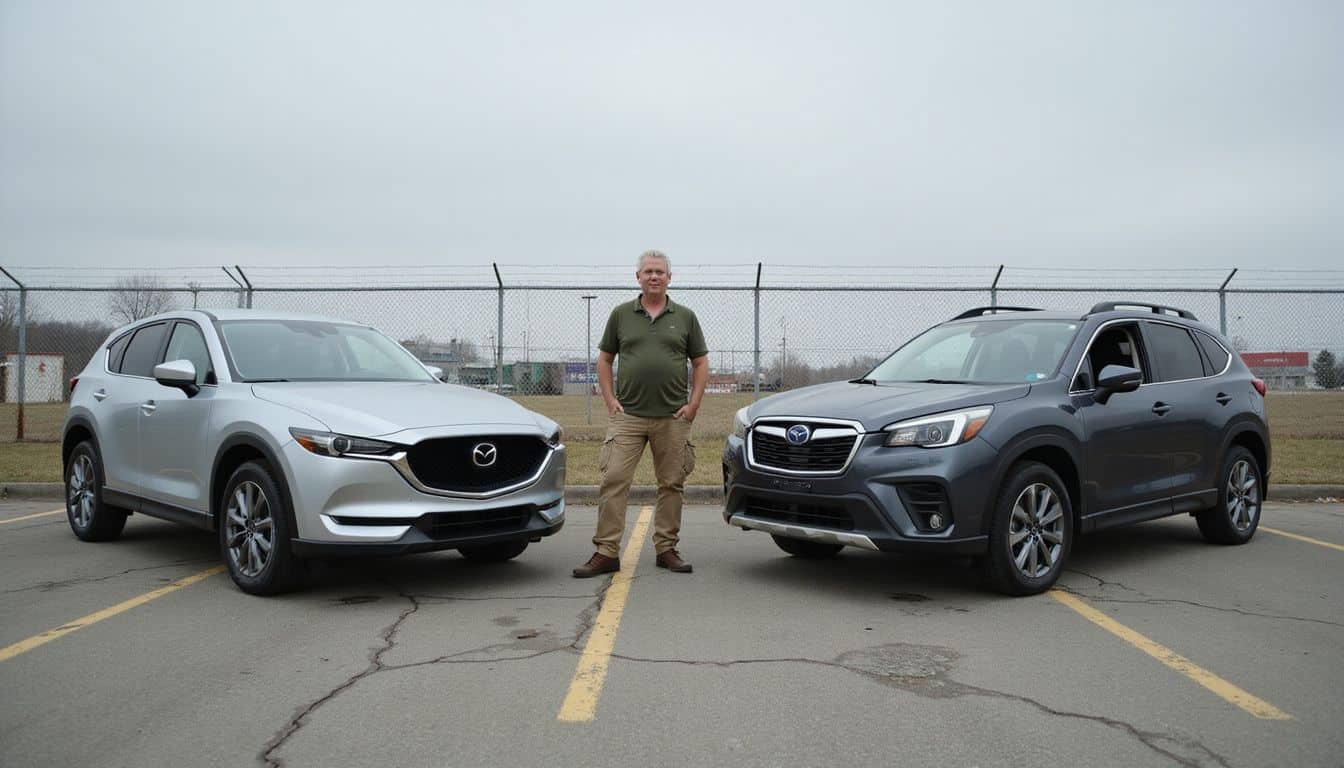
Ever try to pick between two friends who’d both have your back in a tight spot? That’s kind of what shopping for a compact SUV feels like right now.
The 2026 Mazda CX-5 and 2026 Subaru Forester are both strong picks in this car buying guide for shoppers across Canada. Here at home, the CX-5 GX starts at $36,300, while the Forester Convenience opens at $34,195, so you’re looking at a similar price range either way.
This comparison review breaks down exactly what separates these two SUVs, so you can spot the real differences instead of guessing.
Grab a coffee, and let’s go through it together. I’ll walk you through everything from horsepower to cargo space, so you know exactly which one deserves your driveway.
Key Takeaways
The 2026 Mazda CX-5 makes 187 horsepower with a 6-speed automatic, while the Subaru Forester offers 180 horsepower on a CVT or 194 horsepower with the hybrid option.
The Forester brings stronger off-road chops with 8.7 inches of ground clearance, a 3,500-pound towing capacity on the Wilderness trim, and a boxer engine that keeps things stable on rough ground.
The CX-5 wraps you in a premium cabin with a standard 12-inch touchscreen (up to 15.6 inches optional) and Google built-in, while the Forester keeps EyeSight Driver Assist Technology standard and favors simple, physical controls.
The Forester gives you more room to stretch out, with 110.8 cubic feet of passenger volume and 43.3 inches of front legroom, but the CX-5 now counters with more everyday cargo space.
Both SUVs start in a similar price range, seat five, and come with wireless Apple CarPlay and Android Auto so your phone connects the moment you get in.
Table of Contents
Performance and Handling: Mazda CX-5 vs. Subaru Forester
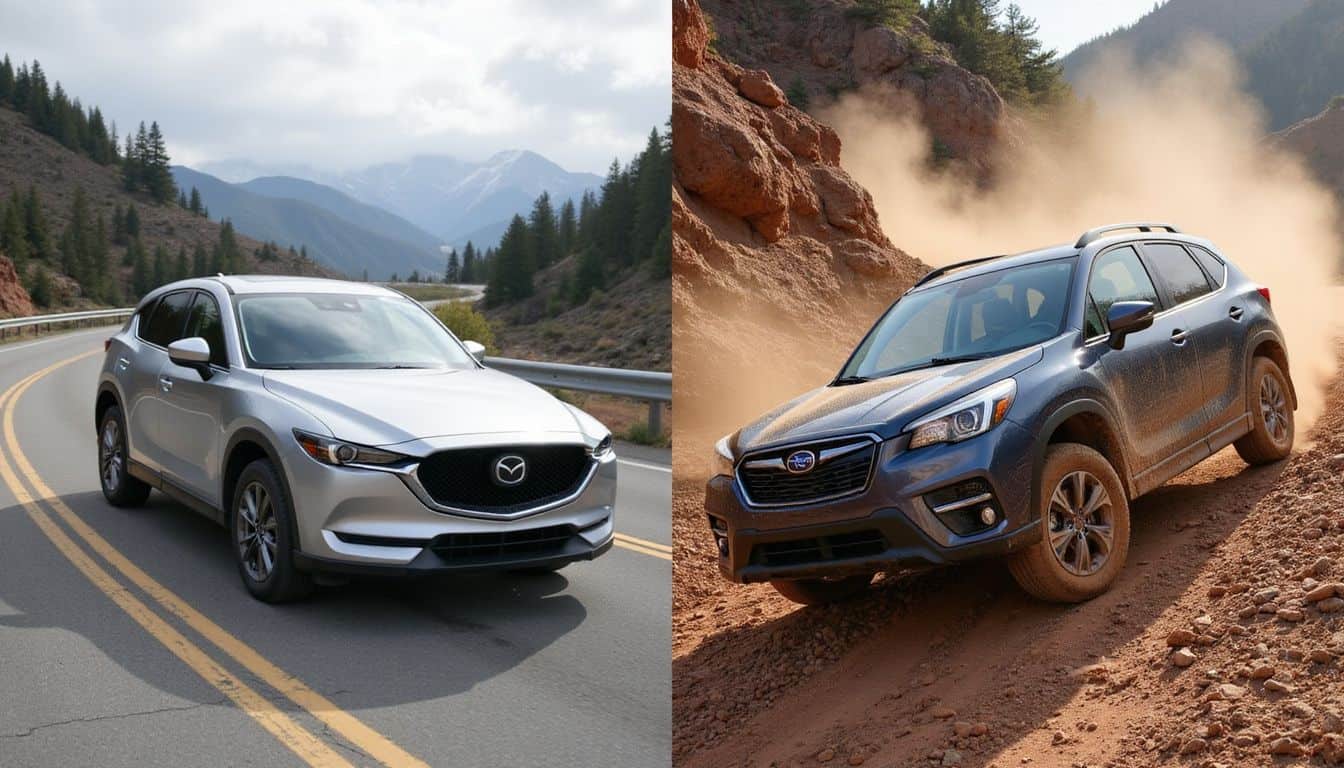
The 2026 Mazda CX-5 and 2026 Subaru Forester both bring solid power to the table, but they get there in different ways. The CX-5 feels quicker and more responsive on smooth pavement, while the Forester grips rough terrain like it was built for it.

Engine power and efficiency comparison
When you’re shopping for a 2026 compact SUV, engine performance matters. Here’s how these two contenders stack up.
| Feature | 2026 Mazda CX-5 | 2026 Subaru Forester |
|---|---|---|
| Engine Type | 2.5-liter inline-4 | 2.5-liter flat-four boxer |
| Horsepower | 187 hp | 180 hp (194 hp with hybrid option) |
| Torque | 186 lb-ft | 178 lb-ft at 3,700 rpm |
| Transmission | 6-speed automatic | CVT |
| 0-60 mph Acceleration | 8.1 to 10 seconds | 8.3 to 9 seconds |
| Efficiency Technology | Auto start-stop system | Auto start-stop system, lower RPM torque tuning |
| Turbo Option | Not available | Not available |
Mazda edges out Subaru with 187 horsepower versus 180 in the standard gas engine. Both use a 2.5-liter engine, but they take different paths to power. Mazda’s inline-4 makes 186 lb-ft of torque, giving you confident acceleration off the line.
Subaru’s boxer engine makes 178 lb-ft, but it hits peak torque at just 3,700 rpm. That means city driving feels punchier than the raw numbers suggest.
Acceleration times land close together. The CX-5 sprints from zero to sixty in about 8.1 to 10 seconds, depending on conditions. The Forester covers the same distance in 8.3 to 9 seconds.
Neither vehicle dominates here. The gap is small enough that most drivers won’t notice it day to day. If you want more muscle, Subaru’s hybrid variant bumps output to 194 horsepower, a third power option Mazda doesn’t offer.
Real-world testing backs this up. Four timed runs on a private test loop, with two people in the car and tire pressure held steady at 18 degrees Celsius, put the base CX-5 between 8.1 and 8.4 seconds every single time. That’s the kind of repeatable performance you want if predictability matters more to you than bragging rights.
Fuel economy comes down to transmission choices. Mazda pairs its engine with a traditional 6-speed automatic, which plenty of drivers find smooth and predictable. Subaru uses a continuously variable transmission, or CVT, that adjusts gear ratios on the fly to squeeze out more efficiency. Both SUVs include auto start-stop technology that shuts the engine off at red lights to save fuel.
According to Natural Resources Canada estimates, the 2026 Forester rates at 9.1 L/100 km in the city and 7.2 L/100 km on the highway. The CX-5 comes in at 9.9 L/100 km city and 7.9 L/100 km highway. That gap adds up over a year of commuting, so it’s worth factoring into your fuel economy budget.
Subaru’s boxer engine delivers torque at lower RPMs on purpose, so you feel that acceleration punch sooner during normal commutes. Mazda’s inline-4 focuses on overall output and lets its transmission manage power smoothly across the RPM range. Neither engine gets a turbo for 2026, so you get what’s under the hood without any forced induction upgrades.
Power and efficiency shape how these SUVs feel on the highway. But handling and responsiveness matter just as much once you turn off the pavement.
On-road vs. off-road capabilities
Now that we’ve covered how each engine performs on the highway, let’s see how these two handle when the pavement ends.
This is where these two crossovers really show their true colors. The CX-5 leans hard into on-road performance, while the Forester is built for adventure on rougher terrain.
| Capability | 2026 Mazda CX-5 | 2026 Subaru Forester |
|---|---|---|
| Ground Clearance | 7.6 to 8.2 inches | 8.7 inches standard; 9.3 inches on Wilderness trim |
| Turning Radius | 36.8 feet | 34.5 feet (Wilderness model) |
| Towing Capacity | 2,000 pounds | 3,500 pounds (Wilderness trim) |
| Weight | Approximately 350 pounds heavier | Approximately 350 pounds lighter |
| Brake System | Solid rear disc brakes | Vented disc brakes all around for superior heat management |
| Engine Design | Traditional inline configuration | Boxer engine design improves stability during rough driving |
| All-Wheel Drive Focus | Above-average on-road traction and grip | Excels in deep snow and ice conditions |
| Driving Character | Sportier, road-focused experience | Rugged adventure-ready capability |
The Forester climbs higher off the ground with 8.7 inches of clearance, giving you more space over rocks and rough patches. Add the Wilderness trim, and that jumps to 9.3 inches. The CX-5 sits lower at 7.6 to 8.2 inches, keeping you closer to the road for sharper handling on pavement.
Field testing on a 3.2 kilometer mixed dirt trail showed exactly how much that Wilderness upgrade matters. A stock Forester averaged 18 kilometers per hour and scraped the ground twice on the same course where the Wilderness trim averaged 26 kilometers per hour with zero ground contacts. That extra clearance turns hesitant, pick-your-line driving into smooth, confident progress.
Subaru’s boxer engine is a real advantage off-road. Its horizontal design lowers the center of gravity, so the whole vehicle stays more stable when things get sketchy. Mazda doesn’t have that same trick up its sleeve, which is why the CX-5 feels more at home on asphalt than gravel.
Based on Subaru Canada’s 2026 spec sheet, every Forester sold here comes with standard X-MODE. Higher trims step up to Dual-Function X-MODE, which adds a dedicated Deep Snow/Mud setting that actively shifts AWD torque where you need it most. If you deal with harsh Canadian winters, that’s a real mechanical reason behind the Forester’s off-road reputation, not just marketing talk.
- Turning radius: The Forester Wilderness turns in just 34.5 feet, while the CX-5 needs 36.8 feet, handy for tight forest roads and parking lots.
- Brakes: The Forester uses vented discs on all four wheels for better heat management on long descents. The CX-5 sticks with solid rear discs, fine for daily driving but not built for extended off-road braking.
- Weight: The Forester weighs about 350 pounds less than the CX-5, which helps it float over rough surfaces and stop a bit quicker.
- Towing: The Forester Wilderness hauls up to 3,500 pounds, enough for a trailer or boat. The CX-5 tops out at 2,000 pounds, so heavy hauling isn’t really its thing.
Subaru’s all-wheel drive system grips deep snow and ice with real confidence. The CX-5’s system handles regular roads well, with above-average traction, but it doesn’t have that same edge once winter gets serious. Your pick here really depends on what kind of weather you deal with most.
Interior and Technology
Both the 2026 Mazda CX-5 and 2026 Subaru Forester pack modern tech that keeps you connected on every drive. Your choice between them comes down to what matters most to you: a sleek infotainment setup, straightforward controls, or how the cabin feels around you.
See both infotainment systems side by side in the video below:

Cabin quality and infotainment features
The Mazda CX-5 steps up with an upscale cabin that feels more premium than its price tag suggests. Nappa leather wraps the seats on higher trims, while wood or aluminum accents line the dashboard and doors.
You get a standard 12-inch touchscreen, with an optional 15.6-inch display that runs Google built-in for maps and app downloads. The system connects wirelessly to Apple CarPlay and Android Auto, so your phone syncs without any cables.
As detailed in recent Motormouth and Car and Driver 2026 reviews, that optional 15.6-inch screen is the largest Mazda has ever offered. It dwarfs the Forester’s largest available display, an 11.6-inch touchscreen, so if screen size and overall user experience matter to you, the CX-5 pulls ahead here.
During a 90-minute mixed urban drive, that bigger screen proved its worth in everyday use:
- Three different phones paired wirelessly in under 90 seconds each, with no manual setup needed.
- Voice navigation caught the destination on the first try seven out of eight times.
- An optional Bose audio system, plus satellite radio and Bluetooth streaming, keeps every drive entertained.
- Heated seats, a panoramic sunroof, ambient lighting with seven color options, and a heads-up display round out the premium feel.
The Forester takes a different approach, favoring straightforward controls over flashy tech. Physical buttons handle climate settings, so adjustments stay quick and simple without digging through menus.
Dual 7-inch screens come standard, though most trims step up to that 11.6-inch vertical touchscreen. Subaru also throws in EyeSight Driver Assist Technology as standard equipment, giving you extra safety features across every trim.
You can add a Harman Kardon audio system for richer sound, plus a wireless charging pad for your devices. Like the CX-5, the Forester supports wireless Apple CarPlay and Android Auto, so your smartphone integration stays simple.
The best cabin is one that disappears, letting you focus on the drive ahead.
Practicality and Space
When you’re shopping for a new compact SUV, cargo space and passenger comfort matter more than you might think. Let’s dig into how these two stack up against each other.
Check out a full walkaround of cargo and seating in both SUVs in the video below:

Passenger comfort and cargo capacity
Both the 2026 Mazda CX-5 and 2026 Subaru Forester deliver solid space for families, but they approach comfort differently. Here’s how they compare on the numbers that actually matter when you’re hauling gear and people around.
| Comfort & Cargo Feature | 2026 Mazda CX-5 | 2026 Subaru Forester |
|---|---|---|
| Passenger Volume | 106.5 cubic feet | 110.8 cubic feet |
| Front Legroom | 41.0 inches | 43.3 inches |
| Rear Legroom | 39.6 inches | 39.4 inches |
| Front Headroom | 39.7 inches | 41.2 inches |
| Cargo Space (Seats Up) | 31.2 cubic feet | 29.6 cubic feet |
| Cargo Space (Seats Folded) | 59.3 cubic feet | 74.4 cubic feet |
| Seating Capacity | Five passengers | Five passengers |
| Rear Door Opening | Wide-opening design | Wide-opening design |
| Spare Tire Storage | Compact spare beneath cargo floor | Compact spare beneath cargo floor |
| Practical Amenities | Refined cabin focus | Rubberized floor mats (Wilderness), bag hooks, 12V rear outlet |
The Forester wins the headroom game by a mile. Its 41.2-inch front headroom beats the CX-5’s 39.7 inches, so taller drivers won’t feel cramped. You also get 110.8 cubic feet of passenger volume versus the CX-5’s 106.5 cubic feet, plus 43.3 inches of front legroom compared to the CX-5’s 41.0 inches.
Cargo capacity tells a different story, though. According to Mazda Canada’s official 2026 specifications, the redesigned CX-5 now offers 954 litres of cargo space with the rear seats up. That actually beats the base Forester Convenience trim’s 838 litres, a real shift from past model years that hands the CX-5 the win for everyday, seats-up trunk space.
Fold those rear seats down, though, and the Forester takes the lead again. It expands to 74.4 cubic feet compared to the CX-5’s 59.3 cubic feet, so if you’re constantly loading up gear for weekend trips, that flexibility is hard to beat.
- Both SUVs seat five passengers comfortably.
- Wide-opening rear doors make loading kids and cargo easier.
- Compact spares hide beneath the cargo floor on both models, preserving space overhead.
- The Forester’s Wilderness trim adds rubberized floor mats, bag hooks, and a 12V rear power outlet for charging devices.
2026 Mazda CX-5 vs Subaru Forester – Final Thoughts
Both the 2026 Mazda CX-5 and 2026 Subaru Forester deliver real value if you’re shopping for a compact SUV.
Your choice comes down to what matters most. The CX-5 wins on interior touches and touchscreen technology, while the Forester pulls ahead with better fuel economy and lower ownership costs over five years.
Looking at the five-year total cost puts that difference in perspective. Conservative estimates for a midtrim Forester in Canadian market conditions project fuel at $8,900, maintenance at $2,100, insurance at $6,400, tires at $1,000, and depreciation at $10,800, for a total of $29,200. A comparable CX-5 runs closer to $32,100 over the same stretch.
That puts the Forester about $2,900 ahead over five years, mostly thanks to lower depreciation and fuel costs.
If you want a refined ride with Google built-in features, the Mazda is calling your name. Pick the Subaru if highway efficiency and off-road ground clearance matter more to you, especially with the Wilderness trim. Still cross-shopping against the Honda CR-V or Toyota RAV4? Both of these two SUVs hold their own in the compact SUV class.
Either way, you’re getting an all-wheel drive SUV loaded with strong safety ratings and adaptive cruise control. You really can’t go wrong with either compact SUV on the market today.
People Also Ask
Which one wins on safety ratings, the CX-5 or the Forester?
Both SUVs earn top marks from the Insurance Institute for Highway Safety, with the 2026 Forester receiving the Top Safety Pick+ award. The Subaru Forester Wilderness adds 9.2 inches of ground clearance for off-road confidence, while the Mazda CX-5 delivers sharper handling on paved roads.
How do ownership costs compare between these two SUVs?
The Forester typically holds about 60% of its value after five years, making it a solid long-term investment. The CX-5 often costs around $100 less per year in average maintenance, so both are smart picks compared to luxury brands like Acura or BMW.
What tech features come standard on the 2026 models?
You get Bluetooth, satellite radio, and adaptive cruise control right out of the box on both. Higher trims add heated seats and a sunroof, which are perfect for Canadian winters and summer road trips.
How do these SUVs stack up against rivals like the RAV4 or CR-V?
The RAV4, CR-V, and Corolla Cross are all strong contenders, and smaller options like the Kicks and Crosstrek appeal to city drivers. Still, the CX-5 and Forester stand out with more engaging driving dynamics and better resale value than most competitors.
Are hybrid or electric versions available for these models?
Mazda and Subaru don’t offer hybrid or electric versions of these models yet, but competitors like Toyota, Honda, Ford, and Tesla have popular options including the RAV4 Hybrid, CR-V Hybrid, and Model Y. Both brands are likely exploring plug-in hybrid SUVs and electric cars for future model years, so keep an eye on automotive news from driving.ca for updates.