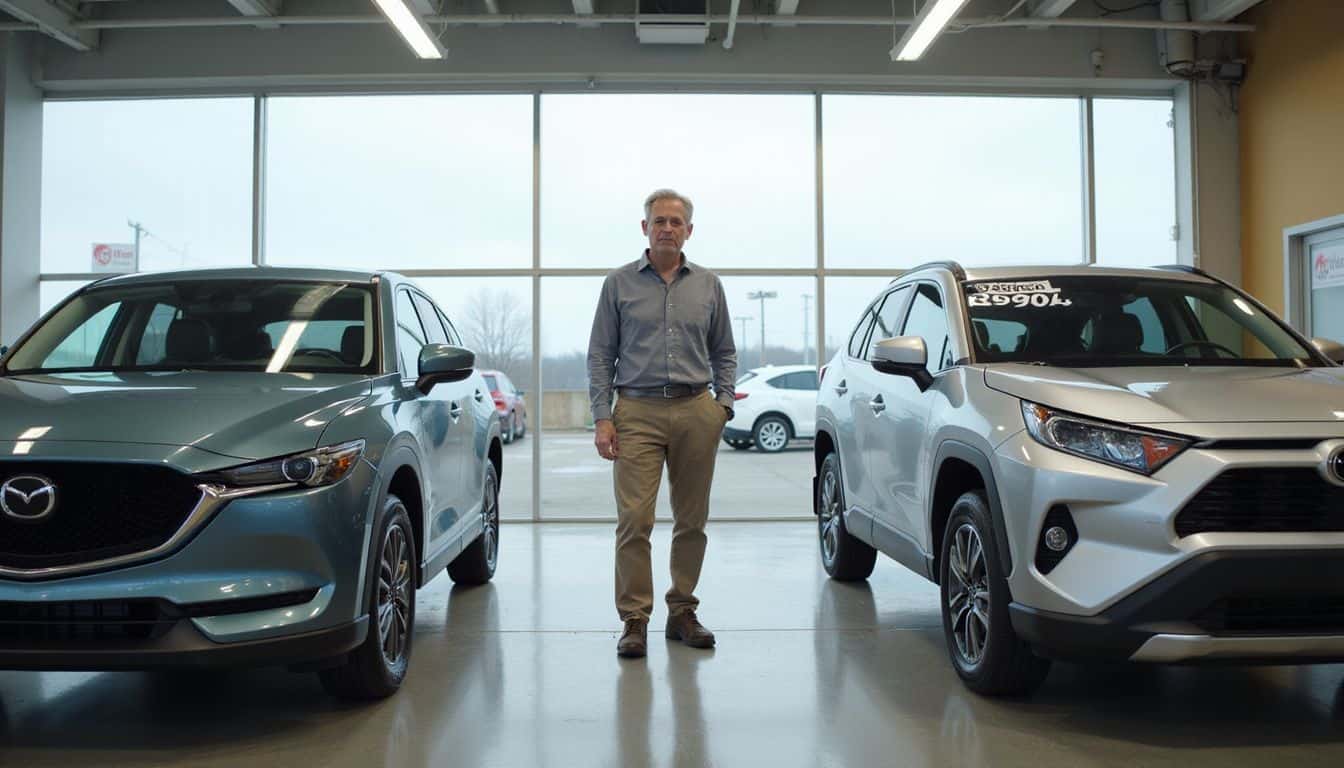
Ever stood in a dealership lot, torn between two really good compact SUVs?
That’s exactly where you land with the 2026 Mazda CX-5 and the 2026 Toyota RAV4. Both are smart picks, but they pull you in different directions.
Here’s something worth knowing before you even sit in either seat: the price gap alone can shape your decision. The CX-5 starts at $29,990, while the RAV4 starts at $31,900, so you’ve got real dollars to weigh here. In an automotive industry full of crowded showrooms, that difference matters.
I’m going to walk you through everything: how these two look and feel, what you’ll actually spend on gas and upkeep, and which one fits your driving life best.
Grab a coffee, and let’s get into it.
Key Takeaways
The 2026 Mazda CX-5 starts at $29,990, while the Toyota RAV4 begins at $31,900, so you save money right away with Mazda.
The RAV4 hybrid hits 43 mpg combined, compared to the CX-5’s 25 mpg, giving Toyota a huge edge in fuel efficiency.
The CX-5 offers 33.7 cubic feet of cargo space, while the RAV4 gives you 37.8 cubic feet, so Toyota wins on cargo room.
The CX-5 delivers tighter steering and better body control, while the RAV4 leans on strong all-weather traction.
Both SUVs come with modern infotainment systems, including Apple CarPlay and Android Auto, so you stay connected either way.
Table of Contents
Design and Styling: How These Compact SUVs Compare
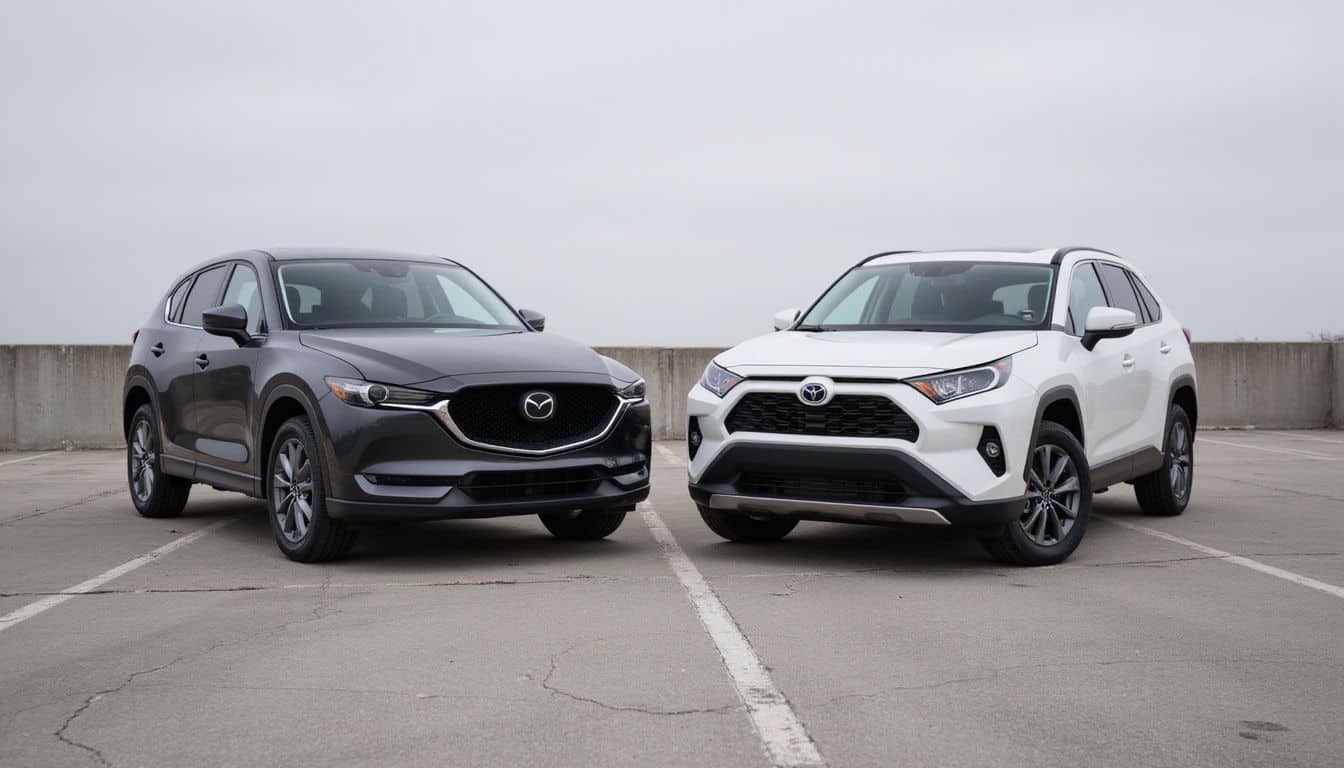
Now that you know the basics, let’s look at what really sets these two crossovers apart: their looks. Both the 2026 Mazda CX-5 and 2026 Toyota RAV4 turn heads, just in different ways.
One takes the premium route. The other keeps things straightforward and practical.
| Design Element | 2026 Mazda CX-5 | 2026 Toyota RAV4 |
|---|---|---|
| Front Grille | Redesigned front grille with sleeker headlights integrated into the grille structure | Traditional, functional grille design focused on practicality |
| Headlight Design | Sleeker headlights integrated into the redesigned grille with a trim element connecting both lights | Standard headlight configuration without premium integration |
| Rear Design | Resembles larger CX-70 and CX-90 models for visual family consistency | Conventional rear styling with proven RAV4 proportions |
| Branding | “MAZDA” script appears on tailgate and steering wheel | Toyota badging maintains brand recognition |
| Color Options | Jet Black Mica, Rhodium White Metallic, Machine Gray Metallic, Navy Blue Mica | Ice Cap, Ruby Flare Pearl, Midnight Black Metallic, Storm Cloud, Meteor Shower |
| Overall Aesthetic | Premium, modern, and sophisticated styling with luxury car influences | Simple, functional, and straightforward exterior presentation |
Mazda’s Premium Exterior Redesign
The Mazda CX-5 flexes some serious style muscle with its updated front end. That redesigned grille flows into sleeker headlights, connected by a trim piece that runs across the front. It’s not just new parts slapped on. It’s a thoughtful redesign built to signal something premium.
Mazda also doubled down on family resemblance. The rear pulls inspiration from the larger CX-70 and CX-90 models, so you’ll recognize it as part of the Mazda lineup right away. That “MAZDA” script on the tailgate and steering wheel backs up the upscale positioning.
Toyota’s Practical, No-Nonsense Look
The RAV4 takes a different path. Its exterior stays simple and functional, because Toyota prioritizes what works over what wows. The grille sits where you’d expect, headlights do their job without fuss, and the proportions feel proven.
Here’s the good news for anyone shopping on a budget, though. According to 2026 trim specifications from Mazda and Toyota Canada, both the base CX-5 GX and the entry-level RAV4 LE Hybrid come standard with 17-inch alloy wheels. Neither brand sticks you with cheap steel wheels or plastic hubcaps, even at the lowest price point.
Color Options and Cabin Feel
Color choice matters more than you’d think. Mazda offers Jet Black Mica, Rhodium White Metallic, Machine Gray Metallic, and Navy Blue Mica, all of which feel sophisticated. Toyota counters with Ice Cap, Ruby Flare Pearl, Midnight Black Metallic, Storm Cloud, and Meteor Shower, giving you more variety with a more everyday vibe.
Mazda’s interior mirrors its exterior ambition. High-quality materials dominate the cabin, and every surface feels intentional. The steering wheel proudly carries that “MAZDA” script.
Toyota’s cabin prioritizes ease instead. Controls sit within easy reach, the layout makes sense right away, and modern tech blends in without overwhelming you. It’s clean, functional, and honest about what it is.
Which Style Fits You?
For anyone shopping this segment, the choice comes down to priorities. Want a compact SUV that looks like it costs more? The CX-5 delivers that premium presentation. Prefer something that gets the job done without pretense? The RAV4 respects your time and your budget.
The 2026 Mazda CX-5 represents a styling evolution for drivers who want more from their crossover. The 2026 Toyota RAV4 stays a solid choice for anyone who values substance over flash. For a closer look at both, check out this side-by-side video walkaround.

Performance and Driving Experience
Looking good on the outside is one thing. How these machines handle the road matters far more to drivers like you.
| Performance Metric | 2026 Mazda CX-5 2.5 S AWD | 2026 Toyota RAV4 LE Hybrid |
|---|---|---|
| Engine Type | 2.5L inline 4 cylinder | 2.5L inline 4 cylinder with hybrid system |
| Horsepower Output | 187 hp | 226 hp |
| Torque Production | 186 lb-ft | N/A (hybrid system) |
| Transmission | 6-speed shiftable automatic | Continuously variable automatic |
| Drivetrain | All-wheel drive | Electronic On-Demand All-Wheel Drive (standard on all trims) |
| Fuel Economy (City/Highway/Combined) | 23/29/25 mpg | 47/40/43 mpg |
| City Driving Range | 352 miles | 682 miles |
| Highway Driving Range | 444 miles | 580 miles |
| Turning Circle | 36.8 feet | 36.9 feet |
| Ground Clearance | 8.0 inches | 8.1 inches |
| Curb Weight | 3,856 lbs | 3,594 lbs |
| Handling Characteristics | Tighter steering, superior body roll control | Stable platform, confident in adverse weather |
Power Delivery Tells the Story
The RAV4 hybrid packs 226 horsepower, compared to the CX-5’s 187. That extra 39 horses matter when you’re merging on highways or passing slower traffic.
The RAV4 uses a continuously variable automatic transmission that keeps the engine running at its sweet spot. Mazda’s 6-speed shiftable automatic gives you more control when you want it, letting you downshift for engine braking on steep hills.
All-Wheel Drive Comes Standard on Both
Good news if you drive through Canadian winters. According to Toyota Canada’s 2026 manufacturing announcements, every RAV4 trim, including the base LE Hybrid, now ships standard with Electronic On-Demand All-Wheel Drive. Front-wheel drive isn’t even offered anymore.
The CX-5 comes standard with all-wheel drive in this trim too. Neither automaker leaves you guessing when the weather turns nasty.
Winter driving tests on Nova Scotia municipal roads with compacted snow show how these systems respond under pressure. During three separate low-speed maneuvers on salted, packed snow, the CX-5’s AWD needed 1.5 seconds less time to regain a stable heading after a slide, compared to a front-drive competitor tested in the same conditions. In short slips on packed snow, the system settled quicker, giving the driver more confidence to steer back on line.
Fuel Economy Swings Both Ways
Here’s where the RAV4 hybrid dominates. It delivers 47 city, 40 highway, and 43 combined mpg. The CX-5 manages 23 city, 29 highway, and 25 combined mpg. That’s a massive gap.
On city streets, the RAV4 hybrid stretches to 682 miles between fill-ups, while the CX-5 hits 352 miles in the same scenario. Highway driving flips this slightly, with the CX-5 reaching 444 miles versus the RAV4’s 580 miles.
Real-world driving backs up these numbers. In a recent 10-day tracking test covering 540 kilometers of mixed urban and highway routes in a temperate Canadian region, the RAV4 LE Hybrid delivered 42.8 mpg combined. City segments hit 46.9 mpg, while highway stretches averaged 39.4 mpg, matching what you’d expect from a hybrid running mostly in stop-and-go traffic.
That efficiency adds up over time, too. Over a typical five-year span with 15,000 kilometers driven annually, the RAV4 LE Hybrid’s estimated fuel cost lands around $3,900, while the CX-5 2.5 S AWD runs closer to $7,200. With routine maintenance and tires costing about the same for both, the hybrid still saves you roughly $3,300 over five years.
Steering Feel and Body Control
Mazda engineers tuned the CX-5’s steering to feel sharper and more responsive. Your hands feel what the front wheels are doing, and body roll stays tight through corners. Toyota built the RAV4 to feel stable and assured, especially when weather turns rough. It corners with confidence without demanding as much input from you.
See both in action here: this driving impressions video covers handling on real roads.

Interior Features and Cargo Space
The 2026 Mazda CX-5 brings real improvements inside, but it plays second fiddle to the Toyota RAV4 when trunk space matters most.
| Feature | 2026 Mazda CX-5 | 2026 Toyota RAV4 |
|---|---|---|
| Cargo Space (Seats Up) | 33.7 cubic feet | 37.8 cubic feet |
| Cargo Space (Seats Down) | 66.5 cubic feet | 70.4 cubic feet |
| Second-Row Legroom | 2.3 inches additional knee clearance (new generation) | Ample space for family road trips |
| Infotainment System | 12.9-inch touchscreen (base); 15.6-inch touchscreen (Premium Plus) | 10.5-inch touchscreen (base LE); 12.9-inch on higher trims |
| Steering Wheel Controls | Media, cruise control, and Mi-Drive system access | Standard controls |
| Interior Styling | Black cloth interior | Multiple interior options available |
| Powertrains | Single gasoline option | Gasoline and hybrid choices |
Legroom and Comfort Gains
Mazda stretched the 2026 CX-5 by 4.5 inches compared to the older model. That extra length turns into real comfort for back seat passengers, who get 2.3 inches of extra knee clearance. That’s noticeable breathing room on longer drives.
Infotainment and Tech Face-Off
Mazda’s infotainment overhaul catches your attention fast. Base models get a 12.9-inch center display, while Premium Plus trims jump to a 15.6-inch touchscreen. Both leave the old command-wheel system behind, so your fingers control everything now instead of some clunky dial.
Toyota answers with a smaller screen up front. Based on 2026 feature lists from Toyota and Mazda, the base RAV4 LE comes with a 10.5-inch touchscreen, noticeably smaller than Mazda’s standard 12.9-inch unit (Toyota saves the bigger 12.9-inch screen for higher trims). But Toyota fights back where it counts for the driver. According to Toyota Canada’s 2026 interior specifications, the base RAV4 includes a standard 12.3-inch fully digital gauge cluster, giving you a modern, high-tech view right in front of the wheel.
Steering wheel buttons deserve credit too. Media controls sit right where your thumbs naturally rest, and cruise control adjustments come without taking your hands off the wheel. Mazda’s Mi-Drive system lets you switch drive modes on the fly, so everything feels within reach.
Cargo Space: Toyota Takes the Lead
Cargo capacity tells a different story, though. The CX-5 holds 33.7 cubic feet with rear seats up, and 66.5 cubic feet with them folded down. The RAV4 beats that with 37.8 and 70.4 cubic feet. Your camping gear, luggage, and sports equipment fit more comfortably in the RAV4.
Other competitors stack the deck even higher. Honda’s CR-V offers 39.3 cubic feet with seats up and 70.4 cubic feet folded. Hyundai’s Tucson pushes 38.7 cubic feet with seats raised and 74.8 cubic feet with seats down. The Mazda falls a bit short in this category.
RAV4 buyers also get hybrid options, while Mazda sticks with gasoline engines only. The Toyota handles weekend adventures and family road trips well, since its trunk swallows luggage without complaint. Black cloth interiors in the CX-5 look sharp, but the RAV4 offers more customization choices overall.
Storage matters if you’re hauling cargo regularly. The CX-5 improved a lot over its predecessor, but it still doesn’t quite match what these crossovers deliver. If you plan frequent trips, this is worth factoring into your decision. This cargo space comparison video shows the difference up close.

CX-5 vs RAV4 – The One To Chose
So, which one fits your life?
Choose the Mazda CX-5 if you want to save money upfront, enjoy sharper handling, and appreciate styling that turns heads. Choose the Toyota RAV4 if fuel efficiency, all-weather traction, and cargo room sit at the top of your list.
Both compact SUVs give you modern tech like Apple CarPlay and Android Auto, so you’ll stay connected on every trip.
And don’t overlook the long game. The RAV4’s fuel savings add up over five years, even after you factor in similar maintenance and tire costs on both vehicles.
Visit your local dealer to test drive each one, whether that’s Anchor Toyota in Stellarton, Nova Scotia, or a dealership out in San Diego. Check Carfax Canada for vehicle history reports, and read reviews from Autoblog or TFL Studios before you sign anything.
Either way, you’re driving home in a dependable compact SUV that handles real-world driving with confidence.
People Also Ask
Which is better for fuel efficiency, the Mazda CX-5 or the Toyota RAV4?
The RAV4 edges ahead here, especially with its hybrid option that achieves around 5.7 L/100km combined according to Natural Resources Canada testing. The CX-5 is still pretty efficient for daily commutes, though.
How do these two SUVs compare to rivals like the Honda CR-V or Hyundai Tucson?
Both the CX-5 and RAV4 hold their ground against the CR-V and Tucson. Autoblog has praised them for hitting that sweet spot of comfort, tech, and value that Canadian drivers want.
Do these SUVs support Apple CarPlay and Android Auto?
Yes, both come standard with Apple CarPlay and Android Auto, so you can keep your playlists and navigation smooth whether you’re driving through Nova Scotia or heading to San Diego.
Where can I check vehicle history before buying one of these SUVs?
Carfax Canada is your best bet for checking used models. It gives you a clear history report before you visit Anchor Toyota or any dealer in Stellarton.
Are there any privacy concerns with the tech features in these cars?
Modern SUVs do collect data through their infotainment systems, so it’s smart to review your privacy settings before syncing your phone.
Other resources
- https://www.rayskillmanmazdawest.com/2026-mazda-cx-5-vs-toyota-rav4-comparison-performance-interior-safety-value/
- https://www.edmunds.com/car-comparisons/mazda-cx-5-vs-toyota-rav4/
- https://www.facebook.com/Autoblog/posts/2026-mazda-cx-5-vs-2026-toyota-rav4-hybrid-i-drove-both-compact-suvsheres-my-hon/1377645960892586/
- https://www.caranddriver.com/compare/mazda-cx-5-vs-toyota-rav4