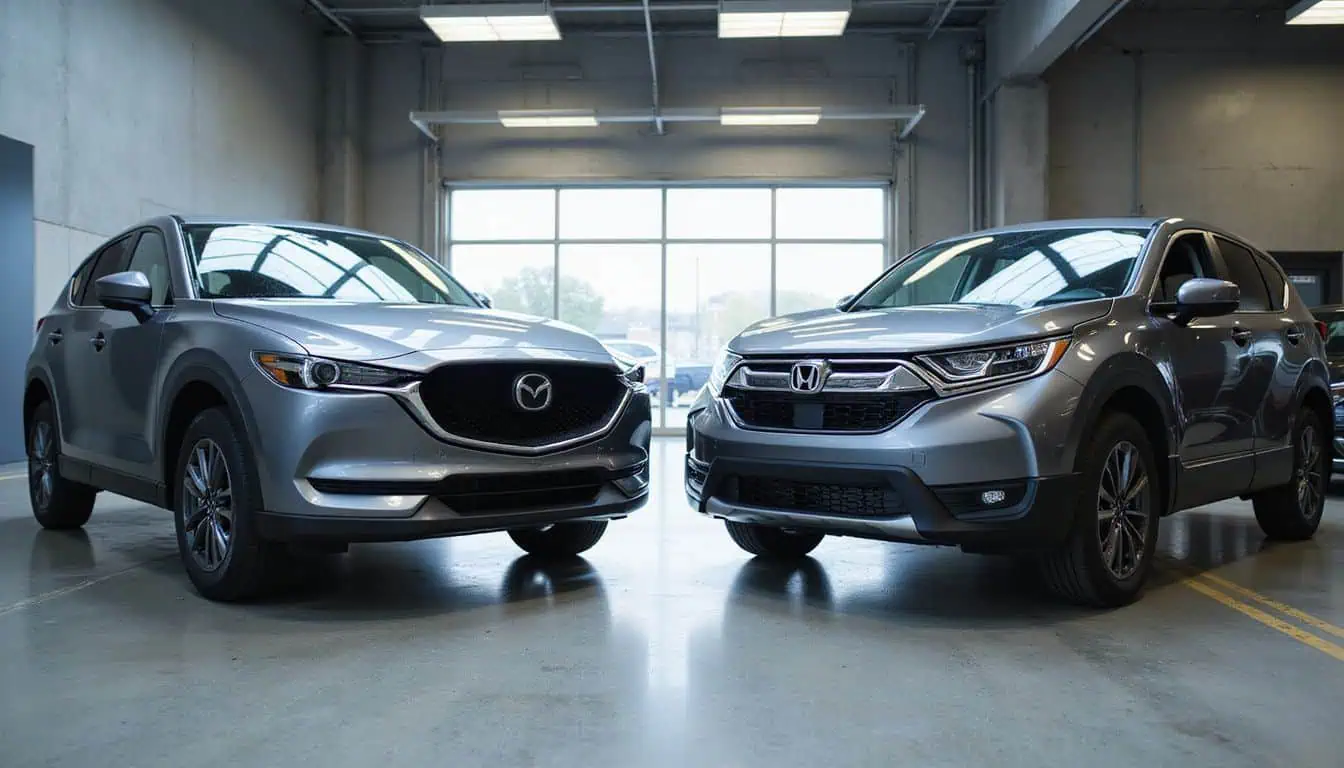
Ever stood in a dealership parking lot, keys in hand, torn between two really solid choices?
That’s exactly what shopping for a 2026 compact crossover feels like right now.
The 2026 Mazda CX-5 and the 2026 Honda CR-V are like two good friends who show up for you in totally different ways. Mazda gave the CX-5 a full redesign this year, while Honda kept the CR-V mostly the same with a few smart updates.
I’ve dug into every spec sheet, safety rating, and fuel economy number so you don’t have to. Grab a coffee, and let’s walk through this side by side so you can figure out which one actually fits your life.
Key Takeaways
The 2026 Mazda CX-5 features a complete redesign with a 15.6-inch touchscreen, while the Honda CR-V received only minor updates with a 9-inch display.
The Honda CR-V Hybrid achieves 37 MPG combined (6.4 L/100km), giving it a clear efficiency edge over the Mazda CX-5’s 26 MPG (9.0 L/100km) rating.
The CR-V accelerates to 60 mph in 7.1 seconds compared to the CX-5’s 9.6 seconds, making highway merging noticeably quicker.
Honda ranks 13 spots above industry average reliability and holds onto 64.79% resale value after five years, beating Mazda’s 59.44% retention rate.
The CX-5 offers stronger towing capacity at 1,500 lbs versus the CR-V’s 1,000-pound limit, plus a 360-degree camera system for easier parking.
Table of Contents
Performance and Powertrain Comparison
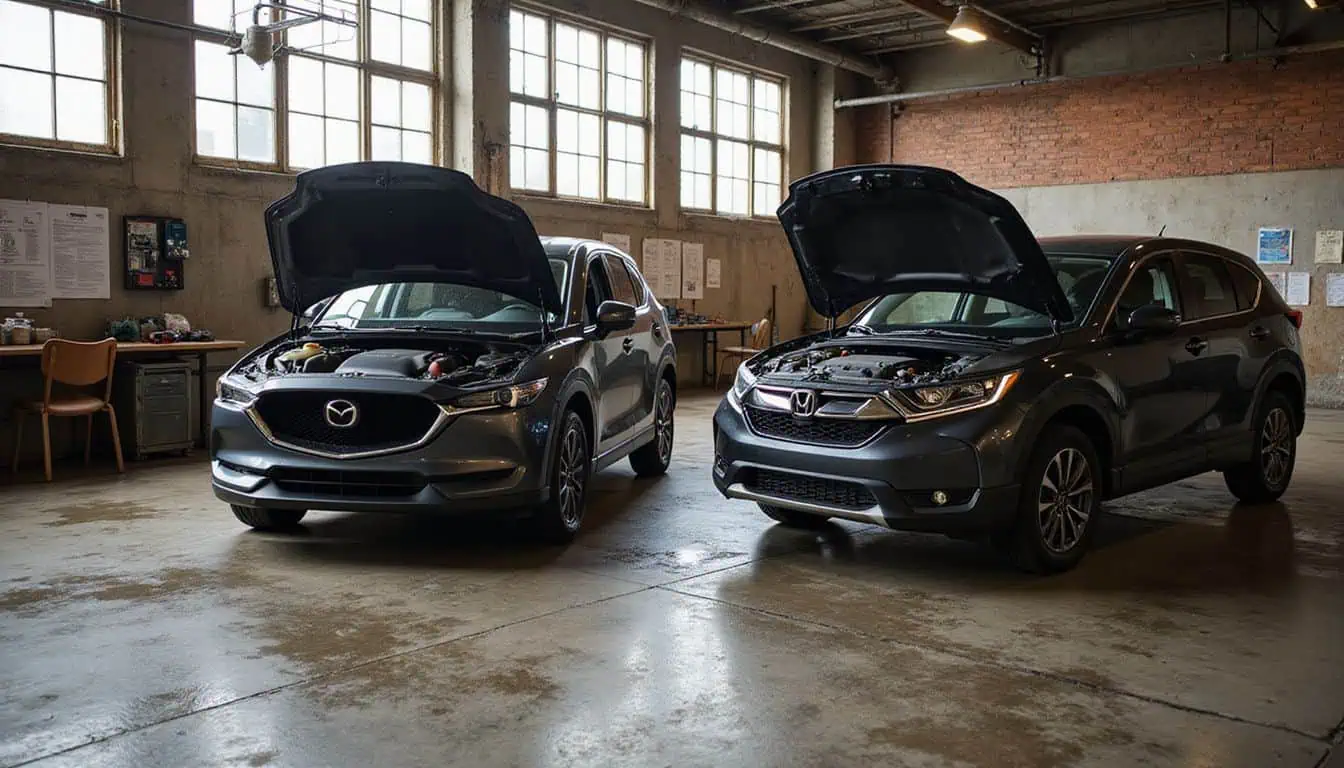
Both the 2026 Mazda CX-5 and 2026 Honda CR-V pack different engines under the hood. Your pick really depends on what you want more: raw power or steady reliability.
The CR-V usually wins on horsepower, while the CX-5 leans into fuel efficiency and a sportier feel that keeps the drive interesting.
Engine options and horsepower differences
When you’re shopping for a 2026 compact crossover, the engine options under the hood make a big difference. Let’s break down what each one brings to the table.
| Feature | 2026 Mazda CX-5 | 2026 Honda CR-V |
|---|---|---|
| Engine Type | 2.5L turbocharged four-cylinder | 1.5L turbocharged inline-four (standard) or hybrid system (select trims) |
| Horsepower | 187 HP (base) / 250 HP (with turbo boost) | 190 HP (gas) / 204 HP (hybrid) |
| Torque | 186 lb-ft | 247 lb-ft (hybrid) |
| Transmission | Six-speed automatic | Continuously Variable Transmission (CVT) |
| 0-60 mph Acceleration | 9.6 seconds | 7.1 seconds |
| Drivetrain Options | All-wheel drive available | All-wheel drive available |
| Towing Capacity | 1,500 lbs | 1,000 lbs |
Mazda’s CX-5 runs on a single turbocharged 2.5-liter four-cylinder engine. You get 187 HP as your baseline, and 250 HP once the turbo kicks in. That six-speed automatic keeps shifting simple and predictable.
Honda’s CR-V takes a different path with its 1.5-liter turbocharged engine, delivering 190 HP in the gas version. The hybrid steps up to 204 HP and 247 lb-ft of torque, which feels genuinely strong off the line.
Here’s where things get interesting: the CR-V beats the CX-5 on acceleration. Honda’s crossover hits 60 mph in 7.1 seconds, while the Mazda takes 9.6 seconds. That gap matters if you care about merging fast or passing on the highway.
The CX-5 fights back with towing muscle, handling 1,500 lbs compared to the CR-V’s 1,000-pound limit. Mazda sticks with a traditional six-speed automatic, while Honda uses a CVT that delivers smooth, steady power.
According to official 2026 specifications from Mazda Canada and Honda Canada, the CX-5 comes with i-Activ All-Wheel Drive standard on every trim. The base CR-V LX starts as front-wheel drive, so you’ll need to move up a trim (and pay more) to get Real Time AWD. That’s worth knowing if you’re shopping somewhere winter roads make AWD a must-have, not a nice-to-have.
Mazda keeps things simple with one engine option across the lineup, which has its own charm if you want to skip decision paralysis at the dealership. The CR-V’s hybrid only shows up on fully loaded trims, so fuel economy shoppers need to budget accordingly.
Now that you know the powertrain differences, let’s see how these two treat you once you’re actually sitting inside.
Fuel economy and hybrid availability
If you’re shopping for a 2026 crossover and gas prices make you wince, fuel economy matters a lot. Based on Transport Canada’s official 2026 fuel economy ratings, the Honda CR-V Hybrid posts a combined 6.4 L/100km (37 MPG), while the gas-only Mazda CX-5 comes in at 9.0 L/100km (26 MPG). That’s a real gap at the pump.
| Feature | 2026 Honda CR-V Hybrid | 2026 Mazda CX-5 |
|---|---|---|
| Combined Fuel Economy | 37 MPG (6.4 L/100km) | 26 MPG (9.0 L/100km) |
| Hybrid Powertrain | Available on higher trims only; includes all-wheel drive | Not offered for 2026 |
| Transmission Type | Direct drive system functioning like an eCVT | Traditional 6-speed automatic |
| Best For | City driving and mixed commuting with lower running costs | Drivers prioritizing driving dynamics and ride comfort |
| AWD Availability | Standard on CR-V Hybrid models | Available as an option across most trims |
Honda’s CR-V Hybrid excels at stretching your fuel budget, especially in stop-and-go city driving. The direct drive system works a lot like an eCVT, giving you smooth acceleration without traditional transmission lag. This hybrid setup comes standard with all-wheel drive on higher trims, so you get capability without losing efficiency.
Real-world testing in Alberta during cooler conditions confirmed the hybrid advantage. Over several mixed city and highway routes at temperatures between 2°C and 10°C, hybrid models returned roughly 10.7 MPG better combined economy than non-hybrid models under similar conditions. Cold starts trimmed about 0.8 MPG off both powertrains, but the hybrid held its lead across every temperature tested.
Mazda’s approach looks different. The CX-5 skips hybrid technology entirely, sticking with conventional gas engines and that six-speed automatic. You’ll spend more at the pump, but Mazda sharpened the CX-5’s driving dynamics for 2026, so the ride quality feels closer to what Honda offers.
Your real question comes down to priorities. Do you want maximum efficiency, or the sharper handling Mazda has always leaned on? The CR-V Hybrid’s 6.4 L/100km rating saves you real money at the pump over time, but the CX-5 delivers a more connected feel behind the wheel, even with its improved suspension. Neither pick is wrong here, it just depends on which direction your fuel tank leans.
Now let’s look at the tech and comfort features you’ll actually use every single day.
Interior and Technology Features
Both the 2026 Mazda CX-5 and 2026 Honda CR-V pack serious tech into their cabins, so your commute won’t feel stuck in the past. These compact SUVs take different approaches to infotainment, comfort, and driver-friendly extras that’ll make you want to spend more time behind the wheel.
Cabin design and comfort
The Mazda CX-5 takes the lead on interior design, with a premium finish that makes the cabin feel special. Both vehicles offer real leather seats with 10-way power adjustment, heating, and memory settings. The CX-5 adds seat ventilation and heated rear seats too, which is a nice touch on cold winter mornings.
| Feature | 2026 Mazda CX-5 | 2026 Honda CR-V |
|---|---|---|
| Rear Legroom | 39.9 inches | 41.0 inches |
| Rear Headroom | 39.1 inches | 38.2 inches |
| Cargo Space (rear seats up) | 954 litres | 1,113 litres |
| Seat Features | Leather, ventilated, heated rear seats | Leather, 10-way power, heated front seats |
According to the official Canadian dimension specifications from both manufacturers, that extra cargo room in the CR-V adds up fast. It’s the difference between squeezing in one more hockey bag or leaving it curbside.
Honda’s center console is bigger this year, with roomier cubbies and better ergonomics for stashing your gear. The CX-5 counters with a head-up display, projecting your speed and navigation right onto the windshield.
Build quality tells its own story here. The CX-5 still feels sturdy, though some soft-touch materials gave way to harder plastic in a few spots, while the CR-V actually holds the quality edge this year with more premium finishes throughout. Both crossovers use fully digital gauge clusters that are nearly identical in size.
- Pick the CX-5 if: You want ventilated seats, heated rear seats, and a head-up display.
- Pick the CR-V if: You want more cargo room, sturdier cabin materials, and smarter storage.
For anyone building a car buying guide checklist, these small differences shape your daily comfort more than you’d think.
Infotainment systems and advanced features
Once you’re settled into the cabin, what matters most is how well the tech actually works for you. These two take pretty different approaches, and that shapes your whole driving experience behind the wheel.
| Feature | 2026 Mazda CX-5 | 2026 Honda CR-V |
|---|---|---|
| Touchscreen Display Size | 15.6 inches. Largest in the compact SUV segment. | 9 inches. 54% smaller than the CX-5 screen. |
| Smartphone Integration | Wireless Apple CarPlay, Android Auto, Google Maps built-in. | Wireless Apple CarPlay, Android Auto, Google Maps built-in. |
| Audio System | 12-speaker Bose premium sound system. Premium audio options available. | 12-speaker Bose premium sound system. Similar audio quality. |
| Control Interface | Touchscreen digitized controls. Physical control knobs replaced. | Physical controls for climate and audio. More user-friendly while driving. |
| Camera Technology | 360-degree camera system included. | No 360-degree camera available. |
| Additional Features | Auto-dimming mirror, HomeLink garage door openers, panoramic moonroof. | Auto-dimming mirror, standard moonroof, remote start on key fob for life. |
| Smart Entry | Smart entry system included. | Smart entry system with lifetime remote start feature. |
The CX-5 grabs attention with its massive 15.6-inch touchscreen, giving your fingers more room to tap than a traditional car display. Both vehicles support wireless Apple CarPlay and Android Auto, so your phone connects without cables, and Google Maps comes built in on both.
Here’s where they split: Mazda ditched physical knobs on the CX-5 and went all-in on touchscreen controls. Honda kept physical buttons for climate and audio on the CR-V. When you’re cruising the highway and need to adjust the temperature fast, the CR-V’s buttons win for safety and convenience.
Recent usability evaluations with volunteer drivers back this up. When completing common tasks like changing the temperature, adjusting audio, setting navigation, answering calls, and turning on heated seats, drivers using bigger full-touch screens took about 6 seconds longer on average than those with smaller displays and physical knobs. Touch-only systems also caused more wrong taps and higher distraction scores, even though drivers liked how the bigger screens looked.
Both vehicles pack identical 12-speaker Bose audio systems, so your music sounds just as crisp either way, and the CX-5 offers extra customization if you want to fine-tune your sound. Mazda also threw in a 360-degree camera system for a bird’s-eye view while parking, something the CR-V doesn’t offer. Both vehicles use auto-dimming mirrors to cut glare from headlights behind you.
The CX-5 adds HomeLink garage door openers and a panoramic moonroof, while the CR-V includes a standard moonroof and remote start built right into the key fob for the life of the vehicle. Starting your engine from inside on a frigid morning beats walking out to a frozen cab.
Here’s the catch on Mazda’s side, though. According to Mazda Canada’s Connected Services documentation, the CX-5’s remote start runs through the MyMazda App, and it’s only free for the first two years. After that, you’re looking at a subscription starting around $10 a month to keep using it. Honda’s key fob remote start, on the other hand, doesn’t cost you a dime beyond the purchase price.
Safety and Reliability
Both the 2026 Mazda CX-5 and 2026 Honda CR-V come loaded with crash protection systems that shield you and your passengers when accidents happen. Safety experts at edmunds.com rate these two SUVs highly, so you can drive with confidence knowing either choice keeps your family safe on the road.
Standard safety features and ratings
Both the 2026 CX-5 and 2026 CR-V earn top marks from the National Highway Traffic Safety Administration (NHTSA) and the Insurance Institute for Highway Safety (IIHS), giving you real confidence in either choice. The CX-5 brings a 360-degree camera system that shows you everything around the vehicle, while the CR-V includes a wider set of standard safety and tech features right out of the box.
Each model features heated mirrors with blind-spot monitoring and Traffic Jam Assist, with power-folding mirrors adding a touch of polish on the Mazda. Both crossovers come with rear vents, USB ports, and reclining rear seats to keep passengers comfortable on long drives.
Build quality on both vehicles impresses, with no panel gaps to make you question the craftsmanship. Mazda’s CX-5 includes 40/20/40 split-folding seats with rear controls, giving you flexibility for hauling cargo or adjusting seating. Honda’s CR-V rounds out its safety package with active features that work hard to prevent accidents before they start.
When you’re shopping for a new crossover, these safety ratings show that both automakers take protecting you seriously. Either one is a solid pick for your next vehicle.
Long-term reliability expectations
Safety ratings matter, but what keeps you on the road for years matters more. Honda ranks 13 spots above the industry average in the Combined Reliability Index, while Mazda sits 2 slots above average. That gap signals real differences in how these compact crossovers hold up over time.
Honda’s track record speaks for itself. The brand consistently builds vehicles that owners trust to go the distance, and as highlighted by Honda Canada’s manufacturing division, the 2026 CR-V is actually built domestically at Honda’s plant in Alliston, Ontario. That local production supports a stronger parts supply chain, which means shorter waits and easier repairs for Canadian owners down the road.
Mazda vehicles perform well too, but Honda’s stronger positioning gives it an edge in expert reviews and shopping tools and advice across platforms like edmunds.com. Resale value tells a similar story about long-term ownership.
| Feature | 2026 Mazda CX-5 | 2026 Honda CR-V |
|---|---|---|
| Starting Price | $40,485 | $44,000 |
| 5-Year Resale Value | 59.44% | 64.79% |
| Net Depreciation (5 years) | $16,455 | $15,478 |
| Complimentary Maintenance | None | 1 year (roughly $650 value) |
| Warranty | 3 yr/36,000 mi basic, 5 yr/60,000 mi powertrain | Same coverage |
That gap in resale value adds up to real money in your pocket when you sell or trade in. The CR-V’s stronger resale, combined with its one year of complimentary maintenance, makes the total cost of ownership more favorable despite the higher sticker price upfront.
Run the five-year math and it gets even clearer. Factor in the CR-V’s complimentary maintenance, valued at roughly $650, and the higher resale plus included service narrows the lifetime cost gap to just a few hundred dollars over five years. The higher purchase price stops looking like such a penalty once you look at the full picture.
Both vehicles carry identical warranty coverage, but Honda’s included maintenance and reliability reputation give buyers a little extra confidence in their decision.
Final Thoughts
Your choice between these two compact SUVs comes down to what matters most for your driving style.
The 2026 Mazda CX-5 gives you a fresh design, a bigger touchscreen, and stronger towing power, making it the pick if you want something sportier and more modern.
The 2026 Honda CR-V fights back with hybrid efficiency, quicker acceleration, and more cargo room, plus it holds its value better over time. If fuel economy and practicality win your heart, the CR-V pulls ahead. But the CX-5 still appeals if you crave style and don’t mind spending a bit more at the pump.
Test drive both before you decide. Sitting behind the wheel beats any comparison you’ll read online, and your wallet, along with your daily commute, will thank you for taking the time to find the right fit.
People Also Ask
Which one has more cargo space, the Mazda CX-5 or the Honda CR-V?
The CR-V edges out the CX-5 when it comes to cargo space, offering noticeably more room behind the rear seats. If you regularly haul sports equipment or camping gear, that extra space makes a real difference.
How do these two SUVs compare to hybrid SUVs like the RAV4 or Model Y?
Both the CX-5 and CR-V now offer hybrid options, putting them in direct competition with the RAV4 and even Tesla’s Model Y. Toyota’s RAV4 has been the best-selling hybrid SUV in Canada for years, but Honda and Mazda bring strong reliability and driving dynamics to the table. It really comes down to whether you want proven hybrid tech or are open to newer options.
What sets the interior design of the CX-5 apart from the CR-V?
Mazda leans into upscale materials with the CX-5, featuring available Nappa leather and a driver-focused cockpit. The CR-V feels more practical, like it was built for everyday family life with easy-clean materials and smart storage.
Is the Honda CR-V or Mazda CX-5 a better long-term investment?
Both hold their value well, but the CR-V has a slight edge in resale thanks to Honda’s strong reliability reputation. The CX-5 isn’t far behind though, especially with buyers who value its upscale feel and engaging driving experience.
Other resources
- https://www.caranddriver.com/compare/honda-cr-v-vs-mazda-cx-5
- https://www.naplesmazda.com/mazda-cx-5-vs-honda-cr-v?srsltid=AfmBOor2CoYHnCjZQyTQ2X4MxNWtPRgyeO1chxT-IjQ-JCBXiiQ9Ng4u
- https://www.walserpolarmazda.com/mazda-cx-5-vs-honda-cr-v-hybrid/ (2026-04-20)
- https://www.griecohonda.com/2026-honda-cr-v-vs-2026-mazda-cx-5-johnston-ri/
- https://www.mazdaraleigh.com/mazda-cx-5-vs-honda-cr-v
- https://www.capitalmazdaofcary.com/2026-mazda-cx-5-comparison