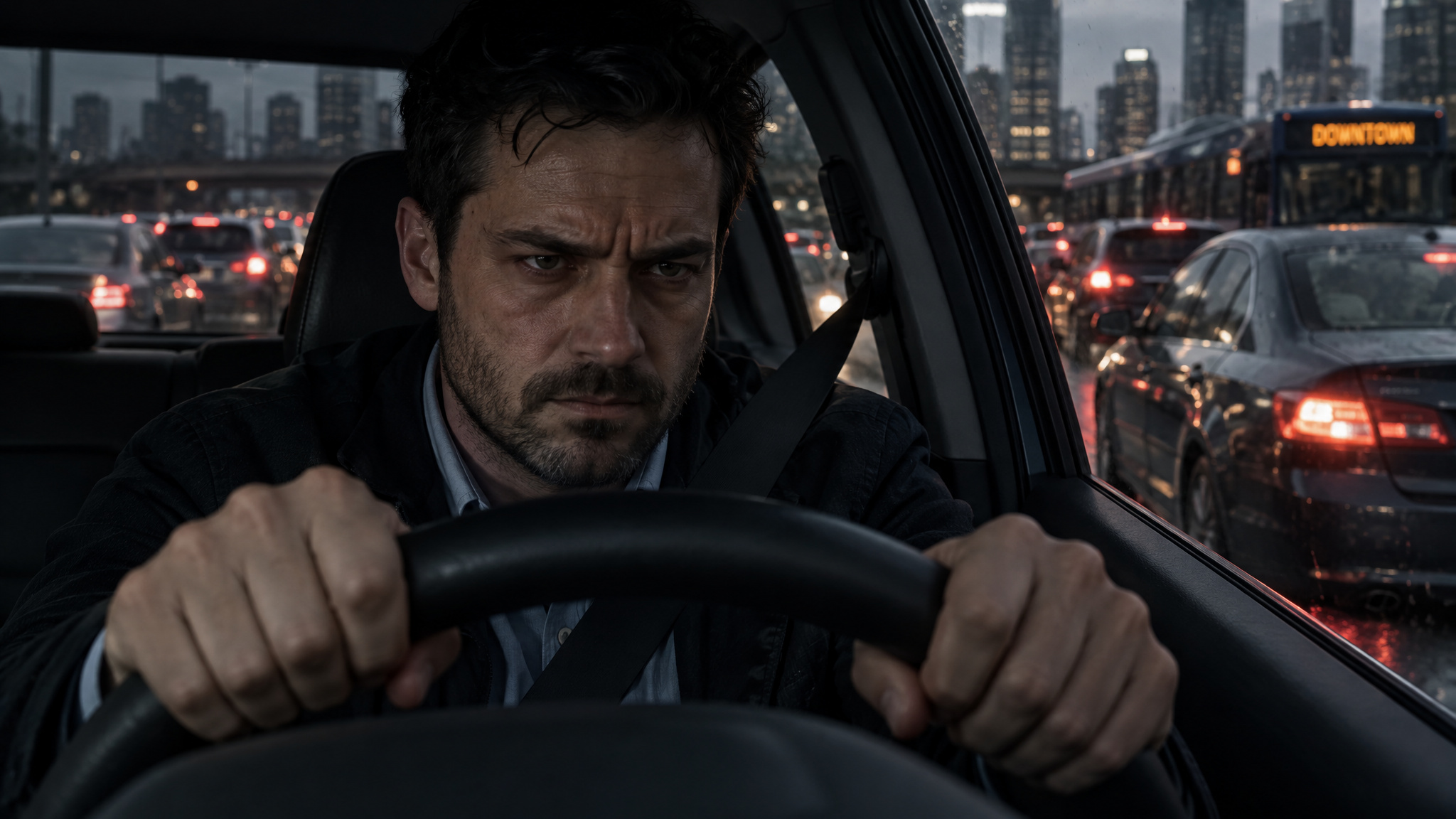
Getting annoyed when someone cuts you off without a blinker or traffic grinds to a halt while you’re already running late is normal whether you’ve had your license for a month or twenty years, and keeping that frustration from turning into road rage comes down to breaking the reaction loop before an impatient horn tap draws an obscene gesture. Left unchecked, ordinary irritation grows into an extreme emotional reaction that triggers hostile or violent decisions. We already broke down why driving anger happens in our psychology of road rage coverage, so this companion playbook focuses entirely on what to do before you start the engine, in traffic, and when another driver targets you.
Key Takeaways
Aggressive driving plays a role in up to 56% of fatal crashes according to the AAA Foundation for Traffic Safety, whose seven-year study of more than 10,000 road rage incidents documented at least 218 murders and over 12,000 injuries.
When an aggressive motorist targets you, the Fort Worth Police Department advises avoiding eye contact, never brake-checking or flashing your brights, letting the car pass, and driving to a police station or hospital rather than home if you’re followed.
To document incidents for law enforcement, police recommend a front-and-rear dash camera with at least 1080p resolution, GPS, and a timestamp, alongside reporting the vehicle description, license plate, time, and location to 911 for active threats or a local non-emergency line afterward.
Table of Contents
Aggressive driving vs. road rage: where the line is
Aggressive driving and road rage carry lethal stakes: AAA Foundation for Traffic Safety research shows aggressive driving behaviors play a role in up to 56% of fatal crashes, and a seven-year AAA Foundation study of more than 10,000 road rage incidents documented at least 218 murders and more than 12,000 injuries. Understanding the crash and fatality numbers behind driving violence clarifies why two separate thresholds exist for judging your own habits, knowing when to call the police, and navigating claims after an aggressive driving crash.
The AAA Foundation defines aggressive driving as any unsafe behavior performed deliberately with disregard for safety, such as tailgating, erratic lane changes, and illegal passing. That behavior crosses into road rage when it becomes a violent criminal act with intent to cause physical harm. The Fort Worth Police Department uses a broader operational standard in its North Division safety guidance: aggressive or violent behavior directed at other motorists beyond normal frustration, including yelling, excessive honking, erratic driving, and potential physical confrontation. Fort Worth PD notes that traffic congestion, stress, and a loss of emotional control spark these flare-ups, while vehicle anonymity makes people act out in ways they wouldn’t face-to-face.
How road rage starts and escalates
Road rage starts with everyday triggers like heavy traffic, running late, carrying outside stress into the car, and feeling disrespected by another motorist’s mistake. Most bad driving happens because someone is distracted or rushed rather than attacking you, and while no source ranks a single number-one cause, taking an unintentional error like a forgotten turn signal personally is the common thread that turns routine annoyance into a confrontation.
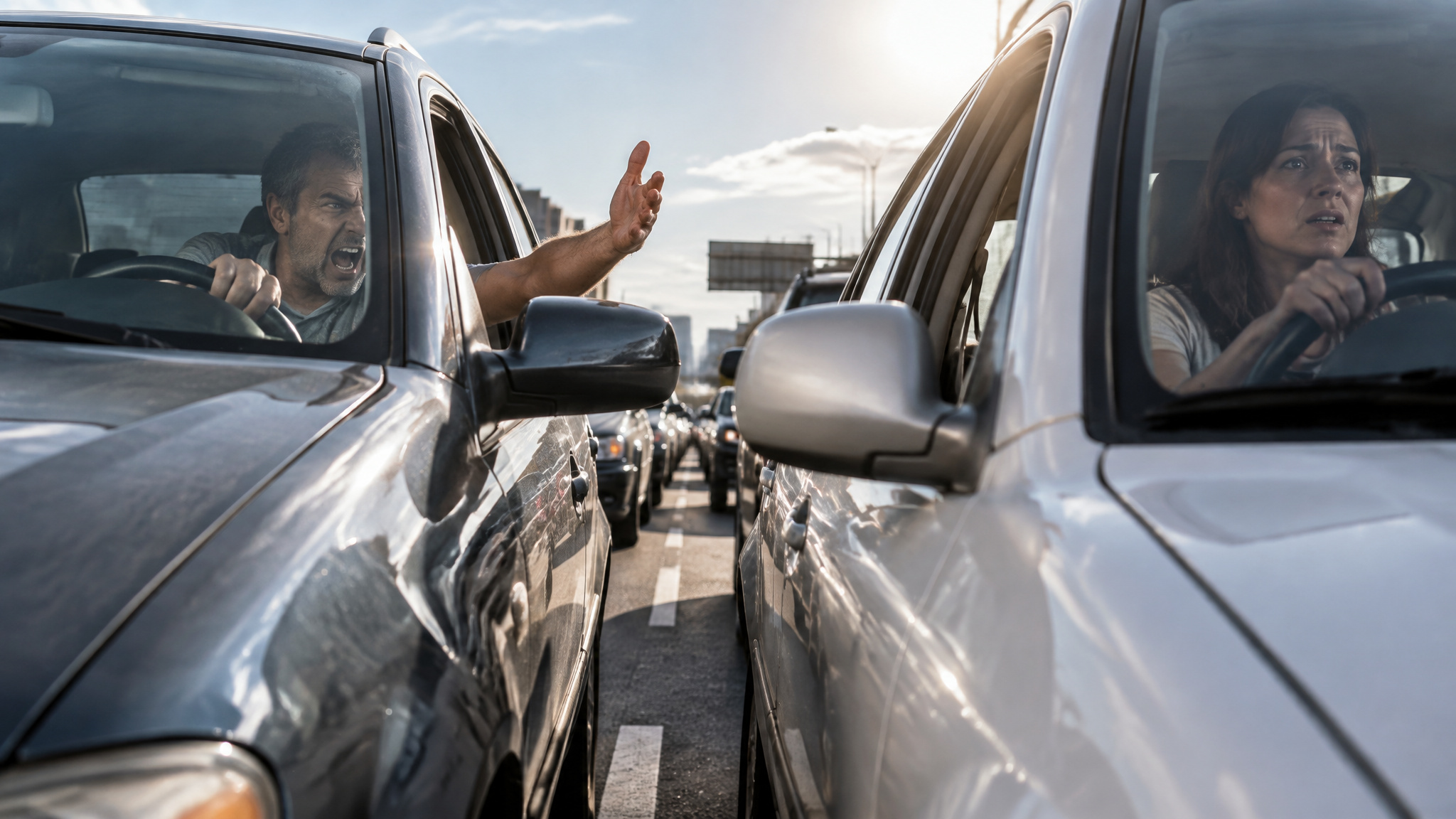
The everyday triggers and earliest warning signs
According to Stop and Go Driving School, the trouble starts with small physical tells before you even realize you’re angry. A driver running late gets stuck behind slow traffic, gives an impatient horn tap, inches toward the bumper ahead, and starts muttering under his breath without recognizing those habits as the first early warning signs of escalation.
The escalation chain, from horn tap to retaliation
That initial irritation feeds an escalation cycle where one aggressive move provokes the next: an impatient horn tap draws an obscene gesture, which prompts retaliatory tailgating, raising the tension at every step until neither guy wants to back down. Once tempers flare, speeding, sudden lane changes, and running red lights become leading contributors to crashes.
In a July 3, 2026, 5:47 PM EDT CBS News Detroit report by Hannah McIlree covering six freeway shootings across Metro Detroit between May and June 2026, Michigan State Police public information officer Lt. Ty Howard noted that while each case had unique circumstances, many shared anger building behind the wheel, pointing to a moment of anger, a moment of frustration, important decision-making, which is going to lead to and escalate to gun violence. Every link in that chain is a choice where you can break the loop.
How to avoid provoking road rage in other drivers
- Practice polite driving: You can prevent road rage in other drivers by practicing polite, predictable driving habits that remove sudden surprises and lane blockages.
- Don’t cut people off: Always signal and leave plenty of space when merging or changing lanes, since sudden moves feel aggressive to other drivers.
- Keep the left lane clear: Stay in the right lane if you’re driving slower than the flow of traffic so faster drivers can pass safely.
- Avoid tailgating: Maintain a safe following distance, because following too closely makes other drivers anxious and more likely to react aggressively.
- Use your signals consistently: Signal turns and lane changes to show courtesy and prevent misunderstandings.
- Respect the right of way: Yield when required, take turns at four-way stops, and don’t try to beat other drivers through intersections or roundabouts.
- Match the safe flow of traffic: Aim to match safe traffic flow, as driving far under the speed limit frustrates others just as much as speeding.
- Don’t take it personally: Remember that we’re all human and nobody leaves home intending to cut someone off on the highway.
- Don’t cut people off: Always signal early and leave plenty of room when merging or changing lanes, because sudden moves feel aggressive to the driver behind you.
- Keep the left lane clear: If you’re moving slower than the surrounding traffic, stay in the right lane so faster cars can pass safely without getting boxed in.
- Avoid tailgating: Maintaining a safe following distance keeps you from provoking other drivers, since riding a bumper makes the motorist ahead anxious and far more likely to react aggressively.
- Use turn signals consistently: Blinking before every turn and lane change shows basic courtesy and keeps other drivers from having to guess your next move.
- Respect the right of way: Yield when required, take turns cleanly at four-way stops, and don’t try to beat other cars through intersections or roundabouts.
- Match the safe flow of traffic: Driving far under the speed limit frustrates people just as much as speeding does, so keep pace with safe surrounding conditions.
Those six habits work because they strip the ambiguity out of shared road space. When you crowd a merge or camp in the passing lane, the guy behind you doesn’t see a distracted commuter. He sees someone deliberately wasting his time. Giving people room and signaling early removes the spark before his temper can catch.
It also helps to extend the same grace in reverse when someone else screws up near your bumper. As Detroit commuter Corey Stearns told CBS News Detroit, nobody walks out their front door in the morning planning to cut somebody off on the highway, and you never know what another person is dealing with in their life. Treating a sloppy lane change as a human error rather than a challenge keeps both cars moving safely.
How to stop road rage before it starts
- Plan ahead: You can stop road rage before it starts by managing your own mindset, planning ahead, setting a positive mood, breathing deeply, not taking other drivers’ behavior personally, and pulling over if overwhelmed. Leave extra buffer time so you aren’t driving under pressure, because running late makes every red light feel personal.
- Set the right mood: Play music, an audiobook, or a calming podcast to build a positive environment where anger has a harder time sticking.
- Breathe: When irritation rises or you’re tempted to slam the steering wheel, take deep breaths and scan traffic to reset your focus.
- Don’t take it personally: Remind yourself the driver who cut you off probably just made a mistake or is having a bad day rather than targeting you.
- Pull over if needed: If frustration gets overwhelming, take a few minutes off the road to calm your nervous system and weigh the consequences before acting on impulse.
- Leave buffer time and check your head: Plan ahead so you aren’t racing the clock, and take a breath before starting the car if you’re already heated.
- Control the cabin and reframe mistakes: Put on music, an audiobook, or a calming podcast, and remind yourself that the guy who cut you off probably just messed up.
- Pull over to reset your nervous system: Clinical psychologist Dr. Lasonia Barlow at Detroit Receiving Hospital advises pulling over to recenter and weighing the consequences before acting on impulse.
Before you drive: planning and mindset
Running late makes every slow lane feel personal. Leaving ten minutes early takes the pressure off your commute, and pausing to check your pre-drive mindset before turning the key stops work stress from spilling onto the highway.
In the moment: breathing, reframing, and pulling over
When irritation rises in traffic, take a few deep breaths and swap the thought “that driver is targeting me” for “maybe they’re having a bad day.” If frustration still boils over, Dr. Barlow recommends recognizing that emotions are taking over, pulling over to calm your nervous system, and asking yourself:
“Is this really a good idea for me to act this impulsively?”
As she notes, a single impulsive decision can change everything.
What to do when another driver targets you
When another driver targets you, de-escalate by refusing to engage, creating distance, and keeping your eyes forward so a one-sided tantrum doesn’t turn into a two-car fight. If an angry driver follows you, don’t drive home; head toward a busy public place like a police station or hospital and call law enforcement.
- Refuse to engage or retaliate: Both CBS News Detroit experts and the Fort Worth Police Department stress never responding to aggression with aggression, avoiding eye contact, and never flashing your brights or tapping your brakes.
- Create physical space immediately: Slow down, change lanes safely to let the aggressive motorist pass, and exit the area as soon as you safely can.
- Go to a public authority if followed: Tap a quick honk to draw nearby drivers’ attention, head straight to a police station or hospital, and call 911 if threatened.
The police-recommended response: disengage and create distance
The normal instinct when someone rides your bumper or lays on the horn is to glare into the mirror, throw a hand up, or tap the brakes. That reaction turns a stranger’s bad mood into a mutual confrontation. Following a deadly road rage shooting on April 30, 2026 at the Interstate 35 service road and Meacham Boulevard in Fort Worth, reported by Fort Worth CultureMap, the Fort Worth Police Department issued a North Division advisory laying out strict defensive positioning. Stay alert, keep your hands on the wheel, avoid eye contact, never flash your high beams or brake-check, and change lanes or slow down to open up as much distance as possible.
Winning a moment of pride on the road isn’t worth the risk. If you’re tempted to shout or slam the steering wheel, redirect your energy by shifting your focus to steady breathing or scanning traffic conditions ahead.
If you’re followed or threatened
While disengagement lowers the temperature, it doesn’t guarantee the other driver will let it go. If someone follows your car or tries to force you onto the shoulder, use a brief horn tap to alert surrounding traffic and drive toward a police station or hospital instead of leading them to your driveway. Call the police any time you feel genuinely threatened or watch a driver endanger other cars. Violent disputes put everyone nearby at risk. As Lt. Ty Howard warned regarding freeway violence:
“When you’re involved in gun violence, you’re putting others in the field of danger as well,”
Detroit commuter Nikki Mariner saw that firsthand during a Wednesday commute when two drivers fighting in bumper-to-bumper traffic exited the freeway and came within inches of hitting her car, a near-miss she described to CBS News Detroit as sickening and sad.
How to document and report road rage to police
Police recommend a dash camera with at least 1080p resolution, front and rear views, GPS, and a timestamp for any driver who wants usable video evidence if an encounter crosses the line. Law enforcement action depends on whether the behavior is unsafe aggressive driving or criminal road rage with intent to cause physical harm, and police advisories focus on witness documentation rather than laying out statutory police powers.
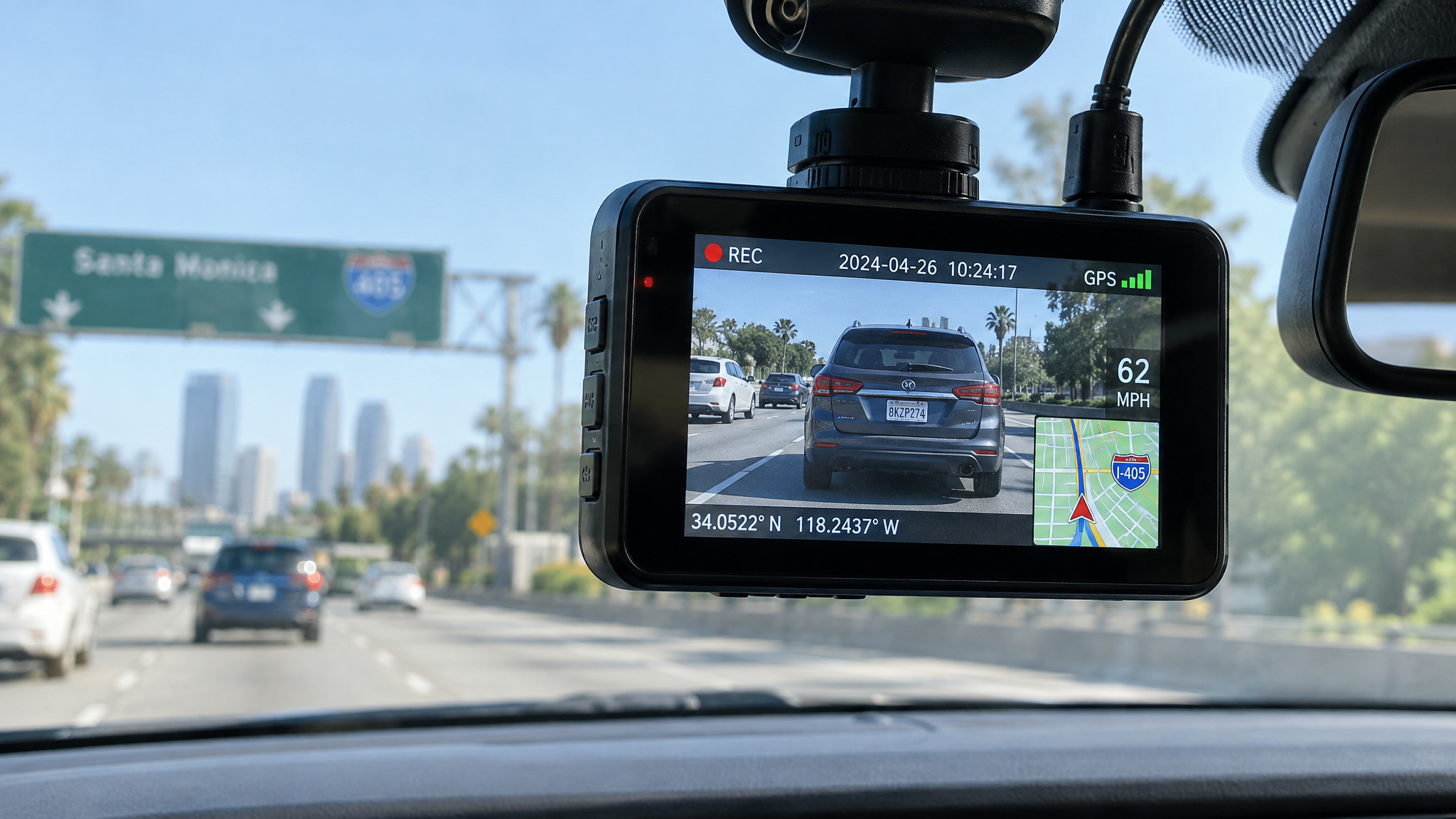
Dash camera features that make footage usable
Fort Worth PD encourages installing a dash camera because clear front-and-rear video captures both the tailgating behind you and the cut-off ahead, while a GPS timestamp locks in where and when it happened.
When to call 911 and what to tell police
To report a road rage incident to police, call 911 immediately if someone threatens you, displays a weapon, or follows your vehicle. For non-immediate reports, use your city’s non-emergency channels; for instance, Fort Worth PD routes reports to its non-emergency line at 817-392-4222 or its Traffic Hotline at 817-392-4850, so look up your own local equivalents. Give the dispatcher five details: vehicle description, license plate number, location, time of the incident, and dash cam footage if you have it.
When driving anger signals a bigger problem
Anger behind the wheel signals a bigger emotional problem when everyday annoyance stops being an isolated bad commute and becomes a recurring pattern where emotions take over, escalating from a simple honk or glare into hostile reactions driven by off-road stress, anxiety, or a lack of control in other parts of life. When irritation starts influencing how you drive, clinicians recommend pulling over to take a break, recenter, calm your nervous system, and weigh the consequences before acting impulsively, and seeing a mental health professional if the pattern keeps returning, even though whether recurring road rage is linked to adult ADHD or operates as a trauma response behind the wheel remains an open question that these police and hospital advisories don’t establish.
What Dr. Lasonia Barlow at Detroit Receiving Hospital points out is that when a guy feels boxed in at work or at home, the driver’s seat often becomes the pressure valve where that stored tension blows. If you find yourself looking for fights in traffic every week, breathing exercises at a red light won’t fix the root cause. Dr. Barlow recommends talking to a mental health professional before a split-second impulse turns into a permanent mistake, and readers who want the deeper behavioral breakdown can revisit our companion piece on the psychology of road rage.
Building long-term patience behind the wheel
Defensive driving courses can help drivers who want structured training in hazard anticipation, stress management, and focus, whereas daily self-taught habits build long-term patience for free if you practice them consistently on every commute. Stop and Go Driving School recommends formal defensive driving classes for learning to spot hazards early and manage cabin stress, which works best when paired with three specific routines: checking your mindset to take a deep breath or a short break before hitting the road if you’re already upset, deliberately letting one driver merge ahead of you each day without reacting negatively, and reflecting after your drive on what bothered you and how you’d handle it differently next time. In the moment, if you’re tempted to shout or slam the steering wheel, shift your focus to steady breathing or actively scanning traffic conditions, and if another driver is following or intimidating you, use a quick honk to get the attention of nearby vehicles.
Real patience is the exact opposite of the satirical 1996-inspired sketch from The Onion featuring fictional defensive driving instructor “Danny Preston,” who tells host Jim that Danny isn’t his real name, swaps muffins, and parodies calm-driving classes as coldly plotting premeditated revenge by following drivers home, breaking in, mailing hours-long videotapes filmed outside their parents’ house as an exploitable weakness, making nightly pay-phone calls reciting cryptic numbers, and murdering a neighbor after a fender bender.
High-risk days: when road rage is predictable
Traffic authorities treat road rage like forecastable weather during heavy congestion and heightened social tension, so you should scale up your buffer time on predictable boil-over days marked by road construction, packed schedules, or holiday surges like AAA’s predicted record 39.1 million Americans traveling by car over the 2026 Memorial Day weekend.
In South Africa, the KwaZulu-Natal Road Traffic Inspectorate deployed 688 officers under the #NenzaniLaEzweni operation for the 2026 local government elections, reported on November 3, 2026, coordinating with municipal traffic departments to escort South African Police Service and Electoral Commission officials, forbidding unauthorized road closures, and protecting roughly 6 million voters across 5,028 voting stations after MEC Siboniso Duma warned that political tension could spark road rage along 13 monitored routes, including the N2 Pongola to Nyoni and KwaDukuza to Umgababa, N3 Van Reenen to Bergville, N11 Newcastle to Ladysmith, R102 Empangeni to Gingindlovu, R618 Mtubatuba to Nongoma, R33 Greytown to Msinga, R74 Bergville to Winterton, R56 Richmond to Kokstad, R617 Merrivale to Underberg, R61 Margate to Port Edward, and R602 Dundee.
Frequently Asked Questions
What is the #1 cause of road rage?
No traffic authority ranks a single number-one cause, because outbursts usually start from a mix of heavy congestion, running late, and carrying outside stress into the car. The common thread that turns routine irritation into a fight is taking another motorist’s mistake personally—assuming a forgotten blinker or sloppy merge was a deliberate sign of disrespect rather than simple distraction.
What causes road rage and how does it escalate?
Flare-ups begin with everyday headaches like gridlock, tight schedules, and off-road stress, which show up early as muttering, creeping toward the bumper ahead, or tapping the horn. That initial annoyance kicks off a tit-for-tat chain reaction where a horn tap draws an obscene gesture, triggering retaliatory tailgating, speeding, or red-light running as neither person backs down.
How can you stop road rage before it starts?
Give yourself a ten-minute time buffer before turning the key so red lights don’t feel like emergencies, and use music, audiobooks, or podcasts to keep the cabin calm. If you still feel your temper rising in traffic, reframe other motorists’ bad moves as honest human mistakes, or follow Detroit Receiving Hospital clinical psychologist Dr. Lasonia Barlow’s advice to pull over, reset your nervous system, and think through the consequences before acting on impulse.
How do you prevent road rage in other drivers?
Drive predictably and politely so other commuters don’t misread your maneuvers as personal slights. Signal before every turn or merge, leave plenty of following distance, stay out of the left lane unless you’re passing, yield the right of way cleanly, and match the safe flow of surrounding traffic rather than crawling far below the speed limit.
How should you handle road rage when another driver is aggressive?
Refuse to take the bait: keep your eyes forward, never brake-check or flash your high beams, and slow down or change lanes to let the angry driver pass. If the motorist follows you or tries to force you off the road, tap your horn briefly to get nearby drivers’ attention, call 911, and drive straight to a police station or hospital instead of leading them home.
How do you report road rage to police?
Call 911 immediately if someone threatens you, shows a weapon, or follows your car; for past incidents without an active threat, use your local police non-emergency line or traffic hotline, such as the Fort Worth Police Department’s non-emergency number (817-392-4222) or Traffic Hotline (817-392-4850). Be ready to give the dispatcher five key pieces of information: the vehicle description, license plate number, time, location, and any dash camera footage.
What’s the difference between aggressive driving and road rage?
According to the AAA Foundation for Traffic Safety, aggressive driving covers deliberate, unsafe traffic violations like tailgating, erratic lane changes, and illegal passing, which play a role in up to 56% of fatal crashes. It crosses the line into road rage when a motorist escalates to violent criminal behavior with the intent to cause physical harm—a category linked to at least 218 murders and more than 12,000 injuries across a seven-year AAA Foundation study of over 10,000 incidents.

