There’s a moment in every mad honey purchase where you realize what you’re actually doing: wiring a few hundred dollars to a seller in Kathmandu for a jar of honey you can’t taste or inspect, shipped through customs systems that have no idea what’s inside it. No marketplace will vet it for you. No regulator is checking the label. If the jar shows up tasting like ordinary honey, your recourse is a strongly worded email to a shop 8,000 miles away.
So where do you actually buy real mad honey? Two paths exist. The first is specialist online stores that ship internationally, which is the realistic route for almost everyone reading this. The second is buying in person near Kathmandu, where physical shops do sell it, including one about 8 km from Thamel. Once you leave Nepal, local availability essentially disappears. The honey is rare in the US because rhododendrons aren’t abundant here, and the specialty stores that do exist ship from Kathmandu, not from a warehouse in Ohio.
Each path has a tradeoff worth naming. Online, you can demand lab documentation before you pay, but you never hold the jar until it lands. In person, you can verify provenance with your own eyes and ask the seller questions face to face, but you have to be in Nepal. What you can’t do is skip vetting entirely, because no listing anywhere guarantees authenticity. The Joe Rogan clip with Will Sonbuchner that pulled 15 million views flooded the market with opportunistic sellers, and a lot of them are moving ordinary honey at psychoactive prices.
The logistics, for what it’s worth, are seller claims: the specialist stores say they ship to 79 countries including the US, UK, Canada, and Australia, via FedEx, DHL, UPS, or airmail, in 5 to 12 business days, averaging 11. That’s the promise. Whether the jar inside the box is the real thing is the question this article exists to answer.
Key Takeaways
Real mad honey runs several hundred dollars per kilogram; a $30 jar is arithmetically impossible, and unusually low prices are a documented fake signal.
Documentation is your only protection: a real certificate names Rhododendron pollen content and quantifies grayanotoxin, not just a generic “lab tested” badge.
Seller dose guides cap at 10-12 grams, but hospitalizations are documented after as little as two teaspoons, because most batches are never tested for potency.
Table of Contents
What real mad honey is and where it comes from
The decisive difference between the two origins is the bee. In Nepal, the honey comes from Apis laboriosa, the world’s largest honeybee, which nests on sheer cliffs up to 13,000 feet and feeds on rhododendron nectar, Nepal’s national flower. That nectar carries grayanotoxin, and the bees concentrate it in the honey nectar by nectar. On Türkiye’s Black Sea coast, the honey instead comes from Apis mellifera caucasica, a different bee entirely, one whose physiology tolerates the toxin. Distinct species, distinct traditions, identical active compound.
The Nepali harvest is its own thing. Gurung harvesters climb those cliffs on bamboo ladders with a single rope, and it’s a centuries-old sacred tradition, not a commodity grab. The harvest happens in Gandaki Province, and a real vendor can tell you exactly where: Sindhupalchowk is a documented sourcing district, and top-tier sellers claim altitudes above 11,500 feet. Those are your vetting questions. If a seller can’t name the harvest district, the altitude, and the bee species, they’re not selling provenance, they’re selling a story.
One honest aside: the bees appear wholly tolerant of the toxin they carry, and researchers still lack an explanation. That’s a genuinely open question, and it tells you something about how much anyone really understands about this honey.
Why you can’t taste or look your way to a real jar
Sensory inspection proves nothing, because most batches are never tested for grayanotoxin and potency swings by season and batch. The margin between a useful dose and a toxic one is small and batch-dependent: in mice, 15.3 micrograms of grayanotoxin per kilogram of body weight reduced heart rate, which for an adult human is roughly the weight of a single poppy seed. At that point the problem stops being wasted money. An unverified jar is an unquantified cardiac risk.
The first-timer failure pattern is common enough to describe without naming anyone: a listing with stock photos, no harvest or batch information, a jar that arrives tasting like ordinary honey, and no certificate to compare it against. If that sounds like the listing you’re looking at, you already have your answer.
The verification checklist: lab tests, certifications, and physical tells
Documentation is the only protection you have, and it has to show specific things. A real certificate names Rhododendron pollen content, which is what tells you how strong the honey actually is, and quantifies grayanotoxin. A generic “lab tested” badge with no numbers is decoration, not documentation.
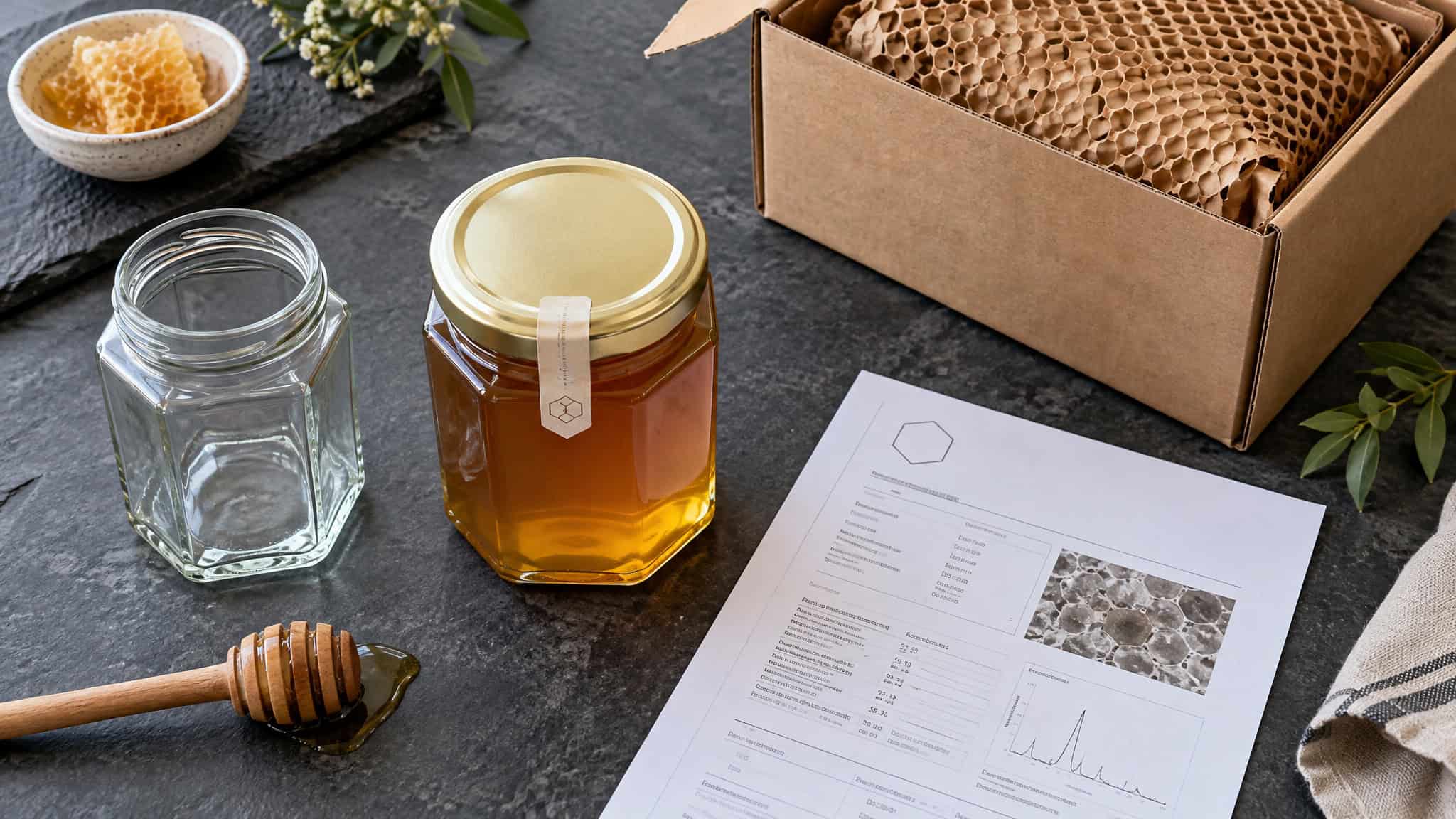
Here’s your reference number: in 2023, the European Commission requested a scientific opinion from EFSA, which set a baseline of under 0.05 mg of grayanotoxin per kilogram of honey as safe against short-term poisoning for all age groups. No safe long-term level exists because the long-term studies haven’t been done. That threshold is an EU reference, not US enforcement, but it gives you something concrete to compare a certificate against.
Physical tells matter too: tamper-proof seals, food-grade glass jars, shock-resistant padding, and packaging carrying certification from Nepal’s Ministry of Agriculture and Livestock Development. Cheap presentation usually matches cheap product.
Then there’s the behavioral red flag, a pattern buyers report when vetting sellers: the shop answers product questions fast, then goes vague the moment you ask about harvest location, season, or pollen documentation. That split is your answer. A vendor who can’t talk about the harvest is moving product they don’t understand.
Red flag: Fast answers about product, silence about harvest location, season, or pollen docs — that split means walk away.
What real mad honey should cost
Real mad honey runs several hundred dollars per kilogram, which makes price the fastest pre-purchase filter you have. A $30 jar is arithmetically impossible at market rates. There is no volume discount that gets genuine cliff honey down to grocery-store pricing.
The seller price tiers, all seller-claimed: Elite Mad Honey at $299 for 300g or $169 for 150g, Clinical Mad Honey at $119 for 300g or $239 for 600g, and Rare Harvest Mad Honey at $399 for 220g. For roughly a cup of honey, that tier costs more than many people spend annually on sweeteners. These are reference tiers from seller listings, not verified market data, worth knowing if mad honey is new to you. But the floor is real: if a listing sits far below several hundred dollars per kilogram, you’re not looking at a deal. You’re looking at the fake signal.
Harvest season and potency
The question that predicts batch strength is simple: when and where was this harvested? Spring harvests, which hit peak rhododendron bloom and are the main harvest, run medium-to-high potency. Autumn yields larger quantities with milder effects. Poisonings cluster sharply in spring, with a smaller wave in autumn, which tracks the harvest calendar exactly. A vendor who can’t answer the season question is a reseller, not an authenticator.
The named vendor landscape (seller claims)
Here are the named options, and every claim below is seller-sourced. Prices may vary; nothing here has been independently verified, which is the honest headline for this entire section.
Elite Mad Honey runs $299 for 300g or $169 for 150g. The seller claims sourcing above 11,500 feet, raw and unfiltered, with high rhododendron pollen content. Altitude is their quality pitch.
Clinical Mad Honey runs $239 for 600g or $119 for 300g, harvested at 8,200 to 11,500 feet. That’s a real, usable difference from Elite’s claim: lower altitude, lower price, and if altitude genuinely correlates with potency, a meaningfully different product. Do the per-gram math before you pick.
Rare Harvest Mad Honey is $399 for 220g, rated 5.00/5 from five reviews. Five reviews is not a sample size, it’s a rounding error. The name alone should trigger some skepticism.
Strong and Potent Mad Honey is a 200g jar rated 5.00/5 from four reviews, an even smaller sample. The company behind it does publish real contact details: an office at Balaju-16, Kathmandu, phone +9779806648794, support@strongmadhoney.com. That’s a legitimacy signal in a market full of anonymous storefronts, though it’s not an endorsement.
Medicinal Mad Honey is supplied by 84 honey-hunting communities across Nepal, per dealer Rashmi Kandel. That supply-chain scale is the most concrete provenance story of the bunch.
Headshop.com and Mad Honey Nepal round out the landscape. Tom Peck’s YouTube review of Mad Honey Nepal covers nearly a month of use, starting at one teaspoon and stacked with shilajit. That’s one guy’s experience, not a verdict.
| Product | Price | Claimed altitude | Rating | Independent lab results |
|---|---|---|---|---|
| Elite Mad Honey | $299/300g or $169/150g | Above 11,500 ft (seller claim) | Not stated | No |
| Clinical Mad Honey | $239/600g or $119/300g | 8,200-11,500 ft (seller claim) | Not stated | No |
| Rare Harvest Mad Honey | $399/220g | Himalayan cliffs (seller claim) | 5.00/5 (5 reviews) | No |
| Strong and Potent Mad Honey | 200g jar | Not stated | 5.00/5 (4 reviews) | No |
Sellers also claim B vitamins (B1, B2, C), calcium, amino acids, and antioxidants. Those are marketing claims with no independent clinical verification behind them. And here’s the critical honesty move, stated plainly: no independent third-party lab results exist for any named product on this list. Every price, rating, and potency claim is seller-sourced. If you’re the kind of guy who reads teardowns before buying a multitool, this is the part where you notice nobody has torn any of these down.
The dosing contradiction sellers won’t tell you
No seller can honestly calibrate a dose, because batch potency is usually untested. Put the two numbers side by side and let the gap speak for itself. Seller guides recommend a 10-12 gram maximum, with one teaspoon for first-timers. Hospitalizations are documented after as little as two teaspoons.
Onset tells the same story. Clinical reporting puts symptoms, dizziness, nausea, weakness, at 20 to 60 minutes after eating it. Sellers cite a narrower 25 to 40 minutes. The wider documented range is the one that matters, because it’s the one built from patients instead of marketing.
The interpretation error buyers make is assuming the recommended teaspoon is calibrated to their specific jar. It isn’t. It can’t be, because nobody tested that jar. The contradiction between seller dosing and hospital records is the finding here, and I’m not going to resolve it for you, because nobody honestly can.
Who gets hurt and how
Yes, mad honey can hurt you, and the typical harmed patient looks exactly like the buyer the marketing targets. The mechanism is plain: grayanotoxin keeps sodium channels in nerve cells from closing, so your nerves fire nonstop. Excess calcium flooding in disrupts muscle and heart function. Heart rate drops, blood pressure crashes.
Standard care involves intravenous fluids plus atropine; recovery typically takes a day or two, and Nepal reports no fatalities tied to consuming the honey. That’s balance, not a guarantee.
The documented cases read like a catalog of exactly how this goes wrong. Tony Cirigliano ordered honey online in fall 2022, the same way any reader would. He got heart palpitations and slurred speech, then weeks later something close to a psychotic break, which his provider attributed to mad honey over-consumption. At Birat Medical College, a 60-year-old combined 2-3-year-old mad honey with alcohol and hypertension medication on a healer’s advice.
His heart rate hit 40 bpm against a normal 60-100, and the doctor there monitored four or five hospitalized cases in six months. In 2018, a 52-year-old woman with no psychiatric history had visual hallucinations after four tablespoons of wild red honey.
About 72% of mad honey poisoning victims are middle-aged men who ate it on purpose, chasing benefits for blood pressure or sexual performance. Read that demographic again. It’s this audience. The literature review behind that number covers 27 published papers and 68 patients since 2009. Secondhand but worth including: the source author’s friend’s father-in-law was hospitalized after wild honey from Nepal’s hills, heart rate dropping dangerously low within about 30 minutes, blood pressure collapsed. He recovered, which fits the pattern, since most patients bounce back within a day or two.
Who shouldn’t buy at all: anyone with a heart condition, especially on blood-pressure-lowering or heart-rate-slowing medication. Pregnant women. Anyone allergic to rhododendron pollen. Documented bad interactions exist with alcohol and blood-pressure meds.
Rarely, psychiatric effects like psychosis or delusions can last days or weeks. And one practical note: physicians in countries such as France and Qatar seldom encounter this type of poisoning, and patients frequently omit dietary details, delaying diagnosis precisely when time matters. If you end up in an ER, say the weird part out loud.
Is mad honey legal where you live?
It depends on where you live, and the US answer is the worst for buyers: legal but completely unregulated. Grayanotoxins are listed in the FDA’s Bad Bug Book, which means the hazard is known. There are no regulations, standards, or guidance attached to it. And the 2025 picture got worse, not better: the MAHA agenda brought Jim Jones’s resignation as FDA Deputy Commissioner for Human Foods, alongside the dissolution of the food-safety advisory committee and a record-low count of foreign food facility inspections.
Nobody’s watching the door. That’s exactly why the checklist above matters.
European Union: the 2023 EFSA opinion set the 0.05 mg/kg short-term threshold, with no safe chronic level established.
South Korea: banned mad honey outright in 2005, yet cases continue via illegal imports and travelers. Fifteen poisoning cases from Nepalese honey were documented there as early as 2013.
Nepal: harvesting is legal with no distinct product regulations. Traditional Indigenous harvesting is permitted in community-managed forests, with formal permits required in national parks.
That’s the documented status, not legal advice. But the pattern is clear: legality tells you nothing about authenticity.
Why the market flooded
The fake market is a direct byproduct of influencer virality colliding with limited genuine supply. The history proves the honey was never a joke. During the Third Mithridatic War (73-63 BC), King Mithridates VI of Pontus left mad honey bowls along Roman troop routes, and Pompey’s soldiers got violently sick and lost the engagement because of it. During the American Civil War, Union troops ate discovered beehives in the Appalachians and got sick and disoriented. Same toxin, same surprise, two thousand years apart.
Then came the modern wave: the Rogan-Sonbuchner clip with 15 million views, where Rogan called the experience bizarre but “completely functional,” and Vice documentaries leaning hard into the hallucination angle. Recreational use is rising on hype, not science, and poisoning cases are now emerging in France, Qatar, and South Korea, regions that never reported them before.
The point for you as a buyer: demand outstrips legitimate supply, and no regulator or marketplace will do the vetting for you. That job is yours.
Ethical sourcing as an authenticity proxy
Supply-chain transparency is a fake-detection tool, not just a feel-good checkbox. Dealer Rashmi Kandel reports that cliff sites holding 20-25 hives six years ago now barely hold one or two, driven by premature harvesting for tourist-influenced demand. When tourists watch honey hunts, it incentivizes hunters to take immature hives, which kills young bees. The cliff bee is also declining from overharvesting, habitat destruction, and climate change, and honestly, there’s no reliable baseline insect population data for the Hindu Kush Himalayan region, so nobody can even say how bad it is.
The scarcity logic connects straight back to your purchase: as real cliff honey gets rarer, the fake share grows. Scarcity and authenticity are the same question. A vendor who can’t explain where his honey comes from is plausibly moving immature or diluted product. That’s a reasoned connection, not a guarantee, but it’s the kind of connection I’d bet on.
There’s a cultural layer too. Gurung, Kulung, Thakali, Rai, and Lhopa communities use mad honey ceremonially and medicinally, for pain, inflammation, immunity, digestion. Not as a hallucinogen, not as a bedroom booster. Kandel calls psychoactive-only marketing misleading and disrespectful, and she’s from inside the trade. Fair-trade operations run by Nepali entrepreneurs since 2016 explain why established sellers charge what they do: someone is paying the harvesters properly.
Where this leaves you
Physical retail exists only in the Kathmandu area, so for most readers the realistic path is a vetted online vendor. If you’re actually going to Nepal, the shop about 8 km from Thamel is a real option and you can ask your questions in person. Everyone else is buying blind, which means the vetting sequence is the product.
Here’s the order I’d run it in. Apply the price floor first: several hundred dollars per kilogram, and anything dramatically below that is out. Demand documentation next: pollen content, grayanotoxin quantification, actual certification, not a badge. Ask the harvest district and season, and expect specific answers like Sindhupalchowk or spring harvest. Verify the packaging story: tamper-proof seals, food-grade glass, certification from Nepal’s Ministry of Agriculture and Livestock Development. Then walk away from any vague answer or cheap listing, because in this market vagueness is the tell.
And if you’ve got a heart condition, you’re on blood-pressure meds, you’re pregnant, or you’re allergic to rhododendron pollen, don’t buy at all. That’s not a caveat. That’s the decision.
Frequently Asked Questions
Is it legal to buy mad honey in the US?
Yes, it’s legal in the US, but completely unregulated. Grayanotoxins are listed in the FDA’s Bad Bug Book, so the hazard is known, yet there are no regulations, standards, or guidance attached to the product. Legality tells you nothing about authenticity — the vetting is entirely on you.
Is mad honey get you high?
It’s psychoactive, but not in the way marketing suggests. The active compound is grayanotoxin, which keeps sodium channels in nerve cells from closing, causing dizziness, nausea, weakness, and hallucinations in some cases — with symptoms starting 20 to 60 minutes after eating it. Nepali communities use it ceremonially and medicinally, not as a recreational drug.
Is mad honey safe to eat or can it kill you?
It can seriously hurt you. Hospitalizations are documented after as little as two teaspoons, with heart rate drops and blood pressure crashes; standard treatment is IV fluids plus atropine, and recovery typically takes a day or two. Nepal reports no fatalities tied to consuming the honey, but anyone with a heart condition, on blood-pressure meds, pregnant, or allergic to rhododendron pollen shouldn’t buy at all.