Mad honey is legal in the United States. There’s no federal prohibition on the books, no state has written a ban naming it, and grayanotoxin, the stuff that makes it mad, isn’t on any controlled-substance list. I checked. That’s the whole answer to the legality question, and it fits in one breath.
Now the asterisk, because there is one, and it’s a big one. Mad honey isn’t legal because some agency looked at it and said “fine.” It’s legal because nobody acted. The FDA knows exactly what grayanotoxin is, it’s listed in the agency’s own Bad Bug Book, the official guide to foodborne pathogens and toxins, and the FDA still offers zero consumption guidance.
No safe dose, no warning threshold, no advisory. Nothing. You’re holding a $100-plus jar of honey that contains a cardiac-active neurotoxin, and the entire regulatory apparatus of the United States government has one thing to say about it: it exists.
That’s the gap this article is about. “Legal” sounds like a guarantee, and in almost every other purchase it roughly is. If a food is legal to sell in the US, you can assume somebody, somewhere, evaluated it. Mad honey breaks that assumption.
It’s legal at every layer, import, sale, consumption, for the same underlying reason: no law forbids it, and no law governs it.. And the same absence means authenticity, potency, and dosing risk land entirely on you. There’s no recall coming. There’s no label standard. The seller’s “start small” note is the most authoritative safety document this product has.
The rest of the world doesn’t fully agree with us, which is worth knowing before you order. South Korea banned the stuff in 2005 after someone died from eating too much of it. Europe actually did the science: in 2023 the European Commission asked EFSA for a formal opinion, and EFSA produced a real number, under 0.05 mg of grayanotoxin per kg of honey is safe short-term for all age groups. The US produced a shrug. Meanwhile the market keeps growing, mostly out of Europe, Nepal, and Turkey, with American buyers ordering the most volume of anyone.
So: legal everywhere you’re likely to read this, regulated almost nowhere. Here’s the full map, and what that map doesn’t protect you from.
Key Takeaways
Mad honey is legal to buy, possess, and eat in the US, no federal ban, no state bans by name, grayanotoxin not scheduled, but there’s zero US regulation or consumption guidance.
The only outright ban is South Korea’s, from 2005, after a fatal overconsumption case; poisonings there continued anyway, with 15 cases from illegally imported Nepalese honey documented by 2013.
The real risks are the buyer’s alone: counterfeit or diluted jars, untested and season-variable potency, and hospitalizations after as little as two teaspoons, a 2015 review of 1,199 cases found no reported deaths.
Table of contents
Table of Contents
Is mad honey legal in the US? The three legal layers
Yes at all three layers, including Texas and every other state, no state bans it by name. “Legal” collapses three separate questions into one word, so it’s worth splitting them. Import: legal, since no federal law prohibits bringing in personal-quantity mad honey (commercial imports require licensing and registration, but personal purchases are generally permitted). Sale: legal, because nothing names it. Consumption: legal, because grayanotoxin isn’t a scheduled substance.
Notice the common thread. All three answers are legal-by-default. No agency evaluated mad honey and approved it; no agency evaluated it at all.
That’s where buyers fool themselves. The usual pattern: a guy checks his state law, finds nothing, and concludes the product must be vetted. It isn’t. The law is silent because it hasn’t spoken, not because it spoke and said yes.
Why a neurotoxic honey escapes drug scheduling
Mad honey is a deliriant, not a psychedelic. That distinction is the whole reason it’s sitting on legal shelves. The mechanism: grayanotoxin comes from rhododendron nectar, and it binds sodium channels in your nerve cells and keeps them from closing. Nerves that can’t shut off. That’s a food-contaminant toxicology problem, not a controlled-substance problem, and regulators treat it accordingly.
Mad honey doesn’t get you LSD-or-DMT high, it’s more of a deliriant, and at typical doses users describe something closer to the physical and psychoactive experience of an edible or a couple of drinks: dizzy, euphoric, sleepy. The overdose symptoms are the flip side: dizziness, nausea, vomiting, low blood pressure, slow heart rate, blurred vision, seizures, irregular heartbeat. Hallucination only shows up at a genuinely dangerous dose: in 2018, a 52-year-old Gurung woman with no psychiatric history experienced hallucinations following her fourth tablespoon serving of wild red honey.
In other words, the “trip” people buy it for is basically the overdose symptom. Nick, who founded Real Mad Honey in Amsterdam, says the hallucinogenic claims are clickbait off the Vice documentary, and the reporting backs him up.
Drug tests: standard panels target scheduled substances, and grayanotoxin isn’t one, so it shouldn’t trigger them. Flagging this honestly, there’s no published testing literature on it. That’s reasoned inference, not a lab-confirmed fact.
Country-by-country: where it’s legal, restricted, or banned
Mad honey is legal almost everywhere except South Korea. That’s the one named ban: 2005, following a fatal overconsumption case. Japan enforces strict controls over health risks. Brazil limits trade because of poisoning cases. Portugal and Spain handle occurrences under EU food safety law, which matters later, when we get to what Europe actually did about it. The Middle East is a different story: strict anti-drug laws there push demand toward mad honey precisely because it’s legal.
Turkey sells it openly, especially in the Black Sea region, and Nepal produces and sells it too. Those are the two places where it’s just… honey. The US is fully legal.
Here’s the counterintuitive part. The strictest anti-drug countries, in the Middle East, India, Japan, are among the best customers. When every intoxicant is illegal, an intoxicant with no legal risk looks like a loophole, and demand flows straight to it. The harshest drug laws on the planet are quietly feeding this market.
What bans actually do: South Korea’s post-ban record
The 2005 ban didn’t stop the poisoning, it moved it underground. Fifteen poisoning cases from Nepalese honey were documented in South Korea as early as 2013, via illegal imports. Since then, cases have surfaced in France and Qatar, and doctors abroad rarely recognize mad honey poisoning; patients often don’t mention eating the honey, which delays diagnosis. A ban redirects supply. It doesn’t delete demand.
EU regulation vs the US vacuum
The EU produced a number; the US produced nothing. In 2023, the European Commission formally asked EFSA for a scientific opinion on grayanotoxins in honey. Because no long-term studies exist, EFSA stopped short of setting a safe chronic-exposure level; instead it established a short-term threshold: under 0.05 mg of grayanotoxin per kg of honey is safe for all age groups against short-term poisoning. That’s an actual number, from an actual authority, just don’t mistake it for a green light on eating the stuff long-term.
The US side of the ledger: grayanotoxins sit in the FDA’s Bad Bug Book yet provides no consumption guidance, and no request for a safe-use scientific opinion has come through Health and Human Services.. And the no-guidance situation isn’t fixing itself. In 2025, Jim Jones resigned as FDA Deputy Commissioner for Human Foods, the food-safety advisory committee was disbanded, and foreign food facility inspections hit a historic low. Mad honey is an import. You can see where that’s heading.
The sharpest way to put it: someone in the US buying a cardiac-active neurotoxin ends up with weaker regulatory safeguards than someone in the EU consuming everyday food. Stated plainly, because stating it louder wouldn’t alter it.
Where it comes from, and the source-country rules
In Nepal, harvesting faces no dedicated product-level restrictions, which means even at the source, nobody’s checking quality. Community-managed highland forests are open to Indigenous Gurung hunters; only national parks and protected areas require formal permits. That’s the entire rulebook.
Production is rarer than the marketing implies. Only two places make it at scale: Turkey’s Black Sea region, where Rhododendron luteum and R. ponticum grow, and Nepal’s high-altitude Himalayan regions. Over 700 rhododendron species exist, and only two or three carry meaningful grayanotoxin in the nectar. The bees matter as much as the flowers: Nepal’s Apis laboriosa nests on cliffs between 3,900 and 13,100 feet and is the world’s largest honeybee at 2-3 cm, and Turkey’s Apis mellifera caucasica appears toxin-adapted.
How the bees tolerate the toxin? Scientists don’t know.

The two harvests look nothing alike. Turkish producers run Langstroth hives next to rhododendron fields, basically normal beekeeping, which is why Turkish honey is cheaper and steadier. Gurung hunters climb cliffs up to 9,800 feet on rope ladders, hands bare, prying crescent-shaped hives off rock. Both countries get one main spring harvest, roughly March to June; Nepal adds a smaller fall one.
Poisonings follow that calendar, clustering in spring with a smaller autumn wave. Fresh honey arrives, people overdo it.
One edge case for Americans: tiny amounts of grayanotoxin honey can occur in the US Appalachians under rare weather conditions, per palynologist Vaughn Bryant. Union troops got sick eating wild beehives in the Northeast mountains during the Civil War. Toxic honey can reach you without ever passing through an import check.
What legality doesn’t protect you from
Yes, mad honey is safe to eat, when you control the dose and the source. Both are exactly what legality doesn’t guarantee. Three failure modes, each with receipts.
Authenticity: some sellers cut mad honey with regular honey or water. Nick founded Real Mad Honey in Amsterdam after seeing reviews of fakes, and Reddit users have reported Turkish brands that did nothing at all. Potency: grayanotoxin levels vary by season, most batches are never tested, and the Nepal-versus-Turkey potency claims are unverified. I’ll say that flat, because the marketing won’t.
On dosing: begin with a single teaspoon; most jar labels caution against exceeding two large spoonfuls daily, and hospitalizations have occurred at intakes of merely two teaspoons. The gap between “recommended” and “hospital” is one spoon.
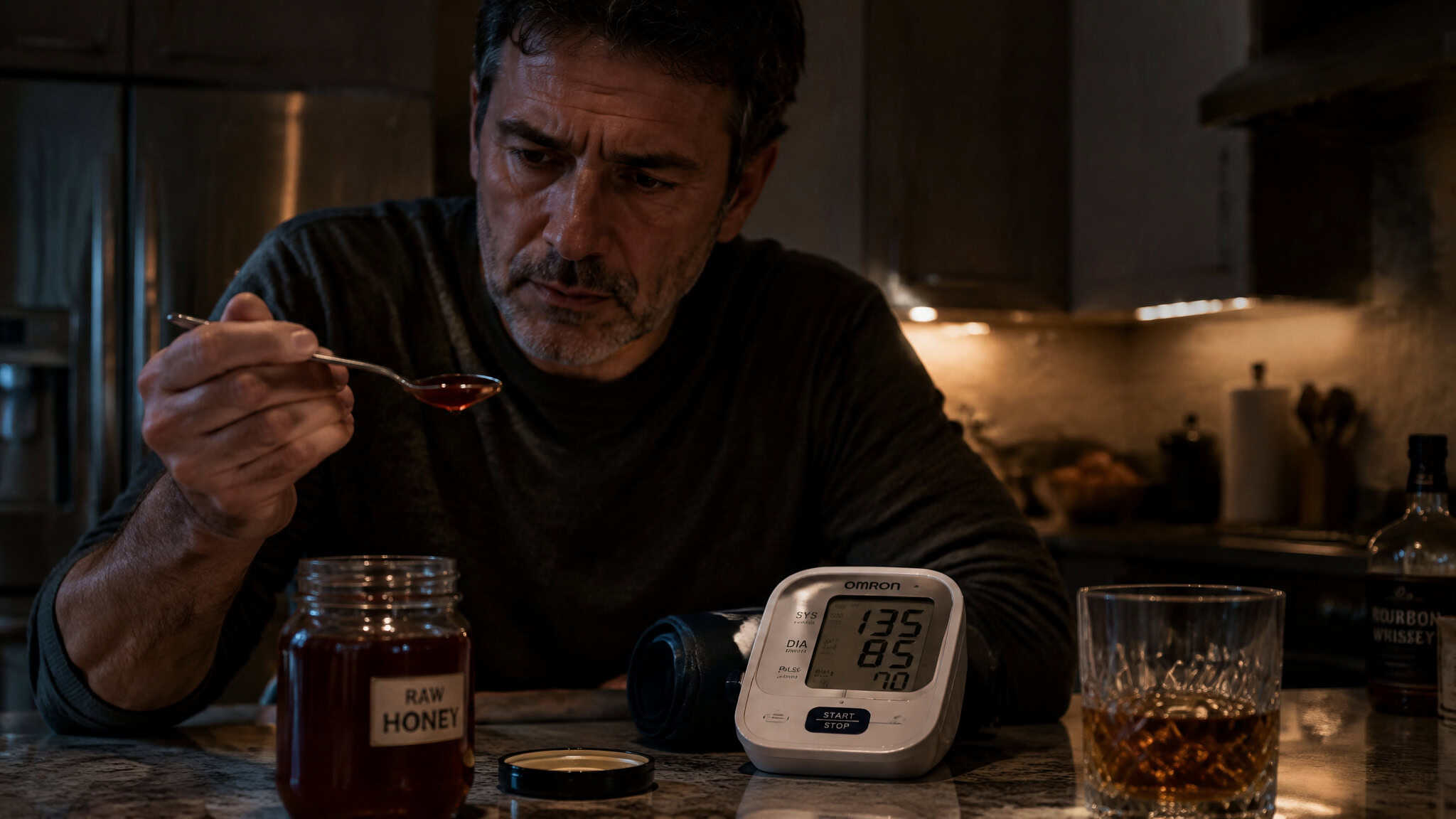
Buyer rule: Start at one teaspoon — a safe starting amount, not a strong dose — never combine it with alcohol or blood-pressure medication, and treat every potency claim on the listing as unverified.
Interactions stack the risk. A 60-year-old man at Birat Medical College combined mad honey with alcohol and hypertension medication in summer 2024; his heart rate dropped to 40 bpm against a normal 60-100. And the American case: Tony Cirigliano, 51, of Fremont, Michigan, bought mad honey online in fall 2022, a fully legal purchase, and got heart palpitations and slurred speech, then a near-psychotic break weeks later. He called 911 and fled with his family.
The calibration, so you’re not scared off entirely: symptoms hit in 30-60 minutes and usually clear within 12 hours; severe cases can run 24 hours and get treated with saline, atropine, or adrenaline. A 2015 review of 1,199 intoxication cases found no reported deaths, and Nepal, where people eat this constantly, reports none either. Keep that separate from South Korea’s fatal 2005 case, which was overconsumption. The risk is hospitalization, not usually death.
What the legal market looks like
Mad honey is legal to buy online in the US, and the market’s structure tells you what to watch for. At least 98% of online brands are based in Europe, Nepal, or Turkey, almost nothing ships from a US warehouse. Only a couple of key distributors exist and annual supply is limited, which is why it’s expensive and why stock runs dry, expect to pay about $166 per pound, with Himalayan honey running roughly three times the price of Turkish. The US orders the highest volume, Japan is significant, and customers come from Dubai and Saudi Arabia despite regional drug laws, the legal-loophole effect again, in the wild.
One of the only US-based sellers of Nepali mad honey, per its own claim: PsychoNaut Anonymous Inc., an Oklahoma NFT project that gave away mad honey on Twitter. Its CEO, who goes by Stoner Degenerate, planned to bundle delta-8, THC-P, THC-O, and honey at a discount. I’d note that “only US-based company” is their claim, unverified, and that a legal intoxicant meeting hustle culture produces exactly this, which is a decent argument for waiting rather than buying from guys like this.
Pricing is transparent, because there’s no prohibition premium: about $166 per pound, several hundred dollars per kilogram, with Himalayan honey running roughly three times the Turkish price. Whether that premium buys anything is an open question, given the potency claims are unverified. Prices may vary.
| Turkish | Nepali (Himalayan) | |
|---|---|---|
| Relative price | Baseline (~$166/lb market) | ~3x Turkish |
| Harvest style | Langstroth hives near rhododendron fields | Cliff hunting by Gurung hunters, up to 9,800 ft |
| Texture | Standard | Thinner, higher moisture, fermentation issues |
| Potency claims | Unverified | Unverified, and stronger-potency claims unproven |
The market has an origin story, and it’s a documentary. The Vice piece. When Abdullah Saeed traveled to meet the Gurung in Nepal’s Annapurna Massif, the interest that followed became the foundation for Nick’s Real Mad Honey. Turkish honey came first, simply because importing from Nepal proved unreliable; both origins came later, backed by a distributor in Turkey’s Black Sea region and another in Nepal working with Himalayan village suppliers.
With essentially two intermediaries standing between hunter and customer, neither supply nor quality stays consistent. Vice Magazine reported back in 2017 on a large market opening in northeastern Asia; the hype cycle has a timestamp.
One useful buyer detail: genuine mad honey shows a reddish tint that sets it apart from ordinary honey. Use that hue as an initial screening cue rather than confirmation, since color is also the simplest property for a counterfeiter to imitate.
The hidden cost of a legal market
Every legal order feeds a demand spike that’s eroding the bees and the tradition behind the product. Apis laboriosa isn’t protected by the Nepalese government, and cliff populations have dropped about 70% annually, with no reliable baseline data, so even that number comes with an asterisk. Rashmi Kandel, who collects from 84 honey-hunting communities across Nepal, reports cliffs that held 20-25 hives six years ago now barely hold one or two, as hype pushes hunters to harvest too early. His framing is worth keeping: presenting cliff honey as merely a psychoactive drug is misleading and disrespectful to communities who’ve used it for centuries as medicine.
Some sellers are responding, leaving half the combs, a honey hunting fund coalition, Himalayan Honey fusing Gurung methods with modern resource management. For the record, the demand engine: the Joe Rogan-Sonny Side clip at 15 million views (Sonbuchner recommended a teaspoon; Rogan’s retelling implies more). Then there’s Balkiz, the bear cub who got drunk on it in Düzce National Park and recovered in three days. And the warfare record goes way back. Xenophon’s army in 401 BCE, Mithridates leaving toxic honeycombs for Pompey’s soldiers in 65 BCE.
Buying mad honey legally: what to actually do
Before you order, know whether you’re getting Turkish or Nepali honey, and from which named distributor. That’s the decisive check. Everything else follows from that. Start at one teaspoon, not because a regulator said so, because no regulator exists.
Never combine it with alcohol or blood-pressure medication; the 40 bpm case happened exactly that way. Treat every potency claim on the listing as unverified, because it is.
So the verdict, with its real shape: legal everywhere but South Korea, regulated almost nowhere, and the buyer carries all the risk the regulators declined to assess. The 2015 review of 1,199 cases found no deaths, the risk is hospitalization, not fatality. But hospitalization has happened after two teaspoons. Legal is the easy part. Everything after the click is on you.
Frequently Asked Questions
Is mad honey considered a drug?
Legally, no. Grayanotoxin isn’t on any controlled-substance list because mad honey acts as a deliriant through a food-contaminant toxicology mechanism — it binds sodium channels in nerve cells — rather than fitting the profile regulators schedule. It’s treated as a food safety issue, not a drug issue.
Can mad honey show up in a drug test?
Standard drug panels target scheduled substances, and grayanotoxin isn’t one, so it shouldn’t trigger a positive result. That’s reasoned inference, though — there’s no published testing literature on grayanotoxin and drug screens, so nobody has lab-confirmed it.
Is mad honey legal in Texas and other US states?
Yes, in Texas and every other state — no state has written a ban naming mad honey. Legality holds at all three layers: import, sale, and consumption. But no state or federal agency has evaluated it either, so legal doesn’t mean vetted.
Is mad honey legal in South Korea, Japan, and the Middle East?
South Korea is the one outright ban, imposed in 2005 after a fatal overconsumption case — though poisonings from illegally imported honey continued anyway. Japan enforces strict health-risk controls, Brazil limits trade, and most other countries, including Turkey and Nepal where it’s produced, sell it openly.
Is mad honey safe to eat if it is legal to buy?
It can be, if you control the dose and the source — two things legality doesn’t guarantee. Start at one teaspoon, never combine it with alcohol or blood-pressure medication, and treat every potency claim as unverified. Hospitalizations have occurred after as little as two teaspoons, though a 2015 review of 1,199 cases found no reported deaths.
What should I check before ordering mad honey from Nepal or Turkey?
First, know which origin you’re getting and from which named distributor — that’s the decisive check. Genuine mad honey has a reddish tint, though color is also the easiest thing for a counterfeiter to fake, and some sellers cut it with regular honey or water. Treat all potency claims on the listing as unverified, since most batches are never tested.