
A guy puts a full night of sleep behind him, knocks back a couple of coffees, and still spends his morning fighting to stay awake at his desk. That exact scenario from a WCNC segment is familiar to plenty of men, and health platform Apollo 24/7 notes that waking up wrecked after a full night is a widespread complaint.
Even when you sleep seven or eight hours every night, don’t drink caffeine too late, and aren’t scrolling on your phone all night, you can still wake up tired, groggy, or drained, sleeping enough but still exhausted even when you’re doing everything right and have already tried lifestyle changes. If you’re still tired after 8 hours of sleep, the clock isn’t your problem.
As Whole Your Health points out, persistent exhaustion usually has nothing to do with how long you stayed under the covers and everything to do with what’s happening inside your body while you’re out. Fixing it means finding what’s interrupting your recovery, not trying to force an extra hour in bed. According to PeRx Peptides, tailored provider-prescribed peptide protocols can target deep sleep, cellular energy, and recovery.
Key Takeaways
Waking up as tired as when you went to bed after seven or eight hours points to broken sleep stages, hidden oxygen dips from sleep apnea or mouth breathing, low muscle mass, or an inverted cortisol curve rather than a shortage of time in bed.
Before buying sleep gadgets or supplements, run a pre-coffee check for physical morning clues like a sticky dry mouth, a thick yellowish or gray tongue coating, bleeding gums, or a dull headache, and pair 16 to 32 ounces of water with outdoor daylight in the first 30 to 60 minutes of the day.
When consistent schedule, light, and strength-training habits don’t clear the exhaustion, ask a doctor for four specific panels: a complete blood count (CBC), a thyroid profile, a vitamin D test, and a diabetes screening.
Table of contents
Table of Contents
The 8-hour paradox: when duration isn’t the problem
Non-restorative sleep is the reason you always wake up tired no matter how much sleep you get, driven by overnight disruptions like sleep apnea, nighttime mouth breathing, low muscle mass, mistimed cortisol, or hidden blood deficiencies that block deep recovery. Across clinical guidance and doctors cited by WCNC, seven to eight hours of sleep is the standard benchmark that should leave an adult rested, yet lying in bed for eight hours does nothing for your brain if light sleep and constant micro-wakings prevent you from reaching deep restorative stages. The simplest diagnostic check is how you feel when the alarm goes off: if you wake up just as tired as when you went to bed, doctors quoted by WCNC note that something is actively blocking restorative deep sleep and pointing toward a likely sleep disorder.
Stretching your time in bed to 9, 10, or 12 hours won’t clear that heavy morning fog either. Extra hours on the mattress don’t repair fragmented alternation between light and deep sleep stages, nor do they stop your airway from narrowing or rebuild a sluggish daytime metabolism. Recovery only changes when you fix the quality of those hours or address daytime metabolic drains, which is why people in sleep studies feel sharper at the exact same sleep duration once their breathing route improves, and why lifting weights fixes low-muscle exhaustion when oversleeping fails.
Here at Unfinished Man, we look at routines the same way we look at tools: by whether the readout actually tells you anything useful. Most guys stare at a watch score or count hours between midnight and 8 a.m. while walking right past physical evidence in the bathroom mirror. A clock only measures how long you lay horizontal. Waking up as tired as you were at bedtime, scraping a thick coating off your tongue, or nursing a dull morning headache tells you what actually went wrong overnight.
What restorative sleep requires
Waking up more tired after eight hours of sleep than after six comes down to where your alarm catches you inside your light and deep sleep cycling. A normal night alternates cleanly between light sleep and deep slow-wave sleep, and breaking that alternation produces non-restorative sleep even when your total hours look great on paper. Six uninterrupted hours that end at the top of a light stage can leave you clearer-headed than eight fragmented hours where repeated disturbances stall your cycle and yank you awake out of the middle of slow-wave sleep.
Deep sleep is when glial cells run the glymphatic system, the brain’s waste-clearance plumbing that takes out metabolic trash overnight, as detailed in a long-form FitnessTM interview on the book Protocols: An Operating Manual for the Human Body (which released in September). According to a Proceedings of the National Academy of Sciences (PNAS) study discussed in that interview, sleeping on your side with your head slightly elevated yields “slightly but significantly” better clearance. The speaker also speculates that about 20 minutes of daytime meditation adds glymphatic clearance and might let regular meditators shave an hour off their sleep need, though his own daily minimum is just 10 breaths of meditation right after waking.
Why “most common cause” depends on who you ask
Feeling sleepy all the time even when you get enough sleep happens because overnight sleep-stage disrupters and daytime metabolic drains carry fatigue straight through your waking hours. Ask three specialists to name the single most common culprit behind waking up exhausted and you get three completely different answers. Each expert diagnoses from their own lane:
- Sleep medicine: Doctors cited by WCNC call sleep apnea the most common issue behind non-restorative sleep, triggering extreme daytime drowsiness that lingers all day.
- Sports and metabolic medicine: Clinician Dr. Ethan Kellum argues that while most people blame stress or lack of deep sleep, low muscle mass is the most common pattern he sees constantly, slowing resting metabolism from morning to night.
- A dental presenter (transcribed as Doctor Jimmy) points to nighttime mouth breathing, a physiological loop, distinct from apnea, that ruins recovery even when your bedtime routine is dialed in.
Apollo 24/7 groups the broader triggers into five buckets: poor sleep quality, sleep disorders, stress and mental health, hidden medical issues, and lifestyle habits like late caffeine, alcohol, irregular meals, and inactivity. Add daytime adenosine buildup from normal brain and muscle energy use, plus thyroid or iron deficits that never switch off at sunrise, and eight hours in bed never stands a chance.
Sleep apnea and restless legs: the disorders that hide
Sleep apnea is the first disorder to rule out if you always wake up tired, and you should check four warning signs right away: loud snoring, waking up gasping or choking, morning headaches, and extreme daytime sleepiness. Sleep disorders like sleep apnea and restless legs syndrome pull you out of deep restorative sleep stages all night without fully waking you up. In sleep apnea, your airway closes during sleep and starves the body of oxygen in repeated pauses, making it the most common sleep disorder behind non-restorative sleep according to WCNC, and one where medical diagnosis, targeted treatment, or supportive options like peptides for sleep can completely turn your daily energy and health around.
Why the sleeper is the last to know
Often you don’t even know it’s happening: you won’t necessarily wake up from it, but your body knows and you’ll feel it the next morning. Millions of people carry sleep apnea or restless legs syndrome (which causes involuntary leg or arm movements while awake or asleep) and only feel a vague sense that something is wrong. Guys looking for a quick fix routinely order anti-snoring mouthpieces or rolls of mouth tape online before checking whether their symptoms point to clinical airway collapse or simple open-mouth breathing. Loud snoring paired with choking wake-ups or morning headaches is a conversation for a doctor, not an online shopping cart.
Mouth breathing and the oral-sleep loop
Mouth breathing at night makes you wake up exhausted when your lips part during sleep, triggering small oxygen dips that fracture recovery even after seven or eight hours in bed. Even without a clinical disorder, broken sleep architecture keeps you out of the deep stages your brain needs.
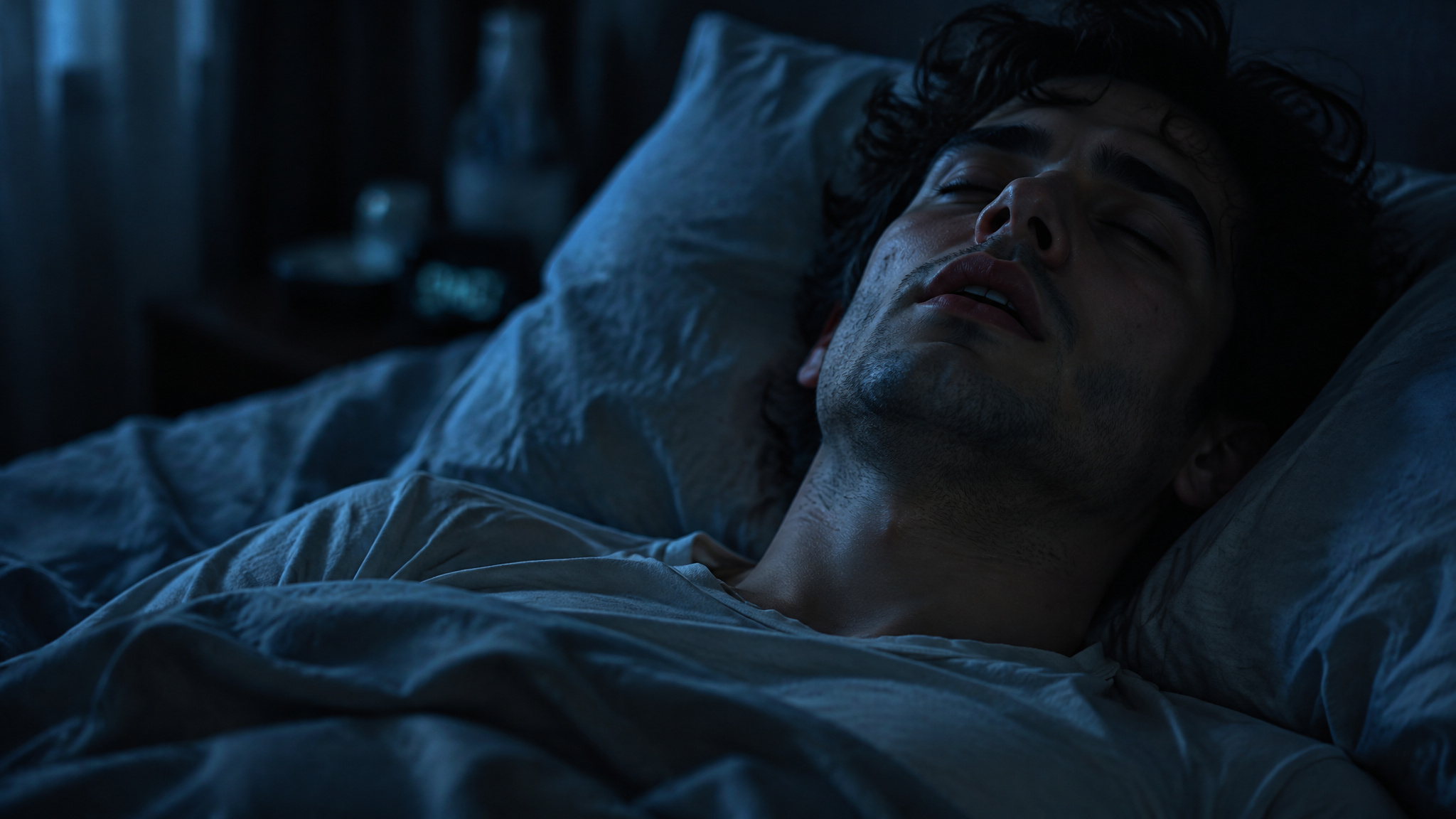
If you sleep seven or eight hours every night, you don’t drink caffeine too late, you’re not scrolling on your phone all night, but you still wake up tired, then your mouth might be affecting your sleep: if your mouth is open while you sleep, even just a little, you’re more likely to get these small oxygen dips. Those dips aren’t full apneas, just enough to interrupt REM sleep and slow-wave sleep while your blackout curtains and pillow setup do nothing to stop it.
What nasal breathing does that mouth breathing doesn’t
Deciding whether to try mouth taping starts with separating participants in a snoring study from someone with an undiagnosed airway disorder. Nasal breathing warms, humidifies, and filters incoming air, supporting oxygen balance, nitric oxide production, and the nervous system’s rest-and-recover mode. Mouth breathing during hard exercise is completely fine, but at rest and during sleep it pulls in cold, dry, unfiltered air that puts the body in a low-level stress state.
The mouth-taping study: same hours, better recovery
In a Japanese study cited by Doctor Jimmy, people with snoring issues gently taped their mouths shut at night. Snoring dropped and they felt more rested the next day on the exact same number of sleep hours. Breathing route alone changed recovery, though that test applied to snorers in a study setup rather than serving as a DIY cure for clinical sleep apnea.
Three days of mouth breathing reshapes oral bacteria
Saliva is part of your immune system, protecting tooth enamel and keeping mouth pH stable. In a study cited by the dental presenter, just 3 days of mouth breathing shifted the bacteria balance in the mouth: good bacteria dropped, inflammatory strains climbed, acidity rose, and saliva flow fell.
Why modern jaws and airways make this widespread
Anthropologists comparing skulls from a few hundred years ago to modern humans found that our ancestors had wider jaws and clearer airways. Modern humans have narrower jaws, more crowded teeth, and smaller airways, partly because softer modern diets demand far less chewing.
The same-morning triage: what to check before coffee
- What sleep inertia is: Sleep inertia is the temporary grogginess that hits right after waking, which is completely different from non-restorative sleep that leaves you dragging with a heavy, foggy feeling for hours from the moment your feet hit the floor until you crawl back into bed.
- Move: Getting up and moving helps clear that short morning lag.
- Hydrate: Drinking water right away helps shake off normal waking grogginess, whereas waking with a sticky, dry mouth that needs water immediately points to overnight mouth breathing and disrupted airflow.
- Get light on your eyes: Morning light exposure helps finish clearing temporary sleep inertia.
- A sticky dry mouth that needs water immediately
- A thick coated tongue
- A sore throat
- Cracked lips
- A dull headache
Waking with a sticky, dry mouth
Needing a glass of water the second you wake up isn’t random thirst. A sticky dry mouth means your lips stayed open all night, cutting saliva flow and knocking you out of deep sleep stages.

A tongue coating that returns every morning
A light film on your tongue is normal, but a thick yellowish or gray coated tongue that comes back every morning after you scrape it signals low saliva, low oral oxygen, and acidic pH. That build-up throws off the bacteria balance in your mouth and releases sulfur compounds that irritate tissue and keep your immune system on alert while you sleep.
Gums that bleed when you brush
Most guys brush off pink foam in the sink by saying, “Oh, I haven’t flossed in a while or my toothbrush bristles are hard,” or figuring their gums always bleed when they brush. Mild bleeding is bacterial inflammation sitting in low-oxygen pockets of the mouth.
In the early 2000s, researchers noticed people with even mild gum inflammation showing signs of heart problems driven by chronic low-grade inflammation leaking into the bloodstream, and that same quiet inflammation activates stress pathways during sleep without waking you. As Doctor Jimmy notes, these oral clues point to a physiological loop rather than sleep apnea, and the fix starts with keeping your mouth moist so your tongue sits naturally and your lips stay sealed.
Muscle mass: the energy system behind morning tiredness
Low muscle mass can cause fatigue after a full night’s sleep when lost muscle slows your resting metabolism, leaving you drained from the moment you wake up. While most tired guys assume they need deeper sleep or less stress, Dr. Ethan Kellum says low muscle mass is the most common pattern he sees behind waking exhaustion because muscle is what produces the body’s energy. His fix isn’t logging more hours on the pillow; rebuilding muscle with strength training two to three times per week turns energy around faster than extra sleep ever will.

Researcher Jared Rutter frames caloric excess without movement as mitochondrial “energy toxicity.” High spontaneous movers burn roughly 1,000 to 1,800 extra calories a day through NEAT (non-exercise activity thermogenesis, the calories you burn moving around outside of workouts), a finding backed by a paper in the journal Science and Rothwell and Stock’s lean-overeaters work. Age-related metabolic slowdown tracks reduced daily movement rather than aging itself when you keep your muscle. Choreographer Twyla Tharp, in her early 80s, still trains two hours a day starting at 5 a.m. with deadlifts and boxing.
The movement layer: NEAT, steps, and post-meal walks
Walking is necessary but not sufficient on its own: aim for 7,000 to 8,000 steps a day rather than 10,000, and take a 10-minute walk after meals to blunt afternoon energy crashes. For post-meal blood glucose buffering, 10 air squats every 45 minutes may match or beat a 30-minute walk according to a comparison referenced by Dr. Rhonda Patrick, tapping the same lower-body glucose uptake seen in unweighted seated calf raises (“soleus push-ups,” where the soleus muscle is only about 1% of your total musculature).
Cortisol timing: the healthy peak and the harmful curve
Maximizing your cortisol peak in the first 60 minutes after waking while keeping cortisol low at night is the real fix for stress-related fatigue, and it explains why you’re still tired after 8 hours of sleep and coffee. You wake up because of the cortisol awakening response, a morning hormone surge that locks onto external cues, which is why you can wake up one minute before your alarm goes off.
People hear that cortisol is bad because of rare extremes like Cushing syndrome (a pathological cortisol excess that causes visceral fat and a moon face), but brief big cortisol spikes that return to normal are healthy. A flattened cortisol curve, too low in the morning and elevated in the afternoon and night, as tracked in 24-hour blood draws across sunlight, caffeine, exercise, and cold plunges, is tied to a shorter lifespan, poorer illness recovery, and longer stress responses, keeping the brain on high alert during sleep.
The three chemicals behind morning energy
In a rough diagram from Protocols: An Operating Manual for the Human Body, morning energy comes down to three chemicals: cortisol, melatonin (the sleepiness hormone that stays low in the morning unless a flattened morning cortisol curve impairs it), and adenosine, a byproduct of cellular ATP energy use that piles up the longer you stay awake, think, and move.
Why coffee can’t fix fragmented deep sleep
When you drink a couple of coffees after an eight-hour night and still fight to stay awake, caffeine is only blocking adenosine receptors. It masks daytime sleepiness for an hour or two, but it does zero repair work on deep sleep stages that got shredded the night before.
Light: the master circadian lever
Stepping outside for morning daylight within the first 30 to 60 minutes of waking (ideally the first 30) and keeping your nights dark is the master lever for your cortisol curve and for avoiding circadian misalignment like jet lag. Low solar angle sunlight near the horizon carries yellow, orange, and red wavelengths with low UV sunburn risk thanks to Rayleigh scattering, hitting light-sensing melanopsin cells in your eyes (ipRGCs) that wire to your master clock (the suprachiasmatic nucleus in the hypothalamus) and trigger your cortisol machinery (the HPA axis, or hypothalamic-pituitary-adrenal axis).
Morning daylight: the first 30-60 minutes
You need outdoor daylight, not direct sunshine; an overcast 8 a.m. December morning in the UK still crushes indoor LED lighting. Window glass and car windshields filter out the needed wavelengths, so step onto a balcony or roll the car window down. Because light is additive, if you miss a day, get twice as long outside the next morning. If you wake two hours before sunrise, use a 10,000 lux artificial light box and check your levels with a free smartphone light-meter app (the Protocols speaker notes he has no affiliation with the app).
The dark half: bright nights, screens, and mortality risk
A large UK Biobank study showed that bright days and dark nights are additive: brighter days improve health outcomes and dark nights improve them further, while bright nights sharply raise early mortality risk. Phone and laptop screens are too dim to trigger your morning cortisol peak, yet bright enough after roughly 6 p.m. to spike nighttime cortisol and disrupt blood glucose and sleep, qualifying most evening device users as “night shift workers” under the study’s definition. Viewing outdoor daylight in the last third of your waking day, what the speaker calls “Netflix inoculation”, buffers your retinal cells against evening screen light, though that buffering doesn’t work for adolescents.
Sunlight on skin: reported benefits and caveats
Getting early and late full-spectrum sunlight on your skin without burning (using a brimmed hat and sunglasses when the sun is high) is credited in the interview with supporting vitamin D, testosterone, estrogen, eye health, mitochondrial function, and pineal-independent melatonin. University College London (UCL) researcher Glen Jeffery’s lab found that shining long-wavelength red light on the back during a glucose tolerance test cut blood glucose peaks by over 25% via mitochondria (making a pricey red light lamp unnecessary if you get real sun), and a correlational Swedish study found that smokers with high sun exposure outlived non-smokers with low sun exposure.
The sequenced day: why order matters as much as habits
The morning wake-up sequence is the fastest way to stop feeling tired after waking up: empty your bladder, drink 16 to 32 ounces of water (with optional electrolytes), get outdoor daylight in the first 30 to 60 minutes, and exercise within the first 3 to 4 hours of the day. That ordered routine sits on top of the baseline sleep rules every clinical source agrees on: keeping consistent sleep and wake times even on weekends, cutting screens 30 to 60 minutes before bed, and sleeping in a dark, quiet, cool room. Starting with bathroom and hydration fires an ascending wake-up pathway running up the vagus nerve that sharpens your mind and drives a higher morning cortisol peak, working toward roughly 80 ounces of water front-loaded early in the day so a full bladder doesn’t wake you at night.

The baseline every source agrees on
Apollo 24/7, Whole Your Health, and the Protocols framework all start with predictability: lock in the same sleep and wake times seven days a week, shut off screens for the last 30 to 60 minutes before sleep (Whole Your Health calls for the full hour), cut off caffeine well before evening, get at least 30 minutes of daily exercise, and quiet nighttime stress with deep breathing, stretching, meditation, writing down thoughts, or professional support.
The morning, in order: water, light, movement
Nobody jumps out of bed yelling, “Yeah, I didn’t feel that much from like drinking some water and getting sunlight,” once they run the steps in order. In the Fitness TM interview, Protocols author Andrew Huberman (who has lifted since age 16 and is around 50) describes a strict morning chain: 10 breaths of meditation in bed, bathroom, hydration, sunlight, dog walk, caffeine, and exercise in the first 3 to 4 hours to lock in cortisol entrainment. His week alternates three resistance-training days with three cardio days (one 60-minute slow session, one 30-minute moderate session, and one max-heart-rate interval session). Adding deliberate cold exposure spikes alertness catecholamines (adrenaline, noradrenaline, dopamine) with minimal cortisol cost while suppressing prefrontal cortex activity for the first 20 to 30 seconds before you engage prefrontal top-down inhibition to stay calm under stress.
Why the protocols ratchet together
Across roughly 50 protocols in seven areas, anchored by 10 zero-cost daily habits done six days a week in day order, each habit acts like a gear that turns the next one. Embracing voluntary difficulty by doing hard things trains the anterior midcingulate cortex (the brain’s tenacity region, studied by Stanford researcher Joseph Parvizi), while 90 minutes to 2 hours of daily mental work pitched at a 15% error rate builds focus. Physical and mental enrichment even protects the aging brain: Oxford neurologist Masud Husain describes long-lived patients carrying abundant Alzheimer’s plaques and tangles with zero dementia because they were lifelong exercisers and avid learners.
The tiredness that isn’t from sleep: air and CO2
When afternoon tiredness hits you in a closed office or bedroom, the culprit is often indoor CO2 climbing past 1,000 ppm rather than last night’s sleep. Cognitive performance drops once room CO2 crosses roughly 1,000 ppm, making ventilation a daytime energy variable with zero connection to bedtime. During the FitnessTM studio recording, a tabletop CO2 monitor (which the crew first mistook for a clock and then a lux meter) climbed from 600 ppm to 1,700 ppm in a sealed room while the host felt progressively more wiped out. Crack a window before blaming your mattress.
The scoped supplement stack: doses and boundaries
If you already sleep well, you don’t need sleep supplements; tart cherry, apigenin, theanine, magnesium, and prescription dual orexin receptor antagonists (DORA, drugs that block wakefulness signals) are conditional escalation tools, while 200 to 400 mg of daily caffeine (used by about 90% of the world) is only correlatively linked to offsetting dementia. The Protocols speaker runs a five-item daily stack for sleep, brain, heart, focus, and strength:
- Magnesium bisglycinate: taken for sleep support.
- EPA omega-3: at least 1 g/day, preferring prescription Lovaza over OTC fish oil for purity.
- Vitamin D: 5,000 to 10,000 IU/day (rejecting 25,000 IU megadoses).
- Alpha-GPC: 600 to 900 mg for choline and acetylcholine focus and REM support, paired the same day with a 600 mg garlic capsule to offset cardiovascular TMAO (a gut byproduct tied to heart risk).
- Creatine: 5 to 10 g/day, which delivers its biggest mental boost when you’re sleep-deprived or stressed.
When self-help fails: the blood tests to ask for
Four basic blood tests (a complete blood count, a thyroid profile, a vitamin D test, and a diabetes screening) are the exact panels to order when you’re always tired despite sleeping enough and dialing in your daily habits. Both Apollo 24/7 and Whole Your Health emphasize that hidden medical conditions and vitamin deficiencies drain your energy around the clock no matter how cleanly you sleep. Mapping those four blood panels against your symptoms catches the quiet internal culprits, anemia (low iron), thyroid imbalance, vitamin deficiencies, and blood sugar dysregulation, while a doctor evaluation can also screen for mild depression.
Deciding when to see a doctor instead of tweaking your morning routine comes down to two clear triggers. Go immediately if you have sleep-disorder warning signs like loud snoring, waking up gasping or choking, morning headaches, or extreme daytime sleepiness, or if chronic gum bleeding and oral inflammation won’t clear up. Otherwise, book the lab work right after consistent sleep-schedule, morning-light, and strength-training changes fail to move the needle.
The four tests and what each screens for
Rather than asking a doctor for a vague “fatigue checkup,” ask for the complete blood count (CBC) and thyroid profile alongside vitamin D and blood sugar panels so you can rule out the major metabolic drains in one draw.
| Blood Test Panel | Screens For | Catches Non-Sleep Morning Exhaustion? | When to Order |
|---|---|---|---|
| Complete Blood Count (CBC) | Anemia and low iron levels | Yes (identifies oxygen-carrying deficits) | After habit fixes fail, or with pale skin and weakness |
| Thyroid Profile | Thyroid hormone imbalance | Yes (catches slowed metabolic rate) | When tired all day despite 7 to 8 hours in bed |
| Vitamin D Test | Vitamin D deficiency | Yes (flags low sun and nutrient depletion) | Alongside baseline blood work when morning energy lags |
| Diabetes Screening | Blood sugar regulation issues | Yes (detects glucose spikes and crashes) | When fatigue pairs with post-meal crashes or thirst |
Waking up tired every single day isn’t normal, and it isn’t a character flaw you have to power through with a third cup of coffee. Treat persistent morning exhaustion like a check-engine light: inspect your airway and your bathroom-mirror clues first, lock in your morning water, light, and lifting, and get your blood panels pulled if the fog still won’t lift.
Frequently Asked Questions
Why do I always wake up tired no matter how much sleep I get?
Constant morning exhaustion comes from non-restorative sleep, meaning your body isn’t completing deep recovery stages even when you spend enough hours in bed. Hidden culprits like sleep apnea, open-mouth breathing, a flattened cortisol curve, low muscle mass, or underlying blood deficiencies repeatedly fracture your sleep architecture or drain your daytime metabolism. Because the problem is recovery quality rather than clock time, staying horizontal longer won’t fix it until you find what is interrupting your system overnight.
Why am I more tired when I sleep 8 hours than 6?
It comes down to which sleep stage your alarm interrupts. Six continuous hours that wrap up at the top of a light sleep stage will leave you feeling much sharper than eight choppy hours where micro-wakings stall your cycle and yank you straight out of deep slow-wave sleep. When overnight disturbances fracture that natural rhythm, a longer night on paper actually feels worse in the morning.
Why am I still tired after 8 hours of sleep and coffee?
Caffeine only plugs up adenosine receptors in your brain, putting a temporary one-to-two-hour mask over your daytime drowsiness without repairing shredded deep sleep from the night before. If you also have a flattened cortisol curve—where your morning cortisol surge is sluggish instead of peaking in the first 60 minutes after waking—a couple of coffees won’t give you real alertness. You need morning outdoor daylight and hydration to fire up a healthy cortisol peak rather than relying on stimulants.
How do I stop feeling tired after waking up?
Run a strict morning sequence to spike your natural cortisol awakening response: use the bathroom, drink 16 to 32 ounces of water, step outside for unfiltered daylight within 30 to 60 minutes of waking, and get your workout in during the first 3 to 4 hours of the day. Pair that morning chain with non-negotiable sleep basics, including fixed sleep and wake times seven days a week, a cool dark bedroom, and zero screens for 30 to 60 minutes before bed. If locking in your schedule, light, and strength training still doesn’t clear the fog, ask your doctor for a complete blood count (CBC), thyroid profile, vitamin D test, and diabetes screening.