
Mad honey is ordinary honey with its safety mechanism removed. Bees making the stuff you buy at the grocery store visit dozens of flower species, so any toxin gets diluted to nothing. Mad honey comes from bees that forage almost exclusively on rhododendron, which concentrates grayanotoxins from the nectar straight into the jar. That’s the whole difference. It’s not a special breed of honey with mystical properties; it’s contaminated honey where the contamination is the product.
And that’s the paradox you’re here for. Online, it’s sold as a psychedelic superfood at around $400 for 200 grams. In the medical literature, it shows up as a cardiac poison that puts 75-year-olds in emergency rooms with a blood pressure of 65/41. Both descriptions are accurate, which is why this deserves a proper look before you spend money on it: what it is, what it does to your body, the dose numbers, whether it can kill you, where it’s legal, and how to judge a listing.
Key Takeaways
Mad honey is honey contaminated with grayanotoxins from rhododendron nectar; commercial honey almost never intoxicates because multi-flower foraging dilutes any toxin to nothing.
15-30 grams (or mL) causes intoxication, symptoms start 0.5-4 hours after eating it, and the toxin clears within 24 hours.
Zero deaths appear in the 2015 review of 1,199 cases, but the “buzz” and the emergency are the same event: a slow heart and low blood pressure. The one fact to give an ER doctor is that you ate mad honey.
What mad honey is: identity, names, and the two kinds of toxic honey
Mad honey is honey laced with grayanotoxins, which bees collect from rhododendron nectar and pollen. The name isn’t marketing; it’s named for exactly what it does to you. It tastes bitter and sharp enough to irritate your throat, which is why it’s also called bitter honey, or deli bal in Turkish, and it runs darker and redder than other honeys.Per Buratti et al., it also has the highest antioxidant activity of any honey type, which is an irony, not a health pitch.
The source plants are Rhododendron luteum, flavum, simsii, and ponticum. Honey in general has been used as folk medicine since 2100 BC and contains at least 181 substances, and there are exactly two kinds of honey poisoning: this one, which clusters in Turkey, South Korea, and Nepal, and tutin honey poisoning from Coriaria shrubs in New Zealand.
How mad honey is made: cliff bees, Gurung hunters, and the price gap
In Nepal, Gurung hunters harvest mad honey from Apis laboriosa, the world’s largest honeybee, which nests on cliffs between 1,200 and 4,000 meters.They climb rope ladders, smoke the bees out, and cut combs that can run 1 to 1.5 meters wide, twice a year in late spring and late fall. Hunters take 100-plus stings per hunt, and a fall from those heights is unsurvivable. They earn under $50 per harvest. The same 200 grams that retails online for around $400 pays the guy risking his life less than fifty bucks.
There’s a conservation problem attached to the markup.Per an ICIMOD 2022 report, cliff bee populations are declining roughly 70% annually, driven by overharvesting, habitat destruction, and climate change. The demand inflating Western prices is collapsing the bees that produce the supply. Turkey’s Black Sea region is the other origin hub, and spring honey is the most toxic of the harvests.
Why mad honey is psychoactive: the grayanotoxin mechanism
It’s psychoactive because grayanotoxin jams sodium channels in their open state, so your nerve cells can’t reset.Channels stuck firing, nervous system stuck in the on position. There’s a second pathway too: the toxin works through the vagus nerve, which is the brake pedal on your heart, and the result is a heart that beats too slow and blood pressure that drops.
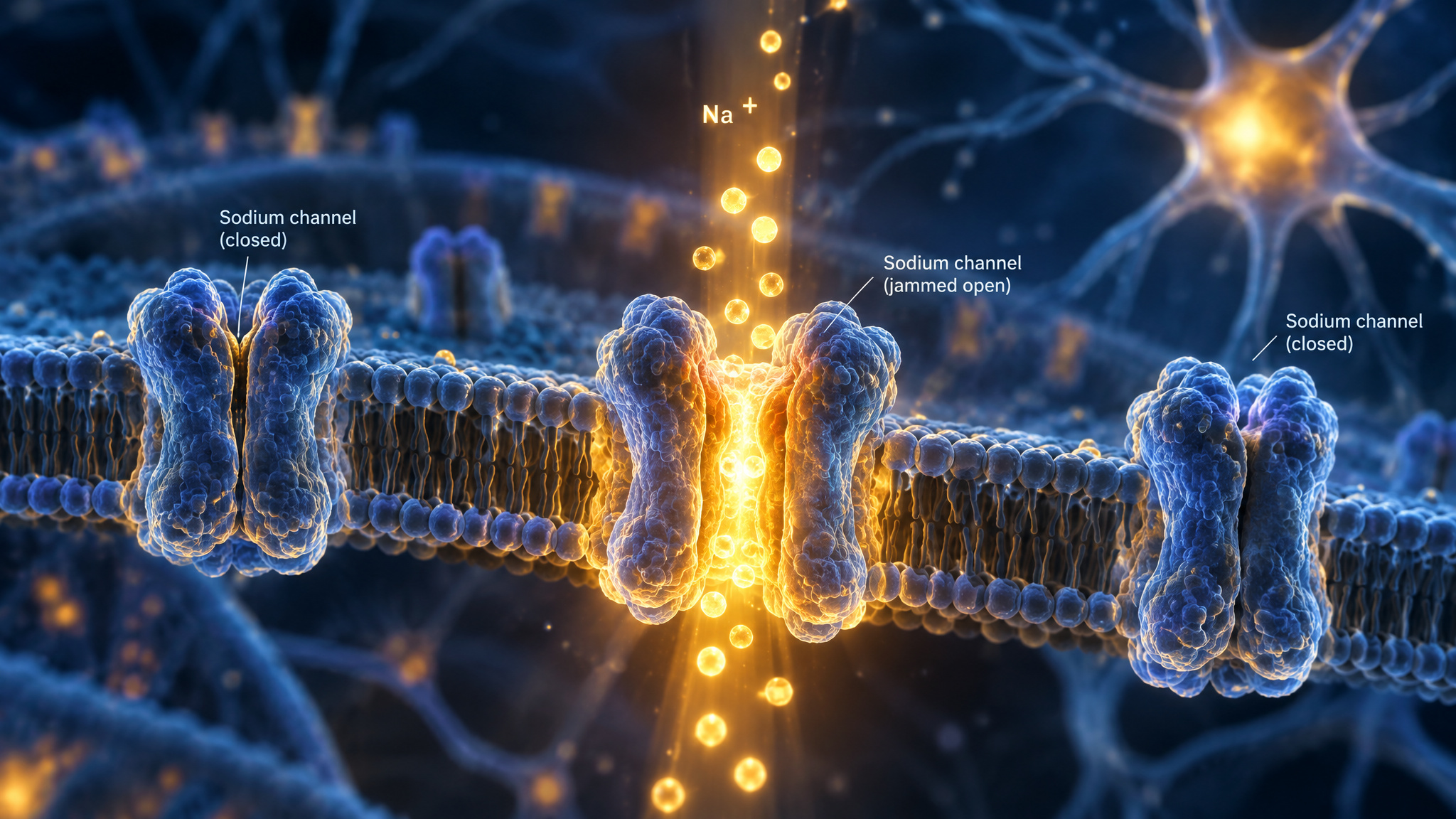
The animal experiments explain why atropine is the go-to treatment. Atropine reversed both problems, the breathing depression and the slow heart rate.A selective M2 blocker called AFX-DX 116 fixed only the heart rate. Cutting the vagus nerve in study animals abolished the slow heart rate entirely, which is how researchers pinned the bradycardia on the vagal pathway.
Omotayo et al.’s feline Purkinje fiber work showed grayanotoxin III producing arrhythmia-triggering after-potentials, and Türkmen et al. found 200 µg/kg of grayanotoxin III dropped rat blood pressure, with bigger drops at 400 and 800 µg/kg. All lab data, not human cases.
There are 18 known grayanotoxin forms and not all are toxic. Grayanotoxin I drives the cardiac effects, II is milder, III causes arrhythmia fast, within 15 minutes in cat heart tissue. Different jars can carry different subtypes, which means different jars can cause different diseases.
What mad honey does to you: symptoms, the buzz, and how long it lasts
The buzz is clinically a slow heart and falling blood pressure.Bradycardia (your heart beats too slow) and hypotension (your blood pressure drops) show up in up to 90% of cases. Symptoms start 0.5 to 4 hours after eating it, sometimes within minutes, and grayanotoxin clears your system within 24 hours. Keep those two numbers in mind, everything below hangs off them.

Here’s the uncomfortable part: euphoria, lightheadedness, and that warm flushed feeling are the subjective experience of the same hypotension and bradycardia that put a 75-year-old man in a UK emergency room at blood pressure 65/41.Recreational users are titrating their own cardiac depression with a spoon. The pleasant buzz and the medical emergency aren’t different experiences at different doses of luck. They’re the same event, described by whoever’s feeling it.
The numbers from the 1,199-case review (Salici & Atayoglu, 2015) make it concrete.Sinus bradycardia in 79.5% of cases, meaning nearly 4 in 5 people’s hearts slowed to a crawl. AV block, where the heart’s electrical signals get delayed, in 30.8%. Atrial fibrillation in 8.7%.
On the symptom side: dizziness around 52%, vomiting around 38%, nausea around 36%, fainting around 15%.The compact rundown: dizziness, blurred or double vision, nausea, vomiting, sweating, tingling, fainting, with impaired consciousness in about two-thirds of cases.
On dose and timing: 15 to 30 grams causes intoxication, and per Ozhan et al., a single teaspoon may suffice. Untreated symptoms last about a day, and full mental clarity can take several days to come back. Published accounts vary wildly, which the researchers themselves document: one person vomited ten times after a single spoonful while their host drifted into euphoria.Two caveats matter more than any anecdote.
First, toxin distribution within a jar is not homogeneous, so two spoonfuls from the same jar can carry different doses. Second, tolerance in habitual users comes from desensitized sodium channels, and it’s a warning sign of cumulative exposure, not a safety margin.
Where the evidence comes from matters too: 69 of the 84 published articles were written by Turkish researchers, because that’s where the cases are.The literature clusters where the poisoning does.
Who gets poisoned and why: the aphrodisiac economy
Regular honey has documented bioactivities in the research literature. Mad honey’s folk-medicine claims, hypertension, diabetes, gut problems, arthritis, sexual performance, are what people believe, not what’s proven. And the poisoning statistics track the aphrodisiac market almost exactly: men run roughly five times the poisoning rate of women, with worse symptoms, because middle-aged guys are taking it as a sexual stimulant.
Men get poisoned about five times more than women, with worse symptoms when it happens. Most cases are males aged 40 to 60. The reason is exactly what you’d guess: guys take it as a sexual stimulant, and that age group already runs higher hypertension rates. No giggling, no lecture, that’s just the data.
The demand evidence is real. South Korea imported over 8,000 kg from Nepal during 2003-04, banned imports in 2005, and cases kept coming anyway through illegal imports and travelers buying it in Nepal. And then there’s the Yarlioglues case: a married couple who both had heart attacks after taking mad honey before sex. It’s a real published case report.
Dry honesty is the only appropriate response. It’s the demand-consequence link in one image.
From Xenophon to biological warfare: a two-millennia record
Xenophon’s Anabasis records Greek soldiers poisoned near Trabzon in 401 BCE who vomited and collapsed but recovered by the next day. Around 65-67 BCE, Mithridates VI left honeycombs along Pompey’s route and three Roman maniples were wiped out, per Strabo.Queen Olga’s 946 honey trap killed 5,000; a 1489 Tatar mead poisoning killed 10,000. Pliny called it meli mænomenon, and Europe imported roughly 25 tons a year in the 18th century.
Notice the pattern: every historical account ends like the modern case reports. Recovery within a day.
Is mad honey dangerous? The scoped mortality answer
No modern grayanotoxin deaths. Zero in the 1,199-case review. The prognosis is very good, no modern fatalities, but that answer needs scoping, because most articles get it wrong.
Treatment is simple: IV saline, atropine at 0.5-2 mg, and rarely a temporary pacemaker. Almost everyone responds. A few deaths occurred in the 1800s, before saline and atropine existed, which is the honest context for the fatality record. The critical distinction: the fatal Lanping County series in China (8 of 31 deaths, 25.8%, 2007-2012) involved honey contaminated with Tripterygium hypoglaucum pollen.
That’s a different, much nastier toxin. It is not grayanotoxin mad honey, and it doesn’t count against mad honey’s record.
Respect is still owed to the real risk. Arrhythmias can be life-threatening and hard to recognize, and severe cases, including asystole, extreme QT prolongation, and sinus arrest, are individually documented.Symptoms look terrifying, treatment is simple, and nobody dies anymore. All three are true at once.
Diagnosis and treatment: what happens in the ER
Mad honey can fake a heart attack. Chest tightness plus ECG changes mimic acute coronary syndrome, because the slow heart rate and low pressure cut blood supply to the heart itself.That mimicry is where misdiagnosis happens.

Diagnosis is detective work, and the honey-intake history is the test, because no routine blood test exists. LC-MS/MS detection is research-only. A pattern shows up repeatedly in published case reports: patients who bought the stuff online as a supplement never think to mention the honey, and physicians outside endemic regions chase a full cardiac workup before the dietary history surfaces.Quick differential notes: a normal cholinesterase test rules out organophosphate poisoning, an angiogram rules out a real heart attack, and antiplatelet therapy isn’t given even with heart-attack-looking ECGs, because the heart isn’t starved by a clot. It’s starved by low pressure.
Treatment escalates simply: saline for mild cases, atropine 0.5-2 mg IV for severe ones, epinephrine or dopamine if that fails, and a temporary pacemaker in only 3 reported patients ever. Gunduz found six hours of ER monitoring suffices without admission, and Sohn saw every patient’s vitals normalize within 24 hours.The first UK case anchors it: a 75-year-old man at blood pressure 65/41 and heart rate 45 after 20-30 mL of Nepali wild honey got 0.6 mg of atropine, his vitals normalized within minutes, and he was discharged after 36 hours of observation without lasting effects.
Is mad honey legal? What the regulatory record actually shows
No explicit US federal ban is documented, and no state bans appear in the record either, not Texas, not California, not anywhere else. Legality is a patchwork, not a clean yes or no, and anyone telling you otherwise is filling in gaps with invention.
The actual regulatory precedents exist, though. A 2023 EFSA review found lab evidence of genotoxicity and set a tolerable combined concentration of grayanotoxins I and III at 0.05 mg/kg of honey, which works out to about 3 tablespoons, or 66 g. No intoxication cases have been reported from EU honeys. South Korea banned imports in 2005 after importing over 8,000 kg, which proves regulation is possible, and also proves it’s leaky, since cases continued via illegal imports.
Meanwhile the spread continues: poisonings are now reported in 10-plus non-endemic countries. Since 2010 there have been 36 case reports, 24 from Turkey, 2 each from South Korea, Austria, and Hong Kong, and 1 each from Nepal, Germany, Japan, and China, as online sellers market the stuff globally.
Buying mad honey safely: the real risk is potency, not legality
The best way to buy mad honey safely online is to evaluate it as a purchase under risk, not a wellness trend. Check the price signal, the harvest season, and the potency problem, because no vendor warning can compensate for a toxin whose concentration varies.That’s how we look at any hyped product with a markup and a risk profile here at Unfinished Man: mechanism, dose, seller, exit risk. No vendors named, no lab tests claimed, because the record doesn’t offer any.
The three buyer signals, with real values:
- Price. Legitimate mad honey runs several hundred USD per kilogram, with 200 g around $400.
Suspiciously cheap product is a red flag. Remember the hunter earning under $50 while the jar lists at $400: the markup isn’t paying for quality control. - Season. Spring honey is the most toxic. Vendors rarely tell you which harvest your jar came from, and the season changes the potency.
- Potency variance.
Toxin concentration varies by season and even within a single jar, so a dose that felt mild last time predicts nothing about the next one.
Authentication has a built-in trap. The documented markers are the bitter, throat-irritating taste and the darker redder color, but taste-testing is itself a dose of the poison. The verification method is the hazard. A common buyer assumption is that price or vendor claims indicate potency consistency.In practice, they don’t.
Online sellers market it as a psychoactive superfood, often without any dosing warnings, and that marketing is exactly what’s spreading poisonings to emergency rooms that have never seen the toxin. The honest limitation: the record offers no vendor evaluations, just several-hundred-dollars-per-kilogram pricing and marketing that skips the safety warnings. Your protection is understanding the toxin, not trusting the seller.
Dose, tolerance, and the bottom line for the curious reader
There’s no safe recreational dose to give you. 15-30 g (or mL) causes intoxication, one teaspoon may suffice, toxicity is dose- and season-dependent, and EFSA’s tolerable reference is about 66 g of honey at regulatory concentrations. The numbers that matter: 15-30 g threshold, 0.5-4 hour onset, clearance within 24 hours. Tolerance, if you notice it developing, signals cumulative exposure, not a safety margin.
Zero modern deaths is a fragile statistic.It depends entirely on atropine, saline, and an ER that knows what it’s looking at, and online sales are now delivering the toxin to emergency rooms that have never seen it. If you’re going to consume it anyway, know the one fact that fixes diagnosis, that you ate mad honey, and the symptom onset window before the first spoonful. Not after.
Frequently Asked Questions
How long does a mad honey buzz last?
Untreated symptoms last about a day, since grayanotoxin clears the body within 24 hours. Onset is 0.5 to 4 hours after eating it, sometimes within minutes. Full mental clarity can take several days to come back, and published accounts vary wildly — one person vomited ten times after a single spoonful while their host drifted into euphoria.
How much does real mad honey cost per gram or jar?
Legitimate mad honey runs several hundred USD per kilogram, with 200 grams retailing online for around $400 — roughly $2 per gram. Suspiciously cheap product is a red flag. For perspective on the markup: the Gurung hunter risking his life on cliff harvests earns under $50 per hunt, so the price isn’t paying for quality control.
What are the symptoms of mad honey poisoning and when should you see a doctor?
The compact rundown: dizziness (around 52% of cases), blurred or double vision, nausea, vomiting, sweating, tingling, and fainting, with impaired consciousness in about two-thirds of cases. Nearly 4 in 5 people develop sinus bradycardia, and chest tightness plus ECG changes can mimic a heart attack. Seek emergency care for any of these symptoms, and tell the ER doctor the one fact that fixes diagnosis: that you ate mad honey — there’s no routine blood test for the toxin.