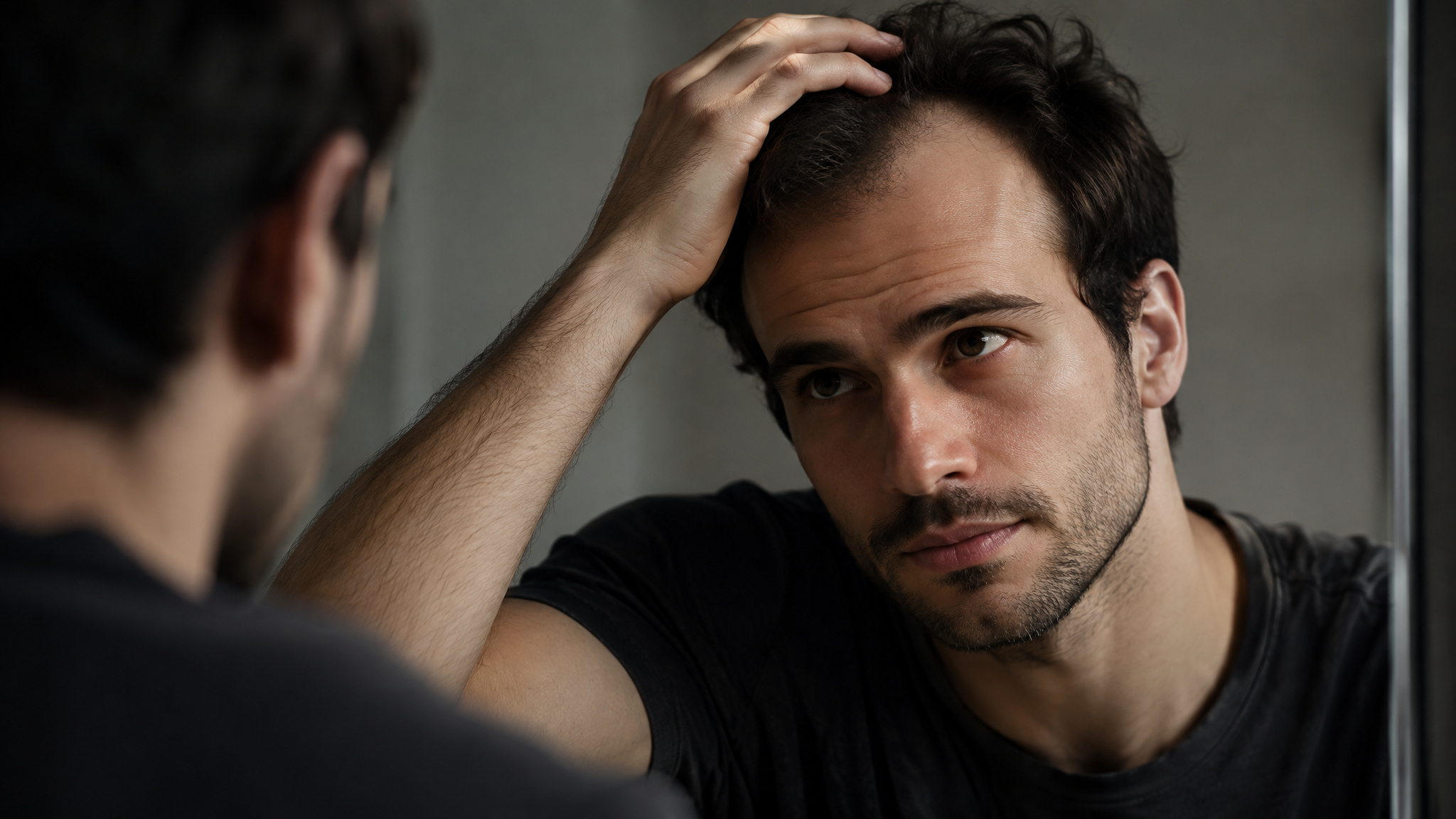
You pull a clump of hair out of the shower drain, notice more strands than usual on your brush, or spot them stuck inside the liner of your motorcycle helmet. Then comes the quiet question about hair loss you don’t say out loud in the mirror: has it started?
Figuring out how to deal with balding doesn’t have to mean panic-buying a bathroom counter full of serums or letting a buddy with a cue-ball head pressure you into grabbing the clippers tonight. You want to know what is causing the shedding, whether it might grow back on its own, what treatments demand in time and daily effort, and how to make a clean call on your haircut.
Key Takeaways
Finasteride typically takes 3 to 4 months of daily use before you notice any improvement, though individual results vary: 4 of 8 posters who reported say hair regrew, while others stopped due to side effects or saw no change.
Combining minoxidil with weekly microneedling beat minoxidil alone after 12 weeks in a study of men aged 20 to 35, though real-world results still require months of daily adherence.
Keeping your hair short or shaving it off is a reversible first-line option, and an American Academy of Dermatology guide notes that hair can regrow without treatment after events like major illness, surgery, or losing 20 pounds or more.
Table of contents
Table of Contents
Step 1: What a dermatologist actually does about hair loss
A board-certified dermatologist can diagnose the exact cause of your hair loss and build a treatment plan around it, starting with a targeted medical exam rather than guesswork. Because effective treatment depends on knowing why your follicles are shutting down, booking an office visit before you spend money on over-the-counter products saves you from treating the wrong problem. According to the American Academy of Dermatology guide at aad.org, dermatologists know the full range of conditions behind shedding, and in-office procedures performed by a board-certified specialist tend to outperform at-home treatments.
What happens at the appointment
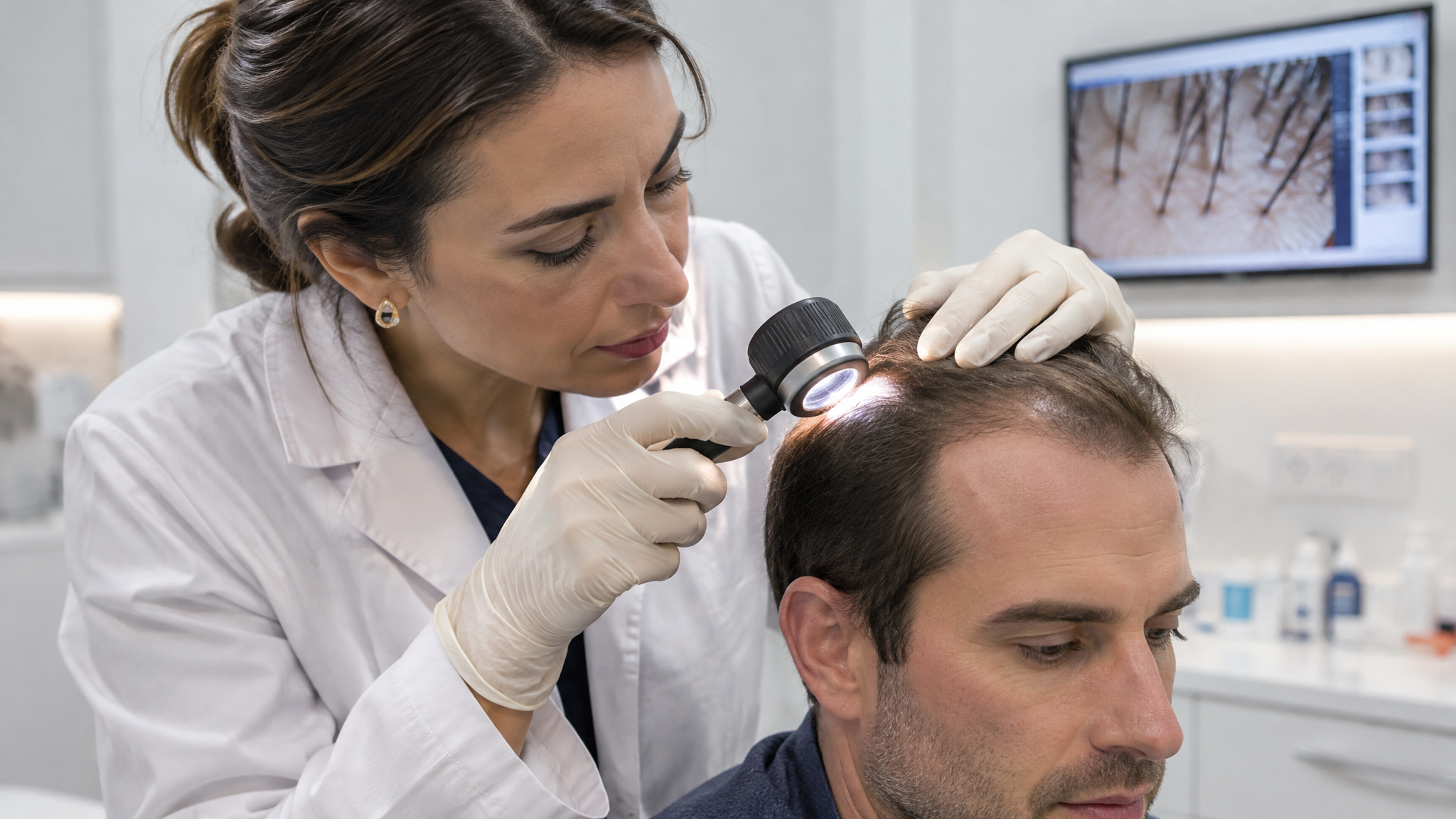
The first visit is mostly questions and a close look. Your dermatologist will ask how long the hair loss has lasted and whether it came on quickly or crept up over months. From there, they inspect your scalp, nails, and any other areas showing thinning, use a magnifying tool called a dermatoscope to examine the scalp surface, and do a light pull test to evaluate strand strength and breakage.
When you’ll need a blood test or scalp biopsy
If the exam points toward an underlying disease, a vitamin deficiency, a hormone imbalance, or an infection, the dermatologist orders a blood test or a scalp biopsy. Both are performed right in the office. For women, female pattern hair loss is driven by follicles reacting to dihydrotestosterone (DHT) and other hormones, so blood tests help spot imbalances; if a medication like spironolactone is prescribed, doctors pair it with birth control pills to prevent pregnancy.
Why one bald spot can have two causes
One person can deal with more than one hair loss trigger at the same time. A woman might experience temporary postpartum shedding stacked right on top of early hereditary thinning, for example. That overlap is why a dermatologist gathers the full picture before naming the cause and picking a treatment.
Step 2: Which type of hair loss you’re dealing with
Early thinning in your late teens or twenties is usually androgenetic alopecia, or male pattern balding, driven by hair follicles reacting to DHT (dihydrotestosterone). Between 16% and 30% of men experience severe hair loss before their thirties, and hairline recession often starts as early as ages 17 to 19. If you notice your temples creeping back or your crown thinning out in your early twenties, family history is the clearest clue, and a dermatologist can confirm whether pattern loss is underway or if something else is mimicking it.
Pattern loss: the DHT-driven majority
Male pattern baldness is largely genetic and unavoidable. Your genetics drive it, often skipping a generation, and despite the barbershop myth, losing your hair is not a sign of high testosterone. It is how sensitive your follicles are to DHT.
The conditions that mimic or masquerade as balding
Well over half of all people live with some degree of hair loss, and not all of it is pattern balding. Alopecia areata is an autoimmune condition that leaves smooth, patchy bald spots. Scarring alopecia involves inflammation that permanently destroys the follicles, while chemotherapy causes its own distinct shedding.
Other culprits look similar in the mirror but require different medicine. Frontal fibrosing alopecia (FFA) often calls for antibiotics paired with antimalarial drugs, whereas scalp ringworm needs an antifungal treatment. Traction damage from tight hairstyles and scalp psoriasis are two more distinct causes a dermatologist separates from pattern loss, because slathering pattern-loss products on the wrong condition wastes money or makes the scalp worse.
Step 3: When hair might regrow on its own
Sometimes the smartest move is doing nothing at all, because certain types of shedding resolve without a single bottle or pill. Hair often regrows on its own after specific physical shocks or cleared scalp conditions, and a dermatologist can let you know if your hair is likely to bounce back on its own before you start any treatment.
Natural regrowth commonly follows:
- Hair may regrow on its own after childbirth
- Hair regrowth is possible after recovering from a major illness or surgery
- Hair may regrow on its own after cancer treatment
- Losing 20 pounds or more is another case where hair regrowth is possible
- Mild alopecia areata may see hair regrow on its own
- Clearing scalp psoriasis can also allow hair to regrow without treatment
Damaging hair care habits and overly tight hairstyles can also cause hair loss on their own. Changing your routine on a dermatologist’s advice is a valid, zero-product fix.
Step 4: At-home treatments: what the evidence says and what they cost in effort
At-home laser caps and combs can give some users thicker, fuller hair, though the evidence is promising but limited and not everyone sees regrowth. In a 26-week study of more than 200 men and women with hereditary hair loss, participants used a laser hair comb or a sham device three times a week, and some laser users came away with thicker hair. Even then, you’re committing to multiple sessions a week for months, and most regimens fail quietly when multi-month routines collide with real life long before the results window arrives.
Minoxidil: the timeline nobody mentions
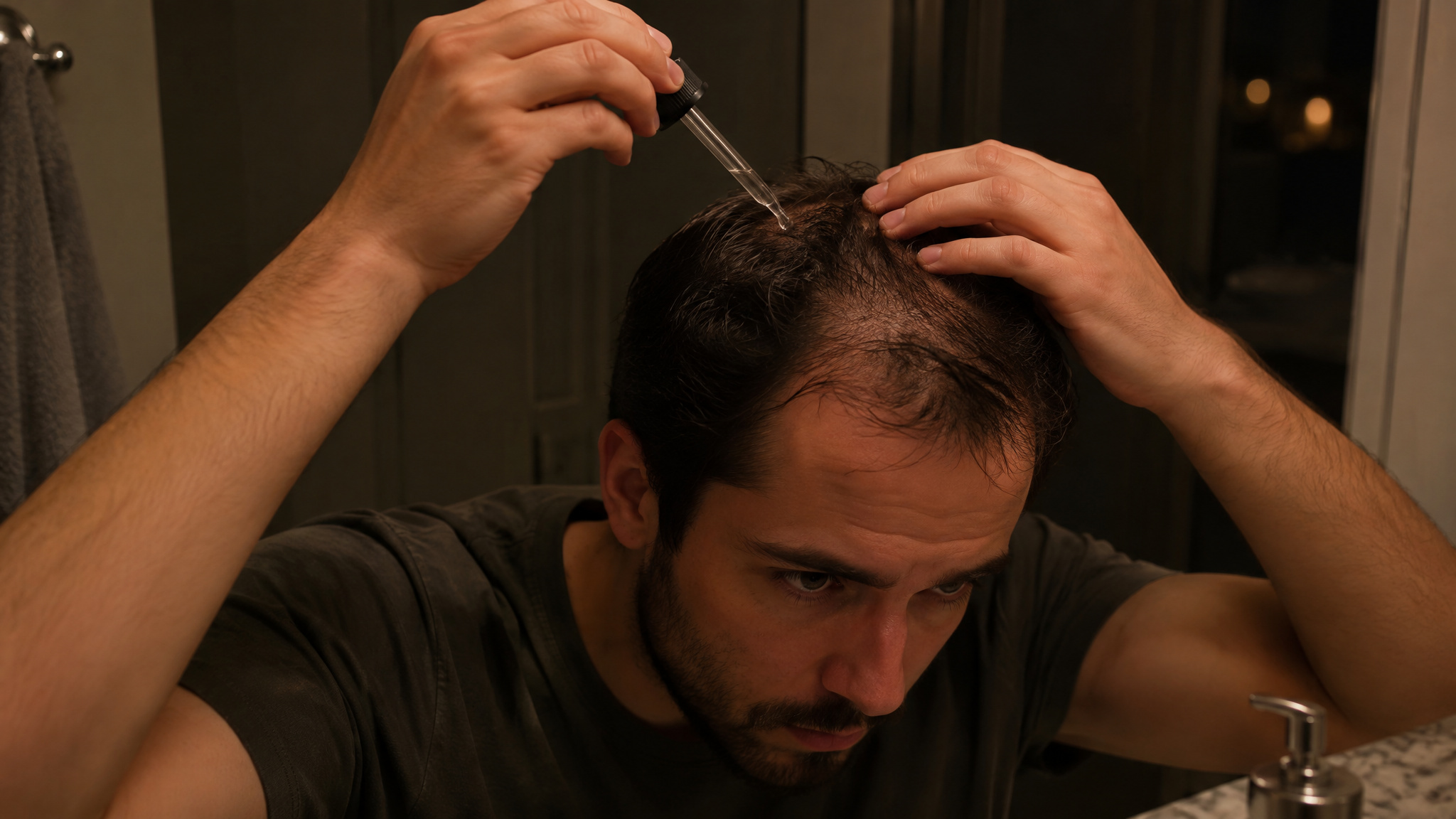
Minoxidil, sold under brand names like Rogaine, takes 6 to 12 months of once- or twice-daily scalp application before you see whether it works, and stopping the routine causes shedding to return and hair thickness to drop. It stimulates growth and slows further loss, which makes it useful for catching early thinning, though it will not regrow an entire head of hair.
Combining it with another approach improves the odds. All 5 hair-loss guides we checked that answer yes or no say minoxidil works better when combined with another treatment. Among 9 forum posters reporting their own experience using minoxidil with another treatment, 4 say hair regrew with the combination, 4 say they saw no regrowth, and 1 says hair regrew on minoxidil alone. As one poster put it, “I switched that out for oral minoxidil and dutasteride.
My hair now is the best it’s ever been.”
Microneedling: the combination evidence
Pairing weekly microneedling with minoxidil beats using minoxidil alone. In a 2018 study of men aged 20 to 35 with mild or moderate hereditary hair loss, applying 5% minoxidil twice daily alongside weekly microneedling produced significantly more growth after 12 weeks than minoxidil by itself. Microneedling also boosts growth when paired with platelet-rich plasma (PRP) or topical corticosteroids.
Before you buy a roller on a whim, know that hair-loss microneedling devices use longer needles than facial skin rollers and can worsen certain scalp conditions. Buyers commonly pick devices based on price or online reviews without checking needle length or whether their scalp can handle it, so check with a dermatologist first.
Laser caps and combs: promising but limited
Red light devices and laser caps you use at home have encouraging, though still limited, evidence for hair regrowth, meaning some users get thicker hair while others see nothing, and researchers still don’t know who benefits most or what the long-term side effects look like. In a 26-week study of more than 200 men and women with hereditary hair loss who used either a laser comb or a sham device three times a week, some laser users did grow thicker, fuller hair.
In my own ongoing routine, I use both red light therapy and microneedling. The real cost isn’t the hardware; it’s sticking to the daily and weekly effort month after month when you’re tired and just want to go to bed.
Step 5: Prescription options: finasteride and spironolactone
Always ask your dermatologist directly about potential side effects before filling a prescription.
Finasteride for male pattern loss
Finasteride, known by the brand name Propecia, is a U.S. Food and Drug Administration (FDA)-approved pill taken once a day at the same time each day for male pattern hair loss. It slows shedding and stimulates regrowth, works best when started early, and requires continued daily use to keep what you gain. In one documented case backed by before-and-after photos, visible improvement showed up within one year and most of the hair regrew after two years.
The hair-loss guides say finasteride may take from 3 to 4 months of daily use before you notice any improvement. Of 8 forum posters reporting what happened while taking finasteride, 4 say hair regrew, 2 say they stopped due to side effects, 1 says hair loss stopped, and 1 says it had no effect. As one poster wrote, they tried fin, got side effects, and stopped. For a reader weighing the pill, the takeaway is simple: the drug works for many men if you give it four months, though side effects do force some guys to quit.
Spironolactone for female pattern loss
For women dealing with female pattern hair loss, the proven medical options are minoxidil, spironolactone, and off-label finasteride strictly for women who cannot get pregnant. Spironolactone halts additional shedding and thickens hair for roughly 40% of women; in a study of 166 women, 42% saw mild improvement and 31% gained hair thickness. Because spironolactone can cause birth defects, pregnancy has to be off the table, and doctors co-prescribe a birth control pill alongside it.
Step 6: In-office procedures: injections, PRP, laser therapy, and transplant
Clinical treatments done by a board-certified dermatologist generally deliver better results than at-home options, though they demand more time in the chair and a bigger budget.
Corticosteroid injections and PRP
When alopecia areata causes only a few small spots, corticosteroid injections placed directly into the thinning areas every 4 to 8 weeks as needed are the most effective option. In a study of 127 patients, more than 80% regrew at least half their hair within 12 weeks.
Platelet-rich plasma (PRP) is another clinic staple. A technician draws your blood, spins it down, and injects the plasma into thinning areas. Studies support it as safe and effective; the 10-minute procedure usually comes with no downtime, repeats monthly for 3 months, and then shifts to once every 3 to 6 months. The first sign it is working is usually reduced shedding within the first few months.
Low-level laser therapy
In-office low-level laser therapy (LLLT) is safe and painless. It may help hereditary loss, alopecia areata, chemotherapy-related shedding, and healing after a transplant, though it requires several clinic sessions a week for many months.
Hair transplant: the evidence and the anecdotes
A hair transplant can be a worthwhile, permanent fix for pattern baldness if you have stable donor hair and realistic expectations, though real-world outcomes carry visible surgical risks if you ever decide to shave later. That dermatologists’ guide calls transplantation an effective, permanent solution for thinning or bald areas caused by pattern loss.
On the other hand, accounts collected by Milou Deelen, who writes at Vice, paint a messier picture. Men she spoke with described friends who later shaved their heads and abandoned strip-harvest implants, leaving behind a permanent, visible scar across the back of the scalp, alongside detectable hair plugs and scalp tattoos that bleed out over time and only look right if you shave every day or two.
Step 7: What treatment can realistically do
Not every type of hair loss is treatable at all, though preventing further loss may still be possible.
Step 8: Shave it, keep it short, or keep fighting
If you’re dealing with early thinning, shorter, textured haircuts look noticeably denser than growing your hair out long, and cutting out damaging hairstyles helps right away. Every one of the 6 hair-loss guides that gives a direct yes-or-no verdict suggests shaving your head if thinning bothers you.

Imagining both scenarios
One version has you sticking to daily pills, topicals, or weekly scalp sessions for years. The other has you owning a buzzcut or a clean shave, spending zero dollars on products, and moving on with your morning.
Friends, especially bald ones, often exert the loudest social pressure to shave it all off right now. Experiment and decide for yourself, knowing that if you take a guard off the clippers and hate it, you can always let it grow back.
What men who shaved report
Among Deelen’s VICE Netherlands interviewees, Jeroen van Nieuwpoort started receding at 17, hid under hats early on, turned down his parents’ offer to pay for a transplant, shaved his head to immediate compliments, and now shaves once a week.
Vinoud Douglas rejected cover spray as pretending, bought a pair of clippers, saves money on monthly haircuts, and speaks openly about losing his hair. Rens Peters lost crown hair at 19, tried thickening powder, shaved at 23 on his girlfriend’s suggestion, felt liberated, and now just remembers to put sunscreen on his scalp.
A barber in the video “How To Deal With Balding” noticed hair piling up in his motorcycle helmet around age 20. His advice is straightforward: own it like Bruce Willis, The Rock, Vin Diesel, or Jason Statham, pair the look with a beard if you can, and pour your self-improvement energy into things you actually control.
Concealers, wigs, and the contested middle path
They cannot slow hair loss or regrow a single strand, and insurance generally won’t cover hair loss treatment, yet they deliver immediate visual results that can boost self-esteem.
Still, the men Deelen interviewed view cover spray and sponge-applied thickening powder, which coats existing hair and dyes the scalp, as “pretending” that only postpones acceptance. Scalp tattooing and hats fill a similar stopgap role, each bringing its own daily maintenance tradeoffs.
Step 9: The mental side: grief, acceptance, and hair neutrality
As Tom Howarth, who writes at Science Focus, notes from psychological research on hair loss, acceptance usually gets easier once balding reaches its endpoint and the new reflection feels like you.
Grief is the normal response
You don’t have to love watching your hairline retreat, and pretending it doesn’t bother you rarely helps.
Techniques that actually have evidence
Acceptance and Commitment Therapy (ACT) is flagged as especially useful for hair-loss distress. Its core move is treating thoughts as passing thoughts rather than facts, such as telling yourself, “I’m having the thought that my bald spot is obvious,” so you can act on your values and prep calm responses to unwanted attention. Cognitive behavioural therapy (CBT) for unhelpful thought loops, individual counselling for processing emotions, and group therapy for connection are solid alternatives.
Instead of forcing yourself into fake “self-love,” aim for hair neutrality. Focus on what your body actually does, including hair’s basic biological job of insulation and sweat evaporation, rather than how it looks. In Dr Jessica Alleva’s 2015 randomised controlled trial at Maastricht University, published in Body Image, participants who completed the Expand Your Horizon exercise, writing nonstop for at least 15 minutes about body functions and sensations, came away with greater appearance and functionality satisfaction, higher body appreciation, and lower self-objectification.
Finding people going through it
Talking with peers at the exact same stage speeds up acceptance. Online forums and support groups fill the gap if nobody in your circle is losing their hair, though they come with two caveats: some members push medical fixes aggressively, and scrolling threads can easily feed social comparison.
Step 10: Handling a lifetime of comments
Unwanted remarks and outside reactions to hair loss can wear on you emotionally, sparking insecurity, self-consciousness, and hurt that can linger for decades, with people still mentioning baldness even 40 years later. As Conor Burke, who writes at ABC Australia, gathered from readers who have lived with it for decades, pointing out someone’s balding is a lack of empathy and manners.
Why people think it’s fair game
Michael Moore is at peace at 68 after a friend’s seven-year-old asked what was wrong with his head, though he’d still love a full head of hair. Bart van Walderveen, now 60, still dislikes being bald after two barbers saw it coming when he was 18, though he buzzes off the remaining hair because his girlfriend prefers the younger look.
Graham Gartrell’s wife told him she “did not give a brass f*ck” about his balding, while Paul Roodenrys stays in shape instead of chasing a transplant, noting, If being bald is my biggest concern then I am a very lucky man indeed.
Responses that keep your dignity
Kevin, 64 and bald since around 23, still gets remarks four decades later and shuts them down with, “Wow, why would you want to be so mean to someone?” John Matthew, who lives by the line, I lost my hair but gained a head, prefers turning the question around and asking how they would feel on the receiving end of that remark.
Step 11: Don’t waste money: spotting hair-loss hype
Biotin, iron, zinc, and natural remedies do not cure genetic balding, and you should only take targeted supplements if a blood test confirms an actual deficiency. Taking excess iron can cause iron poisoning, bringing stomach pain and vomiting, which is why many dermatologists suggest sticking to a standard multivitamin instead. Promises of fast natural regrowth also collapse against the 4- to 12-month timelines of proven medical treatments.

The industry profiting from your worry
The hair restoration industry was worth $6.5 billion, or roughly £5.23 billion, in 2023 and is forecast to grow rapidly through 2030. Dr Fabio Zucchelli at the Centre for Appearance Research, University of the West of England, notes:
“To my mind, the medicalisation of hair loss is reinforcing the problem,”
Glen Jankowski at University College Dublin points out that regulatory approval of finasteride, minoxidil, and transplants boosted the entire industry’s legitimacy, and that plenty of “impartial” hair-loss articles online are disguised advertisements.
Evaluating what you read and what you swallow
Zucchelli and Jankowski recommend building a “protective shield” of media literacy. Check sponsorship disclosures, watch for articles that quote company employees heavily, and adjust your social media ad preferences to cut down targeted hair-loss ads. When reading health claims, run them through the University of Oxford’s 16-question DISCERN Questionnaire to check whether sources are clear, whether multiple treatment choices are presented, and whether the piece explains how each option works.
You’re not the minority: closing on the numbers
Between 40% and 50% of men lose at least some hair by age 50, and androgenetic alopecia affects roughly half of men over 50 and half of women over 65. Jankowski’s “hidden men of baldness” are everywhere once you look, from Dwayne Johnson and Jude Law to Winston Churchill and ancient Egyptians, and happy older bald guys usually treat losing their hair as minor stuff.
Attractiveness standards are socially constructed and shift over time, even as bald celebrities like Dwayne Johnson, Bruce Willis, Vin Diesel, and Jason Statham are often cited as attractive examples. Baldness was revered from ancient Egypt through the 18th century and among the people of Issini in modern-day Ghana, whereas modern culture ties hair to youth, femininity, or virility while an innate urge to belong drives the anxiety. Whether you decide to treat it or grab the clippers, book an appointment with a board-certified dermatologist first so you know exactly what you’re dealing with.
Frequently Asked Questions
Where does male pattern baldness start?
It usually shows up first as a receding hairline at the temples or noticeable thinning at the crown. For plenty of guys, that hairline creep kicks off as early as ages 17 to 19, long before full-blown baldness sets in. Because 16% to 30% of men hit severe hair loss before turning 30, spotting early temple or crown changes is a solid cue to check your family history and get a dermatologist’s eyes on it.
What are some treatment options for a receding hairline?
Medical options include over-the-counter minoxidil, prescription daily finasteride, weekly microneedling paired with topicals, and at-home red light therapy. In-office procedures like platelet-rich plasma (PRP) injections, low-level laser therapy, and hair transplants are also on the table if you want clinical firepower. Of course, buzzing it short or shaving your head completely is a zero-cost, reversible move that skips the daily maintenance altogether.
How do I know if I’m actually going bald at 20?
Early clues include your temples creeping backward, your crown thinning out, or extra strands piling up in the shower drain, on your brush, or inside a helmet liner. At 20, the most common culprit is androgenetic alopecia, though autoimmune patches, tight hairstyles, or scalp infections can mimic it. A board-certified dermatologist can give you a straight answer with a quick scalp exam rather than leaving you guessing in the bathroom mirror.
How can you stop male pattern baldness, and can it be reversed?
You can’t cure genetic balding outright, but starting proven treatments early can halt further shedding and bring back some lost density. Daily prescription finasteride slows hair loss and stimulates regrowth—4 of 8 forum posters who reported their experience with it saw hair regrow—while minoxidil helps hold onto existing strands. Expect to commit for months before judging results, because stopping treatment lets the shedding pick right back up.
Which hormone causes hair loss in females and how is it treated?
Female pattern hair loss happens when hair follicles react to dihydrotestosterone (DHT) alongside other hormonal shifts. A dermatologist will typically run blood tests to pinpoint any imbalances and rule out overlapping causes. When treatment is needed, doctors often prescribe spironolactone—paired with birth control pills to prevent pregnancy—or recommend minoxidil to slow shedding and thicken strands.
Can a dermatologist help with hair loss and what happens at the appointment?
Yes—seeing a board-certified dermatologist before buying random serums saves you from treating the wrong condition. Expect questions about how fast and how long your hair has been shedding, followed by a close look at your scalp and nails using a magnifying dermatoscope and a gentle pull test. If an underlying illness, vitamin deficiency, infection, or hormone issue is suspected, they can run a blood test or scalp biopsy right in the office.
How long does minoxidil take to show regrowth, and what happens if I stop?
You need to apply minoxidil once or twice every single day for 6 to 12 months before you can tell whether it’s working. It won’t restore a full teenage hairline, but it does slow down loss and encourage new growth in early thinning areas. If you quit the routine, the extra shedding returns and your hair thickness drops back down.
Is combining microneedling with minoxidil worth it compared to minoxidil alone?
The combination has better clinical backing than using minoxidil by itself. In a 2018 study of men aged 20 to 35 with mild or moderate hereditary hair loss, weekly microneedling paired with twice-daily 5% minoxidil outperformed minoxidil alone after 12 weeks. Just clear it with a dermatologist before ordering a roller, because scalp devices use longer needles than facial rollers and can aggravate certain scalp conditions.
Do at-home laser caps and red light therapy devices actually regrow hair?
They can thicken hair for some people, though the evidence is still limited and results are unpredictable—in a 26-week study of over 200 men and women, some laser-comb users grew fuller hair while others got no benefit, and long-term side effects remain unclear. I use red light therapy alongside microneedling in my own routine, and the real hurdle isn’t the price tag on the gear. It’s having the discipline to keep up with the sessions week after week when you’re exhausted and ready for bed.