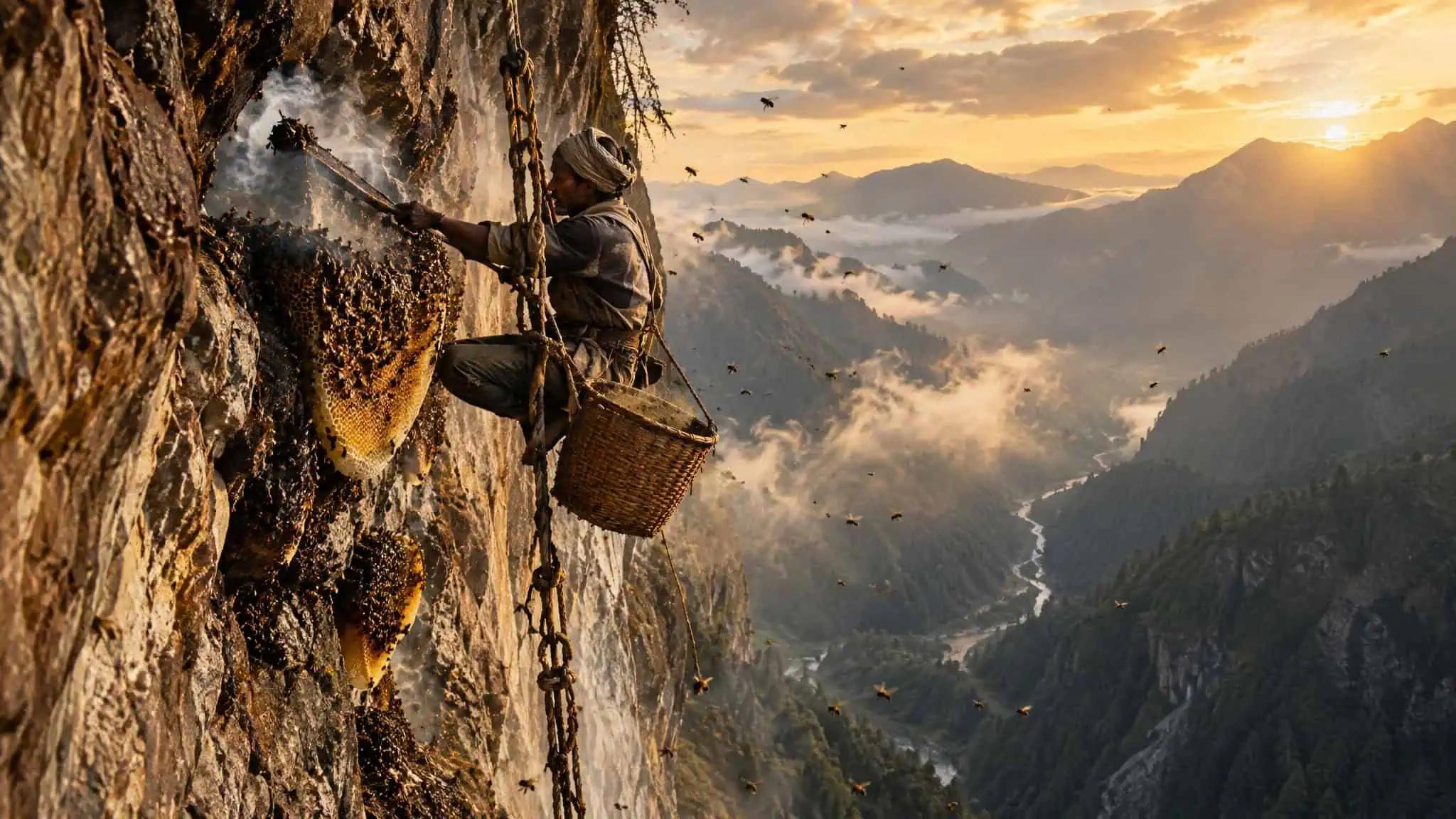
The footage you’ve probably seen goes like this: a man on a rope ladder he tied himself, hanging off a cliff face hundreds of feet above a gorge, cutting honeycomb out from under an overhang while giant bees swirl around his head. It looks ancient. It looks noble. It looks like something out of a myth.
Nepal’s Himalayan mad honey hunters have been filmed this way for years, and the footage is real. What the footage doesn’t show is Maule Dhan Rai, a Kulung honey hunter, saying on camera: I’m tired, and I don’t want to do it anymore. Then, a beat later: The only reason I still do is because I’m poor, and no one else will do it.
That second quote is the whole story. This article covers who these hunters actually are and why the honey they cut down is psychoactive, and why neither the tradition nor the bee that makes it possible might last the century.
Key Takeaways
Mad honey is reddish honey made by Apis laboriosa, the world’s largest honeybee, which concentrates grayanotoxins from rhododendron nectar; more than about a teaspoon slows your heart rate and crashes your blood pressure, and a few tablespoons can be life-threatening.
The harvest happens twice a year (April-May and November-December) from handmade rope ladders on cliffs at 13,000-14,000 feet, and it can’t be mechanized, which is why the honey sells for up to $80 a pound.
The tradition is disappearing because its rules were dismantled: since about 1990, cliff ownership moved from Indigenous communities to government contractors who strip every comb, and there’s still no dedicated conservation project for the bee itself.
Table of Contents
Who the mad honey hunters are: the Kulung and the Gurung
Two communities do most of this work, and they’ve been doing it for centuries: the Kulung in eastern Nepal and the Gurung in Lamjung district, Gandaki Province. The method works, which is the part people miss when they’re busy calling it insane.
The Kulung honey hunters of eastern Nepal
The Kulung live in eastern Nepal and have been scaling sheer cliffs for generations. Maule Dhan Rai, one of the last known Kulung honey hunters, lived from 1959 to 2018. When the 2017 documentary The Last Honey Hunter filmed him, directed and edited by Ben Knight and co-produced by Felt Soul Media and Camp4 Collective with National Geographic and the dZi Foundation, he was 57. His body was worn down from decades of climbing and countless stings.
He believed he’d been chosen in a dream to do this work. He also believed, more plainly, that he couldn’t afford to stop. He died the year after the film came out.
The Gurung of Bhujung and the Gandaki cliffs
The Gurung are the other main honey-hunting people, concentrated in Gandaki Province, notably the village of Bhujung in Lamjung district. They’ve harvested mad honey safely for generations, and that safety isn’t luck. It’s generational knowledge of safe doses, passed down orally, wrapped into a harvest that’s embedded in ritual.
When I visited Bhujung in November 2021 as an Avni Center for Sustainability fellow, I interviewed a man named Pitraman Gurung, who runs a guest house there. He eats a spoonful of mad honey daily to keep himself going in a remote village where calories and convenience aren’t guaranteed. That’s how one hunter actually uses it day to day, not advice on how much to take. Hold that thought until we get to the toxin section.
How the harvest works: rope ladders, smoke, and cliff danger
The hunters reach the hives on handmade rope ladders, using smoke to calm the bees, on cliff faces hundreds of feet above the ground. That’s the starting point for everything else that follows.
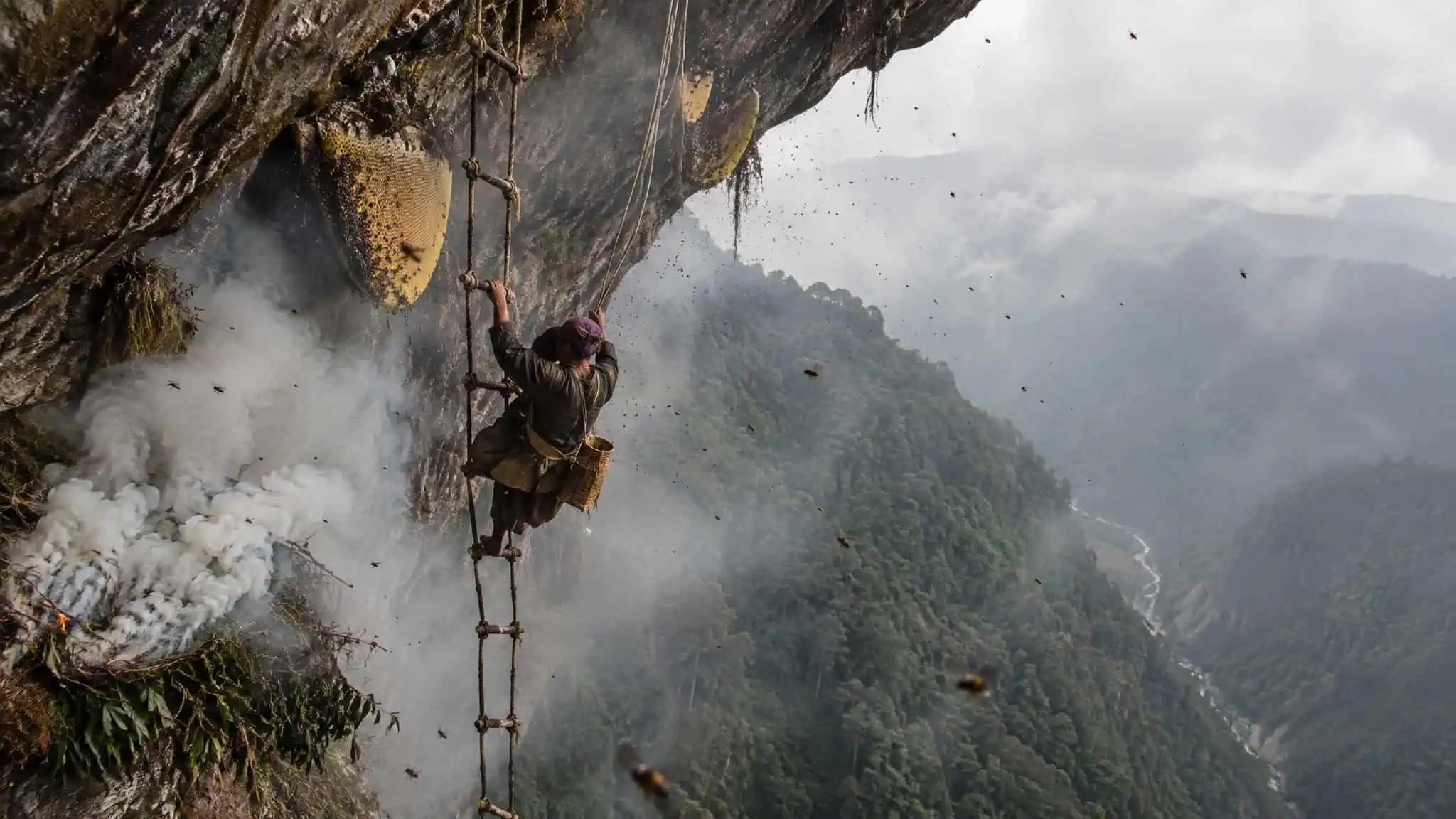
The bees in question are Apis laboriosa, the world’s largest honeybee, and they build huge exposed combs on sheer rock faces at 13,000 to 14,000 feet (4,000-plus meters). The bees chose the worst possible real estate, which is exactly why the honey is what it is. You can’t put a hive box up there. You can’t farm it.
The cliff is the supply chain, and that’s why the honey runs up to $80 a pound. The price exists because the harvest can’t be mechanized.
The sequence, roughly:
- Build the rope ladder by hand. No gear shop, no certified rigging, just rope and knots and a guy willing to trust both.
- Light a smoky fire. Hunters traditionally burn green rhododendron leaves for this, which calms the bees the same way smoke calms bees in your neighbor’s backyard hive, except here it also cuts visibility on an already precarious cliff face.
- Climb down hundreds of feet on that ladder, stand on a narrow ledge, and cut combs out while getting stung the whole time. The bees they’re after, Apis laboriosa, nest on sheer cliff faces at altitudes up to roughly 13,000-14,000 feet.
- Haul the honey back up and hope the weather holds.
That last part isn’t a footnote. Mountain weather shifts fast. Fog rolls in, rain arrives out of nowhere, temperatures swing, and if you’re on a rope ladder when it happens, a routine hunt becomes a fight for survival. The stings are the other constant. Multiple stings are guaranteed, and allergic reaction is the specific risk that makes this job unsurvivable for some people without luck.
Interestingly, some younger hunters have started using climbing harnesses and helmets, and elders argue that the equipment disrupts the spiritual connection the harvest requires. I’ll leave it to you which argument you find more persuasive when you’re imagining the ledge.
None of this is dramatized. The numbers do the work. Hundreds of feet, 14,000 feet of altitude, a teaspoon of the product. It’s a real job with real costs, done by real people, most of whom would rather not be doing it.
The sacred calendar: ritual before the climb
The harvest happens twice a year, and every expedition starts with religious ceremony. Those two facts together worked as resource management, not just folklore.
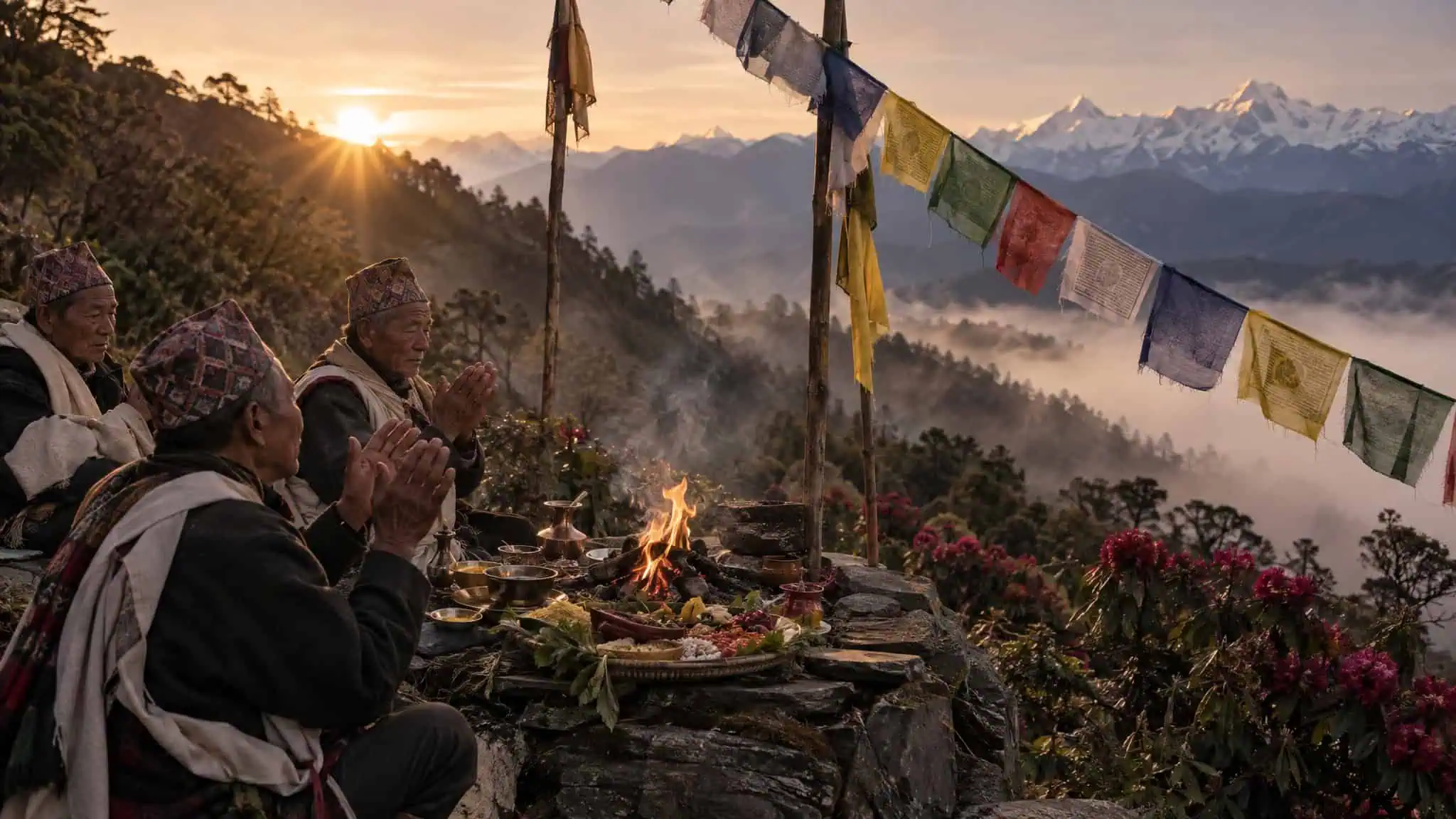
The windows are Chaitra-Baisakh (April-May) and Mangsir (November-December), timed by the lunar calendar and generations of observation. Before each hunt there’s a ceremony: sacred chants that are secret, known only to the hunters, plus prayers and offerings to forest gods. The ceremony includes an apology for taking resources from the forest. Read that again. The apology is the interesting part. It’s a take-only-what-you-need rule dressed in religious language, and it worked alongside other instincts like leaving some combs behind and not hammering the same cliff area twice.
The Gurung traditionally practice animism. They honor spirits of the mountains, rivers, forests, and bees. Mad honey shows up in their rituals, gets offered to deities, and is believed to deepen meditation. That last bit comes from promotional material, so I’m reporting it as what they believe, not as a verified effect.
Either way, the calendar, the apology, and the leave-some-behind rules added up to an implicit conservation system. Remember that, because we’ll get to what happened when it got stripped away.
Why the honey is “mad”: the bee, the flower, and the toxin
Mad honey is reddish, sticky honey that’s psychoactive because of grayanotoxins, which come from rhododendron nectar and get concentrated by the bee that makes it. Locals call it bhir mauri ko maha. Nepal is the famous origin, and Turkey is the other major one, which surprises people who assume this is purely a Himalayan thing.
Apis laboriosa, the giant Himalayan cliff bee
Apis laboriosa is the world’s largest honeybee, and it nests on sheer cliff faces at 13,000 to 14,000 feet, feeding on rhododendrons and wildflowers. Its range runs roughly 2,500 km along the southern edge of the Himalayas, which is an enormous strip of mountains for one insect, and over a third of the population sits in the Nepalese Himalayas. Nepal is the center of gravity for this bee. That feeding detail, the rhododendrons, is the whole story of why the honey does what it does.
Grayanotoxins: from rhododendron nectar to red honey
Here’s the chain. The rhododendron produces grayanotoxins in its nectar and pollen, probably as a defense against nectar-stealing insects. The bee collects the nectar anyway and concentrates the toxin in the honey. Flower, bee, jar. You eat the honey, the toxin messes with your heart’s electrical signaling like a wiring fault.
The open question is genuinely strange: scientists don’t know how the giant Himalayan bee tolerates a compound that could put a human in the hospital off a single tablespoon. Insects that feed on toxic plants usually pay some cost for the privilege, and nobody knows what this bee’s cost is. There’s research lined up to change that. One chemical ecologist working in Nepal, with more than ten years in insect-plant chemistry, plans to test honey by district and season for grayanotoxin levels and to find out which rhododendron species carry the highest toxin load. That’s the study that would actually answer the “how much is safe” question, and it hasn’t happened yet.
If you want the full chemistry and buying picture, our complete guide to mad honey covers it in more depth.
The dose: medicine, poison, and the margin between
Yes, mad honey really does lower blood pressure, rat studies back that up, but the dose that helps and the dose that hurts sit dangerously close together. There are no reported deaths in Nepal, but more than about a teaspoon slows heart rate and crashes blood pressure, and a few tablespoons can be life-threatening. Grayanotoxin interferes with the heart’s electrical signaling; symptoms (dizzy, nauseated, weak) hit within 30 to 60 minutes, treatment is IV fluids and atropine, and most people recover in a day or two. A review of 27 papers covering 68 patients from 2009 onward found that roughly 72% of poisoning victims are middle-aged men who ate the honey on purpose, treating it at home for blood pressure or sexual function. Small doses do bring relaxation and light euphoria, but the margin between “helps” and “hurts” is tiny and shifts by batch, season, and location.
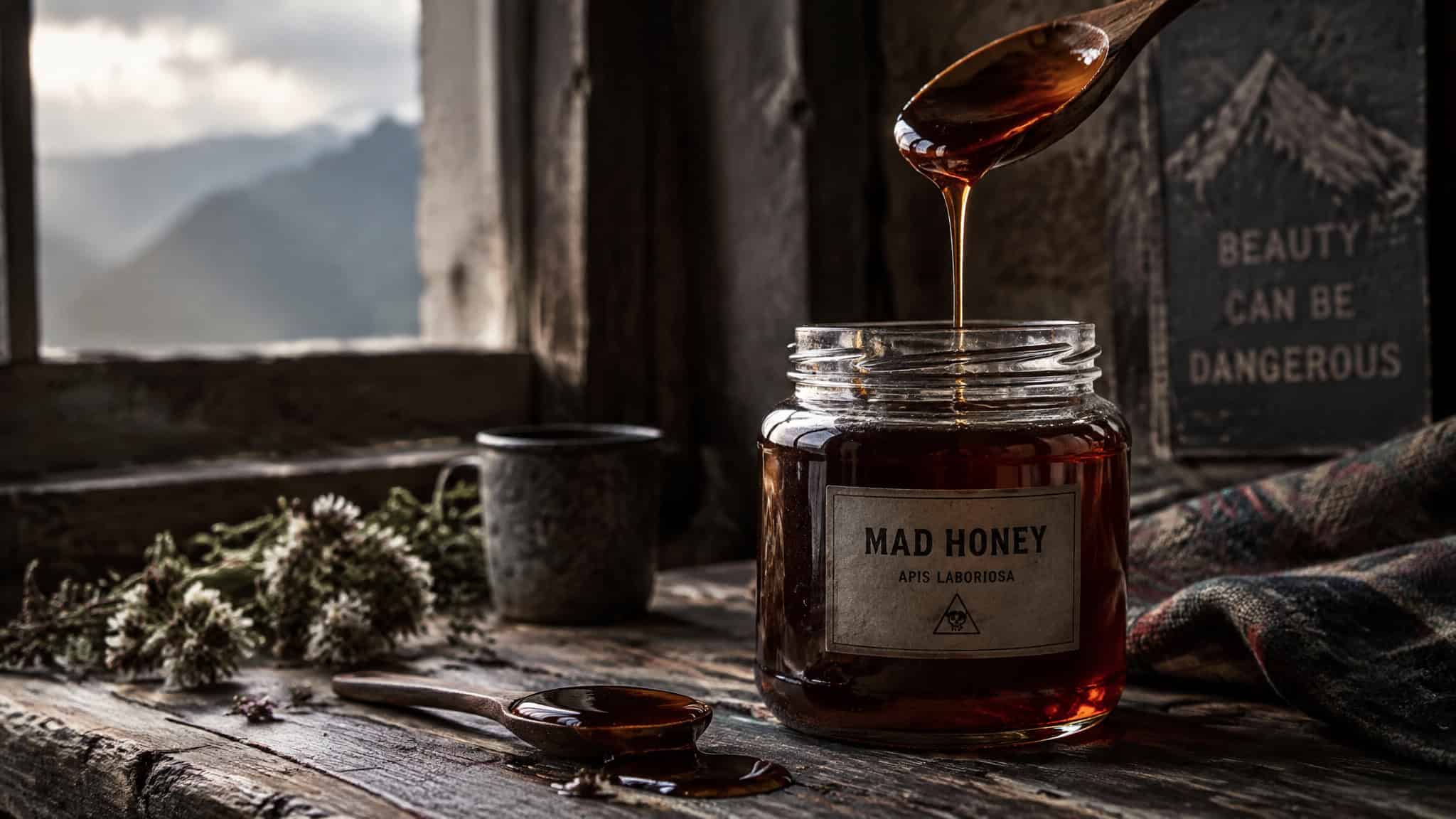
No label tells you where your jar sits on that spectrum, and that uncertainty is the real risk. The typical victim isn’t a curious tourist. He’s the wellness market’s core customer. One concrete case from the reporting: a friend’s father-in-law was hospitalized after eating wild honey from the Nepal hills, heart rate collapsed within about 30 minutes, and he recovered. Two patients at the same hospital on the same day in late October came from the same batch.
Red flag: If a seller won’t tell you the harvest district and season, you can’t know where your jar sits on the dose spectrum.
From cliff to global market: prices, mislabeling, and poisonings abroad
Mad honey is sold online as a psychoactive superfood at several hundred dollars per kilogram (up to $80 a pound by another estimate; prices vary), often with no safe-consumption warnings, to buyers in the US, Europe, and Asia. Some companies mislabel ordinary Himalayan honey as mad honey, and one recurring buyer complaint says it plainly: “Buying Mad Honey is not worth it.” If you’re going to buy anyway, the minimum bar is checking the label for grayanotoxins; real mad honey runs roughly double the effect of regular Himalayan honey. Our where to buy real mad honey guide goes deeper on spotting fakes.
The poisonings have traveled too: 15 cases from Nepalese honey were documented in South Korea as early as 2013, with confirmed cases in France and Qatar. The quiet danger abroad is that doctors seldom see it coming and patients never think to bring up the honey, which delays diagnosis. So, friend-to-friend: if you eat wild honey and feel wrong, tell the doctor what you ate. There’s a fuller medical breakdown in our mad honey poisoning symptoms piece.
What’s being lost: governance, not just culture
Yes, the tradition is disappearing, and the reason is that its rules have been dismantled since roughly 1990. Cliff ownership moved from Indigenous groups to the Forest Department and local government, which assign harvesting rights to contractors who take all the combs, per a 2004 ICIMOD report. The guys with the short-term incentive now hold the keys.
It’s not just outside pressure. Even on community-owned cliffs, younger generations skip the lunar calendar and strip every comb, according to Surendra Raj Joshi of ICIMOD, who has studied the bee since 2004. Bhujung’s own record proves it up close: the village once stopped honey hunting entirely because the bees got too scarce, then resumed with lower yields amid rampant logging and poaching, and villagers believe the honey is less potent as the forest degrades. Whether that potency drop is measurable, their quality check is the forest itself, which tells you something.
The honest read is that the tradition was never inherently sustainable. It ran on constraints: timing by the lunar calendar, gentle extraction, communal ownership. Each of those governing rules has been dismantled since about 1990, and the harvest changed accordingly.
The bee’s decline and the conservation vacuum
The giant Himalayan bee is in decline from climate change, habitat loss, and hydropower, and nobody is even counting. One bee scientist, Ratna Thapa at Tribhuvan University, has put the yearly population drop at 70 percent, a single-source estimate, but a stark one. And there’s no dedicated conservation project for the species anywhere. The threat stack is long: deforestation, pesticides, parasites, competition from introduced European honeybees, tourism pressure, forest fires, street lighting, and floods and landslides. Then there’s the sleeper threat. Nepal’s 10,000-megawatt power agreement with India means mega dam projects that wipe out the riverside nesting habitat the bee favors, while dam diversions alter the vegetation patterns it depends on.
The dam never touches the bee. It just breaks the chain one link down.
Ratna Thapa, a senior bee scientist at Tribhuvan University, estimated a 70% yearly population decline. That’s one man’s estimate, reported to Third Pole, single source, so treat it accordingly. The deeper problem is that no reliable baseline insect data exists across the Hindu Kush Himalayan region, and there’s no dedicated conservation project for Apis laboriosa. The world’s largest honeybee has zero dedicated protection. The stakes cascade beyond honey: this bee pollinates crops and wildflowers, including the rhododendrons it feeds on.
Tourism, film, and the tradition’s second life
Yes, tourists can join honey-hunting expeditions alongside Gurung hunters, timed to the April-May and November-December harvest windows, and there are also hive tours where you hike in and watch the cliff work from a safer distance. Whether you should is the obvious question, and I’m not going to answer it for you except to say this isn’t an adventure booking I’d frame as a bucket-list item.
The commercial side is a mixed record. Best Mad Honey, a Nepalese company under managing director Chintan Kafle, exports worldwide, runs hive tours, and has branched into alichai, ginger, and herbs, plus it has provided flowering trees to communities. Credit the concrete action. But even Kafle acknowledges that growing popularity may pressure the bee, and it’s unclear how much any of it helps while plenty of companies ignore sustainability entirely.
Media is the tradition’s other second life. The Last Honey Hunter is the one to watch if you want the human version of all this. And there’s a YouTube video, posted July 11, 2023, with 488,182 views on a channel of just 2.26K subscribers, filmed in Ghanpokhara, Lamjung according to comments from the Nepali diaspora, who name the hunter village Chipla and post greetings from Indonesia and west Borneo. Small channel, huge reach. The comments section alone proves the audience is global.
Where it all tips is the open question. The same global gaze that endangers the tradition also documents it and turns it into revenue. Tourism and film money could go toward bee recovery or toward faster extraction, and right now nobody knows which way it breaks. Maule Dhan Rai knew which way his own story broke, and he said it on camera: he did it because he was poor, and no one else would. The tradition deserves better than being remembered as a viral clip.
Frequently Asked Questions
What is mad honey from Nepal and why is it psychoactive?
Mad honey — locals call it bhir mauri ko maha — is reddish honey made by Apis laboriosa, the world’s largest honeybee, which nests on sheer Himalayan cliffs. It’s psychoactive because the bees feed on rhododendron nectar containing grayanotoxins and concentrate those toxins in the honey. Nepal is the famous origin, but Turkey is the other major source.
What does mad honey do to you in small doses?
Small doses bring relaxation and light euphoria, and rat studies support the blood-pressure-lowering effect. The problem is that no label tells you where your jar sits on the dose spectrum — toxin levels vary by harvest district and season. If a seller won’t tell you the harvest district and season, you can’t know what you’re actually taking.
Is the Gurung honey hunting tradition in Nepal disappearing?
Yes, and the reason is governance, not just culture. Since roughly 1990, cliff ownership moved from Indigenous communities to the Forest Department and local government, which assign harvesting rights to contractors who strip every comb — dismantling the traditional take-only-what-you-need rules. Even on community-owned cliffs, younger generations now skip the lunar calendar and take everything.