Walk into a barbershop without the right vocabulary and the menu turns into a guessing game. Fade and taper blur together in conversation. A crop and a buzz look identical in bad reference photos, and every style guide online invents its own list of names.
Two reference guides we pulled apart here at Unfinished Man promise to teach men how to get the right haircut. GT Vision’s “The Only Men’s Haircut Guide You Need in 2025 (Fades, Tapers, & Trends)“ breaks down every type of men’s haircut so you never get it wrong again. Zolven’s “Find The Perfect Hairstyle For Your Face | Best Haircuts For Men“ shows how to find the perfect hairstyle for your face. In Zolven’s telling, Hollywood actors and top models reportedly spend thousands, an unquantified figure in his pitch, on stylists who study their face shape to pick the right cut.
A regular guy doesn’t have a stylist on retainer, so he has to run those diagnostics himself. Every style below breaks down by its side system, its top, and who it actually suits, with space reserved under each entry for a single reference photo so you can spot the look and call it by name at the chair.
Key Takeaways
Order any barbershop style by naming its side system (bald, low, mid, or high fade, burst or drop variants, or a low or high taper) and top cut (crop, quiff, twist, side part, or flow), plus an edge finish (taper cleanup or sharp lineup).
Hair behavior and scalp visibility dictate what holds up: a 10-second scalp check separates thin hair (which needs shorter sides and light top texture) from thick hair (which holds big-volume cuts), while loose curly ringlets require taper or low fades rather than high fades.
A straight-on, no-smile selfie with your hair pulled back maps four facial measurements across six shapes (where most men land in oval or square) and three horizontal facial bands that you balance using fringe coverage, vertical hair height, and beard length.
Table of contents
Table of Contents
How men’s haircuts break down into categories
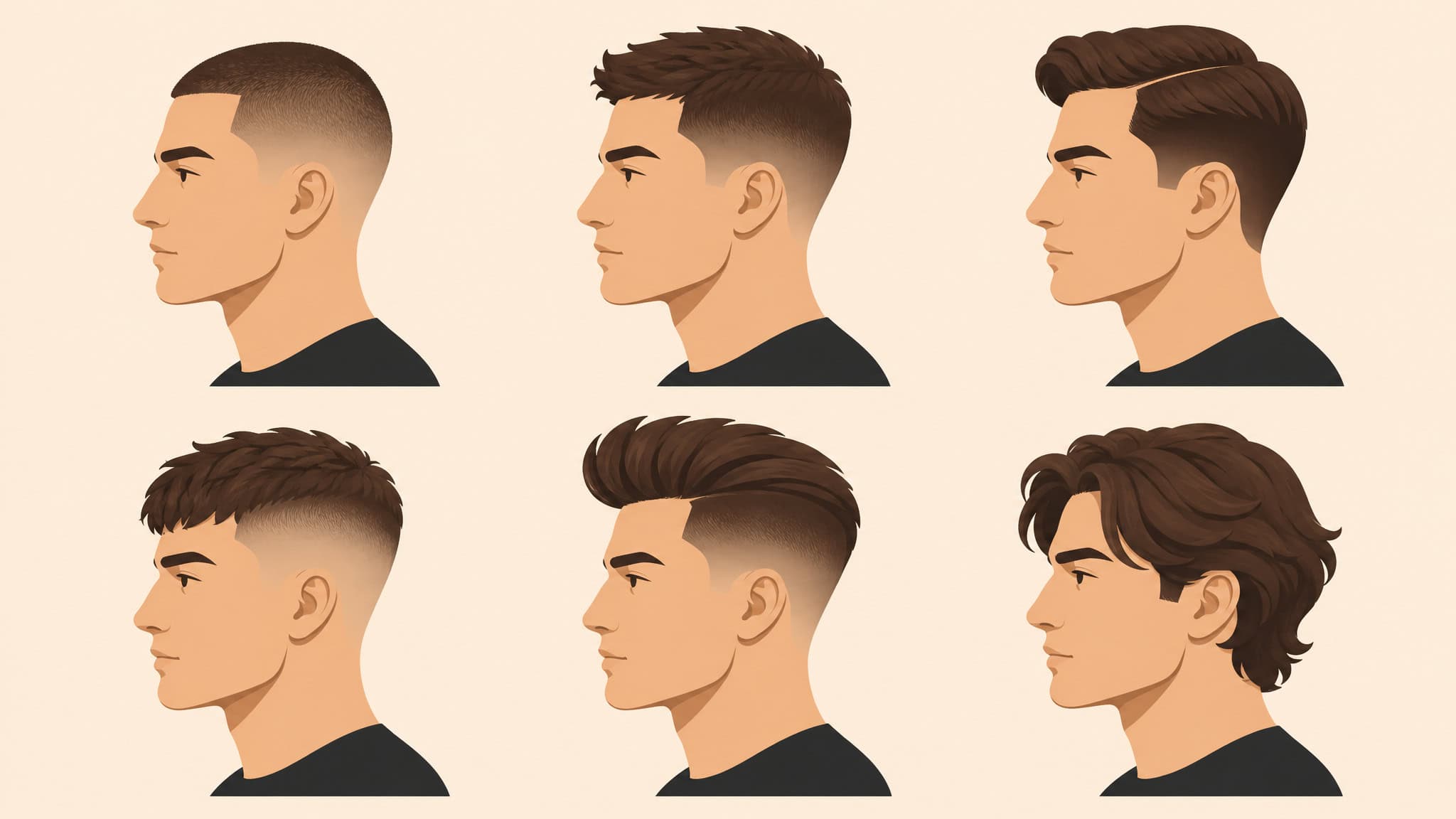
Men’s haircuts break down into six broad families defined by how the sides are blended and how much length sits on top: fades, tapers, short cuts, height and parting styles, medium-to-long flow styles, and textured-hair styles. Because barbershop names are just combinations of edge treatments, top lengths, and finishes, learning those three building blocks lets you identify any cut on sight and order it without memorizing 30 separate names.
The six broad style families
The six families cover fades, short crops and fringes (French crop, textured crop, curtain bangs, messy fringe), minimal short styles (buzz cut), vertical height and parting cuts (quiff, pompadour, slick back, side part), longer styles (modern mullet, layer cut, messy flow), and textured-hair staples (twist, waves, braids, short afro). Each entry below pairs its name with its visual markers: top length, fringe direction, and edge finish.
The three-axis working model
Instead of treating haircut names like a fixed master list, we use a plain-English working model (not an official barbering standard) built on three choices:
- The side system: Fade height (bald, low, mid, or high), shaped fade variants (burst or drop), or a taper (low or high).
- The top system is the length, natural texture, and fringe direction sitting on the crown.
- The finish: How the hairline and edges are detailed, such as a natural taper cleanup or a razor-sharp lineup.
Snap those three pieces together and the barbershop menu makes sense: a French crop with a mid fade, a drop fade with a twist, or a buzz cut with a sharp lineup.
Fade haircuts: bald, low, mid, and high
A fade haircut tapers the sides and back down into the skin. The four main versions differ by how high up the head that blend starts: at the skin line (bald), just above the ear (low), halfway up the sides (mid), or near the temples and crown (high). If you’re torn between low, mid, and high, get the mid fade; it splits the difference between a conservative office cut and aggressive contrast, whereas a low fade keeps things subtle and a high fade strips the sides tight.
GT Vision noted that fades were everywhere in 2025 and remain the cleanest way to upgrade your look. Even though his script claims three fade types, he actually walks through all four heights below, plus two curved variants.
Bald fade
The bald fade takes the blend straight down to bare skin for the sharpest, ultra-clean look on the spectrum. GT Vision notes that it works great on Black or Hispanic hair textures, and calls it a solid choice on straight, Asian, or white hair when you want an ultra-crisp, fresh finish.
Low fade
A low fade blends right above the ear. It’s subtle and keeps a professional look while still reading fresh. Low fades also work well on curly hair and square jaws. GT Vision calls a low fade with curls on top a go-to look for curly hair, and Zolven pairs a low fade with a side part for square faces.
Mid fade
The mid fade sits right between the low and high marks. It’s the safe default when you can’t decide how much skin to show. It forms half of GT Vision’s #1 2025 trend when paired with a French crop, and it also pairs cleanly with a messy top for wavy hair.
High fade
A high fade starts way higher up the head, leaving short sides and dramatic, aggressive contrast. Zolven pairs it alongside the quiff for round faces that need height on top and tight sides, though he warns that high fades ruin curly hair. GT Vision, looking at coily hair rather than loose curls, pairs a high fade with waves as a classic combination.
Burst fade
Rather than running in a straight band around the head, the burst fade curves around the ear. GT Vision pairs a burst fade with a twist as a go-to combination for curly hair.
Drop fade
The drop fade arcs downward behind the ear to follow the bone structure. GT Vision pairs a drop fade with a short afro as a coily-hair classic, and ranks a drop fade with a twist as his #2 2025 trend and one of his channel’s favorite looks for textured hair.
Taper vs fade
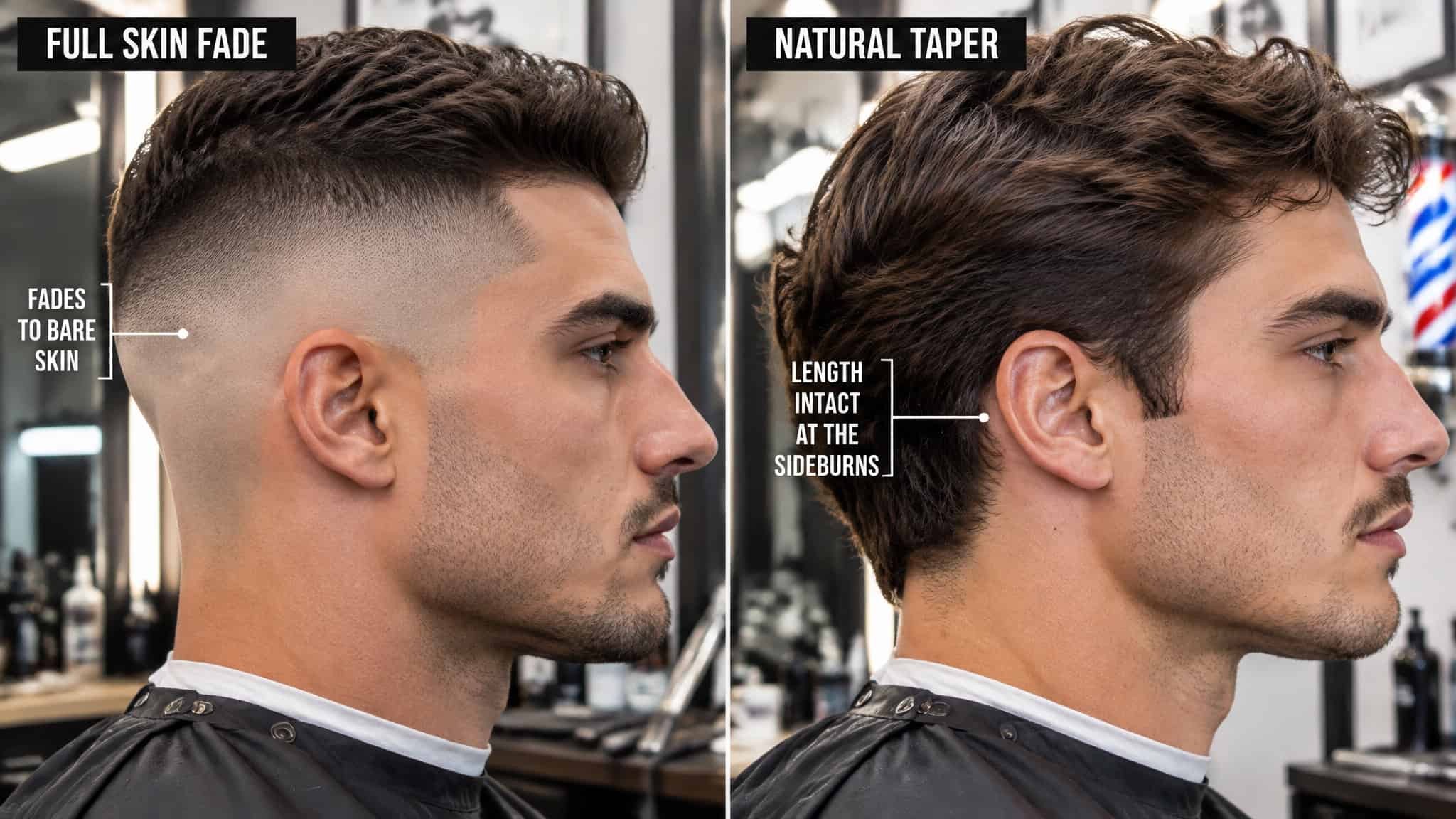
A fade blends the hair all the way into the skin, while a taper only cleans up the edges around the sideburns and neckline, leaving most of your hair length intact. GT Vision points out that guys mix these two terms up constantly at the shop, asking for a fade when they actually want to keep their side length, or asking for a taper when they expect skin-tight sides. If you want to understand how barbers step down clipper guards to build that gradual edge transition without skinning the sides, check out how the 3:2:1 haircut rule builds a natural taper.
Low taper
A low taper is the smart move for long hairstyles like braids, waves, or a flowy K-pop-inspired look. It adds crisp detail at the temples and neck without chopping off the length those styles rely on.
High taper
A high taper moves the blend higher up the temple than a low taper. It’s more noticeable and delivers a sharper look, all without committing your sides to a full fade.
Buzz cut and the sharp lineup
For men who want a low-maintenance short haircut, the strongest options are the buzz cut with a sharp lineup, the French crop, and the textured crop, along with shorter sides paired with light top texture if your hair is thin. Within that short-hair group, the modern buzz cut is defined by how the barber finishes the hairline rather than just the clipper blade length.
Buzz cut with a sharp lineup
GT Vision ranked the buzz cut with a sharp lineup as the #4 trend in 2025, calling it minimal, powerful, and zero daily maintenance (“just vibes”). Because there’s no top bulk to hide behind, your bone structure does all the work. Zolven matches the buzz cut directly to square faces, since stripping the hair back puts the focus straight onto a strong jaw.
Crop haircuts: French crop, textured crop, and fringes
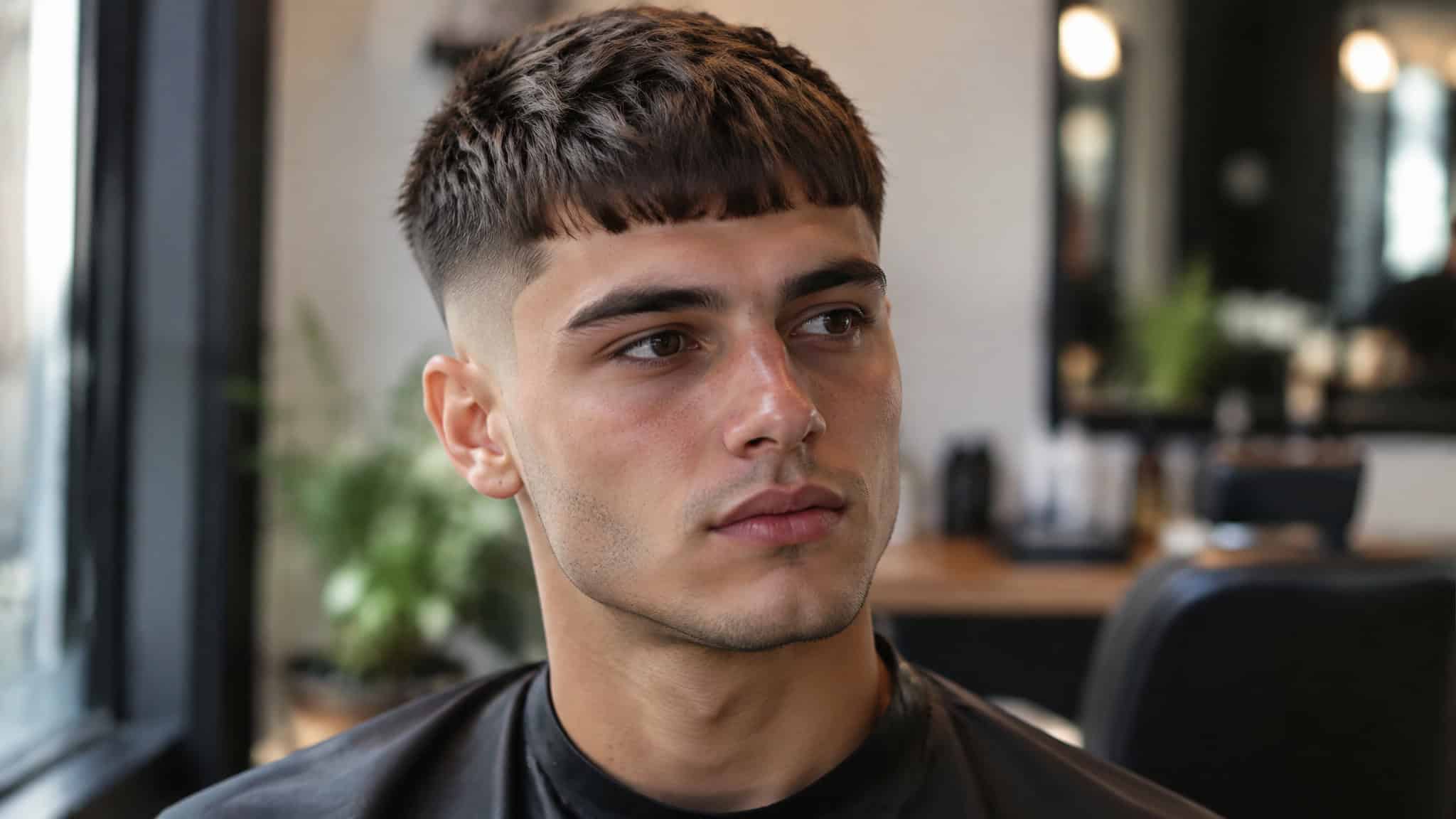
Crop haircuts keep the sides short and pull the top forward into a fringe, varying by how blunt, chopped, or parted that front edge sits. Across the family, the French crop pulls double duty as a major barbershop trend and a practical fix for forehead and jawline proportions.
French crop
Paired with a mid fade, the French crop took the #1 spot on GT Vision’s 2025 trend list because it looks super clean, takes very little effort to maintain, and works on straight or wavy hair. In Zolven’s proportion system, the French crop also solves two facial-thirds problems: its forward fringe covers a big upper third (a high forehead or receding hairline), and its low-to-medium volume balances a small lower third when paired with a well-shaped beard for jawline definition.
Textured crop
The textured crop haircut trades a blunt fringe for choppy, layered movement on top. Zolven puts it on his almost-anything list for oval faces, and GT Vision calls it his top pick for straight hair, noting it was huge in 2025.
Curtain bangs
Centered or off-center parted fringes that frame the forehead, curtain bangs sit alongside the textured crop and classic side part with a taper as GT Vision’s straight-hair picks that were huge in 2025.
Messy fringe
A messy fringe lets textured length fall forward and outward at the temples. Zolven recommends it (alongside longer layered styles) to add side volume that balances heart and diamond faces.
Height styles: quiff, pompadour, and slick back
A quiff, pompadour, or slick back acts like a geometric lever on your head, using vertical volume on top to visually stretch a short face or a small forehead. If you like these timeless gentleman haircuts, pick between them based on how much height your face actually needs.
Quiff
The quiff brushes length upward and forward at the front hairline. Zolven prescribes a quiff (or a high fade) for round faces, where equal face width and length need height on top and tight sides to elongate the silhouette.
Pompadour
The pompadour sweeps a full wave of hair upward and back from the brow. Zolven uses it to add vertical height when a forehead feels too small, stretching the upper third of the face. The classic pompadour also sits on his almost-anything list for oval faces.
Slick back
Combing the top straight back from the hairline does the exact same small-forehead stretching job as the pompadour in Zolven’s system, and it lands on his easy-default list for oval faces too.
Side part haircuts: the three pairings
Swapping the fade or taper on a side part adapts the same parted top for square faces, long rectangle faces, and straight hair.
Zolven uses two versions to solve opposite bone-structure problems. For a square face (strong jaw, equal width and length), he pairs a side part with a low fade, keeping the sides neat and professional without competing with the jawline. For a rectangle face (already long with straight sides), adding vertical height is a mistake, so Zolven drops the tight fade and recommends a medium-length side part or brushed-back style to keep the proportions grounded.
If you have straight hair, GT Vision points to a third build: the classic side part with a taper, which cleans up the edges without taking the sides down to the skin and was huge in 2025 alongside the textured crop and curtain bangs.
Medium and long haircuts: mullet, layers, flow
Growing your hair out past the ears opens up the only two styles in Zolven’s guide that carry a universal-flattery claim, alongside the go-to wave-preserving cut for medium length.
Modern mullet
The modern mullet keeps length at the back while trimming the temples cleaner than the vintage version. It’s one of only two haircuts Zolven names as looking good on anyone, calling it very trendy and a quick way to add charm.
Layer cut
Zolven’s second looks-good-on-anyone pick is the layer cut, scoped specifically to straight or wavy hair. It comes with one mandatory barbershop rule: because “layers” means ten different things, you have to tell your barber the exact type of layer cut you want.
Messy flow cut
Built for wavy hair, the messy flow cut either pairs a mid fade with a messy top or lets longer length flow back (often with a low taper) so soft S-waves can do their thing. GT Vision ranked it as the #3 trend in 2025, pointing to Timothée Chalamet and K-pop styles as the reference looks.
Textured-hair styles: twist, waves, braids, afro
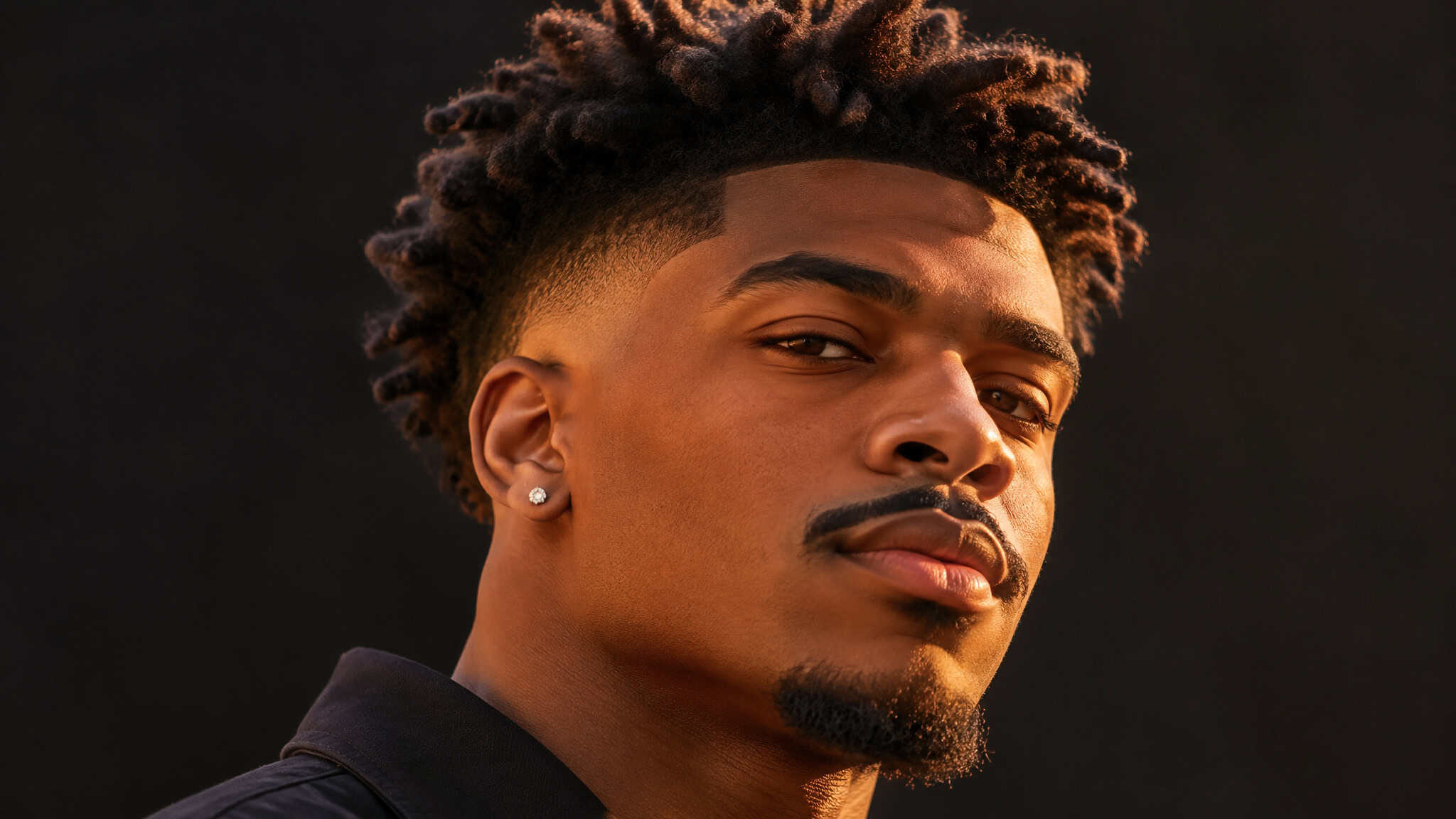
The best haircuts for Black men and coily or curly textures match the cut’s shape to how tight zigzags and ringlets naturally lock and hold volume. Coily hair locks into a high fade with waves, a drop fade with a short afro, or a twist with a taper, while curly and textured hair suits a burst fade or drop fade with a twist. Leading with hair behavior, GT Vision groups these pairings by coil and curl pattern (noting his coily pairings are worn mostly by Black men, his curly pairings mostly by Black or Hispanic men, and that a bald fade works great on Black or Hispanic textures).
Twist
Sponge or finger twists work across three different side systems in GT Vision’s catalog: paired with a burst fade as a go-to for curly hair, paired with a drop fade as the #2 2025 trend for textured hair, and paired with a taper as one of his three coily-hair classics that never miss.
Waves
Brushed-down waves show up twice in GT Vision’s system: paired with a high fade as the second coily-hair classic that never misses, and paired with a low taper when treated as a longer style that needs edge detail without losing coverage.
Braids
Because braids require preserved length across the scalp, GT Vision pairs them with a low taper to sharpen the temples and neckline without chopping the braids back.
Short afro
Paired with a drop fade that arcs behind the ear, the short afro rounds out GT Vision’s trio of coily-hair classics that never miss.
Matching the cut to your hair type
For curly hair, the best cuts are a low fade with curls on top, a burst fade with a twist, or a taper fade; for straight hair, the top picks are a textured crop, curtain bangs, or a classic side part with a taper (keeping the sides shorter with light top texture if your hair is thin). Are high fades a bad idea for curly hair?
Yes, if you have loose curly ringlets, unless you have tight coily hair styled into waves. Zolven warns that a high fade will ruin a curly-haired look and advises sticking to taper fades, whereas GT Vision recommends a high fade specifically for coily/kinky hair with waves; both guides agree that low fades flatter curly hair.
Walking into a shop with a photo of a guy whose hair behaves nothing like yours is the fastest way to hate a technically good haircut. Zolven breaks hair into four types based on behavior (calling straight, wavy, and curly the three most common, with coily as the fourth) and pairs that check with a 10-second thickness test: separate a small section of hair and look at your scalp. Lots of visible skin means thin hair, while barely any visible skin means thick hair.
| Hair Type | Behavior | Thickness / Volume Rule | Recommended Cuts |
|---|---|---|---|
| Straight | Lies flat and shines easily | Thin straight hair needs shorter sides with light texture on top | Textured crop, curtain bangs, classic side part with taper (GT Vision, noting typically Asian or white men); layer cut (Zolven) |
| Wavy | Forms soft S shapes | Thick wavy hair holds big-volume cuts | Mid fade with messy top, messy flow cut (GT Vision, noting mixed, Spanish, or white men); layer cut (Zolven) |
| Curly | Makes clear ringlets | Suits taper fades and low fades; high fades ruin the look (Zolven) | Low fade with curls on top, burst fade with twist (GT Vision, noting mostly Black or Hispanic men); taper fades (Zolven) |
| Coily | Forms tight zigzags | Holds structured geometric fades and short tapers | High fade with waves, drop fade with short afro, twist with taper (GT Vision, noting mostly Black men) |
Straight hair
Zolven calls straight hair the lucky type because it styles however you want, provided you adjust for density with shorter sides and light top texture if your scalp shows easily.
Wavy hair
Soft S-waves naturally build movement, so thick wavy hair easily supports big-volume cuts or a longer flow.
Curly hair
Clear ringlets need side support so the top doesn’t look disconnected, making low fades, burst fades, and taper fades the reliable plays.
Coily hair
Tight zigzags lock into clean geometric shapes, which is why GT Vision calls the high fade with waves, drop fade with short afro, and twist with taper classics that never miss.
Matching the cut to your face shape
To choose a haircut that fits your face shape, you first have to measure four facial widths and lengths on a neutral selfie, a check that puts most men into either the oval or square category.
The four-measurement selfie protocol
When guys eyeball their face in the mirror, they usually botch the setup: smiling widens the cheeks, leaving hair down hides the forehead, and tilting the phone warps the jaw. Zolven’s DIY test fixes that. Pull your hair back, keep a deadpan face with no smile, and take a straight-on selfie. Draw straight lines on the photo to compare four measurements: forehead width, cheekbone width, jawline width, and overall face length. Don’t overthink the lines; most guys land in oval or square, so just pick the closest match.
Oval, square, and round matches
- Oval (slightly longer than wide): Fits almost anything, including a textured crop, slick back, or classic pompadour.
- Square (strong jaw, equal width and length): Suits a low fade with a side part, or a buzz cut that shows off the jaw.
- Round (length and width almost identical): Needs height on top with tight sides, such as a quiff or a high fade.
Rectangle, heart, and diamond matches
- Rectangle (long with straight sides): Skip excess top height and balance the length with a medium-length side part or brushed-back style.
- Heart (wide forehead, narrow chin) & Diamond (sharp cheekbones, narrow forehead and chin): Both need side volume via longer layered styles or a messy fringe.
Facial thirds: the proportion layer
Zolven’s three-band horizontal check brings your forehead, nose, and beard into the haircut decision when an uneven forehead or chin throws off your proportions. Split your face horizontally into three bands: hairline to eyebrows (upper third), eyebrows to the bottom of the nose (middle third), and bottom of the nose to the chin (lower third). Keeping all three visually equal is what Zolven pitches as the secret trick top stylists and models use.
Upper and middle third adjustments
- Big upper third (high forehead or receding hairline): Cover the forehead with a forward fringe like a French crop.
- Small upper third (small forehead): Pull the hair upward with a pompadour or slicked-back look to visually stretch the forehead.
- Long middle third: Leave the forehead completely visible and grow a slightly longer beard to pull visual weight downward.
Lower third and beard adjustments
- Big lower third: Keep medium-to-long volume on top to draw the eyes upward, and keep your beard short or faded.
- Small lower third: Go with a low-to-medium volume cut like a French crop and grow a well-shaped beard to add jawline definition.
Which haircut is best for a man?
Choosing the best haircut for a man starts with Zolven’s two universal defaults, the modern mullet or the layer cut, or his four-step diagnostic if you want a custom fit.
If you have an oval face, almost any style in this catalog works right out of the box. If you want a trendy cut that flatters any face shape without measuring, Zolven names two options: the modern mullet (which adds easy charm) and the layer cut (which works on straight or wavy hair, provided you tell the barber the exact type of layer cut you want).
For everyone else, Zolven’s four-step sequence picks the winner in order:
- Measure your face shape using the straight-on selfie test.
- Check your hair type (straight, wavy, curly, coily) and scalp visibility for thickness.
- Balance your facial thirds using fringe coverage, top height, and beard length.
- Pick the matching cut from the catalog.
What to ask for at the barbershop
Walking in and asking for “a fade” stalls the conversation immediately, because the barber still has to ask how high to take the blend and what to do with the top. Give your barber a complete spec in one sentence by combining three parts: side system + top cut + edge finish. Specify your fade height (bald, low, mid, or high, defaulting to a mid fade when unsure) or taper (low or high), name the top style (French crop, quiff, twist, side part, or an exact layer cut), and call your finish (taper cleanup or sharp lineup).
Men’s haircut trends: the four named combos
The men’s haircut styles driving current trends here in late 2026 carry forward the four baseline combinations from GT Vision’s 2025 benchmark: the French crop with a mid fade, the drop fade with a twist, the messy flow cut, and the buzz cut with a sharp lineup. Each of those four combos earned its spot because it solves a specific maintenance or texture problem:
- French crop with mid fade: Ranked #1 in GT Vision’s 2025 lineup because it stays super clean, requires minimal daily effort, and works on straight or wavy hair.
- Drop fade with twist: Ranked #2, pairing a curved behind-the-ear blend with sponge or finger twists as one of the channel’s favorite looks for textured hair.
- Messy flow cut: Ranked #3, pairing either a mid fade with a messy top or a low-tapered longer flow that lets wavy hair move naturally, modeled on Timothée Chalamet and K-pop styles.
- Buzz cut with sharp lineup: Ranked #4, delivering a minimal, high-contrast look with zero styling maintenance.
Decision shortcuts: Pinterest and ChatGPT
If you don’t want to cross-reference charts, Zolven offers two quick shortcuts to generate a barbershop reference photo, though both have practical limits.
Pinterest search
Once you know your face shape and hair type, Zolven’s low-effort move is typing "hairstyles for your face shape" into Pinterest, picking a photo you like, and taking it to the barber. You still have to know your shape first for the search to work.
ChatGPT photo analysis
Zolven also suggests uploading a selfie to ChatGPT alongside a styling prompt (which he gated behind his video’s description link rather than showing on screen) so the AI acts like a stylist, though drawing four straight lines on a selfie yourself takes two minutes and doesn’t require hunting down a prompt.
Frequently Asked Questions
What is a fade haircut and how do low, mid, and high fades differ?
A fade gradually blends the hair on the back and sides down to bare skin, and the name changes based on where that transition begins on your head. A low fade starts right above the ears for a subtle, office-ready finish, while a high fade climbs up toward the temples and crown for heavy contrast. A mid fade splits the difference halfway up the sides, whereas a bald fade drops the blend straight down to skin level.
What is the difference between a taper and a fade?
A fade takes the hair across the sides and back all the way down into the skin, stripping away most of your side bulk. A taper only blends the tight perimeter at your sideburns and neckline, leaving the rest of your length on the sides intact. If you wear longer styles like braids, waves, or a flow, ask for a taper so the barber only sharpens your edges.
What are the best haircuts for men with straight hair?
Straight hair responds best to a textured crop, curtain bangs, a classic side part with a taper, or a specific layer cut. Because straight strands lie flat and reflect light easily, you should match the cut to your density by separating a bit of hair to check your scalp. If a lot of skin shows through, ask for shorter sides and light texture on top so the style does not fall flat.
What are the best haircuts for men with curly hair?
Loose curls and ringlets look best paired with a low fade, a taper fade, or a burst fade that curves around the ear into a twist on top. Ringlets need gradual weight on the sides so the crown does not look disconnected from the rest of your head. Skip high fades on loose curls, as stripping the sides too high ruins the overall shape.
Which haircut types work best for black men?
Coily hair locks naturally into structured, geometric cuts like a high fade with waves, a drop fade with a short afro, or sponge and finger twists paired with a taper. For curly or textured patterns, a burst fade or behind-the-ear drop fade with twists on top works well, while braids pair cleanly with a low taper that details the temples and neck without cutting into your length. When you want maximum contrast at the edges, a bald fade also delivers a razor-sharp finish.
What are the best haircuts for men with short hair?
The cleanest low-maintenance short styles are a buzz cut finished with a sharp lineup, a French crop, and a choppy textured crop. A buzz cut strips away top volume completely, putting all the focus on a strong, square jawline with zero daily styling. If you want a little length in front to hide a high forehead or receding hairline, a French crop with a mid fade keeps the sides tight while pulling a blunt fringe forward.
How do I choose a haircut that fits my face shape?
Pull your hair back, keep a neutral expression without smiling, and take a straight-on selfie to compare your forehead width, cheekbones, jawline, and total face length. Most men land in the oval category (which suits almost any style) or the square category (which pairs well with a buzz cut or a low-faded side part), while round faces need a quiff or high fade for vertical stretch and long rectangle faces need a medium side part without extra top height. You can then fine-tune the pick by checking your horizontal facial thirds, using a forward fringe like a French crop to cover a tall forehead or upward volume like a pompadour to stretch a short one.
Which hair cut is best for a man?
If you want a style that flatters any face shape without taking measurements first, the two universal defaults are a modern mullet and a layer cut (on straight or wavy hair, provided you specify the exact layering style to your barber). Men with oval faces can also wear almost any standard barbershop cut right out of the gate, including a slick back, pompadour, or textured crop. For a custom fit, match your selfie face-shape check with a 10-second scalp thickness test and adjust your fringe or beard to balance your forehead, nose, and chin.