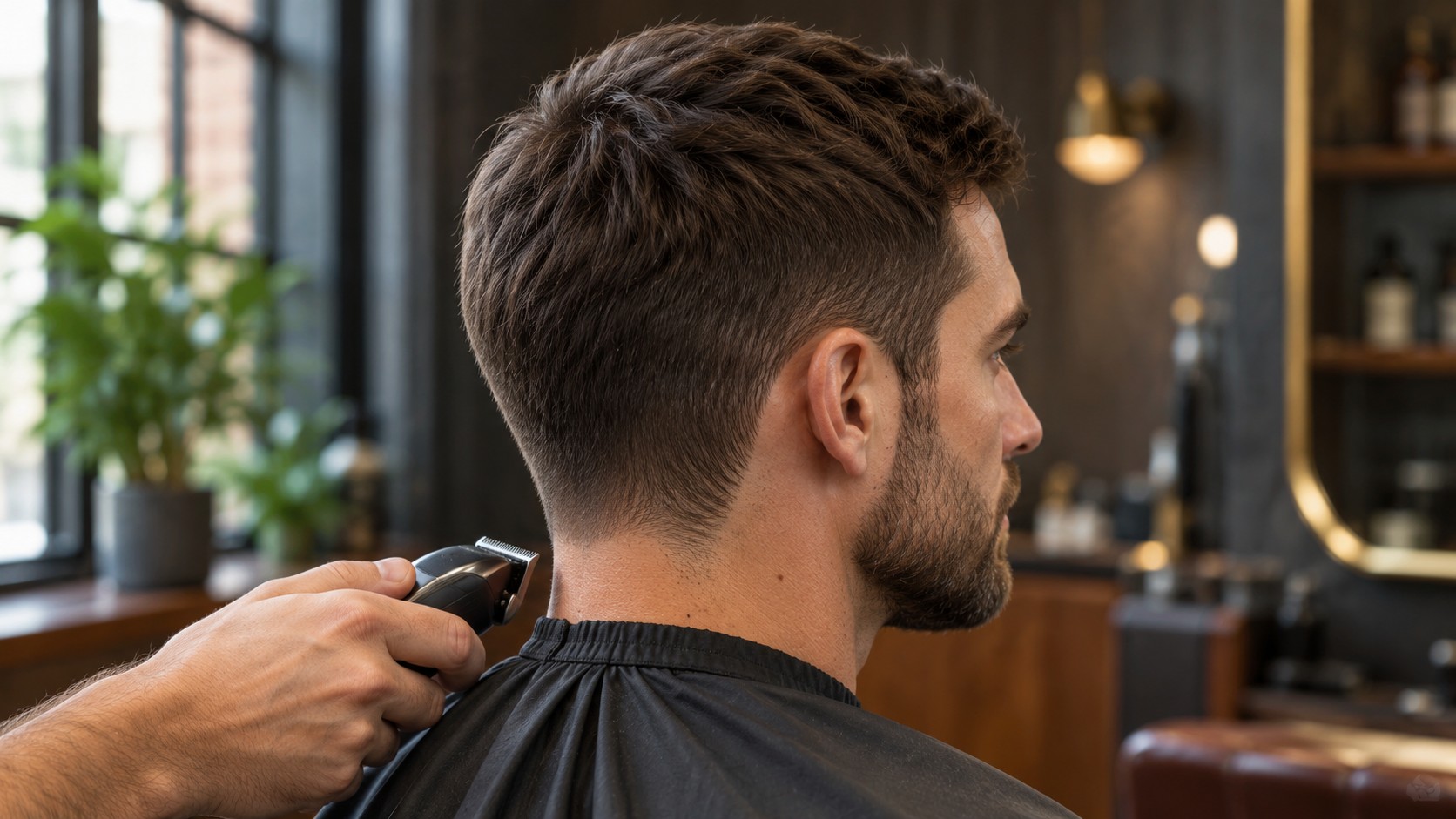
You’re in the chair, cape snapped, and the barber catches your eye in the mirror to ask which guard number you want on the sides. Guessing wrong means living with a peeled scalp for the next three weeks.
The 3:2:1 haircut rule means working clipper guards #3, #2, and #1 down the sides and back, starting with #3 highest and stepping down to #1 at the perimeter, to build an even taper in three 1/8-inch steps: 3/8 inch (about 9.5 mm), 1/4 inch (6 mm), and 1/8 inch (about 3 mm). Here at Unfinished Man, we treat those numbers as a simple system of fractions, head zones, and one clear sentence for the chair.
Key Takeaways
The 3:2:1 haircut rule steps three consecutive clipper guards down the sides and back: #3 (3/8 inch, about 9.5 mm) at the top of the sides, #2 (1/4 inch, 6 mm) through the middle, and #1 (1/8 inch, about 3 mm) at the perimeter.
Every clipper guard number equals 1/8 inch of hair length on a straight linear scale from #1 (1/8 inch) to #8 (1 inch, about 25 mm), while a #0 guard cuts 1/16 inch and a bare blade with the lever closed cuts 0 inches.
Because “3-2-1” can also mean a #3 on top with a #2 on the sides, always name the head zone for each guard out loud and request the longer guard first when you’re unsure.
Table of contents
Table of Contents
What the 3:2:1 haircut rule means
The 3:2:1 haircut rule is a three-guard clipper progression that builds a graduated taper down the sides and back of the head. Barbers use this three-step sequence as informal shop shorthand for a clean, graduated cut rather than an official industry specification, working from the longer #3 guard down to the #1 to prevent harsh horizontal lines. Every clipper guard number equals 1/8 inch of hair length and scales linearly, so lower numbers always cut shorter:
- #3 guard at the upper sides: Leaves 3/8 inch (about 9.5 mm) where the sides meet the top.
- #2 guard through the middle: Steps down to 1/4 inch (6 mm) across the mid-sides and back.
- #1 guard at the perimeter: Tightens the edges to 1/8 inch (about 3 mm) along the temples and neckline.
That 1/8-inch math runs in a straight line across the entire rack: #1 (1/8 inch), #2 (1/4 inch), #3 (3/8 inch), #4 (1/2 inch), #5 (5/8 inch), #6 (3/4 inch), #7 (7/8 inch), and #8 (1 inch).
The 3-on-top, 2-on-sides buzz formula
A 3 on top, 2 on sides haircut is a uniform buzz-cut formula that puts a #3 guard (3/8 inch) across the crown, a #2 guard (1/4 inch) on the sides, and a #1 (1/8 inch) at the neckline and edges. That makes it a full-head buzz rather than a side-and-back taper, which stacks all three guards down the sides and leaves the top out of the count. Because both meanings circulate in barbershops, say out loud where each number goes on your head.
Clipper guard numbers in inches and millimeters
A number 2 haircut is 1/4 inch (6 millimeters) of hair, and a number 3 haircut is 3/8 inch (about 9.5 millimeters) within the standard 1/8-inch-per-guard clipper system. The practical guarded range runs from 1/4 inch to 1 inch, where each guard number adds one 1/8-inch increment. A #2 guard is the recommended introduction to a shorter cut and the last guard before a lot of scalp shows, hiding skin in normal light while revealing it under bright lighting, whereas a #3 guard marks the ceiling of the 3:2:1 rule and the entry to the #3 to #4 blending bridge.
Below the #1 guard, the floor of the system splits into two distinct settings: a #0 guard attachment cuts 1/16 inch (about 1.5 mm, as close to skin as possible without going bald, and reaching 1/8 inch with the lever open), while a bare blade with no guard and the lever closed leaves 0 inches, which is skin length. Because 3:2:1 uses three consecutive rungs on the linear ladder, each step drops by 1/8 inch, and the bottom #1 step sits a full 1/8 inch above bare skin. In video demonstrations, presenter TheSalonGuy calls the #8 guard “finger length” because its 1-inch cut matches what scissors and a comb leave, noting it cuts a whole head quickly at home unless heavy product in the hair keeps the pass from cutting cleanly.
| Guard Setting | Length (Inches) | Length (Millimeters) | Role in or Outside the 3:2:1 Taper |
|---|---|---|---|
| Bare blade (no guard, lever closed) | 0 in | 0 mm | Outside 3:2:1; skin-fade floor, only for true skin length |
| #0 guard (lever closed) | 1/16 in | ~1.5 mm | Outside 3:2:1; near-skin buzz floor (1/8 in with lever open) |
| #1 guard | 1/8 in | ~3 mm | Bottom step of 3:2:1; tightens temples and neckline |
| #1.5 guard (sold separately) | 3/16 in | ~4.8 mm | Optional half-step bridge between #1 and #2 |
| #2 guard | 1/4 in | 6 mm | Middle step of 3:2:1; shortest guard before heavy scalp exposure |
| #3 guard | 3/8 in | ~9.5 mm | Top step of 3:2:1; entry to the 3 to 4 blending bridge |
| #4 guard | 1/2 in | ~13 mm | Outside 3:2:1; caps the 3 to 4 blending bridge with full coverage |
| #5 guard | 5/8 in | ~16 mm | Outside 3:2:1; pairs with #6 for controllable texture |
| #6 guard | 3/4 in (6/8 in) | ~19 mm | Outside 3:2:1; pairs with #5 for textured styles needing product |
| #7 guard | 7/8 in | ~22 mm | Outside 3:2:1; high-volume length requiring daily styling |
| #8 guard | 1 in | ~25 mm | Outside 3:2:1; finger-length top or fast whole-head home cut |
What each guard band does on the head
The guard rack splits into three zones, and the split comes down to two things: how much scalp you’re covering and how much morning effort you’re signing up for. That’s why the 3:2:1 rule stops at #3 and #1. Moving up those zones takes a cut from zero-effort buzz territory to lengths that rely on daily styling products like salt spray or strong hold wax.
Guards 0-2: buzz-cut territory
Running from a bare blade to 1/4 inch, this military-grade buzz-cut zone delivers sharp lines and zero maintenance for time-poor guys: shower and walk out, with no day-to-day look changes. Guards #1 and shorter expose scalp in normal light, while #2 hides it in bathroom light but lets skin show through under bright lighting.
Guards 3-4: the blending bridge
At 3/8 to 1/2 inch, the #3 guard and #4 guard form the blending bridge barbers use to connect tight side fades into longer top hair with full scalp coverage and no morning wax or spray.
Guards 5-8: length that costs daily product
From 5/8 inch to 1 inch, hair holds enough mass for a textured crop haircut or pompadour, where salt spray or strong hold wax is mandatory to keep it from lying flat.
3:2:1 taper vs skin fade and single-guard cuts
A 3:2:1 taper bottoms out at a #1 guard (1/8 inch, about 3 mm of hair), making that visible perimeter band the decisive difference when choosing between a 3:2:1 taper and a regular skin fade. Across the broader types of haircuts for men, pairing a taper with a fade comes down to how much skin you want exposed around your ears and collar. A 3:2:1 keeps a soft shadow of hair along the edges, whereas a skin fade drops below the numbered guard ladder to a #0 guard or a bare blade for zero length.
- Guard range: A 3:2:1 taper steps down through guards #3 (3/8 inch), #2 (1/4 inch), and #1 (1/8 inch); a skin fade blends down to a #0 guard (1/16 inch) or a bare blade with the lever closed (0 inches).
- The tell is the bottom band. A 3:2:1 leaves a 1/8-inch strip of hair at the temples and neckline, while a skin fade erases that perimeter line into bare skin.
- Scalp exposure and daily styling: Both options require zero morning product on the sides, but a 3:2:1 softens scalp contrast while a skin fade highlights every contour of the skull.
- Grow-out and maintenance cadence: The #3 to #4 blending bridge grows out fast and needs regular barber visits to keep its edge crisp, though a 1/8-inch perimeter looks less stark as it grows in than shaved skin transitioning back to stubble.
What a 0 cut actually leaves
A 0 cut is either a bare clipper blade with no guard and the lever closed, leaving 0 inches of hair (skin), or a #0 guard attachment, which leaves 1/16 inch of hair and reaches 1/8 inch when the lever is opened. Barbers warn against asking for a bare-blade zero unless you explicitly want skin showing, because it strips away the entire 1/8-inch buffer that a #1 guard leaves at the bottom of a 3:2:1.
One number all over vs. three numbers stepped
Asking for a single guard all over, such as a uniform #2 buzz cut at 1/4 inch, takes bulk off at one flat depth across the entire head with no graduation. A 3:2:1 progression steps down in three 1/8-inch increments, preserving 3/8 inch of weight at the upper sides while tightening the lower edges. Guard heights can vary slightly across clipper brands and blade setups, so these side-by-side comparisons hold within a single standard 1/8-inch guard system rather than acting as universal micrometer readings across every manufacturer.
When 3:2:1 doesn’t suit your hair
A #1 guard (1/8 inch) makes your scalp show in normal light, and thin or fine hair makes every guard on the rack read shorter and expose more skin than thick, dark hair. When the standard 3:2:1 rule looks too bare or too bulky for your hair type, the fix is matching your hair density with a guard number shift across the entire three-number sequence rather than swapping a single guard.
How a guard length reads on the head is subjective and shifts with hair thickness, density, and color. In on-camera demonstrations, a model with fine, dirty-blonde hair had every guard length look noticeably shorter than the exact same guards used on thick, dark hair.
A #4 guard (1/2 inch) reads dark and full on thick hair, but on fine hair it reads lighter and lets the scalp show through. Keep the 1/8-inch stepping pattern intact and move the whole ladder: step up to a 4:3:2 progression for fine or light hair that needs fuller scalp coverage, or drop down to a 2:1:0 progression on thick, dense hair when you want a tighter fade.
The maintenance trade-off behind the numbers
Short guard cuts like a 3:2:1 require less daily styling than longer haircuts, because guards #1 through #4 need zero morning product while trading away day-to-day styling options and requiring regular trims to keep the blended edge sharp. The way we look at it, knowing the fractions lets you forecast your morning routine before the clippers turn on. The 3:2:1 sequence straddles the pivot point of the rack: its lower #1 and #2 steps sit in shower-and-go territory, while its #3 top step sits in the #3 to #4 bridge, which looks refined and professional without wax or spray but grows out fast along the blend line.
Start with one question: will you use hair product every day?
- No daily product, and seeing scalp is fine: Choose #1 or #2 (1/8 to 1/4 inch) for pure function and zero morning routine.
- No daily product, but you want full scalp coverage without morning hassle: Choose #3 or #4 (3/8 to 1/2 inch) for a clean office-ready finish.
- Willing to use daily product for an easy-to-control textured look: Choose #5 or #6 (5/8 to 3/4 inch) and keep strong hold wax or salt spray on the counter.
- Willing to commit to daily product and a dedicated styling routine for maximum volume: Choose #7 or #8 (7/8 to 1 inch) for crops and pompadours.
Cutting a 3:2:1 taper at home
Basic single-guard clipping is easy at home, whereas cutting a clean 3:2:1 taper yourself takes pro-level tool investment and practiced hand feel to erase the 1/8-inch ledges between the three guards. The hardest part is the 1-to-2 fade haircut, which is the detail-critical transition between the #1 guard (1/8 inch) and #2 guard (1/4 inch) at the lower perimeter, bridged at 3/16 inch by an open clipper lever or a #1.5 guard.
The guideline-first sequence
The easiest foolproof routine starts by snapping on a #1 guard to set the first guideline around the perimeter, then working down from the longer guards to blend into that base.
The lever is the hidden blending tool
Demonstrated on a Wahl Chrome clipper, the side lever controls blade height: pushed toward the blade (closed) delivers the guard’s base length, and pushed away (open) raises the blade for a half-step length (#1 closed is 1/8 inch, #1 open is 3/16 inch; #0 closed is 1/16 inch, #0 open is 1/8 inch). Closing the lever returns the blade to its base length.
The #1.5 guard you have to buy separately
Standard home kits come with a storage case and guards #1 through #8, skipping the crucial 1-to-2 and 0-to-1 blend points. To get a dedicated 3/16-inch blend without guessing lever angles, you have to buy the #1.5 guard separately (along with a separate very-short “half” guard for the 0-to-1 step).
What the blend actually demands
Even stylists can feel intimidated by clippers because freehanding three guards leaves faint horizontal ledges unless you work the lever up and down with confidence and a more aggressive hand. The demonstrations ran on the professional-grade Wahl Clipper 100th Anniversary Edition with metal attachments, an expensive pro tool, and building real fading feel comes down to watching videos and practicing on mannequins over years.
How to ask your barber for a 3:2:1
Asking for a 3:2:1 haircut means stating each guard number alongside its exact placement on your head out loud, separating the top from the sides, and requesting the longer guard number first whenever you’re unsure. Barbers use guard numbers as a shared measurement code, but walking in and asking to “take it down to a 3” or “give me a 3-2-1” leaves the placement blank. To make sure you walk out with a graduated side taper rather than an accidental buzz cut, run through this four-part chair script:
- Call the side progression from top to bottom: Ask for a “#3 at the upper sides, tapered down to a #2 through the middle, and a #1 at the temples and neckline.”
- Lock in the perimeter floor: Specify that the #1 guard (1/8 inch) is the shortest setting at the edges so the barber doesn’t drop to a #0 guard or bare-blade skin fade.
- Separate the top from the sides: Tell the barber how you want the crown handled, whether that’s scissor work, a specific length in inches, or a #8 guard (1 inch, finger length), so the #3 isn’t misread as your top length.
- Adjust the ladder for your hair biology: Ask for a 4:3:2 taper instead if you have fine or light-colored hair and want full scalp coverage under bright office light or daylight.
Unplaced numbers fail in the chair because top-down and bottom-up shorthand conventions shift from shop to shop and across regions. Barbers themselves debate what a client means when he sits down and calls out bare numbers: one barber hears a #3 on top with a #2 and #1 faded down the sides, while another hears a side-only progression and waits to hear what happens on the crown. Laying out the zones in plain English removes the guesswork in ten seconds.
When you’re torn between two lengths, ask for the longer guard first: it’s one-way math. If you can’t decide between a #6 and a #4, or between a 4:3:2 and a 3:2:1 on the sides, always start with the higher guard number. A barber can easily drop a #6 down to a #4 on the next pass, but he can’t glue a #4 back into a #6. Shortening is reversible; lengthening isn’t.
Frequently Asked Questions
What does 3 2 1 mean in a barber’s chair?
In a barbershop, 3:2:1 is shorthand for stepping three consecutive clipper guards down the sides and back of your head to build a smooth taper. Your barber uses a #3 guard (3/8 inch) at the upper sides, a #2 (1/4 inch) through the middle, and a #1 (1/8 inch) along the neckline and temples. Because some shops also hear those numbers as a full-head buzz formula, we always recommend stating the exact head zone for each guard out loud.
Is 3:2:1 a top-and-sides formula or a back taper?
It can mean either depending on the shop, which is why dropping bare numbers in the chair is a gamble. As a taper, all three guards stack down the sides and back—from #3 at the top of the sides to #1 at the edges—leaving your top hair out of the equation. As a buzz-cut formula, it puts a #3 across the crown, a #2 on the sides, and a #1 around the perimeter.
How long is a number 2 haircut in mm?
A number 2 clipper guard leaves 6 millimeters (1/4 inch) of hair. Within the standard 1/8-inch-per-guard system, a #2 serves as the middle rung of a 3:2:1 taper and is the shortest guard you can use before heavy scalp exposure kicks in. It covers skin under normal bathroom lighting, though bright overhead light will still let some scalp show through.
What is a 3 in haircut?
A number 3 haircut uses a #3 clipper guard to leave 3/8 inch (about 9.5 mm) of hair. It serves as the highest step on the sides in a 3:2:1 taper and marks the entry to the #3-to-#4 blending bridge that connects short sides into longer top hair. At this length, you get full scalp coverage and a clean, office-ready look without needing daily wax or spray.
What is the length of a 4-guard haircut?
A #4 guard cuts hair to 1/2 inch (about 13 mm) on the standard 1/8-inch clipper scale. It caps the #3-to-#4 blending bridge, offering full coverage that requires zero morning styling products. While it looks dark and full on thick hair, guys with fine or light-colored hair often see a #4 read slightly lighter with a hint of scalp showing through.
What is a 0 cut?
A 0 cut refers to one of two ultra-short settings below a #1 guard: either a #0 guard attachment that leaves 1/16 inch (about 1.5 mm) of stubble, or a bare clipper blade with the lever closed for 0 inches (pure skin). Barbers caution against asking for a zero unless you genuinely want your scalp exposed, as it strips away the 1/8-inch shadow of hair that a #1 guard leaves around your edges.
What is a 1 to 2 fade haircut?
A 1-to-2 fade is the tight lower transition between a #1 guard (1/8 inch) at the perimeter and a #2 guard (1/4 inch) across the mid-sides. Because erasing the visible ledge between those two lengths is the hardest part of a home taper, you have to bridge the gap at 3/16 inch (about 4.8 mm). You can hit that middle measurement either by opening the side lever on a #1 guard or by snapping on a separately sold #1.5 guard.
3:2:1 taper vs regular fade: which one should I ask my barber for?
Your choice comes down to how much skin you want showing around your ears and neckline. A 3:2:1 taper stops at a #1 guard (1/8 inch), leaving a soft shadow of hair along the edges that softens scalp contrast and grows out gracefully. A skin fade drops below the numbered rack to a #0 guard (1/16 inch) or bare blade (0 inches), erasing the perimeter line into bare skin and highlighting every contour of your skull.
Will a number 1 guard make my scalp show if I have thin hair?
Yes—a #1 guard leaves just 1/8 inch (about 3 mm) of hair, which exposes scalp in normal lighting on anyone and looks even shorter on thin, fine, or light-colored hair. If you have lower hair density and want to avoid a peeled-scalp look, skip the #1 at the edges and shift your entire taper up one rung to a 4:3:2 progression.