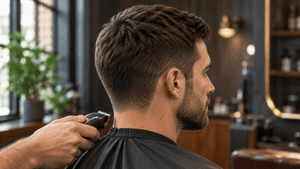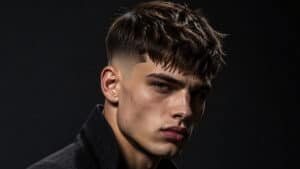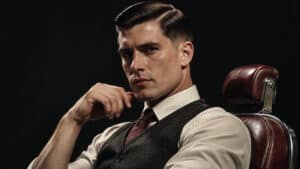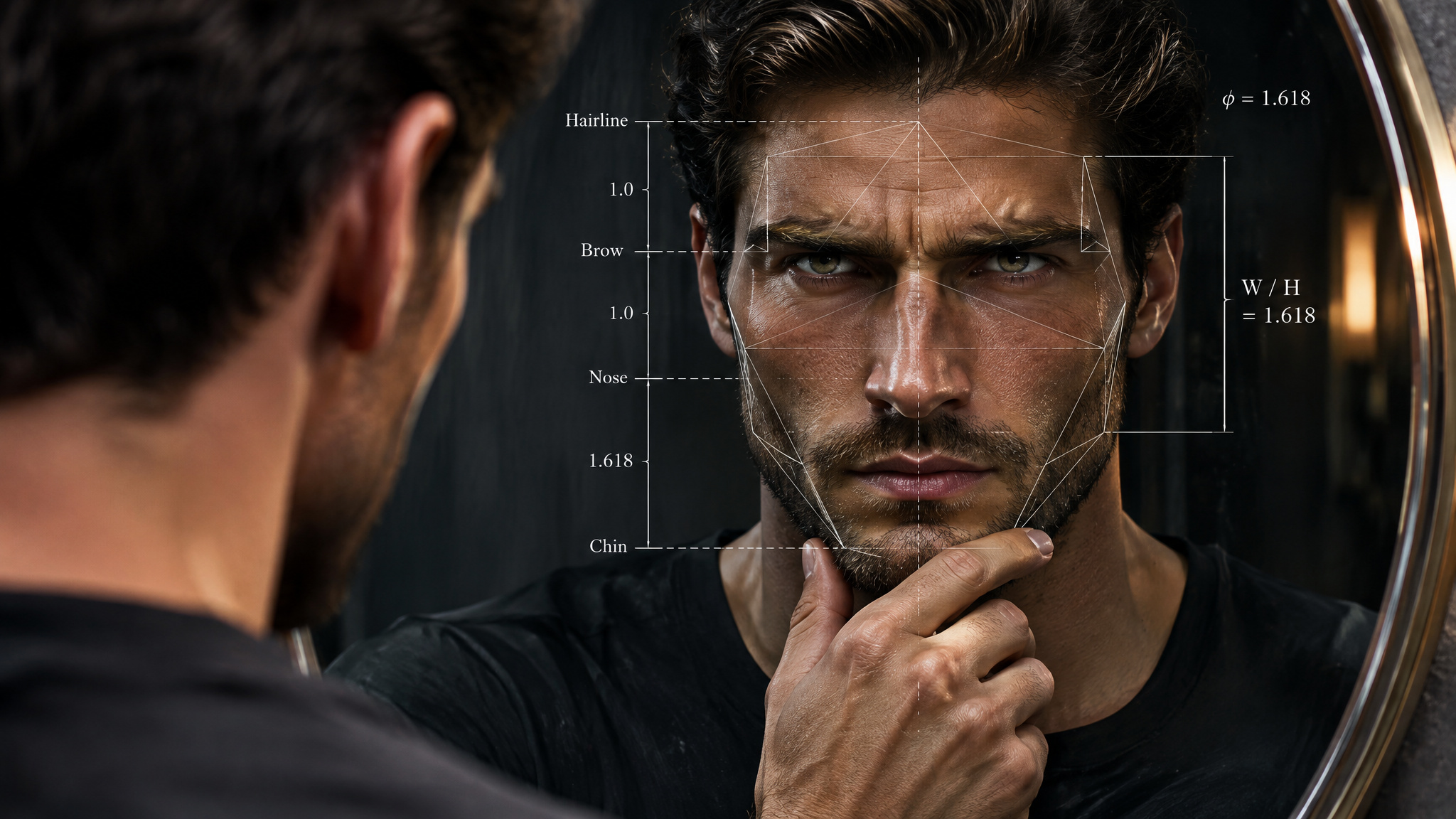
You walk into the barbershop with a photo of a celebrity haircut on your phone, and the barber executes it to the millimeter. A week later, it still looks off in the mirror. That happens when a cut calibrated to someone else’s width-to-height proportions gets dropped onto yours. Matching men’s hairstyles to your face shape is pure geometry.
As GQ‘s grooming guide (presented by Maddie Conrad) points out, the whole objective of a haircut is facial balance, keeping your head from looking too wide or too narrow. Two photos of Justin Bieber in that guide show the mechanism at work: when his hair is cropped forward, his jaw looks noticeably softer; when he wears his usual swept-up-and-back cut with lean sides, the exact same bottom jaw reads much more angular. Both GQ and Feel Good With Ali note that most styling failures come down to picking the wrong haircut, not having bad hair or unattractive features, and Real Men Real Style adds that most guys have no idea which three hairstyles actually suit them. Here at Unfinished Man, our method skips the bare barbershop chart and starts with four at-home selfie measurements, pairing every match with the width-and-height logic behind it.
Key Takeaways
Diagnose your shape from a straight, unsmiling selfie with your hair pulled back by comparing forehead width, cheekbone width, jawline width, and overall face length (roughly 1:1 is round; 1.5:1 is oval).
Use hair and beard geometry to counterbalance your proportions, such as adding top height with tight sides and an angular full beard to stretch a round face, or skipping tight-sided undercuts that make a triangle jaw look comically wide.
Override standard shape rules when your vertical facial thirds are uneven (an oversized forehead justifies a French crop even on shapes ordinarily warned off bangs) or when round-face rules ban a buzz cut regardless of skin-tone contrast.
Table of contents
Table of Contents
How to find your face shape with four measurements
Male face shape is diagnosed at home by taking one straight-on selfie and comparing four facial spans. Pull your hair back, look straight at the camera without smiling, and draw four straight lines across the photo, following Zolven’s four-step method. Comparing forehead width, cheekbone width, jawline width, and overall face length sorts your proportions into six basic shapes: equal length and width with soft edges is round, equal length and width with a strong jaw is square, slightly longer than wide is oval, long with straight sides is rectangular, a wide forehead tapering to a narrow chin is heart, and a diamond shape features sharp, wide cheekbones paired with a narrow forehead and chin.
Round faces run roughly 1:1 in length to width, while oval faces run about 1.5:1 and account for roughly half of all men. Very few guys fit a single box cleanly. As Zolven, a Vitamin-sponsored grooming guide, and the Bromaxxing framework for Black men all emphasize, most men are a blend of two or three shapes and land closest to oval or square, which is plenty close enough to suit the recommended cuts.
Why style guides disagree on the total number of shapes
Depending on where you look, you’ll see four, six, seven, or nine shapes listed. GQ promises nine shapes across its full list (oval, round, square, oblong, rectangular, triangular, inverted triangle, diamond, heart, and pear), Feel Good With Ali covers seven, Real Men Real Style covers six in its 2026 guide (The PERFECT Hairstyle For Your Face Shape | Men’s Hair Styles 2026), and the Bromaxxing framework uses four (oval, square, round, triangle). At Unfinished Man, we treat oblong and rectangular as overlapping labels for the same long-face family, and include inverted triangle and pear so edge cases aren’t left guessing.
Oval face shape haircuts for men
Oval face shape haircuts for men are tight-sided, off-the-forehead styles including the short fade, crew cut, quiff, pompadour, side part, slick back, and textured crop. Because an oval face is widest at the brow with softer angles, an angular jawline, and a balanced 1.5:1 length-to-width ratio, it can wear almost any cut except heavy bangs that cover the forehead and shorten the vertical line. Swept-up-and-back styles with lean sides make the jaw look sharper, and pairing the cut with a solo mustache leaves the jawline bare, which makes the lower face read leaner and more angular.
Feel Good With Ali tells oval-faced guys they’re lucky because width and height are already in equilibrium. Grooming host Bryan Wu gives a quick visual check for the shape: no sharp angles at the forehead, cheeks, or chin, top and bottom halves that mirror each other, and a vertical center line much longer than the cheekbone line. To keep that natural balance from looking soft, GQ recommends a gentle side fade that draws the eye up to the texture on top. Celebrities in this camp include George Clooney, Jake Gyllenhaal, Jude Law, Ryan Gosling, Zac Efron, Justin Bieber, A$AP Rocky, and Henry Golding.
- Comb-over with short back and sides: Wu’s top pick for adding sharp volume and structure to softer oval edges.
- Textured quiff or classic pompadour: Zolven notes longer top hair unlocks these swept-up styles, along with a looser finger-tousled finish.
- Professional side part: Works cleanly on short or medium hair while keeping the forehead open; knowing how to ask for a traditional side part, pompadour, or slick back helps you keep the sides lean instead of bulky.
- Short crop, undercut, or long hair: All work as long as the hair stays off the forehead.
| Hairstyle or facial hair | Works for oval faces | Proportion effect on a 1.5:1 oval face |
|---|---|---|
| Swept-back quiff or pompadour | Yes (keep sides lean) | Exposes the forehead and makes the bottom jaw read more angular |
| Comb-over with gentle side fade | Yes (high top volume) | Cuts side softness and shifts visual focus to top texture |
| Down fringe / French crop | Partial (short-to-medium, hard top edges) | Shortens the face unless used to cover an oversized upper third |
| Man bun or dated forward Bieber crop | No (rounds and softens features) | Compresses vertical length and hides jawline angles |
| Mustache-only facial hair | Yes (best default setting) | Leaves the bottom jaw bare so the lower face reads lean |
The worst haircuts for an oval face
No, not every hairstyle suits an oval face, because cuts that cover the forehead or pull all volume tight to the skull make softer oval features look round. Wu explicitly pushes back on the myth that oval faces can wear anything, singling out the man bun, the dated forward-cropped Justin Bieber style, and face-shortening fringes as cuts to skip. When hair is pulled forward over the brow, it compresses the 1.5:1 vertical line and softens the jaw, the exact visual drop-off seen when comparing Bieber’s old forward crop against his sharper swept-back look.
Should you get a fringe or keep hair off your forehead?
Keep hair off your forehead by default, and treat a down fringe as a conditional exception rather than a total ban. If you want a fringe on an oval face, Wu advises keeping it short-to-medium with hard edges on top and controlled thickness so it doesn’t round out your features. The other reason to break the off-the-forehead rule is an oversized upper facial third, where Zolven recommends a forehead-covering French crop to bring a high hairline back into proportion.
Round face shape haircuts for men
A round face runs roughly 1:1 in length and width, sitting widest at the cheekbones with fuller cheeks, a soft rounded jawline, and slightly lower-set features. Your proportion goal is the exact opposite of a long face: stretch your silhouette visually toward an oval by stacking height on top and keeping the sides short and tight. Any volume puffing out at the ears widens the cheeks further.
Jeremy Renner is GQ’s textbook example of playing a round face by the rules, pairing lean, tight sides with vertical lift on top; Kanye West, Gerard Butler, Jack Black, and Leonardo DiCaprio also share the shape. Whether you can pull off longer, rounded top styles comes down to your jaw. The Bromaxxing framework notes that an angular jawline on a round face can handle top volume or rounded silhouettes, whereas a soft, rounded jaw makes rounded cuts accentuate facial fullness.
Facial hair does heavy lifting here. GQ’s side-by-side comparison of Michael Sarah shows that a mustache-only look makes a round face read wider, while a full beard trimmed with an angular outline elongates the lower face into balance. Sculpting an angular beard also adds enough lower-face structure to let round-faced men wear shorter haircuts.
Short haircuts for round faces and hot-climate adjustments
Short haircuts for men with round faces work when those cuts are built short-and-tall, pairing tight, lean sides with structured height on top via a pompadour, quiff, faux hawk, angular fringe, or high-fade undercut. On a 1:1 round face with full cheeks, taking the whole head down to a buzz cut strips away vertical stretch and leaves the face looking wider, while front-worn flat fringes compress the forehead. In hot, humid climates where long hair turns sweaty and unmanageable, short, clean cuts with minimal styling keep the sides tight while preserving just enough top structure to elongate the face.
- Pompadour or quiff with top volume: Lifts the vertical line while keeping the temples lean; if you need the exact barber terms for fade height and top texture across different men’s haircut styles, lock those in before sitting in the chair.
- Faux hawk or high-fade undercut: Concentrates mass at the crown to create the illusion of length.
- Sharp angled bangs: Cuts across the forehead diagonally to break up circular symmetry, unlike flat horizontal bangs.
- Dreadlocks, twists, or box braids: Hang like curtains along the temples to frame the cheeks and add angularity.
Why a buzz cut makes a round face look rounder
On a round face, a buzz cut ends up looking softer and wider instead of more defined, because taking off that top height eliminates the vertical stretch a 1:1 ratio relies on, a warning repeated across GQ, Feel Good With Ali, and Zolven. Very short flat cuts and waves carry the same rounding risk, especially on younger men. Even though Feel Good With Ali’s skin-tone checklist recommends clean buzz cuts as a high-contrast look for deep skin tones, the repeated round-face ban takes precedence: if your face is round, skip the buzz cut or keep slight length on top.
Square face shape haircuts for men
A square face is built on hard angles at the forehead and jawline, straight vertical lines down the sides, wide cheekbones, and features sitting slightly lower than on a rectangular head. While the Real Men Real Style host jokes about not being born with a God-like square jaw, and Wu frames the square silhouette as the masculine target that softer, “non-Alpha” oval or heart faces should aim for, men who actually have a square face split into two camps: sharpen the angles or soften them. Celebs in this bracket include Brad Pitt, Arnold Schwarzenegger, David Beckham, Tom Cruise, Johnny Depp, Pedro Pascal, Michael B. Jordan, Leonardo DiCaprio, and Robert Pattinson.
The two-path choice: sharpen vs. soften
If you want to show off the jaw, take the sharp path with a crew cut, high fade, low fade with a side part, or a buzz cut (which Zolven notes many guys needlessly avoid out of fear it looks like a bully’s haircut), paired with short shaped stubble. If you want to tone down the boxiness, interrupt the solid vertical lines on the sides with volume and flow: DiCaprio’s parted style with full layered sides, Pattinson’s looser tousled hair, wavy medium length, or a loose quiff.
For coily hair, an afro, tapered afro, free forms, or waves round out the corners. This two-path split also explains why sources clash on fringes: Real Men Real Style says to skip fringes because they soften square edges, while Feel Good With Ali recommends a messy fringe for that exact softening effect.
Facial hair and the age-25 fringe cutoff
To slightly elongate a square face into balance, copy Michael B. Jordan’s setup: a clean-cut mustache combined with a compact, “anchored” chin-tip goatee. If you lean toward forehead-shortening, hair-down-front styles, the Vitamin-sponsored guide (grooming tip #77) puts the cutoff around age 25. Past that mark, youthful front-down cuts hit diminishing returns and look like you’re trying too hard to look younger.
Oblong and rectangular face shapes
Style guides define rectangular faces inconsistently: Zolven calls them long with straight sides like a stretched square, while another guide frames it as an oval with sharper angles, a taller forehead, a wider chin, and greater symmetry. GQ defines the oblong head as broader and slightly more elongated with a strong jawline, whereas Wu views the oblong silhouette simply as an extra-tall variation of an oval or square. Because both labels describe a long face, their core rule is identical: never add extra height on top or stretch the face further. Celebrities across this long-face group include Dwayne Johnson, Jake Gyllenhaal, Chris Pine, Joe Alwyn, Chad Michael Murray, Ben Affleck, Adam Levine, Will Smith, and Idris Elba.
Three ways to style an oblong face
While every source bans high pompadours and spiky tops on an oblong head, they split into three distinct paths for the sides:
- The bald path: GQ and grooming tip #54 advise ditching the comb-over because a balanced oblong face with a strong jawline is ideal for going fully bald, proved by Dwayne Johnson and anchored with a chin goatee.
- The soft, rounded sides path: Feel Good With Ali keeps no more height than width, pairing short hair on top with softer fullness on the sides to mimic an oval shape, as seen on Jake Gyllenhaal.
- The low-volume fringe or Ivy League path: Wu keeps the sides from going too short (skipping sharp fades to preserve width) and pairs them with an Ivy League or a light swept fringe like Chris Pine’s, controlling thickness and texture to avoid a pretty-boy look.
Rectangular allowances and long-hair rules across shapes
For men’s long hairstyles across face shapes, rectangular faces should skip long cuts entirely so they do not elongate the face further, oblong faces growing hair out must match top length with equal side length, oval faces wear long hair easily, diamond faces suit longer layered cuts, and heart faces fit medium textured layers. Rectangular faces should also skip harsh, lean, angular cuts in favor of wavy side parts, scissors cuts with short back and sides, or brushed-up styles with side fullness like Joe Alwyn and Chad Michael Murray. Because a rounder natural skull softens extreme facial angles, rectangular heads can also pull off very short, almost militaristic cuts; keep facial hair clean-shaven or at natural short stubble, and skip chin straps and low-rider beards.
Triangle face shape hairstyles for men
Triangle face shape hairstyles for men are top-volume cuts including the textured crop, side part with extra top height, quiff, pompadour, and longer layered fringe. Because a triangular face has a jawbone wider than the cheekbones and forehead with a pointed chin, building volume at the crown and temples pulls visual weight upward to counterbalance the heavy lower third. Undercuts, high tops with very short sides, and skin-tight fades backfire on a triangle shape by stripping temple width, which Real Men Real Style warns makes a wide jawline look almost comically large.
You don’t have to grow shaggy sides to avoid that trap. Moderate short sides, rounded sides, or longer styles with a rounded top (such as a curly afro for looser curls or free forms for tighter coils, rather than a picked-out afro, which the Bromaxxing guide flagged as declining in 2024 and hard to pull off) contrast the jaw’s natural angularity. Triangle-faced examples include Cillian Murphy, Timothée Chalamet, Keith Urban, Ryan Reynolds, Jesse Metcalfe, and Justin Timberlake.
Calibrating side tightness and facial hair
Coverage near the forehead corners de-emphasizes a narrower brow, illustrated by Chalamet’s long curtain effect (where he looks like he hasn’t had a haircut in eight months), while going clean-cut and clean-shaven shows off an already strong jaw like Murphy’s. For facial hair, either keep stubble light and trimmed so the jaw doesn’t bulk up further, or grow a fuller beard to widen the lower face smoothly and unlock more haircut options.
The inverted triangle (upside-down triangle)
An inverted triangle flips the geometry: a wide forehead and wide cheekbones tapering down to a thinner jawline, seen on Robert Pattinson, Channing Tatum, Bradley Cooper, Chris Pine, and Justin Bieber. Because extra height on top makes a wide brow look top-heavy, opt for a classic side part or a straight, medium-length style swept back and kept flat with styling product instead of lifted at the roots.
Diamond face shape haircuts for men
The defining trait of a diamond face is that the cheekbones are always the widest point, tapering inward toward both the brow and the chin. Because the middle third juts out, shorter hairstyles and tight-sided cuts are out; taking the sides down tight makes prominent cheekbones stick out even wider. Instead, build width at the top and bottom of the head with bangs or a fringe (to widen the narrow forehead), a medium-length swept-back cut with top volume, a voluminous textured crop, or longer layered hair, as seen on Pete Davidson, Keanu Reeves, and Jamie Kennedy. When adding volume on top, keep the top corners soft and rounded rather than angular and high-centered.
Proof in practice: Jason Dulo and James Harden
A side-by-side comparison of Jason Dulo shows how fast diamond proportions flip. The wrong setup stacks height on top with narrow upper sides and an elongated chin beard, turning the lower face into a heavy diamond. The right setup limits top height, builds a wider and rounder hair silhouette, and keeps facial hair short and tight with natural outlines around the chin. James Harden takes the other corrective route, using a huge, broad natural beard to add bottom width over a pointy chin, which balances his head enough to wear his hair tight on top.
Heart face shape haircuts for men
A heart-shaped face combines a wide forehead and wide cheekbones with a softer jawline and a narrow, noticeably pointy chin. If you aren’t sure whether you’re looking at a heart shape, check the center of your hairline: a Widow’s Peak is a classic giveaway of a heart shape, even when it’s subtle like Harry Styles’.
Your goal is to add width near the jaw while pulling attention away from the broad forehead using curl, softness, and movement. Go with side-swept bangs that cover part of the brow, medium layered cuts that fill out the jaw area, a textured or angular fringe (skip flat falling fringes), or Real Men Real Style’s single top pick for heart faces, the dimensional quiff. Styles, Nick Jonas, and Shawn Mendes are the blueprint here.
Fade height and finish rules
Skip aggressive high fades, which strip side weight and make a pointy chin look sharper; ask for a low fade instead. You also want to avoid super-clean, crispy styles like the classic pompadour, leaning into angles, thickness, and a carefree messy finish so your head doesn’t look top-heavy. One useful quirk from Real Men Real Style: triangle-faced men can borrow heart-face haircut recommendations, but heart-faced men can’t wear triangle-face cuts.
Pear face shape haircuts for men
Most mainstream charts skip the pear shape, which features a slightly narrower forehead, wider cheekbones, and the jawline as the widest point of the face. Because the lower face dominates the silhouette, the corrective play is building width through the top of the head to counterbalance the jaw. High-and-tight haircuts backfire here because a narrow crown makes a wide-set jaw look even heavier.
Down below, wear a structured, angular beard to create the illusion of a sharper jaw and a narrower lower third. The pear-shape brief points to Zach Alfanis and Anthony Anderson as classic examples, noting an important body-composition caveat: extreme weight loss can lean out a pear shape until it reads as a more angular or square silhouette, even though the underlying jawline bone structure stays wide-set.
Facial hair as a corrective tool, shape by shape
Facial hair is a geometric lever on equal footing with your haircut, letting you widen, elongate, anchor, or sharpen your lower third without touching the clippers. The exact same facial-hair style can have opposite effects on different heads: GQ shows that a mustache-only look leaves an oval face’s bottom jaw exposed so it reads leaner and more angular, whereas the exact same mustache-only setup on a round face makes the cheeks read wider.
- Oval: Mustache-only to keep the bottom jaw bare and angular.
- Round: Full beard with an angular outline to elongate the face toward oval (proved by Michael Sarah’s two-photo comparison), or sculpted angular stubble so shorter haircuts still work.
- Square: Clean-cut mustache plus a small anchored chin goatee to slightly stretch the lower third (Michael B. Jordan), or short shaped stubble to show off the jaw.
- Oblong: A chin goatee to anchor the lower face, especially when fully bald (Dwayne Johnson).
- Rectangular: Clean-shaven or short stubble with a natural outline; skip chin straps and low-rider beards.
- Triangle: Keep facial hair light, trimmed, or clean-shaven (Cillian Murphy) when the jaw is already wide, or grow a fuller beard to blend the lower face smoothly and unlock a wider range of haircut choices.
- Diamond: Closely cropped facial hair following the natural line of the chin (Jason Dulo), or a broad natural beard to add bottom width and offset a pointy chin (James Harden).
- Pear: Structured, angular beard to narrow and sharpen the wide lower third.
Facial thirds: the measurement that overrides your shape
Zolven’s third step is the proportion rule used by professional stylists and models: split your face horizontally into three zones from hairline to eyebrows (upper third), eyebrows to the bottom of the nose (middle third), and bottom of the nose to the chin (lower third). When all three zones look roughly equal, your face reads as balanced. When one zone is noticeably longer or shorter than the others, balancing your thirds overrides your general face-shape chart. Even if your shape normally warns against bangs, a measurably oversized forehead makes a forehead-covering cut like the French crop the right corrective call.
Five if-then adjustments for uneven thirds
- Oversized upper third (high forehead or receding hairline): Cover the forehead with a cut like the French crop; for a wider forehead, the Vitamin-sponsored guide also suggests asking your stylist about an asymmetric textured fringe to shift width toward the lower face.
- Too-small forehead (short upper third): Add height on top with a pompadour or slicked-back cut to stretch the upper zone.
- Long middle third: Leave the forehead uncovered and grow a slightly longer beard to pull visual weight downward.
- Big lower third: Wear medium-to-long hair on top to draw the eyes up, paired with a short or faded beard.
- Small lower third: Keep low-to-medium volume on top (such as a French crop) while using a cleanly sculpted beard to carve out stronger jawline definition.
Beyond face shape: hair type, skin tone, climate, age
Face shape is only factor one on Feel Good With Ali’s eight-factor checklist, which pairs with Zolven’s four-step method to filter cuts by hair texture, hair density, forehead size, hairline status, skin tone, climate, and age.
Hair texture
Straight hair lies flat and shines easily, so it needs choppy layers, textured finishes, or a messy fringe with soft layered sides to avoid looking lifeless. Wavy hair forms soft S-bends that work best with textured short crops, a tousled quiff, or longer beachwaves built with light mousse or sea salt spray (Zolven also highlights the modern mullet and a barber-specified layer cut for straight or wavy hair). Curly hair forms high-volume ringlets that need moisture so they fall naturally without puffing out; pair curls with taper fades, since high fades ruin the silhouette. Coily or kinky hair grows in dense zigzags that hold twists and locks well but dry out fast.
Hair density
Part a small section of hair in the mirror: lots of visible scalp means thin hair, while barely any scalp means thick hair. Thick hair needs bulk removed with thinning shears, layers, undercuts, or textured layers (skip heavy straight blunt cuts), and thick wavy hair holds big volume styles. Thin hair gets ruined by overlayering; build fullness with shorter sides, light top texture, textured crops, layered side parts, volumizing powders, and matte clays.
Skin tone
The visual weight of a style also depends on hair-to-skin contrast. Dark hair against fair skin produces high contrast suited to short textured crops, medium layers, and side-swept fringes, while blunt one-length cuts look harsh. Medium or brown skin with warm undertones suits undercuts with top volume, taper fades with curls or waves, and longer framing layers (skip super-flat slick backs). Deep skin tones carry high-contrast, high-volume cuts like high top fades, full afros, twists, braids, locks, and clean buzz cuts, though the round-face buzz-cut ban still wins if your face is round.
Climate
Hot, humid regions call for short, clean cuts with minimal styling. Cooler or dry climates like Europe and North America support longer styles, low or high fades, messy quiffs, and layered cuts. Changeable weather in places like Australia or South America favors resilient textured crops, short pompadours, and messy side parts.
Age windows
Your teens and 20s are the window for long hair, disconnected undercuts, and unique fades (with forehead-shortening front-down cuts aging out around 25). Your 30s and 40s call for clean professional cuts like a slick back, side part, or neat fade. By your 50s and beyond, as hair thins, grays, or turns brittle, stick to a short crop, buzz cut, classic taper, or a clean-shaven head with a groomed beard.
Textured and coily hair: the four-shape framework
The Bromaxxing guide dismisses standard nine-shape charts as useless for Black men, narrowing the field to four core shapes (oval, square, round, and triangle, with most men blending two) and ranking three factors ahead of face shape: forehead size first, hairline second, and facial feature sharpness third, alongside curl texture, density, growth speed, and upkeep time. Within those four shapes, oval faces suit almost anything from a short curly or kinky taper fade to longer tapered hair, dreadlocks, or free forms; square faces soften their angles with rounded styles like an afro, tapered afro, short afro, free forms, waves, or a clean buzz/bald look if the skull shape is even; round faces use tight-sided angular cuts or locks, twists, and box braids that hang like curtains to frame the cheeks; and triangle faces pair short or rounded sides with a rounded top like a curly afro or free forms.
Forehead and hairline mapping
- Long forehead: Cover it with longer styles and slight side volume using locks, twists, a tapered afro, free forms, or curls with short sides (gel-combed length can also fake a lower hairline). Skip very short waves and hairline-pulling cornrows, and when growing out short hair, maintain a balanced, rounded silhouette paired with a temple or mid fade so high angular tops don’t make the forehead look taller.
- Wide forehead: Pair short sides with top volume via two-strand twists or locks for a narrowing curtain effect, and tell your barber not to push your hairline back too far during lineups.
- Small or very small forehead: Wear cornrows, braids, or dreadlocks with a bigger front taper, which balances the compact upper third and prevents hairline traction loss.
- Curving hairline: Barbers push the corners back slightly during a lineup to align them with the center.
Jaw conditionals and maintenance reality
On a round face, an angular jaw allows top volume, whereas a soft jaw makes rounded cuts read rounder. Factor in your curl pattern and schedule before committing: loose curls lock differently than tight coils, thinner density changes how braids sit, locks are high-maintenance and take serious time and energy contrary to popular belief, and the picked-out afro was already declining and tough to pull off in 2024.
Hairstyles for a receding hairline
Around one in four men have a receding hairline by age 30. The worst reflex is trying to hide it under long front hair or a comb-over, which only draws more eyes to the thinning temples. Instead, work with the hairline using a short buzz cut, crew cut, or French crop, slick it back, or ask your barber for a sharp taper or fade that draws the eye away from the temples while you still have volume at the crown.
If your receding hairline forms a Widow’s Peak, watch the clippers during a lineup: barbers normally start at the highest point of the hairline and cut straight across, so tell your barber up front if you don’t want the peak buzzed off. For early, slight recession, the Bromaxxing guide flags minoxidil and rosemary oil as topical options worth researching, noting that rosemary oil is credited with similar effects and fewer side effects.
Styling mechanics: volume, hold, and products
Even the right geometric haircut falls flat at home if you don’t know how to control top lift, hold strength, and wash frequency. Dialing in your daily styling routine comes down to pairing targeted heat and root-lifting angles with the right pastes, creams, or matte muds for your texture.
Volume tricks
Whenever a cut needs height on top, use heat from a blow dryer (grooming tip #32). For instant lift on a side part, part your hair on the opposite side from your usual direction; as the Zolven host demonstrates on his own hair, the roots resist the new angle and stand up with extra volume.
Products and washing
Skip pomade and sticky gel on softer, wavier styles and reach for a paste instead (grooming tip #249). Work styling cream into damp hair after showering for light hold with natural movement, use matte mud at hold factor 4 for all-day structure, or use sea salt spray and light mousse for natural beachwaves. Never shampoo every day, especially with longer hair, because daily washing leaves it dry and puffy (grooming tip #47).
Which hairstyle suits me? Tools, AI, and your barber
Free hairstyle AI tools and photo-upload methods for men match haircuts to your proportions by analyzing a straight-on selfie in ChatGPT or running an eight-input diagnostic checklist. Uploading your photo to ChatGPT with a stylist prompt lets the model evaluate your facial geometry the same way a human stylist does, while free hairstyle-finder tools promoted by Feel Good With Ali and Bryan Wu take your personal details and return styles that fit your features and personality. Wu’s recommender claims a match in under 30 seconds by collecting eight specific inputs: face shape, hair type, hair density, forehead size, receding hairline status, skin color, location, and age.
Low-effort shortcuts
Once you know your shape and hair texture from those eight factors, Zolven suggests searching Pinterest directly for hairstyles matching your face shape and picking a photo you like. You can also keep Real Men Real Style’s free face-shape infographic (linked at realmenrealstyle.com) on your phone as a quick pre-barbershop check.
Stylist vs. barber at the chair
Hollywood actors and top models spend thousands of dollars on professional stylists because stylists are trained to study face shapes and hunt for proportion balance, whereas typical barbers are trained to execute cuts. Walk into the shop having already measured your shape, picked the exact cut name, and prepared specific proportion questions, such as asking whether an asymmetric textured fringe will balance your forehead width.
When to break the rules
Grooming guidelines are tools, not laws, because confidence is sexy (grooming tip #147). GQ points out that Michael Sarah’s wide, side-heavy haircut violates every round-face rule and is technically unflattering, yet it works because of his personality and “doesn’t give a” attitude; sometimes irony is cool. Sharp bone structure is the other override: a defined jawline and striking eyes make short hair much easier to pull off regardless of face shape, provided your skull shape suits a close crop and you’ve weighed maintenance costs.
Even style guides disagree on celebrity boxes because mixed features are the norm, filing Leonardo DiCaprio under both square and round, Robert Pattinson under square and inverted triangle, and Jake Gyllenhaal under oval and oblong. Use celebrity photos to see how a haircut shifts width and height, never as a look to copy blindly.
Frequently Asked Questions
What are the 7 basic face shapes?
Different grooming frameworks count anywhere from four to nine shapes, though seven-shape guides sit right in the middle of the standard breakdown. Across our full system, we map out six foundational silhouettes—oval, round, square, rectangular (or oblong), heart, and diamond—plus triangle, inverted triangle, and pear so edge cases aren’t left guessing. For Black men with coily or textured hair, the Bromaxxing framework simplifies the chart down to four core shapes (oval, square, round, and triangle) and ranks forehead size and hairline ahead of face shape.
What are the best short haircuts for round faces for men?
The trick for a 1:1 round face is building a short-and-tall silhouette: keep the sides tight around the ears so the cheeks don’t look wider, and stack structured height on top to stretch your vertical line. Ask your barber for a high-fade undercut, faux hawk, quiff, pompadour, or sharp diagonal bangs that break up circular symmetry. Pairing a short cut with a sculpted, angular beard also carves out crucial structure along a softer lower jaw.
Does a buzz cut work for a round face or does it make it look rounder?
A uniform buzz cut makes a round face look softer and wider, not tougher. Taking the entire head down to one flat length strips away the top height that a 1:1 ratio relies on for vertical stretch. Even if you have a deep skin tone that normally looks great with a high-contrast buzz cut, the round-face ban still applies—either skip the buzz entirely or leave slight length on top.
What is the difference between an oblong and rectangular face shape for men?
Both labels describe the same long-face family, which is why we group them together, though style guides draw slight distinctions in the angles. Rectangular faces are typically framed as a stretched square with straight vertical sides and sharper corners, while an oblong face is viewed as an extra-tall oval or a broader, elongated head with a strong jawline. Either way, the core styling rule is identical: never stack extra height on top, and keep fullness on the sides so you don’t stretch the face further.
What are the best triangle face shape hairstyles for men?
Because a triangle face is widest at the jaw and narrows toward the brow, you need volume at the crown and temples to balance out that heavy lower third. Go for a textured crop, a side part with extra top lift, a quiff, a pompadour, or longer layered fringes like Timothée Chalamet’s curtain style, and pair them with moderate or rounded sides. Never get a skin-tight fade or disconnected undercut—stripping away temple width makes a wide jawline look comically large.