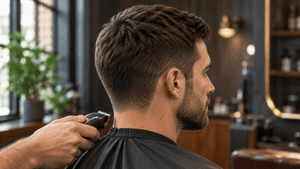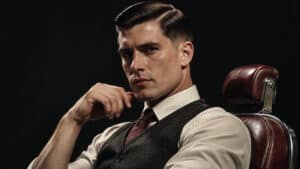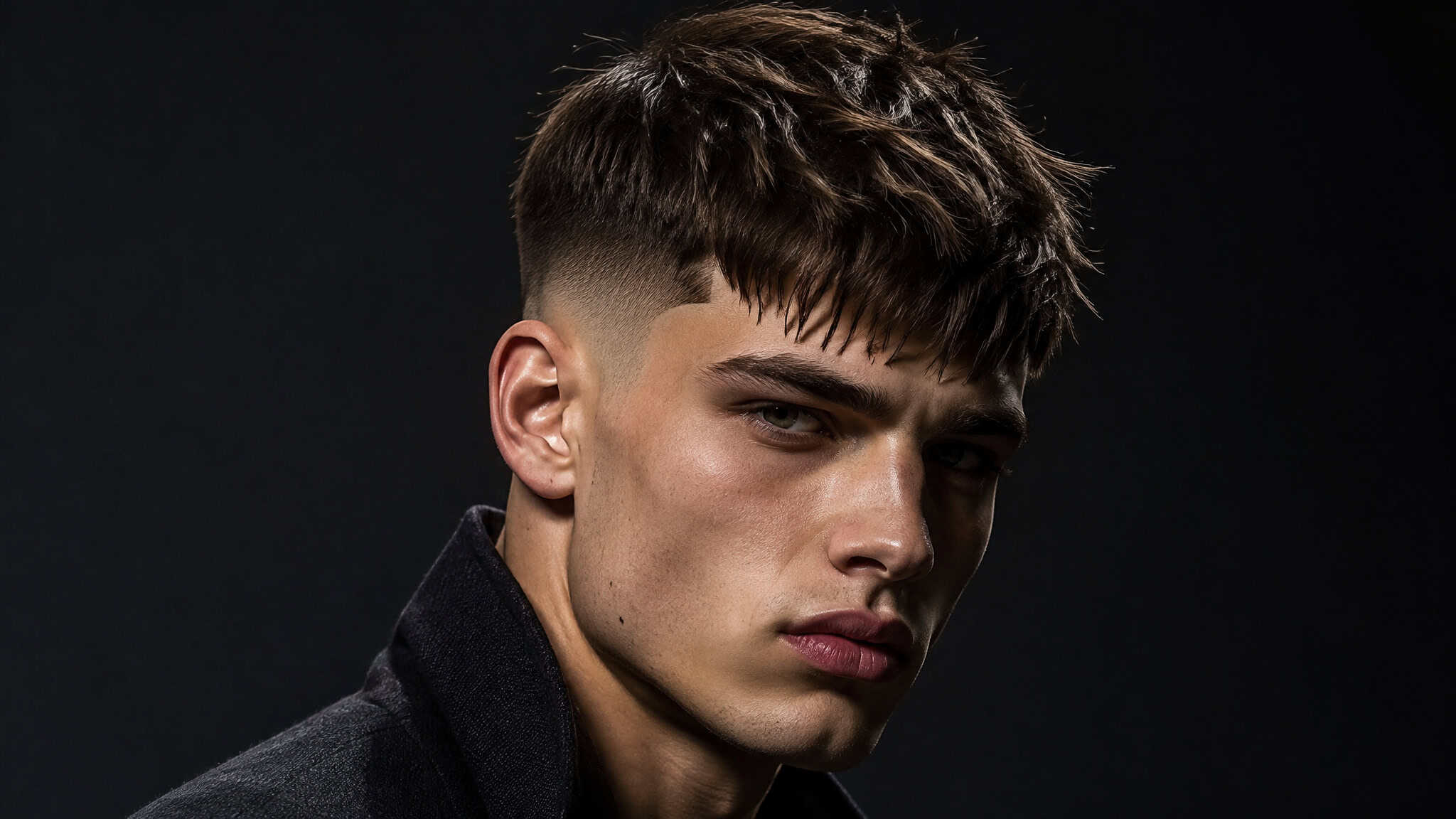
A textured crop haircut is a short men’s cut with faded or tapered sides and a scissor-textured top pushed forward into a short fringe. Most guys can spot one in a photo, then sit down and describe the result they want rather than how the hair is built, which leaves the barber guessing on fade height, top weight, and fringe finish. In a 12 Pell tutorial, a client asks for a short cut, bangs straight across, heavy texture on top, and low maintenance, and the barber tells him he’s asking for a crop cut.
Key Takeaways
Barbers build a textured crop around a shear-cut square corner on the sides, a scissor-cut top with retained weight, and a choppy under-layer of fringe rather than a round-head clipper blend.
Deep point cutting stops about halfway up the hair shaft with scissors angled at roughly 45 degrees; cutting texture down at the scalp leaves short root hairs that poke out and turn the fringe frizzy.
Asking for a textured crop by name alone leaves the fade height and bangs up to chance, so specify a low or skin fade, weight kept at the square corner, a deconstructed fringe, and preserved front length.
Table of contents
Table of Contents
What is a textured crop haircut?
A textured crop relies on a shear-cut square corner at the upper ridge and a choppy under-fringe instead of a standard round-head clipper blend. Those two details give the cut its boxy silhouette and forward push across three zones:
- The sides: Faded or tapered short, stopping at a shear-built square weight line at the upper ridge.
- The top is cut entirely with scissors in choppy layers to create separation and forward movement.
- The fringe and back view pair a short, jagged front hairline with a crown that reads like a triangle from behind.
The sides: the square corner and the crop fade effect
In FADED CULTURE‘s tutorial, the barber builds a strong square corner with shear work, holding his fingers straight up instead of following the head’s curve. Leaving weight at that upper corner lets the front push up when styled, a mechanic he calls the “crop fade effect.” The One Minute Barber uses the same geometry, lifting his fingers slightly on each side during scissor work so the top shape stays square.
The top: scissor-cut, not clipper-cut
12 Pell cuts the entire top with scissors rather than trimmers because running a trimmer blade straight across leaves a blunt finish. The One Minute Barber likewise slices and dices the top with shears to build separation across the crown.
The fringe and the triangle back view
From the back, 12 Pell points out that a crop reads like a triangle: shorter in front and longer toward the back. Up front, The One Minute Barber builds what he calls a “deconstructed fringe” (or “deconstructed bangs” in his stretched-fade tutorial). He pulls a small piece of hair out from underneath and chips into it at a different angle, leaving a choppy hidden layer beneath the visible bangs that feeds them texture. Regal Gentleman similarly layers the front until it sits “really, really choppy.”
Where the texture comes from
Styling pastes and powders only bring out separation that shears and a razor already put into the hair. Even straight or very thick hair that wants to sit flat will stand up once the barber cuts lift directly into the top.
When a client in the scissor-over-comb tutorial sits down with very thick hair that would otherwise lie flat, the barber runs a razor through the top to break up the bulk and add root lift. In the finishing tutorial, weight comes out of thick hair by picking sections up at a higher elevation while still holding the line square, because dropping the corner cuts away the square edge you just built.
The surface separation comes from point cutting, which means snipping into the hair ends at an angle rather than cutting a straight line across. In the beginner drop-fade and finishing tutorials, the barber holds the scissors at about a 45-degree angle to cut small triangles into the hair for a soft exterior finish. That angled work creates a peaks-and-valleys effect that 12 Pell also uses all the way through the top to break up hard lines.
When doing deep point cutting on dry hair, the blades only go about halfway up the hair shaft, never from the scalp. A client in the finishing tutorial asks on camera why the cuts stop halfway up, and the barber explains the catch: cutting texture too low leaves short hairs near the root that poke out and turn the fringe frizzy.
Who a textured crop suits
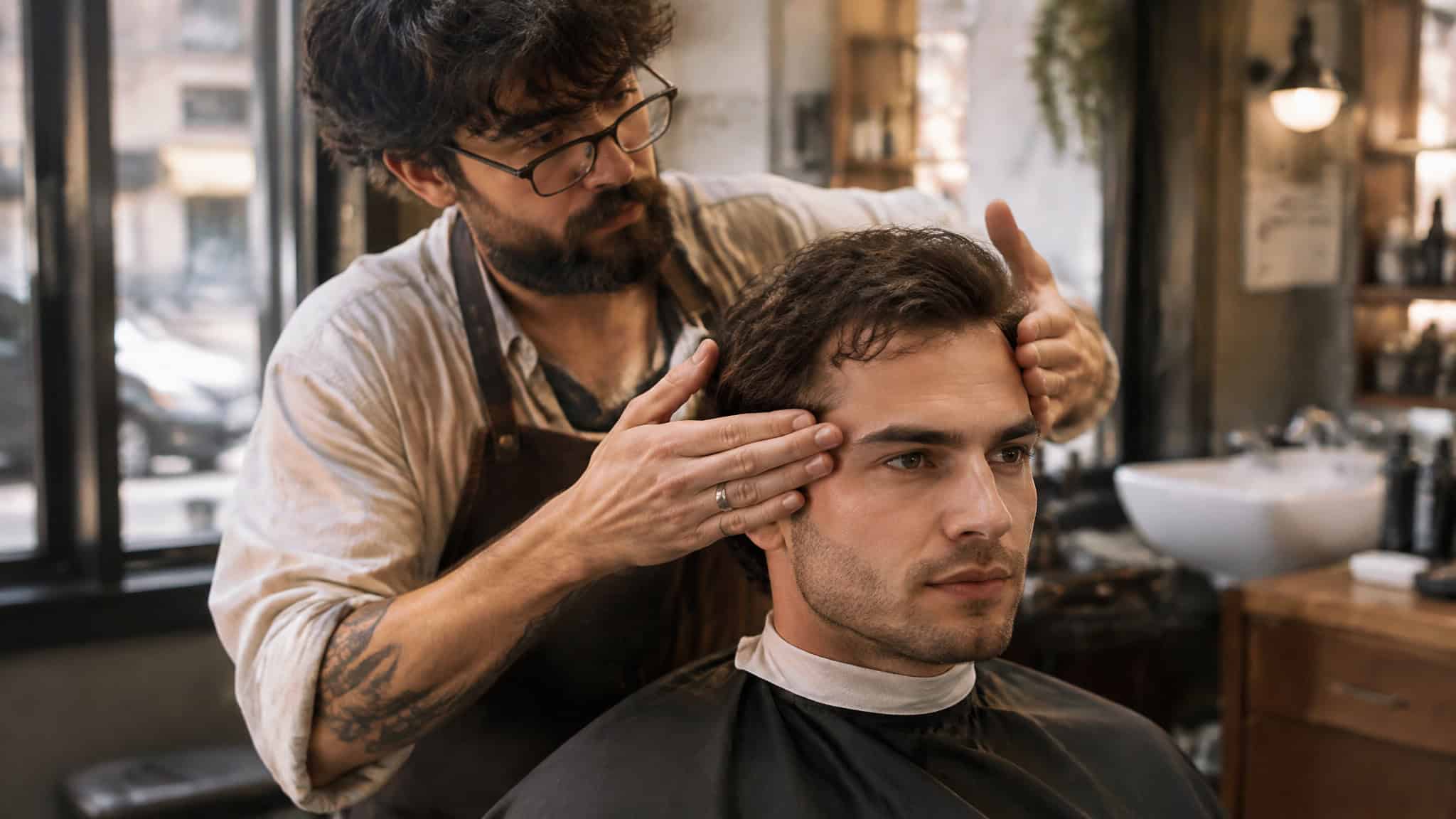
A textured crop suits hair with a slight bend or kink, rectangular or longer face shapes, and hairlines with slight corner recession when the barber adjusts the fringe, corner weight, and fade height. As demonstrated in a Regal Gentleman consultation with 21-year-old client Ruben, who was growing out an even-length lockdown buzz cut with an off-center crown that barely matters for a crop, a textured fringe beats a blunt fringe whenever a natural wave or kink prevents bangs from sitting flat. To balance a rectangular, longer face without making it look even longer, the barber avoids taking the fade too high, leaves length on top for a sharper effect, and keeps weight in the upper corners to add leanness. If the hairline has slight recession at the corners, pulling the hair forward and leaving extra front length through the recession point creates a fuller, straighter fringe.
Face shape and the fade height decision
Ruben has a rectangular, longer face, so the Regal Gentleman barber keeps weight in the side corners and pairs the top with a lower fade. Taking a fade too high on a long face strips away the side framing and makes the head read even longer. Filling out those upper corners adds leanness and balances the proportions. Keeping length on top also gives the crop a sharper effect than taking the crown down tight.
Hairline recession and front length
To handle Ruben’s slight recession at the temple corners, the barber leaves extra length at the front and pulls hair forward through the recession point to keep the fringe full. He treats those higher corners as the natural shape of Ruben’s hairline rather than active balding. He cuts the fringe straight across rather than following a curved natural line, effectively building a new hairline in front. He also leaves that line slightly longer while cutting it wet, since hair rises as it dries and would jump too high if cut to final length damp.
Hair type and the age question
A textured crop works for older men just as well as guys in their twenties, though even working barbers debate where the upper boundary sits. The Regal Gentleman barber rates 21-year-old Ruben 100% suited to the cut and calls the crop a classic style that will never die out. In the same video, he wonders on camera if there’s an age limit, using himself, a 35-year-old father of three with a dog, as the test case.
Hair kink and crown growth matter much more than the birth year on your license. Because Ruben’s hair has a slight bend and kink, the barber chooses a textured fringe over a blunt one, noting that kinked hair will never sit in a clean, blunt line. Ruben also has a fine crown sitting slightly off to the left, which the barber notes doesn’t matter much on a forward-pushed crop.
Textured crop vs French crop vs Caesar
The difference between a textured crop and a French crop is how the barber builds and finishes the front fringe. Both styles pair short faded or tapered sides with a forward-pushed top, which is why the two names constantly blur when guys browse different types of men’s haircuts before heading to the shop. In Regal Gentleman’s breakdown, a classic French crop aims for a blunter, straighter, and thicker front line by over-directing side sections (pulling hair back toward the center before cutting to protect length) into the middle, whereas The One Minute Barber builds a textured crop by chipping an uneven, choppy layer underneath the bangs.
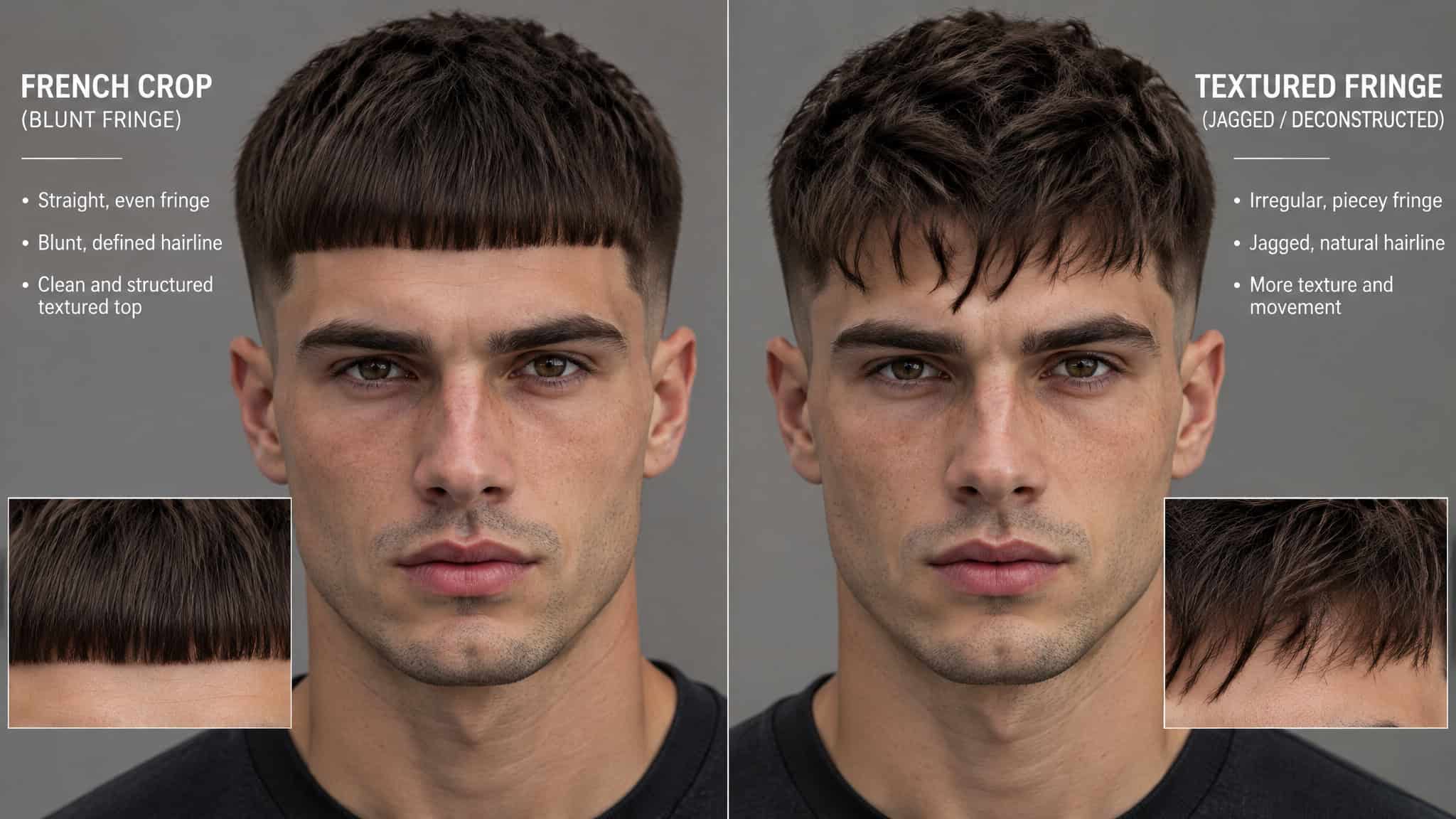
Fringe construction: blunt versus deconstructed
Choose between the two based on your natural hair bend and your temple corners. If your hair has a slight wave or kink, get the textured crop because its jagged, deconstructed fringe works with uneven movement that ruins a straight line. If you want maximum thickness across receding temple corners, the French crop‘s point-cut but straighter fringe holds more weight across the forehead.
General French crop guidelines call for a 2-to-3-inch top with textured ends, a slightly shorter back, and a mid fade (or longer sides if you’re trying the style for the first time) that works across straight, wavy, thick, or fine hair. On a textured crop, the tutorial barbers skip fixed inch measurements and focus on keeping enough top weight and front length so the hair doesn’t bounce up and round off.
Caesar: the comparison the sources don’t settle
A traditional Caesar cut swaps the textured crop’s choppy, uneven under-fringe for a very short, uniform, horizontally straight fringe, though the working barber tutorials we broke down don’t establish formal shop specifications for the Caesar.
Fade options: low, mid, skin, and stretched
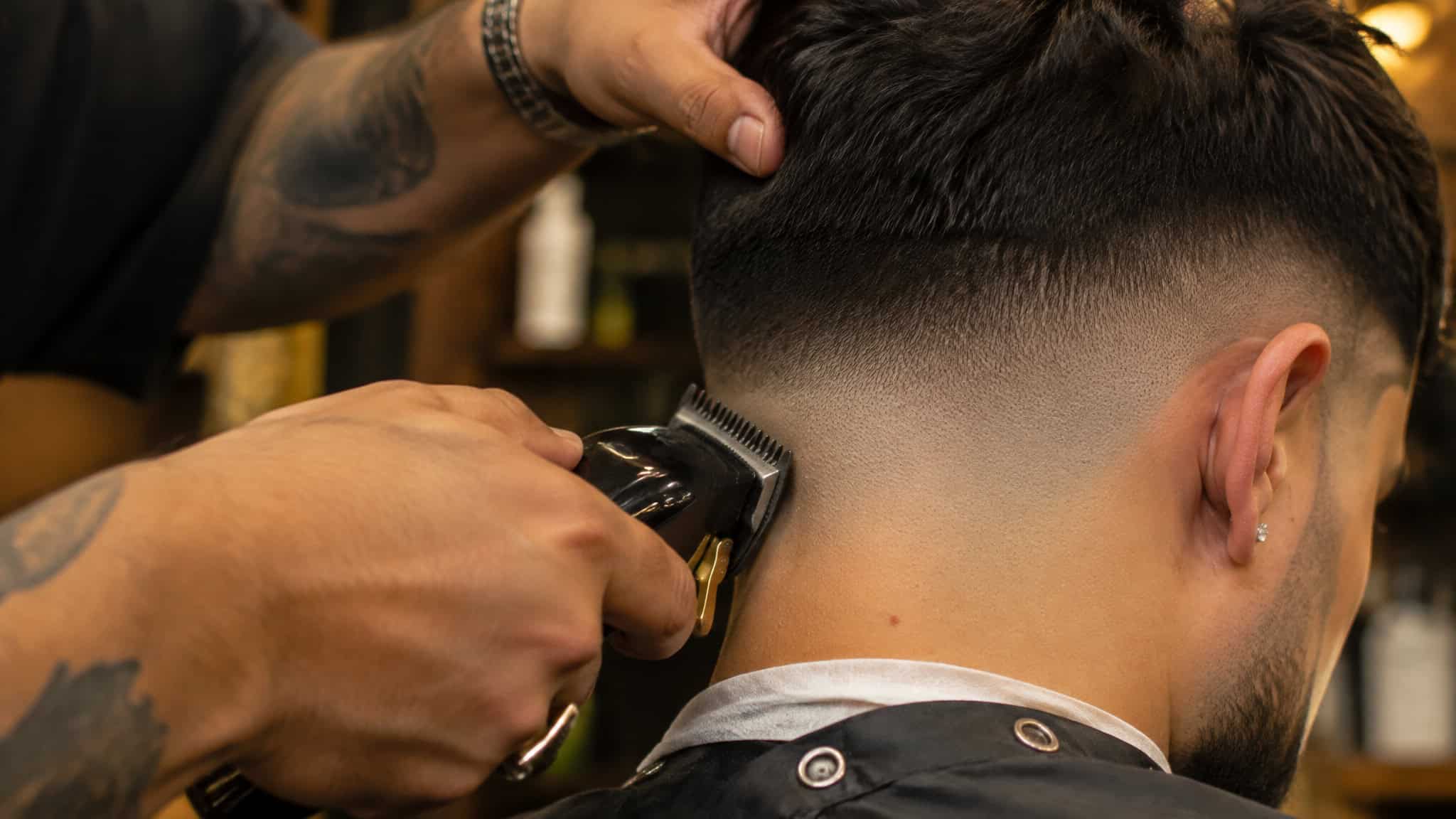
A textured crop with a low or stretched fade is the safer, cleaner choice for longer face shapes and dark hair, while higher skin fades cut closer to the upper ridge for harsher contrast. Choosing the right side blend comes down to how much upper corner weight your face needs and how fast dark hair shows a heavy transition line. On Ruben’s rectangular face, Regal Gentleman cuts a low skin fade with a stretched blend so the sides retain their upper corner frame while still reading as a sharp skin fade at the bottom, and The One Minute Barber keeps his first bald line low on dark hair so the length gain happens at the occipital bone (the bump at the base of the back skull).
| Fade option | Starting height and bone landmark | Upper corner weight kept | Best face shape or hair match |
|---|---|---|---|
| Low skin fade with stretched blend | Low bald line; length gained at the occipital bone | Yes (preserves upper corner shape) | Longer, rectangular faces and dark hair |
| Stretched low fade | Below the occipital bone with rounded back corners | Yes (debulked to the parietal ridge) | Dark hair needing a wider gradient |
| Full skin fade (FADED CULTURE build) | Knuckles at scalp right under where the head rounds | Yes (3 guard open flares out at weight line) | Guys wanting high contrast right under the ridge |
| Scissor-over-comb taper / drop fade | Starts with a 2 guard set at 2.5 down to zero | Yes (stops before guide to balance fringe) | Thick hair needing softer side transitions |
Which fade height works for which face
On dark hair, The One Minute Barber stretches the fade out because a wider gradient looks cleaner than a compressed band of dark stubble. Keeping the bald line low lets him gain length by the occipital bone, which makes blending into the longer top much easier. Taking the fade above that bone forces the crown much tighter. In FADED CULTURE’s higher skin fade, the barber moves his knuckles all the way to the scalp to set the foundation line right under where the head starts to round, running straight back over the shoulder and slanting behind the ear toward the occipital bone.
The stretched fade geometry
Before any detail fading, barbers debulk (knocking heavy length down with a larger clipper guard so overhanging hair doesn’t hide the fade guidelines). The One Minute Barber takes bulk down with a number 3 guard up to the parietal ridge, while FADED CULTURE runs a 3 guard with the lever fully open up to the weight line, flaring the clipper out at the top.
Instead of following a basic 3:2:1 clipper guard rule, The One Minute Barber builds his stretched fade as a multi-tool gradient. He sets the first bald line with a deep-toothed Andis d8 trimmer, adding a line just below the occipital bone at the back to round off the pointed corners. A fine-bladed Andis T-Outliner cleans up the bottom before he dabs a foil shaver at the line to soften it.
The T-Outliner then cuts a second line about 0.5 cm higher. Working through the stubble comes next, which he calls the hardest part of the fade, using a Wahl Senior with the blade closed, halfway, and fully open. Upper guard blending finishes the gradient with number 1, 1.5, and half-guard corner work, using a zero, quarter, and open half guard at the back and a 1.5 guard slightly higher where the skull bones connect.
Why fade names can’t be trusted
A textured crop mid fade and a skin fade don’t have a standard playbook of shared definitions across barbershops, because each tutorial defines fade names in its own context. Barbers use “stretched low fade,” “drop fade,” “mid fade,” “skin fade,” and “low skin fade” strictly on their own terms. FADED CULTURE’s tutorial is literally titled “HOW TO DO A MID FADE WITH A TEXTURED CROP,” while the barber’s authoritative narration and demonstrated steps, moving the knuckles to the scalp and setting the foundation right under where the head starts to round, build a full skin fade.
How the cut is built in the chair
The biggest mistake in the chair is cutting the top too short, which makes the hair bounce, rounds off the square silhouette, and leaves nothing to texture. Barbers leave a length buffer and defer layering until the end because an over-cut crop can’t be reversed.
The cut starts dry by checking the back crown swirl, sectioning the sides off where the head starts to round, and isolating the top with a T-section (a center part meeting the crown like the letter T in Regal Gentleman, or a comb-width profile section between the eyebrows in FADED CULTURE and 12 Pell). Pulling sections behind the apex backward (over-directing) protects the front hairline so nothing gets cut off the bangs, where FADED CULTURE keeps about half an inch at the front connection and feathers client Mauvi’s lineup with a razor right over his forehead tattoos (recommending a guarded feather razor if you aren’t sure with an exposed blade). Good barbers also leave mid-fade dark spots alone until the end, when the connected cut often fixes them automatically.
How to ask your barber for a textured crop
To ask your barber for a textured crop, bring a reference photo and specify four physical details: fade starting height, weight kept at the square side corners, a scissor-cut top with a choppy under-fringe, and preserved front length. Ask for “a textured crop with a mid fade” by name alone and your barber has to guess where to set the skin line and whether you want straight or jagged bangs. Here at Unfinished Man, we translate the working phrases barbers actually use on camera so you don’t walk out with peeled-back sides and a blunt bowl fringe.
Give your barber the exact construction terms from the tutorials:
- For the sides and corners, ask for a “textured crop with a skin fade” or a “stretched low fade,” and tell them to “keep the weight at the square corner” rather than rounding the top into the fade.
- For the top and bangs: Ask for a “scissor-cut top” and a “deconstructed fringe,” or ask them to point cut the fringe at a 45-degree angle so the exterior sits soft and choppy.
- For the hairline: Tell them to over-direct toward the back and leave length at the front hairline connection, especially around your temple corners.
Always show a photo of the exact fade height and fringe finish you want. Even the finishing-tutorial barber with 15-plus years of experience aims every haircut at a saved reference picture of a perfect fade. Skip dictating clipper lever settings or guard numbers, since barbers use a number 3 guard to debulk and a 1.5 for dark spots by feel, and don’t even agree on fade labels across shops.
How to style a textured crop
Styling a textured crop with matte products requires starting on damp hair, working a dime-sized amount of product down into the roots, and finishing a low-heat blow-dry with a cold shot at 98% dry. Rubbing heavy clay or paste across the surface of bone-dry hair is the classic morning mistake that weighs the tips down and collapses the pushed-up front corner. As the finishing-tutorial barber demonstrates, dampening the hair first lets the product dry into the shaft to mold the shape, and sticking to a dime-sized dose at the roots keeps the top standing without needing a wash-out shampoo reset.
You can get out the door in under 7 minutes with this routine:
- Prep damp roots: Mist heat protectant onto damp hair, followed by sea salt texturizing spray aimed at the roots and midsections (the scissor-over-comb barber uses Balmain Texture Salt Spray before drying for initial grip).
- Dry forward on low heat: Blow-dry at medium speed and low-to-medium heat, scrunching the top with your hands or lifting at the roots while directing hair forward and slightly to the side. If you don’t own a diffuser, run the dryer on its low setting held further away from your head so the airflow doesn’t flatten the cut.
- Lock at 98% dry: Once the hair is about 98% dry, flip the dryer to the cold shot on low airflow to stiffen the hair and freeze the shape in place.
- Add root powder and corner shape: Massage matte texture powder into the dry roots at the crown and front for lift. In the scissor-over-comb tutorial, the barber works Reuzel Powder Grip from back to front, leaving the fringe alone until the end before flattening it forward. If you finish with hairspray, mist it from a distance or spray it onto your palms, press it into place, and twist the front corners slightly outward to narrow your face.
Maintenance, grow-out, and whether it’s good
Women can get a textured crop haircut by asking the barber to adjust the fade height and corner weight to fit their face shape for a short, choppy pixie-style crop, even though every client in the barber tutorials we analyzed is a man. Whoever wears it should plan on a barbershop trim every 4 to 5 weeks to keep the fade crisp and the corner weight balanced, and skip daily shampooing in between so your hair’s natural texture does the heavy lifting. That 4-to-5-week cadence comes from general French crop maintenance guidance; the textured crop tutorials don’t pin down a separate week count, though a skin fade and square corner grow out on the exact same clock.
You don’t need three inches of existing hair to start working toward one, either. When 21-year-old Ruben walked into Regal Gentleman growing out a uniform lockdown buzz cut with zero extra front length, the barber still put him in a sharp crop by dropping the skin fade low and refusing to touch the front hairline length. Once the cut is built right, the scissor-over-comb barber shows the real payoff at the end of the session: you run your hand across the top, the hair sticks to your palm, and it stays right where you push it, letting you wear it messy or textured without fighting it in the mirror.
Frequently Asked Questions
Is a textured crop good?
Yes, because the physical separation and lift are cut directly into the hair with shears and a razor, making daily styling take under 7 minutes. Once the barber builds the square corners and choppy layers properly, the top stays wherever you push it with your hand without fighting you in the mirror. You just need a touch-up trim every 4 to 5 weeks to keep the side fade crisp and the corner weight balanced.
Textured crop vs French crop: what is the difference?
Both styles combine faded or tapered sides with a forward-pushed top, but they differ in how the barber builds the front bangs. A classic French crop pulls side hair toward the center to create a thicker, straighter, and blunter front line across the forehead. A textured crop relies on a deconstructed fringe with an uneven, choppy hidden layer chipped underneath the bangs to feed them messy movement.
French crop vs textured crop: which one should I get?
Base your decision on your hair’s natural wave and your temple corners. If your hair has a slight kink or bend, go with the textured crop because its jagged, deconstructed fringe works with uneven growth that would ruin a straight line. If you want maximum fullness to cover receding temple corners, the French crop’s straighter fringe holds more weight across the front.
Textured crop with low fade vs mid fade: which fade height works best?
A low or stretched fade works best for dark hair and longer, rectangular faces because keeping the bald line below the occipital bone preserves upper corner weight to frame your head and gives dark stubble room for a clean gradient. Higher skin fades set right under where the skull rounds strip away that side framing for harsher contrast and force the crown much tighter. Since barbershops don’t agree on what ‘mid fade’ or ‘low fade’ actually means, always show a reference photo and tell your barber to keep the weight at the square corner.
What hair types and face shapes suit a textured crop?
The cut works across straight, wavy, thick, fine, or kinked hair and adapts to almost any face shape or age once the barber adjusts the fade height and front length. For longer, rectangular faces, keeping bulk in the upper side corners and dropping the fade low prevents the head from looking stretched out. If your hairline recedes at the temples, the barber can pull extra top length forward through the corners and cut straight across to build a full new front line.
How do I ask my barber for a textured crop?
Bring a reference photo and specify four build details instead of relying on the haircut’s name alone: your fade starting height, weight kept at the square side corners, a scissor-cut top with a deconstructed fringe, and preserved front length. Ask your barber to point cut the bangs at a 45-degree angle for a choppy finish and to over-direct the top backward so they don’t accidentally clip length off your front hairline or temple corners. Skip calling out specific clipper guard numbers, as barbers blend by feel and define fade names differently across shops.