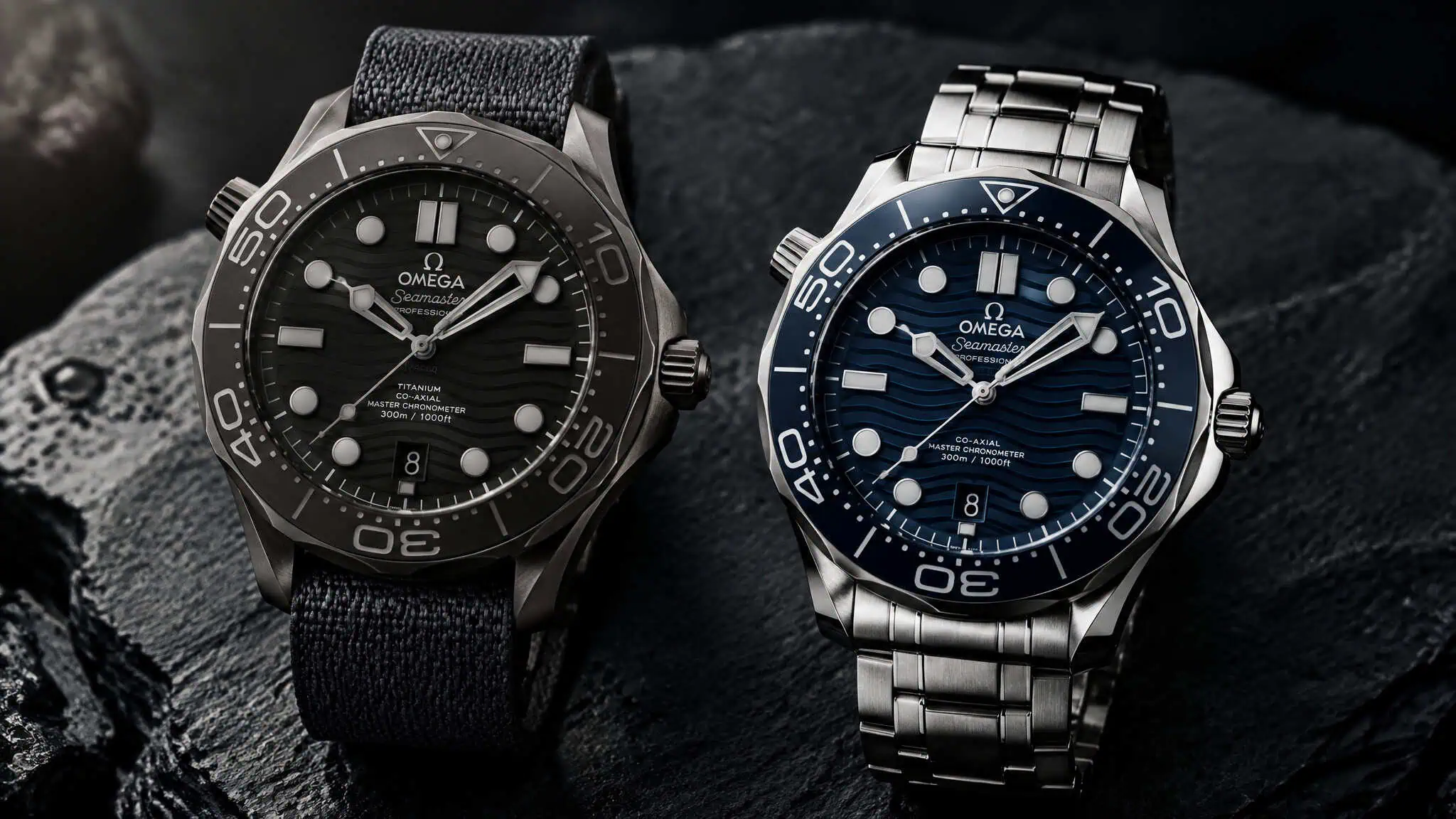
Same watch, two metals, and one of them costs 30-50% more. That’s the titanium decision in a sentence, and whether it’s worth it depends almost entirely on how you wear a watch. I’m going to walk through weight, scratches, corrosion, skin, price, and feel, then give verdicts by use case instead of pretending one metal wins. And because I’d rather trade in numbers than adjectives: the matched Seiko pair below weighs 116 g in titanium versus 186 g in steel. That’s the gap we’re talking about.
Key Takeaways
Titanium is roughly 40% lighter than steel for the same watch: Seiko’s Shogun (titanium) is 116 g on bracelet vs the Sumo’s 186 g, with the bracelet alone at 31 g vs 57 g.
“Does titanium scratch more?” has no answer until you know the grade and the treatment: untreated Grade 2 scratches easier than 316L, Grade 5 is harder, and hardened Grade 2 (Circula DiveSport, 1,200 Vickers) can beat untreated Grade 5.
A documented nickel allergy is the one clear-cut verdict in this whole comparison: steel carries 10-28% nickel, titanium has none.
Table of Contents
Quick answer: stainless steel vs titanium at a glance
Here’s the short version: choosing between stainless steel and titanium comes down to comfort, budget, and how you’ll actually wear the thing. There’s exactly one exception where the decision makes itself. If you’ve got a documented nickel allergy, titanium is the only answer, full stop. Steel contains 10-28% nickel depending on grade, and no amount of “but it’s just a little” changes a wrist that reacts to it.
For everyone else, it’s trade-offs. Titanium is lighter by a real margin, handles saltwater and sweat better, and doesn’t flare up sensitive skin. Steel is cheaper, easier to polish and refinish, and looks brighter under a dress shirt. Neither is universally better.
The numbers, laid out:
| Criterion | Titanium | Stainless steel |
|---|---|---|
| Density | 4.5 g/cm³ | 8 g/cm³ (~40% heavier by volume) |
| Weight example (Seiko, on bracelet) | 116 g (Shogun) | 186 g (Sumo) |
| Scratch behavior | Partial (depends on grade; untreated Grade 2 scuffs easily, treatments like Dia Shield fix it) | Partial (softer than hardened titanium but easier to refinish) |
| Nickel content | 0 | 10-28% depending on grade |
| Tensile strength (Grade 5 vs 316L) | 1,170 MPa | 485 MPa |
| Price vs equivalent steel model | +30-50% | Baseline |
| Best for | Big cases, saltwater, sensitive skin, all-day comfort | Dress wear, value, bright polish, easy refinishing |
Two sentences of verdict: if your watch lives on your wrist through workouts, ocean swims, and 14-hour days on a big case, titanium earns its premium. If you want the most watch for the money, something that shines with a suit, and the ability to buff out wear yourself, steel is the smarter buy.
Weight on the wrist: what 40% lighter actually feels like
Titanium is roughly 40% lighter than steel, and whether that feels great or cheap depends entirely on the guy wearing it. There’s no right answer, just yours.
The cleanest proof point is Seiko’s own matched pair: the Sumo in steel weighs 186 g on bracelet, the titanium Shogun comes in at 116 g. Same family, 70 g apart, about 40%. And here’s the detail most articles skip: the bracelets alone weigh 57 g vs 31 g, so most of the weight you feel sits on the strap, not the case. A Breitling Aerospace in titanium runs around 85 g, if you want another data point.
The bigger the case, the more this matters. On a 44-47mm diver, that weight saving is the difference between all-day comfort and a wrist that’s done by dinner.
Wearer reports split honestly down the middle. Some guys find titanium’s lightness almost irritating, like the watch isn’t quite there. Others say it disappears on the wrist in the best possible way. Both reactions show up in the first week or so of wear.
Which camp you land in? You’ll have to try one on before committing.
Scratches and hardness: it depends on the grade and the treatment
The question “does titanium scratch more than steel?” is unanswerable until you know two things: which grade of titanium, and whether it’s been hardened. Anyone who gives you a flat yes or no is skipping the part that actually matters.
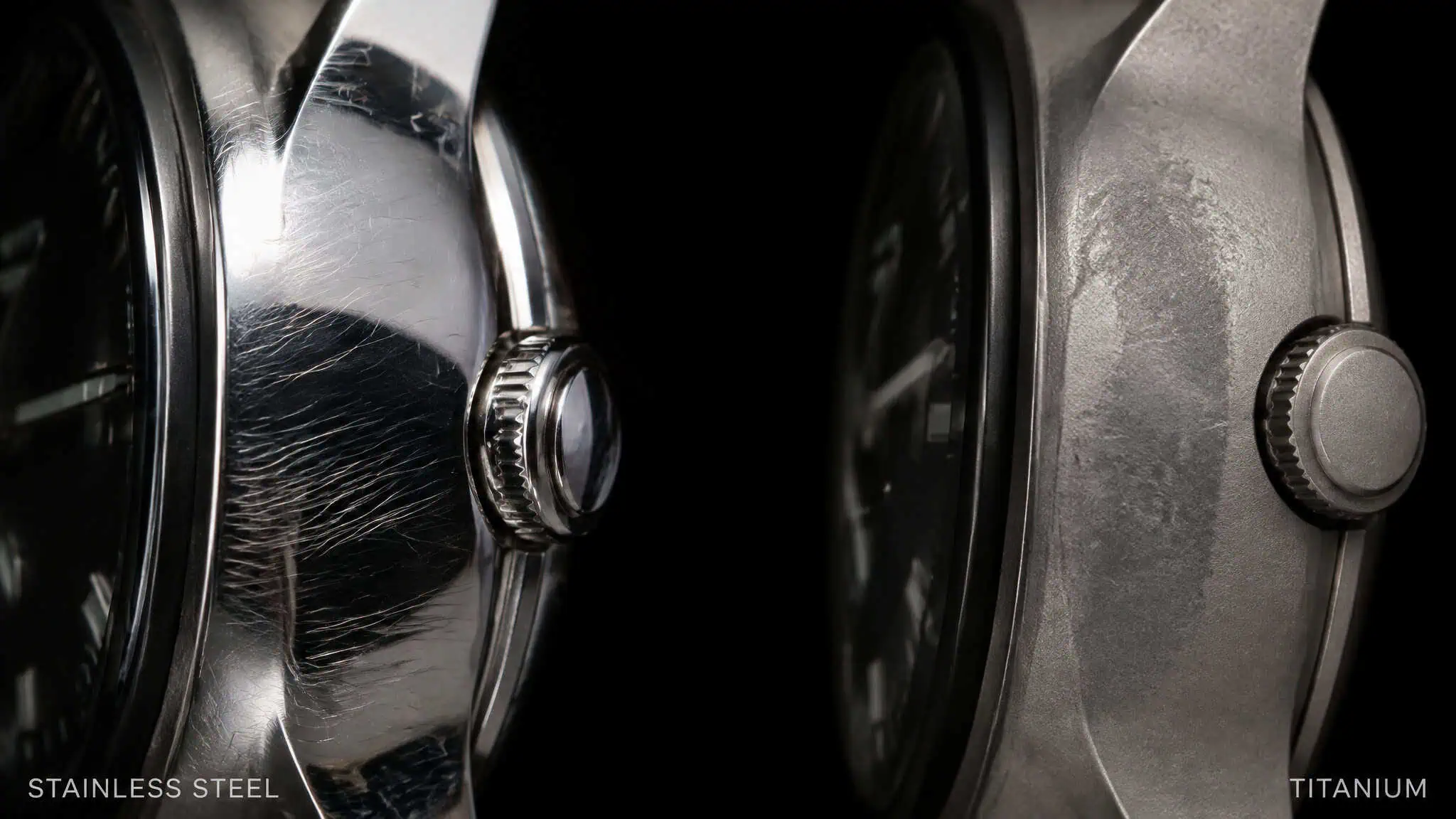
Titanium comes in grades, and the two you’ll see in watches behave completely differently. Grade 2 is about 99.5% commercially pure: light, corrosion-proof, hypoallergenic, but softer than 316L steel, so it picks up scuffs faster. Grade 5, the Ti-6Al-4V aerospace alloy with aluminum and vanadium in the mix, is harder than 316L. On tensile strength, Grade 5 hits 1,170 MPa against 316L’s 485 MPa. You’ll sometimes see Rockwell hardness figures thrown around, Grade 5 around 41 vs 316L around 79, but those numbers conflict in a way that looks like a scale mismatch, so I wouldn’t build an argument on them.
Steel has its own grade split. 316L is the workhorse: machines cleanly, costs less, and is genuinely fine for most guys. Don’t let anyone shame you out of it. 904L is the premium option, packing more chromium, nickel, and molybdenum. It resists saltwater better and holds a deeper polish longer, but it costs more. Worth it if you’re in the ocean regularly or you care about finish retention. Otherwise, skip it.
Then there’s the part that inverts everything: surface treatments. DLC (diamond-like carbon) and PVD coatings, Seiko’s Dia Shield, Citizen’s Duratect: these can transform how a case wears. The Circula DiveSport is the proof point, a Grade 2 case hardened to 1,200 Vickers that can outperform untreated Grade 5. Soft metal, hardened surface. Check the full spec, not just the word “titanium” on the dial.
The classic buyer mistake looks like this: a guy assumes “titanium” means scratch-proof, buys an untreated case, and watches swirl marks appear while someone else’s hardened watch from a different brand shrugs off the same daily abuse. It’s one reason many men end up weighing stainless steel watches against titanium in the first place, the treatment mattered more than the metal. That’s the whole lesson.
Red flag: If a listing just says “titanium” with no grade or hardening spec, assume it’s untreated Grade 2 and scuffs accordingly.
Scratches also look different between the two. Steel shows bright, crisp hairlines. Titanium scuffs into a matte haze, which some guys actually prefer because it hides wear. And steel is far easier to refinish with standard tools; titanium needs specific products and technique if you want to undo damage.
Corrosion and skin: the two clearest titanium wins
Weight and scratches are trade-offs, but corrosion and skin reactions are where titanium pulls ahead outright. One metal shrugs off saltwater and sweat and carries zero nickel; the other can pit and can flare up sensitive wrists. Here’s why.
Saltwater, sweat, and the self-fixing shield
Titanium’s corrosion advantage comes from an oxide layer that forms instantly on contact with oxygen and repairs itself when scratched. It may be only about 1nm thick, which is absurd, but that invisible, self-patching shield is the whole reason the metal doesn’t rust on you. It shrugs off chlorides, seawater, sweat, and alkalis, and its resistance matches or beats even fancy 904L steel, one reason Omega offers titanium on models like the Ploprof and Planet Ocean, as covered in this Omega vs. Rolex durability comparison. Meanwhile 316L can develop pitting with prolonged saltwater exposure.
Daily swimmer or sailor? This matters.
Both materials are fine in pools and the ocean as long as the watch is actually waterproof, so don’t overthink a casual swim. But the dive-watch lineage says something: Seiko built the first titanium dive watch back in 1975, and the modern Circula DiveSport, rated to 500m, shows what the material does in serious water.
The nickel problem steel can’t escape
Steel contains 10-28% nickel depending on grade, and 904L actually runs higher, at 23-28%, nickel allergies being one of the disadvantages of stainless steel watches worth taking seriously. Titanium has none. It’s biocompatible enough that Ti6Al4V is the most-used knee-implant alloy, which is about as strong a skin-contact credential as a metal can get. If your wrist has ever flared up under a steel bracelet, you already know. A documented nickel allergy is the one not-even-close scenario in this entire comparison, and I’ll say it straight: buy titanium.
Price: why titanium costs 30-50% more (and it isn’t rarity)
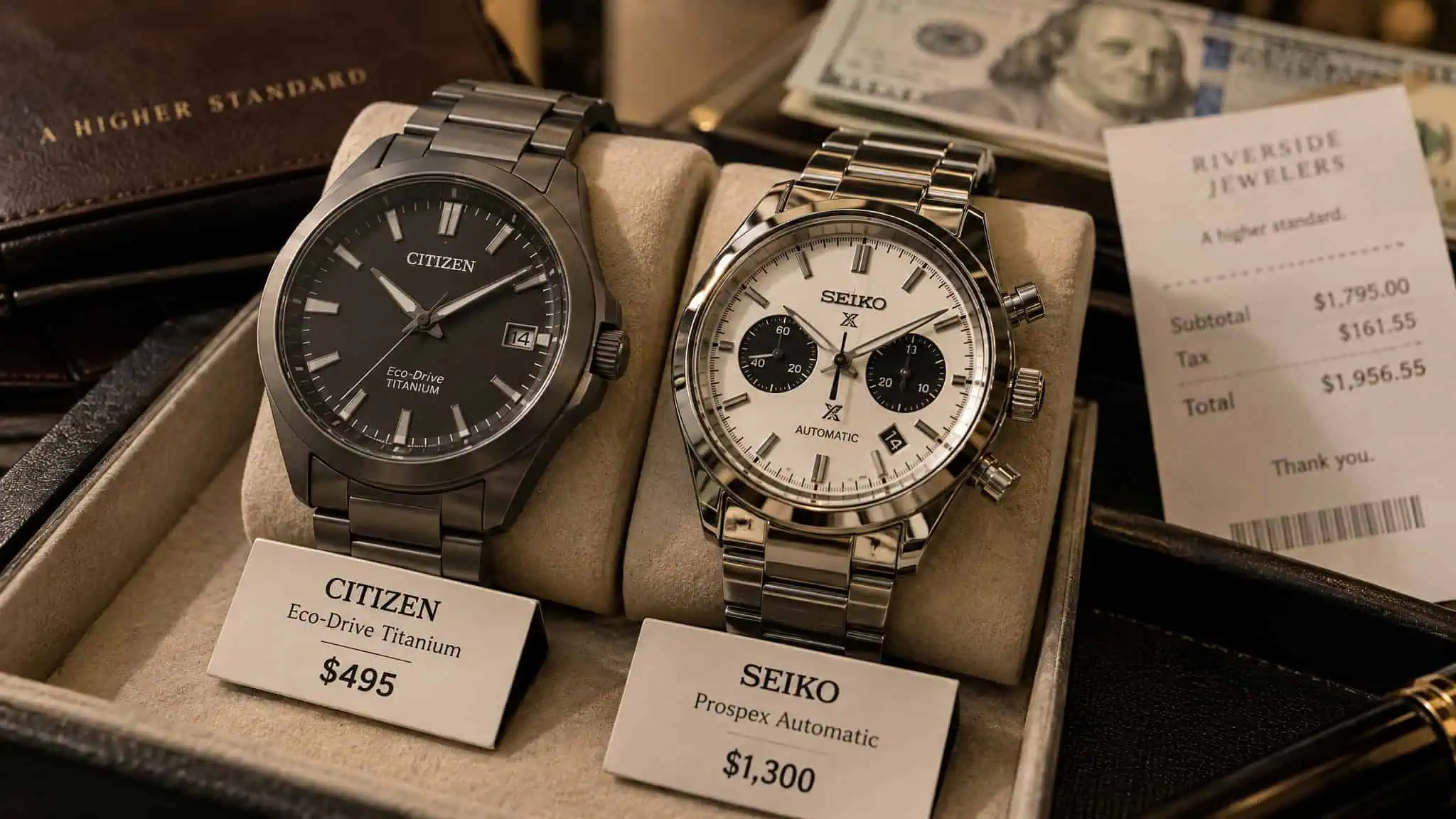
Expect to pay 30-50% more for the titanium version of an equivalent steel watch. Budget for that up front, because it’s consistent across the market. Prices vary by retailer, but the premium itself is stable.
Here’s the myth worth killing: titanium isn’t rare. It’s the seventh most abundant metal on Earth, with roughly 140 known titanium-bearing minerals, and it shows up in meteorites and Moon rock for good measure. The premium comes from manufacturing. The Kroll process, cracked in 1932, extracts titanium as a sponge that then gets remelted repeatedly, and it’s energy-intensive.
After that, the metal is brutally hard to machine, requiring argon and inert-gas containment, eating tooling faster, and demanding tighter tolerances. That’s what you’re paying for, not scarcity.
Perspective check: even with the markup, titanium still costs far less than gold or platinum. A guy I know assumed “space metal markup” until he learned the truth, and his conclusion matches mine: steel is simply the value play. MTM’s Hypertec Chrono 2 lands at $455 in steel, while comparable titanium models run $1,585. That gap is the premium in real money.
Looks, finishes, and feel: gunmetal grey vs bright silver
Steel wins with a suit. Titanium reads as serious equipment. That’s the honest fork, and it’s taste, not superiority: some guys want their watch to shine, others want it to disappear into the cuff.
Finishes and what each metal can do
Steel is a bright, warm silver that takes a deep mirror polish, shows off high-contrast case work, photographs beautifully, and is easy to buff back to new over years of wear, a real advantage when you compare stainless steel to other watch metals like gold, bronze, or PVD-coated alloys. Titanium runs a darker gunmetal grey that suits brushed and bead-blasted finishes but genuinely limits your polish options, a real constraint the spec sheets never mention. Polished titanium is possible, specialists like Bergeon can pull it off, but it’s less brilliant than steel and harder to maintain. Titanium finishes run black, grey, and blue; steel offers silver, gold, rose gold, green, and beyond.
Steel simply gives you more looks. Pair titanium with rubber or nylon for sporty pieces; steel goes with leather or Milanese mesh for dress.
Feel: lighter, not stronger
Kill the myth in one line: titanium is lighter, not stronger, than steel. A same-size titanium watch isn’t tougher than its steel twin, and strength parity only happens at equal weight. The real perks are subtler. Titanium tends to bend rather than break, and its high heat transfer keeps it at wrist temperature, so there’s no cold-metal shock on a winter morning.
A brief history of titanium in watchmaking (and one myth to correct)
Titanium was found twice in the 1790s by two guys working independently. William Gregor, a Cornish clergyman and amateur chemist, identified it in 1791 in ilmenite from the Menaccan Valley and called it menaccanite. German chemist Martin Heinrich Klaproth found it again in 1795 in rutile and named it after the Titans. By 1797 everyone agreed it was one metal, and Klaproth’s name stuck.

Then nothing happened for over a century. Titanium sat useless until 1932, when William Kroll’s extraction process finally made it practical. The metal’s rise ran through aerospace: about two-thirds of production goes to aviation, the US Department of Defense backed its commercialization, NASA used it for heat tolerance, and the CIA literally bought Soviet titanium to build the A-12/SR-71 Blackbird. That’s where the “space-age” reputation comes from, and it was earned. The geography has shifted since the Cold War, though: today China is the world’s largest titanium producer, a title the USSR once held.
Now the correction. Citizen’s X8 was the first titanium wristwatch in 1970, reportedly motivated by the Apollo program. Seiko built the first titanium dive watch in 1975. The 1980 Porsche Design Titan Chronograph, developed with IWC and Lothar Schmidt, drove Swiss adoption, but it’s commonly miscredited as titanium’s watchmaking first. It wasn’t.
Japan got there a decade earlier. As for what’s next: Rice University reported a promising titanium-gold alloy in 2016, and it hasn’t appeared in a single watch since. Cool lab result, dead end so far.
Which should you buy? Recommendations by use case
Everything above comes down to this: match the metal to how you actually wear the watch. Nickel allergy aside, there’s no universal winner, so the verdicts below are sorted by use case rather than by which metal is “better.”
Daily wear
Big case on your shortlist, 47mm territory? Titanium is what makes that wearable. MTM’s Cobra 47 at $1,585 exists at that size only because titanium is so light. Nickel sensitivity or daily saltwater and sweat push the same direction: titanium.
Dress
Steel, and it’s not a debate. The bright finish, polish flexibility, and easy refinishing all matter more than weight when the watch is under a cuff at dinner. The Emporio Armani AR1925 is a polished steel dress option, and the Casio A158WA-1DF proves the value end doesn’t have to be boring.
Sport
Titanium’s home turf. The Citizen Eco-Drive AW1641-81X pairs a titanium case and green dial with a movement you never have to wind or battery you never change. The Edox CO-1 adds black PVD coating over titanium, which is exactly the treatment-plus-grade combo that holds up. Watching the budget? Steel still delivers: MTM’s Hypertec Chrono 2 at $455 or the Black Predator at $1,090.
Apple Watch and smartwatches
The same framework applies to smartwatch cases: weight, scratch resistance, skin contact, and price all matter identically. The material properties don’t change because there’s a screen in the middle. It’s the same call as choosing between a titanium and stainless steel Apple Watch, if you want durability, comfort on the wrist, and better scratch resistance, the titanium upgrade is worth the extra cash.
Bands and bracelets
The bracelet is its own decision, not an afterthought. In that Seiko pair, the bracelet alone accounts for 57 g of steel versus 31 g in titanium, so band material swings the wrist feel as much as the case does. Choose it deliberately: titanium if you’ve got a big daily wearer, saltwater exposure, or nickel sensitivity; steel if you want the classic bright look, easy refinishing, and the best performance per dollar.
State it plainly: nickel allergy is the only clear-cut verdict here. Everything else is trade-offs, and here’s what I’d do: let the use case decide, not the marketing.
FAQ: titanium vs stainless steel objections, answered
What’s the disadvantage of a titanium watch? The 30-50% price premium, limited polish options, and softer untreated Grade 2 that scuffs easily. Plus the weight split: some guys never warm to how light it feels.
Is titanium actually stronger than stainless steel? No. It’s lighter, not stronger. Grade 5’s tensile strength (1,170 MPa) beats 316L’s 485 MPa, but a same-size titanium watch isn’t tougher than its steel twin. The Rockwell figures floating around conflict, likely a scale mismatch.
Are titanium watches worth the extra money? Yes if saltwater, nickel sensitivity, large cases, or all-day comfort matter to you. No if budget or dress-watch polish leads the decision.
Steel for value, polish, and dress. Titanium for weight, saltwater, sensitive skin, and big cases. Nickel allergy is the only unambiguous call. And the single best piece of advice in this whole piece: try both on. Weight preference can’t be read off a spec sheet.
Frequently Asked Questions
Is it better to buy a titanium or stainless steel watch?
There’s no universal winner — it depends on how you wear the watch. Titanium wins for weight (roughly 40% lighter), saltwater resistance, sensitive skin, and making big 44-47mm cases wearable all day. Steel wins on price, bright polish for dress wear, and easy refinishing. A documented nickel allergy is the only clear-cut call: buy titanium.
What is the disadvantage of a titanium watch?
The main drawbacks are the 30-50% price premium over an equivalent steel model, limited polish options (titanium’s gunmetal grey can’t match steel’s deep mirror shine), and untreated Grade 2 titanium being softer than 316L steel, so it scuffs easily. Some wearers also never warm to how light it feels on the wrist.
Is it better to get titanium or stainless steel?
For watches, match the metal to your use case. Titanium suits big cases, daily ocean or sweat exposure, sensitive skin, and all-day comfort; steel suits dress wear, value hunting, and bright finishes. Steel is the value play — titanium versions of the same watch consistently cost 30-50% more.
How much more does a titanium watch cost compared to steel?
Expect to pay 30-50% more for the titanium version of an equivalent steel watch, and that premium is stable across the market. The markup isn’t about rarity — titanium is the seventh most abundant metal on Earth — but the energy-intensive Kroll extraction process and the fact that titanium is brutally hard to machine, eating tooling and demanding tighter tolerances.
Why is titanium better for saltwater and nickel allergies?
Titanium forms a self-repairing oxide layer about 1nm thick on contact with oxygen, which shrugs off chlorides, seawater, sweat, and alkalis — while 316L steel can develop pitting with prolonged saltwater exposure. On skin, titanium contains zero nickel, whereas steel carries 10-28% depending on grade. Titanium is biocompatible enough that Ti6Al4V is the most-used knee-implant alloy.