
Negotiation is a skill, and it shows up way more often than you’d think: roughly a quarter of daily conversations have some negotiation in them, whether that’s dinner plans, a contractor quote, or what the kids are doing this weekend. In Zambia, researchers Corinne Low and Nava Ashraf ran a program of just 12 hours of negotiation classes, six two-hour sessions over three weeks, for 12- and 13-year-old girls.
More than a decade later, those girls had more schooling, more college graduations, and were less likely to marry much older men than a control group. Twelve hours. That’s less time than you’ve spent scrolling this month. The best negotiators do two things at once: they grow the pie and then claim their slice, and they treat the whole thing as persuading and finding common ground, not combat. Here’s the full toolkit.
Key Takeaways
Your BATNA, your best alternative if the deal dies, is your single biggest source of power; a strong plan B lets you negotiate from confidence instead of desperation.
Across hundreds of simulations, the number of open-ended questions a negotiator asked was the single best predictor of success across hundreds of simulations, beating every clever tactic.
12 hours of negotiation training for Zambian schoolgirls produced measurable education and marriage outcomes more than a decade later, hard proof this is a trainable skill.
Table of Contents
Model details below derive from the cited sources; check the brand pages for current pricing.
Analyze and cultivate your BATNA
Your BATNA, best alternative to a negotiated agreement, is the single best source of negotiating power you have. It’s your plan B if this deal dies, and it matters because real power isn’t a smooth line or a confident voice. It’s being able to walk away and pursue another deal.

Identify it before you come to the table, then work on making it better. Keep it concrete: if you’re negotiating with a provider, your BATNA is another company’s offer of a similar service with better conditions. Go get that quote. A solid plan B changes your whole posture. You ask for things instead of hoping for them, because confidence comes from options, not attitude.
Here’s the pattern negotiation coaches see over and over: a guy walks in having picked his bottom line emotionally, never verifying what his alternative is worth. The tell is hesitation the moment the other side pushes past his stated number. He doesn’t know whether the number is real because he never checked. The deal is lost right there, before it starts.
So do the homework early. If your plan B is weak, take steps to strengthen it before you come to the table. Get the second quote. Line up the other offer. The walk-away option is the power, and like most power, you build it before you need it.
Map the ZOPA and set your reservation price
Preparation means knowing two things cold: the overlap where a deal is even possible, and your own walk-away number. The first is the ZOPA, the zone of possible agreement, which in plain language is just the range within which both parties can reach agreement. Worked example: you can pay up to €10,000, the supplier needs at least €8,000, so the deal lives somewhere between €8,000 and €10,000. Any number in that range works for both sides. Anything outside it doesn’t, no matter how good the conversation gets.
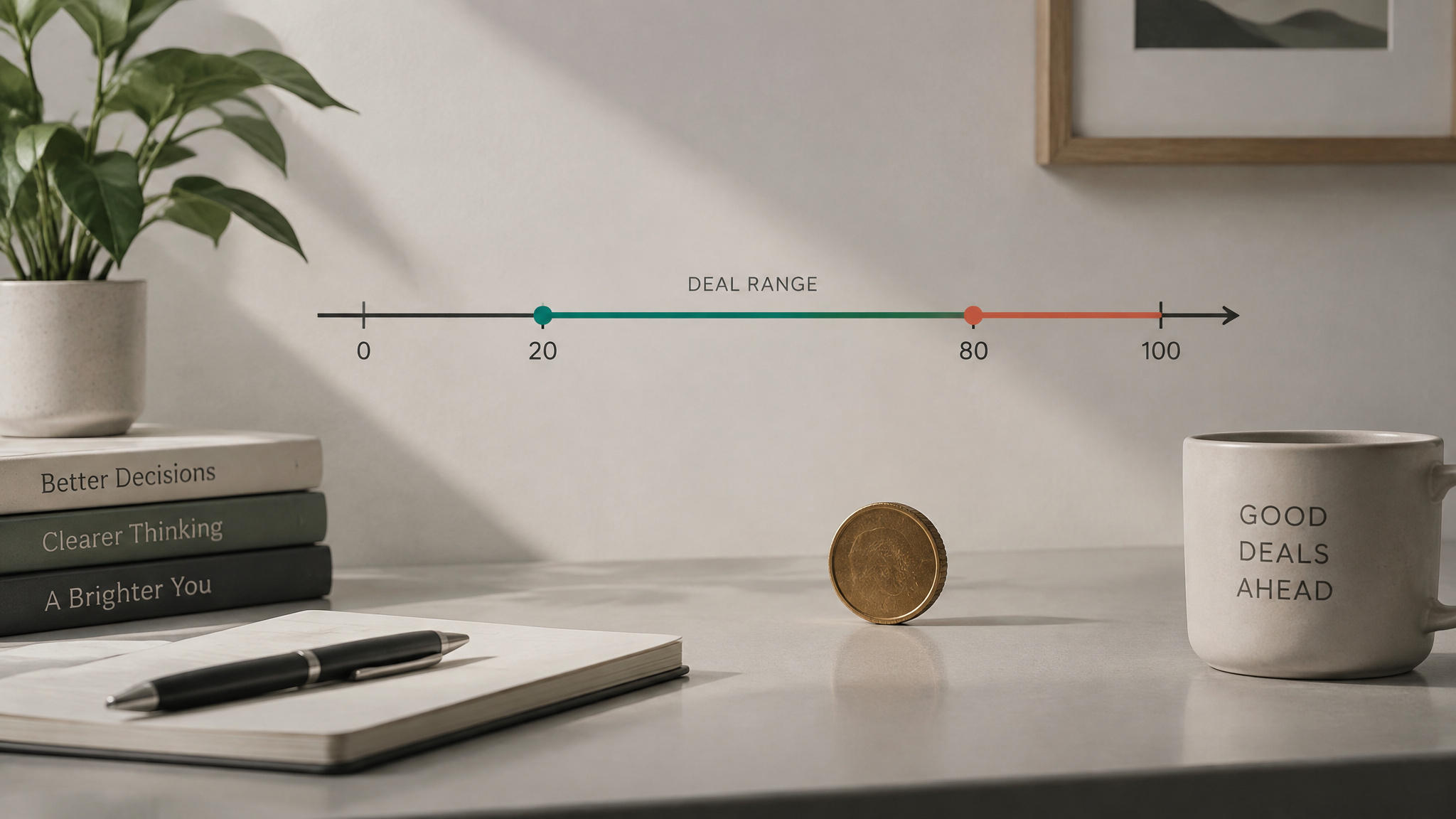
The second thing is your reservation price: the point where yes and no feel exactly the same. Above it you’re fine, below it you’re out. Margaret Neale has a great gut-check for whether you’ve found yours, the coin-flip test. At your true walk-away number, heads you leave, tails you stay, and you don’t care either way. If you wouldn’t flip a coin at that number, it isn’t your real bottom line. You’ve picked a number that still has feelings attached, and feelings are what get pushed around.
Which brings up the failure mode nobody warns you about: negotiators lower their own expectations during preparation and then justify the lower number to themselves. You talk your own ask down before anyone else gets a chance. Don’t negotiate with yourself. The counterpart never even has to do it to you.
Close out prep with goal-setting. Set goals that are specific, reasonable, aspirational, and optimistic, with your bottom line identified. Then map it out: their interests, your persuasive arguments, the concessions you’ll part with, and your acceptable alternatives. Yes, map theirs too.
Prepare more than anyone else
Ashley Lowery’s observation is blunt: it’s shocking how little preparation people do. Answer four questions before you sit down. What do I want? What does the other party want? Who has leverage? What are the circumstances?
Figure out who holds leverage in your situation, then gather it: institutional salary data, what colleagues make, cost-of-living math, another job offer. That last one matters most, because a real alternative somewhere else is the strongest lever you can bring.
Remember that almost everything is negotiable. Salary, moving costs, lab or office space, travel funds, release time. People forget to ask about half of it.
Then rehearse. Say your key lines out loud before the real thing, in front of a mirror, or with people who’ll give honest feedback. Sounds dumb, works. Practice with people who’ll give you honest feedback on your speed, your clarity, and whether your verbal and nonverbal delivery fit.
Negotiate the process before substance
Before arguing about money or terms, negotiate the process before the substance. Don’t assume shared expectations about how negotiations will unfold, because you probably don’t. Sort the boring logistics early: clarify when and how often you’ll meet, who will be in the room, and what topics get discussed and in what order. Addressing those procedural questions up front prevents misunderstandings, ten minutes of logistics talk now saves you the “wait, I thought we agreed…” moment later.
Build rapport and listen actively
Rapport isn’t schmoozing. It’s being a person for a few minutes before being a counterpart, and research shows negotiators who make even a modest effort to know one another are more collaborative and more likely to reach agreement. If the whole thing is happening over email or video, do one brief introductory phone or video call first. A brief introductory call humanizes the interaction, making you a person, not a thread.
Then the listening part, said plainly: resist planning your response while the other party is still speaking. Everyone does it. Stop. Play it back instead, paraphrase their main points to confirm you understood.
If you hear emotions like frustration or concern, name them out loud; acknowledging them defuses them. And ask follow-up questions that clarify their interests, because that’s where the useful information hides. Bonus: active listening uncovers useful information and encourages the other side to listen in return. It’s contagious.
Ask open-ended questions, the best predictor of success
Across hundreds of simulations, the number of open-ended questions a negotiator asked was the single best predictor of who did well. Not confidence, not clever lines. Questions that can’t be answered with one word.
Skip yes/no questions and leading stuff like “don’t you think…?” Those corner people and get you nothing. Use neutral open-ended questions instead, such as “Can you tell me more about the challenges you’re facing this quarter?” That gets them talking, and talking is where the information lives.
Under pressure, people default to questions answerable with a yes or no because they feel faster. The result shows up later: a guy walks away with an agreement but no understanding of the other side’s real constraints, which is exactly why the trade he needed never gets proposed.
One more distinction worth knowing. “How?” questions generate sympathy and closeness. “Why?” questions extract more information but can seem intrusive without tact. Pick based on the room.
Expand the pie before dividing it
Trades beat haggling. A distributive deal, price only, is pure haggling: you push, they push, somebody splits the difference, the way people typically negotiate a used car price. An integrative deal with multiple issues lets you trade, and that’s the whole distinction. Find the asymmetry: what they value highly that you don’t, and vice versa.
That gap is where the deal gets better for both of you. Michele Gelfand’s point is simple: more issues on the table means more room for everyone to win, so widen the deal, don’t narrow it.
Field note: If there’s only one issue on the table, you’re haggling, not negotiating. Add issues until there’s room to trade.
Kill the win-win misconception while you’re at it. Win-win doesn’t mean equal gains. It means both sides walked out better than their alternative. Uneven can still be win-win; each side just has to at least stay whole.
Concrete version: instead of a €1,000/day late penalty, offer €3,000/day late plus a €500/day early bonus. Bigger stick, but a reward for beating the deadline. Same topic, different feel, and it turns a tense standoff into a deal both sides can win.
Who should make the first offer?
Who should make the first offer depends on the situation: go first when you know the values, let them open when you don’t. Anchoring bias is real, the first number out there bends everything after it, even if it’s arbitrary. When values are known and it’s a one-time distributive deal (buying a car is the classic case), go first with an aggressive but realistic number. But when you’re the one lacking information, let them open: their first offer reveals what matters to them. Worth knowing, about 80% of people, CEOs included, think the receiver of the first offer has the advantage, and the research says it’s more complicated than that.
But when you’re the one lacking information, let them open. Their first offer reveals what matters to them, and information beats momentum. Neale’s stat makes it fun: about 80% of people, CEOs included, think the second mover has the advantage. The research says it’s more complicated than that.
If they anchor first anyway, don’t panic-negotiate from their number. Recheck your goal, your plan B, your target, and respond from those.
Present multiple equivalent offers simultaneously
Put a few equivalent packages on the table at once instead of one offer at a time. The technique goes by the acronym MESOs, multiple equivalent offers simultaneously, but you don’t need the vocabulary to use it. One option might carry a higher price with less flexibility; another a lower price with better delivery terms. If they shoot down all of them, ask which came closest and why. That answer tells you what they care about and sparks creative problem-solving. Side benefit: multiple offers reduce impasse risk, because it’s no longer a single yes-or-no decision.
Try a contingent contract
Stuck on what the future looks like? Wager on it. Say a contractor quotes three months and you doubt it. Propose a bonus for finishing early and a penalty for running late.
The tell: a contractor who actually believes his own timeline should take that bet without flinching. If he won’t, you’ve learned something.
That’s what a contingent contract is, a bet on future outcomes resolving stalemates over how the future will unfold, and it turns “I don’t believe you” into prove it, and we both win or lose. Niro Halevy extends the idea: tie future performance to pay or promotion pace, and negotiate the upside as a contingent clause. One honest caveat: this only works when the counterpart is confident in his own claims.
Plan for the implementation stage
The deal isn’t done at handshake. Make it durable: milestones and deadlines in the contract to ensure commitments are met, an agreement in writing to meet at regular intervals and renegotiate if things drift, and a dispute-resolution clause calling for mediation or arbitration, decided now while nobody’s mad.
Power, leverage, and the low-power advantage
Having less power can actually work in your favor, which sounds backwards until you see the research.

What counts as power when you lack formal authority
Power isn’t just leverage and titles. Halevy’s list of overlooked sources runs from network ties and unique expertise down to demeanor, even fluency and height. Some of that you can build before you walk in.
Why low-power negotiators often win
Margaret Neale compared pairs where both sides were high power, both were low, and where power was mixed. The best outcomes came from the mixed pairs. Why: the lower-power side is motivated to find creative value, while the powerful side just grabs what’s already there. The weaker party is the one doing the value creation.
Lowery’s warning fits here: figure out your best option before you’re in the room. If it’s the only option you’ve got, you’re screwed.
When to walk away, the goal is a good deal, not any deal
Walking away is warranted when you’ve stopped caring, when the counterpart is rude or offensive, or when your principles and values aren’t respected. Any of those, go.
Neale has a useful pushback on Getting to Yes, the Harvard method everyone’s heard of: the goal is a good deal, not any deal. Don’t close just to close. And Atwell’s reality check helps: almost nothing is one-of-a-kind. There’s nearly always another one.
The honest beat: some negotiations don’t have a good answer. Bendor’s line is that anyone promising universal negotiation success is fooling you or fooling themselves. And there’s a Voltaire-adjacent trap here: chasing a good alternative that doesn’t exist can make you toss the best one you actually had. Most negotiation questions have “it depends” answers, so do the basic diagnosis instead of hunting for a universal rule.
Adapting your approach: styles, culture, and context
The principles hold everywhere, but the stakes, the prep load, and the relationship horizon change between a salary conversation and a supplier deal.
Match the style to the situation
There’s no one right style. Collaborate when there’s time; it’s the ideal style but it’s time-consuming. Go competitive only when important values are at stake, a quick resolution is needed, or the relationship is low-value, knowing it may damage relationships over time. Accommodate when the relationship matters more than the outcome, which is a choice, not weakness.
Compromise when resources are scarce. Avoid to maintain the status quo or for trivial issues. The best negotiators are flexible and match their style to the situation. Flexibility is the skill.
Most negotiations repeat
You’re negotiating future outcomes, not just today’s. Winning this round while torching the relationship is a bad trade.
Culture and channel
Most of this science comes from Western samples, so flag that honestly. Gelfand’s warning: sports, battle, and game metaphors don’t travel. What reads as tough in one culture reads as rude in another, so adjust your language, pace, and expectations to build trust instead of confusion. Channel matters too: in person you can pivot fast and read body language; phone gives some cues but puts you on the clock; email is slow but lets you think before you hit send.
Supplier deals need real homework, market analysis, a clear value framework, anticipated objections, honest knowledge of your limits. With strategic customers, the play is co-creating value through listening and open questions.
Evidence that negotiation is trainable, and what the research says about gender
Yes, negotiation training works, and the evidence is unusually strong for a soft skill.
The Zambia study
Twelve hours total, six two-hour classes over three weeks, for 12- and 13-year-old girls. A decade later: more schooling, more college graduations, less likely to marry much older men, versus a control group given generic empowerment classes from the same coaches. Researchers Corinne Low and Nava Ashraf built a curriculum with a smart core: understand the other side’s interests instead of treating them as the enemy. Same lesson for you.
The classes also pragmatically respected local hierarchy, kneeling, formal address, the chitenge, when approaching parents, and parents later reported better relationships with their daughters. A 15-year follow-up is planned. The material traveled, too: Free to Run adapted it for online classes reaching about 1,200 girls in Afghanistan, taught by four Afghan women, helping girls manage mental health and negotiate small freedoms, including how to respond safely when stopped by Taliban members in public.
What the Cornell research found
A Cornell team ran five experiments with over 2,400 participants, published in PNAS, and found people consistently preferred negotiating with women, who scored higher on trust, fairness, and communication. Economic outcomes were equal; relational outcomes were better. The preference is social, not financial, and that subjective value compounds: a simulation projects roughly 45% more negotiation opportunities for women over time. The research thread itself dates back to the 1970s and 80s.
Practice deliberately, and use AI carefully
Tomas Quoidbach’s habits are worth stealing: prep harder than anyone else in the room, including guessing their arguments before they make them; ask for the real number, not the safe one; and get creative, because even extreme asks usually have discoverable logic behind them. His core line: the only way to get what you want is to ask for it, and to the other side, asking reads as normal, not demanding. AI tools like the ChatGPT Negotiator can crunch thousands of real conversations and run practice scenarios, but they don’t replace intuition, empathy, or creativity, and they sometimes fall back on cultural clichés, which is exactly the wrong move internationally.
Frequently Asked Questions
What are the 5 C’s of negotiation?
There’s no single canonical list of the 5 C’s — negotiation frameworks vary by source, and the research-backed toolkit centers on different pillars: knowing your BATNA, mapping the ZOPA, asking open-ended questions, expanding the pie before dividing it, and preparing more than anyone else. If someone sells you a fixed set of C’s as a universal rule, treat it skeptically. Most negotiation questions have ‘it depends’ answers, so do the basic diagnosis instead of hunting for a magic acronym.
How can I improve my negotiation skills?
Treat it as trainable, because the evidence is unusually strong: 12 hours of negotiation classes for Zambian schoolgirls produced measurable education and marriage outcomes more than a decade later. Practice deliberately — rehearse your key lines out loud, prep harder than anyone else including guessing their arguments before they make them, and actually ask for the real number, not the safe one. AI tools can run practice scenarios, but they don’t replace intuition, empathy, or creativity.
How do you negotiate when you have no leverage or a weak BATNA?
First, figure out your best option before you’re in the room — if it’s the only option you’ve got, you’re in trouble, so spend time strengthening it before negotiating anything. Then remember that low power can work in your favor: research on mixed-power pairs found the lower-power side is motivated to find creative value, and it’s the weaker party doing the value creation. Power also isn’t just titles — network ties, unique expertise, and even demeanor count.