
Ten guys booked, one guy holding the credit card, and nobody’s talking about what happens when two of them flake. That’s the real situation when you organize travel for a large group: at 10 or more passengers, you’ve stopped buying airline tickets and started signing a contract. Group desks will sell this as a perk. It’s closer to a loan against your deposit. This piece walks the whole thing: thresholds, booking windows, deposits, name changes, deviations, and whether the group desk even beats ten individual fares.
Key Takeaways
Delta and American define a group as 10+ passengers on at least one shared flight segment; drop below 10 on Delta and the booking is cancelled, the deposit forfeited, and everyone rebooks at that day’s fares.
Delta opens group space 240 days out for US/Canada, Caribbean, Central America, and Asia-Pacific, and 331 days out for Europe, Africa, and the Middle East.
Group fares guarantee flexibility and fare certainty, not savings; deviations after the utilization date cost $25 domestic / $50 international per person, capped at 30% of the group.
Table of Contents
What qualifies as a group booking, and the 10-passenger tripwire
A group booking on Delta and American is ten or more passengers flying on at least one shared flight segment. That last part matters more than people expect: you don’t need identical end-to-end itineraries, just one shared leg. Half the guys fly out of different cities and connect into the same flight? Still a group.
AA is looser than most folks assume. Multiple departure airports are fine, any cabin counts including premium, and it works anywhere American or its oneworld partners fly. Good news for a group flying in from two cities.
Now the teeth. On Delta, if your headcount drops below 10 mid-contract, three bad things happen at once.
- The entire booking gets cancelled.
- Your deposit is forfeited.
- Everyone rebooks individually at whatever published fares cost that day.
That’s the tripwire. Keep the headcount above the line.
One near-identical threshold with different wording: Lufthansa’s Green Fares group eligibility, added at the end of January 2026, is phrased as “more than nine people” on long-haul flights. Same ballpark, different paperwork.
How far in advance you can book group flights. Delta’s 240 vs 331-day windows
Delta opens group bookings up to 240 days before departure for US/Canada, the Caribbean, Central America, and Asia-Pacific, and up to 331 days out for Europe and North Africa, Southern and West Africa, and the Middle East. That’s the short version. The fuller version, which is the thing worth screenshotting:
| Destination region | How far in advance |
|---|---|
| US/Canada, Caribbean, Central America, Asia-Pacific | 240 days |
| Europe and North Africa, Southern and West Africa, Middle East | 331 days |
As a general expectation, the big carriers let you block group space up to roughly 11 months out, so Delta’s international window is in line with the industry norm. The regional split is the useful part. If you’re planning a domestic bachelor trip, you’ve got about eight months of runway. Planning the Rome wedding or a Jordan trip? You need to be working nearly a full year ahead.
One caveat on channel, because it trips people up: Delta’s online group booking only covers U.S./Canada travel. Anything international means the phone line or an agent. And don’t assume day one of the window means the cheapest fare. The window tells you how early you can lock seats, not that fares bottom out there.
How the group booking process works: quote, contract, deposit, and the Group Lead
You book a group by contacting the airline’s group desk, getting a quote, and securing seats with a booking fee plus deposit under a Group Contract. Not by checking out ten times online. Whether that actually saves you money is a separate question, see is it cheaper to book flights together, but here’s the lifecycle in the order you’ll actually hit it.
- Request a quote. Delta’s Group Specialists sit behind 800-532-4777, weekdays from 8 A.M. to 8 P.M. EST. Web booking works only for U.S./Canada travel; anything else is the phone. If you’re a managed agency partner, skip the line and go to your Sales Account Executive. American runs it through a contact form or the email aagmt.internet@aa.com; for personal travel you can call 1-800-433-5368, weekdays 5 a.m. to midnight CT. One oddity worth flagging honestly: AA’s page tells business customers to sign in to Southwest Business Assist for group quotes.
That reads like a channel mix-up on AA’s end. Use the phone line and the email as your reliable paths, and don’t burn time wondering about it.
- Review the contract. The exact booking-fee and deposit amounts live in the Group Contract, not the ad copy. Read it before you pay. And know that the booking fee can be nonrefundable, which is the part that stings if plans collapse.
Any change to the contract reopens fare and terms negotiation, so changes aren’t free, they reopen the whole deal. Late additions to the group may pay a different fare than everyone else. The 11th guy joining the bachelor party after the fact might cost more. Get it right the first time.
- Designate a Group Lead. Every group needs one point person, and it’s not optional, the airline deals with one voice, not ten. Pick the guy who actually answers his phone. During significant delays, changes, or cancellations, that person makes the calls for everyone.
They also have to collect email and phone info for every passenger, so build that list early. One odd-but-real detail: the group fare is confidential. Delta won’t tell individual members what the group paid. Ask your Group Lead, not the airline.
Red flag: A nonrefundable booking fee plus a roster that’s still settling is how deposits die. Lock names before you lock the contract.
A pattern worth naming: first-time bookers tend to treat the group quote like a normal reservation. They circulate the fare to the group chat for a week, deadlines pass quietly, and penalties attach that nobody knew existed, a process that’s far easier when travel agents can get cheaper flights negotiated directly for large groups. The calendar negotiates for you either way.

On the third-party side, independent explainers describe travel agents holding bulk seats under one PNR, one confirmation code, everybody on it, with passenger names sometimes not showing in the airline’s system until later. Don’t panic-call over a missing name list. It’s normal.
The usual caveat applies here: policies and prices can change, and your Group Contract is the source of truth. Whatever you read anywhere else, including here, the paper you sign wins.
Deposits, utilization dates, and the forfeiture cascade
Delta’s group deposit is collateral on a timeline, not a refundable hold. The mechanics:
- Early waffling is cheap. You can cancel 100% of seats without fee until the last penalty-free cancel/reduce date.
- Late waffling isn’t. Miss a ticketing deadline or fall short of the minimum utilization percentage, and Delta takes a per-seat fee out of your deposit for every seat below the line. If your contract has no Deposit Due date, no deposit is due, small mercy, worth knowing.
- Full bail-out is the worst case. Cancel everything after the utilization date and the entire deposit is gone.
- Money comes back slowly. Deposits are refunded only for ticketed passengers, and only after travel commences.
For a complete cancellation, you need a cancellation reference number, and Delta’s business records conclusively set the cancellation time. Get that number in writing, same day. Partial cancellations don’t need one.
Deviation rules and name changes: flexibility has a cliff edge
Yes, you can change passenger names and itineraries on a group booking, but how many times and what it costs depends on the carrier and the calendar.
A deviation is any change to date, time, or routing. Before the utilization date, Delta allows unlimited deviations at the group fare with no fee, make your changes early and they’re basically the least expensive way to book a flight at that point. After the utilization date, only 30% of the group may deviate, and each one pays a nonrefundable $25 per person domestic or $50 international, plus any fare difference, with the 30% figured on total seats held at the utilization date. Run the math on a 12-person group and you get roughly three or four deviators, max.
One loophole that saves guys real money: feeders connecting from a different city don’t count against the 30% cap and can be booked any time before ticketing. Payment is credit card only, required at booking, and the charge hits your statement immediately. After ticketing, routing is locked once travel starts, though return date and time changes are allowed with a reissue fee plus fare difference.
Quick test: Before signing, write down your utilization date and count who actually needs to deviate after it. If the answer is more than 30% of the roster, renegotiate or rethink.
Name changes are where American’s own pages disagree. One AA page describes unlimited name changes up to 74 hours before departure on day of travel with no fees. Another AA page, the Group & Meeting Travel one, says one free name change per ticket. I’m honestly not sure which one governs, and I’m not going to pretend I know.
Either version is valuable for a buddy trip where rosters shuffle, but the safe move is confirming your allowance in the contract before you count on it. Delta’s version: contract changes require renegotiation, and additions may price differently. Roster churn, guys dropping and joining right up to the ticketing deadline, is the friction every organizer learns the hard way.
Group booking vs booking everyone individually
Group fares buy you fare certainty and flexibility, not guaranteed savings. Neither Delta, which pitches “competitive fares,” nor American, which offers “special pricing,” puts a number on what groups actually save, because it varies. The move is simple: request the quote, then price it against the sum of ten published fares. On competitive routes with groups of 10 to 15, individual tickets can undercut the contracted fare once booking fees get added, and pricing both paths before signing is a common pattern among organizers.
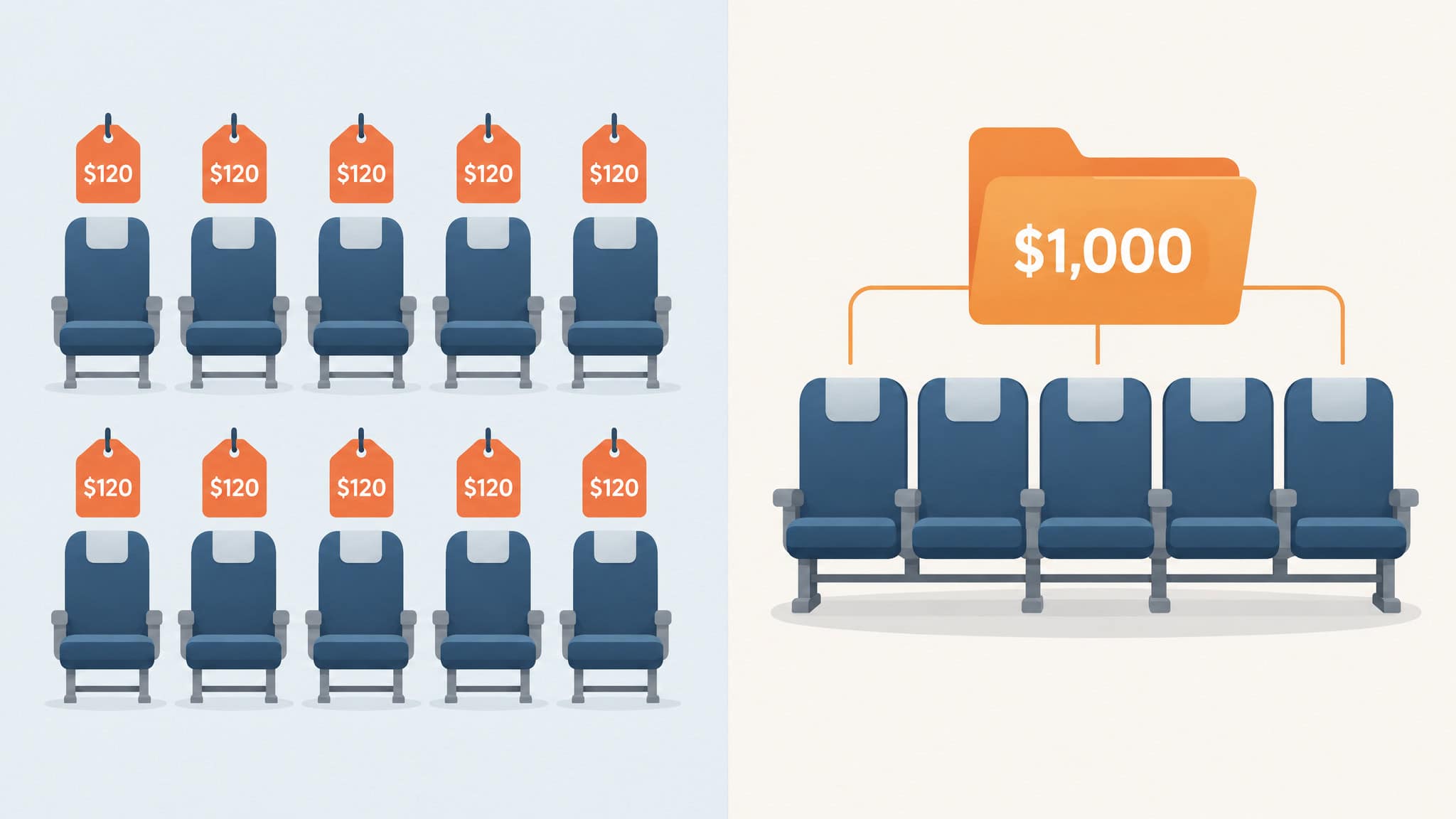
But here’s what individual booking can’t replicate. The group side gives you deposit-protected seat holds before you have names, name-change freedom, and defined deviation terms. And one group-only math factor: American awards a free round-trip ticket for every 30th passenger. A 60-person trip earns two free tickets. Ten individual bookings earn exactly nothing.
Here’s what I’d do: if the trip is fixed, same dates, stable roster, get the group quote and compare honestly. If the roster is a weather system, the flexibility alone might justify a slightly higher fare. That’s the whole decision.
When things go wrong: refunds, disruption rights, and the loyalty fine print
Yes, group passengers get real refund rights on Delta. Under the federal rule 49 CFR 260.6, the Group Lead can cancel and recover unflown ticket portions plus unused prepaid extras like bag fees, but only on Delta-issued tickets (DL-006 stock) on Delta-marketed flights, including Delta Connection and codeshares. Booked through a partner, different story.
What counts as a qualifying change, scannable version:
- Earlier departure or later arrival
- Different airport or added stops
- Downgrade
- Flight number change
- Operating-carrier swap (Delta Mainline ↔ Delta Connection)
Which delay threshold applies depends on when the ticket was issued. Tickets issued before October 28, 2024, qualified at 120+ minutes, domestic or international. Tickets issued on or after that date qualify at 180+ minutes domestic or 360+ international. Check your issue date and you’ll know which bar you’re under.
Then there’s the 7-day clock. If the Group Lead doesn’t rebook or cancel within 7 calendar days of a disruption notice, Delta takes action on its own. The deadline does your deciding if you don’t.
The loyalty fine print, said once: group tickets aren’t eligible for SkyMiles upgrades, and miles accrue per the unpublished/opaque-fare policy, which usually means less than a standard cash fare. Set expectations before someone assumes they’re earning full freight.
On the contract’s legal chunk, lightly: it’s governed by US law and, where federal law doesn’t preempt, the law of the State of Georgia; it’s the entire agreement, damages beyond the ticket are disclaimed, and no Delta rep can waive terms. The paper wins, so get everything in writing. One practical reminder instead of a lecture: passengers are responsible for passports and visas, and in a group of 10+, one guy’s expired passport can mess up everyone’s day.
The 2026 landscape: sustainable group fares and carrier disruption
Yes, since the end of January 2026, Lufthansa Green Fares work for groups larger than nine travelers on long-haul routes, in all travel classes, with a contribution toward CO₂ savings matching the flight’s estimated emissions. A “TO Green” fare for tour operators launched ahead of summer 2026, which matters if your group books through an operator. One honesty beat before anyone pays extra: buying a sustainable option supports network-wide use of sustainable aviation fuel, purchased SAF feeds airport infrastructure within six months, on top of mandatory quotas, it does not refuel your specific flight. SAF itself is a drop-in fuel that blends into normal kerosene, and biogenic-residue SAF cuts life-cycle CO₂ by at least 80% versus fossil kerosene. Context, compressed: over 4 million Green Fares tickets sold to date, and almost 7 million Lufthansa passengers, over 5%, up from under 0.1% four years earlier, chose a greener option in 2025.
Then the Spirit detour, briefly. When Spirit suspended operations, Delta ran reduced, nonrefundable rescue fares for about five days across Spirit’s domestic and U.S.. Latin America markets, through the app and delta.com, including on near-full flights. Spirit crews got 10 days of Delta standby plus a jobs microsite.
The takeaway for planners isn’t to wait for an airline to collapse. It’s that carrier failures open short rescue-fare windows, and knowing they exist is worth more than ever relying on one.
Closing Thoughts
Before you sign anything, make two calls. First, get the group quote. United, American, Southwest, and JetBlue all start group rates at ten passengers, and price it against ten individual published fares, fees included, both sides. Second, read the utilization date and the penalty-free cancel date off the contract before you circulate the fare to the group, because those two dates decide what your flexibility actually costs. And get the name-change terms in writing. Even the same airline’s pages can disagree.

