
You’ve done the Tuesday thing. You’ve gone incognito. You’ve refreshed the same search six times like the fare might blink first. And you still close the tab wondering whether the guy next to you on the plane paid $150 less. Here’s the flat truth: what is the least expensive way to book a flight comes down to a stack of repeatable tactics, not a magic day or a secret website.
Price alerts, date flexibility, the right booking window, all-in cost comparison, route restructuring, mistake fares. Stack them and you’ll start recognizing a genuinely good fare instead of second-guessing every checkout screen. And because most guides assume you’re traveling alone, we’ll flag where each tactic breaks when you’re booking for two or more.
Key Takeaways
There’s no cheapest day or site to book. Fares can change hundreds of times a day per OAG, so tracking beats timing: set alerts across multiple routes and nearby airports.
Flexible flying beats flexible booking: midweek flights ran about 13% cheaper in Google’s 2025 report ($56, $100 per ticket), and Skyscanner’s March 2026 LAX-JFK grid showed $123 on a Saturday vs $142 the Friday before.
For groups, search and book one seat at a time. Airline fare buckets mean a two-seat search can price both seats at the higher fare: $200 + $300 booked separately vs $500 together.
Table of Contents
Is there really a best day for buying airline tickets?
No reliable cheapest day to book exists. Airlines reprice fares constantly based on demand, seat availability, and competition on the route. Flight-data firm OAG notes fares can change hundreds of times a day, which is why refreshing a search feels like chasing a moving target. It is.
Now, the kernel of truth. Some airlines do release promotional fares around Tuesday at 3 p.m. ET. That’s incidental, not a rule. Same story with incognito mode: there’s no strong evidence browsing privately changes what you see.
Fares move because demand and inventory move, not because your browser remembered you. The better question isn’t “when do I click buy” but when does a good fare appear on my route. Only tracking answers that. (We’ve myth-busted the Tuesday thing in more depth here.)
Set price alerts the right way
Price alerts are the most reliable way to track fares, because fares move constantly and a single search tells you nothing. The alert does the watching so you don’t have to.
How to set them up
Search your route, toggle price tracking, set a date range, pick email or app alerts. Then do the same for nearby airports and a second or third route.
The common failure is a setup problem, not an alerts problem. The typical mistake: one alert, exact dates, one airport. Nothing pings for weeks, so the guy concludes alerts don’t work. Widen the airports and stretch the dates a few days each way and suddenly the alert actually fires.
One honest limitation: alerts track specific routes, not open-ended cheapness. An Atlanta-Madrid alert won’t catch a deal to Barcelona. If your destination is flexible, alerts alone won’t do the job (more on that below).
Which tools do what
- Google Flights. Track Prices toggle, plus 60 days of price history so you can see whether today’s fare is actually good.
- Skyscanner. Price Alerts, plus flexible-date and whole-month views.
- Kayak, straightforward fare alerts.
- Hopper, its Watch This Trip feature adds buy-now-or-wait predictions.
- Going, multi-destination alerts, including mistake fares. Membership tiers (Premium and Elite) cover business- and first-class deals. Full disclosure: our coverage of Going carries promotional framing.
Trust predictors, don’t obey them
Hopper’s buy-now-or-wait guidance is a signal, not an order. One documented case proves the point: a predictor missed a fare spike on Miami-Managua when a group booking filled the plane. The Points Guy’s advice when you’re uncertain is the right default: book earlier rather than wait. And if you’re booking for a group, know that group demand can fool predictors the same way it fooled the Managua model.
What days are cheaper to fly? Flexibility beats booking folklore
Midweek and off-peak days are genuinely cheaper to fly, but the specific cheapest day depends on whose data you trust. Most sources cite Tuesday, Wednesday, and Saturday. Expedia’s 2026 report ranks Friday cheapest, up to 8% below Sunday. Google’s 2025 report found midweek flights about 13% cheaper, roughly $56, $100 per ticket. The datasets disagree on the day; they agree on the principle: demand rewards when you fly, not when you click buy. Hopper analysts (Schwimer and Berg) add a timing-of-day note: the first flight of the morning is often cheaper and less delay-prone, and red-eyes are frequently the day’s cheapest seats.
Calendar views
Give yourself three to five days of flexibility on either side of your dates and use whole-month search tools. Here’s the proof you can feel: Skyscanner’s flexible-date grid for LAX-JFK in the first week of May, observed March 2026, showed $123 on Saturday May 2 against $142 on Friday May 1. Same route, seven days apart, $19 difference. Multiply that across a family and it’s real money.
The day-of-week data
Expedia’s 2026 numbers and Google’s 2025 numbers point at different days, and I’m not going to pretend that’s a clean answer. Where they agree: shift off weekend peaks and you save roughly $56 to $100 per ticket, more over holidays. Pick the midweek-or-shoulder day that fits your calendar and stop optimizing past that.
Booking windows: how many months in advance to book
Book domestic flights roughly 1 to 3 months ahead, international 2 to 8 months, and earlier for peak and holidays. The sources overlap rather than contradict: Going says 1-3 months domestic, Skyscanner’s guide says 3-8 weeks, The Points Guy says 1-2. They all converge on the same zone, so don’t chase a fake-precise number. Going calls this the Goldilocks Window, and it has a flip side worth naming: the Bargain Bin Trap.
The Goldilocks Window
For international trips, Going’s range runs 2-8 months, longer for peak season. Book peak-season trips in the opposite season, when they’re cheap and everyone else is planning summer. One dated shift to know: Google Flights’ four-year holiday data had Thanksgiving cheapest around 35 days out and Christmas around 51, and that was the norm until 2026, when fuel-driven fare inflation pushed holiday booking earlier. Those inflation numbers (summer fares up 27% year over year, Thanksgiving up 9-13%, Christmas up 12-18%, international holidays up 16% per Points Path) were conditions in 2026, not permanent rules.
When waiting backfires
Waiting for last-minute deals usually backfires domestically, because prices generally rise near departure. There are rare exceptions on low-demand routes, think Nicaragua, Colombia, rural Mexico, but betting your Thanksgiving flight on one is how you pay $200 more. And watch the thresholds: fares typically jump at 21, 14, and 7 days before departure. Booking inside those windows is a gamble with bad odds.
Is a cheap budget airline fare actually cheaper once fees are added?
No, a budget airline fare is not always cheaper once bag and seat fees are added, because the sticker price only holds if you fly with nothing. Checked bags run $30, $60 each way. Carry-on-only travel saves $60, $120 per roundtrip and unlocks basic economy fares, which also restrict seat selection and changes.
Here’s the checkout surprise travelers keep running into: the headline-fare gap vanishes once bags and seat selection get added, and a Frontier or Ryanair total can exceed a full-service fare. If you genuinely travel light, the budget carriers win. Breeze and PLAY have better service reputations than the extreme-budget tier if you want a middle option. One 2026 trend to note: free carry-ons are becoming less common industry-wide, with tighter size limits and more dynamic pricing of add-ons. The cheap-fare math is getting worse, not better.
OTAs make comparing all of this easier, but booking direct with the airline can get you member fares, loyalty perks, and more flexible cancellation. Full treatment below.
Quick test: Price the same trip with bags and seat selection included. If the budget carrier’s total beats the full-service total, book it; if not, you’ve saved yourself a cramped middle seat for nothing.
Restructure the route: split tickets, codeshares, and nearby airports
The same trip can often be priced cheaper by changing its structure. Mix one-ways, check who sells the same flight, widen the airport search, classic hacks for booking the cheapest flights. These are the tactics with the biggest single-ticket payoffs in the dossier, so here’s the full set with the worked numbers.
Split ticketing
Book NYC-Bangkok as a $450 United one-way out plus a $500 EVA Air return and you beat a $1,200 roundtrip by $250. The caveat that matters: separate tickets carry no missed-connection protection. If leg one is late and you miss leg two, that’s your problem, not the airline’s. So leave at least 3-hour buffers on domestic connections and 3-4 hours internationally. Overnight is even better for long-haul.
Codeshares
In March 2026, the identical JFK-Heathrow 9:35 a.m. flight sold at $300 by British Airways, $305 by American and Iberia, and $315 by Finnair. Same physical seat, three prices. Check every alliance partner selling your flight before you buy. The map: American and Alaska sit in oneworld; Delta is in SkyTeam with Air France-KLM, Korean Air, Virgin Atlantic, and WestJet; United is in Star Alliance with Lufthansa, Air Canada, and ANA. Hawaiian joined oneworld in April 2026.
Nearby airports
Search within a 60-90 minute radius of your city. New York means JFK, LaGuardia, and Newark. London means Heathrow, Gatwick, Stansted, and Luton. LA has five airports.
Worked example: LAX-Tokyo at $792 returning via Narita versus $905 via Haneda, $113 saved. Now the caveat that actually saves you money: ground transport to the distant airport is part of the fare. If the train, bus, or taxi to Narita costs more than $113, Haneda wins. Rome2Rio is good for pricing that last leg before you commit.
Open-jaw and multi-city
Fly into Rome, home from Athens. Multi-city searches create extra pricing combinations and can save hundreds compared with forcing a roundtrip back to your arrival city.
Indirect over nonstop
Taking the layover can save enough to cover a meal or even a hotel night. This works especially well internationally, and a long layover can split a brutal long-haul trip into two survivable halves.
Positioning flights and the Greek Islands Trick
Fly cheap to a hub, then onward. Detroit-Vienna for $677 plus a €20-30 Ryanair hop to Malta beat $1,021 direct. The classic version: a $130 NYC-Milan error fare plus a $20 DC-NYC bus beat roughly $800 direct. Don’t treat these as typical outcomes; they’re documented examples of what the structure can do, not a guarantee every search will find one.
Catch mistake fares without losing money (and the DOT rules that protect you)
Catching an error fare safely means booking immediately with a refundable payment method and accepting that the airline might cancel it. Mistake fares typically originate in currency conversion errors, upload mistakes, and glitches. They appear briefly and vanish. Never pre-book a non-refundable hotel against one, and treat the fare as a windfall, not a plan.
How mistake fares work
See it, book it, pay with a refundable method. Deal services like Going flag these in their alerts. The odds are good and the protections below back you up, just don’t build a trip around a fare that might evaporate.
The DOT rules that back you up
The DOT 24-hour rule gives free cancellation within 24 hours for US-departing or US-arriving flights booked directly with the airline at least 7 days before departure. If the price drops inside that window, book the new flight before canceling the old one. The DOT also guarantees refunds when an airline cancels or significantly changes a schedule; you can take the cash or push for a better flight. Related plays: some airlines issue trip credits when fares drop after booking (basic economy excluded), and there’s the cheap-red-eye gambit, book the red-eye, then switch to a better flight after the airline changes your schedule.
What is the cheapest website to book flights?
No single website is always the cheapest place to book flights. The honest answer is a workflow, not a winner.
Metasearch, and why no single site wins
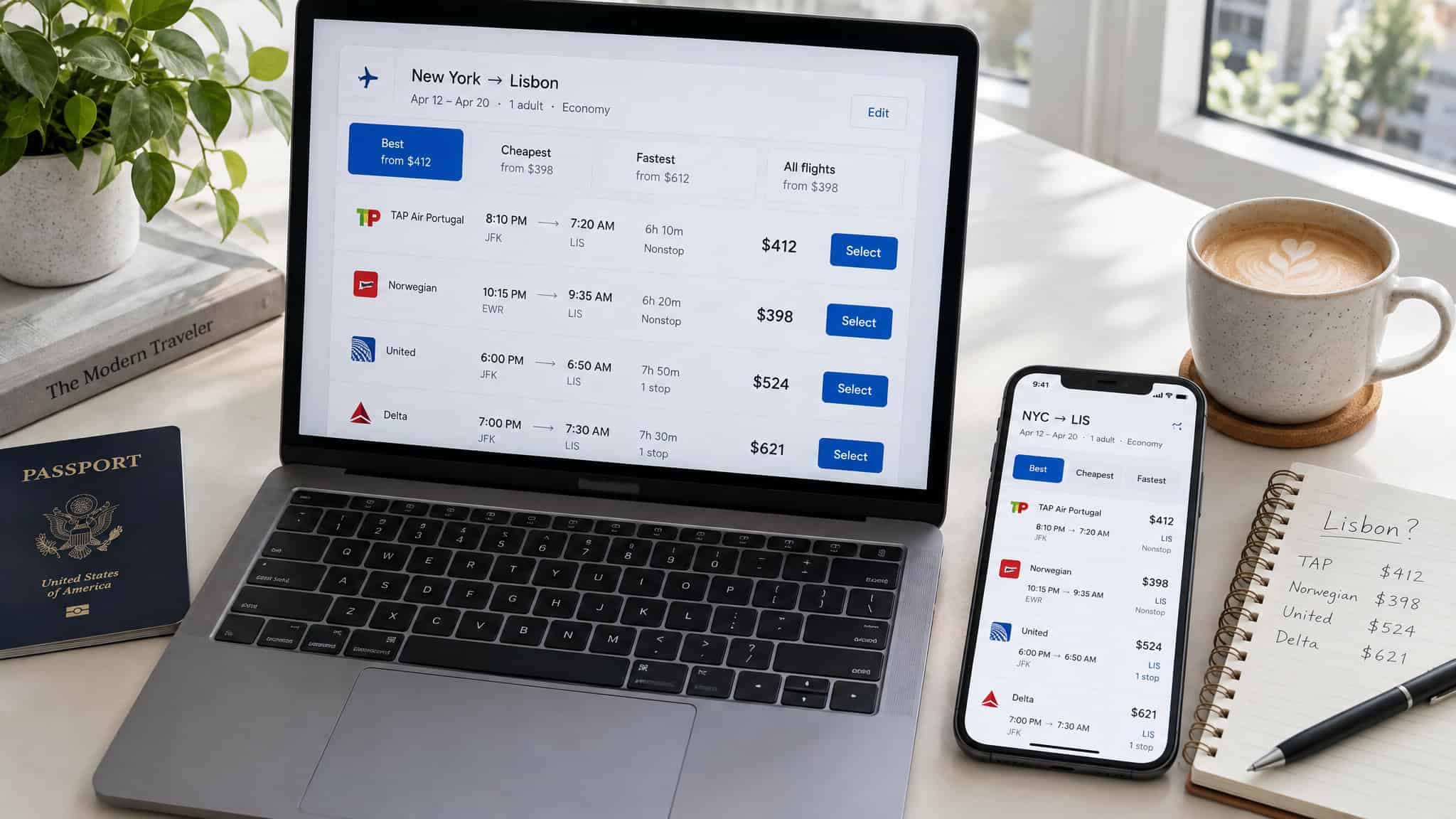
Google Flights, Skyscanner, Kayak, and Momondo each surface different fares. Check at least three, then book direct. Skyscanner’s tools earn their spot: Everywhere Search, the Savings Generator, and a nearby-airport filter. And there’s a whole different way to use these: Google Flights’ Explore Map and Skyscanner’s Everywhere Search let the fare pick the destination and dates, which flips the planning order entirely.
Channels the engines miss
Southwest fares don’t appear on most search engines, so check its Low Fare Calendar directly. Skiplagged occupies its own niche. StudentUniverse is worth a look if you’re an eligible student or young traveler. If the big engines all show the same number, one of these channels is where the difference hides.
Book direct vs foreign OTAs
Booking direct gets you member fares, easier problem resolution when things go wrong, and, critically, the DOT 24-hour rule only applies to airline-direct bookings. That rule is consumer protection you’re giving away when you book elsewhere. Foreign OTAs like Kiwi.com and eDreams, or booking in a foreign currency, can save 10-20% with a no-foreign-transaction-fee card, but they complicate changes and refunds, put you across a language barrier and time zones with a different refund policy, and forfeit US consumer protections. That’s a trade-off, not a recommendation.
One more structural quirk: round-trips originating in Europe are often cheaper. Detroit-London ran $884 from the US versus $678 from London. If you’re already abroad, price the return from there.
Pick your destination and dates by price first, and know what a good fare looks like
Flip the planning order and let prices pick the trip. Google Flights’ Explore Map and Skyscanner’s Everywhere Search show fares worldwide for open destinations and dates. To judge whether a fare is actually good, Going publishes roundtrip benchmarks (their numbers, not an industry standard): Europe $500 or less, Asia $500, Caribbean $300, Central America $300, Hawaii $400, South America $600, Africa $800, Australia $800. They’re set deliberately low, on purpose: below that line, hesitation is the only real risk. Departure city matters too. East Coast airports run consistently cheaper than the interior, and adding a second departure airport can move a fare a full band.
Multi-passenger booking: search and book one ticket at a time
When you’re booking for a family or group, search and price each seat individually. Airlines sell seats in fare buckets, and a multi-passenger search only shows what’s available in one bucket, so two seats together can price both at the higher fare. The worked case: $200 and $300 booked separately versus $500 for both in one transaction. That’s also how group demand spikes fares and defeats predictors, as the Miami-Managua case showed. There’s a deeper breakdown of when booking together actually saves money here.
Buyer rule: Search the group first to see the total, then book seats one at a time so a single high fare bucket doesn’t price your whole family up.
Risky tactics: what’s worth trying and what isn’t
Hidden city ticketing can save money, but only with full awareness of the penalties: it risks loyalty-account bans, and missing any leg cancels your entire itinerary. If you use it at all, final-leg one-ways only, carry-on only, no checked bags. Fuel dumping has been largely eliminated and is rarely worth the risk.
The safe upside is stopover programs. Icelandair allows up to 7 days in Reykjavik, and a formal stopover can effectively save around $300 on a hub stopover while turning a layover into a free mini-trip. Emirates runs Dubai stopovers too. That’s the honest split: the risky tier carries real penalties, the safe tier is just free upside.
Stack the tactics: your pre-booking checklist
Yes, points and miles can get you a cheaper flight than cash. Sign-up bonuses of 60,000-100,000 transferable points often cover a roundtrip international flight. The starter pick is the Chase Sapphire Preferred (75,000 points after $5,000 spend, $95 annual fee); the Amex Gold ($325 fee, 3X on flights) suits heavier spenders; the Amex Platinum ($895 fee) is for frequent flyers. Offers change, so check current terms before applying, and note our card coverage carries affiliate framing.
Book award seats as soon as inventory opens, and Points Path helps compare points versus cash. Think of points as a parallel economy with its own rules, a separate question from cash fares. For the full points-vs-cash playbook, see how to get a real discount on flights.
Then stack the tactics by horizon. This is consensus guidance, not the one true sequence:
- 3+ months out: set alerts covering nearby airports and a plus-or-minus 3-5 day date band.
- Inside the booking window: compare all-in costs and book direct.
- Last minute: don’t wait for a bargain that isn’t coming, except on genuinely low-demand routes.
Before you hit purchase: calculate the all-in cost including bags and seats, confirm the fare class’s change and cancellation rules, check nearby airports and what ground transport costs, glance at fare trends to make sure you’re not buying a spike, and save your confirmations and screenshots in case the app fails at the gate.
No single trick. The stack is the answer.
Frequently Asked Questions
What is the cheapest website to book flights?
No single website is always the cheapest — the honest answer is a workflow, not a winner. Check at least three metasearch engines (Google Flights, Skyscanner, Kayak or Momondo), since each surfaces different fares, then book direct with the airline. Southwest fares don’t appear on most search engines, so check its Low Fare Calendar directly, and Skiplagged or StudentUniverse can hide the difference if the big engines all show the same number.
What is the best website to book flights at the cheapest price?
Google Flights, Skyscanner, Kayak, and Momondo are the core tools, and each earns its spot differently: Google Flights has a Track Prices toggle and 60 days of price history, Skyscanner offers Everywhere Search, whole-month views, and a nearby-airport filter, and Hopper adds buy-now-or-wait predictions. Use two or three to compare, then book direct with the airline for member fares, easier problem resolution, and the DOT 24-hour cancellation rule — which only applies to airline-direct bookings.
Does booking direct with the airline save money compared to using an OTA?
Booking direct doesn’t always show the lowest sticker price, but it protects your money and options: member fares, easier problem resolution, and — critically — the DOT 24-hour rule, which only applies to airline-direct bookings. Foreign OTAs like Kiwi.com or eDreams can save 10–20% with a no-foreign-transaction-fee card, but they complicate changes and refunds and forfeit US consumer protections. That’s a trade-off, not a recommendation.
Is a cheap budget airline fare actually cheaper once bag and seat fees are added?
Not always — the sticker price only holds if you fly with nothing. Checked bags run $30–$60 each way, and the headline-fare gap often vanishes once bags and seat selection are added; a Frontier or Ryanair total can exceed a full-service fare. If you genuinely travel carry-on only, budget carriers win and you save $60–$120 per roundtrip. Quick test: price the same trip with bags and seats included — if the budget total beats full-service, book it; if not, you’ve saved yourself a cramped middle seat for nothing.

