The math doesn’t work the way you hoped. Promo codes top out around 10 or 15 percent, airfares are trending up anyway (jet fuel is under pressure from the Middle East conflict and oil supply disruptions, and long-haul international routes take the worst of it), and you want half off a flight. The honest answer is that a 50% discount exists, but no coupon is going to get you there. The real path is a small set of tactics, and the deepest of them is the mistake fare: an airline pricing error that routinely knocks 60 to 90% off the regular price. It disappears in minutes, and occasionally the airline cancels it after you book.
So it’s real, but rare and fast. You don’t hunt these things. You build a net that catches them.
Key Takeaways
Mistake fares, airline pricing errors like dropped digits and botched currency conversions, typically run 60-90% off regular price, which beats the 50% goal outright.
These fares appear roughly every few weeks and last minutes to a few hours, so alert tools (Google Flights, Kayak, Skyscanner, Hopper, Airfarewatchdog, FareCompare, Secret Flying) are the only realistic way to catch one.
Book directly with the airline, don’t call to confirm, and wait about two weeks before booking any nonrefundable hotels or tours, since roughly 10-20% of mistake fares eventually get cancelled.
Table of Contents
What is a mistake fare and how much can you actually save?
A mistake fare is an unintended airline pricing error, plain and simple. Someone drops a digit, a currency conversion goes sideways, an automated pricing system glitches, or fees get left off the total. Picture a $1,200 ticket accidentally listed at $120. That’s the whole concept in one sentence.
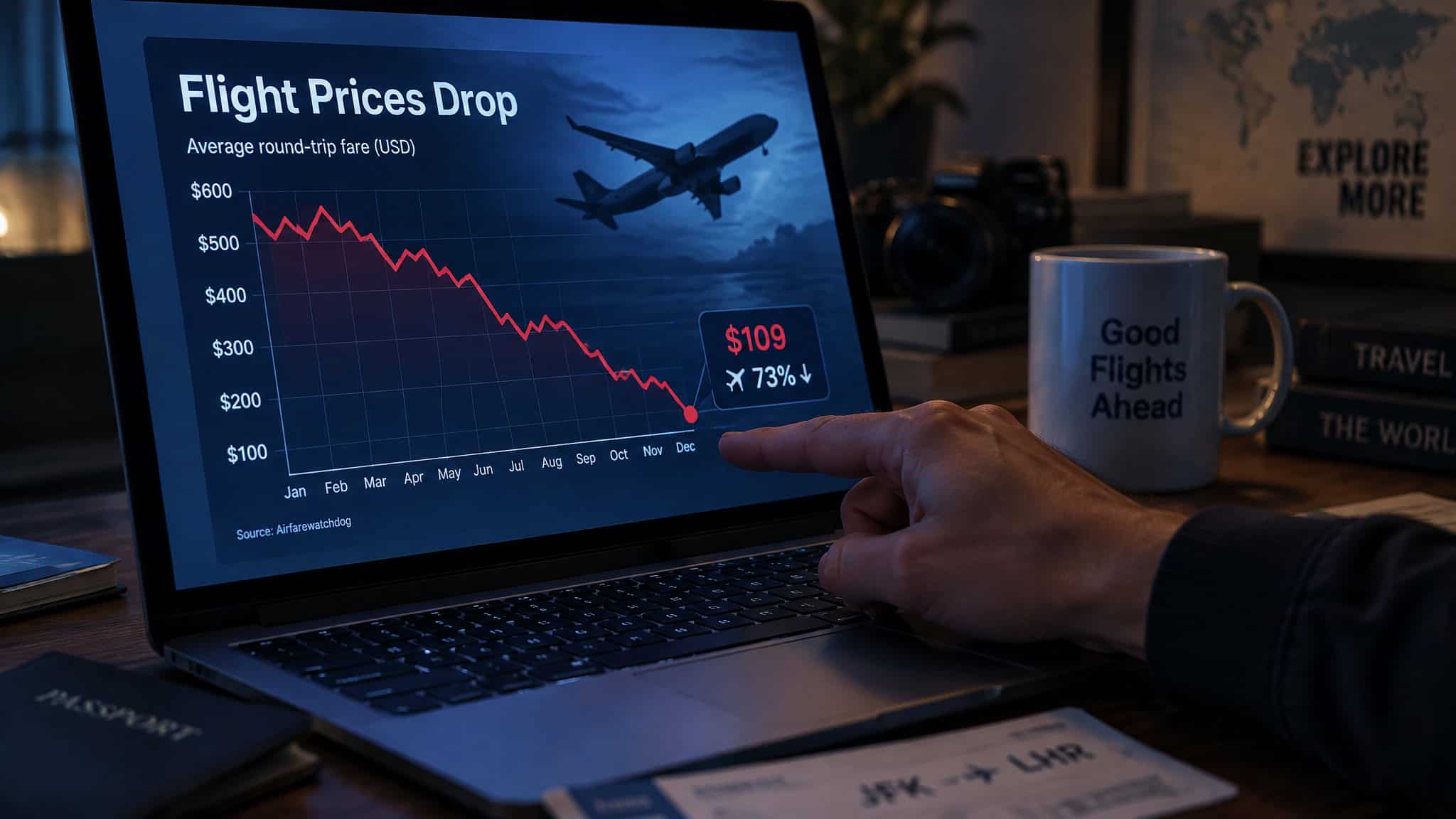
The reason these keep happening, even at major airlines, is that pricing is complicated and mostly automated. Errors aren’t bad luck; they’re an inevitable byproduct of the system. Nobody’s immune, which is good news for you. And no, you’re not doing anything shady by grabbing one. These are genuine screwups by the airline, not scams, and people book them all the time.
How much can you actually save? Typically 60 to 90% off the regular price. That blows past the 50% target you came in with, and it’s worth saying plainly: this tactic, when it lands, doesn’t just meet your goal. It crushes it.
But here’s the distinction that should change how you book. A normal sale or flash deal is intentional. Airlines run those to launch new routes or fill off-season seats, and they’re safe to sleep on. If it’s still there tomorrow, fine.
A mistake fare is different: it was never supposed to see daylight. The airline didn’t approve it, doesn’t know about it yet, and will fix it the moment it finds out. That’s why these can vanish without warning, and why hesitation costs you. If you book before they catch it, you’ve often got a decent shot at keeping the fare.
Finders-keepers, more or less. No guarantees though, and we’ll get to the honest odds later.
One more thing to expect: these pop up roughly every few weeks, but they don’t stick around. Minutes to a few hours is the window, and they rarely last more than a day. So “I’ll book it tonight” means you’ve already lost. It’s a timing game, not a browsing game, and the rest of this article is about building the timing advantage.
Real mistake fares that prove half off is the floor, not the ceiling
Every documented example below beats 69% off, all from 2025. Receipts, rapid fire:
- NYC to Singapore ran $171 one-way against a usual $1,000-83% off.
- NYC to Hong Kong, $244 one-way against a usual $1,000. 76% off.
- Providence to Puerto Rico, $98 roundtrip instead of $500. 80% off, and proof these aren’t only international.
- 11 US airports to Madrid, $603 roundtrip in premium economy. Regular price: $2,500. 76% off, and not even economy.
- Roundtrip economy from NYC to Vienna, Prague, Hamburg, Munich, Zurich, or Berlin ran $250 to $310, with premium economy at $420 to $500 against the usual $800. Up to 69% off.
- Then there’s the premium one, business class from Canada to Europe from $1,570 CAD roundtrip, lie-flat seats included. That was a Secret Flying listing with a travel window of August 20 through November 28, 2025, which has largely passed by now.
Prices will vary, obviously. But the takeaway holds: 50% is the minimum on these, not the promise.
Step 1: Set up flight deal alerts before you ever search
The best alert setup for error fares combines a specialist aggregator with the alert toggles you already have. Here’s why the reframe matters: mistake fares show up roughly every few weeks and vanish within minutes to a few hours, rarely lasting a day. Casually searching Google Flights hoping to trip over one basically never works. You need the alerts doing the watching.
The obvious starting point is Google Flights, which most guys already have open anyway. Toggle “Track prices” above the results and you’re done; you get email alerts, and you can set them for specific dates or any dates depending on how you actually plan trips. Bonus: the tracked-prices view shows a price graph since you set the alert, which is handy for spotting whether a “deal” is actually a deal.
Kayak is just as easy. Make an account, toggle flight tracking on any search, and opt into the price alerts when the pop-up offers. You manage everything in the Notifications section of your account.
Skyscanner’s trick is covering multiple airports at once. Its “Add Nearby Airports” option lets one alert watch several airports, which is genuinely useful if you’re in a multi-airport city like New York and don’t care whether the deal leaves JFK, Newark, or LaGuardia. It’s one of the simplest hacks for booking the cheapest flights around. Set alerts via “Get Price Alerts” and manage them under My Account > Price Alerts.
Hopper is the mobile-only pick. It’s an app that predicts the best booking time, and it claims 95% accuracy up to a year out. That’s their claim, so take it with a mild grain of salt. You’ll need an account and push notifications enabled, and the real value is the “act now or wait” ping when prices drop or look about to rise.
Airfarewatchdog works via Facebook or email signup, which is a small annoyance. Alerts come through a checkbox on flight searches or under My Alerts, covering your home airport, routes, even hotels. Know what it isn’t: it doesn’t book anything. It sends you to OTAs like Priceline or Expedia.
FareCompare is another option. Check “Alert me when prices change” on a search and it’ll ask for your email if you’re not signed in. It’s a search engine too, so you book by hopping to an OTA. The annoyance: it sends travel-tip emails that clutter your inbox.
Secret Flying is the free watcher. It’s an aggregator that tracks error fares in real time, and it’s the no-cost alternative to a paid membership. An alert you see four hours late is worthless, so flip notifications on everywhere the moment you set this up.
One blind spot to know about: budget carriers like Allegiant often don’t show up on OTAs, metasearch engines, or deal sites at all. Which means you could miss their errors completely, a common pitfall when navigating flight booking deals. The fix is low effort: check those airlines’ own websites directly occasionally. Occasionally pays off big.
Quick test: If your alert setup depends on you remembering to search, it’s not set up. Push notifications on, everywhere, before you close this tab.
Going: why the free tier won’t catch the fares this guide is about
For mistake fares specifically, Going’s free tier is a trial, not a substitute. Going, formerly Scott’s Cheap Flights, is the specialist here, and its approach is genuinely different: it watches deals from your home airport rather than specific routes, recommends nearby and hub airports, and shows an estimated duration on each deal so you know how hard to sprint.
The uncomfortable part: the free tier covers up to 5 airports but excludes mistake fares and cheap business class deals. Those are the exact deals this article teaches. The paid tiers run $49 or $199 a year. Whether that’s worth it is your math to do, but here’s a data point: Going uncovered 16 mistake-fare glitches in 2025. One saved fare covers the membership for years.
How to book a mistake fare: the four-step sequence
The sequence is act fast, book direct with the airline, don’t call to confirm, and hold off on nonrefundables about two weeks. Think of it as a race between your ticket issuing and the airline noticing its own error.
Act fast
The fare gets corrected as soon as the airline notices. That’s the clock. You already know the window is minutes to a few hours, so there’s nothing to dress up here.
Book direct
The golden rule: book with the airline itself, not a third-party site. Booking flights can feel like a maze of outrageous rates and maddening rules, and the folks at Going explain it simply: the airline tickets you immediately, while an OTA has to relay messages back and forth, and the fare gets fixed in that gap (more on smart flight booking strategies here). Booking direct also usually gets you a 24-hour free-cancellation window, which is your undo button. Lock the price now, check it actually fits your life, bail free if it doesn’t.
Never call the airline to confirm
Calling is literally how they find out it’s a mistake. One well-meaning phone call can kill your own deal. Just wait for the confirmation email.
Wait about two weeks before nonrefundables
Going says hold off roughly two weeks before booking nonrefundable hotels, tours, or rental cars. The reason is blunt: the airline might refund you instead of honoring the fare, and you don’t want a pile of prepaid plans attached to a ticket that evaporated.
Buyer rule: Book direct, stay quiet, and give it two weeks before you prepay anything else. That sequence is the whole game.
Will the airline honor it? Cancellation risk, your rights, and who wins
Most mistake fares get honored when you book directly with the airline, but Scott Keyes estimates 10-20% are eventually cancelled and refunded. Even a confirmation email in hand doesn’t guarantee the ticket survives; confirmation isn’t a contract.
On rights: a 2015 Department of Labor measure set the ground rules. Airlines don’t have to honor mistake fares, but if they cancel, they do have to reimburse reasonable out-of-pocket costs like nonrefundable hotels, tour packages, and connecting airfare. Real money back, not just the ticket.
The cautionary tale is the Flying Blue mess. Air France/KLM accidentally listed business class from North America to Europe at 1,500 points one way, the intended price was 150,000. About 2,500 bookings came through, and with roughly 40 business seats per cabin, that’s more than 60 full flights’ worth. The sting: they honored it only for members who already had Flying Blue elite status.
Those folks paid something like 13,500 points for the seat; everyone else ate the reversal. Flying Blue’s president, Ben Lipsey, told Brian Sumers of Airline Observer they wanted to set the precedent that a mistake fare was a mistake fare. They even offered to manually reverse bank points transfers for affected customers, which was slow, expensive goodwill. The quiet lesson: whether your fare survives could hinge on being a known loyal customer.
The counterexample: in 2018, Cathay Pacific honored first class to Vietnam and beyond for under $1,200 roundtrip, and the thing blew up on Instagram and TV. Which raises a question I can’t answer: are some “mistakes” deliberate marketing? Maybe. Probably not all of them.
Why the window is closing, and where the payoff is biggest
Before the tactics, the honest outlook: this game is still worth playing, but the clock is ticking. Airlines are getting faster at catching their own errors, and the fares that do slip through are increasingly the ones worth the most. Here’s where the pressure is building, and where the payoff still runs deepest.
The detection arms race
Yes, business class at economy prices happens, and it’s often the most dramatic version of this game. But the landscape is shifting. Airline software and AI are getting faster at catching and rejecting error fares, customers have no legal ground to force an airline to honor one, and once one airline cancels, the others feel less conflicted about doing the same. 2025 was a record year with 16 glitches uncovered, and Keyes predicts fewer in 2026. Nobody has a crystal ball, but each caught error trains the detection. Today’s mistake fares may be the best you’ll ever see.
Premium cabins pay double
The same absolute pricing error that saves $300 in economy can save $5,000 in business, because errors hit hardest on the fare component premium prices load heaviest. Points-based errors exist too; the Flying Blue 1,500-point fare is the famous one, and similar deals have surfaced under 15,000 points. For what it’s worth, I’ve caught a $559 roundtrip business class fare from North America to Australia. Another time it was $700 roundtrip business from Europe to Tokyo. Those are the fares that ruin you for economy.
When cheap fares aren’t mistakes: the legitimate path to deep discounts
When mistake fares don’t show up, the base strategy still works: book shoulder-season or off-season with less flexibility, and book early, airlines reward early bookers who trade flexibility for price. That’s the legitimate path to a deep discount, no error fare required. Don’t second-guess a perfectly good sale into oblivion, either; some deep discounts are intentional exposure or goodwill plays. Student and military discounts are real but modest, and promo codes rarely exceed 10 or 15%, so they won’t get you close to half off. On American Airlines specifically, there’s no special discount mechanic; generic direct booking and the 24-hour cancellation window are the honest tools. The error fare is the wildcard on top, not the base.
A 50% discount on a flight is an infrastructure-and-timing game, not a promo-code hunt. The window is narrowing; Keyes expects fewer mistake fares in 2026, and he might be right. Set up the free alert tools today, and go paid on Going only if error fares are specifically your game.
Frequently Asked Questions
Where can I get 50% off my flight tickets?
Not from a coupon — promo codes top out around 10 or 15 percent. The realistic path to 50% or more is a mistake fare: an airline pricing error that routinely runs 60 to 90% off the regular price. Fares are trending up overall, so the deep discount comes from catching errors, not from hunting promo codes.
How to get a huge discount on flight tickets?
Set up price alerts on tools like Google Flights, Kayak, Skyscanner, Hopper, Airfarewatchdog, FareCompare, and Secret Flying, since mistake fares appear roughly every few weeks and vanish in minutes to a few hours. When one lands, book directly with the airline fast, don’t call to confirm, and wait about two weeks before prepaying any nonrefundable hotels or tours. For the boring base layer, shoulder-season and off-season booking plus booking early still works, though it rarely hits 50% on its own.
What’s the best way to get a discount on a flight?
For routine discounts, book in the shoulder or off-season and book early — airlines reward flexibility traded for price. For deep discounts of 50% or more, the mistake fare is the wildcard: a pricing error that typically knocks 60 to 90% off. Catching one requires automated alerts with push notifications on everywhere, not casual searching, because the window is minutes to a few hours.
What are the best flight deal alert services for finding error fares?
For free coverage, combine Google Flights price tracking, Kayak, Skyscanner (great for multi-airport cities), Hopper on mobile, Airfarewatchdog, FareCompare, and Secret Flying, which tracks error fares in real time at no cost. Going (formerly Scott’s Cheap Flights) is the specialist — it watches deals from your home airport rather than specific routes — but its free tier excludes mistake fares and cheap business class deals, so the paid tiers at $49 or $199 a year are what cover them. Push notifications everywhere is non-negotiable; an alert seen four hours late is worthless.
What are the odds an airline cancels or won’t honor a mistake fare?
Most mistake fares get honored when you book directly with the airline, but Scott Keyes estimates 10 to 20% are eventually cancelled and refunded — and a confirmation email isn’t a contract. Airlines aren’t legally required to honor them, but if they cancel, a 2015 Department of Labor measure obligates them to reimburse reasonable out-of-pocket costs like nonrefundable hotels, tour packages, and connecting airfare. That’s why the rule is to wait about two weeks before prepaying anything else.
Can you get business class for economy prices with mistake fares?
Yes, and premium cabins are where the payoff is biggest: the same absolute pricing error that saves $300 in economy can save $5,000 in business, because errors hit hardest on the fare component premium prices load heaviest. Real examples include business class from Canada to Europe from $1,570 CAD roundtrip with lie-flat seats, plus points-based errors like the famous Flying Blue 1,500-point business class fare. Points errors have also surfaced under 15,000 points.
Are flight deal alerts worth paying for, or are free ones enough?
Free tools are enough to catch most error fares if you configure them properly — Google Flights, Kayak, Skyscanner, Hopper, and Secret Flying’s real-time error-fare tracking cost nothing. The paid case for Going ($49 or $199 a year) is that it watches deals from your home airport rather than specific routes, shows an estimated duration on each deal so you know how hard to sprint, and covered the exact mistake-fare and business-class deals its free tier excludes. One data point: Going uncovered 16 mistake-fare glitches in 2025, so a single saved fare covers the membership for years.