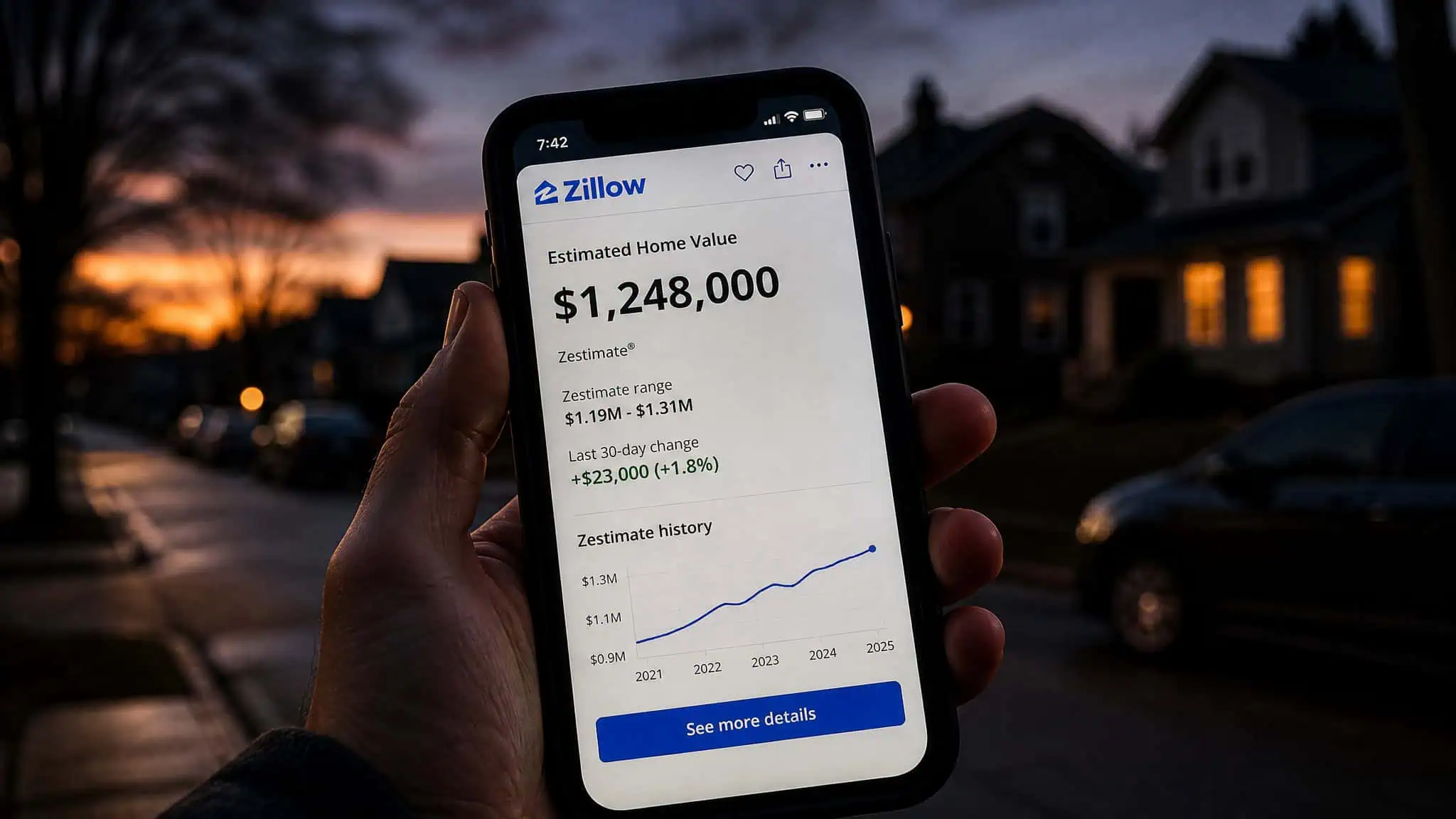
You know the scene. You type your address into Zillow, the spinner spins, and there it is: a number that feels wrong. Your neighbor sold for more three months ago. You just replaced the roof.
You remodeled the kitchen last year. None of it is in there anywhere.
Here’s what that number actually is. The Zestimate is an automated estimate, pulled from public and user-submitted data like square footage, lot size, bedroom and bathroom counts, and public records on renovations. It is not an official appraisal of your specific property. It’s a model doing its best with what it’s given, and what it’s given is often stale, incomplete, or flat-out wrong.
That’s better news than it sounds. You can’t type in a new number and hit save, and anyone who tells you otherwise is selling something. But you can feed the algorithm better information, correct the data the number is built on, and nudge it toward reality. That’s the practical path to improving your Zestimate, plus knowing when to trust it and when to stop trusting it and call a professional. This is part of Unfinished Man’s ongoing home and money coverage, where we sort what’s worth your time from what isn’t.
Key Takeaways
The Zestimate’s median error rate is 1.9% for homes on the market and 7.0% for homes off it, so an active listing feeds the algorithm far more useful pricing signals than a quiet one.
You can’t manually change your Zestimate, but claiming your home and correcting the facts it’s built on is the real lever, and the algorithm can take a few days up to 30 days to re-evaluate.
Zillow’s 12-month forecast is flat nationally at +0.0%, with big regional swings: Syracuse is projected to climb 5.0% while Houma is projected to drop 7.0%.
Table of Contents
Why your Zestimate may look wrong (or low)
A low Zestimate almost always comes down to the same root cause: the data feeding it is stale, incomplete, or just wrong. The algorithm runs on public records and recent sales, and both of those can be months out of date or missing key details. Walk through the usual culprits and you’ll usually spot which one explains your number:
- Outdated comparables. The algorithm anchors to sales from months ago. In a fast-moving market like Bucks County, Pennsylvania, that lag matters. The market moved; your Zestimate hasn’t caught up yet.
- Missed renovations. You remodeled the kitchen or replaced the roof last year. Zillow doesn’t know that unless it’s in public records or you added it yourself. It has no eyes on your house.
- Unique features. A pool, heated floors, or a finished basement can make your place stand out to buyers, but the model can’t value what it can’t see. If it’s not in the data, it’s invisible to the Zestimate.
- Emotional market behavior. Buyers get excited, neighborhoods get trendy, and prices move faster than the model expects. The algorithm can’t feel a bidding war coming.
- Unusual comparable sales. A foreclosure or a sale to a family member at a discount still counts as a comp, even though it says nothing about true market value. The algorithm doesn’t know the story behind the number.
- Errors in public records. Wrong square footage or an incorrect bedroom count is common, and it can throw the whole estimate off. Small typo, big impact.
- Thin local data. Some counties keep rich, detailed records. Others are sparse. Accuracy follows data availability, so your Zestimate is only as good as what your county gives the model.
Each of these maps to a fix further down. Outdated comps point to a CMA with a local agent. Missed renovations point to editing your facts. Public record errors point to the assessor’s office. Figure out which one sounds like you, then jump to the section that matches.
How accurate is the Zestimate, really?
Compared to a professional appraisal, the Zestimate is accurate enough to be a strong starting point, but it’s far more reliable for listed homes than unlisted ones. The median error rate for a Zestimate on a home that’s on the market is 1.9%. For a home that isn’t listed, it jumps to 7.0%. That gap is the whole story in one sentence: listing a home feeds the algorithm real-time pricing signals it simply doesn’t get otherwise. A Zestimate for a listed home also lands within 20% of the actual selling price more than 99% of the time in major metros like Austin, Atlanta, Cincinnati, and San Diego.
So it’s a better tool than people give it credit for. But it’s not an appraisal. A professional appraiser walks your property, notes the condition, the location, the details a model can’t see. The Zestimate is a broad model applied to your address. The appraisal is specific to your house.
There’s also real research in its corner. A peer-reviewed study published in Marketing Science found that the Zestimate improves pricing efficiency, with buyer surplus up nearly 6% and seller profits up more than 4%. Sellers price more confidently, buyers stop guessing, and the gap between asking and offering narrows.
The counterintuitive part is who benefits most. The gains are larger in lower-income areas, where buyer surplus rose more than 9%, even though accuracy there is somewhat lower. The tool reduces guesswork where uncertainty is greatest. That rhymes with how you should use it: the Zestimate’s job is cutting through uncertainty and helping buyers and sellers find each other, not handing you a certified valuation.
What home improvements actually move the Zestimate?
The improvements with the strongest perceived-value impact are the usual suspects: kitchen remodels, added bedrooms, roof replacements, finished basements, backyard pools, and heated floors. Here’s the kicker: none of them move your Zestimate unless they show up in the data set. Zillow doesn’t have eyes on your house. A gorgeous new kitchen means nothing to the model until it’s recorded somewhere the algorithm can read.
Value shows up two ways. The first is immediate: you correct the data and the model re-evaluates against newer inputs. The second is the long game: a good renovation shows up in an appraiser’s report, which becomes a comp, which nudges the Zestimate later. That’s why you shouldn’t renovate purely to game the number.
The play is to build real market value and let the algorithm catch up to it. If you’re weighing which upgrades actually pay off, we’ve covered the top upgrades to increase home value and the cheap upgrades under $500 that earn their keep without blowing your budget.
Unique features are where things get weird. A pool or heated floors can boost perceived value to human buyers, but the algorithm often can’t weight them well. That’s exactly when the Zestimate is least useful to you and a professional opinion matters most. More on that in a minute.
Step 1: Claim your home on Zillow
Claiming your home is the gate that unlocks everything else. Without it, you’re watching a number you can’t touch. Log into your Zillow account, search your address, open your property page, and select Owner View, sometimes labeled More or Edit. Zillow will ask you to verify you’re the legal owner, and it may cross-reference public tax records or deeds against you. It takes a few minutes.
What you get is the ability to edit home facts, correct inaccuracies, and add data the algorithm doesn’t have. Here’s the honest part, though: claiming your home doesn’t change your Zestimate by itself. Nothing lets you do that. You’re changing the inputs, not the output.
In a hot market like Bucks County, even a small correction can shift the number noticeably once the algorithm re-evaluates. The pattern we see all the time is a homeowner frustrated by a low Zestimate who’s never claimed the home or checked the facts, assuming Zillow automatically has everything right. It doesn’t.
Step 2: Update your home facts, every feature counts
After you claim the home, find Edit Facts and work through the list. You can genuinely do this on your phone while you read. That’s how painless it is.
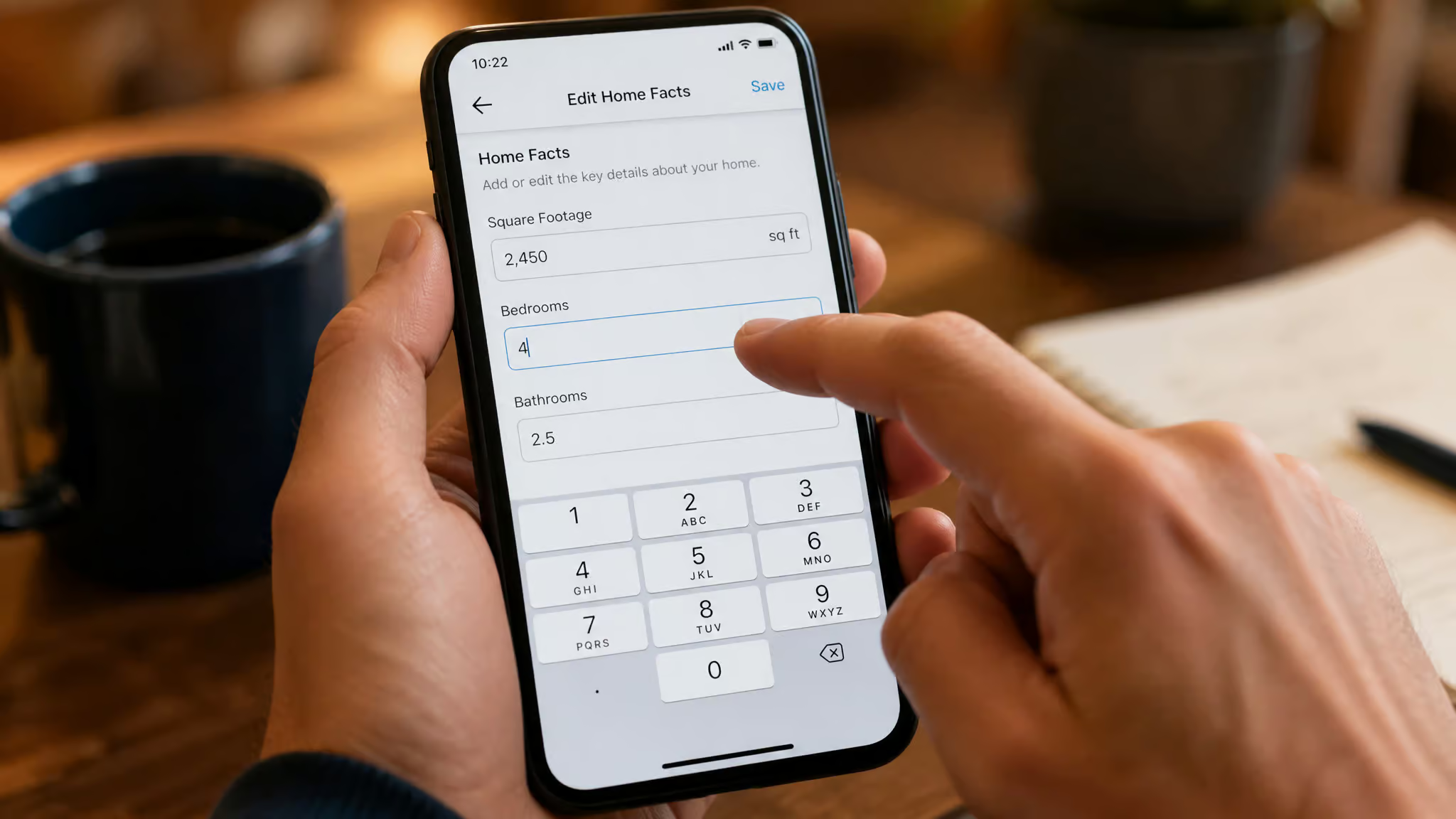
Start with the core numbers: total finished square feet, lot size, bedroom count, bathroom count. Public records are often stale here, and they frequently miss finished basements or additions. A wrong bedroom count isn’t a minor detail; it can skew the Zestimate by a meaningful amount. Then move to the upgrade details: recent remodel years, flooring changes like carpet to hardwood, new appliances, central air.
Don’t skip the outdoor stuff either. Patios, decks, pools. Anything a buyer would notice, the algorithm should know about. The more boxes you tick, the more the model has to work with. And if you’ve got a backyard pool, make sure it’s in there, that’s a feature that can move the needle on perceived value.
The mechanism is simple: more accurate data in, more accurate estimate out. Set your expectations on timing, though. The algorithm can take a few days up to 30 days to re-evaluate against nearby comparable sales. Don’t refresh the page hourly and spiral. Give it a month.
And if you’re renovating because you want the house to feel better, not just to move a number, the comfort-focused upgrades like insulation and HVAC are worth reading up on; we’ve covered them in our guide to the best home improvements for comfort.
Step 3: Fix the public records, the step most homeowners skip
Yes, the tax assessor’s records feed the Zestimate, but only as far as the records go. Remodeled the kitchen last year? If the assessor’s office was never told, the algorithm doesn’t know it happened, and it’s likely not reflected in your Zestimate either. Most “why is my Zestimate so low” frustration traces back to exactly this.
The fix is upstream. Cross-check what Zillow shows for your home against the county’s public property records. If they don’t match, fix it in both places: your Zillow profile and the local assessor’s office. A common setup is a homeowner who did significant renovations, an added bathroom or a new roof, and never told the county. They expect the Zestimate to reflect the work, but the model is running on old public data.
This matters because mistakes in public records, wrong square footage or an unrecorded bedroom addition, can produce a significantly off Zestimate. Even small errors add up. Be honest about the limit, though: updating the assessor doesn’t directly or immediately change the number. The Zestimate isn’t wired to your county’s office in real time.
But unrecorded updates won’t be reflected at all otherwise. Fixing the data at the source is the durable move, and it’s the one almost nobody makes.
Step 4: Compare your Zestimate to recent sales, and get a CMA
If the number still looks low after you’ve corrected the facts, stop working from guesswork and start comparing. Look at what’s sold in your neighborhood in the last few weeks, not the last few months. A stale Zestimate is often just anchored to comparables from a season ago, when prices were lower.
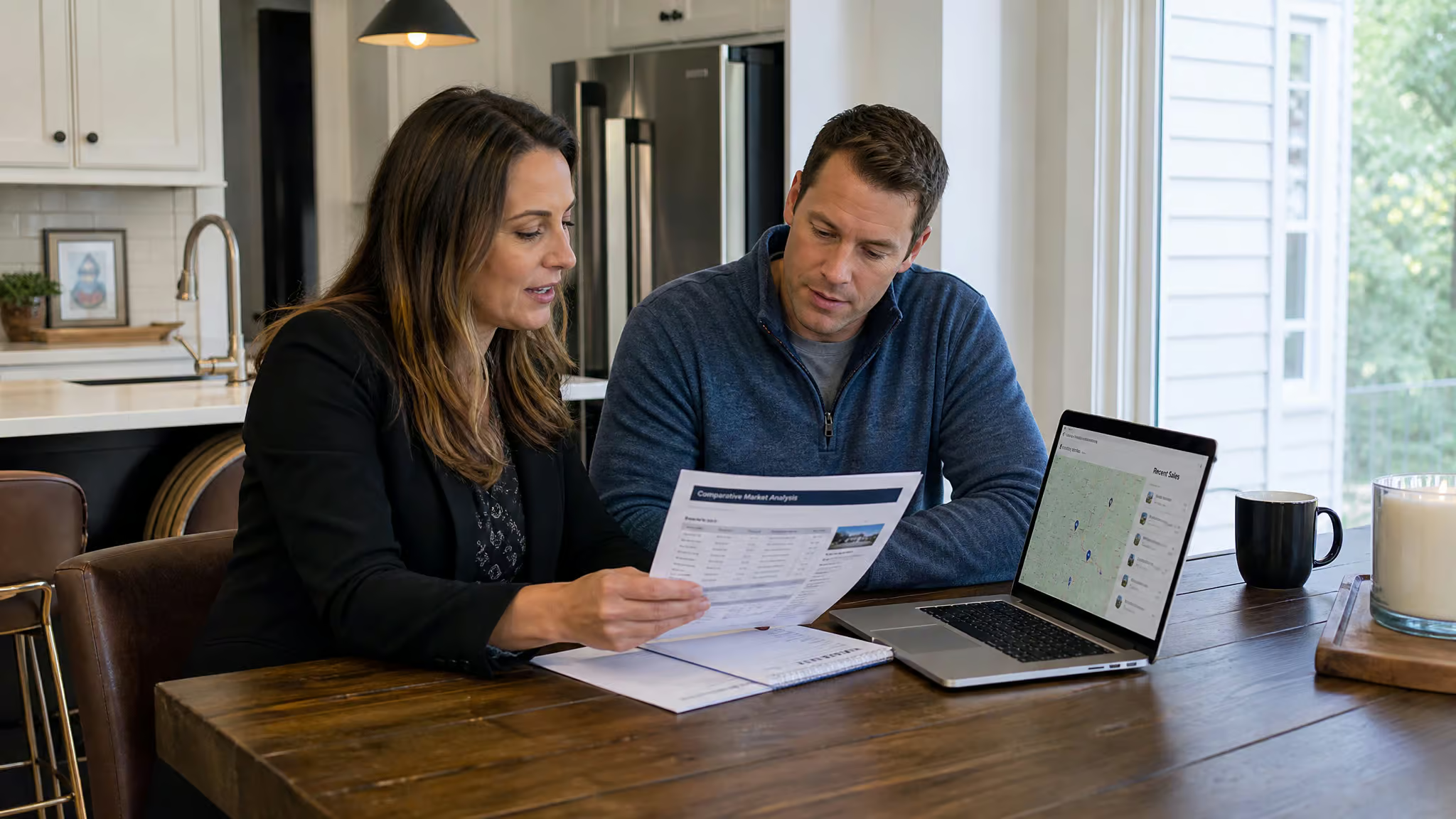
Then bring in a professional. A comparative market analysis from a real estate agent uses today’s conditions, not last quarter’s. Here’s the real difference: the Zestimate runs an algorithm against nearby sales, but a CMA is built by a human who has actually walked through the comparable properties. And a good agent reviews the story behind each sale.
A foreclosure or a family-to-family discount doesn’t reflect true market value, and they can explain why. Ask a local listing agent for a CMA built on the last 30 days of closed sales, not just the app’s automatic comparison.
Step 5: Bring in a local agent, and know when to ignore the Zestimate entirely
Treat the Zestimate as a reliable starting tool, not a pricing decision. Use it for awareness. Use a CMA or appraisal to set your list price. That’s the honest split, and it’s the verdict the rest of this comes back to.
A savvy local agent brings things the algorithm never will. They know what improvements actually add value in your specific market, how to market your home to multiple buyers, and how to price competitively based on today’s conditions. A good agent can tell you if your Zestimate is low because of bad data or because the market is soft, and they can prepare a listing that attracts multiple offers even when the number on the screen says otherwise. Zillow’s own agent directory is a legitimate starting point if you don’t already have someone in mind.
Here’s the reality check the tool can’t give you: no lender will underwrite against a Zestimate, no appraiser will rely on it, and no serious buyer will base an offer on it. A professional appraisal or a solid CMA gives you a far more accurate picture, with a firsthand read on condition and location that the model simply can’t see. And if a sale is actually on your mind, Zillow’s Home Sale Proceeds Calculator is more useful than the Zestimate itself; it walks through repairs, staging, agent commission, and closing fees to show what you’d really walk away with. Use the app for curiosity and market awareness. Leave the pricing calls to someone who’s stood in the houses.
Zillow’s market forecast: what the next 12 months hold
Zillow currently projects U.S. home prices to shift +0.0% over the twelve months from March 2026 to March 2027, a slight easing from the earlier +0.5% forecast., with prices currently up 0.8% year-over-year. In plain terms: a flat, soft market nationally. Not a crash, not a boom. A soft landing.
But the national number hides a lot. Zillow forecasts more than 400 markets, and they are not all heading the same direction.
Where prices look likely to rise
The expected risers are led by Syracuse at +5.0%, with Rockford and Atlantic City close behind at +4.5% each, then Rochester at +4.0%, Utica at +3.5%, and Knoxville at +3.4%. These are projections, not guarantees. If you live in one of these, it’s a data point worth watching, not a reason to start pricing your house.
Where prices look likely to fall
The decliners are steeper. Houma is projected down 7.0%, Lake Charles down 5.6%, Austin down 4.6%, New Orleans down 4.4%, Shreveport down 3.6%, and Beaumont down 3.4%. Louisiana shows up a lot on the downside list, and Austin is notable for a market that was scorching hot just a few years ago.
There’s a silver lining in the macro numbers. As long as home price growth stays below income growth, which is currently up 3.9%, housing fundamentals should keep improving, assuming mortgage rates don’t spike. Flat prices plus growing incomes buys back a little affordability.
One editorial note before you treat any of this as gospel: even Zillow’s forecast is an estimate. My read is that it looks too bearish on New Orleans, which is showing signs of mild tightening after a correction, and too bearish on parts of the Bay Area, particularly San Jose, which has been riding the AI boom. Home values in California are their own animal, and forecasts like this flatten a lot of local detail. If Zillow can’t call its own forecast perfectly, that’s the best argument for getting a human opinion on your actual house.
Where the Zestimate sits in your overall value picture
Here’s the bottom line from the research, stated plainly: even imperfect algorithmic pricing tools improve housing markets when they reduce information gaps. The same study notes that further accuracy improvements, especially in underserved areas, could generate additional benefits. That’s the strongest case for paying attention to the number at all. It makes an inefficient, frustrating process a little less random for everyone.
Which brings us to the emotional core. If you’ve ever thought “this Zestimate is wrong,” you’re probably at least partly right. The algorithm doesn’t see your home, your upgrades, your micro-market, or your neighborhood’s character. It sees a data set. The contradiction here is worth sitting with: the Zestimate can be genuinely useful for market awareness and genuinely useless for pricing your house, at the same time.
Use it as a free data point worth watching, a trigger for questions, and a conversation starter. Never as the sole basis for a pricing decision. You can check how hot your market actually is with two quick numbers: the sale-to-list ratio, where above 100% means homes are selling above asking, and median days to sell, where low numbers mean buyers are competing. Remember that home value data is seasonally adjusted too, which smooths out the spring and summer bumps and the winter dips.
That’s why your Zestimate doesn’t spike in May and crater in December. And know the difference between “home values” and “median sales prices”: values are an estimate of what a typical mid-priced home might fetch, while median sales prices only reflect what actually sold, which can be skewed by the kind of homes that moved.
The one number you should trust most isn’t the Zestimate. It’s a CMA from a local agent who has walked through the houses in your neighborhood.
The whole play in one breath: claim your home, fix your facts, update the assessor, compare against recent sales, and get a CMA for the real picture. Each step feeds the algorithm something true, and the final step replaces the algorithm’s guess with a human one.
The Zestimate is worth monitoring, worth correcting, and worth questioning. It’s never worth treating as a verdict. The real measure of your home’s value isn’t a number on a screen; it’s what a willing, informed buyer would actually pay. That’s a number a local professional can help you find, and no line of code gets you there.
Frequently Asked Questions
Why is my Zillow value so low?
A low Zestimate almost always comes down to stale, incomplete, or incorrect data feeding the algorithm. Common culprits include outdated comparable sales, missed renovations that aren’t in public records, errors in square footage or bedroom counts, and unique features like pools or finished basements that the model can’t see. The fix is to claim your home, correct the facts, and update the county assessor’s records.
How close is Zillow’s zestimate to appraisal?
The Zestimate has a median error rate of 1.9% for homes on the market and 7.0% for homes off it, so it’s a solid starting point but not a substitute for a professional appraisal. An appraiser physically walks your property and accounts for condition, location, and details a model can’t see, making the appraisal specific to your house rather than a broad estimate.
How accurate is the Zestimate for off-market homes?
The Zestimate’s median error rate for homes that aren’t listed is 7.0%, compared to just 1.9% for homes on the market. Listing your home feeds the algorithm real-time pricing signals it doesn’t get otherwise, so an off-market Zestimate is a rougher guess. For a more accurate picture, get a comparative market analysis from a local agent.