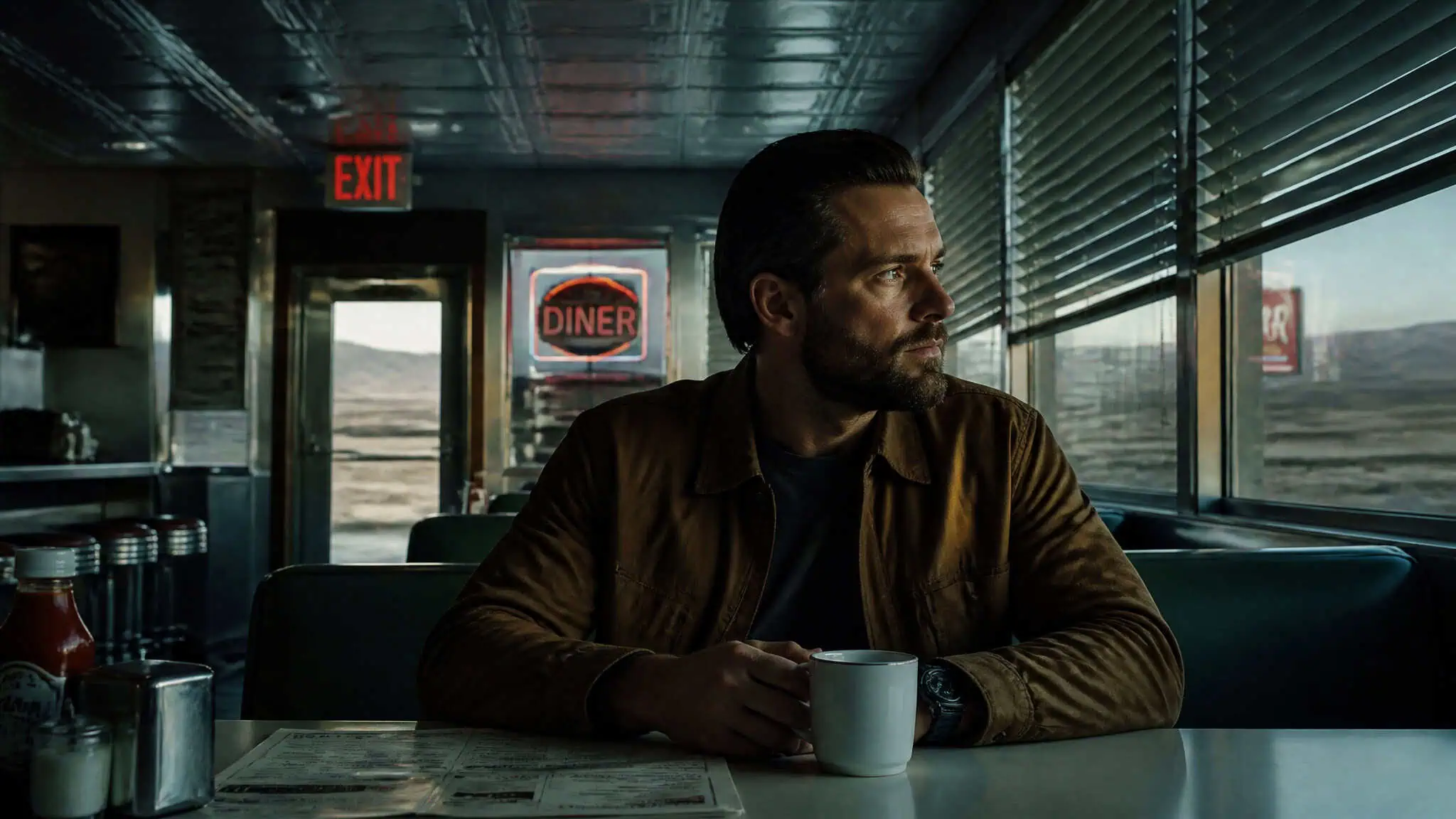
Park the car. Walk into the diner. Before you sit down you’ve already clocked the license plates in the lot, noted the waitress who works her tray left-handed, and pegged the guy at the counter as someone who knows how to handle himself. Coffee, black. You’ve done this a thousand times.
That scene is the whole point of Jason Bourne, and it’s the easiest thing to miss. He’s not doing anything supernatural in that diner. He’s reading a room. And the reason he can is that he’s the product of conditioning, the fitness, the observation, the readiness to grab a bag and disappear. He’s a human Swiss army knife: fight, run, blend, talk your way past a checkpoint, live out of a pack for three days.
Here’s the part that makes this worth your time: almost none of it requires a classified program. The assassination work and the spy-craft shell games are fiction, and also felonies. Everything underneath them, the fitness, the fighting, the languages, the documents, the bag that’s ready in sixty seconds, is real, learnable, and legal.
Here’s what it costs, and here’s what it takes.
Key Takeaways
The fitness plan costs $0. Pull-ups and push-ups on strength days, sprints and parkour on the off days, all done outside on playground equipment, no gym, no fees.
Real self-defense training starts at about $50. A private Krav Maga intro runs around that (group classes are cheaper), and sustained training sits in the $70-200 range, and the mix that actually matches Bourne is Krav Maga, Systema, and Wing Chun.
A proper bug out bag runs $100-500+, and the survivalist consensus is blunt: build your own, because a bag you’ve never opened is just expensive luggage.
Table of Contents
Who Is Jason Bourne? A Quick Background
The name on the poster isn’t his real name. It’s the program’s doing.

In Robert Ludlum’s novels, the trilogy that kicked off in 1980, the man behind the Bourne identity is David Webb, an American Foreign Service officer who specialized in Far Eastern affairs. After his wife and daughter are killed, he’s conscripted into a CIA operation called Medusa, run by Alexander Conklin, and code-named Delta One. He kills a man, wants out of the intelligence life, drifts into the State Department and then academia, and the Bourne identity itself is developed under an ongoing program called Treadstone. Ludlum’s version has his memories far more fragmented than the films do.
The movies rewire the origin a bit. Bourne is born in Nixa, Missouri, recruited into Treadstone, and conditioned hard, waterboarded, sleep-deprived, psychologically rebuilt until he can’t tell where he ends and the program begins. On one mission he’s shot, presumed dead, and survives, floating in the Mediterranean with amnesia: still capable of everything Treadstone installed in him, unable to say his own name. That’s the character’s engine, he can read a room, spot a weapon, and handle himself in a fight, but he can’t tell you who he actually is. How was Jason Bourne trained? digs into the Treadstone conditioning specifically.
The franchise runs long. Ludlum’s trilogy, Van Lustbader’s continuation novels, Brian Freeman’s books, the films with Matt Damon (The Bourne Identity, then Supremacy in 2004, Ultimatum in 2007, and Jason Bourne in 2016), a Jeremy Renner spinoff in 2012 that Damon only returned to under conditions, plus a television series and a video game.
What matters for you isn’t the plot. It’s this: Bourne is a trained result, not a birthright. Every piece of his toolkit, the fitness, the fight skills, the languages, the logistics, is something a normal guy can build in the real world. The one part you don’t replicate is the killing, and the good news is that everything else on the list is legal.
Bourne-Level Fitness: Train in the Real World
Start here, because everything else sits on top of it. Bourne’s conditioning is the baseline, the physical capacity that makes the running, the climbing, and the hands-on stuff even possible. The real-world goal isn’t movie abs. It’s the best version of you at your age, height, and weight, the guy who can hoist himself over a wall and then sprint down an alley afterward.
The training itself is gloriously cheap. Work in the real world, not the gym. Strength days are pull-ups and push-ups, the movements that let you get your body over an obstacle. Off days are sprints and parkour-style movement, because evasion is the other half of the equation.
You don’t need equipment; playgrounds and parks are free. This is interval work, done outside, with zero dollars in fees. Jason Bourne training walks through the full split if you want it mapped out.
The rhythm is simple: strength one day, movement the next, and the cost is exactly nothing.
Self-Defense: The Krav Maga, Systema, and Wing Chun Mix
Set the bar where Bourne actually is: his fights don’t look like fights. They look like problems being solved quickly. The source material runs on brutal efficiency, the takedown in the kitchen, the disarm that’s over before the camera cuts. This is not about looking good.
It’s about ending an encounter fast and moving on. And the law’s expectation of self-defense runs the same direction: you use force to stop a threat, only as much as the threat requires, and you disengage the moment you can.
Run the research on what Bourne’s fighting style actually is, and the same three systems keep coming up:
Krav Maga. Developed for the Israeli military, practical, close-range, and aggressive. It has no sport component, which is exactly why it shows up in Bourne material. It’s also the most common of the three in the US, so this is usually where you can actually find a class.
Systema. Russian military roots, with a more organic approach to body mechanics. It’s less common in the US, though it’s growing.
Wing Chun. A Chinese close-range system built around striking and trapping at arm’s-length distance. Bruce Lee called it a highly refined weapon, direct, efficient, and deadly. Which is the sentence that says everything about why it fits here.
Buyer rule: Pick one system and find an actual instructor. You cannot learn to fight from a book or a video.
The mix works because each system covers what the others underweight. Krav’s aggression, Systema’s bodywork, Wing Chun’s sensitivity at close quarters. Realistically, you’re not training all three. You’re training one, and the point is the approach, not the brand. The practical rule: pay an actual instructor.
You cannot learn this from a book. What fighting style is Jason Bourne? goes deeper on the systems.
Cost: about $50 for a private Krav Maga intro, less for group classes. Sustained training lands in the $70-200 range depending on your city and how often you go.
Bourne vs. Wick: Two Kinds of Combat
Worth a paragraph, because people confuse the two. John Wick’s style blends many martial arts, it’s spectacle, built to show off the range. Bourne’s style is the opposite: minimal movement, no wasted motion, the goal is efficiency, not presentation. One is a concert. The other is a transaction.
When you’re training for the real world, Bourne’s mindset is the one that translates, because there’s no performative element. You’re not fighting for show. You’re solving a problem so you can leave. Jason Bourne vs John Wick runs the full comparison if you want it.
Build a Bug Out Bag
The 72-hour bag. The thing you could grab in sixty seconds and live out of for three days. It’s the most practical item on this entire list, and it’s also the most boring, which is why almost nobody builds one properly.
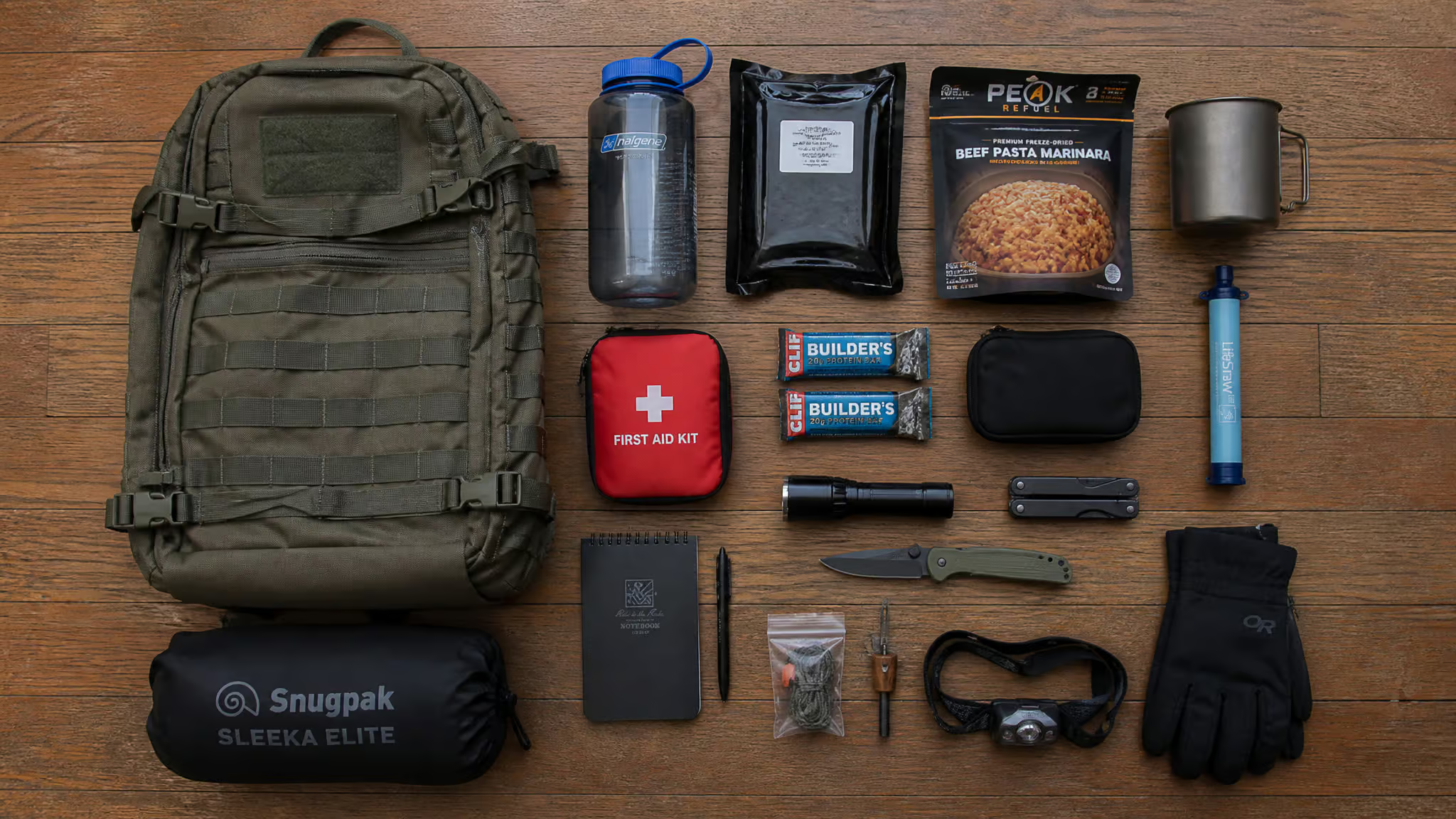
The concept: in an emergency, time is critical. The goal isn’t to out-survive the apocalypse. It’s to get out of harm’s way, fast, self-sufficiently, without being a burden. You’ll recognize the joke from It’s Always Sunny in Philadelphia.
Mac’s ridiculous survival bag. The actual version is the point being made with a straight face.
The decision point is where most people go wrong: buy pre-made, or build your own? The survivalist consensus is blunt, build your own. Because the entire value of the bag is that you know exactly what’s inside, where it is, and whether it works. A pre-built bag is someone else’s priorities in a nylon shell. A bag you’ve never opened is just expensive luggage.
The categories to cover:
- Water and hydration
- Food, compact, non-perishable
- Clothing, weather-appropriate
- Shelter
- Fire
- First aid
- Hygiene
- Tools
- Lighting
- Communications
- Protection
- Self-defense
Cost: a solid build runs $100-500+ depending on quality. Guides like How to Survive the End of the World as We Know It cover the ground thoroughly. Set aside an afternoon, build it once, and maintain it twice a year.
Obtain Multiple Passports
“I don’t need multiple passports”, no, probably not. But the question people ask first is “what’s the point of having multiple passports?” and the answer is practical, not paranoid: it’s about not being locked out.
The baseline first: it’s legal to hold 2-3 passports. It’s not exotic. And the math is concrete. Countries charge US citizens more for visas.
China runs about $140 versus $30 for other passport holders, Russia $160 versus $35, and Brazil lands around $180 for US citizens while some nationalities enter visa-free. A second passport sidesteps the fees, opens doors when a country is making diplomatic point of refusing US citizens, and makes opening international bank accounts and businesses simpler.
The honest routes to a second passport:
- Ancestry. If you have Irish, Italian, or Polish lines, citizenship is largely a paperwork exercise. This is the cheapest serious route.
- Brazil. Have a child born there, and the path to citizenship moves fast, reports put the timeline around a year.
- Investment. Citizenship-by-investment programs in places like St. Kitts, Nevis, or Dominica run $300,000, $400,000. It’s the concierge route. Most people will never need it.
Cost check: Ancestry is the budget route — mostly paperwork. Citizenship-by-investment runs $300,000–$400,000.
The passport conversation is one of those things that sounds like conspiracy-blog territory and is actually just personal resilience. You don’t need three passports to be more like Bourne. You need to understand why having a second one would change how freely you move.
Speak Multiple Languages
This is where the fantasy usually dies, because there’s no shortcut. But there’s a better framework for it.
The logic runs: you’ve got the passport and the bag. Now what happens when you land somewhere and need to get around? You need the language. The real-world recommendation is at least two, for geographic range.
Spanish, unlocks Central and most of South America. Arabic, covers the Middle East and much of Asia. And English, which you already have, is the double-edged one: it’s the universal workaround, but it’s also the thing that marks you as a foreigner the second you open your mouth.
The practical resource is Benny Lewis’s FluentIn3Months, actually, the point isn’t the marketing. The method is the real insight: start speaking from day one, and deliberately put yourself in situations where you have no choice but to use the language. Immersion by force. You learn a language by needing it, not by studying it.
Cost: free to start. Time: months, not weeks. It’s a long game, and it’s the one item on this list that has no shortcut. But speaking a second language is also the single most transforming personal skill there is, it changes how you move through every country, not just the ones on your list.
Open Foreign Bank Accounts
Here’s the scene you remember: Bourne walks up to a bank in Zurich, the manager runs the account number, and it’s a safety deposit box full of passports and cash. The romance of the Swiss account, the implied secrecy, the range of currencies.
Strip out the spy fiction and the actual lesson is mundane and worth having: it’s a diversification play. More than one currency, more than one banking system, so one banking failure, one frozen account, one government making a point doesn’t wipe out your access to your own money.
The good news is you don’t need Bourne-level money to set this up. Some banks allow remote opening. HSBC in Hong Kong has historically opened accounts from abroad, as have banks in Australia. Some banks require an in-person visit, which is faster but pricier in terms of the trip and paperwork. The trade-off is real: remote is convenient, in-person gets you better terms.
And the fun part the movies don’t tell you: you get to say “it’s in my foreign bank account” and mean it. Nobody needs to know it’s only a thousand dollars. Keep it legal and reported, this is diversification, not asset hiding.
Blend In Like a Local
Here’s a genuinely counterintuitive fact: the goal isn’t to be mistaken for a local. If people know who you are online back home, being unrecognizable isn’t the point anyway. The goal is simpler, stand out less.
The proof of concept is real: a pale Irishman named Benny blended into the middle of Egypt. If an Irish guy in Egypt can stop being the obvious foreigner in the room, the skill isn’t about genetics. It’s about habits.
The method is straightforward. Watch how locals move, their pace, their mannerisms, their physical presence in a space, and mirror it. And then remove the things yelling “tourist”: the flashy daypack, the bright technical clothing, the camera on a strap around the neck. Dress down.
Neutral colors. Nothing with a logo.
Benny’s system went further, change the physical details: cut the hair, shave the beard, wear the dull clothes everyone else is wearing. There’s an old joke from Indiana Jones about the friend who could vanish into a crowd, and the joke lands because it’s the one skill that everyone intuitively understands: the person who looks ordinary is the one who controls the room.
Cost: zero dollars. It’s all observation and restraint.
The Rest of the Toolkit
Beyond the big-ticket items, Bourne’s edge comes from a collection of smaller, trainable skills that compound into a serious advantage.
Situational awareness
This is the diner scene. Bourne’s superpower isn’t the shooting, it’s that he reads every room the second he enters it: the exits, the threats, the weight of the room. That’s a teachable habit. You do it at restaurants, at meetings, at the grocery store.
You’re not looking for anything specific, just exits, who’s paying attention, anything off.
Memory recall
Bourne’s memory is a plot device, but the underlying skill is real, and it’s trainable. Memorization techniques, the same ones competitive memory athletes use, will take you further than you think. It’s a genuine force multiplier: walk into any situation with the names, numbers, and routes already loaded.
The short list
The rest is a practical skills grab-bag, each with a real-world training path:
- Evasive driving, real schools teach countermeasures on actual tracks. It’s a skill that normalizes staying calm behind the wheel in bad situations.
- Emergency medical, a basic CPR/first aid class, or a serious CERT program for real disaster response.
- Handcuffs, there’s a genuinely classic guide at Art of Manliness for escaping common restraints. It’s a party trick until it isn’t.
- Firearms. Bourne’s arsenal is mostly pistols, with shotgun, rifle, and grenade launcher in play across the films. If you want that piece, the practical first step is showing up at a local range and asking about classes. Everything else starts with safety and ranges from there.
And underneath all of it is the part that’s easiest to dismiss: Bourne is sharp, methodical, adaptable, quick, good at lateral thinking. He plans. He reads angles. He turns an opponent’s strength into a weakness.
That’s not a plot power. It’s a way of moving through the world. How is Jason Bourne so skilled? breaks down which parts of his edge are real skills versus conditioned reflexes versus just writing.
What It Actually Costs
Here’s the whole list, priced out:
| Item | Cost | Time |
|---|---|---|
| Fitness | $0 | Ongoing rhythm, strength days, sprint days |
| Self-defense | ~$50 to start, $70-200 sustained | Ongoing training |
| Bug out bag | $100-500+ | One weekend to build, twice-yearly maintenance |
| Second passport | Paperwork (ancestry) to $300,000-400,000 (investment) | A year or more (Brazil route), longer for residency routes |
| Languages | Free to start | Months, it’s a long game |
| Foreign bank account | Varies by bank | Weeks to set up, depending on in-person vs remote |
| Blending in | $0 | It’s a habit |
Add it up and the honest version of “becoming more like Bourne” isn’t a single dramatic moment. It’s a year of unglamorous, cumulative choices, the bag, the fitness, the reading-the-room habit, the mug of a second language that you’re still wrestling with. None of it requires a classified program. None of it requires crossing a legal line you’d regret.
Which is the real thesis, and the more useful one. Bourne is a result, not a birthright, and the parts of him worth borrowing are all within reach. By this time next year, you’re not Bourne. But you’re the guy who walks into the diner and knows exactly where the exits are.
Which, honestly, is the whole point. What is Jason Bourne supposed to be? is worth a read if you want the deeper take on the character, but the practical version is simpler: the skills are the point. The rest is just a passport photo.
Frequently Asked Questions
How is Jason Bourne so skilled?
Bourne’s skills are the product of intense conditioning under the Treadstone program, which combined physical training, psychological manipulation, and practical fieldcraft. His edge comes from a mix of real, trainable abilities—like situational awareness, memory techniques, and close-quarters combat—plus the fictional spy-craft shell games. The key takeaway is that most of his toolkit, minus the killing, can be built by a normal person through consistent, legal training.
What fighting style is Jason Bourne?
Bourne’s fighting style is a blend of Krav Maga, Systema, and Wing Chun, chosen for their brutal efficiency and lack of sport component. Krav Maga provides aggressive, close-range tactics; Systema offers organic body mechanics; and Wing Chun focuses on striking and trapping at arm’s length. The mix is designed to end encounters fast, not to look good, and you can train in any one of these systems with a real instructor.
How was Jason Bourne trained?
In the films, Bourne was conditioned under the Treadstone program, which involved waterboarding, sleep deprivation, and psychological rebuilding until he couldn’t distinguish himself from the program. This training installed his physical and mental capabilities, including combat, languages, and observation skills. The real-world equivalent is a combination of fitness, self-defense, language learning, and situational awareness—all learnable without a classified program.
What is Jason Bourne supposed to be?
Jason Bourne is a fictional character who represents the ultimate trained operative—a human Swiss army knife capable of fighting, running, blending in, and surviving with minimal resources. His real name is David Webb in the novels, and he’s a product of the CIA’s Treadstone program. The character’s deeper purpose is to show that his skills are a result of conditioning, not birthright, and that the practical parts of his toolkit are within reach for ordinary people.
How much does it cost to train like Jason Bourne?
The fitness plan costs nothing—just playground equipment and your own body weight. Self-defense training starts at about $50 for a private Krav Maga intro, with sustained classes running $70–200 per month. A proper bug out bag runs $100–500+, and a second passport can range from mostly paperwork (ancestry) to $300,000–400,000 for citizenship-by-investment. Languages are free to start, and blending in costs zero.
Is it legal to have multiple passports like Jason Bourne?
Yes, it’s legal to hold 2–3 passports, and it’s not as exotic as it sounds. A second passport can help you avoid visa fees, bypass diplomatic restrictions, and simplify international banking. The honest routes include ancestry (like Irish, Italian, or Polish), having a child in Brazil, or citizenship-by-investment programs starting around $300,000. It’s about personal resilience, not conspiracy.