
He bobs to the surface of the Mediterranean with two gunshot wounds in his back and no idea who he is. A fishing boat hauls him aboard, and a doctor finds a laser projector implanted under the skin of his hip, pointing to a bank account in Zurich. He can’t remember his name, his country, or his past, but he can kill a trained assassin with a ballpoint pen, hot-wire a car in ninety seconds, and read a room like it’s a schematic. That’s the enduring puzzle at the heart of the Bourne films. The question is one most write-ups never answer outright: how was Jason Bourne trained?
The short answer is Treadstone. A top-secret CIA black-ops program, pure fiction but dressed in the language of plausible deniability, built to turn service members into nearly superhuman assassins. Bourne is its most famous product and its most spectacular failure. The character, who first appeared in Robert Ludlum’s 1980 novel The Bourne Identity, has since spawned a mountain of novels from three authors, five films, a TV series, a video game, and even a stunt show. All of it orbits the same core idea: a manufactured weapon whose skills were installed by conditioning, and whose humanity was considered a bug to be engineered out.
Key Takeaways
Treadstone’s design gave an operative a target, not a plan, making one person the entire operation to minimize exposure. It was efficient, and it was also the flaw that brought the whole program down.
The name “Jason Bourne” belonged to a man David Webb killed. Both the novel and film origins destroy the original identity to build the asset, whether through a false flag murder of his father or a death-squad killing in Vietnam.
The conditioning that made Bourne’s skills instinctive also caused chronic headaches, fatigue, light sensitivity, and total amnesia. The program’s own archives document the cost of peak performance.
Table of Contents
Operation Treadstone: a target, not a plan
Here’s the design choice that makes Treadstone worth understanding. An operative wasn’t handed a mission brief with a support team, extraction route, and backup. He was handed a target and told to handle the rest. Transportation, provisioning, surveillance, reconnaissance, and the kill itself fell to one person. The rationale was pure paranoia: the fewer people who knew about an operation, the smaller the surface area for exposure and compromise. If a single asset can get himself in and out, there’s no paper trail, no loose-lipped logistics guy, no one to flip under interrogation.
That philosophy explains why Bourne is so self-sufficient across the films. He doesn’t call for backup because there is no backup. He’s a one-man operation because the architects of the program wanted it that way. It also explains why the program was so fragile. The same design that made it efficient meant one rogue operative could burn the whole thing. That’s not a spoiler, that’s arithmetic.
Now, to be clear: Treadstone is a fictional program. The real CIA doesn’t run anything like this, and the special operations units that actually exist have very different structures and oversight. This is a story about a movie myth, not an intelligence briefing. Keep that boundary in mind.
The program itself existed in the film universe because of a loophole. A Congressional Act banned U.S. assassinations, so the CIA found a workaround: train operatives so deeply that the agency could plausibly deny any connection. Behavior modification broke down the operatives’ morality, and advanced training rebuilt them into something the government could aim at a problem and fire.
David Webb becomes Jason Bourne
The name is the darkest part of the whole premise. Jason Bourne isn’t a cover identity invented from scratch. It’s the name of a dead man, and the man who would carry it killed him.
The novel origin is the more straightforward tragedy. David Webb loses his family to a stray fighter plane’s bombs in Vietnam. He joins Medusa, a death squad, operating under the callsign Delta One. In the jungles of Tam Quan, he kills the real Jason Bourne, a double agent.
Later, he adopts the dead man’s identity. The murder becomes the foundation of his new self.
The film version is even more baroque. Richard Webb, David’s father and a senior CIA analyst, is the man who created the program. To recruit his own son, the agency murders Richard with a car bomb in Beirut staged as a false flag. Then comes the real horror: the recruitment itself was torture.
Dr. Albert Hirsch ordered Webb waterboarded and sleep-deprived for days in a secret New York City facility until he broke. His acceptance test was killing an unidentified man who was suggested to be the real Jason Bourne. The new name is earned through murder, completing the identity theft.
The films underscore how thoroughly the program erased and rebuilt Webb. His birthdates conflict across installments: September 13, 1970, June 4, 1978, and a false April 15, 1971. When the records themselves can’t agree, that’s the point.
The conditioning and its cost
The break-and-rebuild sequence worked, but the price was documented. The program’s own materials list the side effects across its operatives: chronic headaches, recurring fatigue from the stress of the job, sensitivity to bright lights. These weren’t glitches. They were the predictable output of a system designed to destroy a person’s morality before teaching him how to kill.
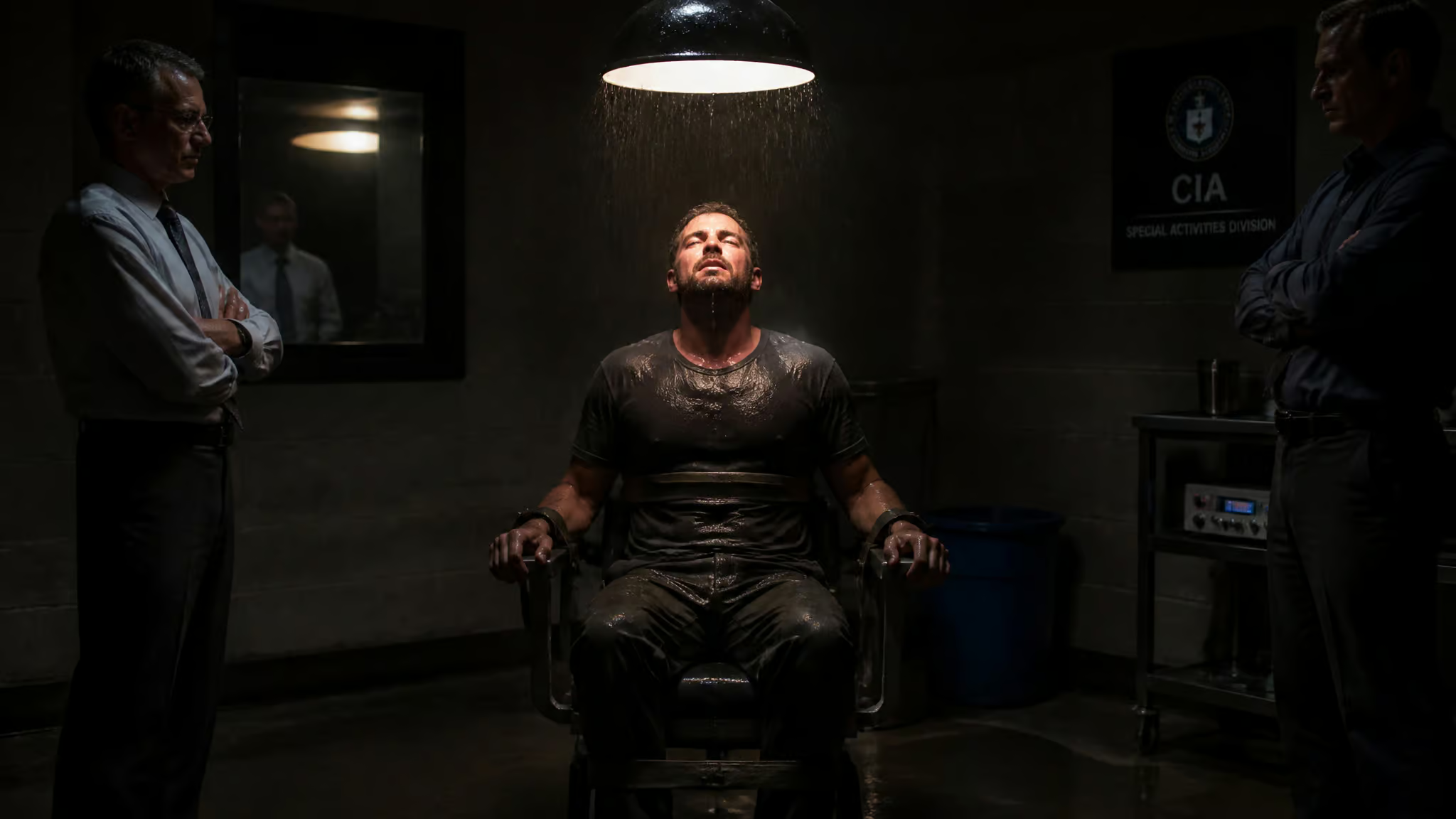
Bourne’s amnesia is the extreme case. The source material describes it as a type of conversion hysteria, a circumstantial stress layered on top of the latent, pre-existing stress imposed by the conditioning itself. In plain terms, the program broke his mind so thoroughly that when the pressure spiked, his identity simply shut down. The skills stayed, because they’d been drilled past the level of conscious thought. The person who learned them, David Webb, was gone.
That’s the paradox Treadstone never resolves. It built instinct-level killers by breaking the minds of everyone it made. The arrangement echoes the brainwashing premise of The Manchurian Candidate, and it gets a knowing wink in Zoolander, of all places. But the films don’t treat it as a joke. They treat it as the hidden cost of the whole enterprise.
The skills Treadstone installed
So what could Bourne actually do? The training covered the full toolkit: sharpshooting, explosives, vehicle operation, hand-to-hand combat, observational skills, and tradecraft. All of it drilled to instinct level. The philosophy behind it is best stated by Conklin and Parsons: Treadstone agents are invisible.
They are flawless. Nothing they do is arbitrary. Every action has a purpose and a goal.
The proof of how deep the training went is that Bourne keeps every one of those abilities after the memory wipe. Total amnesia, and he can still neutralize an assassin, build a bomb out of household parts, and talk his way through a border crossing. Skills survived the loss of biography. That’s the strongest evidence the franchise offers that the training wasn’t just learning, it was rewiring.
The fighting style is the signature. It’s efficient, brutal, and deeply improvisational. The light fixture as a weapon. The pen.
The magazine jammed into a toaster to blow up a building. Bourne doesn’t use a choreographed style; he uses whatever the environment provides, and he uses it mean. That improvisational capacity came from somewhere, and the program’s conditioning is where it was installed.
For three years, Bourne was the top agent in the program. He was the peak of what Treadstone could produce, right up until the moment he wasn’t.
The people behind the program
Treadstone had an organizational skeleton, a bureaucratic architecture that makes the fantasy feel lived-in. The staff were a mix of handlers and administrators. Richard Webb created the program from Beirut. Ward Abbott ran operations.
Alexander Conklin, stationed at Langley, was the field director. Albert Hirsch was the training director. Neil Daniels supervised training officers. Nicky Parsons handled logistics out of Paris, and Daniel Zorn served as an assistant.
The field operatives had base cities that gave them a kind of grim texture: Professor out of Barcelona, Castel in Rome, Manheim in Hamburg, Jarda in Munich, Bootlace in Calshot, UK. There was also a classified asset designated “Secret 01,” held under SCI Level-6 clearance. That detail, the specific clearance level, is the kind of bureaucratic specificity that sells the whole fiction.
On screen, the operatives are mostly silent. They get almost no speaking lines. They exist as threats, not people, dispatched to kill Bourne before he can bring the program down. Their names read like animal codenames, but that’s a fan theory, not a confirmed fact. What is confirmed is the dehumanizing effect: they’re weapons, not characters.
The Wombosi mission: where the training broke
The fall is the hinge of the whole story. Bourne is sent to kill Nykwana Wombosi. But Wombosi is surrounded by his children, and Bourne hesitates. The conditioning doesn’t hold. A human moment, a father’s kids, breaks through the training long enough to stop the kill.
The consequence is a bullet in the back. Two of them, actually. Bourne is shot, dumped in the Mediterranean, and fished out with no memory. He’s hidden on a yacht for five days, then surfaces with that laser projector under his skin pointing to the Zurich deposit box.
The woman who saved him, Marie, becomes a fixture of his new life, and eventually the two settle in Goa. A quiet, human life the program never intended for him.
This is where the moral dimension lands. Treadstone’s dehumanizing conditioning collides with a single human moment, and that collision is what destroys the program’s control. The best weapon they ever built was also the one that could still see a reason not to fire.
Why Treadstone couldn’t hold Bourne
The failure chain is elegant. First, the design flaw. Treadstone’s minimal-footprint philosophy meant a small number of self-sufficient killers, each a single point of exposure. One rogue operative could unravel the entire operation, because there was no redundancy to catch him. Bourne was that rogue.
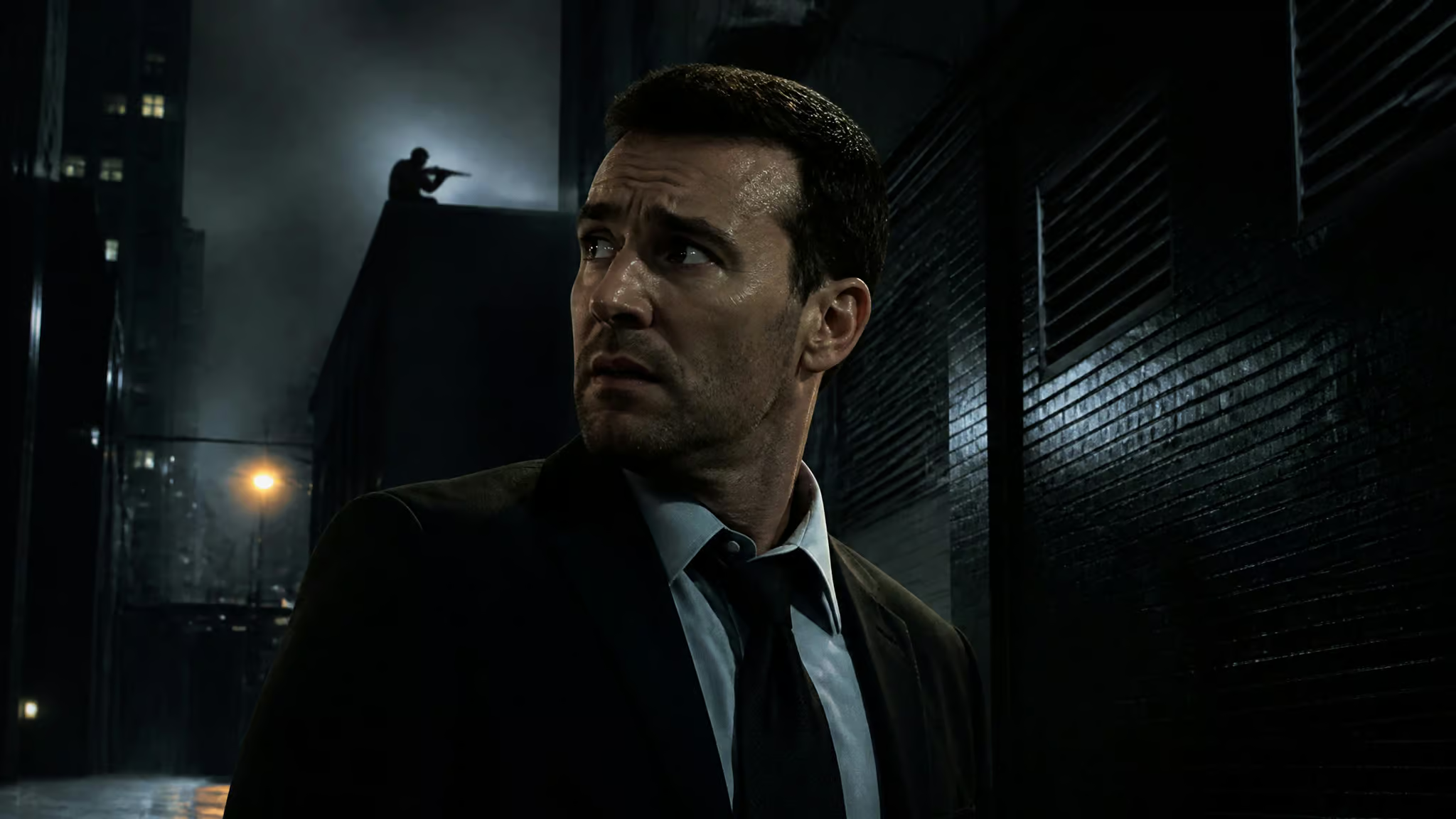
Second, the corruption underneath. Bourne’s first assignment, the assassination of Vladimir Neski in Berlin, was staged to look like a murder-suicide. It covered up Ward Abbott’s theft of $20 million in CIA funds, paid to Russian oligarch Yuri Gretkov. The program wasn’t just broken at the edges. It was rotten at the core from the start.
Third, the exposure. Journalist Simon Ross begins digging into Treadstone, and the CIA’s response is a recurring panic: we need to contain this. The damage is already done. Treadstone is shut down two years before the events of The Bourne Supremacy.
But the machinery didn’t stop. It re-opened under a new name: Operation Blackbriar. Same design philosophy, same assets, new letterhead.
The attempted containment is the engine of the later films. Bourne is framed with planted fingerprints and pursued across continents. The system doesn’t want to kill him. It wants to prove he never existed, that the whole program was a figment of an amnesiac’s imagination. He won’t let it.
The Treadstone TV series: more of the mythology
The 2019 series is the franchise’s strangest expansion. Created by Tim Kring for USA Network and later available on Amazon Prime Video, it removes Bourne entirely and goes deep into the program’s mechanics. The concept is the sleeper agent refined to its logical extreme: “cicadas.” Assets trained by the program who exist as sleeping weapons, activated with no memory of being activated. They awaken, resume deadly missions, and have no idea what they are until it’s over.
The show carries two timelines. One follows agent John Randolph Bentley in 1973, escaping a Soviet behavior-modification program called Project Cicada in East Berlin. It’s the KGB’s mirror of Treadstone, a cold-war parallel showing both superpowers running the same shady, dehumanizing playbook. The modern timeline spreads across North Korea and an oil rig in Canada, demonstrating the program’s global reach. The cast includes Tara Coleman, a journalist uncovering the truth, and CIA officers Matt Edwards, SoYun Pak, and Doug McKenna, though the ensemble never quite settles on a central anchor.
The production history is its own thriller. The series was in development at CBS in 2010, but Tony Gilroy, the writer who shaped the films’ spycraft, shut it down to protect The Bourne Legacy from competition. It sat dormant for years, then revived at USA Network and completed in 2019, filmed in Budapest with 44-minute episodes carrying a TV-MA rating. It premiered October 15, 2019.
Here’s the part that still stings. The show drew over half a million viewers in its first season. It was praised for tense action. It was still canceled after one season, a casualty of the cable TV industry crisis that also claimed The Purge series.
The planned second season was set to close the 1970s storyline, explaining Treadstone’s origins as a response to Project Cicada. We’ll never get it.
The showrunner, Ben Smith, was upfront about the creative choices. Bourne was never going to appear; the Ludlum black-ops mythology was, in his words, a “phenomenal sandbox to mine from,” and the show was built to be watchable without any prior Bourne knowledge. Reviewers generally agreed the action landed while the pacing and the lack of a central character to anchor the viewer held it back. It sits alongside The Bourne Legacy from 2012, the Jeremy Renner experiment that drew mixed reviews, and Jason Bourne from 2016, Matt Damon’s return to the role, as part of the franchise’s wider expansion into every available platform.
What Bourne’s training teaches about real skill-building
Let me be explicit about the boundary before I say anything that sounds like advice. Treadstone is fiction. The waterboarding, the sleep deprivation, the behavior modification: none of that is a real training method, none of it is effective in the way the films suggest, and none of it is something anyone should replicate. These are analogies from a designed story, not instructions.
That said, the dark mirror is worth a look. The program’s core idea is that deep, repeated training can push skills to instinct level, and the strongest proof the franchise offers is Bourne himself. He retains combat ability with zero conscious memory. The skills were built so deeply they don’t need the conscious mind to run them.
That part is a real principle, the reason deliberate practice works. The mechanics of training survive as an analogy. The ethics are the point of contrast.
The documented cost is the warning. Headaches, fatigue, light sensitivity, and a total identity collapse under compounded stress. Peak performance built on unsustainable intensity doesn’t just fail eventually. It breaks the person. The program’s own archive tells you exactly what it did to its operatives, and none of it reads as a system worth copying.
The practical takeaway, if there is one, is about sustainable intensity. Skills that survive at instinct level are real when they’re built through deliberate, repeated practice, the kind you can sustain over years without wrecking yourself. They survive best when the builder’s identity and health aren’t the price. Treadstone’s price was both. The documented side effects, headaches, fatigue, light sensitivity, and a total identity collapse, are the cost evidence. The conditioning that outlived Bourne’s memory is exactly what ended him, because there was no man left to live the life the skills were supposed to serve.
This is the part Unfinished Man is about. Capability isn’t a destination you reach and then stop. It’s ongoing work, and it’s work that only counts if the person doing it stays intact. The fiction’s tragedy is that Treadstone built a perfect weapon and forgot to keep the man attached to it.
The honest lesson is simpler: mastery that costs you your identity isn’t mastery at all. It’s just a very expensive way to lose yourself.
Frequently Asked Questions
How is Jason Bourne so skilled?
Bourne’s skills come from Operation Treadstone, a fictional CIA black-ops program that used extreme conditioning to drill combat, surveillance, and tradecraft into operatives until they became instinctive. The training was so deep that his abilities survived total amnesia, proving they were wired below conscious thought.
Why did the CIA want Jason Bourne dead?
The CIA didn’t necessarily want Bourne dead—they wanted him erased. After he failed a mission and went rogue, the agency feared he would expose Treadstone, so they framed him and sent other operatives to eliminate him. The goal was to prove he never existed and bury the program’s secrets.
Why can’t Jason Bourne remember anything?
Bourne’s amnesia is the result of extreme psychological stress layered on top of the conditioning Treadstone used to break down his identity. The program’s methods—including waterboarding and sleep deprivation—destroyed his moral framework, and when the pressure spiked during a failed mission, his mind shut down his personal memories while leaving his trained skills intact.
What condition did Jason Bourne have?
Bourne’s condition is described as conversion hysteria, a psychological response where overwhelming stress causes a loss of identity or memory. In his case, the stress of the conditioning and the failed Wombosi mission triggered total amnesia, erasing his biography while preserving his combat instincts.
What is Operation Treadstone?
Treadstone is a fictional top-secret CIA program designed to create superhuman assassins through extreme behavior modification and advanced training. Operatives were given a target and no plan, making them one-person operations to minimize exposure. The program was eventually shut down but re-emerged as Operation Blackbriar.
How did David Webb become Jason Bourne?
In the films, David Webb was recruited by the CIA after his father was killed in a false-flag bombing. He was tortured—waterboarded and sleep-deprived—until he broke, and his acceptance test was killing the real Jason Bourne. He then adopted the dead man’s name, completing the identity theft.
Is the Treadstone TV series worth watching?
The 2019 series expands the Bourne mythology by focusing on ‘cicadas’—sleeper agents activated without memory of their training. It delivers tense action and a cold-war parallel storyline, but it was canceled after one season due to the cable TV crisis. If you’re a Bourne fan, it’s worth a look, but it lacks a central character to anchor the narrative.