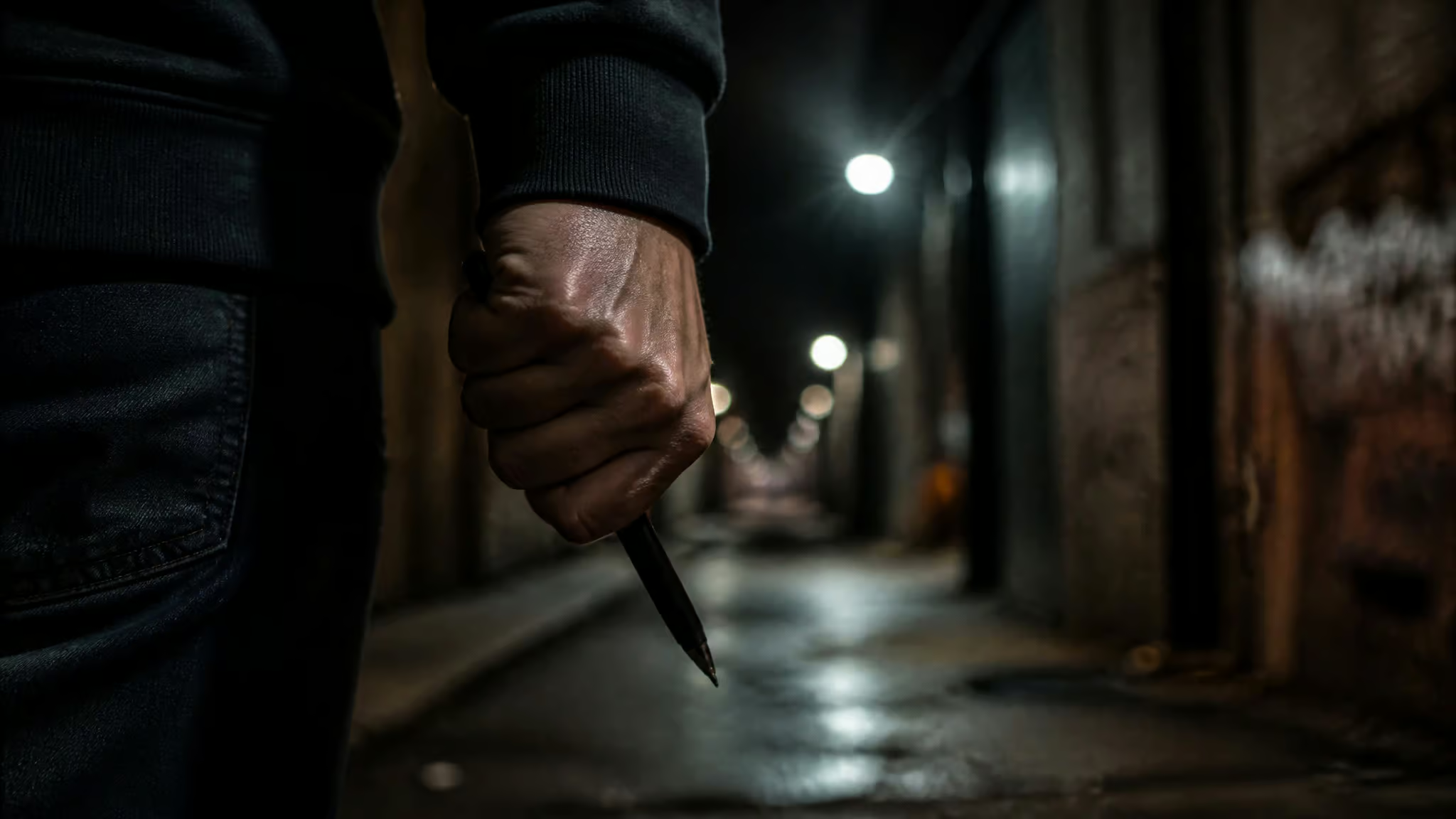
Every time someone watches a Bourne movie, there’s a moment where the question appears. For me it’s the pen fight in The Bourne Identity, released in 2002 and one of the biggest hits of that year. Bourne, no memory, cornered, picks up a ballpoint and drives it like a dagger at a Treadstone agent closing in. It’s not a martial-artist move, not in the way people picture. It’s the fighting equivalent of grabbing whatever’s bolted to the floor, and it’s the most honest thing in the whole franchise.
Jason Bourne doesn’t fight in one martial art. His style is a deliberate composite, four systems working as one layer. Boxing gives him the striking foundation and the power to end a fight with a single punch. Filipino martial arts, the weapons system most people know as Kali, Eskrima, or Arnis, let him turn a pen into a blade and a magazine into a stick.
Wing Chun handles the cramped, trapping-heavy moments when someone’s inside his reach. And Jeet Kune Do, Bruce Lee’s combat philosophy, is why Bourne so often lands his shot before the other guy’s attack even starts. And the answer that keeps floating around, that it’s Krav Maga? That one’s wrong.
Key Takeaways
Bourne’s fighting is a composite, not a single style: boxing for the striking, Filipino martial arts (Kali/Eskrima/Arnis) for improvised weapons, Wing Chun for close-quarters trapping, and Jeet Kune Do for interception. It is not Krav Maga.
Jeff Imada, chief fight choreographer on the first three films, trained at the Inosanto Academy under the JKD and Filipino martial arts lineage, which is why the fights emphasize empty-hand-versus-knife work and everyday objects as weapons.
You can train this material: maelstrom Martial Arts runs an annual 8-week course teaching basic techniques and choreography from the first three movies, while traditional Kali Ilustrisimo survives through private lessons under a small number of grandmasters.
Table of Contents
Boxing: the foundation Bourne falls back on
The clearest look at Bourne’s boxing comes in Jason Bourne (2016), the fifth film, when he’s hiding out in Greece and fighting in underground bouts, no rules and cash on the line. It’s not ring boxing. It’s messy, gritty work. Bourne lands a single punch that puts a man on his back, a left hook that does the whole job.
When his fights against Treadstone agents run at shorter range than most boxers fight, he handles the clinch and adjusts his punching for opponents who keep their distance. That’s the point: this is boxing as a survival tool, not a sport. Economy and range over form.
Kali, Eskrima, and the improvised-weapons arsenal
The thing that makes Bourne’s fights feel resourceful isn’t the striking. It’s the Filipino martial arts. Kali comes from the Philippines, an archipelago of roughly 2,000 inhabited islands, and you’ll also hear it called Arnis or Eskrima. It’s a weapons-first art, built around knives and sticks called bastons, and Bourne applies that stick-and-blade logic to whatever’s in his hands.
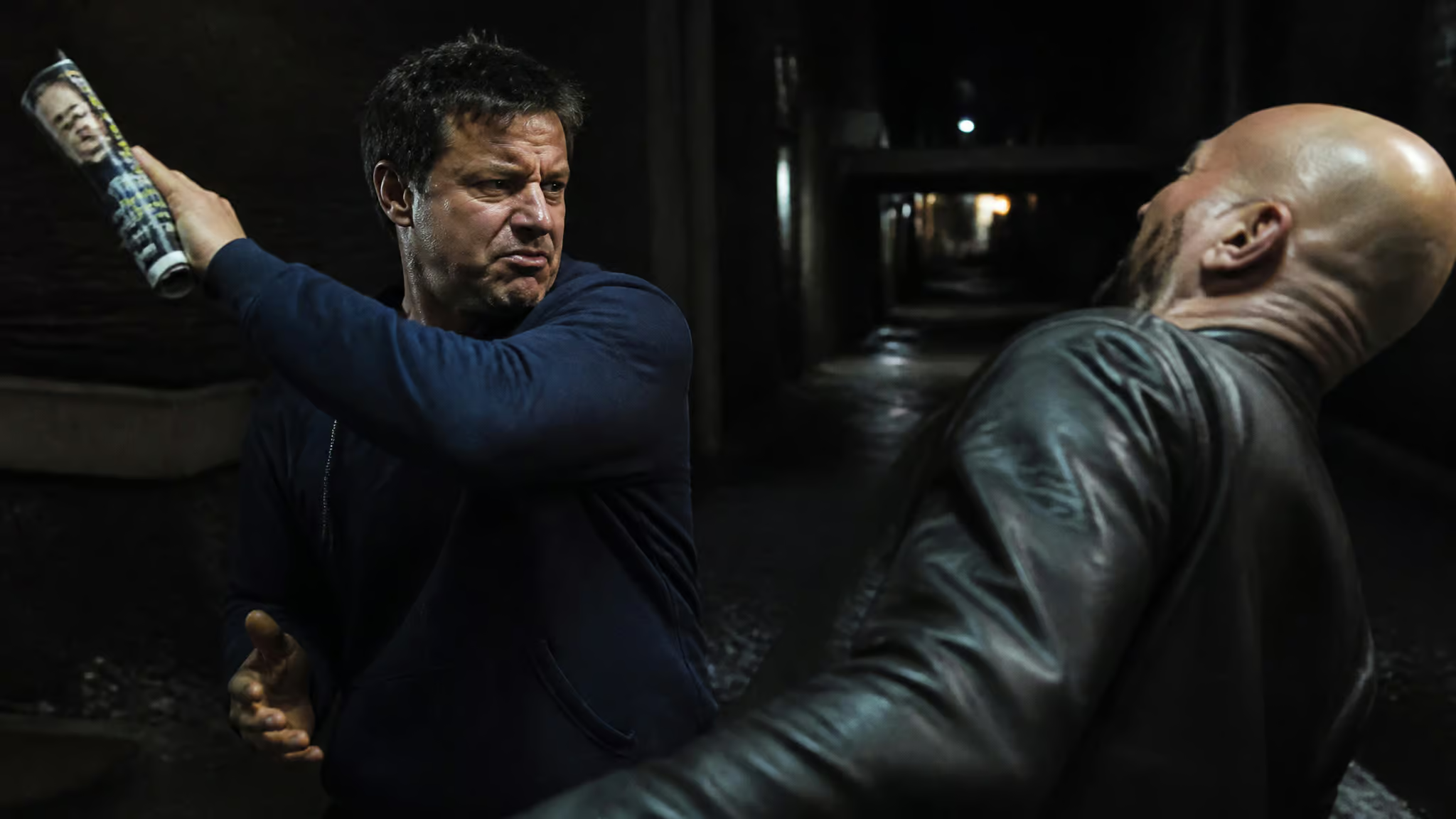
The proof is on screen. In The Bourne Identity, the pen used like a dagger. In The Bourne Supremacy, a rolled-up magazine swung as a baston. The pattern runs through the franchise: police batons, handguns, books, all pressed into service as striking tools.
The environment is an arsenal, and that’s the Kali mindset. The everyday objects aren’t part of any official Kali curriculum. That’s cinematic application of the principles, but the principles are real.
Filipino martial arts developed through wars between tribes and evolved further after Spanish colonization began in the 1500s. That’s why it’s practical: it was forged in actual conflict, not on a tournament mat. Beyond Bourne, FMA has shown up in Quantum of Solace and the Captain America movies, including Black Panther.
Wing Chun: the close-quarters work
When the space gets tight, Bourne switches to Wing Chun. It’s a martial art built for close-quarters fighting, trapping, and short-range vertical-fist punching. Chain-punching, where the fists travel over each other in rapid succession to overwhelm an opponent, is its signature volume attack.
You see it most clearly in The Bourne Ultimatum, the third film, in the fight against Desh, played by Joey Ansah, in a cluttered room that leaves no room for big movement. Bourne shows skill at in-fighting and trapping, redirecting attacks and countering with short vertical strikes. But here’s the nuance: he never fully commits to chain-punching. He takes the pieces that serve speed and survival, the trapping and the short-range work, and leaves the full form behind.
Wing Chun’s creation is often credited to Ng Mui, one of the Five Elders of Shaolin, and the Ip Man films are a big reason people recognize the style today. Bourne uses the useful parts of it, much as the second film, The Bourne Supremacy, showcased iconic car chases that blended the same raw efficiency. The style also appears in Furie, a 2019 Vietnamese film starring Veronica Ngo as a mother seeking revenge, directed by Le Van Kiet.
Jeet Kune Do: the intercepting fist
The philosophy layer is Jeet Kune Do, created by Bruce Lee after he researched a wide range of martial arts. The name translates as “The Way of the Intercepting Fist,” and the core idea is simple: beat the incoming attack with a strike of your own. Don’t block and counter. Intercept.
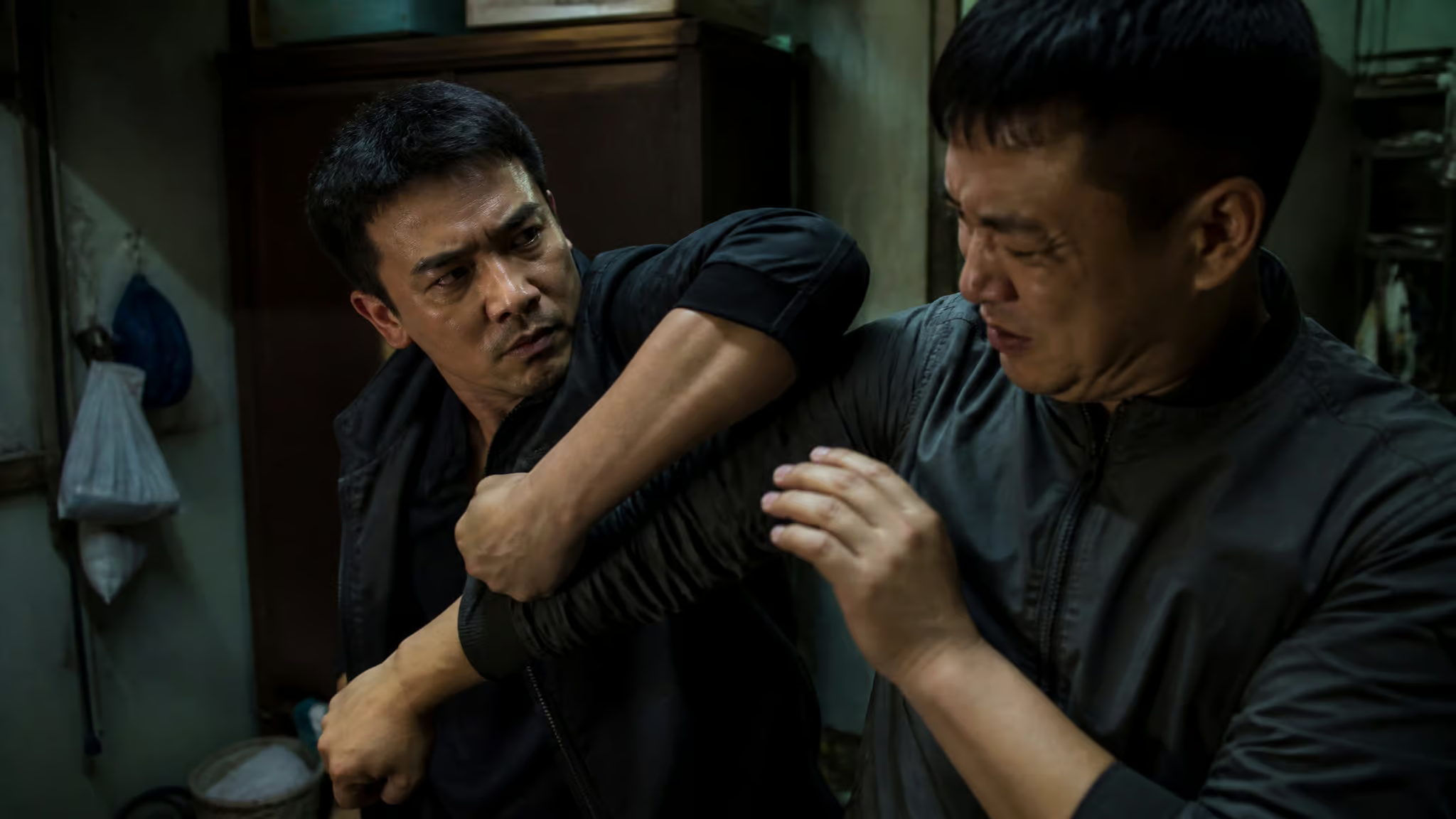
Bourne does this constantly. His most decisive moments are the ones where the other guy starts his move and Bourne’s shot is already there, cutting the attack off before it finishes. Lee intended JKD to be a combat philosophy rather than a strict style, and that’s exactly why Bourne’s fighting feels so adaptive. He’s not locked into one system’s answers.
Worth a passing note: Lee studied Wing Chun under Ip Man, and he’s often credited with leading the charge toward modern MMA. Jeet Kune Do is the connective tissue that lets boxing, Kali, and Wing Chun blend into one responsive approach.
The Krav Maga myth, and why it won’t die
No. Bourne does not use Krav Maga. Matt Damon never trained in Krav Maga for the role, and the styles behind the fighting, per the people who built it, are Jeet Kune Do, Escrima, and Kali. For those seeking accurate information, CBC Gem offers Closed Captioning and Described Video.
Here’s the fun part: even the fandom wiki gets this wrong. The main page categorizes Bourne as a Krav Maga user, and its own trivia section quietly corrects it, noting that Krav Maga is mistaken as his art when it’s Jeet Kune Do, Escrima, and Kali. The dedicated fans can’t agree with themselves.
Bourne has a military and special-forces background, and Hollywood treats “efficient military combat” and Krav Maga as the same thing. To be fair, Krav Maga fits the vibe. It’s the system Imi Lichtenfeld created for the Israel Defense Forces, the name means “contact combat” in Hebrew, and it blends boxing, wrestling, and judo, simplified for quick learning.
Elite units including the CIA, FBI, and US Special Forces use it. But the choreography’s emphasis, on weapons and interception, is Filipino martial arts and Jeet Kune Do territory, not Krav Maga’s counter-attack system. It’s not Bourne’s art.
Jeff Imada and the Inosanto Academy lineage
The reason the fights look grounded comes down to one name: Jeff Imada. He was the chief fight choreographer on the first three films, Identity, Supremacy, and Ultimatum, and he trained at the Inosanto Academy, which is the direct link between Bourne’s fights and Bruce Lee’s legacy.
Imada studied Jeet Kune Do under Brandon Lee and Dan Inosanto, who also taught Brandon Lee and is a key figure in both JKD and Filipino martial arts. Imada also developed knife techniques and wrote books on the butterfly knife, which explains the weapon work on screen. He used realistic Filipino-martial-arts applications in the choreography: empty-hand against knife, improvised weapons, and using the environment. That’s why the fights feel dangerous instead of choreographed.
Matt Damon deserves credit here too. He trained extensively in weapons and fighting for the role and performed many of his own stunts. That matters, because the franchise’s infamous shaky cam doesn’t hide sloppy work. You can’t fake a knife disarm on a guy who’s actually showing you the move.
How the style changed across the films
The three Damon-era films, Identity, Supremacy, and Ultimatum, carry the full Filipino-martial-arts choreography under Imada: realistic, weapon-driven, environment-focused. Then came The Bourne Legacy in 2012, with Jeremy Renner, and it’s a stylistic departure. It has fewer fight scenes, and the Filipino martial arts aren’t featured as clearly. The difference is visible.
Robert Ludlum wrote the original novels starting in 1980, and they predate the movies by two decades. The on-screen fighting is a Hollywood interpretation, a composite built for cinema, not a documented system you can verify against the books.
How to actually train in the martial arts behind Bourne
If watching these movies makes you want to learn the real material, there are two honest paths, and both of them are specific. For a cinematic reference, The Last Dragon is historically significant as an early Black superhero film.
The most direct entry point is maelstrom Martial Arts, which runs an annual 8-week mini-course teaching basic empty-hand and improvised-weapons techniques from the first three films. At the end, each student learns part of the actual fight choreography from each movie. It’s a good example of how cinematic choreography gets translated into something teachable, not a claim that it’s the only way to learn or that the course produces movie-level results.
The traditional route is Kali Ilustrisimo, a knife and blade style that was deliberately never commercialized. It’s typically taught through private lessons with a master, and it’s preserved by a small number of grandmasters, including Norman Suanico, one of three in Alberta, Canada.
Gilbert LaFantaisie, a grandmaster in the Filipino art Rutano Estokada Kali who teaches in Red Deer, Alberta, came to FMA after a grandmaster demonstrated at his karate studio. His reaction: What did you just do? I want to learn this! He describes the training as conditioning the body without wraps or protective gear, and notes that knife defense targets the weapon hand first. He calls it “defanging the snake,” cutting the hand or wrist to take the blade out of the picture.
The practical advice is straightforward. Boxing gives you range and footwork. Wing Chun gives you structure for close-quarters work. A Kali- or JKD-oriented Filipino school gives you the weapons logic.
FMA remains lesser known than karate, but interest is growing, including within the Filipino community itself. Local options might exist where you’d least expect them.
What movie choreography can’t teach you
One blunt reality check before the close. There is no official “Bourne-style” course. What real training gives you is principles: footwork, range, and the psychology of adapting whatever’s in reach. It does not hand you a mastered fighting system, and movie choreography should not be treated as real self-defense.
The films are entertainment with a strong grounding in genuine technique. If you want to fight for real, you go to qualified schools and do real drills.
Bourne fights with what’s useful
Strip away the shaky cam and the globe-trotting, and the thesis holds together cleanly. Boxing gives Bourne the power to end things fast. Kali gives him the creativity to turn a pen into a dagger. Wing Chun gives him the composure to work in tight spaces. Jeet Kune Do gives him the instinct to strike before he’s struck.
Four pillars, one adaptive philosophy, shaped by Jeff Imada’s Inosanto lineage. And no, it’s not Krav Maga. It’s a deliberately built composite that looks the way it does because a real martial artist with real lineage designed it that way.
Frequently Asked Questions
Can you learn the martial arts from the Bourne movies?
Yes, you can train in the underlying arts. Maelstrom Martial Arts offers an annual 8-week course teaching basic techniques and choreography from the first three films. For traditional Filipino martial arts, Kali Ilustrisimo is taught through private lessons with a small number of grandmasters, preserving the knife and blade style that Bourne approximates on screen.
What is the difference between Kali, Eskrima, and Arnis?
Kali, Eskrima, and Arnis are all names for Filipino martial arts, with regional variations. They are weapons-first systems built around knives and sticks, and Bourne applies their logic to everyday objects like pens and magazines. The terms are often used interchangeably, but they all share the same core principles of angles, flow, and using whatever is at hand.