
Two cops get the worst shift of their careers inside the first ten minutes of The Bourne Identity. A man with no memory of his own name is sitting on a bench in Zurich. A patrol officer taps him on the shoulder. A few seconds later both officers are on the pavement and the man is long gone.
He doesn’t know who he is, where he’s from, or why the world seems determined to kill him. His hands remember everything.
That’s the moment the entire franchise runs on, and it’s the question I’ve been chewing on since I watched it in a theater years ago: how does a guy who can’t recall his own name still know exactly how to take a man apart at the joint?
I’ve sat through all five Bourne movies more times than I should admit, and this is the answer I’ve landed on. Jason Bourne’s skills aren’t superpowers. They’re the product of a specific, brutal training pipeline: a kid from Missouri turned into a weapon the CIA built and then tried to destroy. And the amnesia isn’t the plot hole it looks like. It’s the proof of how deep the training went.
Key Takeaways
Jason Bourne is an alias. The man underneath is David Webb, a Green Beret and Delta Force captain from Nixa, Missouri. The CIA murdered his father to force him into the program.
Treadstone broke him with waterboarding and sleep deprivation before teaching him Jeet Kune Do, Kali, French, German, and a long list of pistol platforms; every one of those skills is trainable, and the flawless execution under lethal threat is the part that’s pure cinema.
The amnesia is the point. His hands still know combat, gun disassembly, and complex knots even though his mind erased his identity, and that’s the closest the films come to a real principle: procedural memory.
Table of Contents
The Man Behind the Legend: From David Webb to Jason Bourne
First, the name. Jason Bourne is the codename. The man underneath is David Webb, and the films can’t even keep his details straight, which turns out to be the point. Born in Nixa, Missouri, with a birth date that shifts between September 13, 1970 and June 4, 1978 depending on which source you read.
His passport in the 2002 film The Bourne Identity says 1969. His passport in the 2016 film Jason Bourne says 1978. His dog tags list O-negative blood. His Treadstone file says A-positive.
None of it adds up, and that’s exactly how the franchise wants it. This is a character defined by unstable identity, start to finish.
In the original novels, David Webb was a career Foreign Service officer and specialist in Far Eastern affairs, not a soldier. The films made a different call and went military. Webb joined the U.S. Army Special Forces, the Green Berets, before moving on to Delta Force, and he reached the rank of captain. He joined the CIA on January 4, 1997. That’s the foundation: elite conventional training first, spy work second.
Here’s where it stops being a résumé and starts being a tragedy. Webb’s father, Richard Webb, was a CIA station chief killed in Beirut, Lebanon, on October 7, 1999. Richard had created Treadstone, then threatened to expose it to keep his son out of the program. That threat is what got him killed.
CIA deputy director Robert Dewey ordered the hit, staged it as a terrorist attack, and used the grief to push David straight into the operation. His skills weren’t a gift. They were manufactured on purpose, built on a murder the agency committed to recruit him. The father’s death is the emotional engine the rest of the franchise runs on.
Operation Treadstone: The CIA’s Black Ops Program
Treadstone was a top-secret CIA black ops program designed to make one thing: an assassin. Webb signed on after his father’s death, and they handed him a new name, Jason Bourne, as part of the deal. The program was run by Alexander Conklin, and everything about it was built to erase the man who walked in.
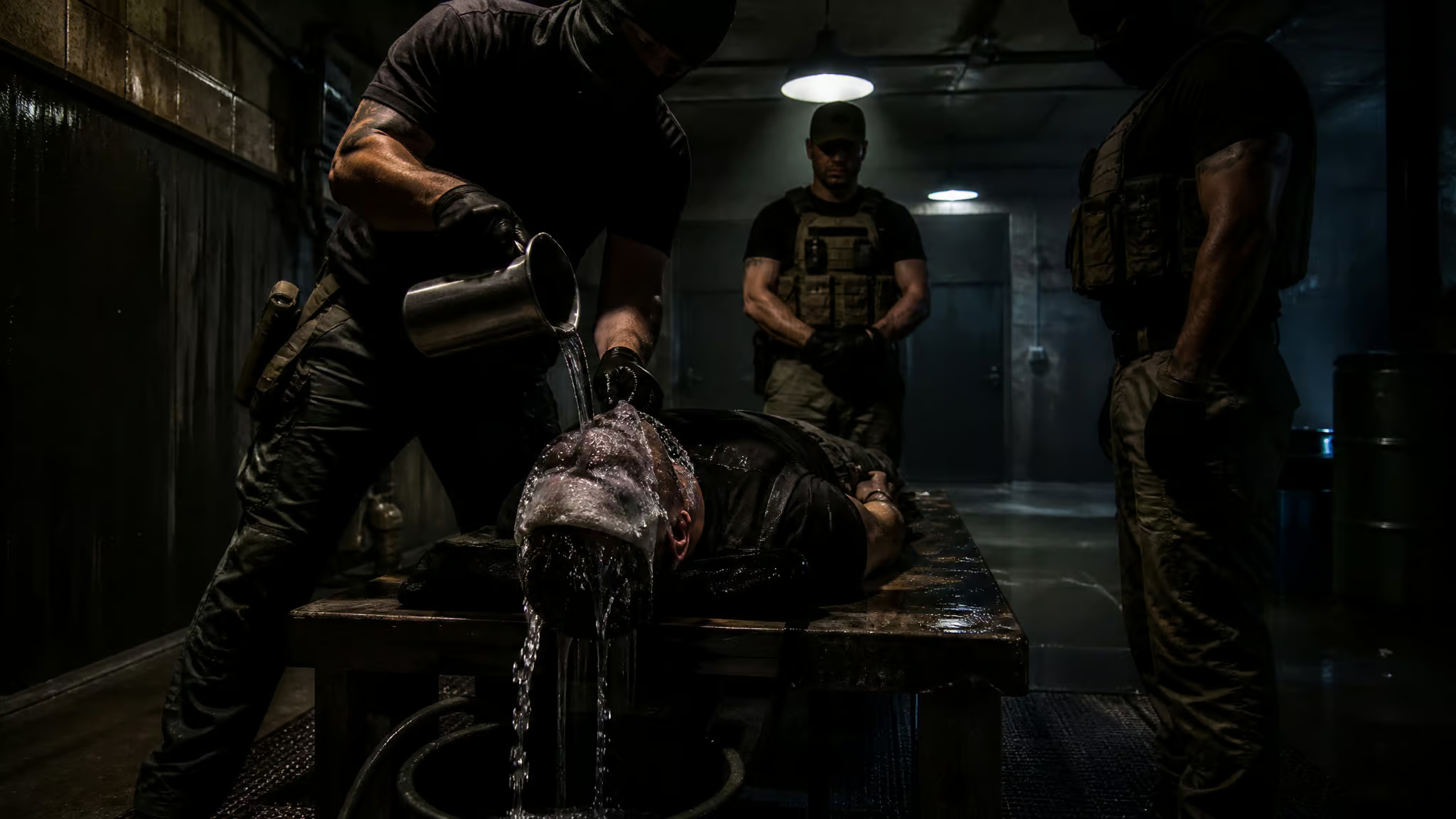
The training wasn’t target practice. The conditioning involved waterboarding and sleep deprivation, deliberate methods to break his spirit so he could be rebuilt into a killer. The goal was to destroy the person and replace him with something the agency could point at a target. That’s the part most people skip when they talk about how impressive Bourne’s skills are. The skills came at the cost of the man who had to learn them.
It worked, in the worst way. Treadstone taught Webb several languages and a wide array of martial arts, and it installed a second self in his body. The program was so thorough that, even after the amnesia erased his identity, the conditioning kept operating underneath. Bourne doesn’t regain his memory and become whole. He spends the entire series navigating a mystery that never fully resolves, and the skills keep working the whole time.
Bottom line: The training wasn’t just about teaching skills—it was about making them automatic so they’d survive even if the man didn’t.
The Complete Arsenal: What Bourne Can Actually Do
Strip away the mythology and Bourne’s toolkit is a list of real, trainable disciplines. Hand-to-hand: Jeet Kune Do and Kali, Bruce Lee’s efficiency system and a Filipino martial art built around weapons and flow. Both are practical and brutal, built for real encounters. When he fights Castel in The Bourne Identity, the fight ends with Castel’s arm and leg broken. If you want to know where to start training in those systems, we’ve broken down Bourne’s fighting style here.
Firearms are where the specificity shows. Bourne is proficient with a long list of mostly pistols: the Glock 17, Glock 19, SIG Sauer SP2009, SIG Pro SP 2022, SIG-Sauer P225, Beretta 92FS, Walther P5 Compact, and a custom Keppeler & Fritz KS II. When a doctor hands him a gun in the first film, he takes it apart in seconds without looking at it, muscle memory doing the work. He also picks up a shotgun to finish the fight with the Professor, and the franchise’s most clinical demonstration of his skill is the Neski job, the Berlin murder-suicide that was actually an assassination he staged.
Languages round out the package: fluent French and German, plus the unspoken promise of more. The source material is famously vague here. It says “several languages” and “a wide array” of martial arts without naming most of them. That vagueness is doing real work. Audiences fill the gaps with whatever feels most impressive, and the character gets credit for competence he was never shown earning.
His situational awareness is the one skill nobody ever mentions but everyone should steal. In a single scene he can recall the license plates of every car on the street, notice a waitress is left-handed, and estimate a man’s weight and combat readiness at a glance. He knows where to look for a gun in any room he enters. That’s not a superpower. It’s trained observation, and it’s the reason he’s never caught in a room he hasn’t already mapped.
Then there’s the improvisation, which is where the films have the most fun. A rolled-up magazine deflects a knife. A pen becomes a weapon. He can tie complex knots, run flat out for half a mile before his hands start to shake, and he pilots a helicopter in The Bourne Ultimatum. He survives being shot twice and dumped in the Mediterranean, but before that he’s hot-wiring his way through Moscow in one of the greatest car chases in movie history, which brings us to the actual heart of the character.
The Amnesia Paradox: Instinct vs. Identity
Here’s the setup. Bourne refused his assignment. He was ordered to assassinate Nykwana Wombosi, but he couldn’t do it with children present, so the CIA tried to clean him up. He was shot twice in the back and fell into the Mediterranean, where an Italian fishing vessel picked him up and a physician named Giancarlo treated him. A device embedded in his hip projected a Swiss bank account number, which is the only clue he has about who he is.
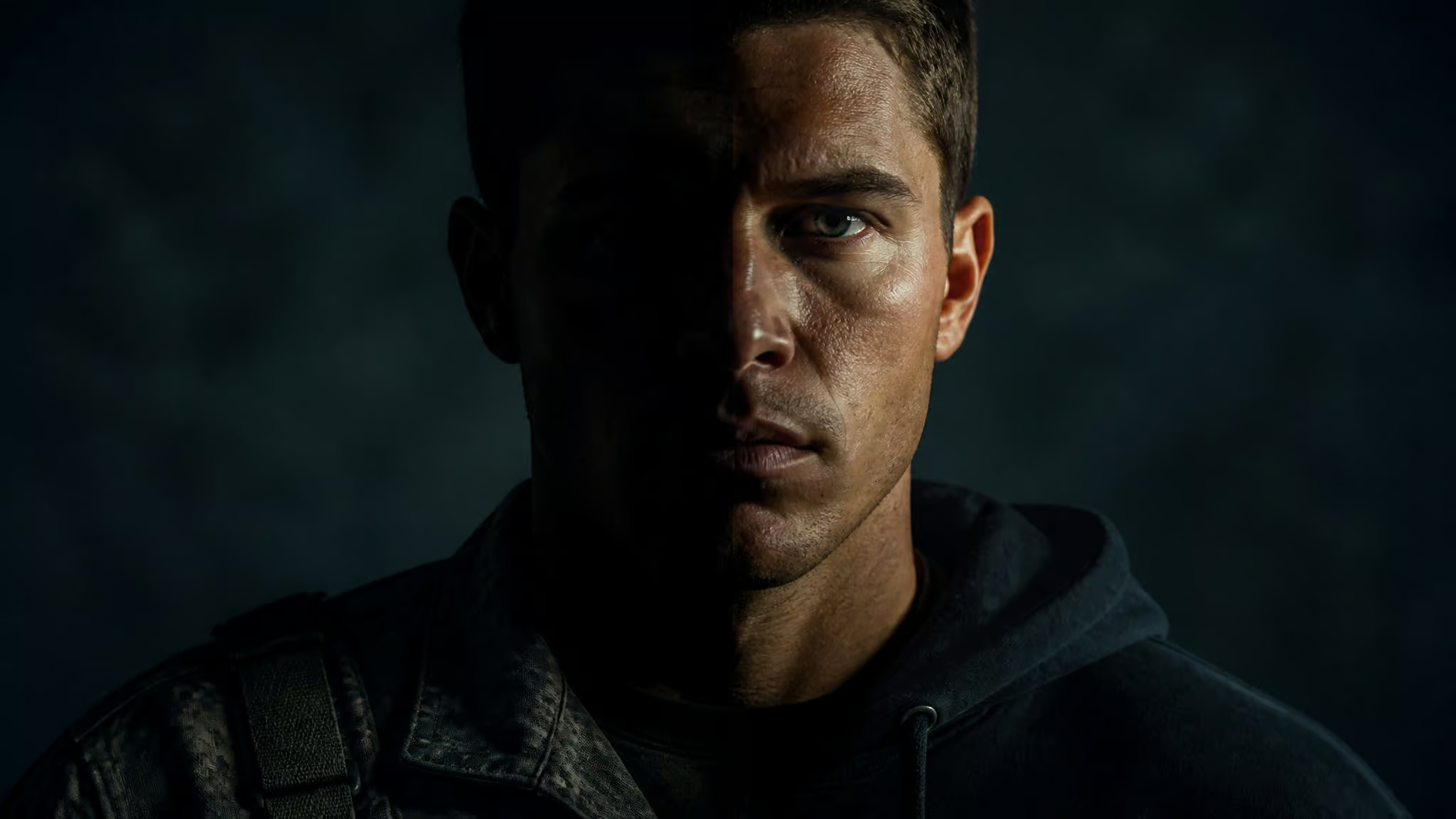
And yet, with his memory gone, the combat skills, the gun knowledge, and the knot-tying all work perfectly. He disarms two cops in Zurich before he can finish processing the thought of resisting.
That’s not fantasy baked into the script. Procedural memory is real. It’s the part of your brain that lets you drive a car or tie your shoes without thinking about it, and years of enforced repetition can bury skills deep enough to survive a lot of damage. But don’t let the science talk convince you there’s a real-world equivalent here.
There isn’t. Knows a dozen ways to kill you but can’t remember his own mother’s name is a great narrative device, not a condition you’d find in a neurology textbook.
The melancholy underneath is the point. The training went so deep it made the memories optional. Bourne’s body carries the weapon even when his mind can’t carry the man, and the amnesia becomes the only doorway he has to a life without violence. His skills are inseparable from the person Treadstone made him.
What Actually Drives Bourne
Skills without a reason to use them are just chaos. What makes Bourne worth rooting for is the code that survives even his amnesia.
The Wombosi mission is the inciting incident for the entire franchise. He refuses to complete the job because children are present, and that refusal turns him into a fugitive. The decision comes from a place he can’t access anymore, which is the tragedy: his body knows it’s wrong before his mind can form the thought. This is not a man with no lines. This is a man whose moral line is so deeply installed that it operates on instinct, same as his fighting.
His enemies keep miscalculating because of this. They assume he’s just another assassin, a weapon without preferences. They’re wrong. He’s a supreme realist who doesn’t count on luck, which is why his situational awareness never feels like luck.
He accepts help when he needs it, teaming up with Marie Kreutz in the first film and working alongside Nicky Parsons later. Those aren’t plot conveniences. They’re proof that he’s a survivor who uses every tool available, including other people.
And the cost is real. He’s defined by guilt he can’t fully remember and a past he’s simultaneously running from and toward. The restraint, not the violence, is his actual superpower.
Reality Check: Is Any of This Actually Possible?
Let’s answer the question people actually search for: is Jason Bourne a super soldier? No. There’s no genetic modification, no tech implanted in his skull, no heart-pumping drug cocktail keeping him at one hundred percent. Everything he does is consistent with intense training. Special Forces, Delta Force, and Treadstone all pull from real-world military methodology, and the foundation is real.
The part that isn’t real is the execution. Muscle memory is real, but the ability to instantly recall and flawlessly execute complex combat maneuvers under lethal threat, every single time, without fail? That’s cinema. Even the most decorated operator has an off Tuesday.
Unwavering reliability under that kind of stress would be more exhausting than any single mission. And for most of the series Bourne isn’t even operating at full capacity; he’s figuring out who he is while the entire world tries to kill him. That’s the stress test that breaks most people, and it’s not something you can train for.
The age math is also a fantasy. The films contradict themselves, with one placing Bourne at 51 and another at 36. Sustaining top-end physical combat into your forties or fifties with zero wear and tear is optimistic even for elite genetics. If you want the practical version, the real-world skills you can actually build, we’ve got a guide to becoming Bourne without the CIA.
Cost check: Real-world skills don’t require the waterboarding or the amnesia—just the hours, which is a price nobody can skip.
So the most impressive thing about Bourne isn’t the skills. It’s the discipline, the drive, the obsessiveness that keeps the whole machine running. A quick wry aside: his enemies have the same drive. Every asset hunting him is just as committed to the mission. Maybe relentless dedication isn’t the whole upside it looks like.
Bourne vs. Bond vs. Ethan Hunt
Put Bourne next to the other two big movie spies and the difference is structural.
James Bond operates with a license to kill, a support network, and Q-branch gadgets waiting in an Aston Martin. Bourne has a pen and a hoodie. Bond’s world stays mostly intact while he works; Bourne’s is dismantled from the opening scene. Bourne never gets a license. He operates with a list of conditions, improvised on the fly.
Ethan Hunt leads a team, draws on IMF resources, and plans elaborate heists with masks and gadgets. Bourne is a loner. He infiltrates an embassy essentially nude, works without backup, and can’t trust anyone, including himself. Hunt’s skills overlap with Bourne’s, but they run on entirely different ecosystems.
The real difference is that Bourne was designed to be disposable. A weapon that can be discarded. That changes everything about how he fights. Bond has M. Hunt has Luther and Benji.
Bourne has a head start and a can of mace, and no one is coming to save him. That’s not a small difference. It’s the difference between a soldier and a weapon.
It’s also the reason the franchise changed the genre. The Bourne movies directly influenced the grittier tone of the Daniel Craig era, starting with Casino Royale. Not invented, but influenced. The “what if spies were real” school of action filmmaking starts here. If you want to see how Bourne’s archetype compares to the other great modern action hero, we’ve pit him against John Wick.
Conclusion
Close the loop on the opening scene. The Zurich cops don’t know what hit them because the man they tapped on the shoulder was never just a man. He was the end product of a pipeline: a Green Beret and Delta captain, broken down and rebuilt by Treadstone, carrying a second self that can function even when his identity is gone. The amnesia isn’t a bug.
It’s the point. It proves the training went deep enough to make the man himself obsolete.
There’s a practical takeaway buried in here, and it’s not “go get waterboarded.” It’s that every individual skill Bourne uses is available to a normal person who puts in years of deliberate work. You can learn to fight. You can learn to observe.
You can learn to stay calm under pressure. What you can’t do is run the whole machine at full output forever, and that’s fine. Bourne is the fantasy version of a real principle: skills built deeply enough become part of you. The rest is just movies being movies.
Frequently Asked Questions
Why did the CIA want Jason Bourne dead?
The CIA wanted Bourne dead because he refused to complete an assassination assignment when children were present, making him a liability. The agency tried to ‘clean him up’ by shooting him and dumping him in the Mediterranean, but he survived and became a fugitive they needed to eliminate.
Why can’t Jason Bourne remember anything?
Bourne’s amnesia is the result of being shot twice in the back and falling into the Mediterranean, which caused memory loss. The films use this as a narrative device to explore how his training, embedded as procedural memory, operates even when his identity is erased.
Is Jason Bourne a super soldier?
No, Bourne is not a super soldier in the sci-fi sense—there’s no genetic modification or implanted tech. His abilities come from intense, real-world-style training through Special Forces, Delta Force, and the Treadstone program, though his flawless execution under lethal threat is pure cinema.
How does Jason Bourne’s amnesia affect his fighting ability?
Bourne’s amnesia doesn’t affect his fighting ability because his combat skills are stored as procedural memory—the kind that lets you drive a car without thinking. Years of enforced repetition buried these skills deep enough that they survive even when his identity is erased, which is why he can disarm cops before processing the thought of resisting.