
Matt Damon shot a bare-knuckle fight scene for Jason Bourne on his 45th birthday, which tells you almost everything about the program that got him there. This wasn’t a six-week crash to look good under a costume. It was roughly 18 months of work that started around his prep for The Martian, carried through the Bourne shoot, and squeezed another film in between. Damon was 29 when he first got in shape for the franchise.
At 45, by his own account, the same job was just brutal. Here’s what that actually meant day to day, who built it, and what it would take to run any of it yourself.
Key Takeaways
The Jason Bourne build ran about 18 months, from prep for The Martian through the film’s shoot, with only a week or two between projects along the way.
Daily pull-up volume sat at 70 to 100 reps, with 70 pounds strapped around the waist and 30 full-range reps as the reported end-state, per trainer Jason Walsh.
Walsh’s method was foundation first: bodyweight Bulgarian split squats before loaded ones (up to 125-pound dumbbells per hand), no floor deadlifts, and mobility treated as a daily habit, not an afterthought.
Table of Contents
The 18-month grind that built the physique
Damon didn’t train for Jason Bourne so much as he lived it for a year and a half. Walsh has said as much, praising Damon for working out straight through the stretch: prep for The Martian, then the Bourne shoot, with The Great Wall filmed in between. The film released in summer 2016, and the timeline ran through Super Bowl 50 in February of that year, when the training was already deep into its final phase. There was no recovery season in that plan. One project wrapped and the next started within a week or two, and the training kept running underneath all of it.
The age detail is the part that makes the whole thing land. Damon was 29 when he trained for the first Bourne film, and he doesn’t dress up the difference. “For the first Bourne movie I was 29 and I thought that was hard work getting into shape,” he told the BBC. “Now I’m 45 and it’s just brutal.” The bare-knuckle scene was shot on that 45th birthday, and he’s joked that maybe the next Bourne will just be fat and happy and old.
The man running the program is Jason Walsh, owner of Rise Nation in Los Angeles. He’s the same coach who prepped Bradley Cooper for American Sniper and John Krasinski for 13 Hours and Jack Ryan, and he’d worked with Damon since Elysium in 2013. He also works with aspiring NFL Combine athletes, which tells you the flavor of the whole thing. This is athletic preparation for a job with physical requirements, not a vanity plan.
Walsh’s approach: foundation before load
Walsh’s method stands on one deliberately counter-intuitive idea, which he’s said plainly: “My biggest thing with Matt is making sure his foundation is solid, and that means he has mobility, flexibility, and overall strength.” The logic is that a solid foundation is what lets an athlete take on heavy work without breaking down. Walsh said they’d worked a lot on keeping Damon’s flexibility and mobility, because losing those during a strength block is the fast route to injury.
That philosophy produced one of the more surprising decisions in the program: no floor deadlifts. Walsh skipped them to reduce injury risk at Damon’s low back and went with pull-ups for back development instead. Worth saying the obvious thing here. That’s one trainer’s judgment for one specific athlete with a shoot schedule hanging over him, not a verdict that deadlifts are dangerous.
The wider point is Walsh’s, and it’s the more useful one. He’d rather build the same back with less exposed risk, because that back has to survive a whole film.
It’s a mind-set that’s been consistent since the early days. Back around Elysium, Walsh was already framing his methods as producing an athletic physique rather than a bodybuilding look. The goal is a body that can do things on set, not one that just reads big in a costume.
Field note: The no-deadlift call wasn’t a blanket rule. It was one coach protecting one actor’s lower back for a full shoot schedule.
The progression: bodyweight to 125-pound split squats
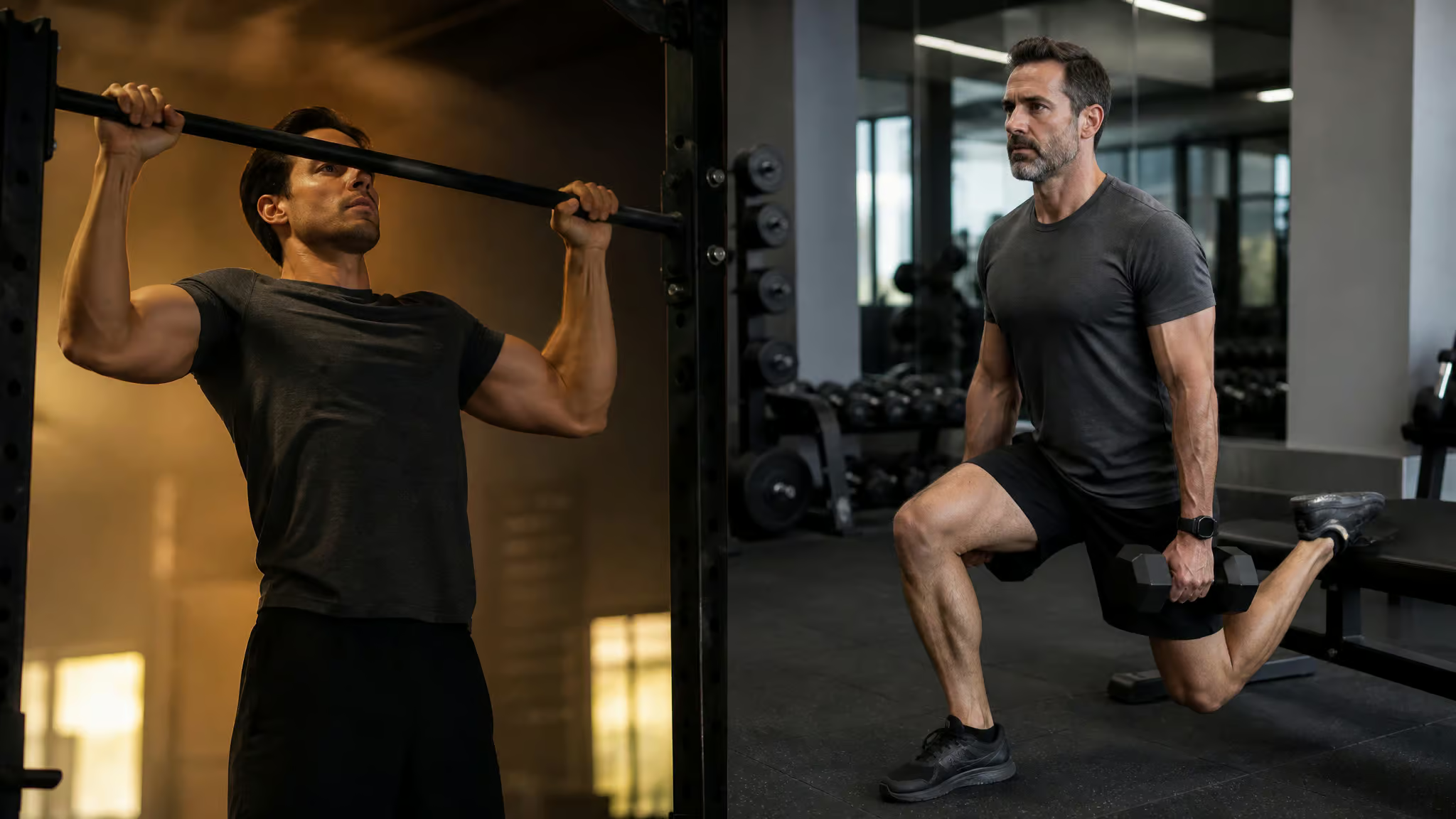
The loaded end-state on the Bulgarian split squat was 125-pound dumbbells in each hand. That’d be a fine headline on its own, but the actual lesson is how long it took to get there. Walsh started Damon on bodyweight, 15 to 20 reps, working the movement before loading it. From there the work moved into slow, controlled isometric-type holds, then into progressively heavier loads, spread over roughly a year before Bourne started filming.
That pacing is the part most people skip. It’s much easier to grab a heavy pair of dumbbells and start the split squat at a weight you can’t hold in position, and that’s exactly where the injury risk comes from. Walsh built the position first and let the numbers follow.
The leg work itself ran as triple sets: Bulgarian split squats, single-leg landmine Romanian deadlifts, and hip thrusts, three exercises back to back with 60 seconds between sets. On the split squats, the tempo was strict: “Do a three-count down to the bottom, hold for one, and come up.” The single-leg Romanian deadlift also does something specific: it works the back of the leg in a way that matters for runners and anyone dealing with knee pain. Walsh called the combined block pure hell, and with that little rest, it’s easy to believe him.
The numbers: pull-ups, VersaClimber, and the conditioning work
Walsh organized everything by what the role demanded: upper-body pulling, leg strength, and conditioning that could run all day if the schedule asked for it. The accessory work filled in the gaps with specific rep schemes: dips at 3 sets of 10 to 15, skull crushers at 3 sets of 10, chest flys at 3 sets of 10, leg press at 3 sets of 10, Arnold press at 3 sets of 10, calf raises at 3 sets of 10, and shrugs at 3 sets of 10.
Pull-ups: 70 to 100 reps a day
The pull-up volume was the daily centerpiece: 70 to 100 reps in training. At the top end, Walsh reported Damon doing weighted pull-ups with 70 pounds strapped around his waist, and the reported end-state was 30 full-range reps in one set. People who can do pull-ups at all will tell you that volume is a real test, not a warm-up. Walsh preferred all that pulling to floor deadlifts for the same injury-prevention reason, and he layered in shoulder-stability work in the form of TRX TYI raises, two sets of four per letter, slow and controlled. That’s maintenance work, the unglamorous kind that keeps the shoulders healthy through everything else.
VersaClimber conditioning
The conditioning side leaned on the VersaClimber, a full-body climbing machine that mimics the climbing motion without the joint impact of running on pavement. Walsh’s position is that it gives the work without punishing the joints, which is why it’s his go-to and why he’ll use it in rehab. “It works all the major muscle groups at once, and burns a lot of calories compared with the bike or running,” he’s said. Damon paired VersaClimber sprints with occasional four- to five-mile recovery runs, and Walsh benchmarked progress with a 100-foot sprint for time.
On the calendar: three to five training days a week, with three mandatory lifting days and the metabolic and circuit work landing on the other days. There were also days built for volume rather than load, which looked roughly like 100 sit-ups, 300 push-ups, 50 squats, 50 jump squats, weighted pull-ups, and sled work. Nobody’s published a day-by-day schedule for this, so treat that as a description of what a volume day looked like, not a weekly calendar.
The diet and the actual grind
By Damon’s own account, the food was the worse half. He followed a very strict diet and spent a lot of time in the gym for Jason Bourne, and he doesn’t dress it up. The process was miserable, and “brutal” is the word he reaches for.

The Courage Under Fire context
People sometimes drag an older, more extreme cut into this story, so it’s worth keeping straight. For Courage Under Fire, years earlier, Damon dropped from a natural 190 pounds to around 139, eating almost exclusively chicken breast and running about 13 miles a day. That was for that film, not for Bourne, and it’s not something anyone should copy. The lesson there is not the extreme, it’s the discipline behind it: body composition goals come down to a deliberately uncomfortable diet, and the training does the shaping on top, something to keep in mind when considering whether to model your approach on Jason Bourne vs John Wick.
What he eats when he’s not prepping
When the prep’s over, Damon eats intuitively, no strict plan. And there’s a great detail in the source material about his ideal taco: crunchy corn shell, ground meat, cheese laid on first so it melts, then tomato, lettuce, avocado, and sour cream. The layering order is the tell. This is a man who’s thought about what’s waiting at the end of a shoot.
The people who quit programs like this rarely quit because of the sets. They quit because of the food. Training takes a couple of hours a day; the diet is the other 22.
What actually changes between 29 and 45
The 29-versus-45 comparison is the honest center of this story, and Damon is not performing when he makes it. The work was harder the second time, and Walsh’s program is the answer to that fact: more patience, more joint-sparing conditioning, more mobility before load. In the 40s, the discipline shifts from pushing everything to building the foundation and not breaking anything on the way. That’s why Walsh leans on the VersaClimber, the only cardio equipment he uses for rehab, because it delivers zero joint impact.
Damon isn’t alone in that. The source lists other actors who did similar physical resets at 40-plus: Paul Rudd, Ben Affleck, Hugh Jackman, Mark Walhberg, Dwayne Johnson. Treat those as reference points, not a ranking, since details on their actual programs aren’t in the material. But there’s a consistent pattern in this genre.
The older actors are the ones most disciplined about the boring work, the mobility, the warm-up, the pacing. They’ve learned what happens when they skip it.
The Bourne-inspired session: what you could actually run
If you want something you can take into a gym, Walsh’s published workouts are here in full. Both assume a real gym and a baseline of movement competence. If you’re coming in cold, get the movement patterns checked before you load anything.
Quick test: Before adding load, hold a bodyweight Bulgarian split squat at the bottom for 30 seconds per side. If you can’t, the weight stays down.
Workout 1
- Farmer’s walks: 4 sets of 50 meters, heavy. Up to 1.25 times bodyweight per hand if you’ve got it.
- Bulgarian split squats: 3 sets of 8 per side. Three-count descent, one-count pause at the bottom, drive up. No rest into the finisher.
- Gym ball leg curls: 3 sets of 8. Shoulder blades on the floor, feet on a gym ball, pull the ball in with your heels until your hips rise.
- 90 seconds of rest between supersets.
- Pull-ups: 50 reps total in as few sets as possible, working toward 100.
Workout 2
- TRX Y-T-W (TYI) raises: 2 sets of 4 per letter, slow and controlled.
- Sled push/pull: 4 sets of 20 meters each way. No sled? Two heavy bags or loaded plates on a mat, same distance.
- Landmine squat: 3 sets of 8. Barbell end jammed into a landmine anchor, or a corner, or a T-row attachment. Drive through the heels.
- Straight into, no rest, landmine press: 3 sets of 8. Press overhead from the shoulder, pause at the top, lower under control.
- 90 seconds of rest between supersets.
The conditioning finisher
Walsh’s described VersaClimber protocols, in three blocks:
- Endurance: 1 minute hard, 3 minutes easy, repeated 6 times.
- Fat-loss block: 10 seconds sprint, 20 seconds recovery, repeated 8 times.
- Speed block: 5 seconds all-out, 5 seconds recovery, 10 repeats, a minute between rounds, the whole block repeated. The 100-foot sprint for time is the benchmark version.
Worth the caveat: these are the trainer’s described protocols, not a verified log of what Damon hit on any given day. And this is a demanding plan written for a professional athlete with a trainer on call. It’s not universal safe, it won’t guarantee anything, and the loads should be scaled hard for anyone not coming from a training background.
If you want the full dossier
There’s a whole second layer to the “become Bourne for real” idea in the source material, and it’s lighter on the training side. Self-defense disciplines like Krav Maga, Systema, and Weng Chun run roughly $50 for a private session or $70 to $200 a month for group classes. A 72-hour bug-out bag runs $100 to $500 plus, depending on whether you build it or buy it. Dual citizenship routes by ancestry, think Ireland, Italy, Poland, cost little; investment passports in places like St. Kitts and Dominica run six figures and up. Language apps like itaki start free and climb with books and tutoring, and foreign bank accounts from places like HSBC Hong Kong and some Australian banks come with minimums that range from about $1,000 to $10,000 depending on the bank.
None of that is legal or financial advice. Rules change, minimums move, and all of it should be verified before you act. If you want the deeper walkthrough on the skill-building side, our guide to becoming Jason Bourne for real covers fitness and tradecraft in one place. And for the fiction behind the skills, there’s a look at how Jason Bourne gets so good at everything.
Frequently Asked Questions
What style of fighting does Jason Bourne use?
In the films, Jason Bourne uses a mix of Krav Maga, Systema, and Weng Chun, among other practical self-defense systems. These styles focus on efficient, brutal, and real-world techniques rather than sport-based martial arts, which fits Bourne’s background as a highly trained operative.
How much does it cost to train like Jason Bourne?
Training like Jason Bourne isn’t a single cost—it depends on your approach. A personal trainer like Jason Walsh can cost $100–$200 per session, while self-defense classes (Krav Maga, Systema) run $70–$200 a month. Gym membership and a VersaClimber (if you want one at home) add more, but you can start with bodyweight exercises and a pull-up bar for under $50.