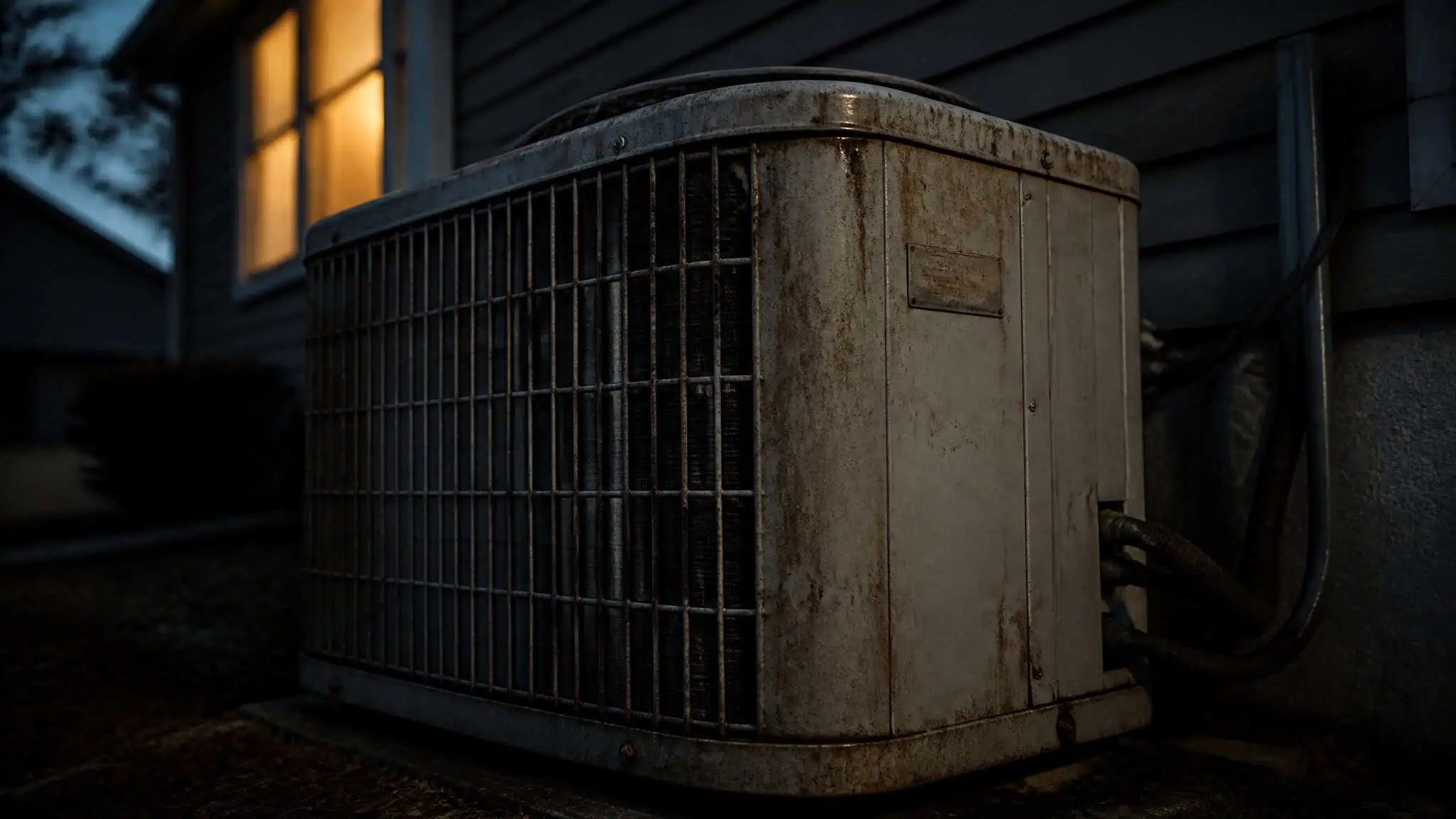
There’s a moment when you realize your AC has turned on you. Maybe it’s the warm air drifting from a vent in the hallway while the rest of the house holds. Or the electric bill that’s suddenly $80 higher than last July for no reason you can name. Or the noise, that new metallic chatter when the compressor kicks in, the kind that makes you pause mid-step and listen.
Most of us ignore it. We figure the unit’s old, it’s been a hot summer, what are you gonna do. But air conditioners rarely fail without warning. They send signals for weeks or months before they quit. You just have to know what to look for.
Here’s the context that matters: a typical central AC unit lasts 10 to 15 years, depending on how well it’s maintained and how hard it’s worked. Some stretch to 20. If yours is in that range, you should be watching for signs, not hoping it’ll hold on forever. And the earlier you catch a problem, the cheaper it is to fix, and the more likely you are to fix it instead of replace the whole system.
Key Takeaways
Most central air conditioners last 10-15 years; if yours is in that range, treat every new symptom as a red flag, not a nuisance.
Use the 5,000 rule: multiply your AC’s age by the estimated repair cost. Over $5,000 means replacement is usually the smarter call, a $600 repair on a 10-year-old unit yields 10 × 600 = $6,000, pointing to replacement.
If you smell burning or chemicals from the vents, that’s not a “call someone tomorrow” problem. That’s a “call someone right now” problem.
Table of Contents
Age is the elephant in the room
Before you diagnose anything else, do the math on how old your system is. Most central ACs run 10 to 15 years, and some push to 20 if they’ve been treated well. An older unit isn’t just closer to dying, it’s also less efficient than today’s models, which means it’s costing you more every month it keeps running.
Here’s the rule of thumb that makes the repair-or-replace call easier. It comes from HVAC techs who’ve seen thousands of units, and it’s simple enough to do on a napkin:
Multiply your AC’s age by the estimated repair cost. If the result exceeds $5,000, replacement typically makes more sense.
Run the numbers on a $600 repair. On a 3-year-old unit, that’s 3 × 600 = $1,800. Fix it. On a 10-year-old unit, it’s 10 × 600 = $6,000.
Replace it. The math changes because an aging system is more likely to need another repair in a year or two, you’re not fixing a problem, you’re postponing the next one.
This isn’t a universal law. It’s a rule of thumb, and there are always exceptions. But it’s a hell of a lot better than guessing.
When repairs become a pattern
One repair in a season is normal. Equipment fails, parts wear out, it happens. But if you’re calling a technician multiple times in one summer, or you’re looking at a second or third year of annual service calls, something deeper is wrong.
Think of it this way: each repair is a vote on the system’s health. One vote against doesn’t mean much. A string of them means the unit is telling you it’s done.
The pattern that matters most is when the big-ticket components start failing. A compressor or a coil replacement is often so expensive that it rivals the cost of a new unit. If a tech tells you the compressor is shot and the system is 12 years old, you’re not looking at a repair. You’re looking at a decision.
A useful guideline: more than one repair a year is a warning sign. And the cost of those repairs adds up fast. Regular maintenance can cut repair frequency in half and extend the system’s life, but no amount of maintenance keeps a worn-out unit running forever. At a certain point, you’re throwing good money at a bad system.
The comfort check: when your house never feels right
If your AC runs constantly but rooms stay warm, or certain parts of the house never cool down, that’s your system telling you it’s losing its ability to do the job. Cooling capacity drops as units age, especially when maintenance has been spotty, so what used to feel comfortable gradually stops cutting it.
Warm air from the vents is the most obvious red flag. It could be something as simple as a clogged filter, or something as serious as a failing compressor or a refrigerant leak. Check the thermostat first, rule that out in thirty seconds, then call a pro.
Weak or inconsistent airflow usually points to a dirty filter, which is an easy fix. If you swap the filter and nothing improves, the issue might be a failing blower motor, a collapsed duct, or an undersized system for your house to begin with, in cases like that, professional AC repair in Phoenix, AZ is the next logical step.
Uneven cooling, hot spots near windows, cold drafts in odd places, rooms that never drop below 80, points to duct issues, an undersized system, or an aging unit losing capacity. Newer variable-speed systems can handle this better than older single-speed units, which is worth knowing if you’re weighing a replacement.
Excess humidity is another tell. Your AC is supposed to pull moisture out of the air. If the house feels sticky, or surfaces feel damp, the system isn’t dehumidifying properly, which often goes hand in hand with an AC not cooling enough issue. That could mean low refrigerant, a broken or frozen coil, or a system that’s simply too old to keep up.
Speaking of frozen: ice on the unit or the indoor coils means something’s wrong, usually restricted airflow, dirty filters, or low refrigerant. Turning off the AC and running just the fan can thaw light ice in an hour or two, but that’s a temporary fix. It’ll come back until the underlying problem is found.
Noises: what your AC is trying to tell you
Every AC makes some noise. The hum of the compressor, the whoosh of air through ducts, that’s normal. What you’re listening for is the noise that doesn’t belong: hard starting, humming, or a unit that runs without cooling, all key AC capacitor failure symptoms that signal a mechanical problem, not a quirk.
Here’s the quick decoder:
- Clanking or banging, a loose or broken part inside the compressor. This is the one that means real trouble.
- Buzzing, electrical issues, or debris sitting around the outdoor unit. Check for leaves and sticks first, then call a pro if it persists.
- Squealing or screeching, fan belt problems, or motor bearings that need lubrication. Fixable, but don’t let it ride.
- Repetitive clicking, the startup click is normal, but a repeating click points to thermostat or electrical connection issues.
- Loud banging, rattling, or hissing, mechanical failure. Damaged blower motor, loose parts, failing compressor. This is the “turn it off and call someone” category.
- Grinding, a worn belt or bearing, and it’s not going to fix itself.
If a noise is new, it’s worth investigating. The urgent ones are the banging, grinding, and hissing, those mean something is physically coming apart. The others, like AC making strange noises, can wait a day or two, but not a month.
Smells: when the air itself is a warning
Your nose is a diagnostic tool. Different smells point to different problems, and some of them are safety issues, not maintenance issues.
- Musty odor, mold or mildew. Usually moisture trapped in the ductwork or a dirty evaporator coil. In humid climates, this is a real concern, mold builds up inside AC components faster than you’d think.
- Burning smell, burnt wire or insulation. This is urgent. Shut the system down and call someone now, not tomorrow.
- Chemical smell, refrigerant leak. Also urgent. You don’t want to be breathing refrigerant, and it means the system’s charge is dropping.
- Fishy smell, electrical problem. Same urgency as burning. Something in the wiring is overheating.
- Sour smell, stagnant water or a clogged drain line. Annoying, but usually fixable.
The general rule: musty and sour mean “schedule a service call.” Burning, chemical, and fishy mean “turn it off and call now.”
What you can see without opening anything
You don’t need to tear your system apart to spot problems. A five-minute walk around the indoor and outdoor units tells you a lot. Run through this list a couple times a summer:
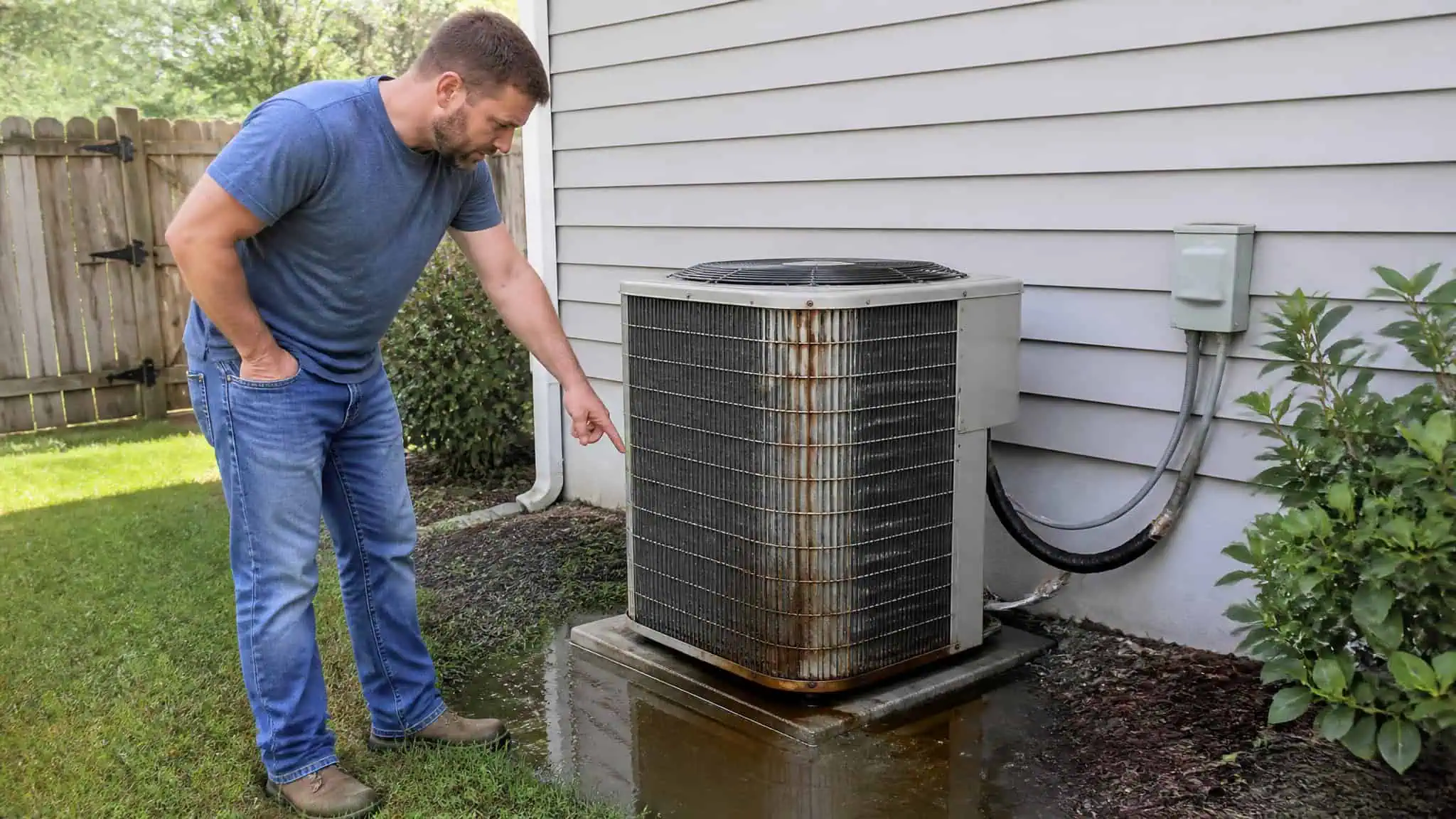
- Puddles or moisture around the indoor unit, might stem from a refrigerant leak or a clogged condensate drain.
- Ice buildup on the outdoor unit or indoor coils, restricted airflow, dirty filters, or low refrigerant.
- Rust on the evaporator coil or electrical components, this can weaken the coil, cause refrigerant leaks, and lead to compressor burnout down the road.
- Damaged wires, exposed or frayed wiring is a safety concern, not just a performance issue.
- Sagging insulation on the refrigerant lines, could indicate a leak, wear, or improper installation.
- Dirty or clogged vents, blockages affecting airflow and indoor air quality.
None of this requires a toolbox. It requires walking outside once a month and looking at the unit while you’re already out there getting the mail.
Your electric bill is a diagnostic tool
You already own a monitoring system for your AC. It arrives in the mail every month.
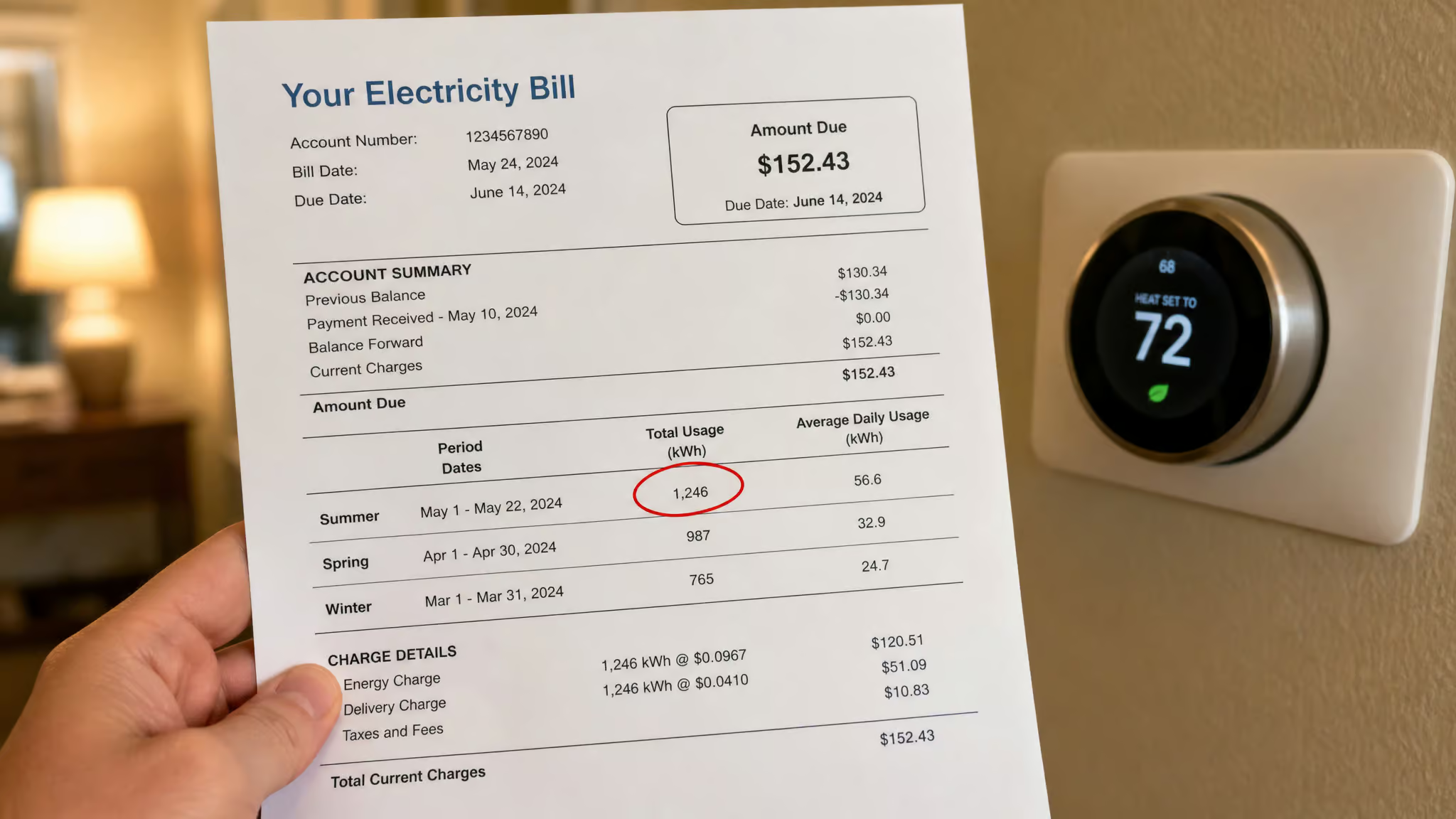
The pattern of your energy bills tells you how hard your system is working. A sudden spike with no change in how you use power means something is wrong, usually a refrigerant leak, a failing compressor, or another malfunction that’s forcing the system to work overtime. A gradual month-over-month creep means the system is losing efficiency, which happens naturally with age, dirt buildup, and worn components, and those hidden inefficiencies are exactly what drive the AC high energy bills that signal your system is working harder than it should.
The practical check is to compare this summer’s bill to last summer’s. Same weather roughly, same usage habits, if this year’s number is significantly higher, your AC is the reason. Newer systems with higher SEER2 ratings use less power, which is one of the arguments for replacing an old unit before it dies completely.
Check the thermostat before you panic
Before you call a technician, spend two minutes ruling out the cheapest possible cause. A thermostat problem can mimic a failing AC almost perfectly, inconsistent temperatures, short cycling, no cooling at all. Checking the thermostat first can save you from unnecessary, expensive AC repairs.
- If the screen is blank, try new batteries first.
- If the thermostat is near a heat source or in direct sunlight, it’s reading the wrong temperature and running the system accordingly.
- If it’s an older unit, dust buildup on the contacts can cause erratic behavior.
- If it’s a smart thermostat, check for software updates and Wi-Fi connectivity, a lost connection can mess up scheduling and responsiveness.
- If the temperature sensor is faulty, the system will run off inaccurate readings.
None of these are hard fixes. They’re also a lot cheaper than a service call. And if you’ve checked all of them and the problem persists, you’ve ruled out the easy stuff, which means the issue is in the AC itself, and you’ll have a better conversation with whoever you call.
The fix-it-or-pitch-it call
This is where it all comes together. You’ve identified the problem, you have a repair estimate, and you need to decide: fix it or replace it.
Start with the 5,000 rule. Age times repair cost. Over $5,000 says replace. That’s the headline.
Then factor in these:
Age. If the system is near or past 15 years old, replacement is usually the better investment. You’re not going to get another decade out of it, and every repair is just buying time.
Repair cost. If the estimate is very high, especially for major components like the compressor or coils, replacing usually makes more financial sense. A $2,000 repair on a high-mileage unit is a bad bet.
Refrigerant type. This one is important. If your system uses R-22, commonly called Freon, you need to know: R-22 was phased out, is no longer produced in the US, and is now extremely expensive and hard to find. A refrigerant leak in an R-22 system might cost nearly as much as a new unit, and even if you pay it, you’d still be running a system that uses obsolete refrigerant. If your AC runs on R-22, replacement is often the smarter call even if the unit isn’t dead yet.
Efficiency. Today’s high-SEER2 units use significantly less power. The upgrade won’t pay for itself overnight, but it does change the long-term math.
One thing worth noting: in most cases, repairing is the more cost-effective and eco-friendly choice. Don’t let anyone talk you into a replacement you don’t need. The 5,000 rule is your guardrail against both fear-mongering and false economy.
When to stop troubleshooting and call a pro
Some symptoms are DIY-adjacent. Dirty filters, thermostat batteries, clearing debris off the outdoor unit, fine, do that yourself. Anything beyond that is technician territory.
Call a professional if you hear grinding, squealing, or buzzing sounds. Call if you see moisture, leaks, or ice. Call if you have poor airflow, uneven cooling, or a sudden jump in your energy bills. Call if the thermostat won’t cooperate after basic checks.
And if you’re seeing multiple signs at once, say, warm air plus a weird noise plus a climbing bill, that’s not coincidence. The system may be close to a full breakdown.
Don’t get ambitious with DIY repairs on complex systems. Electricity and refrigerant can cause serious problems, shock, leaks, further damage to the unit, or worse. This isn’t a lecture about safety. It’s a practical warning: messing with the wrong part can turn a $400 fix into a $4,000 replacement.
When you do call, vet the company. Ask if they’re licensed and insured. Ask how many years of experience their techs have. Ask if they’re certified to handle refrigerants.
Ask if their work is warrantied. Ask for a written estimate. Get a second quote if the first one feels high. A reputable company won’t balk at any of these questions.
Maintenance is cheap insurance
Here’s the thing about AC maintenance: it’s the rare home expense that actually pays for itself. Regular preventive maintenance can cut your repairs in half and extend the system’s lifespan. That’s not a sales pitch from a company trying to sell you a service plan. It’s the basic physics of mechanical equipment, things that are cleaned, lubricated, and checked fail less often. Even a homeowner with no technical background, like Joe Strada, who started working at 14 and never attended college, can benefit from understanding these basics.
A typical maintenance visit includes cleaning the coils and filters, checking refrigerant levels, checking for leaks, securing electrical connections, verifying the thermostat and controls, checking the ductwork, and lubricating moving parts. It usually takes an hour.
Between visits, you can do a few things yourself. Check that the thermostat is set correctly. Make sure the circuit breaker hasn’t tripped. Swap the air filter on schedule, this one alone prevents a surprising number of problems. Clear leaves and debris off the outdoor unit. Keep the condenser coil clean.
None of this is complicated. It’s the kind of thing you do because you know it’s cheaper than the alternative. An hour of maintenance a year beats an emergency repair call in August every time.
Your AC is going to fail eventually. The question is whether it fails on your terms, with warning signs you catch early and fix cheap, or whether it quits in the middle of a heat wave and forces you into an expensive, rushed decision. The signs are all there. You just have to pay attention.
Frequently Asked Questions
What do the symbols on my AC mean?
AC symbols vary by brand, but common ones include snowflake for cool mode, sun for heat, fan for fan-only, and a droplet for dry/dehumidify mode. Some units also have symbols for auto mode, sleep mode, and turbo. Check your manual or look for a legend on the remote or unit itself.
How can I tell if my AC is making me sick?
If you’re experiencing allergy-like symptoms, headaches, or fatigue at home, your AC could be circulating mold, dust, or other allergens. A musty smell from the vents or visible mold around the unit are red flags. Dirty filters and clogged drain lines are common culprits, so start by checking those.
How can you tell if your AC is going bad?
Watch for weak airflow, warm air from vents, unusual noises like grinding or banging, strange smells (burning, chemical, fishy), ice on the coils, or a sudden spike in your electric bill. If your unit is over 10-15 years old and showing these signs, it’s likely nearing the end of its life.
Why does my AC smell like burning or chemicals?
A burning smell usually means a burnt wire or insulation, while a chemical smell often indicates a refrigerant leak. Both are urgent safety issues. Shut the system down immediately and call a professional—don’t wait until tomorrow. These problems can pose health risks and cause further damage if ignored.
Is it worth replacing an old AC before it breaks down completely?
Yes, especially if your system is over 15 years old, uses R-22 refrigerant, or has a major repair estimate. Newer high-SEER2 units use significantly less power, which can offset the upfront cost over time. Replacing on your own terms also avoids the rush and higher costs of an emergency breakdown in a heat wave.