AC Not Cooling Enough? Here’s What to Check (and What to Leave for a Pro)
It’s the hottest day of the year. The thermostat reads 78, you’ve got it set to 72, and the AC has been running for three hours straight. The house is still warm. You stand over a vent, feel the air, it’s moving, but it’s not cold. Now the dread sets in: Is this a $20 fix or a $4,000 mistake?
I’ve been there. Most guys have. The good news is that an AC running but not cooling is usually one of a handful of problems, and several of them are things you can check yourself in about five minutes for free. The trick is knowing which ones are yours to fix and which ones are going to require a licensed technician.
Here’s the honest breakdown of why your AC isn’t cooling, what’s safe to DIY, and when to stop playing hero and call a professional.
Key Takeaways
A dirty air filter is the #1 cause of an AC running but not cooling, check it and replace it before doing anything else, and repeat every 30-90 days depending on your system and household.
A frozen evaporator coil or low refrigerant means there’s a leak, refrigerant doesn’t disappear, so a “top-off” isn’t a fix, and running the system can cause compressor slugging that damages it beyond repair (this is a licensed tech job, not DIY).
A simple 5-minute power reset (thermostat off, breaker off, wait, restore) can fix glitches after a power surge, and it’s worth doing before you call for service.
Table of Contents
Why Is Your AC Not Cooling Enough? Start With Your Air Filter and Airflow
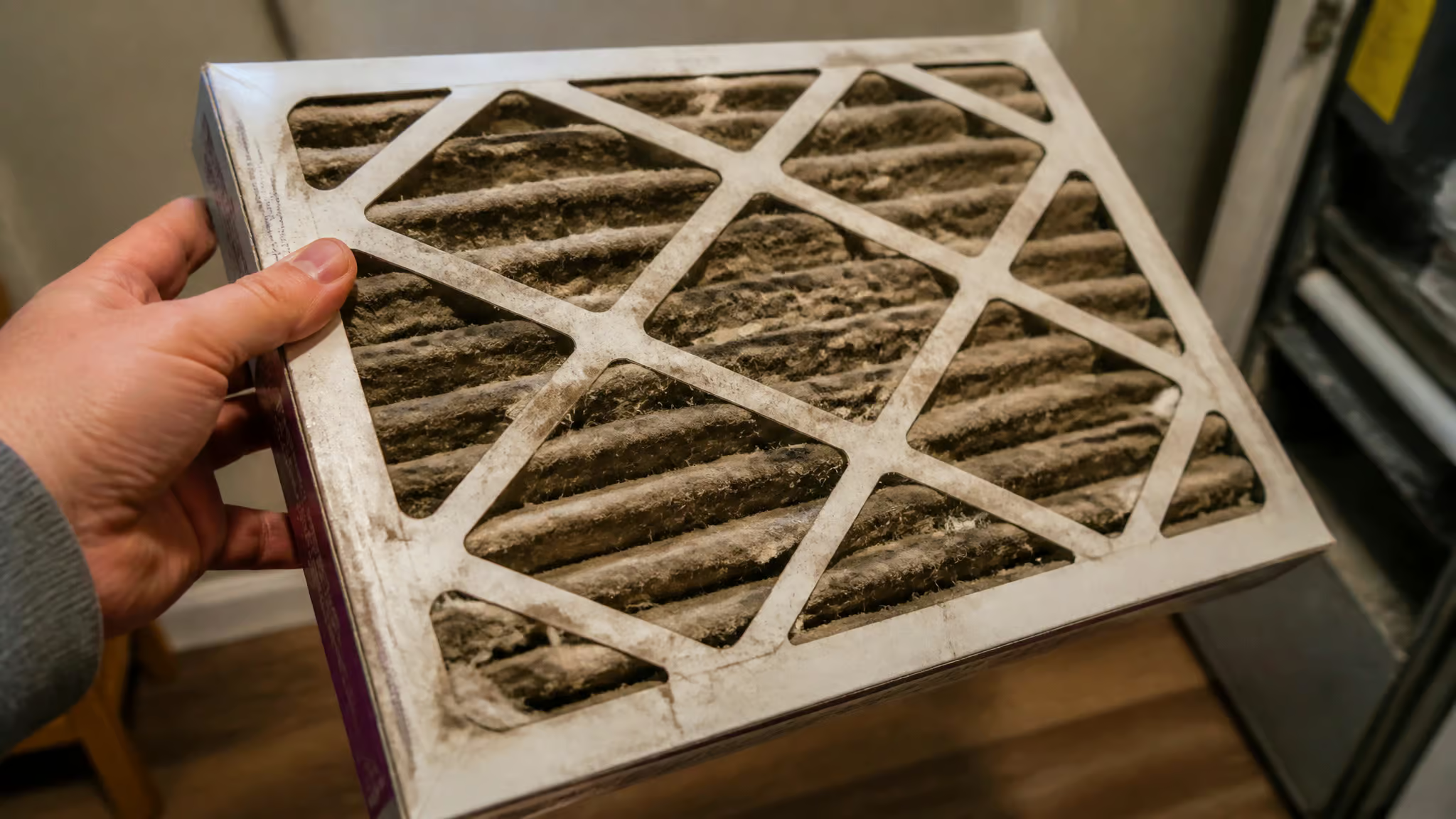
Can a dirty condenser coil cause your AC to run but not cool? Yes, and so can a dirty air filter. In fact, here’s your first and most likely culprit: a clogged filter. Think about what the filter does.
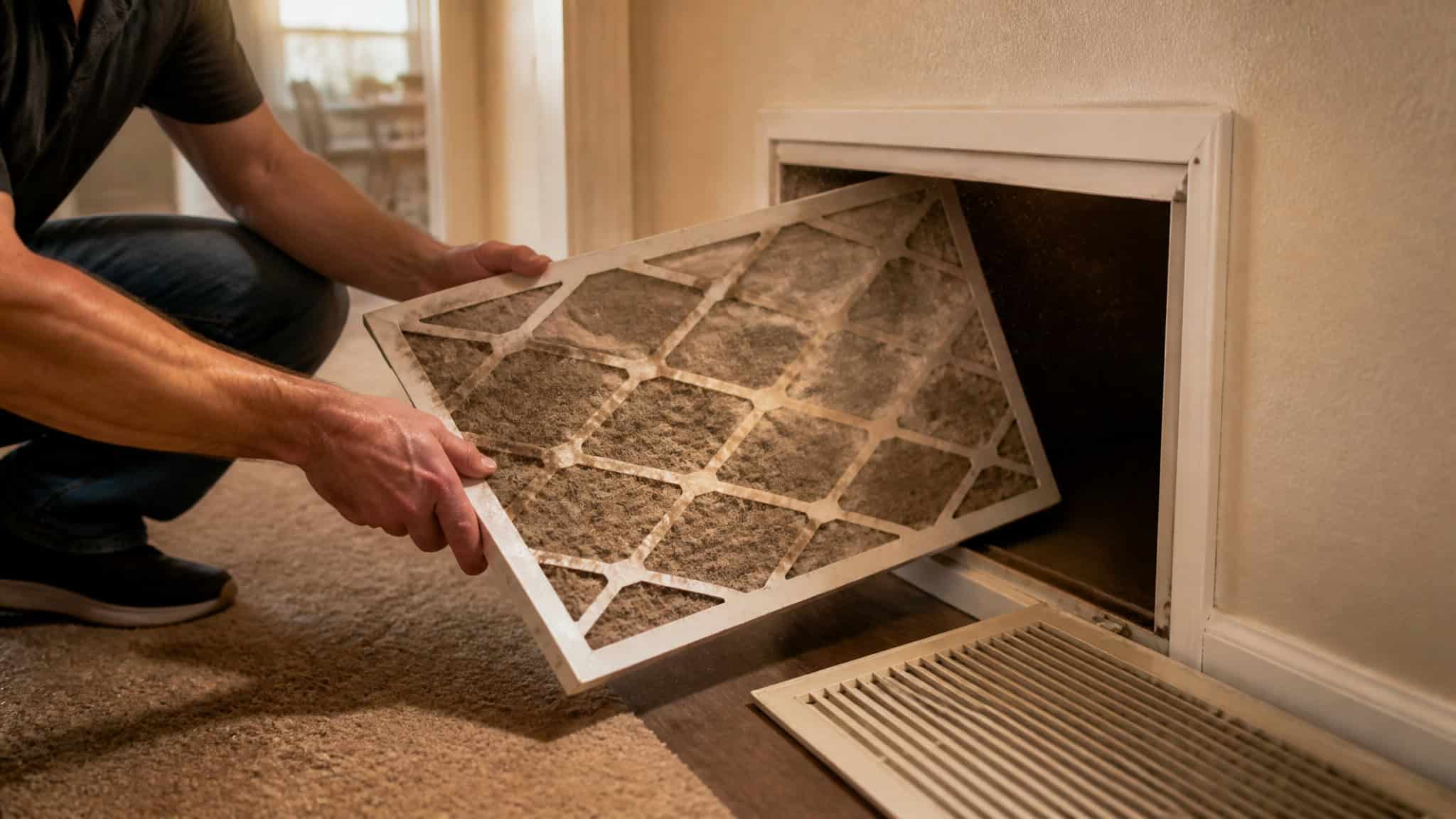
It’s the thing standing between your system’s guts and every piece of dust, pet hair, and pollen floating around your house. When it gets clogged, it’s like trying to breathe through a straw. The system works harder, efficiency drops, and you get warm air.
Most homeowners check everything else before they check the filter. That’s backwards. If your AC is running but not cooling, the filter is where you start.
The dirty filter problem
The typical scenario goes like this: You’ve been meaning to change the filter for months. The dog sheds, the dust piles up, and somewhere in the back of your mind you know it’s due. Then one day, the AC just stops keeping up. Weak airflow, warm air, the whole house feels stuffy.
The fix is embarrassingly simple. If the filter looks dirty, change it. If you can’t remember the last time you changed it, change it. Most systems need a new one every 30 to 90 days, depending on how much junk is in your air and how often the system runs. A clean filter isn’t just about airflow, it’s about preventing ice from forming on the coil and avoiding extra strain on every component downstream.
Dirty condenser coils and ductwork leaks
The outdoor unit has one job: dump the heat your AC pulled out of your home. It does this through the condenser coils. When those coils are caked with grass clippings, leaves, and road grime, the system can’t shed heat. It overheats.
It struggles. You get warm air inside while the unit outside works itself into an early grave.
Here’s the DIY fix: take a garden hose and spray the outside unit on a gentle setting. That’s it. Just enough to clear the crud from the fins. What you don’t want to do is blast it with a pressure washer, high pressure will bend the fins, and bent fins on a condenser are a real problem.
While you’re out there, clear away any weeds, branches, or debris crowding the unit. Give it some breathing room.
The silent cousin to this issue is ductwork leaks. Cool air escaping into the attic or behind walls instead of reaching your living spaces is exactly the kind of problem that’s hard to spot and even harder to fix yourself. Finding duct leaks takes specialized tools and experience, so if you suspect that’s your issue, that’s one to hand off to a professional.
Refrigerant Leaks and Frozen Coils. When the AC Can’t Cool Because It Can’t Absorb Heat
Here’s where we move from DIY territory into “call a pro” territory. If your AC is freezing up and not cooling, let me put it plainly: a frozen coil is a symptom, not the root cause. It means either your system doesn’t have enough airflow (dirty filter, you can fix that) or it doesn’t have enough refrigerant (leak, you can’t fix that).
And here’s what most people get wrong: low refrigerant is never a “top it off” situation. Refrigerant doesn’t disappear. If it’s low, there’s a hole somewhere, and that hole needs to be found and sealed.
The refrigerant leak problem
The tell-tale pattern is unmistakable. The AC blows warm air. The outdoor unit runs constantly, trying to keep up. But no matter how long it runs, the house stays warm. If you keep the system running in this state hoping it’ll catch up, you’re making a costly mistake.
Here’s what happens: refrigerant is the substance that actually pulls heat out of your air. No refrigerant, no cooling. And running the AC with a leak can cause something called slugging in the compressor, liquid refrigerant finding its way into a part that’s only designed to handle gas. Slugging can damage the compressor beyond repair. That’s not a “call a pro” situation; that’s a “you may need a whole new outdoor unit” situation.
Finding and fixing the leak, then recharging the system, is something only a certified technician can do legally. It’s not a skill issue; it’s a licensing issue. Refrigerant handling is regulated, and for good reason. Your job here is to recognize the signs early, shut the system down, and make the call.
Frozen evaporator coil: a sign of a bigger problem
Inside your system, the evaporator coil is where the magic happens, it pulls heat and humidity out of the air. When ice forms on that coil, it acts like insulation. The coil can’t absorb heat, so warm air circulates through your house, and the ice just keeps building.
You’ll know it’s frozen if you see frost on the copper tubing running from the outdoor unit, or if the system is blowing warm air and there’s excessive condensate draining. Frozen coils come down to two root causes: not enough airflow (the dirty filter we already covered) or not enough refrigerant (the leak we just talked about). Both are fixable, but only one is a DIY fix.
Getting to the evaporator coil means digging into the heart of the system. That’s not a weekend project. If your coil is frozen, turn the system off immediately and call a professional. Running it while frozen can cause severe damage to the compressor.
Thermostat Settings and Electrical Checks. The Simple Fixes You Might Be Missing
Before you go down the rabbit hole of expensive repairs, let’s cover the dumb stuff. It sounds too simple, but it’s often the actual problem: make sure your thermostat is set to “cool,” not “fan” or “heat.”
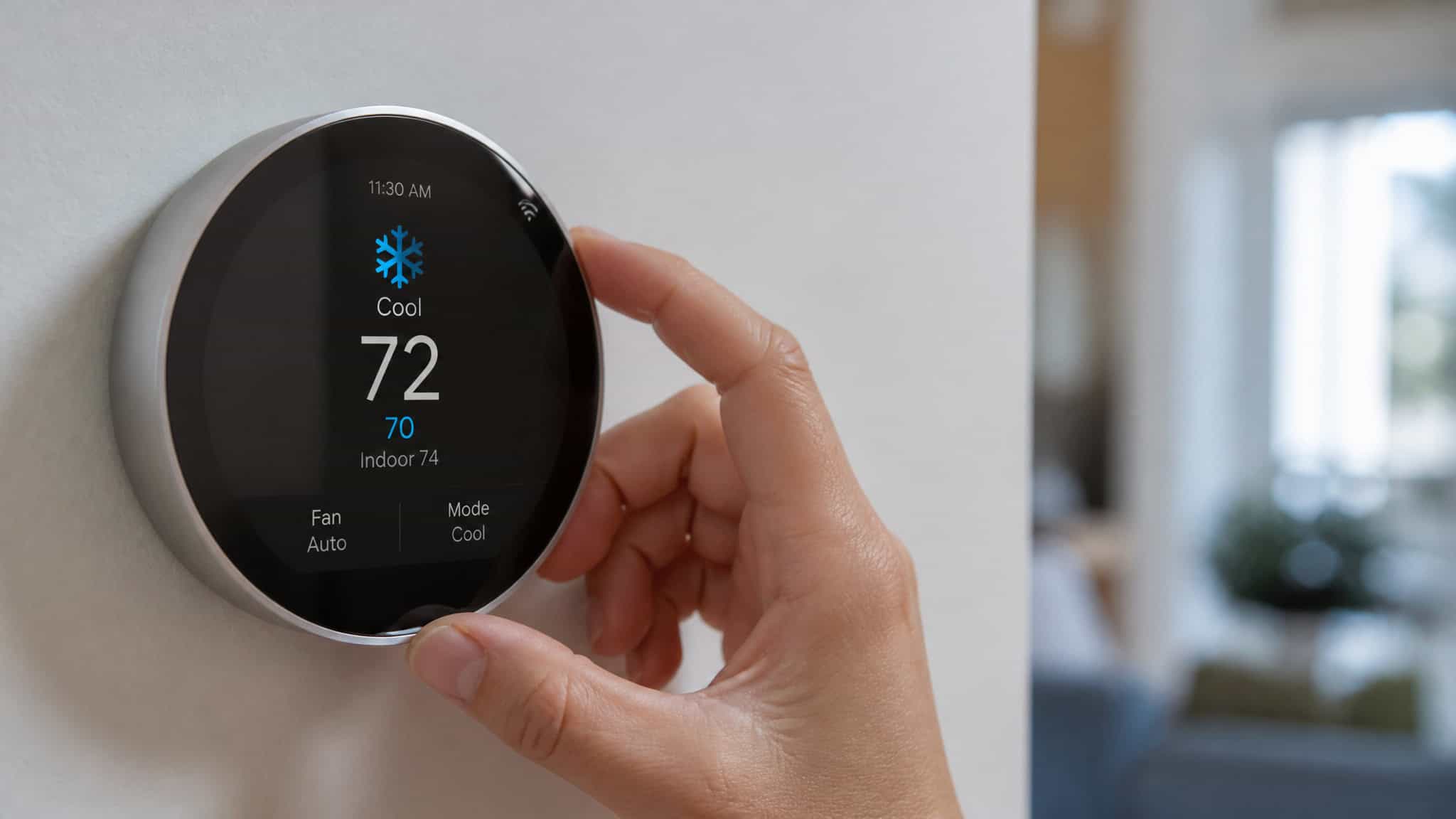
I’ve seen it happen more times than I can count. Someone bumps the thermostat, or a family member changes the setting, and suddenly the AC is running but the house is warm. It’s not broken. It’s just set wrong.
Why the thermostat fan setting matters
Here’s a detail most people miss: the fan setting. If your thermostat is set to “ON,” the blower runs 24/7, even when the cooling cycle isn’t active. You feel air moving, so you assume the AC is working. Meanwhile, the air is just recirculating, not cooling, which is why a cooling mist fan can create an indoor summer breeze instead of just moving warm air around. That’s why it feels like the system never stops running and never gets the house comfortable.
Set the fan to “AUTO.” That way, the blower runs only during cooling cycles. You’ll get cold air when you need it and you’ll stop wasting energy.
Thermostat issues are also frequently battery-related or configuration-related, not hardware failures. If the display is dead, it’s almost certainly the batteries. Swap them out. If the thermostat is reading the room temperature wrong, try recalibrating it.
Replacing an old, flaky thermostat with a smart model is a reasonable upgrade if the settings check out but the unit is still misbehaving. But don’t jump to replacement until you’ve confirmed it’s actually the thermostat and not something downstream.
Capacitor failure and how to reset your system
What are the signs that your AC capacitor is bad and needs replacement? The classic signs are a clicking sound, a humming noise from the outdoor unit, or a system that won’t start at all. These are among the most common early AC warning signs that a comprehensive guide covers, helping homeowners catch problems before they escalate. Capacitors are the parts that give the motors their initial kick to start and then keep them running. When they fail, things get weird, and the weirdness is usually electrical.
Capacitor replacement is not a DIY repair. You’re dealing with stored electricity, and a capacitor can hold a dangerous charge even when the power is off. This is a job for a licensed HVAC technician.
But before you call, there’s one check that might save you the service call: the circuit breaker. After a power surge, the breaker for your AC can trip without you noticing. Here’s the reset procedure that fixes more problems than you’d think:
- Turn the thermostat to “off.”
- Switch off the breaker for your AC unit. This kills power to the system.
- Wait at least 5 minutes. This lets the system reset properly.
- Switch the breaker back on.
- Turn the thermostat back to “cool” and see if cold air starts flowing.
If you’ve got power and the capacitor checks out, a simple reset can clear a glitch and get you back to cold air in minutes. If the reset doesn’t help, you’ve got a bigger issue, and that’s your cue to call a pro.
Is Your AC Undersized or Facing a Major Component Failure?
Is it normal for an AC to run constantly without cooling the house? No, full stop. If your system runs nonstop and the temperature never drops, either the unit is undersized for your space, or a major component is failing, which might also explain AC making strange noises. Neither one is a simple fix, and both need professional assessment. But understanding which one you’re dealing with helps you know what to expect.
What an undersized AC looks like in practice
An undersized unit is one that’s too small for the square footage it’s trying to cool, especially when outdoor temperatures rise. The behavior is always the same: the AC runs constantly but never catches up. On the hottest days, it’s a losing battle.
This is a design problem, not a repair problem. An oversized unit has its own issues, it short cycles and wastes energy, but an undersized unit just runs itself ragged. More wear, higher utility bills, shorter lifespan, all for a system that can’t do the job. The only real solution is to have a professional do a load calculation to determine the correct size for your home. Guessing is how you end up with the wrong unit in the first place.
Compressor and fan motor failure
The compressor is the heart of your AC system. It circulates refrigerant between the inside and outside units. If the compressor is damaged, the system can’t cool, period. And here’s the tough truth: when the compressor fails, you’re often looking at replacing the entire outdoor unit rather than just the compressor. It’s the most expensive scenario in air conditioning.
The outdoor fan motor is a slightly less catastrophic failure. Its job is to pull air through the condenser coils so the system can dissipate heat. If the fan dies, the condenser can’t dump heat, the system overheats, and your cooling performance tanks. A failed fan motor means no cooling, just like a failed compressor, but the repair is more straightforward.
One important note: heat pumps operate like AC condensers in cooling mode. That means they face all the same issues, dirty coils, frozen coils, refrigerant leaks, compressor problems. If you have a heat pump, everything in this article applies to you.
Your DIY Troubleshooting Checklist Before Calling a Pro
What are the most common reasons an air conditioner runs but doesn’t cool the house? It’s a short list: a dirty air filter, a thermostat set incorrectly, dirty condenser coils, low refrigerant, or a failing capacitor. Here’s the order to work through them, and everything on this side of the list is something you can safely do yourself. If the problem isn’t on this list, AC smells bad, musty, burning, or like rotten eggs, points to a separate issue you’ll want to address before troubleshooting cooling further.
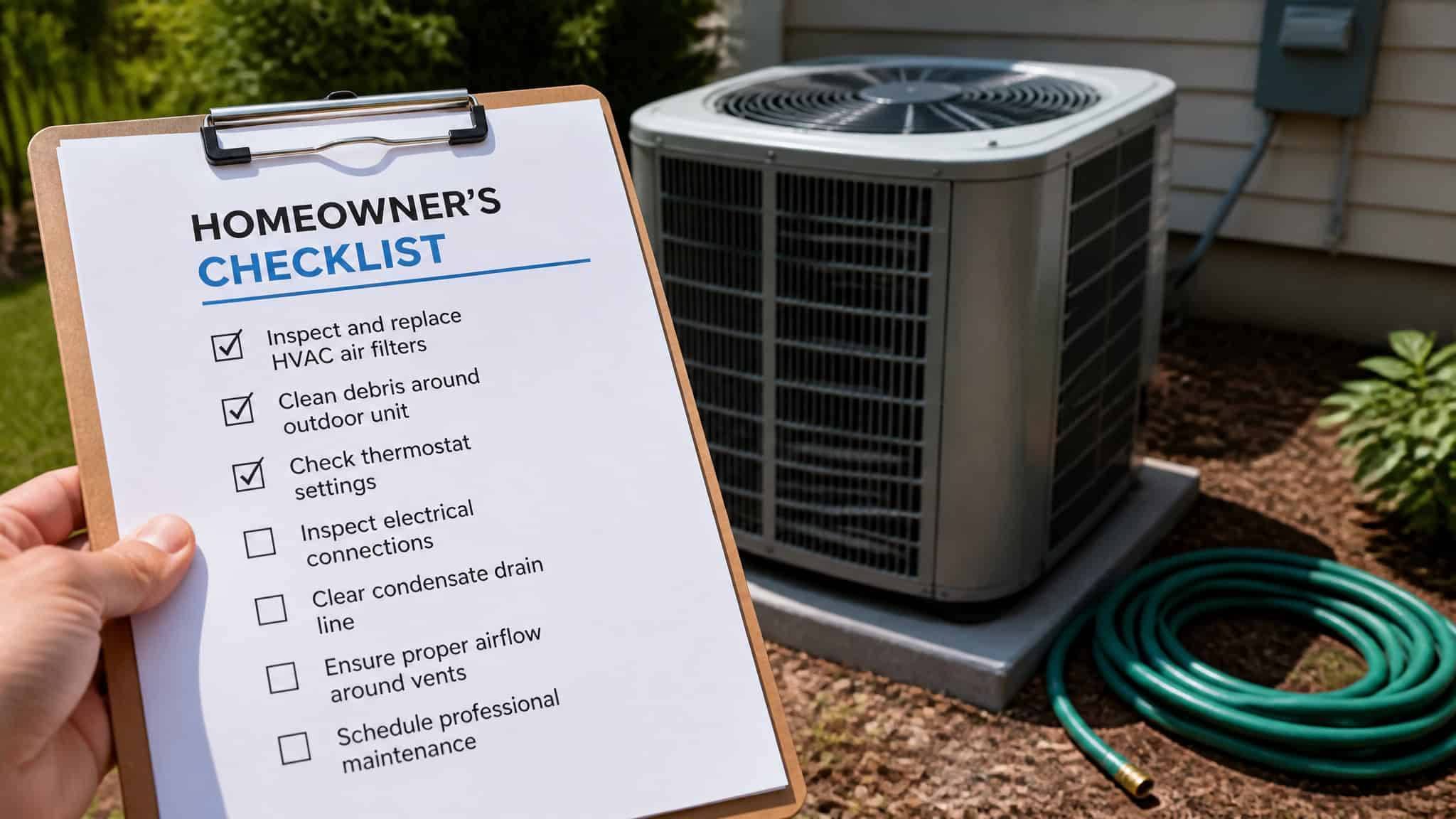
The checklist before you call for service
- Check thermostat settings: Make sure it’s set to “cool,” not “fan” or “heat.” Confirm the fan is on “AUTO,” not “ON.”
- Check the circuit breaker: A power surge may have tripped the breaker. If it tripped, reset it.
- Check the air filter: If it’s dirty or clogged, replace it. This is the most common cause, and the cheapest to fix.
- Clear away debris: Remove leaves, branches, or grass blocking the outdoor condenser unit.
- Gently hose off the outdoor unit: A light rinse clears dirt from the coil. Never high pressure, you’ll bend the fins.
- Ensure vents are open: Check that furniture, rugs, or curtains aren’t blocking airflow from your registers.
- Perform the 5-minute reset: Thermostat off, breaker off, wait 5 minutes, restore power, thermostat back to “cool.”
Work through this list in order. If none of these steps resolve the problem, the issue likely requires a professional, and at least you’ll know it’s not something simple.
Signs your AC needs attention
Beyond the not-cooling issue, there are warning signs you should never ignore:
- Warm air blowing from vents
- Weak airflow
- Unusual noises, buzzing, rattling, grinding
- Water leaks around the unit
- Frequent cycling on and off
- A sudden spike in your energy bill
These are early warnings. Ignoring them leads to more expensive repairs, especially in a hot climate where your system runs constantly. If you notice water leaking around your AC, it can mean a clogged drain or a frozen coil, and either way, it needs to be checked. And if the system is cycling constantly, it’s working too hard, and that’s a sign of trouble.
Maintenance Frequency: Why Annual Isn’t Always Enough in Hot Climates
Is it worth repairing an old AC unit that isn’t cooling, or should you replace it? The deciding criteria are the unit’s age, how often it needs repairs, and whether the compressor has failed. If your system is over 10 years old, needs frequent repairs, or has a failed compressor, replacement is often the more cost-effective long-term move.
When to repair vs. replace your AC
Air conditioners typically last 8 to 20 years, with most falling somewhere in the 10 to 15 year range if they’re maintained. After that, efficiency drops and repair costs start to outweigh the benefits. If a repair quote is substantial and your unit is already in that age range, you’re throwing money at a system that’s past its prime.
The biggest line item is the compressor. Replacing a compressor is often so expensive that replacing the entire outdoor unit makes more sense, unless the unit is still under warranty. When you add up the repair costs and the efficiency losses of an aging system, a new unit frequently comes out ahead.
There’s also the upgrade angle. Upgrading your heating and cooling system is one of the most effective ways to cut utility bills. Efficient heat pumps, in particular, can reduce the amount of energy a home needs overall. If you’re in the market for a new system and you’re in a position to pair it with solar, that combo can cut costs even further.
As for maintenance frequency: once a year is the standard baseline, but it’s not a rule. In hot climates where the system runs near nonstop, annual service may not be enough. More runtime means more wear, that’s just how it works. If you’re running your AC constantly from May through September, step up to twice-yearly tune-ups. A little preventive maintenance beats a breakdown in August.
The Bottom Line: When to DIY and When to Call a Pro
Why is your AC blowing warm air while the outside unit is running? It usually comes down to three possibilities: the condenser can’t dump heat (dirty coils or a bad fan motor), the refrigerant is low, or the thermostat is misconfigured. Here’s how to sort through them.
Start with what you can control: check the thermostat, check the air filter. Spray down the condenser coil with a garden hose.
Make sure the breaker wasn’t tripped. Perform the 5-minute reset. These are free, safe, and they resolve a surprising percentage of “AC not cooling” problems.
If you’ve done all of that and the system still blows warm air, you’re in professional territory. Refrigerant leaks, electrical issues, capacitor problems, compressor failure, and ductwork leaks all require a licensed technician. This isn’t about skill; it’s about safety and legality. Refrigerant handling is regulated, and electrical work can kill you.
And here’s the most important piece of advice in this entire article: if your AC isn’t cooling, turn it off. Running a malfunctioning system strains the compressor, the single most expensive part to replace. If you have a frozen coil or a refrigerant leak, running the system can cause severe damage. It won’t fix itself. Turn it off and make the call.
Why cooling isn’t optional
Here’s the reality: this isn’t just about comfort anymore. California summers are getting hotter, the average summer temperature is up about 3 degrees Fahrenheit since 1896, with another 2 degrees possible by 2040. Southern California heatwaves are getting more humid, which means warmer nights. And humidity makes it harder for your body to cool down. It’s not just about the temperature; it’s about the combination of heat and moisture.
Hot nights mean your body doesn’t get a break. That’s when heat becomes dangerous. And if you’re thinking fans will help, know this: fans don’t actually cool the air. In extreme heat, they can even make things worse.
Los Angeles County has recognized this reality. Starting January 1, 2027, landlords in unincorporated LA County must provide cooling capable of keeping rentals at or below 82 degrees. That makes cooling a housing standard, alongside heating and hot water. If you live in incorporated cities like Los Angeles, Santa Monica, Pasadena, Inglewood, or Glendale, this specific rule doesn’t apply to you, but it signals where things are heading.
Landlords can try passive cooling first, like insulation, shades, and fans, before they have to install mechanical cooling. Enforcement is complaint-driven, so renters can report non-compliance.
The bottom line is simple. Most AC-not-cooling situations are either something you can fix in minutes for free, or a clear sign that it’s time to call a professional. The key is knowing which one you’re dealing with.
Work through the checklist, change the filter, hose down the condenser, reset the system. If that doesn’t do it, shut it down and call a licensed tech. There’s no shame in knowing your limits, that’s what separates a guy who’s smart about his house from a guy who turns a $200 repair into a $4,000 replacement. And if you’re in Dallas, a quick search for local HVAC pros gets you someone who can handle it fast.
Being able to handle what you can, knowing when to stop, and having the sense to call a pro when the job is beyond you, that’s the whole game.
Frequently Asked Questions
Why won’t my AC get colder than 72?
If your AC won’t get colder than 72, it’s usually because the system is struggling to keep up due to a dirty air filter, dirty condenser coils, low refrigerant, or an undersized unit. Check the filter and clean the outdoor unit first—these are the most common DIY fixes. If the system still can’t cool below 72, especially on a hot day, you may have a refrigerant leak or an undersized system, which requires a professional.
How can I increase my AC cooling?
Start by replacing a dirty air filter, which is the #1 cause of poor cooling. Make sure the thermostat is set to ‘cool’ with the fan on ‘AUTO,’ not ‘ON.’ Clear debris from the outdoor condenser unit and gently hose it off to help it shed heat. If those don’t help, perform a 5-minute power reset by turning off the thermostat and breaker, waiting, then restoring power—this can fix glitches after a power surge.
Can a dirty air filter cause my AC to run but not cool?
Yes, a dirty air filter is the #1 cause of an AC running but not cooling. A clogged filter restricts airflow, making the system work harder and reducing efficiency. It can also lead to a frozen evaporator coil, which further blocks cooling. Check and replace your filter every 30-90 days, depending on your household and system.
What are the signs of a refrigerant leak in an AC?
Signs include warm air blowing from vents, the outdoor unit running constantly without cooling, ice forming on the copper lines or evaporator coil, and a hissing sound. Low refrigerant always means there’s a leak—refrigerant doesn’t disappear. Running the system with a leak can cause compressor slugging, which can destroy the compressor, so shut it off and call a licensed technician.
Why does my AC run constantly but never cools the house?
If your AC runs nonstop and the temperature never drops, the unit is likely undersized for your space, or a major component like the compressor or fan motor is failing. An undersized unit runs constantly but can’t keep up, especially on hot days. Both issues require a professional assessment—an undersized unit needs a load calculation, and a failing compressor often means replacing the outdoor unit.