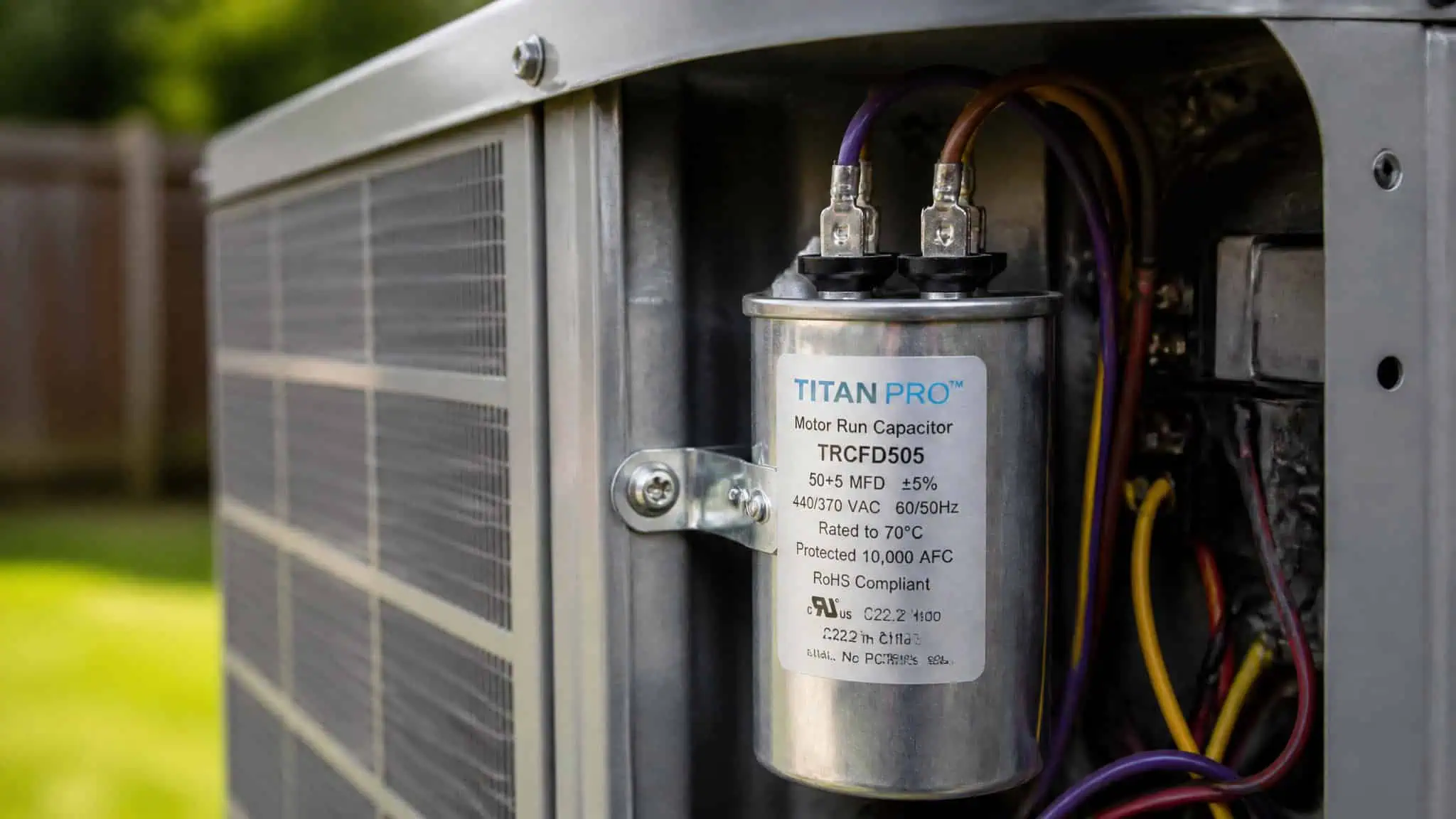
The air conditioning unit sits in the corner of your yard, humming along day after day, completely ignored until the moment it stops working. And when it does fail, the instinct is to assume the worst, a dead compressor, a refrigerant leak, a five-figure replacement bill.
But here’s the thing no one tells you: a surprising number of AC breakdowns start with a part the size of a soda can that costs less than your monthly electric bill. It’s called a capacitor, and when it fails, it produces a very specific set of warning signs. Learn to recognize them, and you might save yourself a lot of money and a very uncomfortable week in July.
What a Capacitor Actually Does (and Why It Matters)
Think of the capacitor as a high-powered battery pack for your AC’s motors. It stores electrical energy and releases it in a sudden burst when the system needs it. That burst creates the torque needed to get the compressor and fan motors spinning from a dead stop. Once they’re running, the capacitor keeps delivering a steady stream of power to keep them going.
There are different types of capacitors, each with a specific job. A start capacitor gives the motor that initial jolt to get moving. A run capacitor provides the steady current to keep it running. Many systems use a dual run capacitor that handles both the compressor and the condenser fan in one unit.
Here’s what that means in practical terms: if a dual run capacitor fails, it can affect one or both components. Your fan might spin but your compressor stays silent. Or the compressor runs while the fan sits still. That variability is why capacitor failure produces so many different symptoms, and why it’s so often misdiagnosed.
The capacitor plays a vital role in your AC system. It stores and releases energy to start the motors and keep them running. Without it, your system is just a very expensive box of metal sitting in the yard.
Why a Failing Capacitor Is Worth Catching Early
A capacitor doesn’t always fail all at once. Sometimes it fails slowly, losing its ability to hold a charge over weeks or months. During that window, your AC keeps running, but it’s working harder than it should. The motor strains, draws more current, and your energy bill creeps up. It’s a hidden tax on your comfort that you’d never connect to a failing part.
A dual run capacitor operates both the compressor and the condenser fan. When it fails, it can take out one component or both. That means you might see a fan that won’t spin while the compressor runs fine, or you might get warm air because neither is working. The symptoms vary depending on which function failed.
Warning Signs Your AC Capacitor Is Failing
A Humming Noise Coming From the Outdoor Unit
This is the classic capacitor failure signature. You’ll hear a persistent hum from the condenser unit outside, but the fan isn’t spinning. The motor is getting power, it’s trying to start, but it doesn’t have enough juice to actually get moving. The capacitor acts like a booster, providing the extra surge of energy needed to kick the motor into motion. When it can’t deliver, you get a motor that’s stuck in “trying” mode.
If you hear this sound, turn the AC off at the thermostat. Letting it run like this can overheat the motor and turn a cheap fix into an expensive one.
The 9 Warning Signs of a Failing Capacitor
1. Humming noise from the outdoor unit with no fan movement. This is the classic capacitor failure signature. The motor is getting power, but not enough starting torque to actually spin.
It’s stuck in a loop, trying, failing, trying again. That humming sound is the motor straining against the electrical equivalent of a dead battery. If you hear it, shut the system down.
2. The fan won’t spin, but the compressor is running. A dual run capacitor powers both the compressor and the condenser fan. If it fails partially, it can affect one component but not the other.
The result is a compressor that’s running hot because the fan that’s supposed to vent the heat has stopped. This is a serious problem, the compressor can overheat and fail permanently if it keeps running without proper airflow.
3. The AC blows warm air. If the compressor isn’t getting enough juice to start, you’ll get warm air blowing through the vents. The system is running, but it’s not actually cooling. This is one of the most common, and most confusing, symptoms because everything looks normal from the outside.
4. A humming sound from the outdoor unit. This is the classic capacitor failure signature. The motor is getting power but not enough boost to start spinning.
It’s trying. It can’t. The result is a persistent hum that should be your cue to turn the system off.
5. The condenser fan won’t spin. If the compressor is running but the outdoor fan remains stationary, that’s a strong clue. The capacitor supplies the initial jolt that gets the fan moving, and without it, the motor just sits there, getting hotter by the minute.
Here’s the important part: don’t let it keep running like that. A humming, non-spinning fan means heat isn’t being released. The motor can overheat, and the compressor can sustain serious damage. Turn the AC off at the thermostat and call a professional.
6. Warm air blowing from the vents. If the fan on your outdoor unit isn’t spinning but the compressor is running, you’ll get warm air inside. The system can’t shed heat without the fan moving air across the condenser coils.
This is a classic sign of a failing dual run capacitor, a single part that serves both the compressor and the fan motor. When it fails, it can affect one component, both, or neither, which is why the symptoms can vary so much.
The Hidden Cost of a “Soft” Failure
Here’s a scenario that catches a lot of people off guard: your AC seems to be working fine, but your electric bill climbs noticeably higher than usual. Same thermostat, same habits, same house. What gives?
A failing capacitor can cause what technicians call a “soft” failure. The system still runs, but it’s struggling. The motor draws more current than it should, working harder to overcome the lack of startup assistance. That added strain translates directly into higher energy consumption. If you notice your bill creeping up during cooling season with no change in your habits, the capacitor is worth checking before you blame the rate increase or the summer heat.
The practical tip: pull out your last three or four electric bills and compare them to the same months last year. If there’s a noticeable jump with no explanation, an AC inspection is a smart move.
The 9 Warning Signs Your AC Capacitor Is Failing
Your AC Won’t Turn On at All
The most obvious sign: you set the thermostat, the system clicks, and nothing happens. No hum, no fan, no cold air.
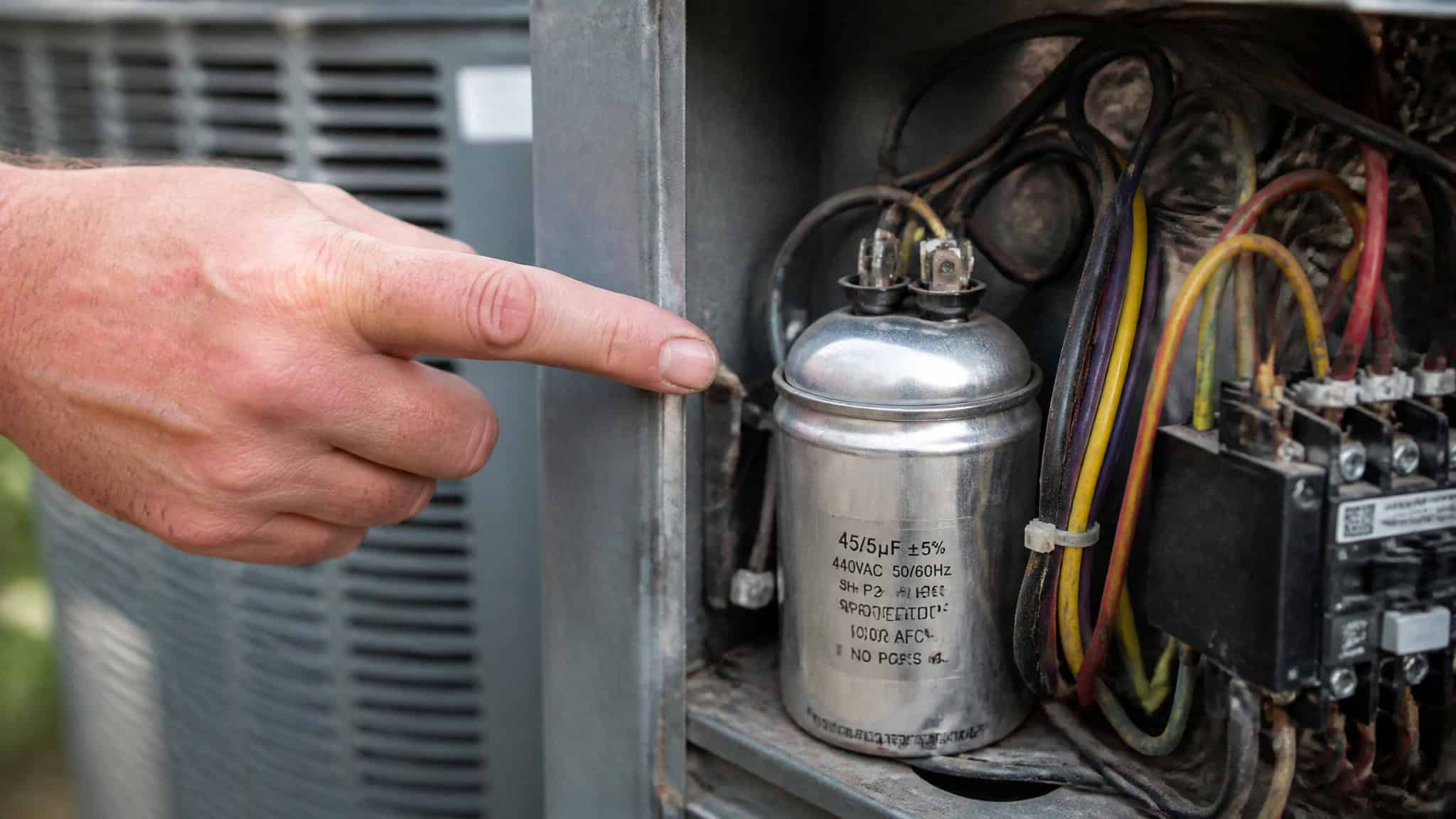
A failed capacitor means the motor doesn’t get the initial jolt of electricity it needs to start. The system might be receiving power, but without the capacitor’s stored energy, the motor simply can’t get moving.
That said, a completely silent AC isn’t a guaranteed capacitor diagnosis. It’s a frequent culprit, though other issues can cause this, a bad thermostat, a tripped breaker, or a failing motor. The capacitor is the place to start, but it’s not the only suspect.
The Hum That Means Trouble
When I talk to homeowners about AC problems, the most common description I hear goes something like this: It’s making this humming noise, but the fan won’t spin. That combination, humming but no movement, is about as close to a smoking gun as you’ll get in HVAC diagnostics.
Here’s what’s happening: the motor is receiving power, but the capacitor can’t deliver the extra jolt needed to actually start it spinning. The motor is trying, but it doesn’t have the juice. So it sits there, humming, getting hotter by the minute.
If you hear this, turn the AC off at the thermostat immediately. Continuing to run it this way can overheat the motor and turn a $200 capacitor fix into a $1,200 motor replacement)Skip the fluff that fills generic HVAC blogs and get right to the meat of this issue. Because understanding this single component could be the difference between a hundred-dollar service call and a thousand-dollar emergency repair.
The 9 Warning Signs Your AC Capacitor Is Failing
Sign #1: Your AC Won’t Turn On The most obvious symptom. The unit is completely silent. No hum, no click, no attempt to start. This happens when the compressor and fan motor can’t get the initial jolt of electricity they need. A dead capacitor often means a dead AC, even when everything else checks out fine.
Sign #2: Humming Noise, No Action This is the classic one. You hear a distinct hum coming from the outdoor unit, but the fan isn’t spinning. The motor’s getting power, but it’s not enough to overcome inertia and get things moving. That hum is the motor’s way of saying, “I’m trying, but I can’t start.”
It’s a frustrating, distinctive sound that AC repair pros hear constantly. If you notice it, shut the system down before the motor overheats.
Sign #3: The Fan Isn’t Spinning (But the Compressor Is) Sometimes the compressor runs, but the fan on top doesn’t turn. This points to a failed capacitor that’s still managing to power one component but not the other. Without the fan, heat can’t escape the condenser coil. The system will struggle, overheat, and eventually shut down or fail.
Sign #4: Warm Air from the Vents The system’s running, the fan’s blowing, but the air coming out of your registers isn’t cold. This happens when the compressor isn’t getting enough juice to start. The fan works, the blower works, but the heart of the cooling process, the compressor, isn’t spinning up. You’re paying to run a fan that’s just moving warm air around.
Sign #5: The Fan Won’t Spin (But the Compressor Runs) This is a trickier one. Your outdoor unit is humming along, the compressor is running, but the fan on top is dead still. This means the capacitor has failed selectively, it’s still feeding the compressor but not the fan motor. The result is a system that’s actively working but unable to shed heat, which can cause the compressor to overheat. Shut it down and get it checked.
Sign #6: Visible Damage on the Capacitor Itself
If you’re comfortable opening the access panel on your outdoor unit (with the power off), a quick visual check can tell you a lot. A failing capacitor often shows physical signs:
- A bulging or swollen top
- Leaking oil or fluid
- Rust or corrosion around the terminals
- Cracks in the casing
- Burn marks or discoloration
A capacitor that looks like a soda can that’s been shaken and expanded? That’s a capacitor that’s done.
Sign #7: The Fan Spins Slowly or Stops
Sometimes the capacitor fails partially, not completely. The fan might spin slowly, hesitate, or stop and start erratically. This is the capacitor trying to deliver power but unable to provide the full boost the motor needs. If you notice your condenser fan acting sluggish, that’s a capacitor with one foot in the grave.
Sign #8: Your Energy Bills Spike
This is the sneaky one: the AC still runs and the air still cools. But your electric bill climbs higher than it should.
A failing capacitor makes the motors work harder, drawing more current and making the system run inefficiently. Compare your recent bills to the same months last year. A noticeable jump with no change in habits is worth investigating.
Sign #9: AC Runs but Won’t Cool Properly
When the capacitor can’t deliver full power, the compressor might struggle to start or the fan might run at reduced speed. The result is weak cooling, longer run times, and rooms that never quite reach the set temperature. The system simply isn’t operating at peak performance.
What Actually Causes a Capacitor to Fail?
Capacitors fail for a variety of reasons. Heat is the number one culprit, they live outside, right next to the components they serve, and constant temperature swings take a toll. Power surges from storms or utility grid fluctuations can also damage them. And like any component, they simply wear out over time. Most capacitors last somewhere in the 8-15 year range, but that depends heavily on how often your system runs, the climate where you live, and how well the system has been maintained.
The signs are usually pretty clear: the system won’t start, it hums without the fan spinning, or it starts but stops shortly after. However, a failing capacitor can also cause subtler issues, like intermittent cooling, where the unit works fine sometimes but fails during peak demand. It’s the electrical equivalent of a car that starts most mornings but occasionally leaves you stranded.
What a Capacitor Does (and Why You Should Care)
Think of the capacitor as a high-powered battery pack. When your AC kicks on, the compressor and fan motors need a massive jolt of energy to get spinning. The capacitor stores that energy and delivers it instantly. Then, once everything is running, it keeps a steady flow of current going to keep those motors turning. Without it, the motor would stall or overheat.
There are two main types: start capacitors, which give the initial jolt, and run capacitors, which provide the steady current. Many modern systems use a dual-run capacitor that handles both the compressor and the condenser fan. That’s why a failing capacitor can cause strange combinations of symptoms, the compressor might still run, but the fan doesn’t spin.
The Hidden Cost of a Failing Capacitor
Here’s the sneaky part. A capacitor doesn’t always fail all at once. Sometimes it degrades slowly, and your AC keeps running, just badly. The motor has to work harder, drawing more electrical current than it should.
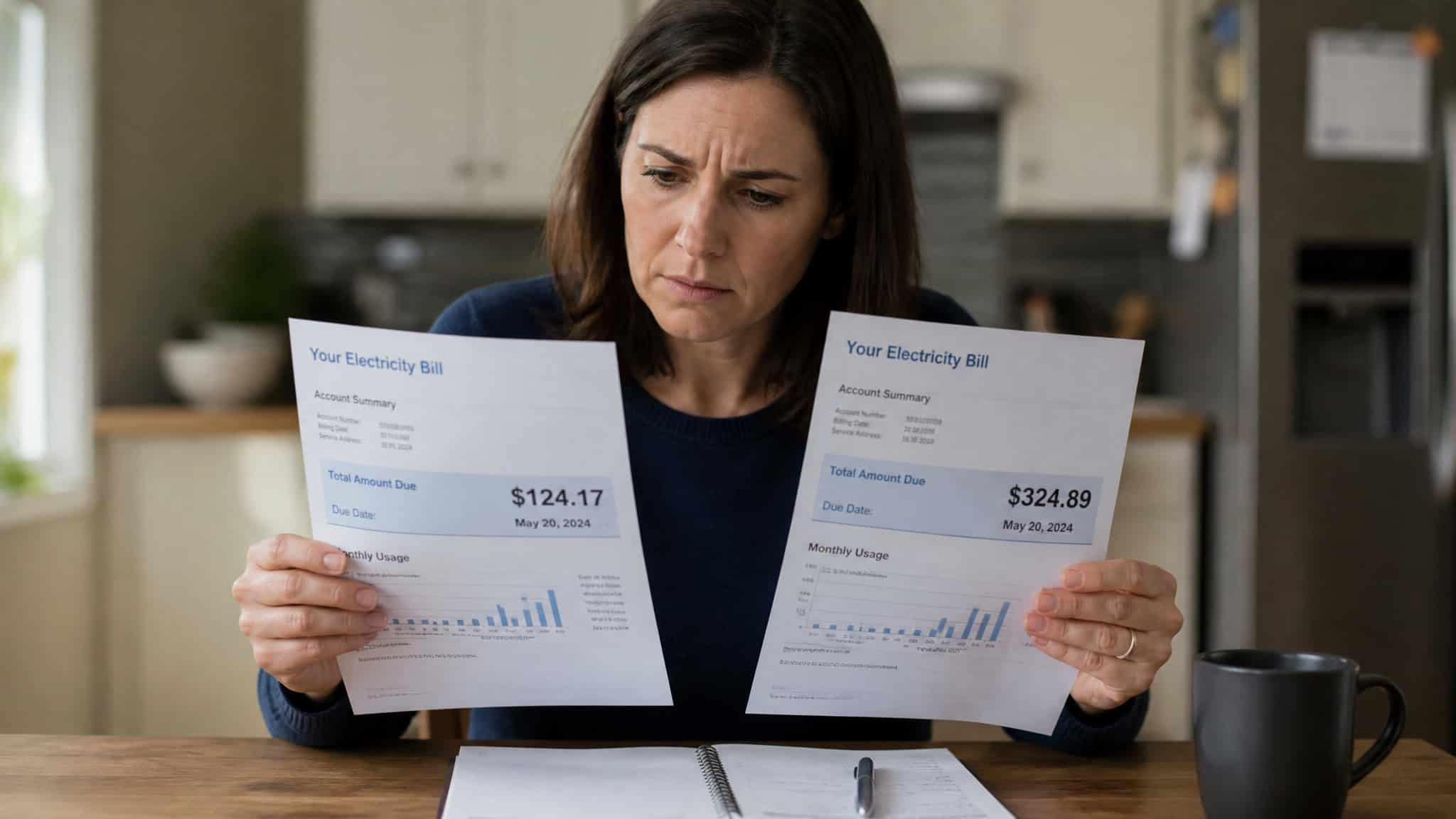
This inefficiency doesn’t show up on any dashboard or warning light. It shows up on your electric bill.
If your power bill has crept up over a few months without any change in your usage patterns, electrical work in your home, or a rate change from your utility, the AC is a prime suspect. An AC with a failing capacitor can draw significantly more power than one running at peak efficiency.
The fix is the same regardless of which capacitor type your system uses. The replacement process is identical for a start capacitor, a run capacitor, or a dual run capacitor: disconnect power, verify zero voltage, remove the old part, install the new one.
How a $20 Part Becomes a $1,500 Repair: The Hidden Cost of Ignoring the Signs
Here’s the uncomfortable truth about capacitor failure: it compounds. A bad capacitor doesn’t just fail, it stresses everything around it. The motor struggles to start, draws excess current, and generates excessive heat. That heat damages motor windings over time. The compressor, the most expensive component in your system, gets forced to work harder against a fan that’s not spinning or a start sequence that’s failing.
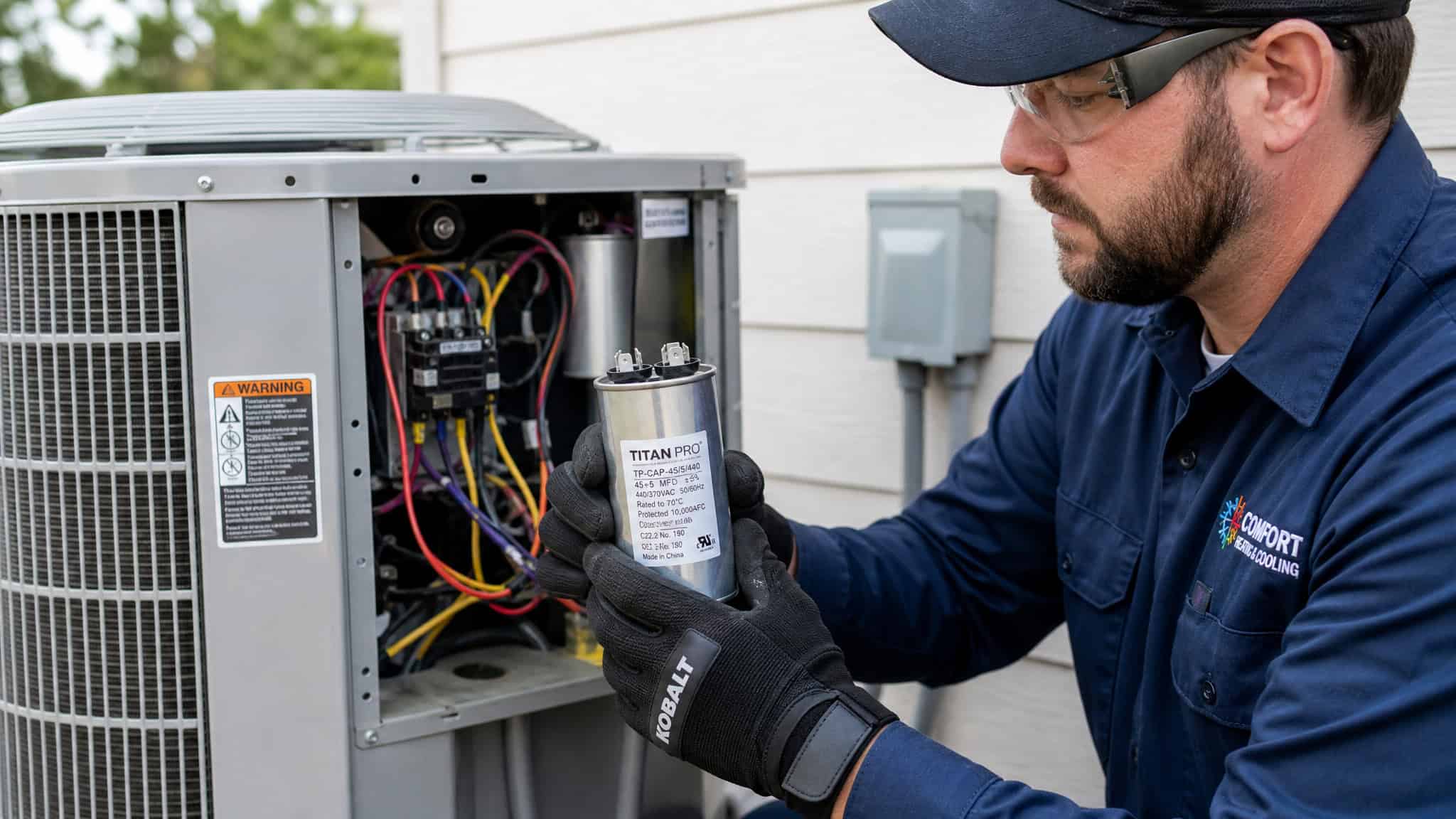
Acting fast is cheap. Acting slow is expensive. And the symptoms above are your early warning system.
But this isn’t just about the capacitor itself. Here’s what most homeowners don’t think about: where your AC sits in its own life cycle. If you have an older system, a capacitor fix is often just a band-aid. You might be fixing the capacitor today and the fan motor next month.
Then the compressor. Then the evaporator coil. You can pour money into a unit that’s already living on borrowed time.
The age question is central to whether a capacitor repair is worth it. If your system is fairly new, under eight or ten years old, replacing a capacitor is a no-brainer. It’s a minor maintenance event in the life of the system. If your system is pushing 15 years or morecarsomewhere between $8 and $14. And here’s the catch: once that system is open, Federal regulations require bringing the rest of the refrigerant up to standard, which means more labor and more gas.
If you’re on a 20-year-old R-22 system, the honest math changes. A $200-$400 capacitor repair might be perfectly reasonable. But if the system failed entirely, you might be looking at a repair bill that approaches a third or more of the cost of a new high-efficiency unit.
The smart move: ask the technician about the overall health of the system before you authorize the repair. If the capacitor is the only weak link)Skip the fluff and get to the meat.
The AC unit sits in the backyard, humming along day after day, completely ignored. Until it stops. And when it stops, it’s never convenient, it’s the hottest day of the year, you’ve got people coming over, and suddenly you’re calling around for emergency HVAC service while your house turns into a sauna.
But here’s the thing: most AC failures don’t happen without warning. Your system has been trying to tell you something’s wrong for days, sometimes weeks, before it finally gives up. You just haven’t been listening.
The culprit is often a tiny part called a capacitor, a modest little cylinder, usually tucked inside the outdoor condenser unit, that costs anywhere from $15 to $50 if you buy it yourself. That same part, installed by a professional, might run you $150, $400. And when it fails, the symptoms are so distinctive that knowing what to look for can save you from an unnecessary full-system replacement quote.
Let’s talk about what the capacitor actually does, how to spot its failure signs early, and why acting fast matters more than you think.
What a Capacitor Does (and Why It’s the Workhorse of Your AC)
Your AC has two major motors: the compressor and the condenser fan. Both are powered by your home’s electrical system, but they don’t behave like a simple light bulb. They need a jolt of energy to start, overcoming inertia to get the mass of the fan blade or the compressor piston moving, and then a steady, lower level of energy to keep running.
That’s where the capacitor comes in. Think of it like a high-powered battery that sits between your home’s electrical supply and the AC’s motors. It stores up energy and then releases it in a quick burst to get the motor spinning. Once the motor is up to speed, the capacitor switches to a continuous role, keeping the motor running efficiently.
Most modern AC units use something called a dual run capacitor. It’s a single component that serves both the compressor and the condenser fan motor, two separate circuits in one can-shaped package. This is a clever design, but it has a downside: if that one capacitor fails, it can take down both the compressor and the fan. That’s why a single failed part can produce such different symptoms, sometimes the fan stops but the compressor keeps running, other times the whole system goes silent.
The Subtle Killers: Symptoms That Get Overlooked
Sign 4: The Fan Spins Slowly or Wobbles. If it’s weaker than it should be, the motor might be getting just barely enough power to turn but not enough to run at full speed. A slow-spinning fan looks like a working fan if you’re not paying attention. It isn’t.
Sign 5: Acrid, Burning Smell Near the Outdoor Unit. When a capacitor fails, it can overheat internally. The plastic casing can start to melt. The dielectric fluid inside can leak. The result is a distinct, acrid, electrical-burning smell that you won’t mistake for anything else.
If you catch this early, you’re replacing a capacitor. If you don’t, you’re replacing a motor.
Sign 6: Visible Bulging or Leaking. If you’re comfortable taking the service panel off your outdoor unit, you can see the capacitor. It’s a cylindrical metal can, usually with a plastic or aluminum top. A healthy capacitor has a flat top.
A failed one is often swollen, bulged, or visibly leaking fluid. Don’t touch it, even when the system is off, capacitors hold a dangerous electrical charge.
The Visual Check: What to Look For
Capacitor failure has a fingerprint. If you can safely open the access panel on your outdoor unit (after turning off power at the breaker, not just the thermostat), here’s what failure looks like:
- A bulging top. The capacitor should be perfectly flat on top. If it’s domed or bulging, the internal pressure has built up and it’s failing.
- Leaking oil or fluid around the base or terminals. That’s the dielectric fluid escaping, a death sentence for the part.
- Rust or corrosion on the metal case or terminals.
- Cracks or burn marks on the housing. This is what overheating looks like.
One caveat before you go poking around: a capacitor can hold a lethal charge even when the AC is off. That’s not a scare tactic, it’s physics. The component is literally designed to store electricity. Touching the terminals without discharging it first can deliver a serious shock. Unless you know exactly what you’re doing, leave the inspection to a professional.
What’s Actually Wrong: The Three Ways a Capacitor Fails
Capacitors don’t usually die dramatically. They degrade.
The hard fail: One morning the AC just doesn’t come on. You check the thermostat, the breaker, the air filter, everything looks normal. But the unit is dead. The capacitor has failed completely overnight unquestionably the most dramatic moment in capacitor life.
But this instant-fail scenario actually covers a few different things, the capacitor might be completely open, internally shorted, or its thermal protection may be tripped. Either way, no power gets stored, and the motors don’t start.
The soft fail: The system still runs, but things aren’t right. The fan is slow. The compressor struggles to start. Cooling is weaker than it should be. This is the dangerous one because it’s easy to ignore, and it’s the one that leads to the compressor strain and energy bill spikes mentioned earlier.
The partial fail: Dual-run capacitors serve both the compressor and the condenser fan motor. They can fail for one function while still working for the other. That’s why you can see a system where the compressor is running but the fan isn’t spinning, or the fan spins fine but the compressor won’t kick in, or just the opposite. This adds a layer of confusion, unless you know what to look for.
The Field Guide to Spotting a Bad Capacitor
If you’re comfortable opening up the access panel on your outdoor condenser unit, you can do a simple visual inspection. This is perfectly safe to do as long as the unit is powered off and the disconnect is pulled. If you’re not comfortable with that, skip this part, there are plenty of technicians who can do it in five minutes.
The swollen top. A healthy capacitor has a flat top. A failing one often bulges upward, like a soda can that’s been shaken. That swelling means internal pressure from a failing dielectric. It’s the most obvious visual clue.
Leaking fluid. Some capacitors have a small vent. If you see oily residue around it or around the base, that’s electrolyte that’s leaked out. It means the internal seal has failed.
A burnt smell. If the capacitor has overheated, you might smell it before you see it. That acrid, electrical-burning odor is a serious warning.
Cracks or bulges in the casing. The capacitor is a sealed unit. Any physical deformation means it’s failed.
Corrosion or burn marks around the terminals. These indicate arcing or heat damage.
A swollen top. The top of a healthy capacitor is flat. If it’s bulging or domed, the capacitor is failing or already dead.
Important: If you’re checking, know that visual inspection only tells you part of the story. A capacitor can fail electrically while looking perfectly normal. That’s why professional diagnosis matters. But if you do happen to see a swollen top, leaking fluid, or burn marks, that’s a definitive sign.
Also, and this matters, if you see a bulging capacitor, don’t poke it. Those things can hold a charge long after the system is off.
When a $40 Part Is the Problem (and When It Isn’t)
The capacitor is the most common AC failure point, but it’s not the only one. Before you blame the capacitor, know what else can cause these symptoms:
- Thermostat issues. A dead thermostat battery or a faulty thermostat can prevent the system from calling for cooling.
- Faulty contactor. The contactor is the relay that sends power to the compressor and fan. If it sticks or fails, the fan won’t run even with a good capacitor.
- Failed fan motor. The motor itself can burn out. A bad motor will sometimes hum too, making it easy to confuse with a capacitor issue.
- Low refrigerant. Ice on the coil, warm air, and a hissing noise usually point here, not to the capacitor.
That’s why the diagnosis matters. Swap a capacitor on a system with a bad motor, and the new part burns out quickly. The capacitor is often the culprit, but it’s not always the only problem.
The Cost of Doing Nothing vs. the Cost of Acting Fast
Here’s where the math gets interesting. A service call with a capacitor replacement typically runs $150 to $400 depending on your area and the technician’s rates. The part itself is cheap, often $15 to $50 if you’re looking at DIY. The labor is the real line item, and it’s worth every penny when you consider the alternative.
Wait too long, and that humming fan motor can overheat and seize. Now you’re looking at a replacement motor, which combined with labor can easily run $600 to $1,200. If the compressor overheats and fails, and it can, when the condenser fan stops moving air across it, you’re looking at a repair bill that’s a significant fraction of a whole new system.
A capacitor failure is the most common AC breakdown there isString Module. It’s also one of the cheapest to fix, if you catch it early.
What You’ll Pay (and Why It’s Worth It)
Most homeowners should budget between $120 and $300 for a capacitor replacement, including the service call. The part itself is remarkably inexpensive, typically $15 to $50 for a dual-run capacitor, which is the type most central air systems use. The rest is labor, diagnosis, and the professional’s responsibility.
That range might seem steep for a part that costs less than a tank of gas入了. But here’s the thing: the service call isn’t really about the capacitor. It’s about the diagnosis. A technician isn’t just swapping a part, they’re verifying that the capacitor is actually the culprit)Skip to the good stuff. Cut out anything that sounds like a lecture or a placeholder.
The reader already knows capacitors are important, they’re searching for symptoms. Give them the signs, the what-to-do-next, and the honest cost picture. Skip throat-clearing. Be the guy who’s been through this and is telling them exactly what to look for.
If Your AC Is Acting Up, Check These 8 Capacitor Warning Signs First
Your AC is a machine of quiet routines. But when something’s off, it starts sending signals, a hum here, a warm puff of air there. One of the most common culprits behind these odd behaviors is a small, cylindrical part called a capacitor image.jpg, and it’s worth getting familiar with.
A capacitor acts like a backup battery for your AC’s motors. When the thermostat calls for cooling, the compressor and fan need a jolt of high voltage to start spinning CircleN, and the capacitor delivers it. Then it keeps working, providing a steady current to keep the motors running. When it starts to fail, your AC behaves in ways that can seem confusing, or it just stops working altogether.
Here’s what to watch for.
The Unit Just Won’t Start
The most common and obvious symptom. You set the thermostat, you hear the click, and then… nothing. No fan, no compressor, no sound at all. The outdoor unit is completely silent.
This happens because the capacitor has failed completely and can no longer provide the initial surge of power the motors need to start. Without that boost, the compressor and fan motor are dead in the water.
But here’s the catch: a silent unit can also mean a blown fuse, a tripped breaker, or a failed motor. The capacitor is a prime suspect, not the only suspect Math, buddy. Vary it, give me one or two sharp, conditional, niche formulas in a row, and only when natural.
What an AC Capacitor Does and Why It Matters
A capacitor is a small cylindrical component inside your outdoor AC unit’s control panel. Despite its modest size, it plays an outsized role in your system’s operation. Think of it as a high-powered battery that provides the initial jolt of electricity your AC’s motors need to start.
Your AC has two key motors: the compressor (which pressurizes the refrigerant) and the condenser fan motor (which pulls air across the coils to release heat). Both need a big burst of energy to start spinning. Once they’re running, they need a steady but much smaller supply to keep going着一张.
That’s where capacitors come in. The start capacitor delivers the initial burst of energy, a quick, high-voltage kick that gets the motor turning. The run capacitor provides a continuous, lower-level charge that keeps it running smoothly. Many modern systems use a dual run capacitor, which does both jobs for both the compressor and the fan motor in a single cylindrical unit.
Here’s a critical detail: a dual run capacitor contains two separate capacitor circuits. When it fails, it can fail for just one of those circuits. That means your fan might stop spinning while the compressor keeps running, or vice versa. This is why two AC units with failed capacitors can show completely different symptoms.
The whole system is electric and interdependent. The capacitor gives the motor the initial jolt to start and then regulates the electrical current to keep it running. When that delicate dance is disrupted, everything else suffers.
The 9 Warning Signs
You don’t need to be an HVAC technician to spot a failing capacitor. You just need to know what to look for. Here are the warning signs, ranked roughly from most common to most subtle.
Your AC Won’t Turn On at All
The system is completely dead. No sound, no movement, no cold air. This is the classic full-failure symptom: the capacitor can’t deliver the jolt of electricity needed to start the compressor or fan motor. Nothing happens.
A Humming Sound with No Fan Movement
This is the most distinctive capacitor symptom. You’ll hear a low, continuous hum coming from the outdoor unit, but the fan blade isn’t moving. The motor is receiving power, but not enough to overcome inertia and start spinningable to start. It’s trying, and failing, repeatedly.
This is a strong clue that the capacitor’s ability to store and deliver a surge of power is compromised. Turn the system off immediately; letting it run like this can overheat the motor and turn a cheap fix into an expensive one.
The Fan Doesn’t Spin, but the Compressor Runs
Here’s a less obvious one. If your compressor runs while the fan on top of the outdoor unit is stationary, the capacitor is the prime suspect. This is a partial failure, the capacitor is still delivering enough power to the compressor but not enough to the fan motor. The system may still blow air indoors, but it won’t cool effectively because the outdoor unit can’t shed heat. Left running, this can overheat the compressor and lead to a very expensive failure.
Warm Air Blowing from the Vents
If your AC is running but the air coming out is lukewarm or warm, the capacitor could be the culprit. A failing capacitor can cause the compressor to run weakly or overheat. The system continues to blow air, but it’s not actually cooling. This is insidious because everything seems normal on the surface, fans are spinning, the thermostat says cooling, but the air just never gets cold.
Your Electric Bill Spikes Without a Reason
This is the hidden symptom. Your AC might still be cooling your home, but it’s working harder than it should. A failing capacitor makes the compressor work less efficiently, drawing more electricity to do the same job. If your bill jumps significantly during cooling season, it could also be a sign of AC thermostat problems that mimic a system failure, so it’s worth having the thermostat and capacitor checked separately. It’s a small part with a big impact on efficiency.
The AC Restarts Repeatedly
Does your AC cycle on and off more frequently than it used to? Does it struggle to start, then shut off after a few seconds? This is common when a capacitor is too weak to keep the motor running. The motor heats up, trips the internal overload protector, then starts again once it cools.
Then the cycle repeats. It’s a sign that something is straining, and the capacitor is a likely culprit, so test the capacitor before assuming the worst.
A Burning Smell Near the Outdoor Unit
If you catch a burnt odor coming from the condenser unit, that’s serious. It can mean the capacitor is overheating, the wiring is melting, or the motor is cooking itself. Any burning smell from an electrical component is a stop-and-call-a-pro situation. Turn the system off at the thermostat immediately.
The AC “Starts and Stops” Repeatedly
This is called short cycling. The compressor kicks on, runs for a few seconds, then shuts off before the cycle should end. It’s a symptom of several problems, but a failing capacitor is high on the list.
Visible Damage on the Capacitor Itself
If you’re comfortable looking inside the condenser unit (with the power fully off), you might see the capacitor with the naked eye. A swollen or bulging top, oil or fluid leaking from the case, corrosion on the terminals, or a burnt smell, these are all signs the capacitor is failing. But here’s the catch: sometimes a capacitor fails with no visible signs at all. So don’t assume a normal-looking capacitor means everything is fine.
What a Capacitor Does (and Why It Fails)
Think of a capacitor as a tiny, high-capacity battery. Its job is to store electrical charge and release it in a quick, powerful burst. When your AC’s compressor and fan motors need to start, they need a jolt of energy to get spinning, that’s the start capacitor. Once they’re running, a run capacitor provides a steady stream of power to keep them going.
These components are under constant stress. They charge and discharge every time the AC cycles on and off. They sit in a hot metal box outside in the summer. They endure voltage spikes from the grid.
It’s a hard life, and eventually, they fail. The average lifespan varies widely depending on heat, humidity, power quality, and how often the system runs.
What a Capacitor Actually Does in Your AC
A capacitor is a small cylindrical component inside your outdoor unit that stores and releases electrical energy. Think of it less like a battery and more like a quick-release energy reservoir. When your AC calls for cooling, the capacitor delivers a powerful jolt of electricity to start the compressor and the condenser fan motor. Then, it provides a steady stream of energy to keep them running.
Different systems use different setups. Some have a start capacitor (a short burst of high torque to get the motor moving) and a separate run capacitor (continuous power to keep it moving). Many modern systems use a dual run capacitor, a single unit that serves both the compressor and the fan motor)Skip that. Let me rework this entirely.
The capacitor matters because it’s the part that gets the motor spinning. A motor can’t start on its own; it needs an extra push of energy. The capacitor provides that jolt enormous force. Once the motor is spinning, the capacitor continues to feed it a steady stream of power, keeping it running efficiently.
Dual run capacitors handle both the compressor and the condenser fan motor from one cylindrical can. That’s convenient when everything works, but it means one part is responsible for two critical jobs. When it fails, it can take out one or both components.
Why This Part Fails (and How to Slow It Down)
Capacitors are the most failure-prone component in an AC system. They’re under constant electrical stress whenever the unit runshare subject to extreme heat inside the metal cabinet. In many regions, the outdoor unit sits in direct sunlight all summer, cooking the capacitor day after day.
Heat is the primary enemy, every 10-degree increase in temperature roughly halves a capacitor’s lifespan. That’s why failure rates spike during the hottest weeks of summer, exactly when you need the AC most.
Surges from the grid, brownouts during heat waves, and frequent on-off cycling all stress the internal dielectric layer. Over time, the insulating material degrades, and the capacitor slowly loses its ability to store charge. Eventually, it can’t deliver the kick the motor needs, and the system fails.
Good news: an annual maintenance check can catch a weak capacitor before it dies completely. A technician can test it with a simple multimeter reading, and replacing it on the spot is quick and relatively inexpensive.
What a Capacitor Replacement Actually Costs
If you’re facing a failed capacitor, here’s the good news: it’s one of the most affordable AC repairs you can make. The part itself costs between $10 and $50 depending on your system’s specifications. Professional installation typically runs $150 to $300, bringing the total to around $200, $400 for the complete job. The cost varies by region, the service company, and whether they’re already on site for a diagnostic call.
A quick online search shows replacement capacitors for common AC brands running $12 to $35. The markup when you hire a pro covers their time, their expertise, and the guarantee that the replacement is properly matched to your system. That’s worth it. A mismatched capacitor can damage your system.
One caution: while the capacitor itself is a cheap part, labor charges and service call fees will dominate the final bill. The biggest cost isn’t the part. It’s the diagnosis, the trip, and the peace of mind that comes from knowing it was done safely.
Cost of Replacement vs. Cost of Ignoring It
A capacitor replacement typically costs anywhere from $150 to $400, depending on the part, the service call, and regional labor rates. The DIY route: a replacement capacitor costs between $10 and $50. But here’s the catch: capacitors can hold a lethal charge even when the power is off, so replacing one safely requires knowing how to discharge it properlycpp_empty
, which is why we recommend leaving this job to a pro.
The real cost of ignoring the warning signs is much higher. A failing capacitor forces the compressor to work harder, generating heat and stress that can shorten its lifespan. Compressor failure is one of the most expensive AC repairs you can face, often $1,200 to $2,500 or more. Compare that to the modest cost of a capacitor replacement, which typically runs $120, $300 including parts and labor.
Why You Shouldn’t DIY This One
The internet will tell you that replacing a capacitor is a $20 part and a 15-minute job. That’s technically true. But there’s a catch that the DIY crowd doesn’t mention: capacitors store electrical charge even after the power is off. That small silver cylinder can hold a lethal jolt for quite a while after you flip the breaker able to deliver a serious shock long after the power is cut. Every year, experienced HVAC technicians get hurt doing this job, it’s not something a homeowner should attempt without proper training and equipment.
There’s also the matter of diagnosis. A failed capacitor is obvious. But a failing capacitor that’s causing higher energy bills or intermittent cooling could be one of several issues, including a bad fan motor or a struggling compressor. A professional can test the capacitor with a multimeter and confirm it’s outside its rated microfarad range, something you can’t do by looking at it.
The cost of professional replacement is reasonable, typically $150 to $400 for the part and labor, and it addresses the root cause. A DIY swap might save you $100, but it’s not worth the risk of serious injury or a misdiagnosis that leaves you hot and frustrated on a 95-degree day.
The Hidden Cost of Waiting
Here’s what makes capacitor failure so insidious: it often doesn’t happen all at once. A capacitor can fail gradually, losing its ability to store and deliver charge. The AC still runs, but it runs poorly.
The compressor struggles to start. The fan motor labors. The system pulls more current than it should. It’s the electrical equivalent of driving with the parking brake on, you’ll get where you’re going, but you’re putting unnecessary stress on every component along the way.
When you replace a capacitor early, you’re not just paying for a part. You’re protecting the two most expensive components in your system: the compressor and the fan motor. A capacitor that’s allowed to fail completely can take one of those with it)Skip.
What to Do When You Spot These Signs
Here’s where you need to make a decision: call a professional or attempt a DIY fix?
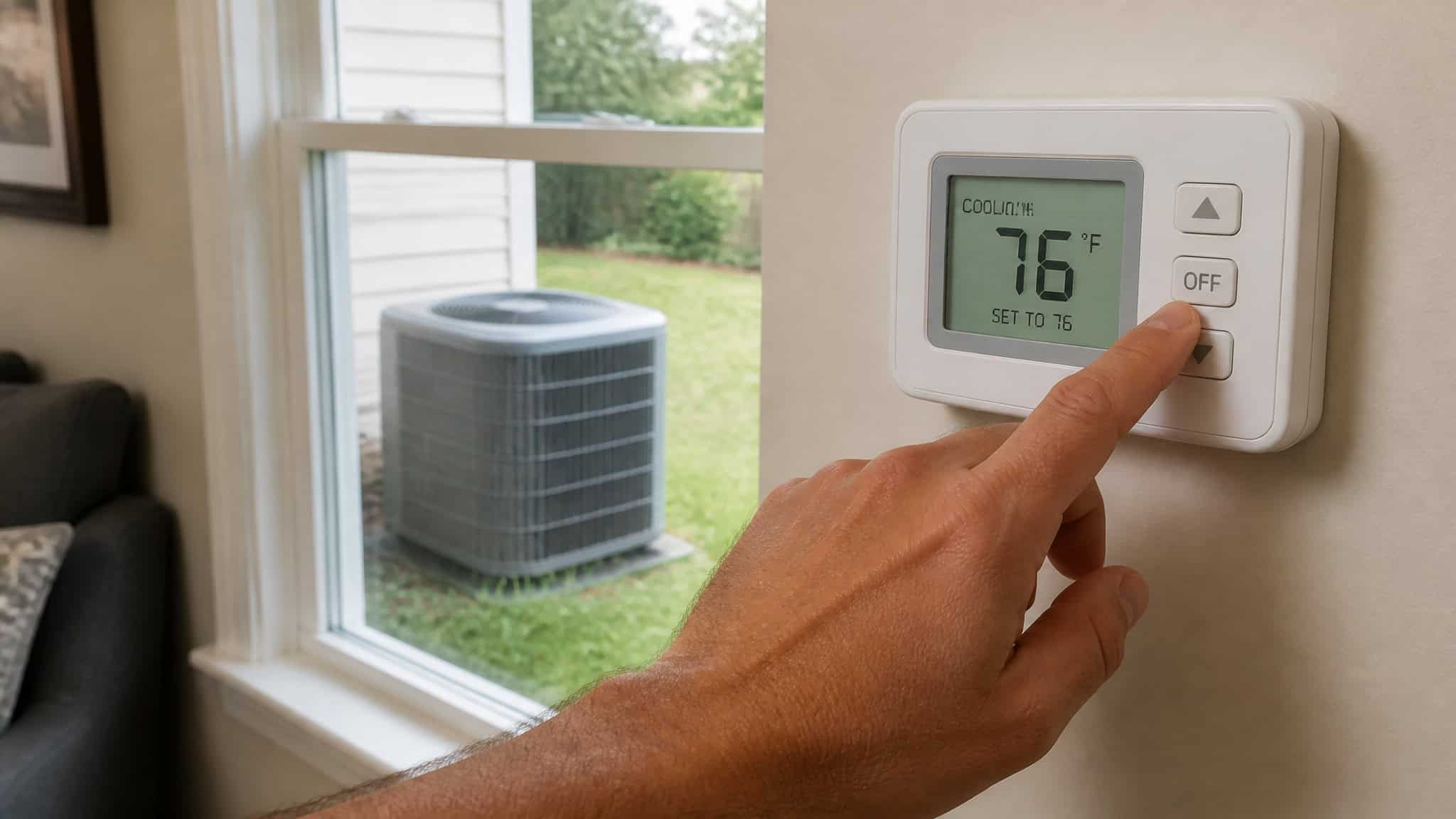
The right answer for most people is to call a professional. Here’s why:
The shock risk is real. Capacitors store electricity even when the power is off. A capacitor can hold a lethal charge for a long time after the unit is disconnected. Professional technicians are trained to discharge them safely. This isn’t a part you want to learn on.
The diagnosis matters. A failed capacitor is one possible cause. But a capacitor can also fail because something else is wrong, a struggling motor, a wiring issue, or a refrigerant problem can all put excess strain on the capacitor and kill it. Replace the capacitor without finding the root cause, and you might be replacing it again in a month.
Cost is reasonable. Expect to pay $150 to $400 for a professional capacitor replacement, depending on the part and labor. That’s without a service contract. It’s a small price for the peace of mind of knowing the job was done safely.
If you attempt a DIY replacement, the capacitor itself costs $10 to $50. The catch is the danger. A capacitor stores electricity even when the power is off. You can discharge a glass, pull a wire, and get a shock that stops your heart. Professionals discharge capacitors safely before touching them, and you should never attempt this unless you have the training and tools to do the same.
What Happens If You Ignore It
There’s a temptation to let a struggling AC keep limping along. The fan still spins sometimes. The house gets cool eventually. But every cycle it runs while the capacitor is failing does more damage.
A capacitor that’s struggling to start the motor forces the motor to draw excessive current. That extra current heats up the motor windings. Over time, that heat can fry the motor entirely, a repair that costs three to five times more than a capacitor swapleys.
The bottom line: A capacitor replacement is one of the cheapest AC repairs you’ll ever make. The part itself costs $10 to $50. With a professional, expect to pay between $150 and $350 for the service call and installation. If you wait until the motor burns out, you’re looking at hundreds more. If the compressor goes too, the cost climbs into the thousands.
Do It Yourself or Call a Pro?
The question of DIY capacitor replacement is worth addressing honestly. The part is relatively inexpensive to buy online, and swapping it does look simple: pull the old one out, put the new one in, connect three wires. But the risk isn’t in the mechanical swap, it’s in the 370 to 440 volts the capacitor can hold after the power is off.
That charge can persist for minutes after you kill the power. It can deliver a shock that stops your heart. Even a seasoned DIYer without the right training has no business opening that panel unless they know exactly what they’re doing.
This is a job for a licensed technician. They have the tools to safely discharge the capacitor, the expertise to verify the correct replacement part, and the knowledge to check that the failure wasn’t caused by a bigger problem, like a struggling motor that’s drawing too much current.
The $150 Fix That Could Save Your $6,000 System
When a capacitor fails, the repair cost is refreshingly modest: typically $150 to $400 including parts and labor. You’re not paying for the part itself, that’s usually just $15 to $50. You’re paying for the diagnosis, the service call, and the technician’s expertise to make sure the capacitor is actually the problem and not a symptom of something worse.
A failed capacitor doesn’t just sit there. Every time the AC tries to run with a failing capacitor, it strains the compressor and fan motor. If you ignore the warning signs and keep running the system, you risk turning a $200 repair into a $2,000-plus repair when the motor overheats or the compressor fails. That’s the real cost of waiting.
Before You Call: The Visual Check
If you feel comfortable getting a flashlight and taking a look at your outdoor unit, you can sometimes spot a failing capacitor before it quits entirely. The capacitor is a cylindrical metal or plastic component inside the electrical compartment, usually with a wire or two running to it.
Look for the signs of stress:
- A swollen or bulging top. A healthy capacitor has a flat top. If it’s dome-shaped or visibly distended, it’s failing. It’s essentially a small bomb waiting to go off.
- Leaking fluid. If there’s oil or a brownish residue around the capacitor, the internal seal has broken. That’s a death sentence for the part.
- Rust or corrosion on the terminals or case. This can cause poor electrical contact and lead to failure.
- A burnt smell. If the capacitor smells like it’s been cooking, it has been. Heat damage means replacement time.
What’s Actually Wrong: The Mechanical Reality
Capacitors don’t fail the way light bulbs do. There’s no dramatic pop (usually). Instead, they degrade. The internal electrolyte, the stuff that lets the capacitor store energy, dries out over time.
The metal plates inside develop microfractures from thermal cycling. The electrical connections loosen.
This is why capacitor problems often show up on the hottest days of the year. Your AC has been running harder, the ambient temperature is higher, and the capacitor, already weakened by years of stress, finally crosses the threshold where it can’t deliver enough starting torque to the motor.
The system might have been humming along on a weak capacitor for weeks without you noticing anything. Then the hottest day of the year hits, the AC works overtime, and suddenly it stops. The seasonal pattern isn’t a coincidence; it’s physics.
The 9 Warning Signs
Here’s what to watch for:
1. The AC won’t start at all. You flip the thermostat to cool, hear nothing, and the house stays warm. A dead capacitor is one of the most common reasons an AC unit fails to start.
2. Humming from the outdoor unit. If you hear a buzz or hum coming from the condenser but nothing is moving, the motor is getting power but not enough to start. This is a classic capacitor failure signature.
3. The fan doesn’t spin, but the compressor runs. If the compressor kicks on but the outdoor fan sits still, the capacitor has likely failed for the fan function specifically. This is especially common with dual-run capacitors, which serve both components, one function can fail while the other continues to operate.
4. Indoor air is warm, not cold. Most people notice this first. The system runs, the fan blows, but the air coming out of the vents isn’t cold. A weak or failed capacitor means the compressor isn’t running at full capacity or isn’t running at all.
5. The AC takes a long time to start cooling. If it takes several minutes for cool air to arrive, the capacitor may be struggling to get the compressor up to speed quickly.
6. Your energy bills are climbing. Here’s a less obvious one: if a capacitor fails partially, the motor may still run, but inefficiently, drawing more current than it should. You’ll see the result in your utility bill before you notice it in your comfort.
7. You hear a clicking sound. When a capacitor can’t start the motor, the AC may cycle through repeated start attempts, you’ll hear a rhythmic clicking. That’s likely the system trying to start, failing, and trying again着脸.
8. The fan spins but the air isn’t cold. A failing capacitor can still get the fan moving but won’t supply enough power to the compressor. The result: air moves, but it’s not cold.
9. You smell something burning. A burning smell from the outdoor unit is serious. It can mean the capacitor is overheating or other electrical components are failing. Turn the system off and call a professional immediately.
What Causes a Capacitor to Fail?
Capacitors are one of the most failure-prone components in an AC systemcommonly failing after about eight years of service. But that timeline isn’t fixed. It depends on several factors:
- Heat: Excessive heat is the primary killer of capacitors. The outdoor unit operates in direct sunlight, and the capacitor sits inside a metal box in the middle of summer heat. Every degree of additional heat stress shortens its life.
- Power fluctuations: Electrical surges, brownouts, and inconsistent power delivery can damage capacitors over time. They stress the internal dielectric (insulating) layer with every spike.
- Manufacturing defects: They happen. Some capacitor brands are simply more reliable than others.
- Frequent cycling: An oversized AC that short-cycles (turns on and off rapidly) puts more stress on the capacitor. Each start requires that big initial burst of energy.
The “hidden” symptoms of a failing capacitor
Not all capacitor failures are dramatic. A capacitor can fail gradually, and the symptoms can be subtle. One of the most common? A slow rise in your energy bills defending against summer heat waves.
Here’s the mechanism: when a capacitor is weak, the compressor motor struggles to start. Rather than drawing a quick, efficient burst of current to get spinning, it draws higher current continuously, especially under load. This inefficiency translates directly to higher power consumption. You might not notice the AC running longer or struggling. But you’ll notice the bill.
A failing capacitor can also cause the system to short-cycle, turning off and on more frequently as it struggles to maintain target temperatures. That frequent cycling is harder on the compressor than the longer runs you’d see with a healthy system.
What Happens When a Capacitor Fails: The Two-Stage Breakdown
AC capacitor failures typically follow one of two paths: sudden or gradual.
Sudden failure is what you expect when you hear “capacitor went bad.” The AC was running fine. Then one afternoon it wasn’t. No warning, no intermediate symptoms, just a dead system.
This happens when the capacitor fails open, the electrical path inside the part simply breaks, and the motor gets nothing. The system won’t start at all. Often the unit won’t even hum. It’s just… quiet.
Gradual failure is more insidious. The capacitor’s internal capacitance degrades over time, a process accelerated by heat. The motor still starts, but it takes longer, draws more current, and runs hotter. You might notice the AC cycling more frequently, struggling to start on hot days, or your electricity bill creeping up with no obvious reason. This is the capacitor that hasn’t failed yet, but it’s failing.
What to Do When You Spot These Signs
If you’re experiencing any of these symptoms, the first step is to turn off your AC at the thermostat. This prevents further strain on the system and avoids turning a minor repair into a major one一点儿.
Next, call an HVAC professional. A technician can diagnose whether the capacitor is the culprit or if something else is at play. The diagnosis is quick, they’ll check the capacitor’s microfarad rating against its labeled spec, and replacement is simple for someone with the right training. The part itself costs $15 to $50 at most supply houses; the service call will cost more, but it’s the difference between a safe, correct fix and a serious injury or expensive mistake.
The total cost for a professional capacitor replacement is manageable. You’ll typically pay between $150 and $300, which includes the service call, the part, and labor. It’s a bargain compared to the cost of replacing a damaged compressor or fan motor, repairs that can run into the thousands.
And if you’re tempted to swap the part yourself, consider this: capacitors can hold a lethal charge even after the unit is powered off. The risk isn’t worth the savings. This is a small part with a big job, and it’s connected to one of the most dangerous components in your home.
What the Fix Costs
The capacitor itself is an inexpensive part, anywhere from $15 to $50 at a supply house. Professional replacement runs between $150 and $400, depending on your area and the service call. That’s a small price compared to the $1,200-plus you’d face for a new blower motor or the $2,500+ for a compressor replacement.
If you ignore the warning signs and keep running the system, you risk damaging those far more expensive components. A failing capacitor that’s allowed to keep the motor struggling can literally burn out the motor, turning a $200 repair into a $2,500 problem.
The Check Engine Light of Your AC
Think of the capacitor as your AC’s version of a check engine light. When it starts to fail, it’s telling you the system is under stress. The capacitor itself is cheap to replace. The parts it protects, the compressor and fan motors, are not.
There’s a window of time between “capacitor is failing” and “capacitor has failed completely.” In that window, you have a choice. You can call a professional, spend $150 to $400, and be back to cold air within a day. Or you can wait, let the struggling motor overheat, and end up paying hundreds more for a motor replacement.
The math favors acting early. A failed capacitor that takes out the compressor can turn a $300 repair into a $3,000 oneyb. That’s the real cost of waiting.
The Good News: This Is Usually a Quick Fix
When a capacitor fails and nothing else is damaged, the repair is straightforward. A technician diagnoses the problem, verifies the correct rating, and swaps in a new part. The whole thing typically takes under an hour. If you’re hearing the telltale signs, humming, clicking, or an AC that starts then stops, you’re likely facing a capacitor issue.
While you’re at it, ask the technician to check the rest of the system. A failing capacitor is often a symptom of an overworked system. Dirty coils, a clogged filter, or low refrigerant can create extra strain that wears out electrical components faster.
Is a Capacitor Replacement a DIY Job?
The short answer: no. Capacitors store electrical energy even after the power is off, and they can deliver a dangerous, even lethal, shock. A capacitor can hold a charge for hours after the unit is unplugged. Professional HVAC technicians know how to safely discharge them and verify they’re safe to handle.
The cost to have a professional replace a capacitor is modest, typically between $150 and $400 depending on your location and the specific part. The part itself costs $10 to $50. The peace of mind is worth the difference.
What You’ll Pay and Why It’s Worth It
A professional capacitor replacement usually runs between $150 and $400. That covers the service call, the part, and labor. It’s one of the least expensive AC repairs you’ll ever have. By contrast, ignoring the problem can lead to a failed compressor, and compressor replacement typically runs $1,200 to $2,800.
The smart play is to act on the early warning signs. A capacitor replacement is a quick job for a pro, often less than an hour. Catching it early prevents the strain that can kill the compressor.
When the Fix Is Just the Beginning
There’s one more thing worth understanding: a failed capacitor can be a signal, not just a random event. Capacitors wear out from heat. If yours failed, it might simply be old age. But it might also be a sign that your system is running too hot, the condenser coil is dirty, or the unit is struggling in a way that will cause repeated failures.
That’s why the cost conversation matters. A capacitor replacement is one of the least expensive AC repairs you’ll ever have. If this is the first repair on a system that’s still under warranty or less than 10 years old, it’s a no-brainer. Fix it, maintain it, move on.
But if your system is 15 years old, uses R-22 refrigerant (which is being phased out), and this is the second or third repair this year, the math changes. The capacitor replacement might be cheap, but the underlying issues may keep coming. At some point, you’re pouring money into a system that’s past its prime, and a new system will save you money in energy costs alone.
The key is to get a professional assessment of your system’s overall health before you decide. A good technician will give you an honest picture of whether the capacitor fix is the last repair you’ll make for a while, or the first of several.
The Bottom Line
Your AC’s capacitor is a small part with a big job. When it starts to fail, it usually sends clear signals: humming, warm air, a fan that won’t spin, a burning smell, or a mysteriously high electric bill. Pay attention to these signs and act early.
A capacitor replacement is quick and affordable. Waiting too long can turn it into a major repair. And when the technician tells you the capacitor is bad, remember: it’s not a reflection on you or your AC. Capacitors simply have a limited lifespan. Replacing it is routine maintenance, not a crisis.
But if your system is getting older, say, 15 years or more, it’s worth thinking beyond the immediate repair. That capacitor might be the first domino. Have the technician assess the overall health of the system. And if your system uses R-22 refrigerant, keep in mind that this older coolant is being phased out due to environmental regulations, which means service costs for it are climbing. At some point, the math of repeated repairs on an aging system stops making sense, and a new system becomes the smart investment.
For now, though, the takeaway is simple: if your AC is humming but not cooling, or your energy bills have quietly crept up, don’t wait. A quick diagnostic call could save you from a much bigger, and much hotter, problem down the road.
People Also Ask
How expensive is it to replace an AC capacitor?
A professional capacitor replacement typically costs between $150 and $400, including the service call and labor. The part itself is only $10 to $50, but the diagnosis and safe installation are what you’re really paying for.
What is the average lifespan of an AC capacitor?
Most capacitors last between 8 and 15 years, but that depends heavily on heat, power surges, and how often your system runs. High temperatures and frequent cycling can shorten their life significantly.
How long after replacing an AC capacitor will it work?
Once a technician replaces the capacitor, the AC should start working immediately—usually within the hour. The repair itself is quick, but the service call and diagnosis take most of the time.
What are the warning signs of a bad AC capacitor?
Common signs include a humming noise from the outdoor unit with the fan not spinning, warm air from the vents, the AC not turning on at all, visible bulging or leaking on the capacitor, and a spike in your electric bill.
Can I replace an AC capacitor myself?
It’s risky. Capacitors can hold a lethal electrical charge even after the power is off, so DIY replacement is dangerous without proper training and tools. A professional can do it safely for a reasonable cost.
What happens if I ignore a failing AC capacitor?
Ignoring it can turn a cheap fix into an expensive one. A struggling motor can overheat and burn out, leading to a $600–$1,200 motor replacement or even a $2,500+ compressor failure.
Why does my AC capacitor keep failing?
Capacitors fail from heat, power surges, and normal wear. If yours fails repeatedly, it could be a sign of a bigger issue like a dirty condenser coil, a struggling motor, or an aging system that’s nearing the end of its life.