
Six months in the same guild, hours every week in voice chat, running the same raids. She’s funny, she plays well, you’ve got inside jokes. And nothing ever happens, because you’ve got no idea if she’s single, and the social math of flirting in voice chat where the whole crew can hear is brutal enough that most guys never do it. Then you open a dating app, and your bio lists your job, the gym, whatever music you’re into, and carefully omits the thing that eats 20 hours of your week.
That gap is the actual problem. In-game contact gives you no profile context and no intent signal. GamerDating, one of the two big names in this space, admits it on their homepage: they say meeting someone in-game can seem impossible, and ask the fair question, who’s who? Who’s single, who’s actually a woman, who’s even an adult, none of that is visible. So the fix isn’t “play more games.”
It’s picking a venue where intent is understood, presenting yourself honestly, and then converting the match into something scheduled. Here’s how that breaks down.
Key Takeaways
GamerDating and LFGdating are the two documented platforms built for this: one leans on a searchable game library, the other on humans reviewing every profile before it goes live.
Neither publishes pricing, user counts, or outcome data, so nobody can honestly tell you which is “worth it” with numbers. The real choice is signal versus pool size.
The move after a match is proposing one scheduled, low-pressure co-op session early, because conversation dies at “what do you play?” when nobody actually books the session.
Table of Contents
Where to meet gamer women
There are two buckets: dating platforms built specifically for gamers, and the communities where gamers already hang out. Both work. They work differently, and they attract different intent.
Gamer dating platforms and in-game communities
Niche dating apps are the obvious starting point because everyone there opted in, which solves the intent problem immediately. In-game social spaces are the other baseline, but as we’ll get to, they solve nothing on their own. They’re where the people are, not where the dating happens.
Discord, Reddit, Twitch, and offline events
Beyond GamerDating and LFGdating, the standard community advice is game-specific Discord servers, gaming subreddits, Twitch, conventions, LAN events, and local game shops. Worth noting plainly: neither platform documents any of this, so treat it as consensus guidance from the community rather than vetted strategy. It tracks with how people actually meet, but nobody’s run the numbers.
Match the venue to the gamer archetype
This is the part most guys skip, and it’s where the effort actually goes. The woman grinding raids in Azeroth and the one farming turnips in Stardew Valley are not in the same Discord servers. LFGdating’s own copy names the range: someone grinding through Azeroth, someone tearing through a few hours of Fortnite, someone nerding out on Stardew Valley or Palworld, someone who just likes retro gaming on weekends. Four archetypes, four different habitats, though habitat isn’t everything, since my girlfriend and I actually met through an FS casino, nowhere near any of these communities.
The MMO grinder is in guild Discords and raid communities. The battle-royale player is in duo-queue circles. The cozy-game crowd clusters around Stardew and Palworld communities, which skew friendlier and slower-paced. The retro player is at conventions and local game shops more than anywhere online.
Local versus global matters too. If you want actual dates, you need conventions, game shops, and location-filtered search. If you’re fine with a long-distance co-op partner, the whole internet opens up. And be honest with yourself about which you want before you pick a venue, because some guys want a gaming partner, some want a life partner, and some want both in one person. Knowing which one you are saves you months of filtering the wrong pool.
Why meeting someone in-game stalls
Guilds, raids, and voice chat are already where gamers socialize. The opportunity is right there, which is what makes the failure so annoying. But the contact you get in those spaces is missing the two things dating requires.
First, profile context. GamerDating’s framing gets at it: the whole challenge is finding the person behind the avatar. In a guild you know a gamertag, a play schedule, and a voice. You don’t know relationship status, age, location, or interest, and asking directly risks making every future raid weird. Their own copy admits meeting someone in-game can seem impossible, and who’s who is exactly the right question.
Second, intent signal. Even if she is single and would say yes, voice chat has no safe way to find out. Flirt badly and you’ve burned the friend group. Most guys correctly read that risk and stay quiet for months.
Dedicated platforms exist because gamers asked for something that closes that gap. That’s GamerDating’s stated origin story, and it’s why the features actually fit the problem: on a gamer dating site, everyone’s single, everyone opted in, and the games are already on the table.
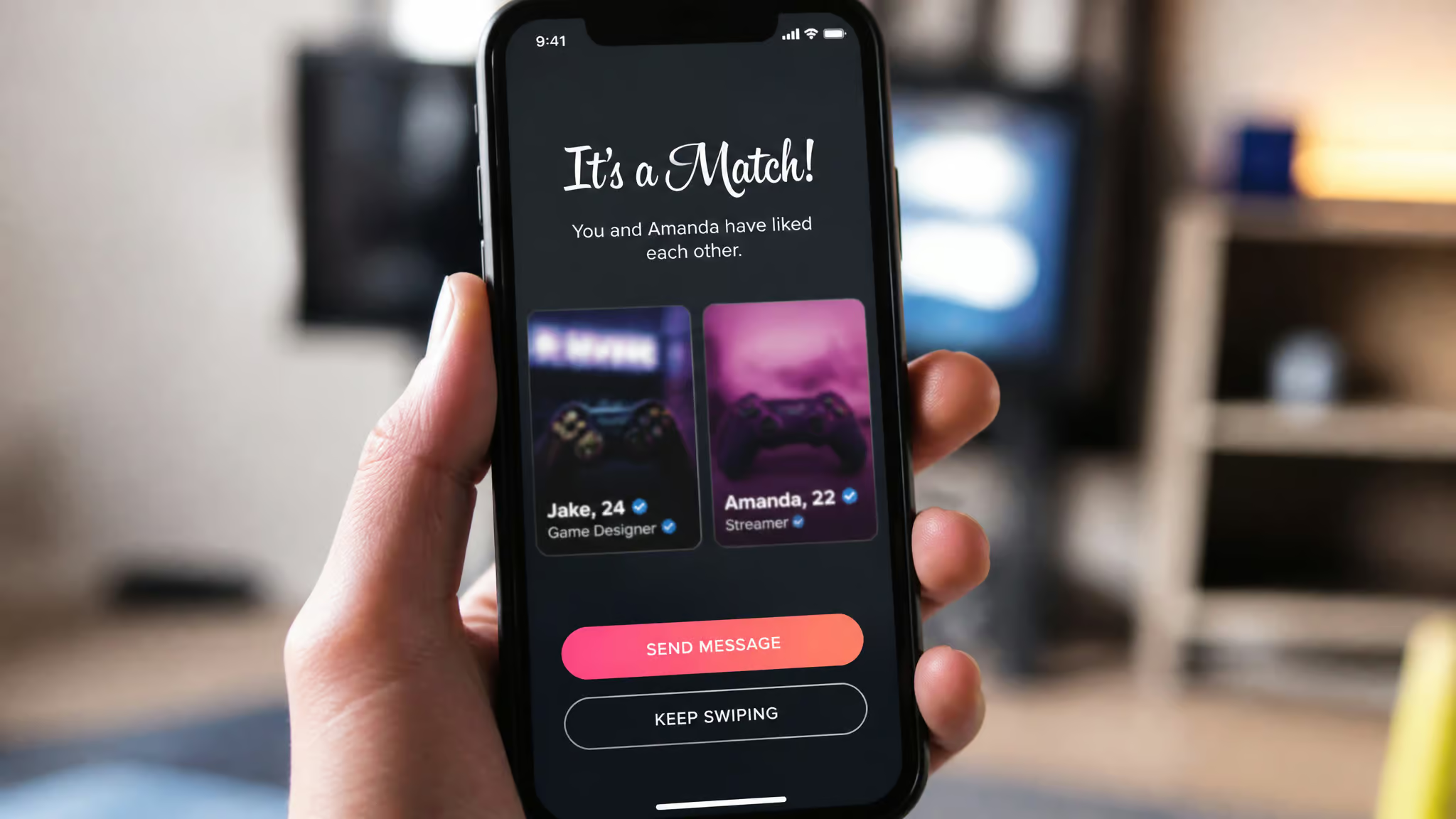
Yes, there’s a Tinder for gamers
Yes, gamer dating apps exist, and they’re an established category, not a novelty. GamerDating and LFGdating both have documented track records: GamerDating positions itself as a community of adults looking for real love in-game and out, while LFGdating runs on iOS, Android, and web and claims to be custom-built for gamers, though that last part is their own marketing talk.
GamerDating is built for adults who play games and want actual relationships, in-game and off, not a hookup app with a gaming skin. The marketing leans cheesy, with taglines like ‘Life is a game, Play with someone you Love’, but the underlying mechanics are practical. Search and matchmaking tools cover guys down the street and across the globe.
LFGdating has been around since 2012 and runs on iOS, Android, and web, so whatever device you’re on, it’s covered. They call themselves the world’s only 100 percent custom-built premium gamer dating app, and the most-trusted, and the number one. All of that is their own marketing about themselves, so file it accordingly.
GamerDating vs LFGdating
The honest comparison comes down to what each one actually does, because both attack the same core problem of intent and profile context, just from different angles: GamerDating is built around a searchable game library and matchmaking, while LFGdating leans on human-reviewed profiles and an ad-free premium tier. Here’s how each one works in practice.
GamerDating: game libraries and matchmaking
The signup experience is light: profiles are preferences plus pictures, and the platform calls your ideal match your “Player 2.” It’s a gamer in-joke, and here it lands, and then you move on. Signing up means agreeing to their terms of service, same as every app ever.
The interesting mechanic is the game library. You add your favorite games to your profile, and you can search what other singles are playing. That combo is the discovery engine of the whole platform. Someone who plays the same games as you can find you by title, which means your library is doing the opening line before you type anything.
Subscribers also get rewards on top of dates, which the site frames as something to do together. Nice perk, not the reason to sign up.
If discovery-by-game and local or global search fit how you’d want to meet someone, this is the straightforward pick.
LFGdating: verified profiles, ad-free premium
The origin story is good texture: founded in 2012 by two founders with unlikely day jobs: one taught high school English, the other served as a Marine Corps officer. That’s an odd pairing, and over a decade of running the thing counts for something in dating-app years.
The main differentiator is that a team of actual humans reviews and approves every new profile. Fewer fake profiles means less time messaging a “woman” who turns out to be a crypto bot. The premium tier, which they call “Focused on Love,” is what you’d expect from a paid tier done right: no spam, no ads, real gamers with real profiles, conversations that start real. You’re paying to skip the junk.
On the service side, the operators, including a guy named Casey, claim to respond to members within 24 hours, and they do Reddit AMAs where founders answer questions publicly. They note their so-called competition never bothers. Slightly cocky, but responsiveness like that suggests the operators actually care. Honest read: responsive founders also signals a small operation, which has upsides and downsides.
Red flag: If a niche dating platform won’t tell you who reviews profiles, assume bots before you enter card details.
So the contrast: GamerDating if finding people by shared games and filtering by distance is your play. LFGdating if vetted profiles and an ad-free experience matter more to you.
How to spot real profiles instead of bots
The first thing to check on any niche dating platform is how profiles get vetted, because niche communities attract bot farms faster than mainstream ones do. That’s the check experienced users run before entering card details anywhere, and it’s a three-question evaluation. LFGdating works as the worked example.

Verification method: who reviews new profiles? LFGdating has actual people checking every single one before it goes live.
Business model: does the platform make money from ads? If it does, the incentive tilts toward volume. LFGdating’s whole premium pitch is the opposite, no ads and no spam.
Operator reachability: can you get a human? LFGdating promises 24-hour responses and does public Reddit AMA sessions where founders answer questions directly, which, again, they say their competition doesn’t do. The same crew backs it up with stellar customer service, so a stuck profile or billing question actually gets answered by a person.
The honest limit: LFGdating claims human review, not a zero-bot guarantee, and this guide hasn’t verified how other platforms vet anyone. So run the three questions as a filter, not a certificate.
Own your gamer identity
Don’t hide it. Here’s the spiral LFGdating’s own copy describes, and every gamer reader has lived some version of it: you build a profile on a mainstream app, start wondering whether matches will even reply once they read “gamer,” and quietly bury the hobby. The result is the bio that lists every interest except the one consuming most of your week. It’s dumb that the stereotype exists, but there it is.
The reframe: gaming works as a filter rather than a flaw. Putting your actual games up front pre-qualifies matches instead of attracting people you’ll have nothing to say to by week three.
The concrete tactic applies directly on GamerDating: list the games you actually play in your library, because other singles search by title and find you. It reverses the usual photo-optimization advice. Your library, not your headshot, is the discovery signal. And list your real library, not your most impressive three games. The guy who actually plays Stardew Valley on weeknights should say so.
From match to shared play
Here’s where most gamer dating matches die: the conversation hits “so what do you play?” and then loops there for two weeks, because nobody proposes an actual session.
The fix is to propose one scheduled, low-pressure co-op session early. That could be tending a Stardew Valley farm, queueing as a Fortnite duo, or grinding Azeroth, pick whatever you’d actually both enjoy.
Gaming becomes the structure of the date instead of just the topic of the texts. You already know you’re compatible on the one thing that matters to you both; the session confirms whether the company holds up outside a lobby.
GamerDating built its subscriber rewards around exactly this rationale. Their line is that love is its own reward, but they wanted to give you something to do together. Cheesy, attributed, and honestly correct.
Free apps vs paid niche sites, honestly
Free mainstream apps give you volume, ads, bots, and the stereotype problem. Niche platforms give you signal, meaning vetted profiles and no ads, at the cost of a smaller pool. That’s the trade. You’re choosing which failure mode you’d rather live with.
The honesty beat: neither platform publishes pricing, user counts, or outcome data. Nobody can answer “is it worth paying” with math, including me. What you can check is what each one actually does, which is the whole point of this article.
As for the question everyone asks: what app do gamer girls actually use? There’s no gender-specific usage data. Both platforms are built for gamers, period. The commonly cited industry figure that roughly half of gamers are women is from broad industry surveys, not these platforms, and it doesn’t tell you where any individual woman spends her time.
Pick the venue that matches the partner you actually want, put your real games front and center, vet how the platform handles profiles before you pay, and propose a session rather than letting another week pass on “what do you play?” These sites exist because wanting a gamer girlfriend is a legitimate thing to want, not something to apologize for in your own bio. Pick one venue this week and rebuild the profile around the games you actually play.
Frequently Asked Questions
Is a paid gamer dating site worth it over free apps?
It’s a trade-off, not a clear win: free mainstream apps give you volume along with ads, bots, and the stereotype problem, while niche platforms give you signal — vetted profiles and no ads — at the cost of a smaller pool. Neither major gamer dating platform publishes pricing, user counts, or outcome data, so nobody can answer the worth-it question with math. What you can check is how each platform vets profiles before you enter card details.