Your AC stops cooling. The house starts to feel like a parking lot in July. Your first instinct is to grab the phone and book a service call, bracing for a bill that could run into the hundreds or thousands.
Before you do that, check the thermostat. The cheapest component in your entire HVAC system is also the most common failure point, and it’s usually the last thing anyone thinks to look at. A blank thermostat screen is almost never a dead thermostat. It’s dead batteries, loose wiring, or a tripped breaker.
A replacement thermostat runs $20 to $200. A service call to diagnose the same problem runs a lot more than that.
The diagnostic path is simple if you follow it in the right order. Here’s how to figure out whether you’re dealing with a $5 fix or a real mechanical failure.
Key Takeaways
A blank thermostat screen is usually dead batteries, loose wiring, or a tripped breaker, not a dead thermostat, and a replacement costs just $20 to $200.
Short-cycling (frequent on/off without reaching your set temperature) points to a dirty air filter first, so change that before calling anyone.
Trane smart thermostats carry a 10-year registered warranty if installed by a dealer and registered within 60 days, versus the 1-to-3-year warranties most other brands offer.
Table of Contents
Seven signs the thermostat is the problem
Thermostats fail in recognizable ways. If yours is doing any of the following, the problem is probably in the wall, not in the mechanical system.
Blank screen. This is the big one. Dead batteries, loose wiring, a tripped breaker, or the thermostat itself gave up. One thing most homeowners don’t realize: the thermostat might share a breaker with the indoor furnace or air handler, not the outdoor AC unit.
Check the right one. And if the breaker tripped, don’t just flip it back. A tripped breaker can signal a system problem, and resetting it without fixing the underlying issue can damage the equipment.
System won’t turn on. Faulty wiring or a bad connection can stop the thermostat from talking to the HVAC system. If the display works but the system won’t kick on, that’s a wiring or circuitry issue worth a professional’s look.
System runs nonstop. It’s not always about extreme outdoor temperatures. Sometimes the thermostat just isn’t sending the “stop” signal. Try turning the thermostat off. If the system keeps running anyway, the wiring may be bad or the thermostat needs recalibration.
Short-cycling. On, off, on, off, never reaching the temperature you set. That’s the definition of short-cycling, and it’s hard on the equipment. Usually it’s a bad thermostat or a dirty air filter.
Start with the filter. Swap it out first, and if that doesn’t fix it, call a pro.
Erratic temperature changes or hot/cold spots. Temperatures jumping around the house is a classic sign of a failing thermostat. A dying thermostat can’t read the room right, so the whole house feels off. But it’s not always the thermostat. Other HVAC issues can cause the same symptom, so if your home never feels right, get a pro to check the whole system.
Incorrect temperature readings. The thermostat says 70 but the room feels like 80. Something’s off. The thermostat should match what you feel, and if it doesn’t, trust your gut.
It could be where the unit is placed, a need for recalibration, or the system short-cycling. Start with placement. Thermostats in direct sunlight, near drafty windows, or close to heating and cooling sources read the room wrong.
Forgets programmed settings. If your thermostat keeps losing your schedule, that’s not just annoying, it’s a sign. It might need recalibration or a software update. Check that before replacing anything. If it’s old, it might just be worn out.
Stuck on one temperature. If it won’t budge from a single temp, it might be locked. Press plus and minus together for at least 5 seconds to unlock it. If it’s not locked, change the batteries and reset the breaker. Simple stuff first.
Quick test: Press plus and minus together for 5 seconds to unlock a stuck thermostat before you replace anything.
Five signs it’s actually the AC, not the thermostat
The opposite mistake is just as common: replacing a perfectly good thermostat while the mechanical system is failing. Here’s how to tell the difference.
Weak airflow. If the air barely moves, the problem is downstream of the thermostat. Possible causes include clogged air filters, blocked ductwork, failing blower motors, or frozen evaporator coils. A dirty air filter restricts airflow and makes the system work harder.
That extra strain affects efficiency and shortens the system’s life. Change the filter before you do anything else.
Strange noises. Air conditioners always make some noise, yet unusual sounds deserve attention. The noise tells you what’s wrong. Rattling means loose components.
Grinding means motor problems, squealing means belt or bearing issues, and buzzing means electrical concerns. This is the detail most homeowners never learn, and it’s the fastest way to narrow down the problem.
Unpleasant odors. Musty smells mean mold or mildew in the unit or ductwork. Burning or electrical smells mean overheating components or wiring issues. Neither one is a thermostat problem.
Water around the unit. A small puddle near the air conditioner can be easy to overlook, yet any moisture near the unit warrants investigation for common AC warning signs. Clogged condensate drain lines, malfunctioning components, or refrigerant leaks. Any leak in the cooling system needs prompt attention. Don’t wait on this one.
Sudden energy bill spike. This is the shared symptom, the one that appears in both failure worlds. When it’s the AC, the causes are dirty coils, failing components, refrigerant issues, or airflow restrictions. If the problem is a failing part, recognizing AC capacitor failure symptoms, like hard starting, humming, or no cooling, can explain why this small component brings the whole system down, whereas dirty coils reduce cooling efficiency because they move heat out of your home, and when they’re dirty, the system struggles.
Leaky ductwork wastes cooled air, so the system runs longer to compensate. Blocked vents reduce airflow. An aging system loses efficiency, so it might still run, but not well.
How to tell the difference: thermostat vs. AC
The rising energy bill is the fork in the road. It appears in both failure worlds, and the path you take from that symptom determines whether you fix a $20 problem or a $2,000 one.
First, look at your habits. Costs rise with frequent large adjustments, setting the temperature lower than necessary, or leaving the system on while the house is empty. If your habits haven’t changed but the bill has, something else is wrong.
Then run the test sequence in order:
- Check power. Make sure the AC unit is actually getting power. Sometimes it’s just a tripped breaker or a blown fuse.
- Check batteries. Change them first. That’s the most common fix for a blank screen or unresponsive display.
- Check wiring. Loose terminal screws or corroded wires cause all sorts of intermittent issues.
- Test thermostat response. Change the temperature and see if the system responds. If changing the temp does nothing, that’s a clear sign something’s broken.
- Check the outdoor unit. Make sure it’s actually running. If the thermostat is calling for cool but the outdoor unit is silent, the problem is in the mechanical system.
The temperature mismatch test is the most direct diagnostic. Tape a thermometer next to the thermostat, wait 20 minutes, and compare readings. If the thermostat says 70 but the thermometer says 80, the sensor is lying to you. That confirms a sensor or placement issue, not a mechanical failure, so check your AC servicing checklist to rule out other causes.
Placement matters more than most people realize. Direct sunlight, drafts, proximity to heating and cooling sources, and isolated areas all throw off accuracy. If the thermostat is poorly placed, consider moving it. That might fix the issue entirely.
Quick test: Tape a thermometer next to the thermostat and wait 20 minutes. If they disagree, the sensor is the problem.
DIY fixes to try before calling anyone
Most thermostat issues are fixable in under 15 minutes with basic tools. Work through these from cheapest to most involved.
Batteries first. The $5 fix for blank screens and unresponsive displays. Change the batteries before you do anything else.
Breaker check. The thermostat may share a breaker with the indoor furnace or air handler, not the outdoor AC unit. If the breaker tripped, consult a professional before resetting. A tripped breaker may indicate a system problem, and resetting without addressing it could cause damage.
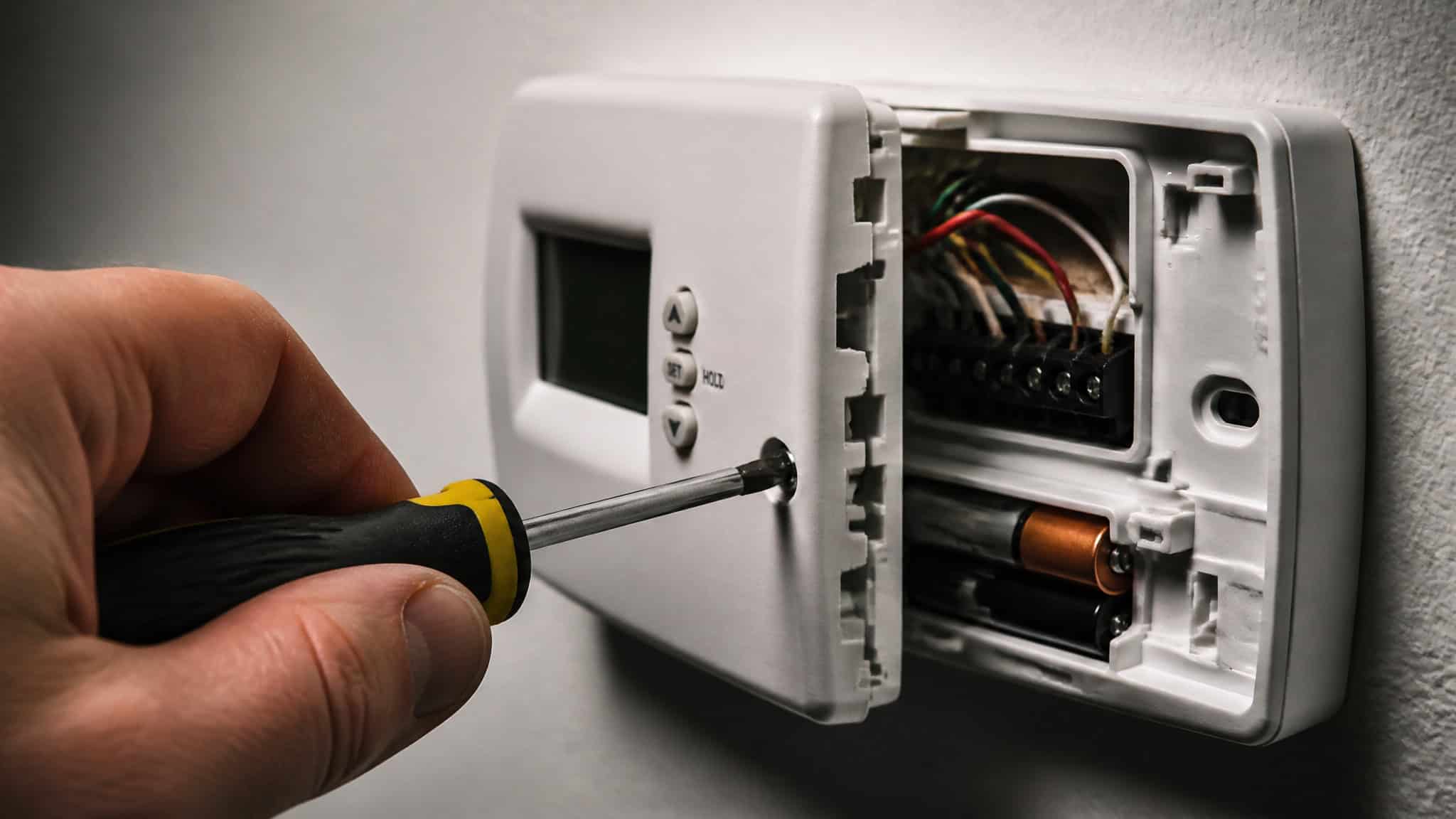
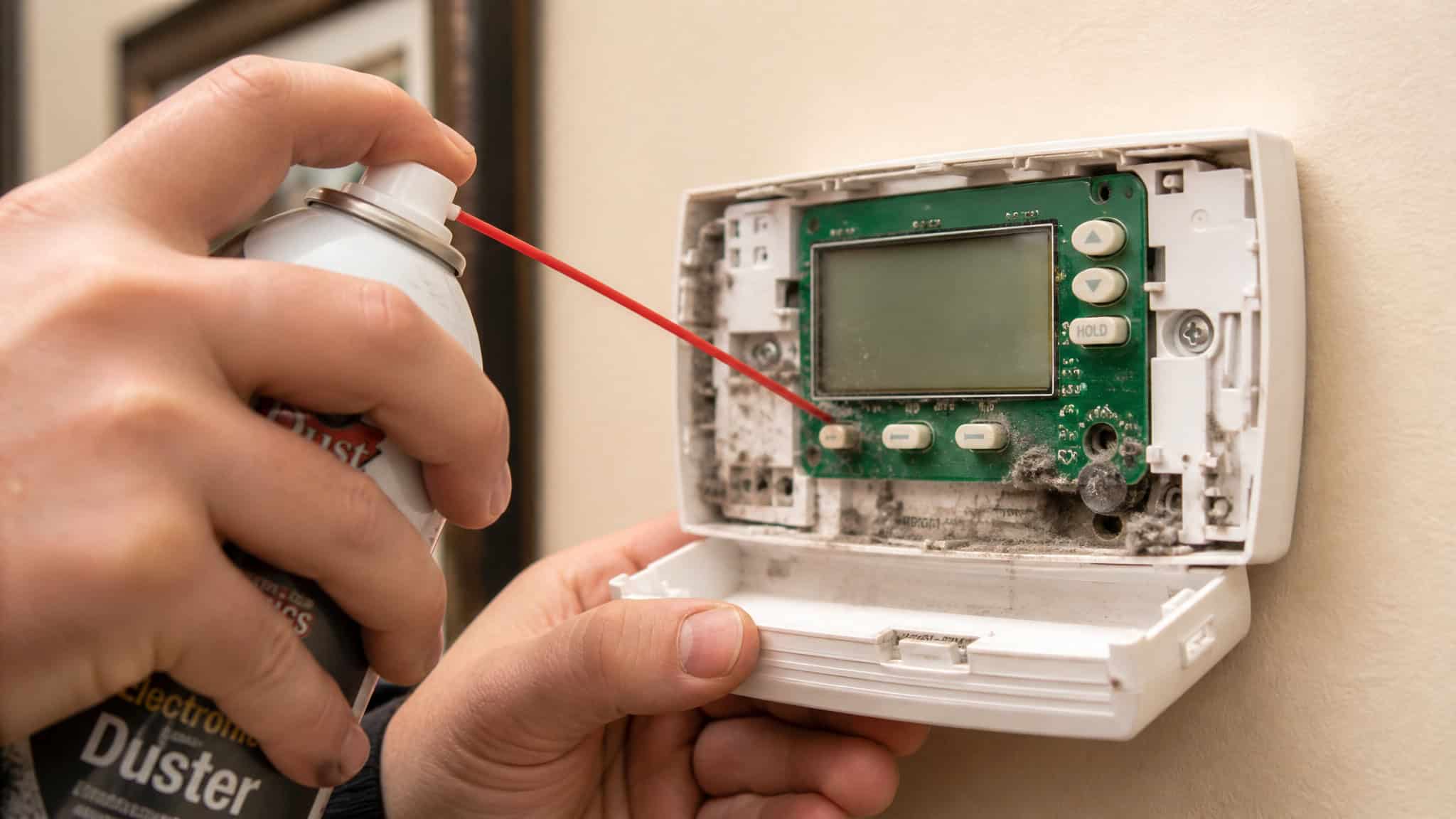
Clean the interior. Dust, dirt, even nicotine residue can coat the components and affect performance. Shut off the thermostat breaker before removing the cover. Use compressed air or a soft brush, gently. That might be all it needs.
Level check. Mercury-switch thermostats get thrown off if the unit isn’t level. If it’s tilted, it’ll read wrong. Use a bubble level to verify. Simple and quick.
Anticipator adjustment. This is the forgotten mechanical fix. The anticipator is a little dial that controls how long the AC runs per cycle. If the system cycles too often, move the arm one notch toward “longer.”
If it never reaches the temperature, move it one notch the other way. Give it two to three hours to adjust. Don’t expect instant results. This solves short-cycling without any replacement, and almost nobody knows about it.
Wiring check. Loose terminal screws or corroded wires cause all sorts of intermittent issues. Tighten the screws, carefully scrape off corrosion with a knife, if you’re comfortable doing that. If you’re not, skip this step and call a pro.
Placement fix. Relocate the thermostat away from direct sunlight, drafty windows, heating and cooling sources, or isolated areas. Where it sits matters.
When to replace the thermostat instead of fixing it
If troubleshooting hasn’t fixed the problem, you’re dealing with frequent issues, inexplicably high utility bills, a thermostat over 20 years old, or deep-rooted electrical problems. These are indicators, not certainties, but they point in the same direction.
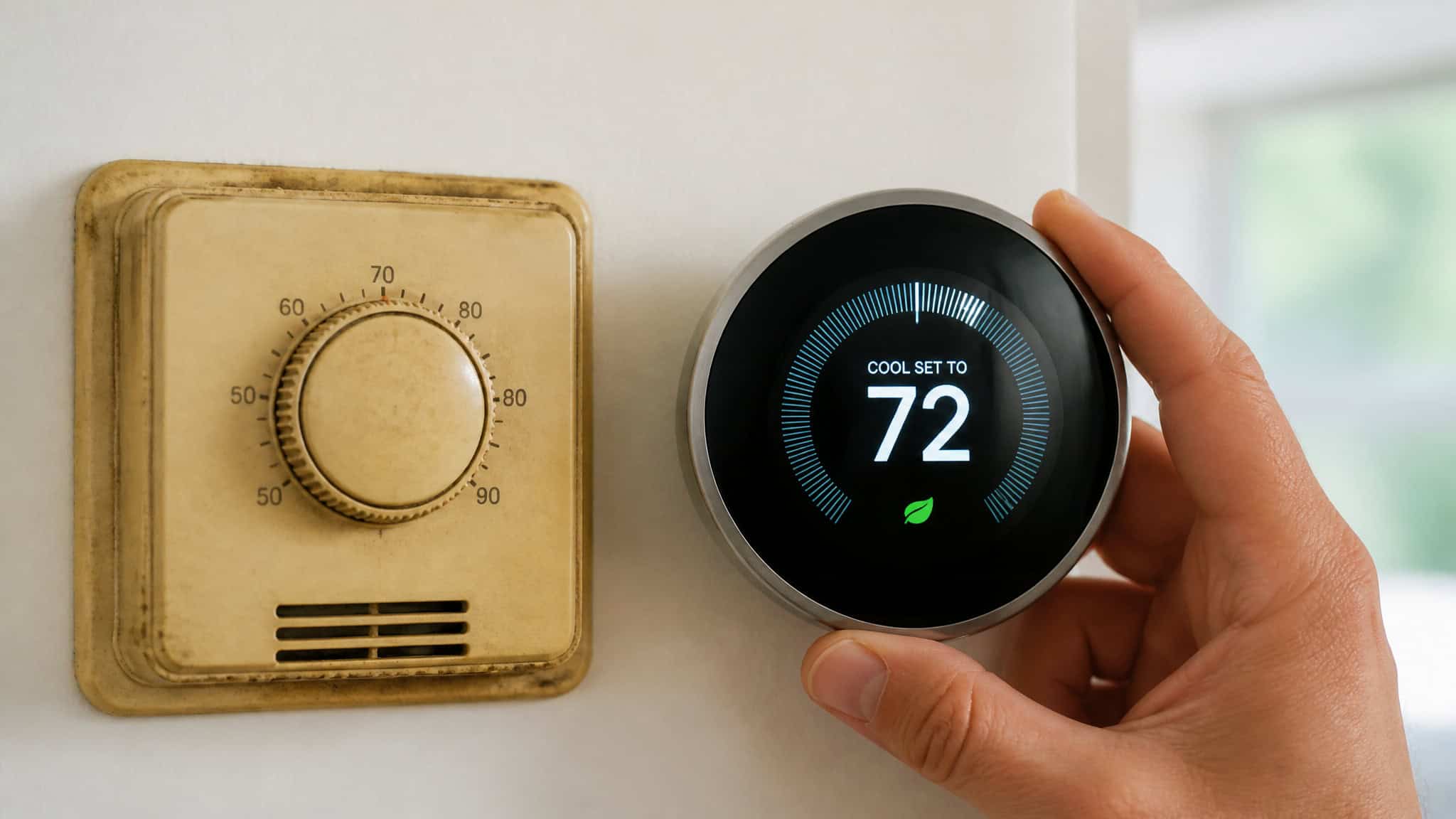
The cost makes the decision easy. A typical programmable thermostat runs $20 to $200, and installation costs little. That’s the stark comparison against potentially thousands in AC repair. Thermostats typically last about 10 years, so more than 20 years strongly suggests replacement. Older units may lack programmable schedules and smart controls, which means you’re missing out on easy energy savings.
Here’s the trap most homeowners fall into: not all thermostats work with every system. Heat pumps and variable-speed systems need specific thermostats. A variable-speed system may need a thermostat that handles hundreds of fan speeds, and most homeowners don’t know this until they’ve bought the wrong one. Don’t assume any thermostat will work with your setup.
Installation should be done by an HVAC technician. Wiring and testing aren’t DIY-friendly, and getting it wrong means more problems than you started with.
Bottom line: A variable-speed or heat pump system needs a specific thermostat. Don’t assume any model will work.
Going smart: what the upgrade actually gets you
Smart thermostats add remote control, programmable scheduling, and energy optimization. They help cut energy bills and improve comfort, if you use them right. The remote control works through a home app, so you can adjust heating and cooling from your phone, anywhere. That’s the convenience angle.
The proactive angle is the monitoring service. It’s like a dashboard warning light for your home. A dealer can identify minor issues early, preventing them from escalating, shifting the approach from emergency repair to routine upkeep.
The warranty comparison is the real differentiator. Trane smart thermostats carry a 10-year registered warranty if installed by a Trane dealer and registered within 60 days. The XR724 model has a 5-year warranty, which is still decent. Other brands typically offer 1 to 3 years.
That gap changes the total cost of ownership calculation. A thermostat that’s covered for a decade is worth more than one that’s not, even if the sticker price is higher.
When to call a professional
Simple fixes are homeowner-safe: batteries, dusting, level checks. Complex tasks are professional territory. Wiring, circuitry, and compatibility issues require professional diagnosis. If you’re uncomfortable at any step, call.
That’s not a failure. That’s the boundary working.
Safety note: shut off the thermostat breaker before removing the cover for inspection. A tripped breaker may indicate a system problem, and resetting without fixing the underlying issue could damage the entire system.
If you need a local referral, companies like Comfort First Heating & Cooling offer same-day service and upfront pricing, and they work on all HVAC brands. They cover Palm Beach at 561-202-1422 and Port St. Lucie at 772-905-3358. In Western North Carolina, All Seasons Heating & Air Conditioning is based in Fletcher, NC, and handles AC repair, maintenance, installation, replacement, heat pumps, ductless systems, ductwork, indoor air quality, furnaces, and boilers. They’re at 828-651-9998.
The boundary is simple: if you’ve tried the cheap fixes and the problem persists, stop guessing. A professional diagnosis costs less than a wrong replacement.
People Also Ask
How do I know my AC thermostat is bad?
A blank screen, system running nonstop, short-cycling, erratic temperature swings, incorrect readings, or forgetting programmed settings are all classic signs. Before blaming the thermostat itself, check for dead batteries, loose wiring, or a tripped breaker — those are the most common culprits and cost almost nothing to fix.
How do I reset my AC thermostat?
Start by changing the batteries and checking the breaker, since the thermostat may share a circuit with the indoor furnace or air handler. If the screen is stuck on one temperature, press the plus and minus buttons together for at least 5 seconds to unlock it. For a full reset, you may need to consult your specific model’s manual, but the simple fixes resolve most issues.
What is the most common cause of a thermostat failure?
It’s rarely a dead thermostat. The most common causes are dead batteries, loose wiring, or a tripped breaker — all of which are cheap and easy to fix. A dirty air filter can also cause short-cycling, so swap that out before calling a professional.
What’s the difference between a thermostat problem and an AC problem?
If the thermostat display works but the system won’t kick on, or if it’s giving incorrect temperature readings, that points to the thermostat. Weak airflow, strange noises, unpleasant odors, or water around the unit point to the AC itself. A sudden energy bill spike can be either, so run the test sequence: check power, batteries, wiring, then see if the outdoor unit actually runs when the thermostat calls for cool.
Is a smart thermostat worth the upgrade?
Smart thermostats add remote control, programmable scheduling, and energy optimization, which can cut bills if you use them right. The real differentiator is the warranty — some brands like Trane offer a 10-year registered warranty if installed by a dealer and registered within 60 days, versus the 1-to-3-year warranties most other brands offer. That gap changes the total cost of ownership.