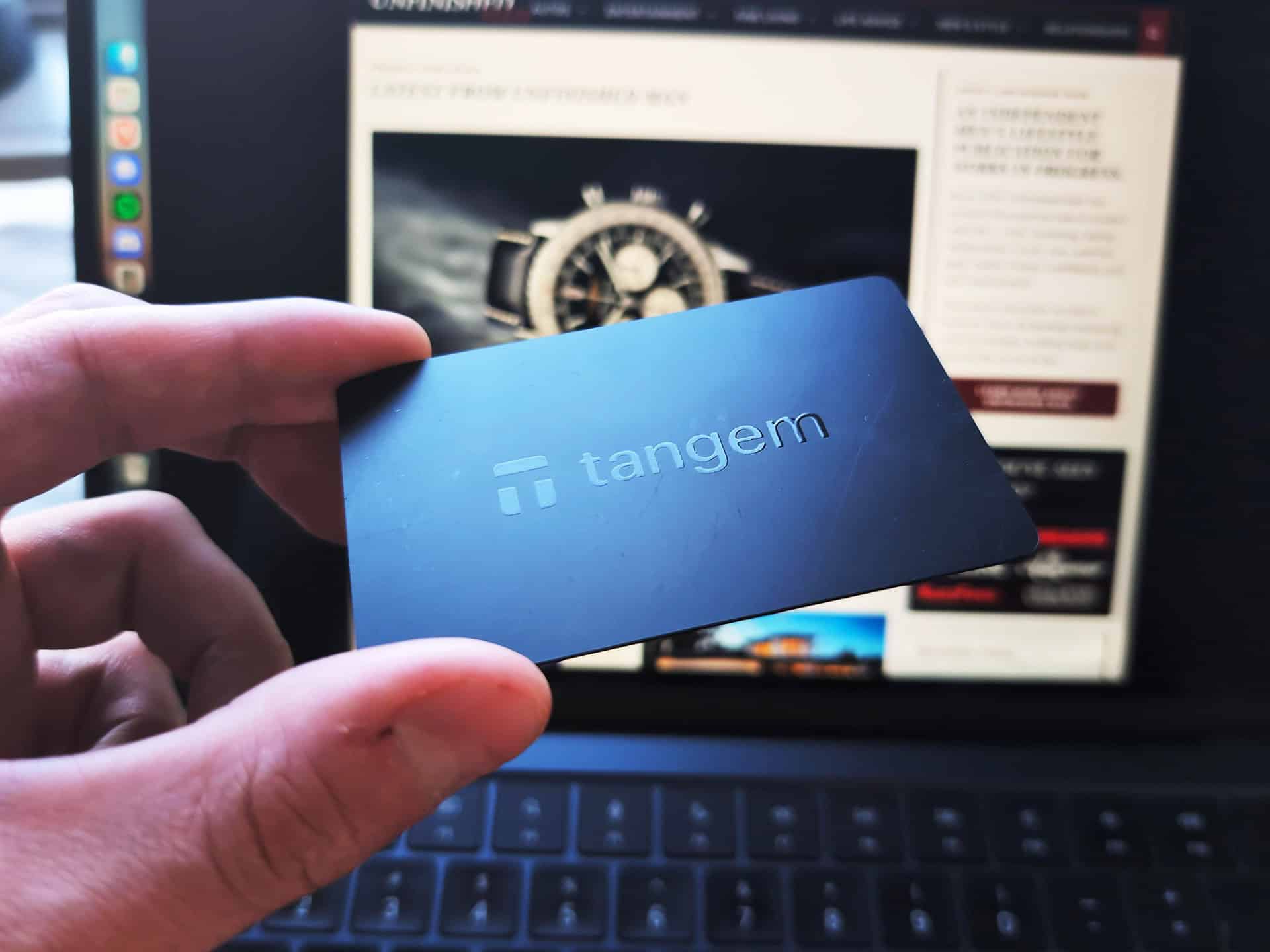
You’re standing at a checkout page with two very different things in your cart. One’s a $55 credit card you tap against your phone. The other is a $79 to $399 gadget with a screen, made by a company that’s been selling them since 2014. Both claim to keep your crypto safe. Both are probably right, in the way that matters most of the time.
Here’s the part nobody puts in the affiliate reviews: the case against each wallet was written by the other wallet’s company. Ledger’s team dug up the sharpest anti-Tangem material. Tangem’s blog is where the Ledger Nano S deprecation story got the full treatment. Neither vendor is neutral, and this piece won’t pretend otherwise. Every security claim below gets attributed to whoever made it, which honestly is the only way to compare two security products without laundering somebody’s marketing into fact.
So the Tangem wallet vs Ledger question isn’t really “which is safer.” It’s which way you’d rather lose money: getting tricked at the moment you sign a transaction, or getting stranded when a product line dies a few years after you bought it. Both failure modes have receipts. Let’s go through them.
Key Takeaways
Ledger is the safer pick for verifying what you sign because its screen shows the transaction on the device itself; Tangem is the safer pick against your wallet becoming obsolete, since no Tangem product has ever been deprecated while Ledger ended Nano S support in June 2025.
The February 2025 Bybit hack showed screens displaying legitimate addresses while hidden code moved about $1.5 billion, which is the strongest argument for on-device verification.
Tangem runs $54.90, $69.90 with a 25-year warranty; Ledger runs $59, $399 with a 1-year warranty and a documented replacement cycle.
Table of Contents
At a glance: where the two designs actually differ
Ledger is the safer pick for verifying what you sign, because its screen shows the transaction on the device itself. Tangem is the safer pick against your wallet becoming obsolete. Everything else is detail.
First, the part they agree on. Both wallets generate your private keys on the device and sign transactions offline, inside a tamper-resistant chip that never touches the internet. Neither one makes you paste your seed phrase into a website. Think of the chip as a little vault: the key lives in there, it never touches the internet, and signing happens inside the vault walls. They both get that right, so the fight is about what happens above that floor.
Tangem’s bet is the card. Credit-card thin, no screen, no buttons. You tap it against the back of your phone and NFC does the rest, like paying for coffee with a contactless card. “Carry crypto like cash” is their pitch, and it’s good marketing, but it’s marketing.
The technical reality is that the card only signs a hash. Your phone builds the transaction, shows you the address, and does the verifying. The card trusts whatever the phone shows.
Ledger’s bet is the opposite: don’t trust your phone’s screen, bring your own. A dedicated signer with its own touchscreen, bigger on the Nano Gen5, Flex, and Stax, which is a big part of why the price climbs. The screens are driven directly by the Secure Element, offline. Plain version: the screen can’t lie, because your phone isn’t drawing it.
So where does the code that decides what you sign actually run? On a Tangem, it runs on your phone. On a Ledger, it runs inside the certified chip. That’s the hinge everything else swings on.
Blind signing and compromised interfaces
On-device verification matters most if you sign anything beyond simple sends, and Ledger’s screen is built for exactly that. If you’re just sending BTC to your buddy once a month, the gap is smaller. If you’re doing DeFi, it isn’t small at all.
Blind signing, translated: approving a transaction you can’t actually read. When details can’t render on a device, it shows you raw hexadecimal code or a cheerful little “Data Present.” Nobody reads hex. It’s the equivalent of signing a contract written in a language you don’t speak.
You’d never do it with a house. People do it with six figures of crypto.
The second problem is the compromised interface. If the thing showing you the transaction is hacked, you approve the wrong thing without knowing. Malware on your phone can quietly swap the transaction before it reaches the card over NFC. The card signs honestly. It’s just signing the wrong thing.
The Bybit hack is the proof this isn’t theoretical. February 2025: attackers socially engineered their way into a supplier’s system, not broken crypto, just fooled people and machines that did what they were told. The screens displayed legitimate addresses while hidden code moved about $1.5 billion in seconds. That accounting comes from Fortune.com, TRM Labs, and NCC Group. One of the largest thefts in history, and the displays said everything was fine.
Now picture the common pattern: a guy approves a transaction on his phone screen without ever checking that what’s displayed matches what’s actually being signed. That’s not a stupid-user story. It’s the exact gap the Bybit attack used.
Ledger’s verification stack
Ledger’s answer to the display problem has two layers, and both are worth knowing about before you buy either wallet.
The first is Clear Signing, built on the EIP-7730 standard. One sentence version: transactions show up in plain English on the tamper-proof device screen, and it’s native in the Ledger Wallet app, so within Ledger’s own software, what you see is what you sign.
The caveat almost nobody covers: through MetaMask, Phantom, or other dApps, Clear Signing depends on the dApp sending parsed metadata. Complex contract interactions can still end up blind-signed. Ledger is expanding support across the ecosystem, so the momentum is real, but it’s not finished. Don’t buy a Ledger thinking every dApp is covered.
The second layer is Transaction Check. Before you approve anything, the unsigned transaction gets sent out for independent simulation. Providers send back cryptographically signed risk reports, and the chip verifies the report matches your exact transaction before showing the risk on the device screen. A second opinion you can actually trust, because it’s signed. It comes standard on every Ledger, not as a paid add-on.
Tangem has no equivalent to either. No screen to show risk, no updatable firmware to add one. That’s the capability gap, stated flat, and it’s the single biggest argument in the Tangem wallet vs Ledger debate.
Firmware: unpatchable bug vs. orphaned device
Tangem’s firmware can’t be updated, and that’s the headline disadvantage. An unpatchable bug stays a bug forever. If something’s broken, the fix is new cards, which is a weird kind of warranty.
Ledger’s team, the Donjon, their in-house crew that continuously attacks their own gear, reportedly found a password rate-limiting bypass that let weak passwords be brute-forced on cards shipped before the fix. Because Tangem firmware is immutable, it can’t be patched on cards already in pockets. Hold onto two things from Ledger’s claim: it’s their claim, not neutral fact, and it only bit people using weak passwords.
Ledger’s counterpoint to the whole update debate: firmware updates fix bugs while keys stay inside the Secure Element. The update goes around the trust boundary, not through it. Ledger’s CTO, Charles Guillemet, put it this way on February 2, 2026: “Freezing the system doesn’t protect users, it protects the attacker.”
Red flag: If a vendor’s core claim about a competitor comes only from the competitor’s rival, hold it as a claim, not a fact.
Now give Tangem’s side equal weight, because the same immutability is why every Tangem generation still works. The audits are legit: Kudelski Security in 2018, Riscure in 2023. But those are snapshots, years apart, with closed firmware nobody can inspect in between. Ledger runs a continuous find-fix-retest loop on code that touches your keys.
Audits are snapshots, not shields. Continuous beats occasional, mostly.
Except when it doesn’t. A Coinkite Coldcard bug from 2021, an RNG downgrade, sat in public open-source code for years before tens of millions in Bitcoin got stolen in July 2026. Open code, big loss. So execution quality matters more than the source model, and if you fear an unpatchable bug, you should equally fear an unpatchable business model. Pick your poison knowingly.
Longevity and the migration tax
On lifespan, Tangem wins on the record: no Tangem product has ever been deprecated, while Ledger’s most-distributed model already lost support. If “which lasts longer” is your question, that’s the answer.
The Nano S story, in past tense, because it’s all done. Launched June 2016 at around $66, sold for six years as the most-distributed hardware wallet on the market, retired June 2022, and then in June 2025 Ledger ended all updates, app submissions, and security patches. The reason is the 320 KB of flash memory ran out. The thing can’t run Clear Signing, Transaction Check, Ledger Sync, NFT transfers, THORChain or Uniswap swaps, or even new language packs. Emergency patches might be possible until 2026, no promises.
The typical Nano S owner’s position right now: restore the seed onto new hardware, or move funds on-chain and pay gas. Ledger offered 20% off replacements, and the touchscreen models run $149 for the Gen5 up to $399 for the Stax. Tangem’s blog calls this a “migration tax,” which is vendor framing, but it’s also honestly how it feels: a penalty for owning the older thing.
Then there’s the Nano X battery, the thing nobody mentions at checkout. It’s a sealed 100 mAh battery, non-replaceable. Ledger’s own failure numbers: 1.4% die in the first six months, and by the one-year mark you’re at about 3.3%. Ledger’s advice: charge it every three months. So your backup device needs a charging schedule, like a smoke detector with worse consequences.
Tangem’s counter is strong here: no battery at all. NFC-powered, IP68 rated against water and dust. The Note from 2018, Wallet 1.0 from 2022, and Wallet 2.0 from 2023 all still work, because the app adds features while the card only does cryptography. Someone who reads our Tangem wallet review and buys one today, and even those who bought a Tangem Note with 0.01 BTC back in 2020, can still tap and move it, with 10% off making the entry point easier.
Updatability fixes bugs. Immutability dodges obsolescence. Your call which risk you’d rather carry.
Authentication and recovery: where the defaults can cost you everything
Yes, you can permanently lose crypto on a Tangem Wallet if you lose all your cards and never enabled the seed backup during setup. That’s the blunt answer, and the two-card default is where it gets interesting.
Side by side: Ledger puts the PIN on the device screen and wipes it after 3 wrong tries, with an optional 25th-word passphrase also entered on-device, which creates a hidden decoy wallet behind your main one. Tangem has you type the password on your phone, with a security delay. That’s the exact mechanism the Donjon bypass targeted. If you use a seed phrase with Tangem, that gets typed on the phone too.
Here’s the part the buyer who never opens settings needs spelled out. Tangem cards ship with identical keys, so any card works, like a spare house key, the same convenience that draws people to a slim cardholder wallet in the first place. Password recovery is enabled by default. That means someone holding two of your three cards can reset your password and get at your funds immediately, because Tangem treats possession of two cards as proof of ownership. Most people never flip default settings. Say it straight: two stolen cards, defaults on, money gone.
Quick test: Before you buy, decide whether you’ll enable the seed backup and change the recovery default. If the answer is no, the two-card setup is your single point of failure.
Lose every card and it’s over, unless the seed backup was on during setup. The multi-card backup cuts both ways: great redundancy if you keep them apart, a single point of failure if they all disappear together.
Ledger’s answer is boring and good, in the best way. A 24-word BIP-39 phrase generated on the device, restorable in any compatible wallet. If Ledger the company vanished tomorrow, you’d recover your coins anywhere. With Tangem, you’re tied to their cards and their app; so what are the disadvantages of Tangem?
In short: vendor lock-in, single-device backup questions, and a seed phrase approach that differs from the open standard. And the privacy note most readers don’t know they care about yet: HD standards rotate your receiving address every transaction, while Tangem reuses one address, so your full balance and history sit visible on-chain.
Ledger also sells two recovery products worth telling apart. The Recovery Key is a Secure Element card holding an encrypted offline copy of your phrase, free with new touchscreen signers, no cloud, no subscription, wipes after 3 wrong PINs. The paid Ledger Recover splits your seed into encrypted third-party shards, which got roasted hard for putting the seed in other people’s hands. Fair symmetric critique: both recovery models put trust somewhere contested.
Certifications, audits, and the open-source myth
Chip ratings alone aren’t enough to compare these wallets, because EAL measures hardware test level, not the code touching your keys. These ratings get thrown around like scripture. They’re not.
EAL, in one plain sentence: it tests the chip’s resistance to physical attacks like side-channel analysis, fault injection, and probing. Here’s the correction almost everyone gets wrong: only the Nano X is EAL5+. The Nano S Plus, Gen5, Flex, Stax, and Tangem are all EAL6+. So “Tangem’s EAL6+ beats Ledger” is wrong, and so is “Ledger’s chip is better.”
Chipmakers like Samsung and STMicroelectronics earn the rating before any wallet code goes on the chip. For context, the NGRAVE ZERO sits at EAL7, which tells you the whole argument lives in a narrow band.
The code is a different question. Tangem leans on the Kudelski and Riscure audits, 2018 and 2023, with the gap between them speaking for itself, and closed firmware nobody can check in between. Ledger runs the Donjon’s continuous loop on exactly the code the EAL rating doesn’t cover.
And open source doesn’t automatically mean safer, the open-source question is one of the big divides in the Tangem wallet vs Trezor comparison. Tangem’s free mobile wallet app is open but its firmware is closed, and a locally compiled Tangem app reportedly doesn’t fully work with the cards, so you’re pushed toward the official app. Meanwhile a December 2024 Tangem app bug saved some recovery phrases to device logs when backup was on. It got patched by update with no reported fund losses, but it proves the phone side is the soft spot.
One line of small print: support emails may attach device metadata like your phone model and OS version. Ledger’s embedded apps are on GitHub, and its genuine check verifies the app on the Secure Element itself. Tangem’s check can’t cover the phone-side logic, because the phone is outside the check.
Ecosystem, privacy, and software risk
Asset support is effectively a tie, so the deciding factor is whether new features preserve the hardware boundary.
Ledger’s numbers: 15,000+ coins and tokens, with about 500 supported natively and 5,000+ through roughly 50 third-party wallets. Be straight with yourself that most coins ride through partners. You get staking on Ethereum, Solana, Polkadot, and Cosmos, cross-chain swaps, DeFi and NFT hooks into Uniswap, Aave, and OpenSea, plus MetaMask, Phantom, Rabby, and WalletConnect support. There’s also FIDO2 passkeys for passwordless logins to things like Gmail and GitHub, which is a genuinely handy extra: one device guarding your money and your logins.
Tangem claims 16,000+ assets across 90+ networks with native swaps and staking through providers. Those are vendor numbers, cited as claims. Near enough to a wash that the count shouldn’t decide anything.
The fresh critique is the early 2026 move: Tangem added software-only hot wallets inside the card-management app. Keys sitting on your phone, no hardware protection, near-identical UI to the cold side. Wrong-wallet sends become easy, and mixing hot and cold storage in one app blurs the exact line a hardware wallet exists to draw. That’s a critic’s concern about a strange design choice, not a proven vulnerability. But it’s a fair flag.
Price, warranty, and track record
Tangem wallets cost $54.90, $69.90 with a 25-year warranty; Ledger devices run $59, $399 with a 1-year warranty. And the sticker price isn’t the real difference.
The quick version of the grid:
| Tangem | Ledger | |
|---|---|---|
| Design | Screenless NFC card | Dedicated signer with touchscreen |
| Verification | Phone display | On-device screen, Clear Signing |
| Firmware | Immutable | Updatable |
| Recovery | 2-3 identical cards, seed optional | 24-word BIP-39, restorable anywhere |
| Privacy | One reused address | HD address rotation |
| Price | $54.90, $69.90, Ring $160 | $59, $399 |
| Warranty | 25 years | 1 year |
On price: Tangem runs $54.90 for two cards, $69.90 for three, $160 for the Ring, and that 25-year warranty number is the eyebrow-raiser. Ledger runs the Nano S Plus at $59, $79, Nano X and Gen5 at $149, Stax at $399, one year of warranty. Lifetime read: one $55, $70 card pack that’s lasted for decades so far, versus a documented replacement cycle of $149, $399. That’s what you’ll actually pay, not just what’s on the sticker today.
Track record, all attributed as Ledger’s claims: 8 million+ units sold, around since 2014, a claim to protect 20%+ of the world’s crypto value, and “no device-level hacks,” which deserves to be held at arm’s length since it’s the vendor grading its own exam. Balance honestly: Ledger had a 2020 customer-data breach and a 2024 breach through vendor Global-e. Data stolen, keys untouched. Tangem has been active since 2017, has the audits mentioned above, and its sales figures aren’t public.
Can Tangem be trusted?
Yes, Tangem can be trusted, with specific caveats: it was audited by Kudelski Security in 2018 and Riscure in 2023, its one notable software bug in December 2024, recovery phrases saved to logs, was patched with no reported fund losses, but its firmware can’t be patched and its two-card recovery default is a real risk.
That’s the specifics, not reassurance. Notice what’s not on that list: any claim that Tangem has “never been hacked,” which you should treat as a red flag whenever you see it in reviews, because nobody’s verified it.
One honest limitation here: there’s no sourced community evidence in this comparison, so this article can’t represent Reddit or forum consensus, and we’re not going to invent any. In fact, no independent, non-vendor evaluation of either wallet exists in the mainstream coverage this comparison draws on. The attribution method throughout this piece, naming which company made each claim, is the trust mechanism. Use it when you read anything else about these two, too.
Which should you buy
Choose Tangem if you want tap-and-go simplicity and the lowest long-term cost; choose Ledger if you sign complex DeFi transactions and want to verify everything on the device itself.
It comes down to two failure modes and which one you’re more exposed to. Getting deceived at signing time is the Ledger buyer’s nightmare, mitigated by the screen, Clear Signing, and Transaction Check. Getting stranded by obsolescence is the Tangem buyer’s nightmare, mitigated by hardware that never went stale. If you’re in DeFi daily, signing contracts, approving swaps, the verification stack earns its price. If you’re a long-term holder who wants a card in a drawer and zero maintenance, Tangem’s record is hard to argue with.
Trust specifics over vibes, and remember both vendors’ best arguments are their own marketing. Read all of it as sourced positioning.
Zoom out once before you swipe the card: most people lose crypto to phishing, fake apps, and bad approvals, not wallet hardware failures. The FBI’s IC3 counted over $5.6 billion in 2023 fraud losses, and almost none of it was a chip getting cracked. A cold wallet for long holds and a hot wallet for daily spending is still the sane setup. For perspective on the wider market, 2026 roundups topped out with the Ledger Stax, the Trezor Safe 7 at $249, and the SafePal S1, and that’s the roundups’ consensus, not mine. There’s no direct Tangem-versus-Trezor head-to-head data here, so if you want that comparison, that’s a different article.
Frequently Asked Questions
What are the disadvantages of Tangem?
Tangem’s main disadvantages: firmware is immutable so bugs can never be patched on cards already in circulation, transactions are verified on your phone’s screen rather than on a trusted device display, and the default two-card setup means a thief with two of your cards can reset your password and access funds. It also has vendor lock-in, reuses a single receiving address instead of HD rotation, and its seed phrase approach differs from the open BIP-39 standard.
What is the most trusted crypto cold wallet?
There’s no independent, non-vendor evaluation of any mainstream hardware wallet, so ‘most trusted’ comes down to which specific trust model you prefer. Ledger is the older, most-distributed brand (selling since 2014, 8 million+ units claimed) with on-device verification, while Tangem has never deprecated a product and carries Kudelski and Riscure audits. Both vendors’ best arguments are their own marketing, so weigh attributed claims rather than trust labels.
Can Tangem be trusted?
Tangem can be trusted with specific caveats. It was audited by Kudelski Security in 2018 and Riscure in 2023, and its one notable software bug — a December 2024 issue that saved recovery phrases to device logs — was patched with no reported fund losses. The real risks are the unpatchable firmware and the default recovery setting that lets anyone holding two cards reset your password.
Which lasts longer: Ledger or Tangem?
On the record so far, Tangem — no Tangem product has ever been deprecated, and the Note from 2018 and Wallet generations from 2022 and 2023 all still work, with no battery to die. Ledger’s most-distributed model, the Nano S, lost all updates and security patches in June 2025, and the Nano X has a sealed, non-replaceable battery. The trade-off: Tangem’s longevity comes from firmware that also can’t be fixed.
Is Ledger’s on-device screen verification really safer than verifying on your phone?
Yes, structurally. On a Ledger, the screen is driven directly by the Secure Element, so your phone can’t redraw what you’re approving; on a Tangem, your phone builds the transaction and the card trusts whatever the phone shows. The February 2025 Bybit hack — where legitimate-looking screens hid code moving about $1.5 billion — is the strongest real-world argument for on-device verification.

