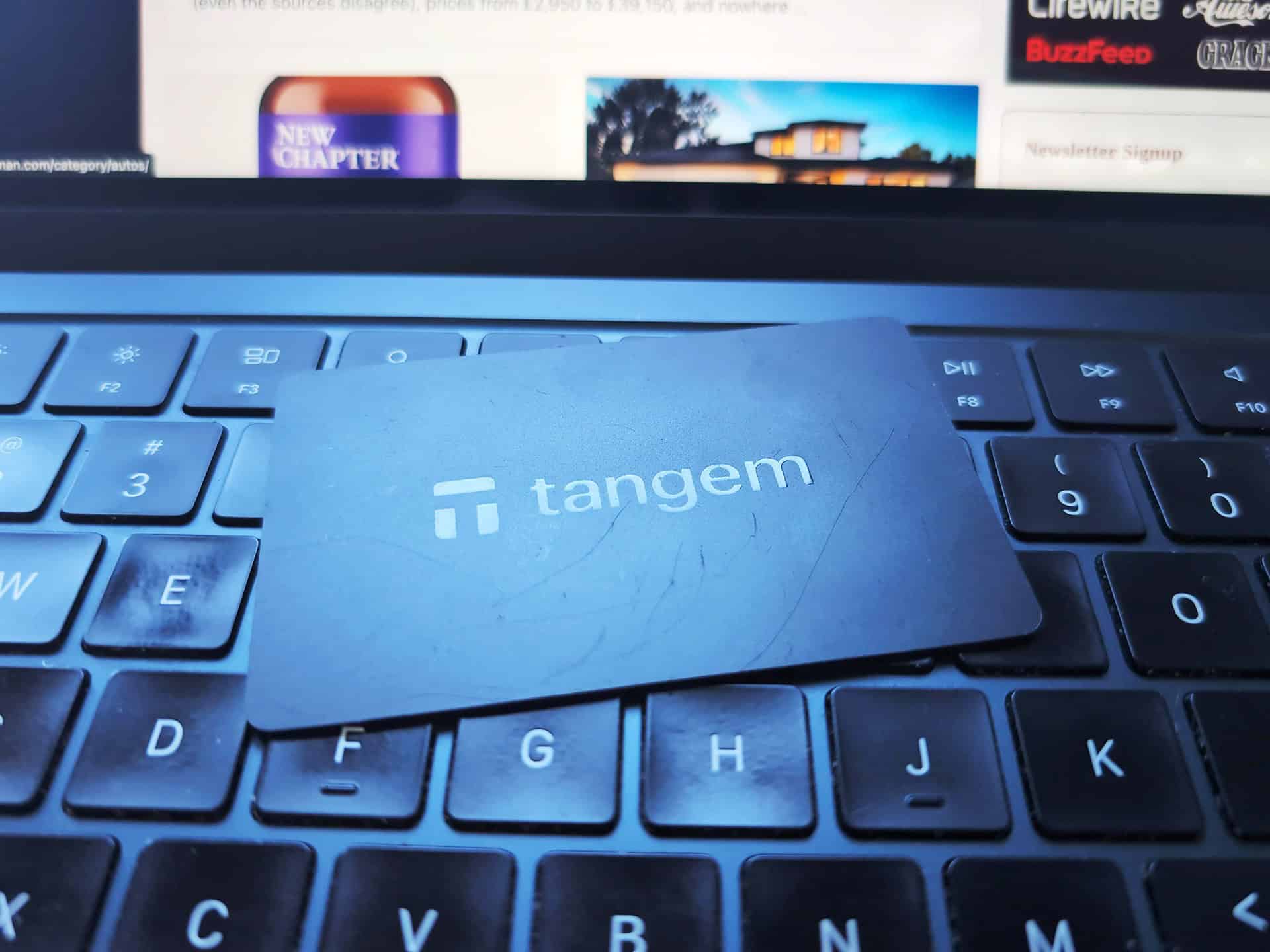
The first question with any crypto wallet is always the same: is this real security or just convenience marketing? With Tangem, the answer is actually interesting. It’s cold storage in the form of a credit card. Your private keys get generated on the card itself during setup and never leave it.
There’s no seed phrase by default. Instead, your backup is two or three linked cards. If you lose one, you tap another. And if you’re the traditionalist type, a second-generation card will let you set up an optional BIP39 seed phrase at activation, which is funny because Tangem has said publicly that they think seed phrases are the weak link in crypto security. They added the option because users demanded it.
Why bother with cold storage at all? Because in February 2025, Bybit lost $1.5 billion to hackers attributed to North Korea. The largest crypto theft on record. Money sitting on an exchange is money someone else holds the keys to.
Tangem itself dates back to 2017 in Zug, Switzerland; the consumer wallet showed up in 2021. The zero-hacks claim is theirs, and so is the card count: anywhere from 2 million to 6 million-plus, depending on which marketing page you read. That’s a company-reported figure, not an independently verified one, and honestly the moving number is a little amusing. But no confirmed incidents in several years of shipping is a legitimate starting point.
Key Takeaways
Keys are generated on the card via a Samsung secure element chip and never leave it; every transaction requires physically tapping the card to your phone, so remote theft means compromising your phone, not the card.
Backup is locked in at initial setup: 2 or 3 cards max (or the Ring plus two), an optional BIP39 seed on gen-2 only if you choose it at activation, and losing every card means losing your funds.
Trustpilot sits at 4.0/5 (“Great”) from roughly 700 to 1K reviews. Almost all the complaints? Logistics and support. Not security.
Table of Contents
How the Tangem security model actually works
Yes, the Tangem Wallet is safe, on one condition: your phone isn’t compromised. Everything else follows from that.
Here’s the chain. At setup, a Samsung secure element chip generates your private key using its own hardware randomness. Your key was never on a computer, never on a server, never typed by you. It lives on the card and doesn’t come off.
Nothing moves unless the card is physically tapped to your phone. The chip is a Samsung S3D350A, or an S3FV9RR in newer units, rated EAL6+, which is a high security certification for the chip itself. If someone steals a card, they can’t do anything with it without your access code, and repeated wrong guesses trigger escalating delays up to 45 seconds. Tedious for a thief.
The firmware has been audited twice by real firms: Kudelski Security in 2018 found no backdoors, and Riscure in 2023 found no private-key exposure. Tangem also claims a third audit, though details on that one are thinner.
Now the caveats. Tangem markets EAL6+ as the “highest certification level among competitors,” which isn’t literally true since EAL7 exists. Dry point, worth knowing. And the transparency model is inverted from what open-source folks expect: the mobile apps are open source on GitHub, but the firmware is factory-installed, closed, and immutable, and Wallet Scrutiny couldn’t reproduce the app builds.
Translation: you can check the app, but you’re stuck trusting the card. That’s the opposite of Trezor, where you can verify the device and trust nothing else. Neither model is wrong. They’re just different bets.
The no-display tradeoff
The Tangem Wallet’s main limitations are right on the surface: no display, no desktop client, no browser extension, mobile only, no multisig, no passphrase support, no Tor, no full node, closed firmware, and a backup that’s locked in at setup. Some people will read that list and nope out. That’s fine. It’s the honest trade for a card that costs about the same as a dinner out.
The one that matters most is the missing screen. A hardware wallet with a display can independently verify the address you’re sending to. Tangem can’t. Wallet Scrutiny’s scenario is the sharpest critique out there: if your phone is compromised, the app can display address X on screen even as the card authorizes a transfer to an attacker’s address Y, and the card has no way to know.
It trusts your phone’s screen, which is exactly the surface malware lives on. To be clear, there’s no evidence this has happened to actual Tangem users. But it’s a structural blind spot, and whether it’s acceptable depends on your threat model. If your phone is the kind of device that picks up sketchy APKs, think twice.
There’s also a disputed attack worth mentioning. A July 2026 claim circulated that a laser attack on the card hardware was unpatchable. It’s a single source, low confidence, and Tangem’s rebuttal is that cards can’t be secretly copied because backup linkage happens only once at setup. Neither side has won that argument. I’m not calling it either way.
Has Tangem ever been hacked?
No. Tangem has no confirmed hacks, though the zero-hack record is company-reported rather than independently verified.
The card count in that claim keeps shifting: 2 million was the conservative figure, 6 million-plus is the latest marketing number. Pick your date, pick your figure. There’s no third-party telemetry backing any of it, which is normal for this industry. Reviewer Demarcus echoed the general sentiment, saying he hadn’t heard of any hacks either.
That’s anecdote, not proof, but it matches the record. If you want the deeper dive on incidents and rumors, we have a separate Tangem wallet hacked breakdown.
Setup and the backup decision you can’t undo
Setup takes under three minutes, with the first scan running about 15 seconds. The catch is that the decisions you make during those three minutes are permanent.
There’s no battery, no cord, no updates, ever. The card powers off your phone’s NFC. Your backup is two or three linked cards, or the Ring plus two cards. Those cards link only during initial setup. You can’t add a third card next year.
You can’t re-clone a lost card. If you lose every card and never set up a seed phrase, your funds are gone. Full stop. Gen-2 cards offer an optional 12 or 24-word BIP39 seed at setup only, and it’s not retroactive.
Red flag: Treating the backup decision as reversible. Card count and seed-versus-seedless lock in at setup, and the only way back is re-initializing from scratch.
That last detail is my favorite bit of product honesty in this whole space. Tangem believes seed phrases are a security weakness, said so publicly, then added them anyway because customers kept asking. The customer won. Shocking.
Phone replacement, the scenario everyone worries about, is the payoff of this design. New phone, install the app, tap the card, you’re back. No seed ceremony, no sweating over handwritten paper. It just works.
Here’s the pattern that keeps showing up in buyer questions and reviews: people treat the backup decision as reversible. They set up with two cards, decide months later they want a third or a seed phrase, and discover the only path is re-initializing the wallet from scratch. Don’t be that guy. Decide before you tap.
Everyday use: assets, swaps, and where the friction shows up
Tangem is worth it for beginners, and the evidence is decent: Bob, a self-described beginner, found setup and moving funds off an exchange genuinely easy. Lionel had his whole setup done in under three minutes. The app sits at 4.9/5 on iOS from around 16K ratings and 4.7/5 on Google Play. And there’s nothing to charge, ever.
Coverage is a moving target. Depending on the review’s date and app version, the count runs anywhere from 6,000 to 16,000-plus assets on roughly 37 to 85-plus networks. New chains get added continuously, so there’s a good chance your coin is covered. I’m not going to pretend there’s one true number, because the sources don’t agree.
The card is the key. The app is everything else. Tangem Express handles in-app swaps by aggregating seven providers, with 800K-plus pairs flowing through SimpleSwap, and your tokens never touch an exchange account. You can buy with Apple Pay, Google Pay, or card through Mercuryo, MoonPay, or Simplex.
There’s staking, NFTs on Ethereum and Solana, and WalletConnect for dApps. What there isn’t is a desktop suite. It’s all mobile.
The real everyday pain isn’t missing features. It’s networks. Bob’s only stumble, and the most common one in user reviews, was picking the correct blockchain for a multi-chain coin. Funds “not showing up” on the wrong network is the panic moment. The fix is unglamorous: send a small test transaction first. Every time.
What real users say: the Trustpilot evidence
Trustpilot rates Tangem 4.0/5, “Great”, as a Cryptocurrency Service, off roughly 700 to 1K reviews. The complaints almost never touch security.
A few honesty notes first. Trustpilot doesn’t fact-check reviews; “verified” only means a real transaction happened. The platform flags the crypto category generally for high-risk investments, not Tangem specifically. Tangem invites reviews, positive or negative. Small trust signal, but a real one.
The praise clusters where you’d expect. Bradley Cox highlighted the beginner-friendly setup, fast stablecoin swaps, and the fact that nothing needs charging. Lionel praised fast delivery, the ring combo, quick support, and that sub-3-minute setup. Jessica Marry called the app clean and good for learners.
François Christin liked not needing a seed phrase at all. Diane Wyatt put it bluntly: “100 times better than the Ledger wallet.” Her reasoning came down to no cords, which, fair.
The complaints are logistics. Jasper T’s PayPal order looked unconfirmed, so he re-ordered by card. Both went through. Tangem refused his cancellation mid-warehouse.
Watch your checkout, one order at a time, though if you’re starting fresh, you can buy a Tangem hardware wallet with 10% off. Barrett Depew says his support emails went unanswered and he ended up fixing things with ChatGPT; Tangem says replies were sent and may have landed in spam.
Both sides, no referee whistle. Michele Keenan and Thomas both found the printed instructions thin. And then there’s Cam in Australia, the worst case on record: $86 stranded in the app, no way to buy in-app, and no luck adding Tangem Pay to Google Pay, so he threw out all three cards and went back to Ledger. Tangem found no support ticket linked to his account. It’s ugly, it’s real, and it’s the outlier, not the pattern.
One more story worth telling. A reviewer named Kahu posted that his crypto had vanished. It turned out to be his own error, and Tangem’s explanation is genuinely useful: simply scanning a card to check addresses can never move funds, and losses trace back to shared backup-card access codes, exposed seed phrases, or malicious approvals. So, how safe is the tangem wallet?
The deep dive into its security architecture is reassuring, secure element chips, EAL6+ certification, audited code. But that’s also the sharp edge of self-custody. The same “we can’t touch your funds” property that protects you means nobody can bail you out either, no matter what happens if a card is lost or stolen.
Practical stuff: wallet and app issues go to support@tangem.com, order issues to store@tangem.com, and if you want a free Tangem mobile wallet to go with them, that’s available too. And Tangem will never ask for your seed phrase or access code. Anyone who does is a scammer. One honest note: our source base has no authentic Reddit-thread evidence, so I won’t cite Reddit sentiment here.
Tangem vs Ledger, Trezor, and the card rivals
The decisive difference isn’t the feature list, it’s how trust works: blind tap versus screen confirmation, closed versus open firmware, card backup versus seed phrase. What are the disadvantages of Tangem? Chiefly, single-device backup questions, the seed phrase approach, closed-source elements, and vendor lock-in. Apply that lens to everything below.
Ledger is the default comparison. Its USB devices confirm transactions on a screen, which Tangem can’t do. But Ledger’s 2020 customer-data breach was still fueling phishing attempts in 2026, and the Ledger Recover feature drew real heat for pulling encrypted key material into a subscription service. Neither makes Ledger unsafe today, but it explains why people shop for alternatives. We’ve got a fuller Tangem wallet vs Ledger breakdown if you want it.
Trezor is the open-source pick, with a touchscreen on nicer models. The wrinkle: Trezor Safe 3 had a physical key-extraction disclosure in 2025. Every device has something. The real Tangem wallet vs Trezor question is transparency versus simplicity.
On the card side, CoolWallet is the other card-style option, and Arculus is the other NFC card, made by the same company that makes the Amex Centurion card. Trivia-grade, but a fun one. If you’re Bitcoin-only, skip all of this and look at COLDCARD Mk4 or Foundation Passport. If you want a screen and open firmware, Cypherock X1, Keystone 3 Pro, or BitBox02 are the signposts.
One reviewer pattern worth passing along, attributed and not endorsed: a cautious ColdWallet-comparison reviewer distrusts Ledger Recover, caps any single wallet at $50k to $100k, and skipped the Tangem 2.0 over app lock-in despite liking the design. That’s one person’s practice, not advice. But it’s a sane template for thinking about concentration risk.
Tangem Pay and Yield Mode: a changing trust model
Tangem Pay lets you spend self-custodial USDC on Polygon through a virtual Visa in Apple Pay or Google Pay. You keep the keys while spending. It launched in late November 2025 in the US, LATAM, and APAC; the UK and EU followed in early 2026 with MiCA alignment.
There’s a real compliance backend under it: Paera handles KYC, Sumsub runs identity checks, Elliptic monitors transactions, Third National issues the card, and Rain co-signs transactions. That co-signing quietly dilutes the “keys never leave the card” purity, so know that going in. Fee-wise, Tangem charges nothing itself beyond normal Polygon gas and Visa FX. Physical cards, more stablecoins, and rewards are on the roadmap, not shipped. And honestly, there’s no documentation on how Pay behaves day-to-day outside the launch markets.
Yield Mode is the other addition: an Aave integration for USDT, USDC, and DAI with audited contracts and instant withdrawal. Park stablecoins, pull out when you want. It’s still DeFi, so no yield promises from me. Cam’s failed Tangem Pay attempt, with $86 stranded in the app, is a fair reminder the rollout is still rough around the edges.
Buying safely and the pre-purchase checklist
Buy only from the official Tangem store. A card that passed through a third-party seller, possibly tampered with, defeats the entire point of the product.
Base prices: the 2-card set runs about $54.90, the 3-card set about $69.90, the Ring with 2 cards is $160, and the Family Pack is $139.80. Discounts come and go, so treat the base prices as the reference and ignore whatever promo code a YouTube video is shouting this week. If you’re weighing packs and budgets, our is Tangem a good wallet piece covers the value question in more depth.
Durability is genuinely a selling point. The card is credit-card sized, weighs 6 grams, carries a 25-year warranty, and is IP68 rated, which Tangem claims is the highest environmental protection among hardware wallets. It’s rated from -25°C to +50°C and shrugs off X-rays, EMP, and ESD. There’s a 30-day return on unused items, so the risk of trying one is basically nil.
Quick test: Send a small transaction first, on any network, every time. A mis-sent transfer is unrecoverable, and the test costs pennies.
Now the part where most regret originates. Before you activate: buy from the official store, decide between 2 and 3 cards, decide seed versus seedless, and understand that losing all cards means losing your funds. All four decisions lock in at setup. Same warning as Section 4, because it’s the one that actually burns people.
XRP holders: does Tangem fit?
Yes, Tangem supports XRP, and it’s the best simple cold-storage pick for it. If you want XRPL-native features, Xaman and Joey Wallet lead that space, with XRP Toolkit for advanced use.
The XRP-specific gotchas are worth knowing before you move anything. The XRP Ledger requires a 1 XRP base reserve, plus additional owner reserves for trustlines and offers. Some transfers require destination tags, especially from exchanges. And test transactions matter more here than on most chains, because a mis-sent XRP transfer is gone. For context, about 7.7 million XRPL accounts were activated as of March 2026 per XRPSCAN. Big network, unforgiving transfers.
Verdict
Here’s how I’d say it to a friend. Tangem is the right tool if you’re a beginner, a traveler, a mobile-first person, or a long-term holder who wants cold storage without a seed-phrase ritual. It’s the wrong tool for DeFi power users, desktop traders, and open-firmware purists. The strengths are real: seedless on-card keys, tap-to-sign, no battery, three-minute setup. The weaknesses are just as real: closed firmware, no desktop suite, and at the end of the day you’re trusting the vendor.
For what it’s worth, after the 2025 hack reports I moved my day-to-day exchange transfers from Trust Wallet onto a Tangem card. The long-term stuff stays on other cold wallets. That split turned out to be the right frame for the whole product: Tangem isn’t a Ledger replacement, it’s one layer in a multi-wallet stack. The cautious reviewer I mentioned earlier caps each wallet at $50k to $100k, which is his practice, not a rule, but the underlying idea holds. If you’re holding serious money or you can’t stand blind signing, put a display wallet like a COLDCARD, Passport, or Keystone 3 Pro in the mix for the large positions, and let the Tangem card handle the tap-and-go layer it was built for.
Fifty-five bucks for one layer of that architecture. Honestly, that math works.
Frequently Asked Questions
What are the disadvantages of Tangem?
The main drawbacks are the missing display, mobile-only operation (no desktop client or browser extension), no multisig, no passphrase support, closed factory-installed firmware, and a backup that locks in at setup. The biggest one is the lack of a screen: the card can’t independently verify the address you’re sending to, so it trusts your phone’s screen. If your phone is compromised, the app could show one address while the card authorizes a transfer to another.
What is the most trustworthy crypto wallet?
There’s no single answer — it depends on your trust model. Tangem asks you to trust a closed, factory-installed firmware but lets you inspect the open-source app; Trezor is the opposite, with verifiable open firmware. Ledger offers screen confirmation but has faced a 2020 data breach and criticism of its Recover subscription feature. Every device has trade-offs, so the honest approach is matching the wallet’s weaknesses to your threat model.
Is the Tangem wallet safe to store large amounts of crypto on?
The security architecture is solid, but for serious money a display wallet like COLDCARD, Foundation Passport, or Keystone 3 Pro is the better fit for large positions, since Tangem can’t independently confirm addresses. One cautious comparison reviewer caps any single wallet at $50k to $100k to manage concentration risk — his practice, not a rule, but a sane template. Tangem is best as the tap-and-go layer in a multi-wallet setup.
Is Tangem a good cold wallet compared to Ledger and Trezor?
It’s a different bet, not a strict upgrade or downgrade. Ledger confirms transactions on a screen, which Tangem can’t, but Ledger’s 2020 customer-data breach still fueled phishing in 2026 and its Recover feature drew heat. Trezor offers open-source firmware and verification, while Tangem offers seedless convenience, tap-to-sign, and no charging. Choose based on whether you value screen confirmation and transparency or simplicity.
Where should I buy a Tangem wallet to avoid fakes or scams?
Buy only from the official Tangem store. A card that passed through a third-party seller and could have been tampered with defeats the entire point of cold storage. There’s a 30-day return on unused items, so the risk of trying one is minimal.
How do I set up and use a Tangem wallet step by step?
Setup takes under three minutes: buy from the official store, install the app, tap the card to your phone (the first scan runs about 15 seconds), and the Samsung secure element generates your key on-card. Before you tap, decide between 2 or 3 linked cards and whether you want the optional gen-2 BIP39 seed phrase — these choices are permanent. After that, every transaction is a physical tap of the card to your phone, and switching phones is just install the app and tap.

