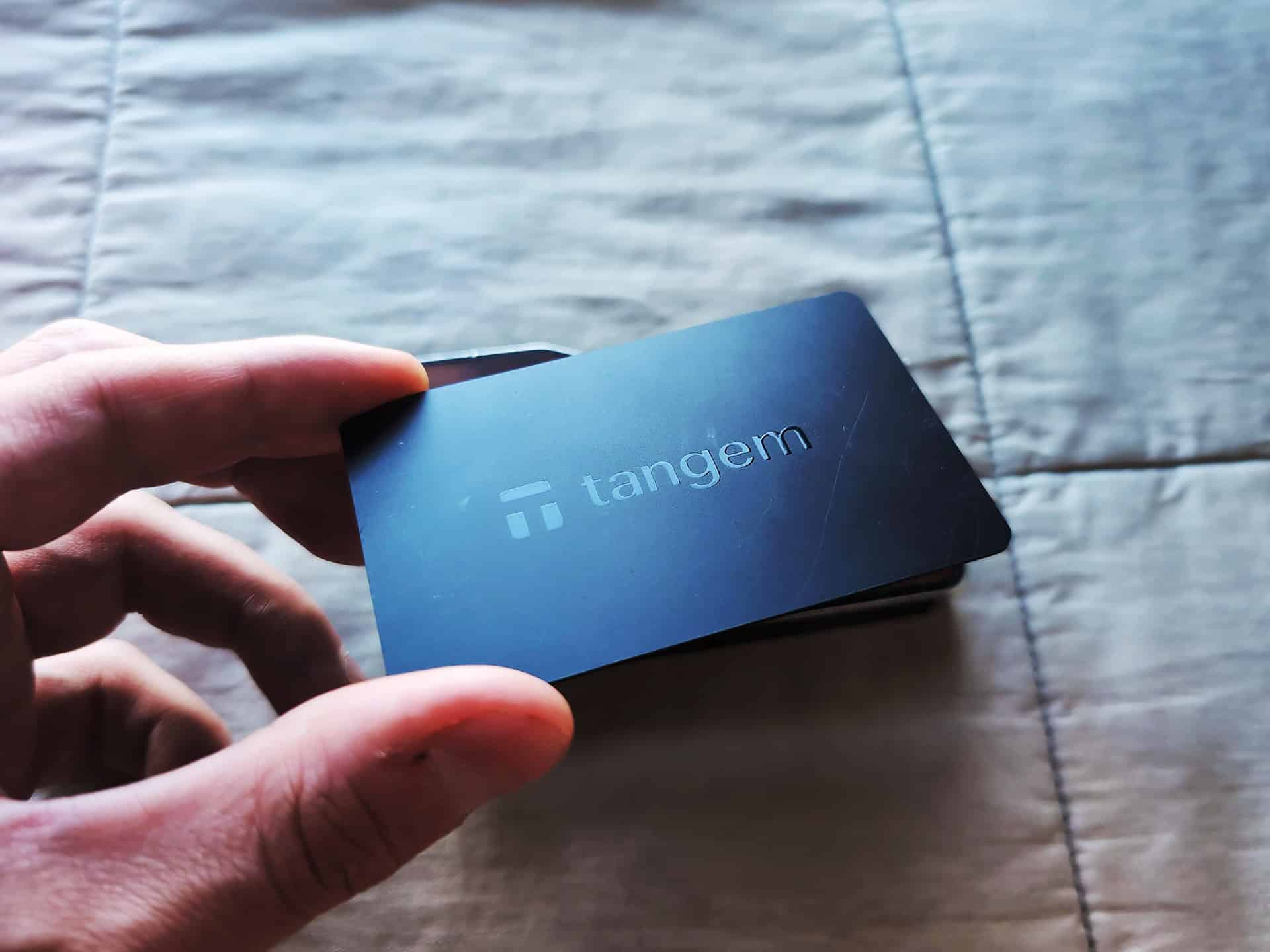
If you’ve seen a Tangem Wallet in person, you know the hook: it looks like a credit card, and you tap it against your phone to sign a transaction. No battery anywhere. The company’s been around since 2017, based in Zug, Switzerland, and the private keys are generated inside an EAL6+ Samsung chip on the card itself and never leave it. On paper, that’s a legitimately clever cold wallet.
Here’s the thing, though: the four biggest selling points, seedless backup, the card form factor, tap-to-sign, and firmware that never changes, are exactly the design decisions behind every major disadvantage. No screen to verify what you’re signing. Your phone becomes the single point of trust. Firmware nobody can inspect, ever.
And a backup model where losing every card means losing everything. So when people ask what are the disadvantages of Tangem, the honest answer is that the flaws and the features come from the same six decisions. This is still a capable, secure wallet. It just doesn’t hold up to the competition on basics, and both of those things are true at once.
Key Takeaways
The card has no display, so every address and amount you verify happens on your phone, a compromised app could show you address X while the card signs a transaction to the attacker’s address Y.
Firmware is factory-installed and immutable: the apps are on GitHub, but Wallet Scrutiny couldn’t independently reproduce the builds, so you’re leaning on the Kudelski (2018) and Riscure (2023) audits.
The default seedless setup means if you lose every card without a seed phrase, your funds are gone for good, and turning on seed mode in Wallet 2.0 switches off the multi-card backup failsafes.
Table of Contents
The disadvantages of Tangem at a glance
The main problems with the Tangem Wallet are closed-source immutable firmware, no on-device display, a mobile-only workflow, DeFi access through WalletConnect only, no passphrase or multisig support, key generation from a single random-number generator, and seedless lock-in if all your cards go missing. That’s the list. The card itself is credit-card sized, 85.6 x 54 mm, 6 grams, and every transaction confirmation happens over NFC on your smartphone.
Ordered by how badly each one bites, it looks like this:
- Losing every card with no seed set up. Total loss. Hits everyone, because it’s the default configuration.
- Single random-number generator for key creation. Matters most to large holders, since every guarantee downstream inherits that one chip.
- Closed, immutable firmware. You can’t inspect or patch it; you’re trusting paid audits.
- Mobile-only, no desktop client. The dealbreaker for desk traders and DeFi power users.
- No display. Your phone is the only witness to what you’re signing.
- No passphrase, multisig, USB, or QR signing. Missing pro features the boxy competitors have.
- DeFi via WalletConnect only. It works, but it’s one door.
Each of these gets the full treatment below. No padding, no dread-mongering. Just the trade-offs you’re actually signing up for at checkout.
Closed, immutable firmware: what you’re actually trusting
No, the Tangem Wallet isn’t fully open source, and the part you’re trusting most, the firmware, can never be independently verified. The apps are open, the firmware is not, and that’s the whole ballgame.
What you can verify, and what you can’t
The firmware comes fixed from the factory. You can’t update it, read it, or patch it, and neither can the community. Before you file that under “dealbreaker,” consider the flip side: nobody can push a malicious update to your card either. Immutability cuts both ways. Some security-minded buyers actively want firmware nobody can touch, because it also means nobody can push a malicious update to your card.
The apps live on GitHub, the iOS app under an MIT license, though the Android licensing situation is murkier, but here’s the wrinkle. Wallet Scrutiny, an independent site that checks these claims, couldn’t rebuild the same app from the published code. So it’s open-ish. Not verified-open.
And as for the hardware itself? Nobody outside Tangem has published open information on it. That’s an honest “we don’t know,” and we’d rather say that than invent certainty.
What the Kudelski and Riscure audits do and don’t certify
Two audits back the closed code. Kudelski Security reviewed the code in 2018, and that audit turned up no backdoors. Riscure’s 2023 review went deeper, covering the code, the architecture, and the commands exposed over NFC, and found nothing that would expose keys. Those are real names and real findings, worth more than a forum’s reassurance.
But be clear about what they are: vendor-commissioned snapshots of a moment in time. Not ongoing verification. They soften the closed-source criticism considerably. Partially. That qualifier is the honest part, and it’s a legitimate dealbreaker for buyers who want to see the code themselves.
No display: verifying transactions on a compromised phone
The card has no screen because a battery-free NFC card can’t afford one, and that costs you, the person who assumed a hardware wallet meant on-device verification. The secure element genuinely protects your keys. But everything you check, every address and every amount, happens on your phone. The card is blind. Your phone is the witness.
Walk through the scenario. Your screen shows address X, the recipient looks right, you tap the card, it signs, done. Boring and normal, until it isn’t. A compromised app could be getting the card to sign to address Y, the attacker’s, while showing you X. The card can’t warn you, because the card can’t tell you anything.
To be clear, that’s a hypothetical attack pattern, not a documented theft. But it’s the natural consequence of the design, and reviewers docked points in security and privacy for exactly this.
That’s the uncomfortable core of the no-display problem. The missing screen moves trust from tamper-resistant silicon to the malware-exposed phone. That’s the opposite of why most people buy a hardware wallet in the first place. What a careful owner does about it: double-check addresses on the phone before tapping, keep the device clean, and remember every signature still requires a physical tap, so nothing signs while the card sits in your wallet. People coming from screened USB wallets also report an adjustment period, learning to trust a screen they used to treat as the untrusted component.
If that gap bothers you, screen-equipped alternatives like the Trezor Model T and CoolWallet S close it directly. More on those later.
The seedless backup trade-off: two ways to lose everything
Yes, if you lose every Tangem card without a seed phrase set up, access to your funds is permanently lost. Not “recoverable with support.” Gone. That’s the deal you’re signing with the default setup, and the one failsafe worth knowing before you buy: the multi-card kits exist precisely to prevent this, which is exactly why the seed option undermines them.
Seedless mode, total loss if all the cards are gone
Out of the box, there’s no seed phrase. Your backup is two or three cloned cards. Lose them all, fire, theft, one drawer, one bad day, and the money is gone with them. If you forget your access code, the only way to reset it is with a surviving backup card, which is practical but slightly annoying, like most recovery stories.
So the obvious-but-ignored step: store the cards in different places. And remember the other edge of the sword, anyone who holds one of your cards together with your access code can spend. The cards alone won’t sync to a stranger’s phone, which is a genuine advantage, but a full set in one bag changes that math. (The full setup walkthrough lives in our Tangem wallet review if you want the hands-on version.)
Seed mode, turning on a seed switches off the card failsafes
Wallet 2.0 lets you generate or import a 12/24-word BIP39 seed right in the app. Do that, and the multi-card backup failsafes switch off. No screen exists on the card to verify the phrase as you write it down, either. And here’s the composite pattern that keeps showing up in buyer discussions: people who bought the 3-card kit, essentially a perfect cardholder wallet setup, enable seed mode later without realizing they’ve voided the redundancy they paid extra for.
Tangem deserves a fair hearing here. They’ve long argued that seed phrases themselves are insecure, that’s why the product was seedless for years, and there’s a real counter-argument in their favor: most lost Bitcoin comes from owner mistakes, which is exactly why some people argue that a seed written down makes recovery by family easier. Both positions are defensible. The trap isn’t either mode. It’s flipping the switch without understanding what it costs.
Key randomness depends on a single chip
Almost nobody covers this one. Your private key is generated on-card by a single hardware random number generator: Samsung’s S3D350A, a DRAM-based true random number generator that leans on the chip’s own physical sensors. Best practice in the field favors blending multiple unpredictable entropy sources, and a single generator could theoretically hide a bug that nobody finds for years, bugs like that have surfaced late in similar chip classes before. It’s probably fine.
But it’s one throw of the dice you can’t inspect, and every guarantee downstream inherits it. The suggestion floating around, that future hardware should combine several entropy sources, is a fair one.
Mobile-only by design: no desktop client, no pro features
No, the Tangem Wallet doesn’t work for DeFi power tooling, multisig, or passphrase protection, and that flat-out disqualifies desktop-first traders and anyone who lives in a full wallet suite. Everything routes through the iOS or Android app. That’s the deal.
No desktop software, no USB, no browser extensions
The cards have no ports. Everything goes over NFC (ISO 14443), and your phone powers the card during the tap, which also means it’s not truly air-gapped, a line some buyers will care about a lot. What actually breaks: multi-tool desktop trading, multi-window DeFi sessions, browser-extension workflows. Not inconvenient.
Unavailable, full stop. If you manage crypto at a desk all day, that’s real friction, and the guidance out there points you toward Ledger or Trezor instead.
One fair counterpoint: losing your phone is trivial. Re-scan the card, you’re back. Losing your desktop workflow isn’t fixable at all, because it never existed.
Missing passphrase, multisig, and air-gap support
Fast list, let it speak: no passphrase, no multisig, no USB, no QR signing, no air-gap mode, and no Bitcoin-only firmware option like some rivals offer. These map directly to features competitors build entire marketing pages around, and they’re the reason security-conscious buyers comparing specs keep sliding past Tangem.
The DeFi ceiling: WalletConnect-only and integration gaps
One door: WalletConnect, from the phone. That’s the entire DeFi story, and coverage depends on each protocol’s own support, so complex contract stuff hits gaps and extra taps.
It does work, to be fair. Yield Mode earns interest on USDT, USDC, and DAI through Aave with instant withdrawals, unlike the locked-yield services, though note the string: Tangem’s backend can pull funds if a protocol breaks, which is convenience with a condition. Tangem Express aggregates swaps across providers like 1inch, ChangeNOW, and Changelly, with a fiat off-ramp at 0.35% plus gas that sells straight to a bank card or IBAN. For heavy, active DeFi, though, a hot wallet is genuinely faster, and pretending otherwise would be doing you a disservice.
The balance beat: complaints cluster around three things, recovery risk, a thinner ecosystem than Ledger and Trezor, and support speed that varies case by case. But ratings are solid: 4.1 out of 5 on Trustpilot across 700+ reviews, 4.9 on the iOS App Store, 4.7 on Google Play. Tangem Pay, announced in November 2025, spends USDC on Polygon through a virtual Visa card inside Apple Pay and Google Pay, with KYC handled by Paera LLC alongside partner Rain; the UK/EU rollout was slated for early 2026, which has since come and gone. That’s context for how much of the ecosystem rides on third parties, not an upsell. And swap and on-ramp availability depends on your region, worth knowing before you buy expecting full access.
Vendor lock-in: what if Tangem disappears?
Your private keys stay on the card if Tangem goes out of business, but your ability to actually use them may not survive the trip. The funds aren’t custodial, the keys live on the card regardless of what happens to the company. That’s the good news. The rest of the picture:
- Seedless users depend entirely on the Tangem app remaining available and installable.
- Firmware is immutable, so there’s no community patch path ever, no matter how long the company lasts or doesn’t.
- The 25-year warranty is a pledge from the company, not something the card’s structure can guarantee.
- Ecosystem features carry named dependencies: Tangem Express runs through swap partners, and Tangem Pay’s KYC sits with Paera LLC.
No prediction here about whether Tangem survives, that’s not the point. The point is structural: map out who you’re relying on, because with this design, the list is longer than it looks.
Is Tangem still safe? A due-diligence checklist
Yes, the Tangem Wallet is still safe to use under stated trust assumptions: two audits found no backdoors, and no successful hacks have been reported against an estimated 1 to 6+ million cards in circulation. (Tangem claims 6 million-plus produced; sources conflict, so treat the range as the range.)
- The chip claim. It’s an EAL6+ Samsung S3D350A, and Tangem’s “highest chip security standard” line overstates things, because EAL7 exists above EAL6+. Clean, checkable, and a good litmus test for how much to trust the marketing.
- The builds. App builds still haven’t been independently reproduced, per Wallet Scrutiny.
- The data. The app collects data, which sits awkwardly next to the no-monitoring pitch.
- The track record. Zero successful hacks reported across that 1 to 6+ million card range. Kudelski in 2018, Riscure in 2023, clean sheet since.
And one for the amusement file: that just a chip with an antenna, no points of vulnerability marketing line. Reviewers called that overstated, and everything above explains why. Marketing got ahead of the engineering on more than one occasion. The core security story holds anyway, there’s a deeper look at rumor versus fact in our piece on whether Tangem wallets get hacked.
Who should consider other options, matched to each drawback
If you need desktop suites and deep DeFi integrations, insist on open-source firmware and an on-device screen, or trade across multiple desktop tools, the Tangem Wallet fails your basic tests, and the Ledger Nano X is the closer match. Then it depends on which disadvantage bothers you most, because each alternative fixes a specific one:
- Trezor Model T, fully open-source software, touchscreen, USB, Trezor Suite desktop workflows. It fixes Tangem’s closed firmware and missing display in one move, and it’s the pick for people who want to read the code themselves. (So if the Trezor-vs-Tangem question is open-source and desktop vs. tap-to-sign simplicity, that’s your answer.)
- Ledger Nano X. Ledger Live on mobile and desktop over USB or Bluetooth, more than 5,500 assets, third-party integrations that have matured, and a seed phrase by default. It fixes the ecosystem-depth gap. The grown-up option, not an affiliate pitch. Full breakdown in our Tangem vs Ledger comparison.
- CoolWallet S, the same credit-card idea, but with Bluetooth and an actual screen on the card, plus 10,000+ tokens including ERC-20 and BEP-20. It fixes the no-display problem inside Tangem’s own form factor. Trade-off: it needs charging. Tangem doesn’t. Neither is strictly better; it’s whichever flaw annoys you less.
- Cypherock X1. Shamir key splitting across physical shares, inheritance features, 4 wallets per system. It directly answers the seedless lock-in and family-recovery risk. For beginners who mostly hold and send, Tangem’s setup runs roughly 3 minutes and its entry price is cheap, which beats Cypherock on simplicity; Cypherock wins on redundancy. If you’re holding serious size or planning for the worst case, the extra hardware earns its keep.
- Foundation Passport / COLDCARD Mk4, for the Bitcoin-only crowd who look at 16,000+ assets across 85+ blockchains and see attack surface instead of a feature list. That’s a legitimate camp, and dedicated Bitcoin devices are the reviewers’ pick for it.
The cost calculus, since you’re wondering: the 2-card kit runs about $54.90, the 3-card kit about $69.90, roughly $60 discounted, with no wallet fees beyond gas. Cheap. The third card is inexpensive insurance against the lock-in risk, and at the $50-70 mark it’s worth it for the right buyer. For the disqualified profiles above? Not at any price, because the flaw isn’t fixable with more cards.
A well-engineered product that still doesn’t hold up to the competition for basic features, that’s the honest verdict. The sleek design and the missing fundamentals come from the same convenience-first decisions, which is what makes this wallet interesting and what makes it frustrating. Stack Tangem’s long anti-seed history and its embellished marketing against real strengths like the secure element, the audits, and the clean hack record, and you’ve got a genuine judgment call. Which disadvantage is deal-breaking depends entirely on your holdings and your workflow. At least now you know they’re one deliberate choice, not six unrelated flaws.
Frequently Asked Questions
Is Tangem still safe?
Yes, under its stated trust assumptions: two independent audits (Kudelski in 2018, Riscure in 2023) found no backdoors, and no successful hacks have been reported against an estimated 1 to 6+ million cards in circulation. The caveats are that the firmware is closed and immutable and the app builds haven’t been independently reproduced, so you’re leaning on vendor-commissioned audits rather than ongoing verification.
Why does Tangem Wallet not have a screen or desktop app?
There’s no screen because a battery-free NFC card can’t afford one — your phone powers the card during the tap, and everything routes through the iOS or Android app. The card has no ports, so USB, QR signing, and desktop workflows are unavailable by design, not by oversight. That’s also why it isn’t truly air-gapped.
Is Tangem fully open source and can the firmware be verified?
No. The mobile apps are on GitHub (the iOS app under MIT license), but the firmware is factory-installed and immutable, and Wallet Scrutiny couldn’t independently reproduce the published app builds. What backs the closed code instead are the Kudelski (2018) and Riscure (2023) audits — vendor-commissioned snapshots, not ongoing verification.
Is Tangem or Trezor a better choice for open-source and desktop users?
Trezor, clearly. The Trezor Model T is fully open-source software, has a touchscreen for on-device verification, works over USB, and supports Trezor Suite desktop workflows — it fixes Tangem’s closed firmware and missing display in one move. If tap-to-sign card simplicity matters more to you than inspectable code and a desktop workflow, that’s the only case where Tangem wins.

