The fake Ledger Live app that surfaced in April 2026 sat on the Apple App Store for about two weeks. The publisher listed was a company called “Leva Heal Limited,” and in roughly six days it drained $9.5 million from more than 50 people who typed their recovery phrases straight into software. Three of the victims lost seven figures each. That’s the FBI-documented world we’re shopping in: crypto fraud cost over $5.6 billion in 2023 alone, per the FBI’s IC3 report.
Almost none of it was hardware failing. It was humans getting tricked.
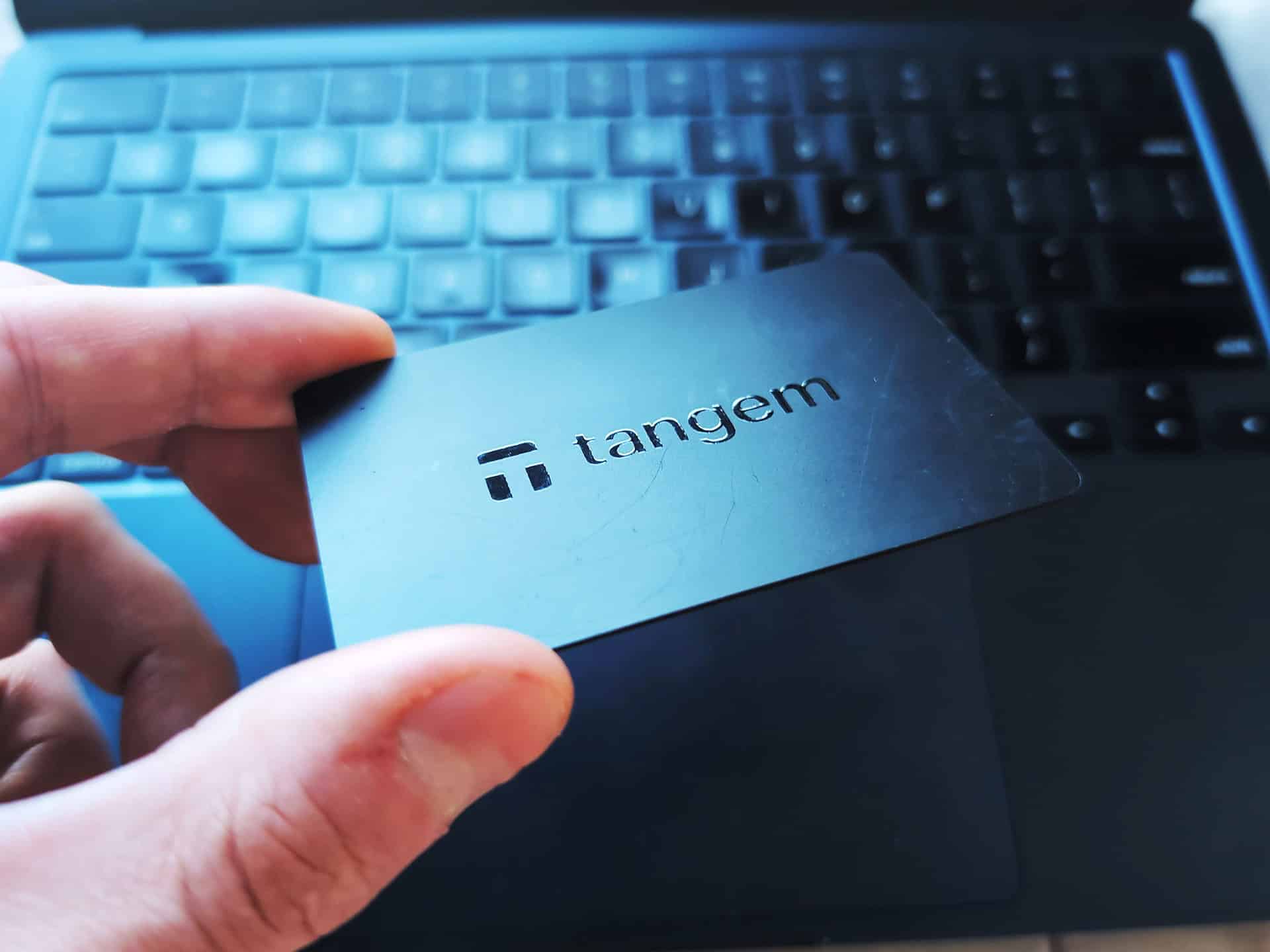
That’s what makes the Tangem-versus-Trezor comparison interesting. These two take opposite bets on where things go wrong. Tangem is a seedless NFC card set: your key lives on the card’s chip and never leaves it, and there’s no recovery phrase for anyone to steal. Trezor is the open-source veteran: a 12 or 24-word phrase plus code you can audit yourself on GitHub, and you own the responsibility that comes with it.
One design makes the classic seed-phishing scam structurally impossible. The other makes it impossible to hide what the machine is doing.
I haven’t owned either. This is me deciding which one I’d buy with my own money, walking through the real numbers and the real failure modes. This is a threat-model comparison, not a feature-scored winner, and none of it is financial advice. Whichever you pick, you’re the one holding the keys.
Key Takeaways
Tangem sets run $54.90 for two cards or $69.90 for three, carry an EAL6+ chip, a 25-year warranty, and IP68 water resistance, and lose the seed phrase entirely; lose every card and the money is gone.
Trezor’s lineup runs $79 (Safe 3), $169 (Safe 5), and $249 (Safe 7), with fully open-source GPLv3 firmware, 12/24-word seed phrases, and Shamir backup for splitting recovery into shares.
Neither wallet is universally safer: the April 2026 fake-app scam proves seed phishing is the dominant real-world loss, while the reported Coldcard incident shows open-source code sat broken for five years before tens of millions in BTC were stolen.
Table of Contents
Tangem and Trezor at a glance: the key differences
Tangem and Trezor are opposite answers to the same problem. Tangem is mobile seedless minimalism: a credit-card-shaped chip you tap against your phone. Trezor is open-source desktop control: a small device with a screen that plugs into your computer. The decisive difference is the recovery model.
Tangem’s backup is chip-to-chip cloning across up to three cards, with no words to write down. Trezor uses a 12 or 24-word BIP-39 phrase, and its answer to redundancy is Shamir (SLIP-39), which splits recovery into multiple shares. Seed-phrase phishing is the dominant real-world loss path in crypto, and Tangem’s design removes the phrase entirely. Trezor’s design keeps it but gives you code you can audit yourself on GitHub.
| Tangem | Trezor (Safe 5 as flagship) | |
|---|---|---|
| Seed model | None; chip-to-chip card cloning, up to 3 cards | 12/24-word BIP-39 + Shamir (SLIP-39) |
| Connectivity | NFC (tap your phone) | USB-C |
| Display | None on card; phone screen only | Gorilla Glass 3 touchscreen, 1.54 inches |
| Open source | App layer open; card firmware closed, EAL6+ audited | Fully open-source GPLv3 firmware |
| Secure element | EAL6+ | EAL6+ |
| Price | $54.90 (2 cards) / $69.90 (3 cards) | $169 |
| Warranty | 25 years | 2 years |
| Weight | ~3 g | 23 g |
| Water resistance | IP68 | Not rated |
| Asset support | 16,000+ across 85+ blockchains | 9,000+ (some need third-party wallets) |
Three differences actually drive this decision:
- Recovery model: a phrase that exists and can be phished, versus cards that can be lost.
- Transparency: Trezor’s code is public on GitHub; Tangem’s card firmware is certified but closed.
- Workflow: phone-only NFC versus desktop Suite with on-device verification.
Everything else flows from those three.
Security model: seedless cards vs seed phrases
No. If you lose every Tangem card and you didn’t clone backups, the funds are gone permanently. There’s no recovery phrase, no customer service line, nothing to reset. That’s the honest price of seedless, and Tangem’s mitigation is simple: during setup you tap extra cards against your phone so the key clones chip-to-chip, up to three cards total. The private key itself is generated inside the EAL6+ secure element and never leaves the card. The other downsides sit right next to the convenience: the app is phone-only (no desktop interface), and the card has no screen, so you’re trusting your phone’s display when you verify a transaction.
How Tangem’s seedless backup works
The pitch is that the key is born on the secure element chip and stays there for life. Backup happens by tapping your spare cards against the phone during setup, which clones the key card to card. No 12 words to write on a card that lives in your desk drawer, nothing to photograph “for safekeeping.” And since there’s no phrase, the classic enter-your-recovery-words scam has nothing to hook.
There’s no phrase for a scammer to fish out of you. If a card dies or gets lost, you tap a backup card and keep going, provided you actually made one.
Tangem does offer an optional seed-phrase configuration, but the seedless default is the thing being compared here, and it’s the reason anyone considers the cards at all.
How Trezor’s seed works, and where it’s been abused
Trezor still runs on the classic model: a 12 or 24-word BIP-39 phrase written down at setup. It’s portable and vendor-independent; in a worst case, any compatible wallet can restore it. Shamir backup (SLIP-39) is the smarter version, splitting recovery into multiple shares so no single piece is enough. It’s more control, and more responsibility on you.
Here’s the evidence that the phrase is a real attack surface, not a theoretical one. In April 2026, a fake Ledger Live app published under “Leva Heal Limited” spent roughly two weeks on the Apple App Store and drained $9.5 million in six days from 50+ victims who entered their 24-word phrases. Three victims lost seven figures each. On April 8, it was $1.95 million in BTC, ETH, and stETH. April 9 took $3.23 million in USDT, and April 11 another $2.08 million in USDC. The stolen funds moved through 150+ KuCoin deposit addresses and the AudiA6 mixer.
Recovery is unlikely. These weren’t rookies typing phrases into random websites; they were experienced holders following a setup flow that looked official.
Red flag: Any setup flow that asks for your recovery phrase in software is the scam itself, no matter how official it looks.
The recurring setup mistake looks the same every time: phrase written on the box card, photographed “as a backup,” or typed into a lookalike app. The hardware worked fine in all of it.
So which is safer? Neither, universally. The question is which downside fits you: phishing exposure (Trezor’s model, where a tricked user is the vulnerability) or losing all your cards (Tangem’s model, where carelessness with the physical set is the vulnerability).
Open source vs certified execution: does transparency make Trezor safer?
Yes and no. Trezor’s openness is real and genuinely valuable if you’re the guy who wants to verify things himself. But open source alone doesn’t make a wallet categorically safer, and there’s a documented reason to say so.
The two postures
Trezor’s firmware is fully open-source under GPLv3, published by SatoshiLabs s.r.o., viewable on GitHub, with SHA-256 checksums and PGP signatures so you can verify your download. Anyone can read the code, including the researchers who poke at it continuously. Tangem splits the difference: the app layer is open, you can grab the free Tangem mobile wallet yourself and inspect it, while the card firmware is closed, factory-fixed, and audited, carrying EAL6+ certification. So, what are the disadvantages of Tangem? You’re trusting Tangem’s internal audits and the certification lab instead of your own eyes.
What the evidence actually says
Start with the EAL ratings, because marketing loves them. EAL runs 1 through 7 and measures the rigor of a chip’s testing process, which is not the same as inherent security. Tangem and the Safe 5 both hit EAL6+, so the chip rating decides nothing here. Most cold wallets are EAL5+, and if you want the ceiling, the NGRAVE ZERO sits at EAL7 with biometrics, fully air-gapped, at €398. Chasing the top rating costs real money and still doesn’t settle the argument.
Now the counterexample. As reported, an RNG weakness introduced in a 2021 Coldcard update sat in publicly viewable, open-source code for five years before tens of millions in BTC were stolen in July 2026. The code was there the whole time. Everyone could see it.
Nobody did. The lesson isn’t that open source is bad; it’s that execution quality beats code visibility, and transparency plus certification are complements, not a ranking.
Honestly, this one revised my own assumption. I went in expecting to crown Trezor on the open-source argument alone. I don’t anymore.
Everyday workflow: NFC tap vs desktop verification
The first real difference is the platform. Setting up Tangem is a phone-only NFC flow: tap the card, the app (iOS/Android only, no desktop) generates the key on the card’s EAL6+ Secure Element where it stays, then you clone it onto up to three additional cards as your backup, no seed phrase to write down. Setting up a Trezor involves the desktop Trezor Suite and generating your seed phrase on the device itself, never on a computer screen.
Tangem’s flow: fast, with one real blind spot
Daily use is tap-to-sign. No cables, no battery, no buttons, and nothing on the card to read. Usability rates 4.5/5 in editorial reviews, and the card itself is about 3 grams, IP68 water resistant, credit-card form factor. If you hate carrying a card, the Tangem Ring can substitute for one card in a three-card set. No monthly fees anywhere in this picture, on either brand.
The gap most reviews skip: the card has no screen, so transaction details get verified only on your smartphone. You’re trusting the phone display, not the card. That’s the strongest counterargument to the whole convenience story, and it’s the same class of trust problem, in miniature, as typing a phrase into an app you believed was real.
The common setup mistake is the one Tangem’s own model punishes hardest: activating one card, skipping the backup cloning, and carrying a single card daily. Do that and you’ve built a single point of failure into a system designed to avoid one. If you buy the three-card set, clone all three on day one.
Trezor’s flow: slower, but the device shows you everything
Trezor Suite runs on desktop and web, and the device screen verifies addresses and transaction details independently of your computer. The Safe 5 delivers that through a color touchscreen, 1.54 inches of Gorilla Glass 3, with haptics, PIN and seed operations handled on-device, and USB-C signing only. Firmware updates have kept coming; the Safe 5 was on v2.12.4 as of August 19, 2026.
The annoyances are real: no Bluetooth on the older models, and limited iOS support. Paranoid guys count “no radio” as a feature, and honestly, fair. This is the desk-first setup: plug in, verify on the device screen, manage the portfolio from a real monitor.
Takeaway: Tangem wins on speed and travel, Trezor wins on verification you can see with your own eyes.
Price and value: card sets vs the Trezor Safe ladder
Tangem sets run $54.90 for two cards and $69.90 for three, while Trezor’s lineup spans $79 to $249. Those are typical list prices; sales happen. The mismatch buyers make constantly is pricing a multi-card Tangem set against one Trezor model, when the honest comparison is a card set versus the whole ladder.
Here’s where this comes from: a month ago I realized I needed a new way to carry my cards, and that spiral eventually took me from the perfect cardholder wallet to hardware wallets, here’s how the top options compare:
| Wallet | Price | What you get |
|---|---|---|
| Tangem 2-card set | $54.90 | EAL6+ chip, IP68, 25-year warranty (you can also get 10% off through the link) |
| Tangem 3-card set | $69.90 | Same, plus a third clone of the key |
| Trezor Safe 3 | $79 | 0.96-inch monochrome display, core Trezor model |
| Trezor Safe 5 | $169 | Gorilla Glass 3 touchscreen, haptics, EAL6+ |
| Trezor Safe 7 | $249 | Transparent auditable TROPIC01 chip, Bluetooth, wireless charging, post-quantum firmware protections |
Card count is a security variable, not just a price tier. The difference between two cards and three cards is literally how many cards you have to lose before the money is gone. On the Trezor side, the Safe 7’s $80 premium over the Safe 5 buys an auditable chip and post-quantum firmware protections, not just a better screen. And yes, there’s an irony worth a passing mention: Trezor’s newest flagship ships with the Bluetooth radio its own fanbase used to brag about avoiding.
Tangem’s value case is the 25-year warranty and IP68 durability against Trezor’s 2 years. Full disclosure, plainly: there’s a 10% Tangem coupon floating around (“thebitcoinhole,” taking $59.90 to $53.91) and it’s an affiliate code. That’s the whole commercial angle here, stated so you can weigh it.
Neither brand charges monthly fees for the wallets themselves.
Cost check: Compare a full card set against the Trezor model you’d actually buy, not one card against one device — the redundancy is part of the price.
Takeaway: $54.90 buys a redundancy system; $169 buys verification hardware. Decide which problem you’re paying to solve.
Which Trezor should you compare to Tangem?
Match the Trezor to your intent, not to the Tangem price. Safe 3 is the price-parity pick: $79, 0.96-inch monochrome screen, out October 12, 2023, and the cheapest way into the Trezor security model. Safe 5 is the head-to-head most reviews actually use: $169, color touchscreen, EAL6+, released June 14, 2024, and the closest thing to a mainstream default. Safe 7 is the future-proofing tier: $249, the transparent TROPIC01 chip you can physically inspect, Bluetooth, wireless charging.
Budget money? Safe 3. Want on-screen verification and the pick you won’t second-guess? Safe 5.
Maximum auditability and longevity? Safe 7. Against Tangem specifically, the Safe 5 is the fairest fight: screenless cards against a screen you verify with, phone-only against desktop-first.
Assets, companies, and safe software setup
On paper, Tangem claims 16,000+ assets across 85+ blockchains versus Trezor’s 9,000+, some of which need third-party wallets. Both numbers are vendor-sourced snapshots, taken at different times. Older Tangem listings showed far lower counts, that’s where stale articles get their figures. The actionable takeaway beats the scoreboard: check your specific holdings against each vendor’s current list before buying. Raw counts don’t decide anything, and if you’re weighing Tangem against Ledger too, that comparison lives in Tangem wallet vs Ledger.
Who makes each, and how to verify the software
Tangem AG is Swiss-headquartered with Hong Kong assembly, and the card launched in 2023. SatoshiLabs s.r.o. is Czech, and the Trezor Model One shipped July 19, 2014. A decade of history versus a three-year-old product form factor; age isn’t reliability by itself, but it’s data.
Here’s the five-step check that takes five minutes and would have saved every victim in the April scam:
- Download only from the official site, never from a search result or app store first result. Phishing sites and fake apps regularly dominate those with paid ads.
- Check the publisher name. It’s a two-second glance most guys skip: “SatoshiLabs s.r.o.” for Trezor Suite, “Tangem AG” for the Tangem app, “Ledger SAS” for Ledger Live. The fake app said “Leva Heal Limited,” and that mismatch was the entire save.
- Verify checksums if you’re the nerdy type: Trezor offers SHA-256 plus PGP signatures, Ledger uses SHA-512. This step is for the technical reader, and that’s fine.
- Your seed phrase never goes into any software or website, ever. It only ever gets entered on the device itself. No exceptions.
- Bookmark the official URLs so updates come from your bookmark, not a fresh search.
The cautionary pattern, one last time: official app stores aren’t bulletproof. The fake Ledger Live app cleared Apple’s review, sat there for about two weeks, and the money went through mixing services and never came back. Five minutes of paranoia saves your stack.
Beyond the two poles: Ledger and the alternatives
Tangem and Trezor are opposite poles; everything else sits in the middle. Ledger splits the difference, and it comes with the widest asset support (15,000+ total, with 500 native in Ledger Live and the rest through third-party wallets) and the biggest scam target to show for it. Coverage attracts criminals too, as April proved. For a deeper dive, see our Tangem wallet review.
Ledger
Ledger’s OS is closed-source with an open app layer, published by Ledger SAS, and it uses a 24-word recovery phrase: longer, same write-it-down ritual. The Nano S Plus is $79 with an EAL6+ chip and ANSSI CSPN certification. The Nano X is $149, EAL5+, with Bluetooth and a 5-hour battery; that $70 gap buys the radio and the battery, and Bluetooth widens the attack surface, your call. The Stax is $399, EAL6+, with a 3.7-inch curved E Ink touchscreen, and it’s been named best overall in multiple 2026 rankings.
It’s also a steep price for good looks. The recurring annoyance across the line: frequent firmware updates.
SafePal
SafePal is the cheap-and-paranoid tier: S1 at $49.99, S1 Pro at $89.99, X1 at $69.99 with Bluetooth 5.0. Everything signs via air-gapped QR codes on EAL5+ chips, and there’s a self-destruct mechanism that wipes the secure element if someone tampers with it. Fun detail. The catches: usability is 3/5 because QR signing is slower than plugging in, it still leans on seed phrases, and the code is only partially open-source. Cheapest real cold storage, though.
Keystone
Keystone is the power-user option: fully air-gapped QR signing, fingerprint unlock, and strong multisig support, which is its hook for serious setups. The friction is real too. It’s bulkier, starts around $129, QR signing is slow, the mobile setup is awkward, and it’s seed-based and partially open-source. You’re paying more for a bigger, fussier device.
Ellipal and OneKey
Ellipal is a Hong Kong company founded in 2018 that claims the first 100% air-gapped cold wallet; note the word claims, that’s their marketing. QR signing, no USB, no Bluetooth, EAL5+ chips, Titan Mini at $99 and the 2.0 at $169, 10,000+ assets. The strikes against: closed ecosystem, seed phrases, not open-source.
OneKey, founded in 2020 and backed by Coinbase Ventures and Dragonfly, is fully open-source with EAL6+ chips, SignGuard transaction defense, 100+ blockchains, and 30,000+ coins. The Classic 1S runs $99, and the Pro at $278 packs four secure elements with air-gapped camera signing, overkill in the best way for the redundancy guy. Full disclosure: the OneKey details here come from a sponsored section, so weight them accordingly.
Verdict: which wallet fits which user
Tangem is better for beginners and mobile-first users: NFC tap on iOS and Android, 4.5/5 usability, no desktop app, and a security model that’s genuinely the hardest to screw up. Trezor suits the transparency-first, desktop-first holder: open code you can audit, on-device transaction verification, and Shamir backup for large holdings.
Choose Tangem if
Phishing is your dominant fear. A phrase that doesn’t exist can’t be typed into a fake app, full stop. You live on your phone, you travel, and you’ll reliably keep your backup cards cloned from day one. This is the one your less-into-crypto friends should buy, and it’s the answer to the Reddit question (“which do real owners prefer?”) that I can’t answer with sourced threads: I’d answer it with threat-model logic instead, and the logic points to Tangem for anyone whose realistic failure mode is getting tricked rather than getting robbed.
Choose Trezor if
Auditability and self-verification matter most to you. You want transaction details confirmed on the device screen, a desktop workflow, and Shamir backup for serious holdings. And the lack of Bluetooth on the older models reads as a feature, not a gap. That instinct is rational, not paranoid.
Baseline: keys offline on EAL6+ chips either way, and either one beats exchange custody by a mile. You can’t really pick wrong here, only differently. Realistically, most guys keep their savings on a cold wallet and handle daily spending with a hot one anyway. MetaMask for DeFi, Trust Wallet on mobile, Zengo’s seedless MPC recovery for beginners (the $20/month tier is optional), Electrum for Bitcoin-only control. Safe for the savings, handy for the checking.
The plain-people disclaimer: this is information, not financial advice, and whichever wallet you buy, your keys are your responsibility. Pick the trade-off you can actually live with, then set it up carefully.
Frequently Asked Questions
What are the disadvantages of Tangem?
If you lose every card in your set and never cloned backups, the funds are gone permanently — there’s no seed phrase, no reset, no customer service recovery. The card also has no screen, so you verify transactions on your phone’s display, and the card firmware is closed-source, so you’re trusting audits and EAL6+ certification rather than inspectable code. The app is phone-only, with no desktop interface.
Is Tangem the safest wallet?
Not universally, but it’s arguably the hardest to screw up. Because there’s no recovery phrase, the dominant real-world scam — typing your seed words into fake apps or phishing sites — has nothing to hook. The trade-off is physical: lose every card in the set and the money is gone.
What is the most trusted crypto cold wallet?
There’s no single most-trusted option; the choice comes down to which failure mode you can live with. Trezor is the decade-old open-source veteran with auditable code and seed phrases, while Tangem is the seedless NFC card set that removes phishing exposure entirely. Ledger, SafePal, Keystone, Ellipal, and OneKey all sit between these poles with different trade-offs.
What is the difference between Tangem’s seedless security model and Trezor’s seed phrase backup?
Tangem generates your private key inside an EAL6+ secure element and never lets it leave the card; backup works by cloning the key chip-to-chip across up to three cards, so no recovery phrase ever exists. Trezor uses a 12 or 24-word BIP-39 phrase written down at setup, with Shamir (SLIP-39) backup as a smarter option that splits recovery into multiple shares. Tangem’s model eliminates seed phishing but punishes losing all cards; Trezor’s phrase is portable and vendor-independent but is the main real-world attack surface.
Is Tangem safe if I lose all my cards, and what are the disadvantages of Tangem Wallet?
No — lose every card and the funds are permanently gone, with no recovery path. The mitigation is cloning backups during setup: tap all your spare cards against your phone on day one so up to three cards share the key. The other disadvantages are the phone-only app, the card’s lack of a screen for transaction verification, and closed-source card firmware.
Which is safer: Tangem or Trezor?
Neither is universally safer — they protect against different threats. The April 2026 fake Ledger Live app that drained $9.5 million from 50+ victims shows seed phishing is the dominant real-world loss, which Tangem’s seedless design makes structurally impossible. But the reported Coldcard incident, where a flaw sat in open-source code for five years before tens of millions in BTC were stolen, shows transparency alone doesn’t guarantee safety either. Match the wallet to your realistic failure mode: getting tricked (choose Tangem) or wanting auditable, self-verified control (choose Trezor).

