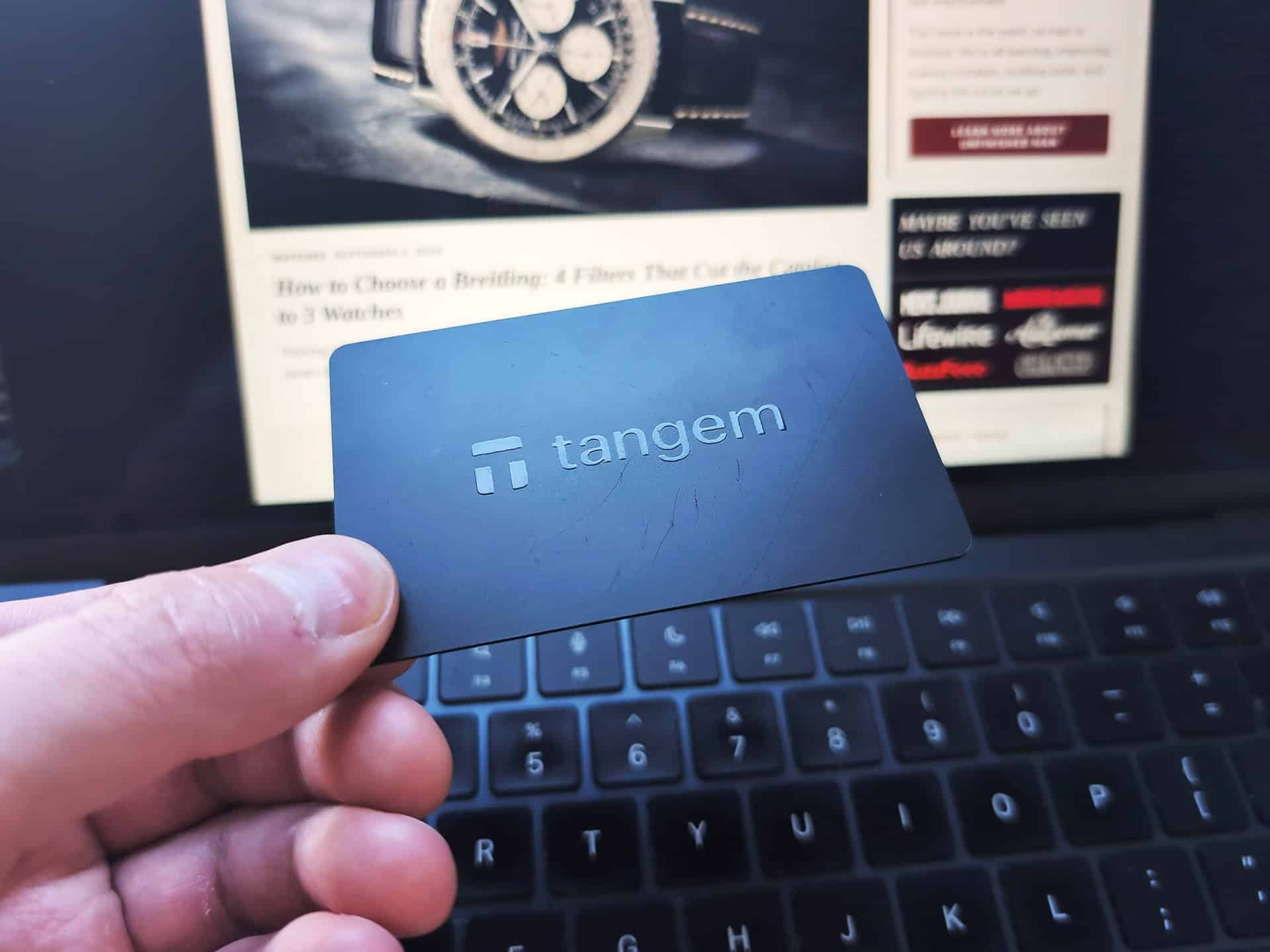
A guy with real money in crypto eventually hits the same wall: where do I actually keep this stuff? Not where the YouTube guy says, not where the exchange makes it convenient. Where. And at some point someone hands him a Tangem, a black card the size of a credit card with no screen, no battery, nothing written on paper, and he’s supposed to trust it with his savings.
The honest answer is yes, the Tangem Wallet is safe for cold storage of large amounts of crypto, provided you handle the access-side risks this article walks through. The card itself is built around an EAL6+ certified Samsung secure element that keeps your keys on-card and unreachable, it’s been independently audited twice by firms that specialize in exactly the attacks it claims to survive, and across millions of deployed devices since 2018 there isn’t a single successful hack. But here’s the thing: a “yes” with no receipts is just a marketing claim. Security deserves the same skepticism you’d apply to any expensive tool.
Show me the certification, the audits, and the track record. That’s the standard this piece holds it to, and the uncomfortable flip side comes at the end: most ways to lose money on a hardware wallet involve the guy holding it, not the chip.
Key Takeaways
The Tangem line uses a Samsung S3D350A secure element certified EAL6+ under Common Criteria (ISO/IEC 15408), the same chip class as biometric passports and payment cards, and it’s in every model, not just a premium SKU.
Two confirmed audits, both clean: Kudelski Security (2018, firmware) and Riscure (2023, hardware and side-channel testing). The app is open-sourced on GitHub with a live bug bounty on top. Device counts run 3M to 8M+ depending on the source, zero successful hacks across all of them.
The chip protects against key theft; it can’t protect against you. Phishing approvals, blind signing, address poisoning, wrong-address sends, and losing every backup card with no seed are all user-side losses that survive the secure element intact.
Table of Contents
What “safe” means for a hardware wallet
Tangem is a cold wallet: your keys live offline inside a secure element on the card, the app on your phone only ever handles unsigned data, and signing happens when you tap the card over NFC. That’s the category, and it matters, because the whole reason hardware wallets exist is to keep the key off the internet.
Here’s the frame worth holding all the way through. Crypto is cash in your pocket. Whoever has the key has the money, no undo button, no fraud department, no password reset. An online wallet keeps that key on an internet-connected device exposed to malware, phishing, and the platform itself going under. A cold wallet takes the key and puts it where the internet can’t reach.
So “is it safe” actually splits into two honest questions. One: can a thief pull the key off this thing? Two: can you lose access through your own mistakes? Most real losses live in question two, and those aren’t hardware failures. Keep both questions running, because the card answers them very differently.
The stakes aren’t theoretical either. Roughly $1.38 billion in crypto got stolen in the first half of 2024, nearly double the same stretch of 2023. And a 2025 study put the incident rate under 5% for hardware-secured wallets versus over 15% for software-only. That gap is the entire sales pitch for cold storage, said without a single adjective.
The five things any hardware wallet must prove
You can reuse these five checks on any wallet, including ones that aren’t Tangem:
| The bar | What it means in plain terms |
|---|---|
| Key can’t be extracted | Hardware isolation in the chip itself, not software promises |
| Provably genuine from factory | The card cryptographically proves it wasn’t tampered with in transit |
| Independent audit | A real third-party firm checked the work, not the company grading its own homework |
| Immune to remote attack | The key never touches the internet, so remote attacks have nothing to grab |
| Track record at scale | Been around long enough, in volume, with no documented breaches |
Tangem clears all five. Here’s the proof.
How the cold-storage architecture works
The architecture comes down to one arrangement: the key lives offline on the card, the phone app only ever handles unsigned data, and signing happens on the card itself over an NFC tap. The two pieces below walk through how that plays out in practice, first by following a single transaction, then by looking at what the lack of connectivity removes.
The signing flow, watched over someone’s shoulder
Say you’re sending 100 USDT. The app on your phone builds the transaction, but it never touches the key. You tap the card, the card does the signing internally, using the same ECDSA math Bitcoin and Ethereum run on, and only the signed result comes back to the phone so it can hit the blockchain. The key stayed home the entire time. That’s the whole pitch: unsigned request in, signature out, nothing internet-facing ever gets near the key.
No connection, no compromise
Cold storage here isn’t something you switch on. It’s built into how the thing works, which is why it shrugs off the usual attack routes. You could click a sketchy link on your phone, land real malware, and your cold-stored funds would still be unreachable, because the attacker can’t get to a key that lives on a card with no radio beyond NFC tap-to-sign. The card speaks ISO 14443 Type A, the same standard as tap-to-pay, has no battery, and connects over no USB and no Bluetooth. Fewer doors, fewer ways in.
Self-custody is the other half of the architecture. The exchange never holds your keys, which means nobody freezes your account, nobody goes bankrupt with your coins, and there’s no counterparty to fail on you. For a concrete picture of what that removes: the January 2025 Phemex hack cost users around $69.1 million, money that was on someone else’s servers when it vanished. Your money on your card isn’t anyone else’s database entry.
What the secure element actually does
Certifications name the standard; this section is about what the chip itself is and what it physically stands up to. The short version: a dedicated microprocessor built to hold the key under active attack, hardened against a specific family of physical attacks, with a failure mode that ends in a dead chip rather than an exposed key. Start with what a secure element actually is.
The safe deposit box inside the safe
A secure element is a dedicated microprocessor built for one job: holding and working with sensitive data under attack-resistant conditions. It sits on its own chip, apart from the main processor, and runs its own show, and it gates what data can be touched and blocks direct memory reads. The tech is borrowed straight from credit cards, SIM cards, and e-passports, which means billions of daily uses before crypto ever borrowed it. Think of it as the safe deposit box inside the safe.
There’s also a protective mesh woven into the silicon. Penetrate the surface with a laser or a probe and the chip kills its own data before your key gets out. Physical attacks end with the chip destroying itself rather than handing over the key. That’s the designed failure mode, and it’s the right one.
The attacks it’s built to defeat
The chip is hardened against a specific family of physical attacks, each with a countermeasure:
- Power analysis, where an attacker reads key patterns out of the chip’s electrical noise. Countermeasure: randomized sequences and masking.
- Electromagnetic leakage, the same idea through radiation. Countermeasure: shields and noise.
- Voltage and clock glitching, which tries to skip an instruction like a PIN check. Countermeasure: anomaly sensors halt the chip.
- Laser fault injection. Countermeasure: light sensors and that protective mesh.
- Cold-boot attacks freezing RAM to read residue. Countermeasure: encrypted memory, nothing residual left behind.
The hierarchy here is what makes it meaningful. A dedicated secure element beats a trusted execution environment, which shares buses with the main OS, which beats a general-purpose chip. Older Trezor Model One and Model T units and KeepKey run general chips and can, with physical access, be voltage-glitched into dumping keys. That’s a fact, not a dunk; those wallets moved on, as the firmware section covers.
Tangem’s card is a monolith by design: screenless, batteryless, molded as one piece, rated IP68. Fewer components, smaller attack surface.
What EAL6+ proves, and why most wallets don’t have it
EAL6+ is a certification level under Common Criteria, the international standard for independent security evaluation (it’s ISO/IEC 15408), and it matters because it’s the tier biometric passports and payment cards sit at. Translation without the acronym worship: the design is semi-formally verified and tested for high-value targets. Serious engineering, independently checked, with real attack scenarios and heavy documentation behind it. Not a rubber stamp.
The scale in one breath: EAL1 through 4 is basic assurance, fine for gear that doesn’t face serious physical attacks, which a crypto wallet isn’t. EAL5+ is the credit-card and e-passport grade, and most consumer wallet chips land at EAL5 or 6. EAL7 exists but is basically unattainable for real products, so EAL6 and 6+ are the practical ceiling. The “+” means extra requirements stacked on top, like fault-injection resistance.
One honest note that most reviews skip: EAL measures how rigorous the evaluation was, not invincibility. Never trust anyone who says “unhackable.”
The chip is a Samsung S3D350A, developed with Samsung Semiconductor, and the documentation says no backdoors. Worth mentioning, not worth promising. Here’s the rare part: the EAL6+ certification covers Tangem’s whole line. Ledger reserves EAL6+ for select models, the Nano S Plus and the Stax, while the popular Nano X runs an EAL5+ ST33 chip.
Everyone gets the good chip. Fair to Ledger anyway: EAL5+ is still strong, and EAL5+ minimum is the sensible floor for high-value holdings.
Why doesn’t everyone hit EAL6+? Good reasons, actually. Accredited independent labs cost real money and real time, and the strict EAL6+ profile constrains how the chip gets used and updated. Plenty of makers pick flexible architectures over chasing the top level.
Reasonable people, reasonable trade-off. Supplementary ratings like a CER Security Rating, CertiK Skynet, or ANSSI CSPN exist alongside EAL as extra context.
Has Tangem ever been hacked? The audit record
No. The Tangem Wallet has never been successfully hacked. How many devices? Sources don’t agree, anywhere from 3 million to over 8 million deployed since 2018. What they do agree on: zero successful hacks and no reported user fund losses across all of them.
And the honest caveat: no hacks yet isn’t the same as unhackable. It’s a track record, which is a different, more honest thing.
Certification and audits answer different questions, and you want both. Certification is what the chip can withstand. Audits ask whether the firmware and the protocol layer are clean. One is “we’re secure, promise”; the other is the version where outside experts tested us and published the results.
Quick test: Before trusting any “audited” claim, check who audited it and whether their specialty matches the threat — a firmware audit and a physical-attack audit are not the same receipt.
The two confirmed audits
Kudelski Security, 2018. They’re a serious global cybersecurity firm whose lane is embedded systems and cryptographic protocols, and they audited the card firmware and found no vulnerabilities. Riscure, 2023. They specialize in exactly the side-channel and fault-injection attacks the chip claims to defeat, and their assessment of the hardware security came back clean too. That auditor-threat match is the detail most reviews miss; it’s not just that they were audited, it’s that the auditors were the right specialists for the threat model.
The full proof chain, each layer covering a different surface: chip certification covers the silicon, Kudelski covers the firmware, Riscure covers physical attacks, the app and SDK are open source on GitHub for anyone to kick the tires on the software layer, and there’s a live bug bounty program, maintained as part of their actual security setup, which is proof they expect scrutiny, not just welcome it. Firmware itself is closed source but independently audited and immutable. A trade-off, not a scandal.
One honesty beat worth flagging: a Cure53 audit dated 2026 circulates in a single source, and the tell is that it shows up in verdict copy but not in any evidence section. Treat it as unverified. SlowMist likewise appears associated with Tangem in one source and nothing more; don’t bank on it either.
Immutable firmware and the trust-versus-verification question
Tangem’s firmware is closed source and permanently fixed, which puts it on the trust side of the oldest argument in security: trust a vendor’s audited process, or verify everything through open code. There’s real evidence on both sides, and neither one walks away clean. First, what immutability actually buys and costs.
Why the firmware never updates
Tangem’s firmware is baked in at the factory, write-once, no user updates, ever. The feature argument is straightforward: if nobody can push an update, nobody can slip a malicious one in. That closes a whole attack door. The real cost, said plainly: no remote patching and no code you can inspect.
Security rests on the vendor’s audits. Some people will hate that, and the trade deserves to be named rather than spun.
The open-source counter-position
Trezor’s history is the best argument for the other side. The Model One and T shipped with no secure element at all, because no chips with disclosed blueprints existed. Then came the OPTIGA Trust M in the Safe 3 and Safe 5, and now the Safe 7 carries the TROPIC01, the first truly open secure element: RISC-V, open netlist, no NDAs, built on Kerckhoffs’s principle that security should rest on the key, not on process secrecy. OneKey takes a third path: fully open software with up to four EAL6+ chips in the Pro.
Here’s the empirical part: open versus closed shows no consistent vulnerability pattern. Coldcard, a Bitcoin-only specialist running its own approach, shipped an MK2 with a PIN brute-force flaw, fixed in the MK3. (A single source alleges a July 2026 Coldcard RNG bug; I wouldn’t hang a verdict on it either way.) Certification stays the primary assurance whichever philosophy you pick.
| OneKey | Trezor | Tangem | |
|---|---|---|---|
| Chip | Up to four EAL6+ secure elements (Pro) | OPTIGA Trust M (Safe 3/5), open TROPIC01 (Safe 7) | Samsung S3D350A, EAL6+, line-wide |
| Open software | Yes | Yes | App and SDK open, firmware closed |
| Open hardware | Partial | Safe 7’s chip fully open | No |
| Form factor | Device with screen | Device with screen | Screenless card (plus Ring) |
| Connectivity | USB/air-gap options | USB | NFC only, no battery |
Seedless Smart Backup, and what losing a card actually means
The Tangem Wallet uses a seedless multi-card backup by default: two or three cards sharing one key, any single card giving you full access, with an optional 12 or 24-word seed phrase you can generate or import if you want one. Claim and trade-off, all in one design.
The mechanics
During setup the key gets cloned across the cards over encrypted NFC. None is a master; they’re equals. Lose one card and nothing changes as long as another survives, and you can add a replacement card through the recovery flow without a paper phrase. Store them in different places, the way you’d treat spare house keys.
The optional seed, and why the default is seedless
If you opt into a BIP-39 phrase, that phrase becomes the key: it lives inside the chip and stays there. But the reason the default is seedless is that seed phrases fail people constantly: paper gets lost or wrecked, digital copies get compromised, nobody remembers where they put the thing. And the sharp one: photograph your 24 words, and someone who finds that photo can restore your entire wallet on his own device, no chip involved. The secure element protects what’s inside it, not secrets you’ve already leaked somewhere else.
The failure mode no backup eliminates
Yes, you can lose your crypto on a Tangem Wallet, but only one way: losing every backup card with no seed set up. That’s permanent, and Tangem can’t rescue you either; the design is explicit about it. (If you’re planning to buy a Tangem hardware wallet, you can currently get 10% off.) Which risk is smaller, a leaked paper seed or lost cards, depends entirely on your storage discipline.
Neither is strictly safer. You’re picking which catastrophe you’re less likely to cause.
Some resilience comes free with the architecture. Lose your phone? The card is the wallet, the app is just the screen: new phone, download a free Tangem mobile wallet, tap the card, done, nothing like the depressing realization I had a month ago that I’d need to buy a whole new cardholder wallet. And if Tangem the company vanished tomorrow, your keys live on your cards, the firmware is on-card, the cards keep working for 25-plus years, and blockchain access doesn’t run through their servers.
IP68 sealing, a -25 to +50 °C operating range, and a 25-year warranty back that up. The rival backup philosophy is Cypherock X1’s Shamir five-shard split, which gets its own comparison below.
What Tangem cannot protect against
The chip signs what it’s told. That single fact is why the secure element does nothing against phishing-approved malicious transactions, blind signing, address poisoning, wrong-address sends, seed leakage, or you losing your own access. Everything below is a user-side loss that the hardware survives without a scratch.
Phishing approvals and wrong addresses
A fake Uniswap-style approval page tricks you into signing a malicious transaction. The card executes it faithfully, because it has no idea the request was a lie. Once it’s on-chain, no undo. The wallet does confirm the address before signing, but it can’t stop you from approving the wrong one. The final check is on you.
Blind signing on a screenless card
The card can’t show you what that hex data means. Approving an unreadable transaction is signing a blank check, and on Tangem you’re doing it structurally more often than on a device with a display. Say it straight: the missing screen is Tangem’s most honest weakness, baked into the form factor, not a user error. On a Ledger, the screen is controlled directly by the secure element, which defeats address-substitution malware. WalletConnect DeFi sessions and third-party swaps and on-ramps are the surfaces where that phishing exposure re-enters.
Address poisoning
Scammers send zero-value transactions from look-alike addresses hoping you copy theirs out of your transaction history later. The card has no way to know that address is a scammer’s instead of your friend’s. It signs whatever you paste.
The human limits
Physical coercion defeats every hardware wallet, full stop. Forced tap plus forced access code equals access; that’s a human-world limit, not a Tangem flaw. On the codes themselves: six characters minimum, with the card slowing down progressively after six failed tries. “123456” technically qualifies and protects you from almost nobody.
The architecture is strong; the code is only as strong as you make it. One pattern worth naming: new owners treat the access code like a phone passcode, trivial and recoverable. On a seedless setup, it isn’t.
And flatly: it’s mobile only. iOS and Android, no desktop app, no web interface. For desktop-first guys that’s a genuine annoyance, and it sits alongside closed firmware and no display as the wallet’s main disadvantages.
Buying real: attestation, pricing, and doing it right
The app cryptographically verifies your card and its firmware on first tap, before any wallet operation happens, so a counterfeit fails before a cent goes on it. Each card carries its own key pair just for proving it’s genuine, like checking the seal on a new phone. One more rule worth following: buy only through official channels. The classic mistake: grabbing a discounted sealed unit from a marketplace seller to save a few bucks. Pricing: $54.90 for the 2-card set, $69.90 for the 3-card set, around $160 for the Tangem Ring.
Red flag: A “sealed” wallet bought from a marketplace third-party seller. The app verifies the card on first tap, but official channels are the only chain of custody worth trusting.
What a sensible guy actually does: keep small spending money in a hot wallet while the real stack sits in cold storage, carry a twenty, not your savings. Test your recovery before real money is on the line; the cheap lesson beats the expensive one. And keep at least two backups in different places. Don’t stash keys or access codes in notes apps, photos, or cloud docs.
Check addresses, don’t sign what you can’t read, and keep your guard up, because phishing and address poisoning are still the top threat today. Awareness matters as much as the chip.
Privacy and durability in one beat: there’s no account and no KYC for basic use, no personal data gets collected, transactions go straight to the chain, and IP addresses aren’t linked to wallets. It handles 85+ blockchains and 16,000+ tokens, with one source saying fewer; treat the lower figure as the floor. As for sentiment, the picture is honest spread rather than consensus: Trustpilot sits at 4.1 out of 5 from 700+ reviews, while the App Store runs 4.9 from around 16,000 ratings and Google Play 4.7, a tangem wallet review reddit roundup of real user threads captures the same pattern of recurring praise and complaints, so lay out the spread and admit the limits: nobody’s fabricating what the complaints say. For the broader hands-on picture, the full Tangem wallet review covers setup and everyday use.
Tangem vs the field: comparing on safety, not spec sheets
The decisive difference between hardware wallets isn’t price or coin count. It’s chip certification per model and backup philosophy, and “safest” depends on which risk you weight most. Applying the same criteria across the field:
Certification per model
| Wallet | Price | Chip certification |
|---|---|---|
| Tangem (2/3-card) | $54.90 / $69.90 | EAL6+ line-wide |
| Tangem Ring | ~$160 | Same line |
| Ledger Nano X | $149 | EAL5+ (ST33) |
| Ledger Stax | $399 | EAL6+ |
| Trezor Safe 3 / Safe 5 | $79 / $169 | OPTIGA Trust M |
| Trezor Safe 7 | $249 | Open TROPIC01 |
| OneKey Pro | $278 | Up to four EAL6+ chips |
| NGRAVE ZERO | $398 | Sources conflict: EAL6+ or EAL5+ (STMicroelectronics AFEA100), both attributed, neither confirmed |
| CoolWallet Pro | $149 | EAL6+ card, with a screen |
| SafePal S1/X1 | $49.99, $89.99 | EAL5+, air-gapped |
| Coldcard | $177.94, $249.21 | Bitcoin-only specialist |
Ellipal and Keystone round out the air-gapped camp. Certification per model is the axis commodity reviews skip, and it’s where the money actually is.
Air-gapped rivals and the QR trade-off
Air-gapping cuts online attack vectors, but Shift Crypto found no conclusive evidence of an inherent security advantage, and QR and microSD paths introduce substitute risks like malicious payloads. Tangem’s NFC model isn’t a step down; it’s a different door with its own lock. A fuller side-by-side lives in our comparison of whether Tangem is a good wallet.
Backup philosophy
Tangem’s multi-card cloning, Cypherock X1’s Shamir five-shard split ($129, $299, KeyLabs audit clean), or a plain paper seed. That’s a philosophy choice, not a spec-sheet winner. Fair credit all around: Ledger’s EAL5+ Nano X is still a good wallet, and Tangem’s genuine strengths, seedless on-card key generation, tap-to-sign, a battery-free card that survives abuse, fast setup, an intuitive app, don’t require anyone else to be bad.
Who Tangem is for, and where vendor trust creeps back in
By this point the hardware case is laid out, so the remaining question is about fit and about the places where trusting Tangem the company quietly re-enters the picture. The card itself removes the counterparty; some newer company features don’t. So who’s this wallet actually for?
Fit and anti-fit
Tangem suits beginners wanting simple cold storage, long-term holders who don’t want maintenance, mobile-first guys and travelers, and anyone who hates paper seeds. Look elsewhere if you’re a DeFi power user who wants transaction detail on-device and a desktop suite, a desktop-first trader, or an open-firmware purist. Company context in one beat: founded 2017, headquartered in Zug, Switzerland, millions of cards produced, with the Wallet and the Ring in the line.
The tension almost nobody covers
Tangem Pay, announced November 2025, started rolling out gradually from the waitlist in the US, Latin America, and APAC, with the UK and EU following in early 2026 under MiCA. It lets you spend USDC on Polygon through a virtual Visa in Apple Pay or Google Pay while the funds stay on-chain and user-controlled. But look at the plumbing: KYC handled through Paera LLC, compliance co-signing by Rain, Sumsub and Elliptic monitoring. And Yield Mode auto-supplies USDT, USDC, or DAI to Aave with a stated caveat that Tangem’s backend can withdraw funds on a protocol vulnerability. These quietly reintroduce the counterparty trust the core card architecture was built to remove.
Not a scandal. An open question worth asking before you opt in.
Final verdict
The hardware side of this is documented: an EAL6+ Samsung chip that keeps keys on the card, two audits that came back clean from firms whose specialties match the exact threats, and zero hacks across millions of devices. The access side is entirely yours, and every documented loss pathway here routes through user practice, not chip failure. The hardware is ahead of how most people use it, which is why the last practical move is the boring one: small spending money in a hot wallet while the real stack sits in cold storage, and the safety story stays something you can verify instead of something you were told.
Frequently Asked Questions
Is the Tangem wallet safe to store large amounts of crypto on?
Yes, for the hardware side: it’s built around an EAL6+ Samsung S3D350A secure element, audited clean by Kudelski Security in 2018 and Riscure in 2023, with zero successful hacks across millions of devices deployed since 2018. The caveat is the access side — phishing approvals, blind signing, address poisoning, and losing every card are all user-side risks no chip protects against. Large holdings deserve a strong access code and backups stored in different places.
What certifications and independent audits does the Tangem wallet have?
The chip is a Samsung S3D350A certified EAL6+ under Common Criteria (ISO/IEC 15408), the tier biometric passports and payment cards sit at, and the certification covers the whole Tangem line. Two independent audits came back clean: Kudelski Security audited the firmware in 2018, and Riscure, a side-channel and fault-injection specialist, assessed the hardware in 2023. The app and SDK are open source on GitHub, with a live bug bounty on top.
Is Tangem a cold wallet or a hot wallet?
Tangem is a cold wallet. Your keys live offline inside the card’s secure element, the phone app only handles unsigned data, and signing happens on the card itself over an NFC tap — no USB, no Bluetooth, no battery. Even if your phone gets infected with malware, cold-stored funds stay unreachable because the key never touches an internet-connected device.

