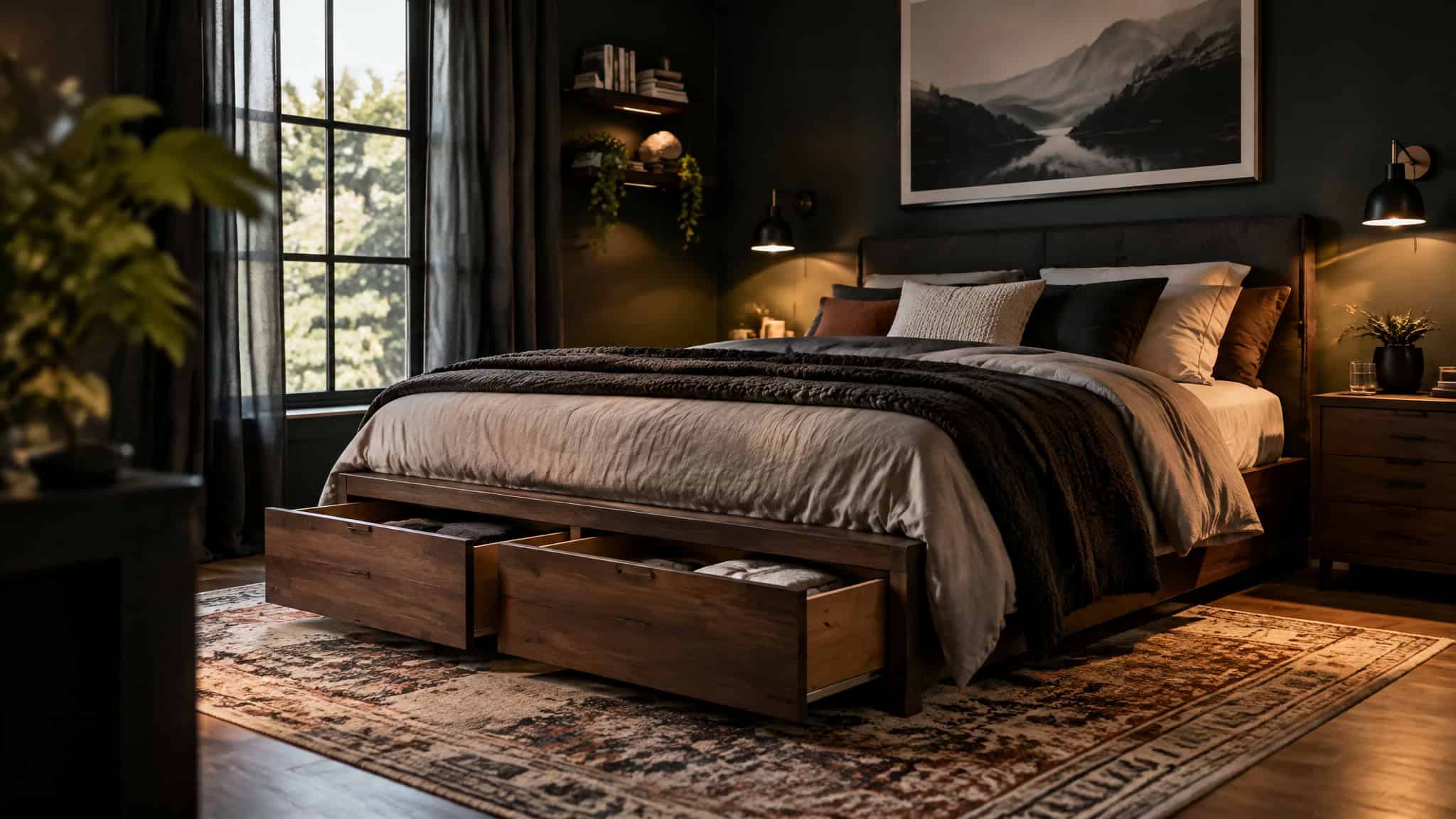
A small bedroom should be the easiest room in the apartment to make look sharp. It’s one bed, one dresser, done. Instead, most of us end up with a 10×10 that reads like a dorm we never bothered to fix: a bed crammed against the wall, clothes migrating to a chair, one sad overhead bulb making everything look like a hallway at 2am. The gap between a sleek bachelor room and a cramped afterthought isn’t budget. It’s three levers most guys never pull at the same time: multifunctional furniture that does two jobs per footprint, vertical storage that uses the height of the room instead of the floor, and a layout that treats the bed as the focal point instead of an obstacle.
This isn’t a photo listicle. After years of testing small-space products, plus interviews with organizers and designers conducted in April 2025 (Jill Singer, Jamie Hord, Colin Chee, and Cristina Cleveland among them), I can tell you which storage bed drawer actually holds six thick bath towels or 10 pairs of jeans, which under-bed bin tips over when you overfill it, and which wall sconce installs in under five minutes with one screw and no electrician. You’ll get the honest trade-offs too, because every space-saving move costs you something: drill holes, a ladder climb at night, a lid that only opens one way.
Below are 18 ideas, roughly in the order I’d tackle them. Storage bed first, because it’s the single biggest floor-space win if your room can spare the drawer clearance. Multifunctional furniture and lighting get the most depth, because that’s where the tested products and the designer advice actually change decisions. And near the end there’s a worked example: a real 11×11 room, crossed in about four to five steps, that uses nearly every trick here. If you’re furnishing from scratch, the broader bachelor bedroom ideas guide covers style directions and budget tiers; this one is about squeezing a small room until it stops fighting you.
Key Takeaways
The Room & Board Hudson Bed‘s drawers hold six thick bath towels or 10 pairs of jeans each and pull out nearly two feet in queen, which means you can skip the dresser entirely if you measure clearance first.
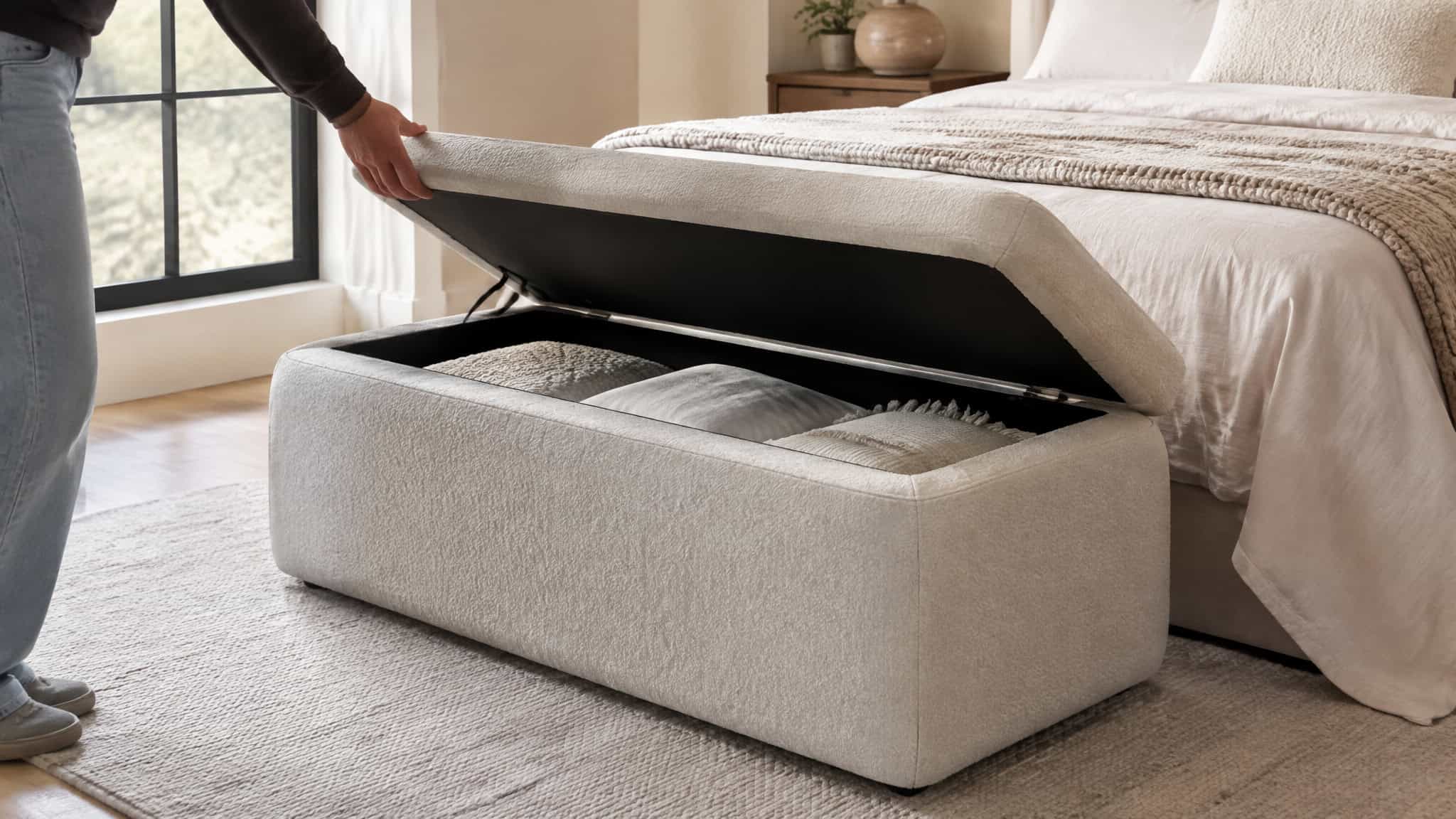
The Article Maribo Storage Ottoman was the top-tested storage bench. Foam padding you can actually sit on, three sizes from 12x15x15 to 18.5x48x15.5 inches, and a lid that opens one-handed even pushed against a wall.
Dark colors don’t shrink a small room. Four designers back darker hues for depth, and the real variable is lighting: one overhead bulb makes any small room feel like a hallway.
Table of Contents
| Pick | Why it stands out |
|---|---|
| Use a Storage Bed Frame | Use a Storage Bed Frame: built-in drawers or lift-up compartments replace bulky dressers; store clothes, shoes, bedding; neutral tones like black, grey, or wood for masculine |
| Install Wall-Mounted Shelves | Adds storage without using floor space; keeping items off the floor makes the room feel bigger. |
| Go for a Minimalist Design | Go for a Minimalist Design: keep only what you truly need; palette of black, white, grey, or earthy tones; clean-lined furniture, avoid overcrowded surfaces |
| Add a Floating Desk | Add a Floating Desk: wall-mounted workspace with no floor footprint; pair with chair tucked underneath when not in use; suits work, study, or gaming |
| Use Under-Bed Storage Boxes | Maximizes unused space under the bed with containers specifically designed to fit underneath. |
| Choose a Loft Bed Setup | Elevated sleeping area frees the space underneath for other uses. |
| Install Built-In Wardrobes | Add Bonus Storage Even those with built-in closets sometimes find |
Model details derive from the cited sources; check the brand pages for current pricing.
Use a Storage Bed Frame
A storage bed frame is the better pick when your room can’t spare the floor space for a dresser, but only if the layout leaves room for the drawers to open. That’s the whole deal: drawers or a lift-up bed mean you can skip the dresser entirely, and the proof is real. One drawer in the Room & Board Hudson Bed holds six thick bath towels or 10 pairs of jeans and extends nearly two feet in queen.
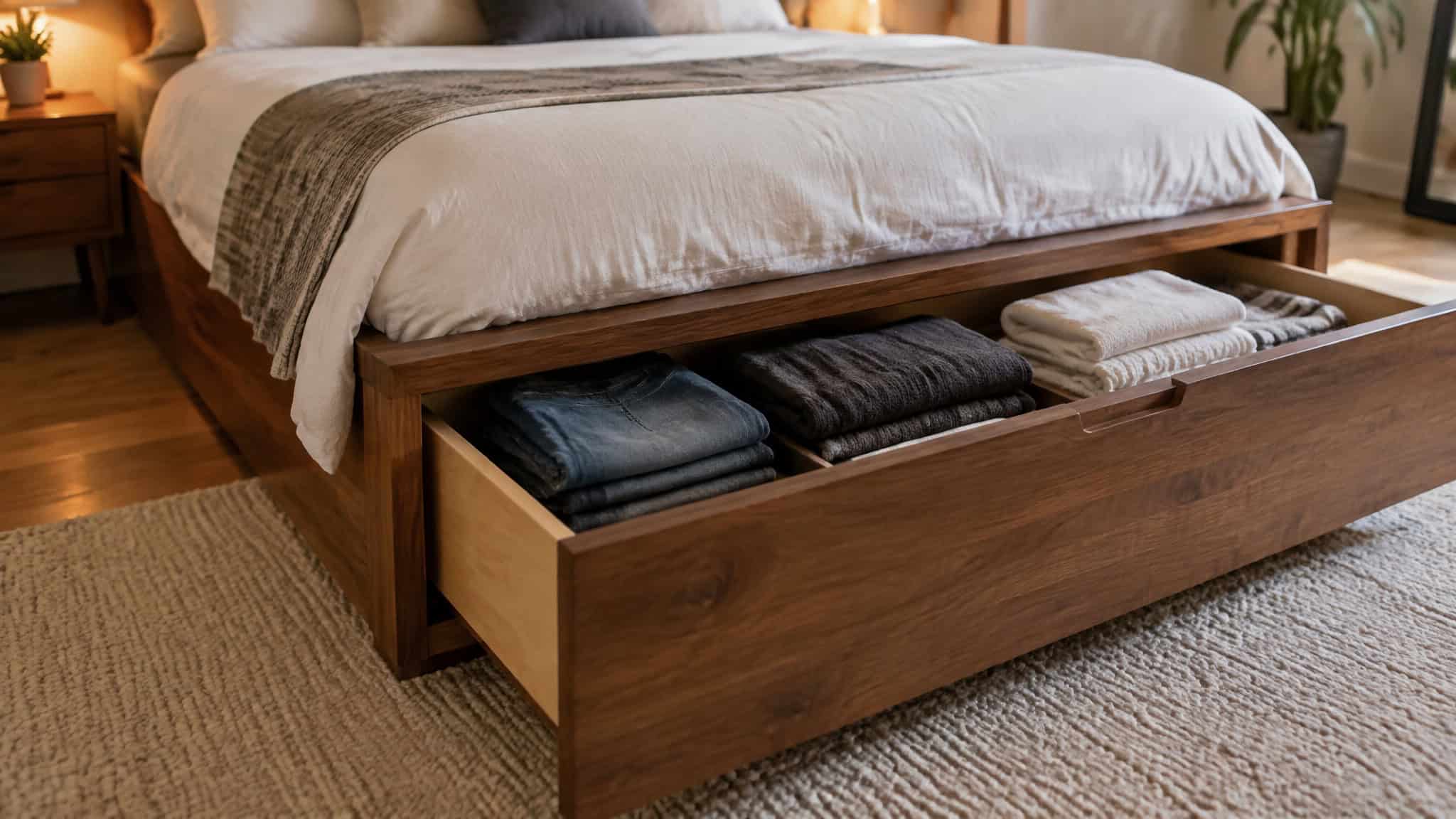
Room & Board Hudson Bed. It’s got four drawers in solid hardwood, made in West Virginia, with nine stain options and every size from twin to California king. White-glove delivery, so you’re not assembling it yourself. One tester jumped on it to prove it wouldn’t complain.
The honest caveat: the corners are sharp, so they’re worth padding if you share the room with small kids. This is the buy-it-once option if you’re keeping the bed a decade.
IKEA Malm. The budget default. Get the two-drawer version if you’d rather slide, the hinge-top if you’d rather lift. One tester ran theirs 13 years and the drawers still slide fine. Some units squeak after a few years, assembly needs a second pair of hands, and a cat can pry the drawers open. Ask me how I know that last one is a real risk.
West Elm Myla Pop-Up Storage Bed. The specialty tool for rooms where every inch fights back: the whole top lifts, so nothing needs swing clearance. Expert-recommended for very tight rooms. If your room isn’t that tight, cheaper options exist.
Right-size the bed first. The biggest small-bedroom mistake isn’t too much furniture, it’s a bed that’s too big. Designer Jennifer Press sees guys squeeze in a king where only a queen fits, leaving no room for properly sized nightstands. Jaime Zehner’s counterpoint: going too small backfires too, since tiny nightstands and skimpy rugs make a room feel disjointed. Annie Downing’s line sums it up: a handful of well-made pieces that each do double duty will always outperform a room stuffed with furniture.
And do the boring step buyers skip: drawers extending nearly two feet need walking space, so measure the clearance before you commit. Built-in drawers suit everyday clothes; lift-up storage or loose bins suit bedding you touch monthly.
Install Wall-Mounted Shelves
Floating shelves in dark wood or metal add storage with zero floor footprint: above the bed, above a desk, on any empty wall. The trade is honest. You’re drilling into walls you might not want to touch, and anything mounted above the bed has to stay neat or it becomes the thing you stare at while falling asleep. But keeping stuff off the floor is something you notice walking in. The room just feels bigger.
Floor-to-ceiling bookshelf. The library move. Shelves framing the bed double as display space and make the bed the focal point instead of an afterthought. The trade-off: they become a junk shelf if you let them.
Fenestra Bookends. Four thin steel pieces that use almost no shelf width, with a bit of color as a bonus. If your shelves are already tight, this is the detail that keeps books standing without eating an inch you don’t have.
Go for a Minimalist Design
The biggest furnishing mistakes in a small bedroom are clutter accumulation, an oversized bed, and undersized pieces, so the minimalist reset is the fix, not a lifestyle. Keep only what you actually use. The test is one question: when did I last touch this? If the answer needs a calendar, it goes.
Stick to colors that get along, black, white, grey, or an earthy tone. Clean-lined furniture. Surfaces that aren’t covered in junk, because crowded surfaces are what make a small room feel smaller than its square footage. One practical move if you’re working with hand-me-downs: repaint that colorful dresser in a natural tone.
Costs an afternoon, changes the whole mood of the room. That’s it. Less stuff, calmer room.
Quick test: Ask one question about every item in the room: when did I last touch this? If you need a calendar to answer, it goes.
Use Multifunctional Furniture
The furniture worth prioritizing in a small bedroom is the kind that does two jobs. Every object has to justify its footprint twice. Frame it as getting two pieces for the footprint of one, with the honest caveat that dual-purpose pieces are rarely great at either job. The mechanics matter more than the concept: how a lid hinges, whether a bench actually works pushed against a wall.
Desk as nightstand. Christina Higham’s move: swap the nightstand for a small desk and you pick up a workspace without giving up any extra floor. A dresser can sit in that spot too, if you’d rather have the drawers.
Armoire desk. The workstation that disappears. Shut it evenings and weekends and the office is gone, which matters when your bedroom is also your office. An armoire with shelves and drawers can also stand in for a linen closet. Two problems, one piece.
Utilitarian headboard. A shelving unit as headboard holds books and trinkets and uses wall space you weren’t doing anything with anyway. Trade-off: it looks storage-y, so it only works if you keep it tidy.
Storage bench at the foot of the bed. Holds pillows and blankets, and a window-seat version with cushions doubles as a reading spot. It’s still a big piece in a small room, so measure first.
Article Maribo Storage Ottoman. The tested top pick. Foam padding you can actually sit on, in boucle, leather, or felt. Three sizes: small at 12x15x15 inches, medium at 18.5x32x15.5, large at 18.5x48x15.5. The detail worth knowing before you buy: the lid opens one-handed and pitches forward, so it works even pushed against a wall. That’s the kind of thing you only learn living with one, and it’s the difference between a bench you use and a bench you climb around.
IKEA Domsten stool. Under $100, powder-coated steel legs, solid pine seat. It ends up doing five jobs: seat, plant stand, book display, step ladder, side table. One stool covers the small jobs so you don’t buy five things.
Add a Floating Desk
A floating desk mounts to the wall and gives you a workspace with no legs eating floor. The detail that matters most: the chair tucks fully underneath when you’re done. Sounds minor. It’s the difference between a workspace and a clutter magnet. If a mounted desk isn’t in the cards, a foldaway table with a vintage chair converts unused wall space the same way, use it when you need it, store it when you don’t.
Works for work, study, or gaming. The payoff is a place to actually get things done in your room without sacrificing the floor you need to walk. A foldaway table with a vintage chair converts unused wall space the same way if a mounted desk isn’t in the cards.
Use Under-Bed Storage Boxes
Under-bed boxes are the cheapest storage win in the room, the flexible fallback when there’s no storage bed. The trade: cheap and effective, but digging blind under a bed is miserable, so go clear or labeled. Measure your bed clearance before buying anything, because the typical setup failure is bins that don’t slide or don’t fit the gap. Match storage to access frequency: plastic drawers for everyday clothes, flexible bins for bedding.
Iris Under Bed Drawer. Each drawer stands about 6 inches tall and 30 inches deep, and they’re sold as a set of four. They glide smoothly but tip if you overfill them or yank too far. That’s the flaw, stated plainly. Container Store gives you four months to return them, and when one tester’s arrived with a chipped corner, the return wasn’t a fight.
IKEA Sockerbit. A split-lid bin that holds about 15 folded sweaters or two dozen T-shirts. Zoe Vanderweide used hers daily for four years. The latches are fiddly, so she just leaves the lid open for everyday stuff. Real-use detail, flaws included.
Container Store Boot Box. An under-furniture workhorse. One documented setup hid them under a crib behind a crib skirt, which generalizes carefully: the trick works anywhere there’s low clearance, but it’s hiding, not organizing.
Under-bed baskets as decor. Woven baskets hold sweaters, textbooks, extension cords, and look fine doing it. Storage you don’t have to hide.
Choose a Loft Bed Setup
A loft bed makes sense when you want a permanent zone underneath, a desk, storage, a lounge spot, whatever you’re missing. Bunk beds work the same way, stacking a second sleeping spot where the floor used to be. A Murphy bed makes sense when you want the floor back every day. The loft trade-off is real: you gain a full zone underneath, but you’re climbing a ladder at 2am.
Get one that’s sturdy and doesn’t read like dorm furniture. Modern finish, solid build.
Murphy bed. Flips up by day, down by night. The nuclear option for a room that has to be two rooms. Big commitment, big payoff.
Daybed and trundle. For the guy who actually hangs out on his bed beyond sleeping. A trundle bed slides underneath, so you get a spare sleeping spot without giving up floor by day. Requires honest self-assessment about how you live.
Canopy bed. Skepticism is fair, but the new versions run from patterned four-posters to cleaned-up half testers in textural solids. Not your uncle’s canopy bed.
Install Built-In Wardrobes
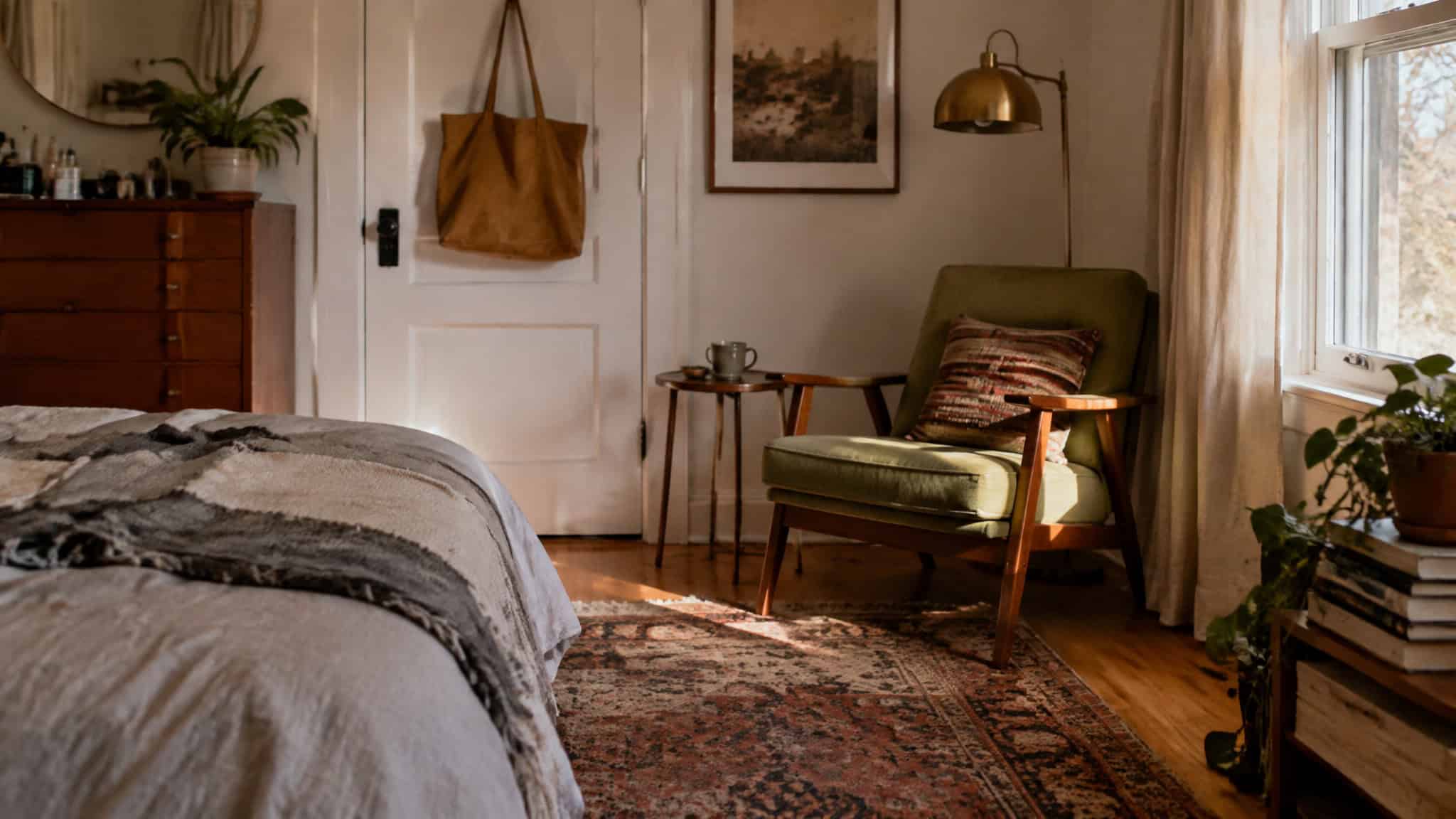
No closet? Built-ins if you can swing it; otherwise interior organizers and door hooks. Built-ins fit where a standalone closet won’t, which is the whole argument, and sliding doors save the clearance a swinging door eats. They just look finished: the room reads put-together instead of furnished-with-whatever-fits.
Closet organization with racks and baskets. Caroline Joy’s setup: a hanging rack, stacked shelves for shoes, baskets for accessories. The real cost is a weekend of sorting, not much money.
Behind-the-door storage. Closet doors hold hangers and hooks for bags, shoes, accessories; Wellesley & King makes the hardware. Free real estate you’re already paying for.
Vintage crates for shoes. Stacked, as The Merrythought did. Character and cost, zero polish. Your shoes are on display either way.
Use Dark and Neutral Colors
Dark colors don’t shrink a small room. Four designers, Cortney Bishop, Christina Higham, Corine Maggio, and Jaime Zehner, back darker hues for depth, and the real variable is lighting, not wall color, a point that holds whether you’re styling any space or browsing masculine bedroom ideas for small rooms. Black, grey, navy, brown: bold without being loud, and they hide clutter, which is the slightly lazy-guy appeal and I’m not pretending otherwise. The one condition: dark rooms need layered lighting, or they feel cramped instead of cozy.
Dark ceiling, taller room. Higham drenches small rooms in darker hues and they come out cozy and sophisticated. Maggio’s version keeps the dark on the ceiling only, which can make the room read taller if it contrasts with the walls. Zehner pushes back on default white: color, texture, and accents add warmth.
Light, not white. Christian Bense goes the other way, tinted light neutrals over pure white. Both work. Pick your lane.
Pattern-drenching. Jess Weeth’s bold route, sometimes with wallpaper borders as a twist. Commit or don’t. The tamer version: one big graphic art piece as the focal point.
Add a Foldable Chair or Desk
Use it when you need it, stash it when you don’t. That’s the zero-commitment option for rooms that do two jobs, which is most guys’ reality: bedroom plus office plus whatever else the apartment doesn’t have room for. Two warnings. Skip the flimsy folding chair; get one sturdy enough that you don’t hate sitting in it.
And make it look decent, because it’s going to be visible whether it’s in use or leaned against a wall. Beyond that, this one’s a principle, not a shopping list.
Use Vertical Storage Units
Tall shelves and cabinets trade height for floor space. Use the height of the room, not the floor. The bonus you notice without measuring: tall furniture pulls your eye up and the room feels bigger. Annie Downing and Corine Maggio both land on the same strategy from different angles: wall sconces, floating shelves, wall-mounted side tables, and full-height furniture are all one vertical play. The honest trade-off: top shelves become dead zones, so store the stuff you touch twice a year up there, not your everyday jeans.
Keep Décor Simple and Functional
Décor should earn its spot. A few things you like beat a shelf full of filler. Clocks, lamps, framed art: stuff that does something or looks good doing nothing. In a tight room, ornament costs surface space, so every frame and figurine is a trade you’re making whether you thought about it or not.
Pick the two or three pieces that actually mean something to you and let the rest go. Taste advice, not a curation framework.
Use a Mirror to Create Space Illusion
The oldest trick in the book, because it works. Mirrors bounce light and add depth. That’s the whole physics lesson. What separates this from generic “add a mirror” advice is placement: opposite a window for the biggest effect; in the darkest corner with a light above it to balance the lighting; small mirrors above nightstands as a vanity substitute.
The full mini grooming station is a mounted painted drawer, a vintage mirror, and sconces. Go frameless or minimal frame so the mirror doesn’t add visual noise to a room that can’t afford any.
Opt for Sliding Doors
Sliding doors save the swing clearance a normal door needs. That’s the entire argument. They work for closets, a built-in wardrobe fits better than a bulky standalone closet, or the room itself, and they happen to look modern as a side benefit.
Keep the Floor Clear
Renter-friendly storage without drilling is real: over-door racks, freestanding pieces, and shallow wall hooks cover most of it. Under-bed storage boxes work the same way, low-profile containers that slide under the bed and keep seasonal clothes and shoes out of sight. But the principle underneath all of it is the single biggest small-room win: if it’s on the floor and doesn’t need to be, it’s costing you space. Wall storage and hidden compartments cost money or effort up front, but they buy back your floor. And the chair pile, the worn-but-not-dirty clothes with no home, is the tell of a small-room organization gap.
Everyone has it. Here’s the fix.
Iris Hantverk Birch Peg Rail. Two, four, or seven pegs, and only 3 inches deep, so it fits behind a door. Editor Daniela Gorny uses hers for worn-but-not-dirty clothes, which kills the chair pile at the source. Check projection depth before buying: what fits behind a door or beside a walkway matters.
Orbit 8-Hook Over Door Rack. Eight hooks, no drilling, powder-coated steel with wooden ball ends. Looks intentional, not like a dorm hack. Two years in, the one complaint: the door needs a firmer slam. Worth knowing up front.
Vitra Coat Dots. Spherical hooks that mount flush or stick out about an inch, sold in sets of three in ombre groups. The small splurge that looks like design even when empty.
Use Compact Nightstands
Compact nightstands fix the space-hog problem without giving up the essentials: a spot for your phone and water, nothing else. The trade-off is less storage than a full nightstand, so be honest about what you keep at arm’s reach. One grounding number: the Kartell Componibili runs 12 inches across, with a curved sliding door that doesn’t need swing clearance.
Add Smart Lighting
With only one overhead light, the fix is layered ambient lighting. A single overhead bulb makes any small room feel like a hallway, and you notice it the first night. Corine Maggio’s takeaway, condensed: more light sources, less cave. Wall lights and LED strips beat a lamp eating nightstand space.
Poplight. Rechargeable, cordless, no outlet needed. That’s the whole selling point for a room where you can’t touch the walls. Several bright colors, app control, mounts with screws or adhesive, and it has a built-in level so it’s actually straight. The level is the thoughtful touch.
Wooj Allium Sconce. Plug-in, 3D-printed recycled plastic that reads like frosted glass. Installs in under five minutes with one screw. But the cord shows. Fast install, visible cord: that’s the deal.
Yarra-Decor bedside lamp with USB port. 4.7-inch base, charges your phone, touch control. Cheap, small, useful. Low risk.
Sconces instead of table lamps. Mount them on the wall and your nightstand is just a nightstand again. Simple cause and effect.
Declutter Regularly
Colin Chee’s 11×11 room works because decluttering came first: keep what you need, lose the rest, don’t dress it up. A clutter-free room looks better and feels bigger, and in a room you cross in four or five steps, that’s most of the battle.
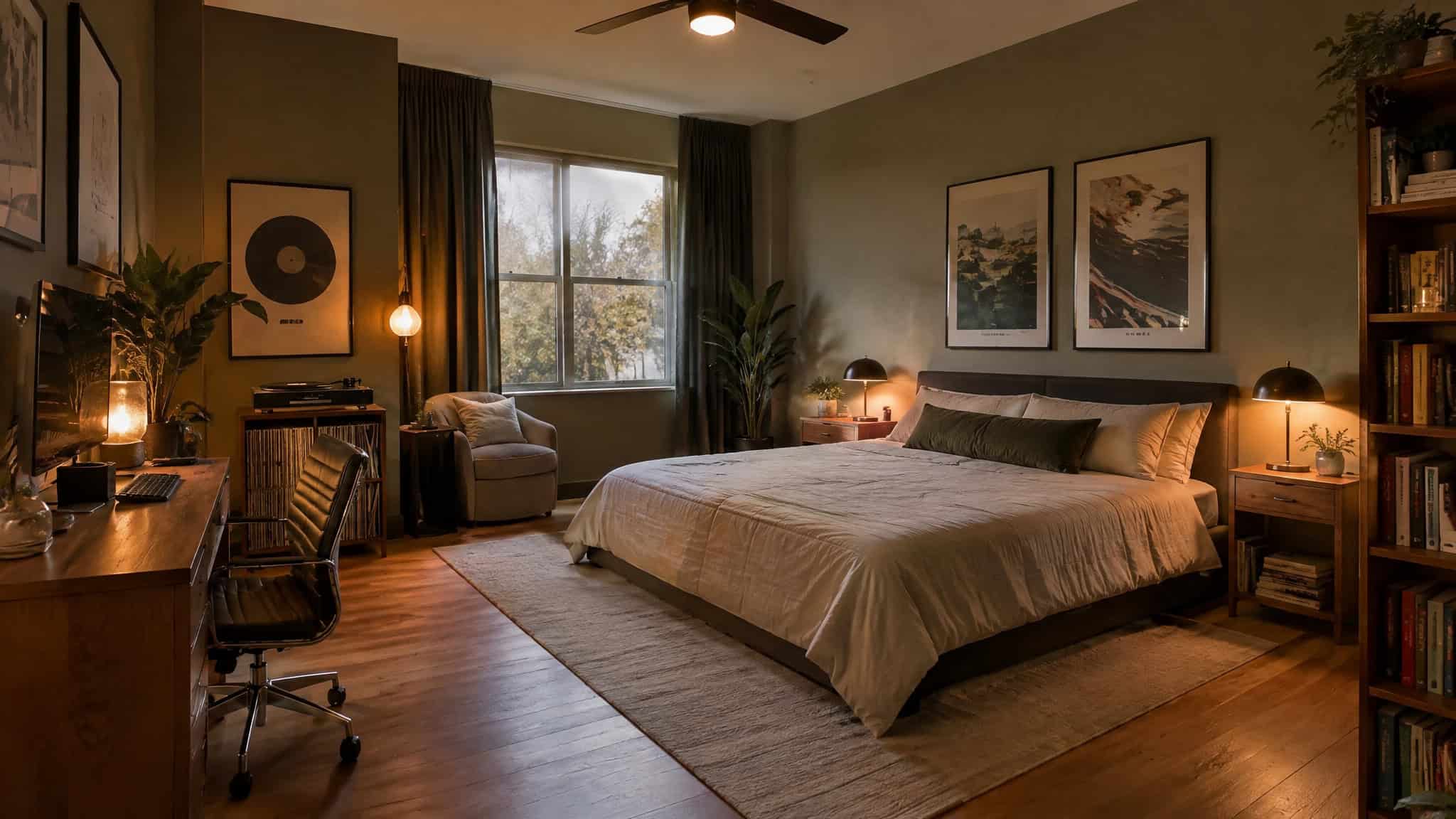
Zoning a real 11×11 room. Colin Chee’s room is 11 by 11 feet, crossed in about four to five steps. Go measure yours; that number is the point. His setup: an editing desk zone, the bed styled as the focal point, a record player nook, and a camera collection on a bookshelf, plus a closet organizer, under-bed cubes, warm layered lighting, and mirrors.
Not a universal formula, just one worked example of every trick in this article operating in a single room. If you want the style-side version of this thinking, the simple bachelor bedroom guide covers the restrained-setup angle.
Sourcing and Budget Workarounds
Furnishing on a budget comes down to secondhand sourcing and smart product lines, not just buying cheap new. The IKEA Malm and the under-$100 Domsten are the proven budget picks, and prices may vary, so check before you commit.
Secondhand and marketplace sourcing. eBay, Facebook Marketplace, Chairish. The hunt is worth it, and that’s a practical observation, not a moral position. Laura Stephens’s reupholstered eBay Georgian chair became her favorite piece, which points to the upgrade path: reupholstery turns a cheap find into a character item.
Midcentury and teen-market lines. Midcentury stuff runs smaller-scale anyway, which suits tight rooms. The RH Teen Laguna 2-Drawer Nightstand is the exemplar. Yes, the teen line, and that’s actually the point: smaller scale, same storage. The cost is a pride cost, not a quality one.
Full-wall shelving and TV concealment. Brandon Schubert’s flat runs full-wall shelving with a narrow coffee table; Sarah Vanrenen uses a Vert de Mer bookcase as the focal point in a room with no fireplace. One wall does the heavy lifting so the rest stays open. Hiding the TV behind art or a cabinet keeps the room from reading as “gaming setup”: HÁM hid theirs behind a painting in a Cornish cottage, and Bense built a bespoke cabinet for his.
Works at any level of ambition. For more low-cost moves, the budget bachelor bedroom guide covers thrifted furniture and staging tricks in depth.
Frequently Asked Questions
What are some good room décor ideas for small bedrooms?
Keep décor functional: clocks, lamps, and framed art that either do something or look good doing nothing. Pick two or three pieces that actually mean something to you instead of a shelf full of filler, because in a tight room every ornament costs surface space. Mirrors earn their spot too — opposite a window for the biggest effect, or in a dark corner with a light above it.
What are some creative bedroom ideas for a bachelor?
An armoire desk that disappears behind closed doors when the workday ends, a record player nook or camera collection on a bookshelf, and a storage bench at the foot of the bed that doubles as a reading spot. A daybed with a trundle works if you actually hang out on your bed beyond sleeping. Hiding the TV behind art or a bespoke cabinet keeps the room from reading as a gaming setup.
Is a storage bed frame better than under-bed storage boxes for a small bedroom?
A storage bed is the single biggest floor-space win because it can replace your dresser entirely — a well-made drawer holds six thick bath towels or 10 pairs of jeans. But it only works if your room can spare the drawer clearance, which can be nearly two feet in queen. Under-bed boxes are the cheapest, most flexible fallback, though digging blind under a bed is miserable, so go clear or labeled.
What are the biggest mistakes to avoid when furnishing a small bedroom?
The big three are clutter accumulation, an oversized bed, and undersized pieces — a king squeezed into a queen’s room leaves no space for properly sized nightstands. Crowded surfaces make a room feel smaller than its square footage, and one sad overhead bulb makes everything feel like a hallway. Anything on the floor that doesn’t need to be there is also costing you space.
How can I maximize storage in a small bedroom with no closet?
Built-in wardrobes fit where a standalone closet won’t, with sliding doors saving the clearance a swinging door eats. On a budget, a hanging rack with stacked shelves and baskets costs a weekend of sorting, not much money. Behind-the-door hooks and racks are free real estate you’re already paying for, and a tall armoire with shelves and drawers can stand in for a linen closet too.