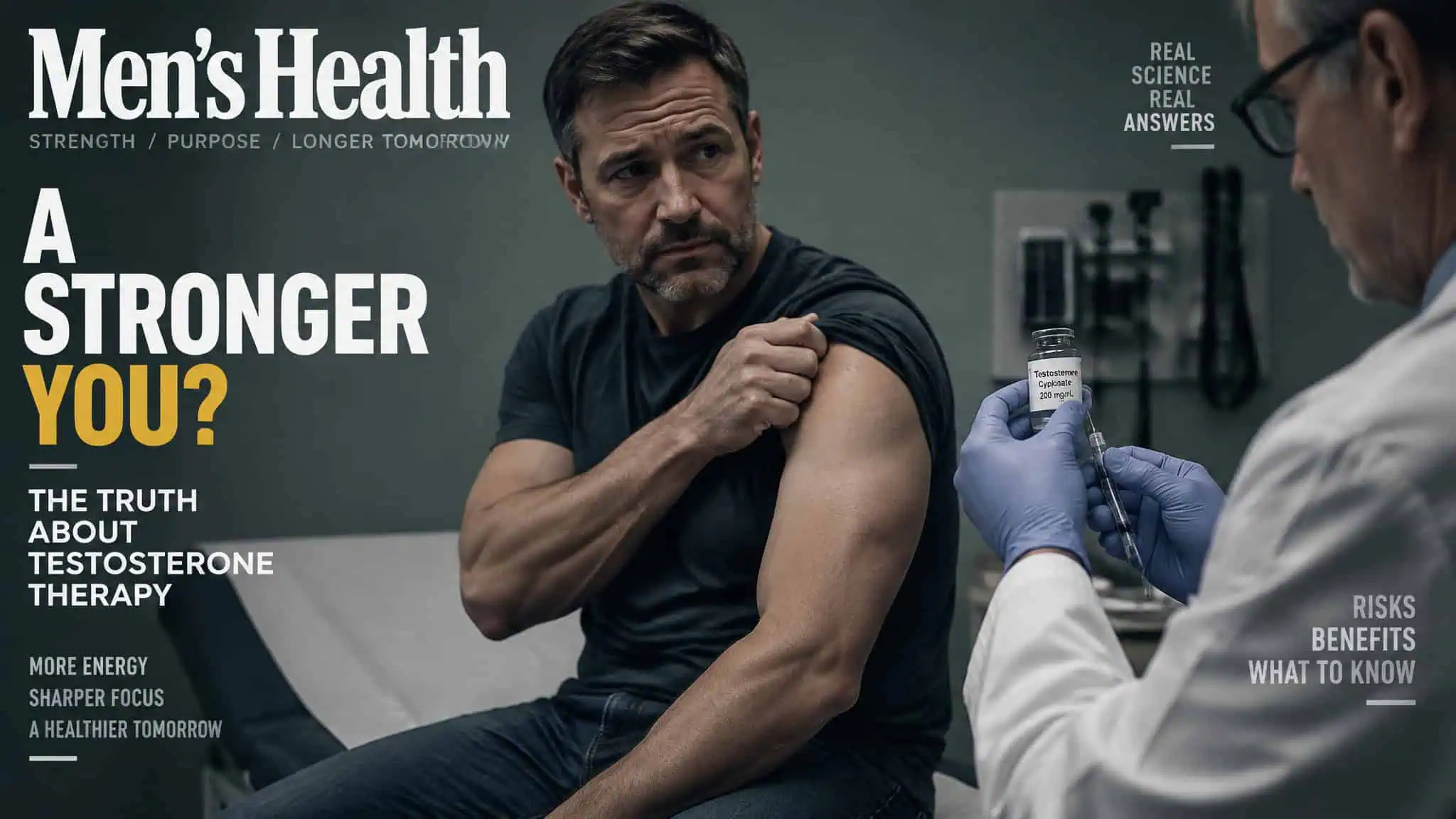
The ads promise a better version of you. The lawsuit ads promise a lawyer. Somewhere between the two is the actual answer, and it depends heavily on three things nobody in either ad mentions: how high your dose runs, how you take it, and whether anyone bothered to diagnose you properly before the needle came out. Testosterone replacement therapy, or TRT, is exogenous testosterone prescribed to men with confirmed low levels, and the side effects of TRT in males range from annoying acne to a fertility shutdown that can take the better part of a year to reverse. Here’s the real list.
Key Takeaways
Sperm count can hit zero within 2-4 months on TRT, and one study showed about 4 months to regain baseline fertility and 9 months to normalize sperm count, with some men never fully recovering.
The heart-risk evidence is genuinely split: a JAMA study found nearly 30% higher heart attack, stroke, and death risk in men who already had heart disease, while a 2023 NEJM trial found no added risk at normal doses for men with actual hypogonadism.
Long-acting injections and pellets can push testosterone levels 2-5x normal, which is where most of the serious side effects live; gels and low-dose injections keep levels adjustable.
Table of Contents
What TRT is and how it works in males
Testosterone replacement therapy is the medical practice of giving a man testosterone from outside his body, usually because his own production has dropped below the level where his body works the way it should. The prescription version comes in five main forms: patches you wear daily; rub-on gels like AndroGel and Testim; a small buccal patch stuck to the upper gum each day; injections every few weeks, including a long-acting version called testosterone undecanoate; and subcutaneous pellets inserted under the skin every 3 to 6 months. Same hormone, very different daily routines, and we’ll get to why that matters more than it sounds.
Here’s the mechanism that explains half the side-effect list in one sentence: when you supply testosterone from outside, your pituitary gland stops sending the two signals, LH and FSH, that run your natural production and your sperm output. That’s the hypothalamic-pituitary-gonadal axis doing exactly what feedback loops do. Your testicles go quiet because they’ve been told to. That shutdown is why shrinkage happens and why fertility tanks, and it’s planted here because everything later connects back to it.
So who’s actually a candidate? The clinical line is a testosterone level under 300 ng/dL, measured properly. Normal for an adult man runs roughly 300 to 800 ng/dL on a sensitive assay, and here’s the detail that matters: your levels can swing up to 30% in a single day and peak in the morning. Which means the number you get depends heavily on when the blood was drawn and how good the lab equipment was.
A guy who feels flat at 3 pm on a Tuesday might measure very differently the next morning fasting. The definition sounds simple. Getting a number you can trust is not.
Common side effects: skin, hair, and appearance
Yes, TRT can cause acne and oily skin, speed up male pattern baldness, and grow breast tissue. Three different mechanisms, three different levels of annoyance.

The acne is the teenage-skin comeback. Testosterone drives oil production in the skin, so more of it means breakouts, especially on the back and shoulders. If you were already breakout-prone, this is the one that’ll bug you day to day. Annoying, visible, usually manageable, but real.
Baldness is more honest than the marketing suggests: TRT doesn’t cause it, it accelerates the schedule for men who were genetically headed there anyway. If your hairline was already receding, it’ll recede faster.
Gynecomastia is the one guys worry about most and get least. Some of the extra testosterone converts to estrogen, and in some men that means actual breast tissue. Rare enough to mention, real enough to watch for. You’ll see a “25% of guys get gyno” figure floating around podcast content. That number isn’t peer-reviewed. The risk itself is well established; the size of it isn’t.
Testicular shrinkage and fertility
Fertility suppression on TRT is a shutdown, not a drift: sperm count can reach zero within 2-4 months of starting, because the same pituitary signals that run your natural testosterone production also run sperm output, and outside supply switches both off. That’s also why testicular shrinkage happens, plainly, no euphemism needed. Your own production goes quiet, the tissue follows. Same mechanism, two symptoms.

The part the podcasts skip is the recovery math. One study showed about 4 months to get fertility back to baseline and 9 months for sperm counts to normalize, and some men never fully recover. Fast to lose, slow to reverse, sometimes not reversible at all. A typical pattern clinicians describe: a guy starts TRT without anyone having a fertility conversation, decides a couple years later he wants kids, and discovers counts near zero with recovery measured in quarters of a year.
Buyer rule: If kids are anywhere on your timeline, settle the fertility conversation with your doctor before the first injection, not after.
If kids are anywhere on your timeline, this is the side effect that matters most, and it’s worth weighing male birth control options alongside choices like hCG co-management before you start, not after, even the Pentagon tells doctors not to prescribe TRT to men hoping to have kids soon. When the Department of Defense is the voice of caution, this isn’t fringe advice.
Serious risks: heart attack, stroke, and blood thickening
The heart risk depends on who you are and how much you take, and the evidence is contested enough that anyone giving you a flat yes or no is selling something.
Start with the scary stuff, caveats attached. A JAMA study found nearly 30% higher heart attack, stroke, and death risk in men on testosterone therapy, but in men who already had heart disease and low testosterone. The population caveat travels with the number. A 2010 NEJM trial in frail men was stopped early over cardiac events, but the treatment group started with worse heart risk, which limits what it proves.
Then the counterweight: a 2023 NEJM study found no higher heart attack or stroke risk at normal physiologic doses in men with actual hypogonadism. The newer, better-designed evidence is calmer than the older stuff, and the upside side of the ledger what TRT can realistically fix, deserves the same honest weighing as the risks. The honest read: the answer differs by cardiac history and dose, and the question isn’t settled in either direction.
Then there’s polycythemia, which is less contested. Testosterone stimulates red blood cell production, which thickens your blood and raises clot, heart attack, and stroke risk. This is why regular blood draws become part of the deal; your hematocrit gets checked and stays checked. You may have heard “315% higher risk” somewhere.

That figure came from a podcast, not a study. Treat it accordingly.
Sleep apnea can also get worse on TRT. The direction is accepted; the “4x” magnitude you might have heard is also podcast-sourced and shaky. And here’s the twist that matters later: untreated sleep apnea is itself a hidden cause of low testosterone. Keep that in your pocket.
Does TRT cause prostate cancer or raise PSA?
No strong evidence says TRT causes prostate cancer or meaningfully raises PSA, with one standing exception. The saturation model, credited to researcher Abraham Morgentaler, holds that prostate tissue maxes out its androgen uptake at a point, so extra testosterone doesn’t add more stimulation. Counterintuitively, prostate cancer actually shows up more in men with low testosterone. In a Khera et al. study of 187 men over 45, one year of TRT produced no significant PSA change; the only bump, a modest 0.32, came in severely hypogonadal men starting under 250 ng/dL, with no change at 250 ng/dL or above. But is TRT safe for men with a prostate cancer history?
It remains contraindicated and off-label, because the definitive trial hasn’t been done, one estimate puts it at 6,000 men treated for six years. A review by Shabsigh covering 11 placebo-controlled and 29 non-placebo-controlled randomized trials found no relation between TRT and prostate cancer, but reviews aren’t the definitive trial. So the rule stands.
Who actually needs TRT, and why diagnosis determines your side-effect risk
The proper diagnostic standard is a fasting, morning blood draw, done twice, on a sensitive mass spectrometry assay, plus at least three actual symptoms alongside the confirmed low number. Numbers and symptoms together, not one bad afternoon.
That bar exists because levels swing up to 30% in a day and peak in the morning, so a single draw read against youthful numbers is a common interpretation error, not a diagnosis. Dr. Margaret Wierman, an endocrinologist at the University of Colorado Anschutz, hears the low-T clinic reasoning all the time: “Oh, I used to be an 800, and I’m a 400…” Her answer is blunt: “But normal is normal.” Her fuller take is worth hearing in full: it’s an anabolic steroid, everybody feels “better” on testosterone, and it’s not safe to give to men who are normal.
The system around TRT is sloppier than the science. US men starting testosterone therapy almost quadrupled since 2000, per the Washington Post, and most new patients hadn’t had levels measured recently, or got one test ever before starting, raising real questions about who should actually take TRT. Almost 3% of American men over 40 hold prescriptions, and sales were projected near $5 billion by 2017 per Bloomberg Businessweek. Big business, and big businesses market.
Also worth knowing: low testosterone is often downstream of something else. Pituitary tumors, fatty liver disease, untreated sleep apnea, obesity, glucocorticoids, opioids, some supplements, and rising SHBG from the liver can all drag levels down. Treating sleep apnea alone can normalize testosterone, which is the cheapest fix in this entire article. And the loop closes ugly: TRT can worsen the very sleep apnea causing the low T in the first place.
How delivery method changes your side-effect risk
The delivery method changes which side effects you get and how manageable they are, because it changes how high your levels run. Wierman favors adjustable forms: gels, lotions, low-dose injections. Long-acting injections and pellets often push levels 2-5x normal, and that’s where the side effects live: more red cells, thicker blood, clot risk, possible prostate contribution, and at the extreme, the “roid rage” stereotype. Control beats convenience here.
Pellets mean zero daily effort, but you’re locked in with levels that can run high until the next insertion. A typical pattern: guys on pellets or long-acting shots feel great initially, then develop thickened blood or worse snoring without connecting it to the peaks, because their levels were only checked once, at the trough between doses.
One practical note if you go the gel route: topical gels can transfer to partners through skin contact. Real precaution, worth taking seriously if someone else shares your bed or holds your kid.
Stopping TRT
Quitting TRT is possible, but not consequence-free: because the therapy has suppressed your HPG axis, stopping abruptly leaves you with suppressed natural production, meaning low testosterone and low sperm count while your system slowly reboots. The sourced timeline runs about 4 months to regain baseline fertility and 9 months to normalize sperm count, with some men never fully recovering. Fast down, slow up. That asymmetry is the whole story, and it’s why the decision to stop belongs with a doctor who knows your numbers, not a Reddit thread. Beyond the fertility data, the honest answer on other withdrawal effects is that the evidence doesn’t cover them well, so anyone promising you a precise timeline is guessing.
Is TRT worth it? Weighing side effects against benefits
For properly diagnosed hypogonadal men treated to normal levels, yes, the documented benefits are real. For men already in the normal range, no, it’s risk without benefit. That’s the verdict, and the numbers behind it are worth seeing.
For confirmed hypogonadal men, TRT delivers more muscle, better recovery, less fat, stronger bones, working libido, less fatigue, and improved depressive symptoms, at physiologic levels, not superhuman ones. The timelines are concrete. Sexual function improved by 3-6 months and held through 12 months in an 849-patient registry. In the TRIUS registry of 762 men, severe depressive symptoms fell from 17.3% to 2.1% at 12 months, which for genuinely low men might be the most underrated benefit on the list. Spine bone density gained 3.8% at 30 months, while short 6-month trials showed nothing. Bones are slow; patience is part of the deal.
The mortality numbers are striking but need their asterisk: in type 2 diabetic men, death rates dropped from 20% to 9.1% over 5.8 years in one study, and a Seattle cohort went from 21% to 10%. Those are observational, not randomized, so treat them as encouraging, not proof. TRT can also restore responsiveness to ED meds in men who’d stopped responding, though one study found no extra benefit in men who weren’t significantly hypogonadal. Both halves of that sentence matter.
Set realistic before-and-after expectations: sexual function and mood move within 3-6 months. Bone density takes a year or more. If someone promises you a transformation in six weeks, they’re selling something.
Then the hype check. Podcasters like Joe Rogan and Andrew Huberman tout TRT for energy, strength, and focus. Experts say those sweeping benefits aren’t backed by science, and the Pentagon’s own guidance, dated September 18, 2026, states the evidence doesn’t support use for energy, vitality, physical function, or cognition. When the institution ordering mandatory testing for service members over 30 is also the institution debunking the marketing, pay attention.
The management backbone if you do start: regular hematocrit and PSA checks, and knowing the red flags. Chest pain, severe headaches, vision changes, signs of blood thickening. Those warrant prompt medical attention, full stop.
And if something does go wrong, there are actual avenues: manufacturers can face product liability suits, and negligent prescribers can face malpractice claims, with damages potentially including medical bills, lost wages, and emotional distress. That’s context, not the story.
The story is this: TRT is a legitimate treatment with real benefits for men who genuinely need it, a real side-effect list for everyone, and a risk profile that depends almost entirely on how carefully you got there. Get properly diagnosed and properly monitored, and the math works for the right guy. Skip those steps, and you’re taking an anabolic steroid because an afternoon blood draw said so.
Frequently Asked Questions
Is TRT hard on your body long term?
The long-term picture hinges on monitoring and dose. Long-acting injections and pellets can push testosterone levels 2-5x normal, which is where the serious side effects live — more red cells, thicker blood, clot risk. With regular hematocrit and PSA checks and adjustable delivery forms, the risk profile is far more manageable than with set-and-forget high-peak methods.
Does TRT cause infertility and can men on testosterone still have children?
TRT shuts fertility down fast: sperm count can hit zero within 2-4 months of starting, because the same pituitary signals that run natural testosterone production also run sperm output. Recovery is slow — roughly 4 months to regain baseline fertility and 9 months to normalize sperm counts — and some men never fully recover. If kids are anywhere on your timeline, settle the fertility conversation with your doctor before the first injection, including options like hCG co-management.
What is better, TRT or peptides?
TRT is the better-studied option by a wide margin. For confirmed hypogonadal men, it delivers documented benefits — more muscle, less fat, stronger bones, working libido, improved depressive symptoms — at physiologic levels, with concrete timelines from large patient registries. Peptide marketing doesn’t have an equivalent evidence base behind it, so the comparison isn’t close on data.
Can my husband taking testosterone shots affect me?
It can if he uses topical gels rather than shots. Rub-on gels can transfer testosterone to partners through skin contact, which is a real precaution worth taking seriously if someone shares his bed or holds a kid. Injections and pellets don’t carry that transfer risk, though his dose and delivery method still shape his own side-effect profile — long-acting shots and pellets can push levels 2-5x normal.