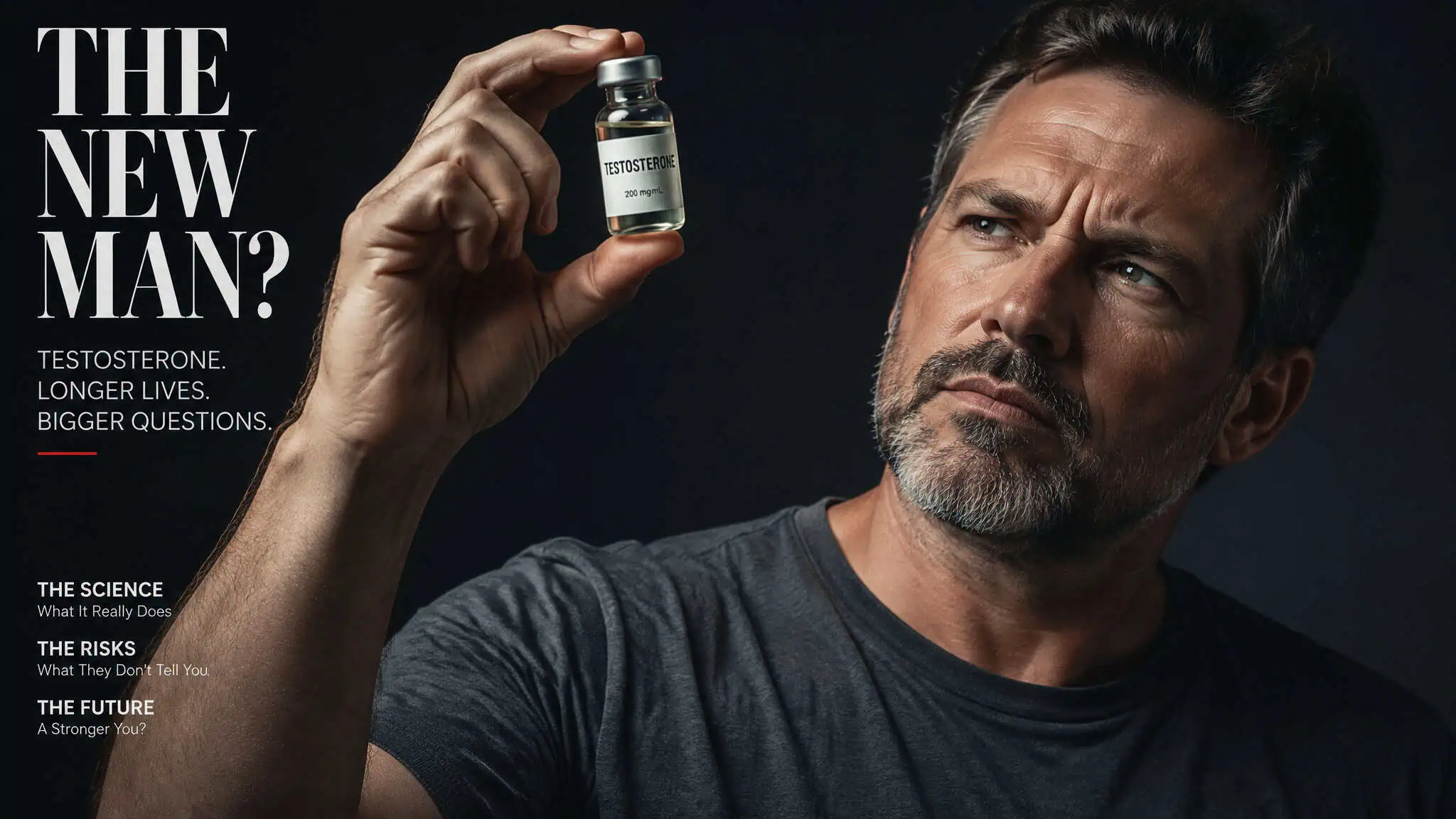
The ads promise a lot. Energy like you’re 25, a flatter stomach, a better mood, a sharper brain, and a gym progress that finally shows. Testosterone replacement therapy is the product, and the pitch is everywhere: clinics, podcasts, sponsored posts. But when you grade each promised benefit against actual trial data, the TRAVERSE study of more than 5,200 men and a PLOS One review of 226 randomized trials led by Georgetown’s Adriane Fugh-Berman, the list mostly falls apart.
The one well-established TRT benefit is for properly diagnosed hypogonadism, a real medical condition. Nearly everything else in the marketing doesn’t survive contact with the evidence. So we ran the same filter we’d run on a $400 purchase that claims to do five things: check the receipts, claim by claim.
Key Takeaways
TRT’s only well-established benefit is for diagnosed hypogonadism; the 226-trial PLOS One review rated it ineffective for erectile dysfunction and found no consistent benefit for mood, fatigue, weight, or cognition.
The TRAVERSE trial (5,200+ men, 1-4 years) found no meaningful increase in heart attacks or strokes, but did find higher blood pressure, heart rhythm problems, kidney injury, elevated PSA, more fractures, and roughly a 50% relative increase in pulmonary embolism.
A legitimate low-T diagnosis requires symptoms plus consistently low testosterone on at least two early-morning fasting blood tests, with a common cutoff near 300 ng/dL, and reversible causes like obesity (BMI over 27) get treated first.
Table of Contents
TRT benefits, graded claim by claim
Here’s the claim-by-claim grading, run against the same two sources: the TRAVERSE trial of more than 5,200 men and the PLOS One review of 226 randomized trials. Some claims survive contact with the evidence, most don’t, and the ones that do come with catches. Starting at the top, with the claim that fares best.
Libido and erectile function
Libido is the one claim with some honest support: trials show sex drive may go up on testosterone. Erectile dysfunction is a different story. The 226-trial review rated testosterone ineffective for ED, and sexual function didn’t improve overall. Desire maybe, performance no. If your main complaint is performance, testosterone isn’t the fix, the actual causes of ED are a conversation for a doctor, not a clinic selling monthly injections.
Energy, mood, and focus
This is the stuff most guys are actually shopping for, and it’s where the evidence is emptiest. Trials show testosterone doesn’t reduce or prevent fatigue, irritability, weight gain, or depression, and most mood studies found no effect at all. The PLOS One review found no consistent benefit for mood or cognition across six decades of research. The symptoms that drive men into TRT clinics are, per the trials, symptoms testosterone doesn’t fix.
Muscle and belly fat
Testosterone consistently increased muscle strength in trials. Here’s the catch: physical function didn’t improve. Bigger lift numbers, no better at getting through your day, and this was at normal replacement doses, not steroid doses. On belly fat, there’s no trial support at all for losing it. The Endocrine Society’s guidance actually cuts the other way: for men with obesity-associated low testosterone (BMI over 27), weight loss is the first-line treatment, not testosterone.
Bone density
Bone is where the data gets genuinely strange. In TRAVERSE, bone density went up. Fractures went up too. That’s the lesson in one finding: the number on the scan improved while the outcome that actually matters got worse.
It echoes what’s happened with bone-density drugs in women, denser bones on paper, still more breaks. Nobody has a clean explanation, and it’s worth sitting with the discomfort rather than pretending the scan number is the win the marketing says it is.
Fugh-Berman put it bluntly after reviewing all 226 trials: testosterone has been pitched as a fix for many conditions, yet for the vast majority of those claims, no adequate clinical trial support exists.
Why some men feel great on TRT anyway
The honest answer to “why do I feel so good” is that subjective reports are uncontrolled self-report, which means they’re wide open to expectation effects and regression to the mean, but they’re not fake, and the guys reporting them aren’t lying. The problem is what the reports get used for. There’s no established link between “Low-T” and most of the symptoms testosterone is sold to fix, and no solid science that it treats normal aging or works as a fountain of youth. Getting older isn’t a deficiency.
Your buddy feeling great on TRT proves your buddy feels great. It doesn’t prove it works, or that it’s safe for you. That’s the point the National Center for Health Research keeps making: personal experience shouldn’t replace scientific evidence. The sympathy goes to the guy who feels run-down at 45. The skepticism goes to whoever’s selling him a lifelong drug off the back of that feeling.
What TRT won’t fix, and the signs that actually matter
There’s no supported “3 months on TRT” milestone for men. The only timeline anywhere in this evidence is for women’s HSDD therapy, where results take weeks to months and there’s a stop point around six months if nothing improves. For men, expectations have to be framed against trial nulls: strength numbers, fatigue, mood, and weight didn’t move in the studies, so an invented before/after arc at the 90-day mark is marketing, not medicine.

What does warrant a doctor conversation, per the Mayo Clinic list: a definite change in sex drive, needing to shave less often, losing muscle mass or body hair, shrinking testicles, breast enlargement. Notice how specific those are compared to the Low-T ad symptom list, tired, flat, a little soft in the middle, which, by its own logic, would qualify most American men. Truly low testosterone affects a very small fraction of the US male population. Needing to shave less is the detail worth remembering. It’s weird, it’s specific, and it’s the kind of sign that isn’t just “being 45.”
Who actually qualifies for TRT, diagnosis before benefits
Yes, a real diagnosis is required before TRT, and the bar doesn’t move with age. Symptoms alone diagnose nothing, low energy and low libido have a dozen causes in aging men. The actual requirement is symptoms plus consistently low, accurately measured testosterone on blood tests, measured at a CDC HoST-certified lab so the number means the same thing everywhere. Here’s what that looks like in practice:
| Requirement | The standard |
|---|---|
| Symptoms present? | Yes, required, labs alone don’t qualify |
| Number of blood tests | At least two |
| When drawn | Early morning, fasting |
| Common low-T cutoff | Near 300 ng/dL |
| Same bar at 30 and 65? | Yes |
The testing problem nobody mentions
Here’s the part that should make you pause before any clinic hands you a prescription: the same blood sample can read “low” at one lab and “normal” at another, because testosterone assays aren’t standardized. That cuts both ways: some guys get diagnosed who shouldn’t be, others get missed. Many labs run inaccurate tests with sketchy reference ranges. The standardized ones are CDC HoST-certified labs, and the actionable move is simple: ask whether your lab is certified before you take the number seriously.
Quick test: Before trusting any T number, ask two things — was the draw early morning and fasting, and is the lab CDC HoST-certified?
The pattern clinicians describe goes like this: a guy gets one afternoon blood draw at a non-standardized lab, sees a low number, and starts therapy without anyone ruling anything else out. Afternoon draws run lower than morning ones. Non-standardized labs run wherever they run. And nothing else, sleep, medications, weight, thyroid, got checked first. That’s not a diagnosis. That’s a number. The actual bar is symptoms plus consistently low testosterone on at least two early-morning, fasting tests, one draw at one lab doesn’t clear it.
Reversible causes first
Before TRT, the reversible stuff gets ruled out: obesity (BMI over 27), corticosteroids, opioids. For weight-associated hypogonadism with no other cause, weight loss is the guideline-endorsed first treatment, not testosterone. The order matters, because a lot of “low T” resolves when the actual cause does, and it helps to be clear that planned TRT is not steroids, since supervised therapy differs from anabolic steroid abuse in dose, monitoring, and purpose.
Also worth knowing: labels such as “age-related,” “late-onset,” and “functional” hypogonadism resist clear definition and blur the line between disease and normal aging. That fuzziness is exactly what the marketing exploits. And there’s no evidence for screening men who feel fine, if you’re not symptomatic, there’s no case for routine T testing.
The one clear benefit: diagnosed hypogonadism
TRT at normal replacement doses has clear benefits for men whose hypogonadism comes from actual disease of the testes, pituitary, or hypothalamus, a context worth understanding in testosterone replacement therapy more broadly. Even for these men, long-term safety, including prostate cancer risk, remains unestablished, and pre-treatment risk assessment plus ongoing monitoring aren’t optional extras. The drug works for a disease most men being advertised to don’t have.
Is TRT safe? The risk inventory the marketing omits
It depends, and the decisive condition is what you’re weighing. TRAVERSE found no meaningful increase in heart attacks or strokes, that’s the reassurance most readers fear they won’t get, and it’s real. But the trial found genuine signals elsewhere, and those deserve the same airtime.
What TRAVERSE found
The setup matters: TRAVERSE was a two-year randomized trial of testosterone gel dosed to normal levels, with more than 5,200 men followed one to four years. That’s real-world TRT, not steroid abuse, which changes how the results read. Endpoint by endpoint, testosterone-treated men had higher blood pressure, more atrial fibrillation and other heart rhythm problems, more kidney injury, and elevated PSA. Pulmonary embolism, a blood clot in the lungs, went up roughly 50% relative to placebo. Promoters cherry-pick the clean heart data, detractors cherry-pick the rest, and neither headline is the whole result. The feared outcome didn’t move; several quieter ones did.
The known risk list
Beyond the trial findings, the established risks cover blood clots, shrinking testicles, sleep apnea, congestive heart failure that can get worse, and polycythemia, too many red blood cells. That last one has a flip side worth understanding: excessively high testosterone makes bone marrow pump out extra red cells, which thickens the blood and raises stroke risk. Excess testosterone can also promote prostate growth. None of this is drama. It’s the label.
The open prostate question
PSA, the prostate blood marker that can flag prostate cancer risk years in advance, rose in TRAVERSE. But a two-year trial is too short to detect whether that PSA rise translates into more prostate cancer, so the honest line is “we don’t know yet,” not “it’s safe.” There’s also a built-in caveat: a two-year trial with normal-range targets may underestimate real-world risk, where men stay on for a decade and start lower. The National Center for Health Research’s bottom line, stated plainly: the risks outweigh the few established benefits. If you’re weighing the full picture, our breakdown of side effects of TRT in males covers the day-to-day stuff in more detail.
The parallel case: testosterone for women
For women, testosterone’s one established benefit is for HSDD, hypoactive sexual desire disorder, where low-dose, monitored therapy keeping blood levels in the premenopausal range improves desire and satisfaction. But the trial evidence amounts to less than one additional sexual event per month, there’s no established benefit for cognition or musculoskeletal health, and the global position statement supports only HSDD use. As Sharon Winer puts it, testosterone isn’t just a male hormone, women make it too, in the ovaries and adrenal glands, and it feeds sexual motivation and arousal. Levels decline slowly from around age 30, unlike the sharp estrogen and progesterone drop at menopause, which is why “T deficiency” is a fuzzier story in women.
The delivery problem
There’s no FDA-approved testosterone product for women in the US, so everything is improvised. Doctors adapt male products at roughly a tenth of the male dose, and as Bryan Jick cautions, it’s easy to overshoot. Compounded versions aren’t regulated the same way and vary in sterility, dosing, and quality. Pellets are the controversial option: once inserted, they can’t be adjusted or removed, which is why many clinicians prefer creams. At proper doses, side effects are the annoying-but-manageable kind, acne, extra sweating, body odor, more face and body hair.
The serious stuff (scalp hair loss, voice deepening, clitoral enlargement) happens when levels exceed the female range. It’s not for women who are pregnant, breastfeeding, or have active liver disease, hormone-sensitive conditions, uncontrolled lipids, or severe acne, and stacking it with DHEA raises the risk. If nothing improves by about six months, the stop point. It’s the same pattern as the men’s side, big benefit claims resting on thin data, but the evidence doesn’t transfer between them.
Before TRT: the decision framework most articles skip
TRT versus boosters comes down to one decisive difference: TRT has a narrow proven use, diagnosed hypogonadism, while over-the-counter testosterone boosters, including DHEA (dehydroepiandrosterone), have no support anywhere in this evidence. Whatever the booster label claims, the trials don’t back it. For men, the ordering is weight loss first if BMI is over 27 with no other cause, then a medication review (corticosteroids, opioids) before TRT even enters the conversation. For women, the non-testosterone options come first: flibanserin (a daily pill), bremelanotide (an as-needed injection), menopause hormone therapy, vaginal estrogen, plus the unglamorous work on sleep, stress, and relationship factors.
Low libido is rarely one thing. Testosterone is the option after reversible causes are exhausted, not the first lever, and if you’re still on the fence, our guide on whether men should take TRT walks the full decision through.
Where the evidence goes next: the regulatory fight
TRT’s benefit claims are being actively re-litigated at the FDA right now. The December 2025 FDA expert panel on testosterone for men was enthusiastic but, per the National Center for Health Research’s critique, ran on opinions rather than evidence, downplayed risks, and oversold benefits. NCHR, a nonprofit that takes no money from anyone with a stake in the answer, filed a comment on Docket No. FDA-2025-N-6743 recommending no labeling changes for men or women until large, long randomized trials are done. The same pressure showed up at the FDA’s July panel on menopause hormones, and the Endocrine Society has proposed a long-term “Men’s Health Initiative” on the model of the Women’s Health Initiative. Better trials, not louder claims, will settle what TRT can do.
Frequently Asked Questions
What happens after 3 months on TRT?
There’s no supported ‘3 months on TRT’ milestone for men — that before/after arc is marketing, not medicine. In the trials, strength numbers, fatigue, mood, and weight didn’t move, so expectations should be framed against those null results rather than an invented 90-day transformation.
How small do balls get on TRT?
Shrinking testicles are on the established risk list for TRT, alongside blood clots, sleep apnea, and polycythemia. A definite change like shrinking testicles is also one of the specific signs that actually warrants a doctor conversation, per the Mayo Clinic list — unlike vague ad symptoms like being tired or ‘a little soft in the middle.’
Who is a good candidate for TRT and who should avoid it?
A legitimate candidate has symptoms plus consistently low testosterone on at least two early-morning, fasting blood tests at a CDC HoST-certified lab, with a common cutoff near 300 ng/dL — and the bar is the same at 30 and 65. Reversible causes get treated first: obesity (BMI over 27), corticosteroids, opioids. If you’re not symptomatic, there’s no case for routine T testing at all.
Is TRT safe for men?
It depends on what you’re weighing. The TRAVERSE trial of more than 5,200 men found no meaningful increase in heart attacks or strokes, but it did find higher blood pressure, heart rhythm problems, kidney injury, elevated PSA, more fractures, and roughly a 50% relative increase in pulmonary embolism. Long-term safety, including prostate cancer risk, remains unestablished, and the National Center for Health Research’s bottom line is that the risks outweigh the few established benefits.
What does TRT actually improve, and what does the evidence say?
The one well-established benefit is for properly diagnosed hypogonadism from actual disease of the testes, pituitary, or hypothalamus. Beyond that, trials show muscle strength may increase (though physical function doesn’t improve), libido may rise, and bone density went up in TRAVERSE — but fractures went up too. The review of 226 randomized trials found no consistent benefit for mood, fatigue, weight, or cognition.