A friend of mine inherited a furnished rental bedroom last year: plain white walls, a silver doona, and one rose-print chair he flat-out refuses to throw away because his grandmother gave it to him. His budget for the whole project is basically nothing, because the rest of the house eats first. That’s the situation most masculine bedroom decor advice ignores, and it’s the situation this article is built for. Because the truth is the whole category changed. The mirror-clad bars, circular beds, and leather-sofa defaults are retired; the 2026 version is a curated retreat that adapts to future relationship changes.
The idea dates back to the 1950s, when a masculine bedroom meant Martin Denny records and art deco furniture, but what’s come back around is far more useful. What follows: a materials formula you can run on any room, a palette decision rule, a lighting spec with real numbers, a small-room playbook, and 27 named looks you can reverse-engineer piece by piece.
Key Takeaways
The 3-hard-plus-2-soft formula: three hard materials like walnut plus two soft ones like a wool rug is what makes a room read masculine, not paint color.
Lighting runs three layers on separate dimmers: aimable task sconces at 3000K, headboard sconces at 2700-3000K, and a motion-sensor under-bed LED strip so a 3 a.m. bathroom trip doesn’t blast you awake.
Small-room fix is scale discipline both ways: 8×10 rug minimum for a queen (9×12 for a king), nightstands 20-24 inches tall to line up with the mattress top.
Table of Contents
What makes a bedroom read masculine: the 3-hard-plus-2-soft materials formula
The answer is a material ratio, not a color rule. One source frames it like a tailored suit: three hard materials plus two soft textures. The hard three are wood (walnut or oak), stone (basalt or soapstone), and metal (blackened steel or aged brass). The soft two are a flat-weave wool rug and leather, either a headboard or a sling chair.
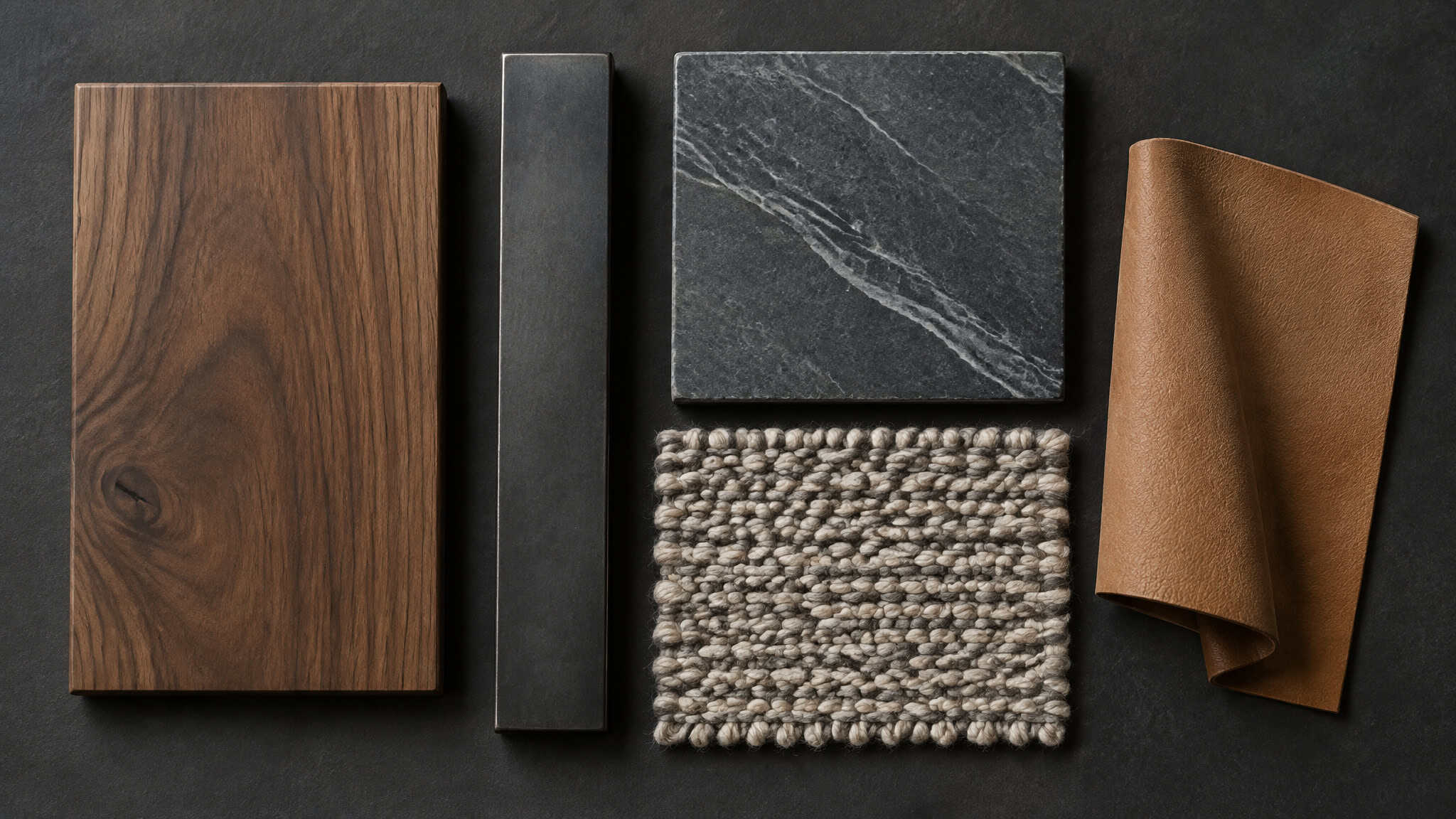
It’s one designer’s rule of thumb, not industry law; plenty of rooms ignore it and work fine. Secondary accents like canvas, denim weave, or herringbone can join in, but with restraint. A little goes a long way.
The useful part is that you can count. Rooms that feel cheap usually have too many softs and no honest materials: plastic everywhere, fake lacquer, nothing with weight. Run the count in your own room right now and you’ll see the imbalance immediately. And keep an eye on the texture triangle for later: wood structure, leather, and a wool blanket on the headboard wall.
The 2026 color code: controlled neutrals vs. dark depth
The masculine palette this year is controlled neutrals: charcoal, espresso, and midnight navy anchored, softened with sand, taupe, and mushroom, plus one refined accent like olive, tobacco, rust, or slate blue. Pick one accent. That’s the discipline. Skip chrome unless the concept is industrial; matte black or aged brass instead.
Controlled neutrals, the full recipe
Lime wash or micro cement on the walls gives a matte, mineral finish if flat paint bores you. Put the contrast at the headboard wall and keep it lower everywhere else. One pro move sounds weird and works: paint the ceiling two shades darker than the walls.
Dark walls in a small bedroom
The contrarian case: lighter isn’t always better. Designer Cortney Bishop puts it plainly: sometimes a richer palette creates depth and coziness. Christina Higham says drenching a tight room in a darker hue can feel cozy and sophisticated, and dark wallpaper works even in small spaces. Corine Maggio has a trick worth stealing: limit the dark hue to a contrasting ceiling and the room reads taller. In a small room, bold graphic art gives you a focal point, and built-ins plus wall-mounted lighting free up floor.
When neutral goes sterile
Jaime Zehner’s counterpoint: all-white everything reads bland, and color, texture, and chosen accents are what add warmth. Here’s the decision rule that resolves it: neutral base plus one accent when you want restfulness; drench darker only when the room needs depth or feels too tight. Clark’s caveat bounds the whole thing: don’t go too dark or heavy. Keep it restful, keep the sheets crisp white, skip the ornate details.
masculine bedroom looks you can copy piece by piece
Each look below is a recipe, not a mood board: a palette move, a material pairing, and the details that keep it from going flat. Run the 3-hard-plus-2-soft count and the one-accent rule against any of them and you’ll see why they work. Start with the worked example, then steal pieces from the rest.
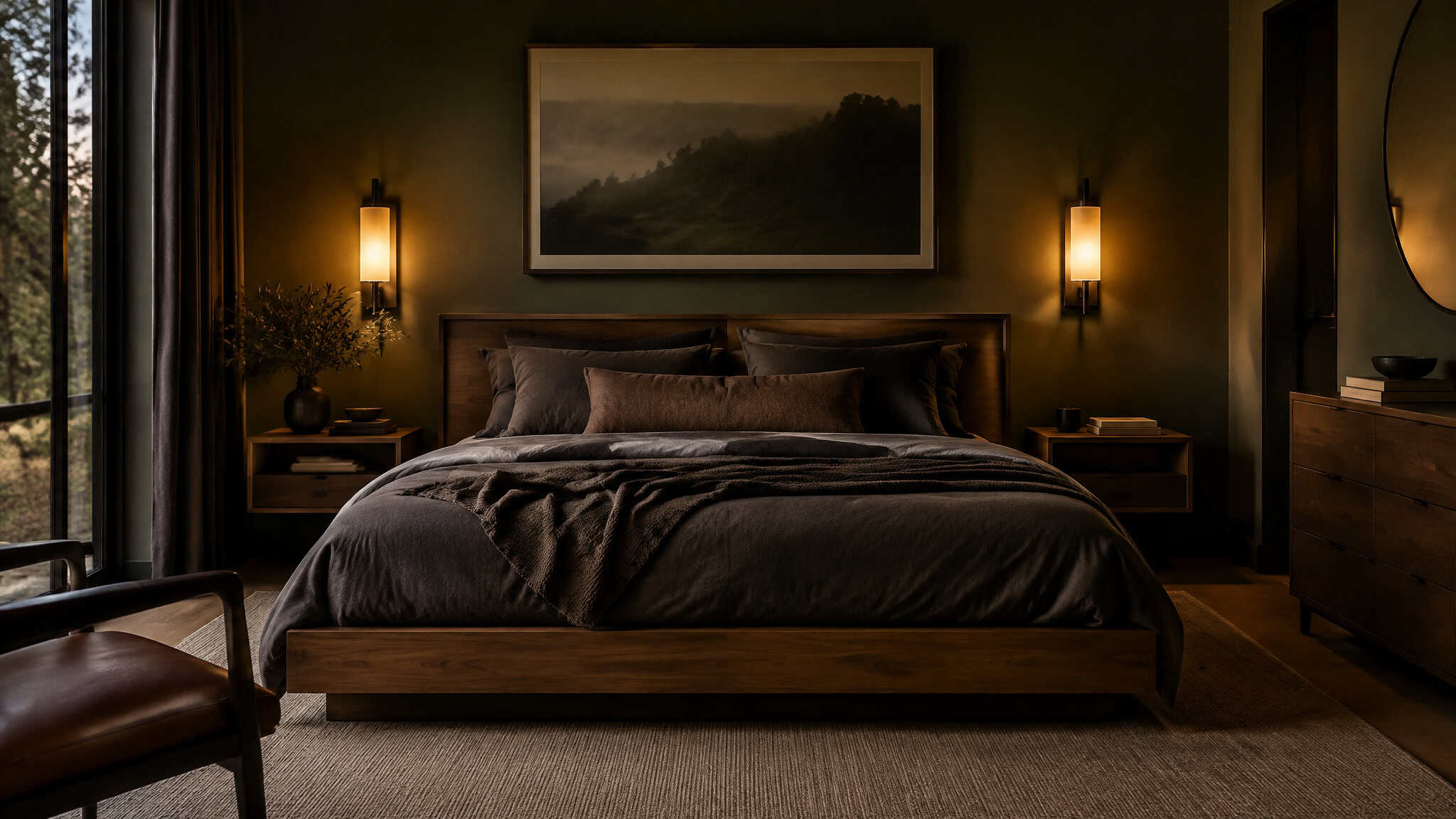
Moody Olive Retreat
This is the one I’d build first, and it’s worth treating as a recipe rather than a vibe. Olive walls wrap the room like a cocoon: the room physically feels like it closes around you at night, calm in a plain, guy-legible way. Dark wood furniture and charcoal bedding are what keep it grounded; without them the olive floats. The contrast that stops it going flat comes from three details: abstract artwork, one crisp lamp, and greenery by the window. Skimp on those and the room turns into a single-note box.
Copying it piece by piece: olive matte paint on all four walls, a low walnut platform bed, charcoal bedding in a heavier weave, one large abstract in muted tones over the bed, a single well-chosen table lamp rather than a bank of them, and a plant that gets actual window light. No gadgets doing the atmosphere’s job. This room is built for unwinding, and that’s the entire point of it. Atmosphere over distractions is the whole brief.
What makes it the worked example is that it hits the formula perfectly: olive walls (controlled neutral plus accent in one), walnut (hard), charcoal (neutral), and the greenery and art supply the softening texture the two-soft rule demands. If your room currently reads cheap, this look is the fastest way to fix it with paint and bedding before you buy a single piece of furniture.
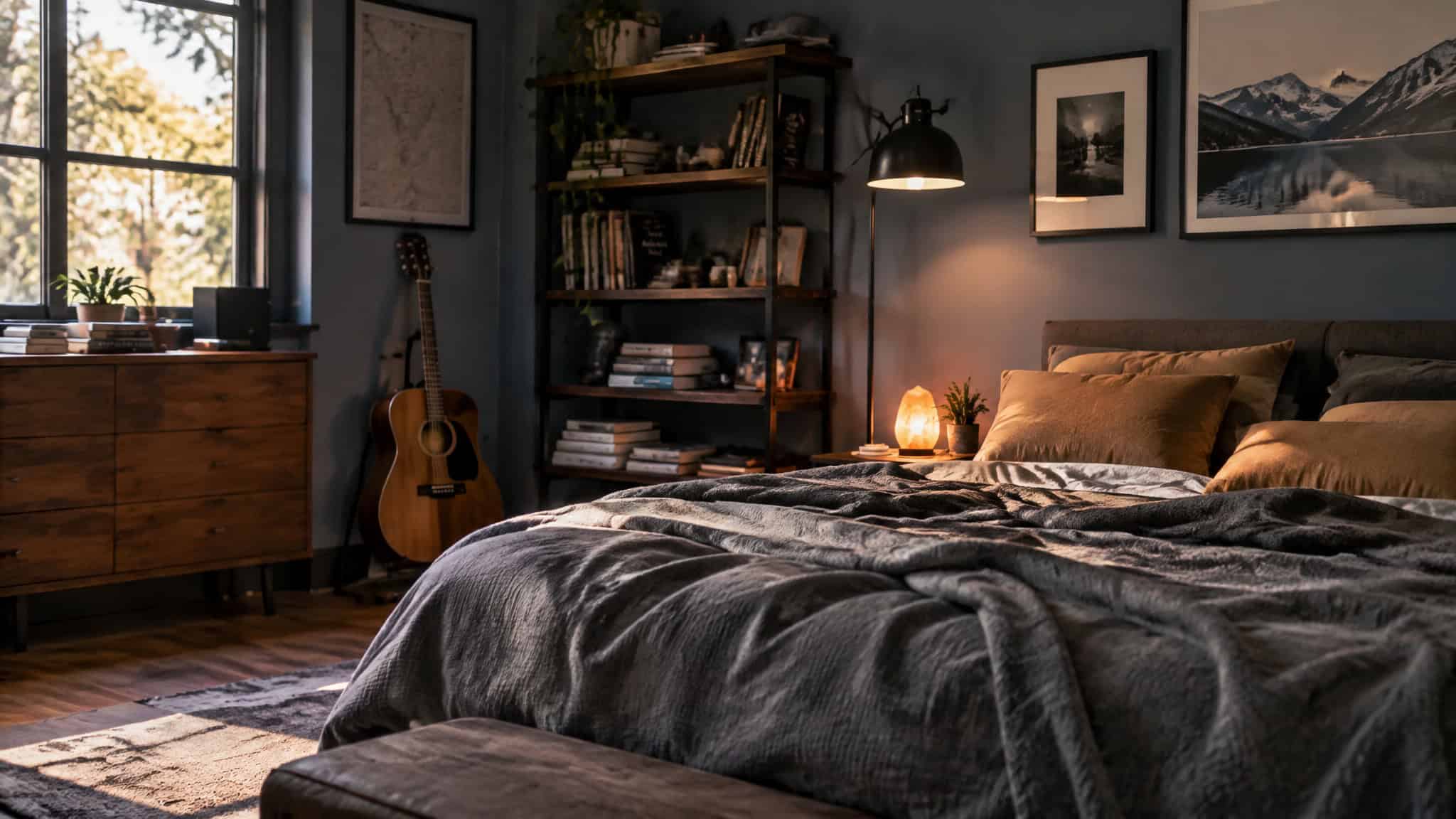
Casual Cool Layers
Slate blue walls, rumpled gray throws, warm tan pillows. The personal stuff is what makes it: a guitar on a stand, open shelving, the glow of a salt lamp. Relaxed, not styled within an inch of its life. Lived-in but considered, like a room someone actually sleeps in rather than a showroom.
Desert Modern Edge
One big foundation move: a black paneled wall, everything else builds on it. Graphic textiles and carved wood add the texture, and a patterned rug plus sculptural wall decor give the room rhythm. Your eye moves around and nothing sits dead. Curated but not precious; it embraces contrast and personality.
Tailored Neutral Balance
The tidy, grown-up option. An upholstered bed, soft grays, subtle patterns. Clean lines and symmetry carry it: everything lines up, and that’s the whole trick. Nothing here is accidental, and proof that masculinity doesn’t require darkness; discipline does the work.
Warm Minimal with a View
Deep burgundy walls with plaid bedding, an unusual combo that’s exactly why it works. Natural light from the window keeps the burgundy from getting heavy, and the tones actually deepen in the evening. Richness through restraint, and it earns it.
Soft Industrial Glow
Industrial bones but livable. Dark walls and linear details lean industrial; soft bedding and warm lighting are what stop it feeling cold. One overhead fixture doing real work adds drama without taking over. That trade-off, warmth against the edges, is the whole look.
Understated Luxe Layers
Nice stuff, quietly. Warm woods, soft upholstery, layered neutrals, a smooth headboard, a woven bench, subtle pattern on the rug. Texture does the talking. Refined but not overly polished; a room you’d actually relax in.
Classic Contrast Comfort
Black and white, done soft. Counterintuitive but true: the pairing can feel soft rather than stark. Dark curtains frame the windows, crisp bedding keeps it fresh, and greenery, a cozy chair, and one sculptural overhead light keep the palette from going cold.
Refined European Calm
Older, quieter, still masculine. Paneled walls, soft lighting, a curved headboard. Elegant without feeling formal, timeless and grounded, very much the kind of masculine sanctuary worth building. Soft restful palette where nothing competes for attention, so you actually rest. Good landing spot for the established-reader life stage, which I’ll come back to.
Light Linen Simplicity
The bright end of the spectrum. Soft linen tones, gentle textures, natural light. Layered bedding and simple decor keep it from feeling bare, which is the fix for anyone worried minimal means empty. Minimal but still warm: that’s the whole point in one line.
Earthy Panel Calm
Deep olive-brown vertical wood paneling sets the mood, and soft cream bedding keeps all that wood from feeling heavy. Layered pillows in subtle prints and chocolate tones are a small detail with big payoff. Built for slow mornings with gentle light; it’s how the room feels at 7 a.m.
Structured Modern Focus
For the guy who works in his room and wants it to look deliberate. Clean lines, a low-profile wood bed, a graphic rug, and built-in workspace and shelving that give the room purpose without clutter, the kind of masculine bedroom ideas for small rooms that actually work. The order here is calming, not fussy: a tidy room that doesn’t feel like a hotel.
Deep Green Comfort
A greener cousin of the olive room. The green wall creates the same cocoon effect, said plainly. A tufted headboard and soft gray layers ground it, and a chunky knit throw, lighting, and symmetry create calm without being predictable. The room has personality despite the order.
Black Accent Drama
One dark wall, big payoff: it frames the bed like a statement piece, so the bed becomes the art. Lighter furniture and floors keep the black from getting intense, which is the trade-off for anyone scared of dark walls. Velvet, wood, metal, layered on purpose.
Olive and Neutrals Blend
The softer take on the olive idea. Olive tones paired with warm neutrals, simple styling, nothing overdone. The sell is longevity: current now, won’t look dated in five years.
Sculptural Dark Minimal
Architectural, moody, sparse. Vertical slats, a dark palette, and soft lighting make the room feel architectural; matte walls, soft bedding, and hidden lighting that glows are the details worth noticing. Minimal but not empty: that distinction is what makes it work.
Classic Moody Layers
Dark, collected, timeless. Deep walls, layered neutrals, a vintage-inspired rug. Artwork above the bed is the focal point and makes the room feel collected, one piece doing all the work. Timeless richness without heaviness is the balance it strikes.
Rustic Industrial Edge
Wood, grit, function. A wood-paneled wall in darker tones paired with soft gray bedding; the pairing is the point. An open wardrobe adds a practical, styled touch: function that looks good. Texture over decoration, function plus atmosphere.
Tailored Modern Luxe
Clean, expensive-feeling, quiet. Clean paneling, a soft neutral palette, subtle lighting. High-end without being flashy; nothing shouts, everything’s right.
Warm Contemporary Layers
Wood tones, soft lighting, layered textiles. Three ingredients, plainly listed, and the same recipe behind plenty of masculine bedroom ideas we’ve pulled from over 40 distinct styles. Artwork above the bed ties the room together without overpowering, the same move as the moody layered room, just lighter.
Soft Glow Slat Wall
The lighting does the styling here. A vertical slat wall washed in warm backlighting creates a soft rhythm, and hanging bulbs add an intimate glow. At night is when it sells: calm tonal palette, upholstered headboard, layered bedding. One video takeaway worth keeping: a slatted or fluted wood headboard running wall to wall reads bespoke.
Cityscape Neutrals
Art does the talking. One oversized city artwork in muted tones anchors the room; everything else stays quiet. Nothing crowded, nothing bare, nothing competes. Refined, grown-up ease, full stop.
Cozy Contrast Corner
Dark accent wall with soft cream layers and plush textures; the soft stuff is what makes the dark wall livable. Mirrors and warm lighting bounce the glow around, which is what makes it feel intimate. This one especially works at night, when the room actually gets used.
Sculpted Beige Luxe
Tall, soft, tailored. Tall upholstered panels behind the bed add height and softness in one move, and a restrained chandelier adds drama without overwhelming. Yes, a chandelier in a bedroom. The bold pick that proves beige can be luxe instead of bland.
Warm Wood Retreat
A wood-paneled wall with real texture and depth, brought out by soft lighting; the lighting is what makes the wood pop. Creamy bedding and simple styling. Grounded, calm, lived-in comfort.
Classic Navy Framed
The safe-but-sharp option. Deep navy walls, crisp white bedding, warm wood tones; that’s the whole recipe. Symmetry adds order, while framed pieces and layered pillows keep it from feeling stiff or formal.
Moody Modern Balance
Bold but controlled. Deep green walls, warm metallic lighting, soft textiles; name all three and you’ve got it. Simple shapes and a tight palette are the restraint that lets the green be bold. It’s the equilibrium the whole color section teaches, in one room.
The headboard wall as command center
The bed wall is the highest-leverage surface in the room, so that’s where the money goes. A low platform bed in walnut, smoked oak, or powder-coated steel starts it. Then the texture triangle: wood structure, leather headboard or cushions, wool blanket. Boring detail, huge daily payoff: hardwired outlets with USB-C behind the nightstands plus a recessed cable trough, so nothing dangles on the floor.
And the pro move: line the headboard niche with charcoal or olive acoustic felt panels. Looks sharp and quiets the room, two birds.
How to light a masculine bedroom: the executable spec
Three layers: overhead, reading light, mood light, each on its own dimmer. Ambient comes from an edge-lit ceiling fixture or cove LEDs. Task is aimable sconces at 3000K. Accent is an under-bed LED strip, motion sensor, low lumen. Headboard sconces sit at 2700-3000K with a discreet LED wash behind the headboard.
Save three scenes to one haptic paddle: Focus (bright, cool), Everyday (mid, natural), Night (dim, warm). And a foot-level motion sensor triggers only the under-bed glow, so a 3 a.m. bathroom trip doesn’t blast you awake.
Corine Maggio’s warning covers the failure mode: a single overhead fixture makes a small space feel oppressive, so keep nightstand space for a lamp alongside the sconces. The circadian routine is straightforward: a 30-minute warm sunrise ramp, an amber wind-down, and blackout ripple-fold drapes with magnetic side channels to kill the light leak.
Quick test: Kill the overhead at night. If you can’t read in bed and still find your way to the bathroom without full brightness, the layers aren’t set yet.
Small masculine bedroom playbook
The fix is scale discipline in both directions, not buying less furniture. Jennifer Press names the classic error: a king bed in a room that fits a queen, leaving no space for nightstands. Jaime Zehner flags the opposite mistake: playing it too safe with too-small rugs and undersized nightstands, which makes the room feel disjointed. Get the numbers right: 8×10 rug minimum for a queen, 9×12 for a king, with the front legs of the bed plus the nightstands on the rug.
The nightstand spec is one drawer plus an open shelf, 20-24 inches tall so it lines up with the top of the mattress. The drawer hides the mess; the shelf holds a book.
Furniture should work harder. Annie Downing’s advice: fewer, high-quality, multifunctional pieces, plus wall sconces, floating shelves, and wall-mounted side tables. Christina Higham adds that a desk or dresser can stand in for a nightstand as long as you keep a table lamp for reading. Use vertical space wherever it exists: sconces, floating shelves, full-height furniture, loft areas. Keep frequently used stuff low, and if bookshelves are on display, put books and mementos on them, not nothing.
Named fixes for the squeeze, all designer-recommended:
- West Elm Myla Pop-Up Storage Bed, Christina Higham’s pick for rooms too small even for a drawer bed
- Room & Board Emerson bedside table, which comes in sizes including 19 inches
- Midcentury furniture’s smaller scale, Annie Downing’s route, citing the Design Within Reach Corbel Shelf
- Teen-market lines like Urban Outfitters and the RH Teen Laguna 2-Drawer Nightstand for big storage in a small footprint
- Serena & Lily headboards, pairable with a bed skirt when a full frame won’t fit
- Secondhand over IKEA for uniqueness, and an Amazon mattress if you’re building a nontraditional frame
For couples, align on a storage bed or under-bed storage from the start, since belongings double overnight. And a deep windowsill can sub for a nightstand more legitimately than you’d think.
Storage that disappears and the close-down ritual
Calm comes from storage that visually disappears, not from owning less. Built-in wardrobes with flat fronts, push-to-open, painted to match the walls: a commitment, but it works. Inside, a valet rod by the door, an EDC tray, felted bins, pull-out shoe racks. Under the bed, go low soft-closed drawers and skip open bins; they’re dust magnets.
A floating dresser mounted 8-10 inches off the floor shows more floor, so the room reads bigger. A slat wall with pegs near the entry corner handles tomorrow’s outfit, gym bag, and headphones without wrecking the closet. A bedside valet tray with a watch dish, ring cone, and wireless charger means everything lands in one spot and stops disappearing. Then the ritual: a 10-minute nightly close-down.
Collect the cups, reset the pillows, clear the surfaces, set the night scene, hit the single all-off button by the door. The ritual replaces willpower, and the room stays photo-ready with basically no effort.
Invisible tech and tech-as-decor
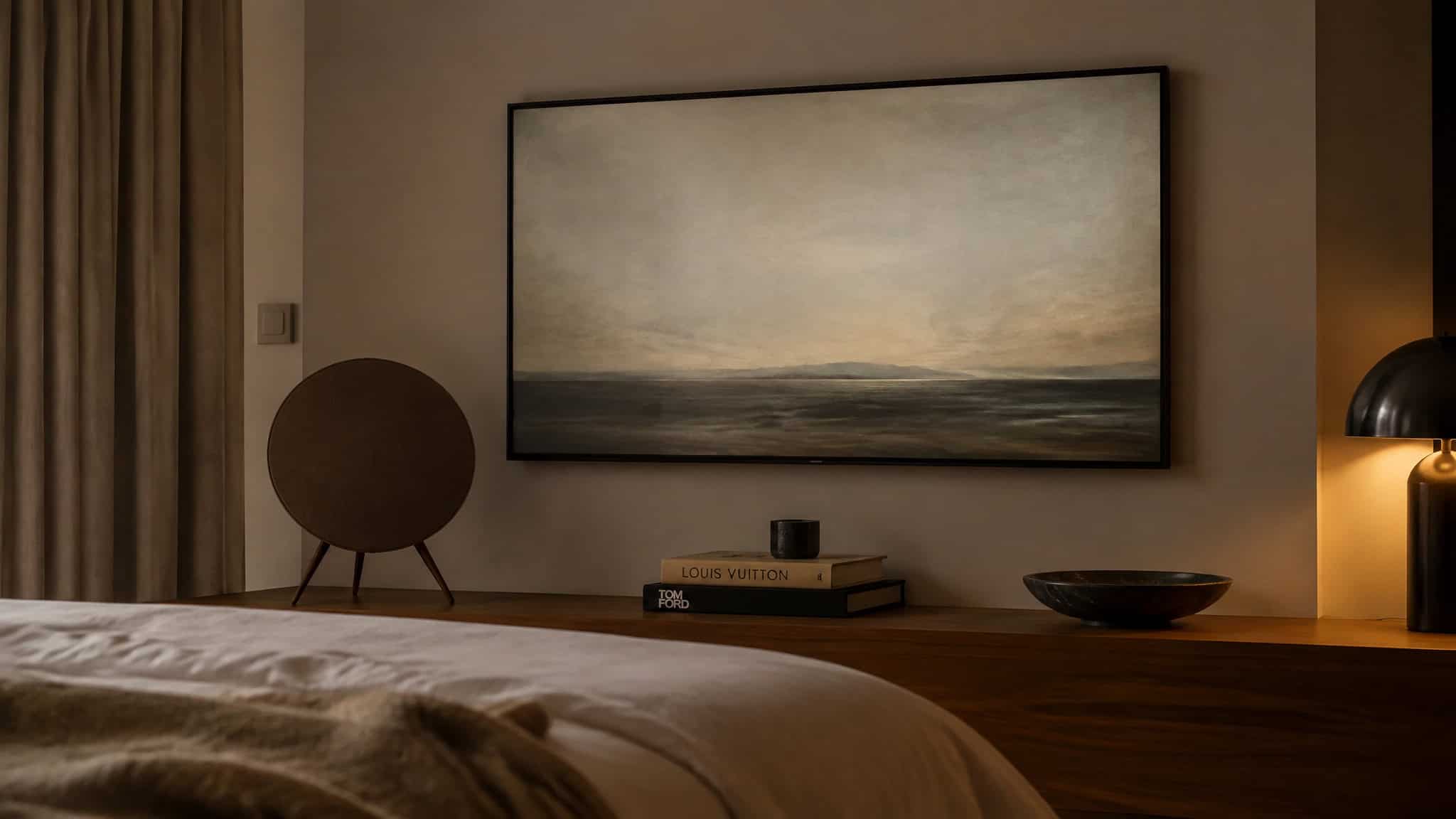
Two valid paths, nothing between. Hardware disappears entirely: a Matter-compatible hub hidden in a ventilated closet with labels inside, consoles concealed when idle, recessed cable troughs doing the dirty work. Or a device earns feature-piece status, which means passing one test: does it have a decorative purpose when it’s off? The Samsung Frame TV blends into the wall and displays chosen images, and the Bang & Olufsen A9 (4th gen), a three-leg disc design from $4,300, is the classic example; the Nietzsche joke reattributed to it, that without music life would be a mistake, fits nicely on a shelf next to it.
De-feminizing a room on a budget
Paint, textiles, and lighting shift a room’s gender read on their own, so furniture comes last. Back to the opening room: white walls, silver doona, the rose-print chair that stays. The swap order is textiles first, then one dark accent wall or bold graphic artwork, then lighting. Repaint a loud hand-me-down dresser in a naturally toned color and it settles in. A deep windowsill works as a nightstand substitute.
The reason all this works: masculinity signals come from palette weight and material honesty, not new furniture. No sourced dollar figure here, because the budget depends entirely on your room, but the sequence is the cheap part by design.
Personality without clichés: art, objects, and the two-sided audit
The audit cuts both ways. The dead tropes, mirror-clad bars, circular beds, leather-sofa defaults, are out, but so is the photo-perfect neutral room that photographs flat. One imperfect personal object, a worn jacket, a vintage sign, hobby gear displayed deliberately, is what anchors the room. If you need art in one line: large-scale black-and-white photography or abstract graphite in slim, consistent frames.
Finishing touches: accessories that encode adult rituals
The best accessories encode rituals, not ornament. The shoppable tier: the Tom Dixon Tank Whiskey Decanter (mouth-blown glass, from $200; it may change colour over time and isn’t dishwasher safe, which is part of the appeal, patina is earned), the AYTM Unity Tray (35cm walnut, from $100), the LSA International City Glass Bowl with walnut base (from $250), the HAY No. 8 Striped Merino Blanket (100% merino, from $300), and the Vitra Butterfly Stool (Japanese-inspired, from $1400). If those fit: the Off-White Notebook Cube (from $100), Supreme Stars Incense Burner (from $100), AYTM Curva Magazine Holder (from $360), L’Objet Shell Tic-Tac-Toe Set (from $1400), Magis 360° Container (from $700), KAWS Share Companion (from $1000), and HAY Tulou Table ($358). These picks come from living-room sourcing, adapted here to the bedroom. Prices may vary.
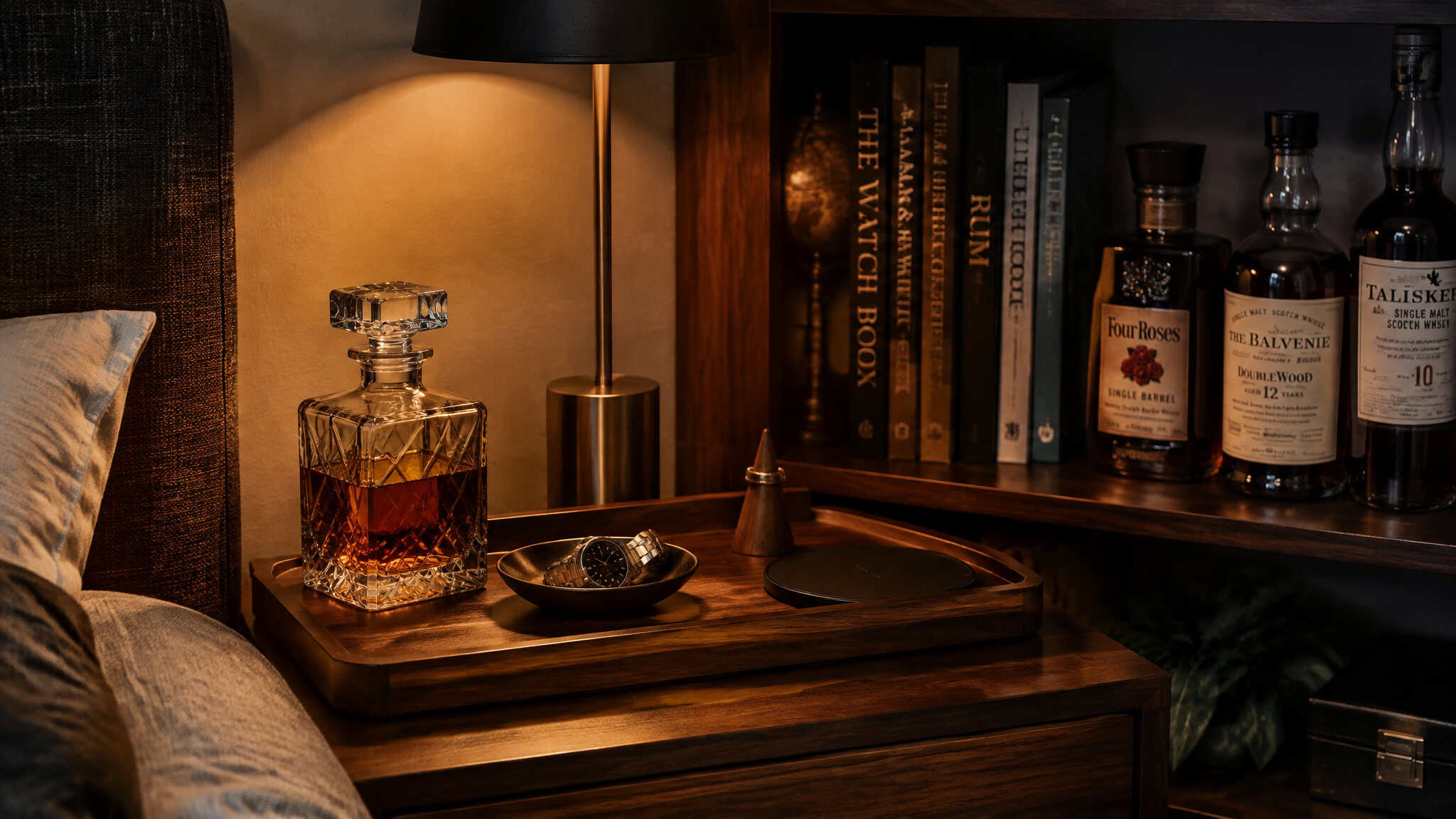
Behavior design is the other half. Snack from a bowl, not a bag. Drink from a glass, not a bottle. A liquor shelf with quality brands labels-forward, a curated bookshelf, consoles concealed. The room needs a centre of gravity, a focal point it organizes around, and balance comes from earth tones, simple whites, blacks, and woods.
Life stage and sleep performance: what makes the same palette read grown-up
The decisive difference between a dorm-read and a grown-up room is systems, not furniture price. Early-20s renters lean casual layers and industrial looks, shopping midcentury and teen-market lines. Established readers lean Refined European Calm and Tailored Modern Luxe. The adaptability criterion from Man of Many is worth adopting at any age: choose pieces that survive future relationship-status changes.
Couples align on storage beds or under-bed storage. No interviews here, just archetypes worth knowing which one you’re in.
The sleep stack matters more than the wall color, because it’s the stuff you touch every night. Medium-firm hybrid mattress, percale or stonewashed linen sheets in neutrals, temperature-regulating duvet, 18-20°C at night, circadian lighting with that 30-minute warm sunrise ramp and amber wind-down, blackout ripple-fold drapes with magnetic side channels. A compact purifier with a PM2.5 indicator tucked into a ventilated nightstand bay, a low broadband noise scene, and a solid-core door if noise is the issue. Zones, if you need them: a fold-down desk work nook with concealed cable bay, matte screen, facing a window, reading as a panel when closed, only if you actually need it.
A fitness corner with compact bench, adjustable dumbbells, anti-fog mirror, an outlet for a fan, and a woven basket for towel and bands. A low-slung reading lounge with sling or club chair, round tea table, and its own dimmable sconce. Micro-rituals finish it: cedar blocks in drawers, a vetiver or bergamot diffuser, a discreet speaker for the morning playlist. None of it announces itself, which is exactly the point.
For more room-by-room depth, the full bachelor bedroom guide breaks down style directions and budget tiers, and if your taste runs sleeker, the modern bachelor bedroom angle covers the same ground in a darker register.
Frequently Asked Questions
How do you make a small masculine bedroom work?
Scale discipline in both directions, not buying less furniture. Get the numbers right: an 8×10 rug minimum for a queen (9×12 for a king) with the bed’s front legs and nightstands on it, and nightstands 20-24 inches tall to line up with the mattress top. Use wall sconces, floating shelves, and multifunctional pieces to free up floor, and don’t be afraid of dark walls — drenching a tight room in a darker hue can feel cozy and sophisticated.