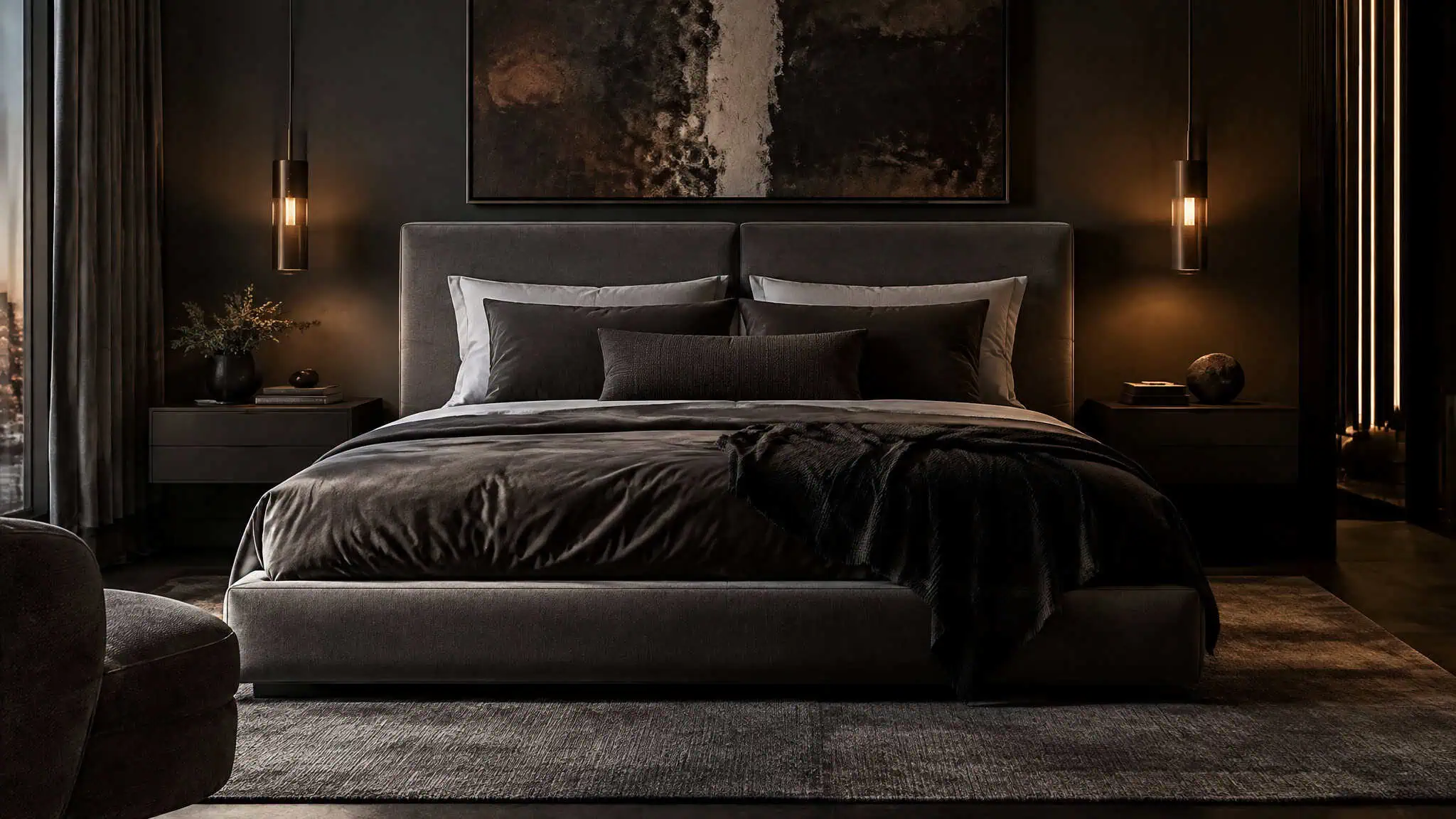
Every list of modern bachelor bedroom ideas I’ve ever scrolled says the same thing: moody, textured, masculine, layered. Zero measurements. Zero products. Just adjectives and a mood board you can’t actually buy.
So this one works differently. Every idea below comes with a real product, a mounting height, a Kelvin rating, or a price, so you can go from vague idea to ordered furniture in a weekend. The short version: the bachelor pad is dead. What marks a grown man’s room in 2026 is restraint.
Clean lines, dark tones, honest materials, layered lighting, and tech you can’t see. Here’s how to specify the whole room.
Key Takeaways
Wall-mounted nightstands like the Pilsen Graphite (12″ x 22″ x 8″) hang 20-24 inches up so the top lines up with your mattress, and they’re sold as a pair so symmetry costs one purchase.
Rug sizing is the most common mistake: minimum 8×10 for a queen bed, 9×12 for a king, with the bed’s front legs and nightstands on the rug. If only the bottom two-thirds of the bed sits on it, it’s too small.
Lighting runs on three layers, each on its own dimmer: ambient, task sconces at 2700-3000K, and a low-lumen underbed LED on a motion sensor for 2 a.m. navigation.
Table of Contents
Bachelor bedroom furniture essentials: the bed wall build
The essentials are a low-profile platform bed, wall-mounted nightstands aligned to the mattress top, and a low dresser. That’s the whole formula. Everything else is decoration. Here’s what that looks like as a fully specified design board, built around a real designer’s picks.
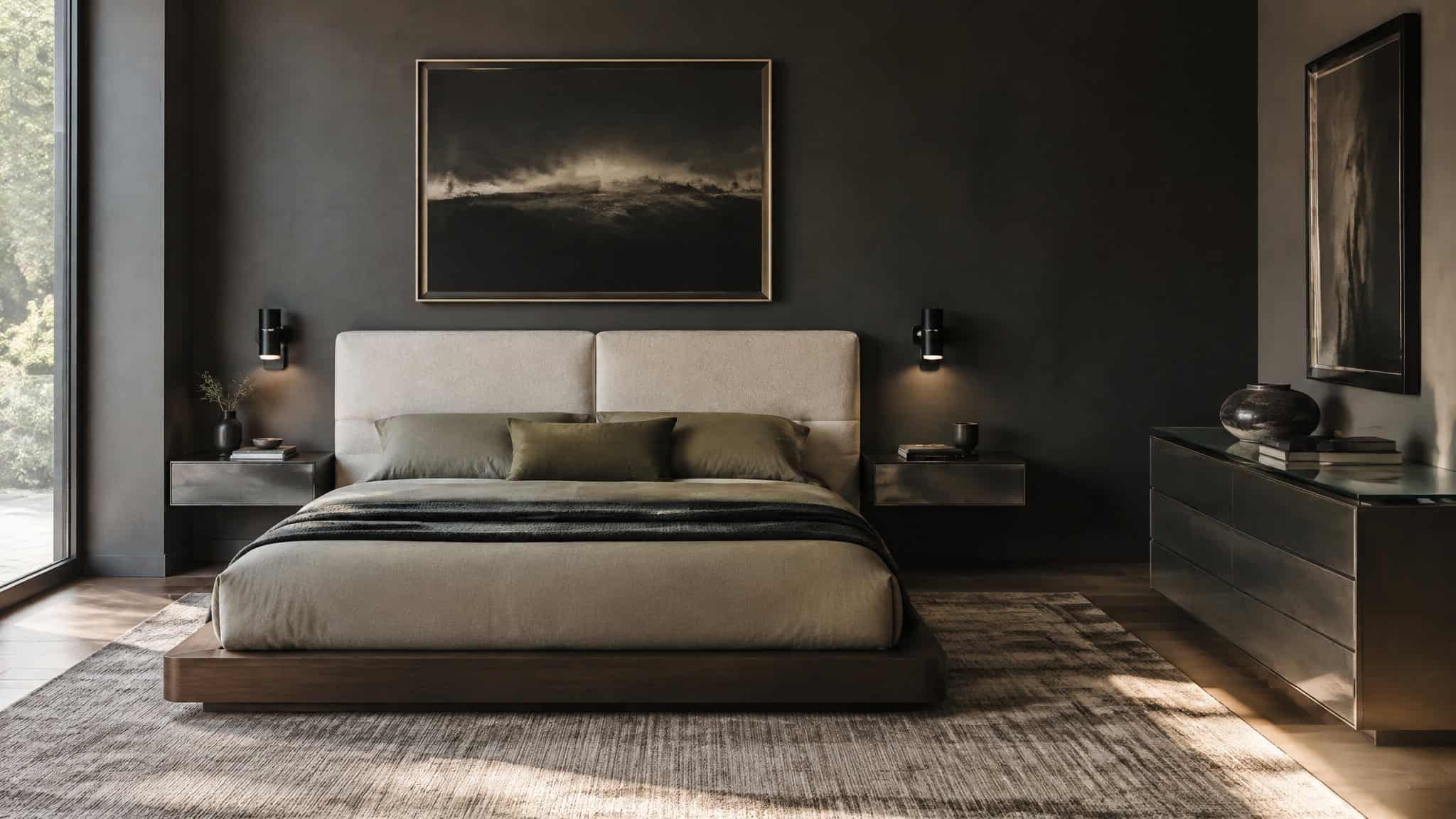
The anchor is the Flange Queen Headboard with Batten Plinth-Base Bed from Mitchell Gold + Bob Williams, designed by Bill Eastburn of William Eastburn Design. It runs 88.25″ long, 67″ wide, and 48″ tall, with 15 slats and an 800 lb max weight rating including the mattress and whoever’s on it. That weight number is the one that matters day to day: it means the frame won’t creak or flex every time you sit down. The finish is smoked grey in a mix of solid poplar, hardwood, oak veneer, and engineered wood.
I’ll be straight with you: it’s not all solid wood, and the price reflects that. The headboard itself is benchmade, kiln-dried engineered hardwood with soy-based polyfoam, made in Vietnam. The kiln-dried part is worth caring about, because that’s what keeps it from warping.
Flanking it are the Pilsen Graphite Floating Nightstands from Mark and Graham, designed by Mark Daniel of Slate Design and made in Taiwan. Each is 12″ x 22″ x 8″, wall-mounted steel with a graphite grey powdercoat, a single drawer, and the mounting hardware included. They’re sold as a pair, which is convenient: two of them flanking the bed gets you symmetry without buying two different pieces. The mounting spec is the part guys get wrong.
They order wall-mounted nightstands, never check stud locations or mattress height, then hang them too low or too far from the bed. The rule is 20 to 24 inches up so the top of the nightstand aligns with the top of the mattress. Find the studs first.
Buyer rule: Hang wall-mounted nightstands 20-24 inches up, aligned to the mattress top, and locate the studs before you drill.
For storage, the Lawson Low Glass Top Dresser measures 20″ tall by 78″ wide by 32″ deep. That’s nearly six and a half feet wide, so measure your wall before you fall in love with it. It’s a slim black iron frame with six solid acacia drawers, a clear glass top, and an open shelf for keys, watch, and wallet. The low profile is the point: storage without a bulky box dominating the wall.
Under all of it goes the Sloane Handloom Rug in 8’x10′, a CB2 exclusive. It’s handwoven in a mix of basket weave, herringbone, and stripes in black and white, and the flatweave construction handles foot traffic and vacuuming without fuss. On sizing: 8×10 is the minimum for a queen, 9×12 for a king, with the front legs of the bed plus the nightstands on the rug. Say it plainly: if only the bottom two-thirds of the bed sits on the rug, it’s too small.
Each piece earns its role. The plinth base gives you a clean, low silhouette. The upholstered headboard is the focal point. The floating nightstands keep the floor visually light.
The glass-top dresser keeps sightlines open. And the craftsmanship tell people notice without knowing why: edge-banded shelves with a continuous grain line running across them. That uninterrupted grain reads as custom work, not flat-pack.
What color is most suitable for a bachelor bedroom? The three-role formula
The most suitable bachelor bedroom colors are charcoal, espresso brown, or midnight navy as anchors, softened by sand, taupe, or mushroom, with one accent of olive, tobacco, rust, or slate blue. That’s the three-role formula: anchor, soften, accent. Anchor with the dark tone, soften with the neutrals so the room doesn’t read as a cave, and pick exactly one accent. Two accents is a mess.
Contrast discipline matters more than the specific colors. High contrast lives at the headboard wall only, and lower everywhere else. One trick that works: take the ceiling down two shades from the wall color. It lowers the visual noise in a way you feel more than see.
Renters, you’re not locked out. The Dark Gray Grunge peel-and-stick mural from the Surya Collection covers 144″ x 96″, a full 12′ x 8′ wall, so measure first because it’s a commitment. It’s smooth matte, removable, and split into panels so one guy can install it alone. The removability is the whole selling point: dark accent wall now, deposit back at move-out.
Masculine paint colors for bachelor pad: finishes and where the dark goes
Masculine paint colors for a bachelor pad start with matte charcoal, espresso, or midnight navy walls. From there, map the palette to what paint can actually do: charcoal and midnight navy as the anchor walls, olive or rust as the accent, espresso on the trim. If you want texture instead of flat color, lime wash or micro cement are the finishes that get you there.
The accent wall goes at the headboard wall. Same decision as the statement wall, same wall, no debate. That’s where your eye already goes, so that’s where the dark belongs.
One honest limitation: the design sources here give palette direction, not paint brands or chip numbers. So there are no brand names in this section, and I’m not going to invent any. Take the direction to a paint store and match it there.
What materials and textures make a bedroom look modern and masculine?
The materials that make a bedroom read modern and masculine are three honest materials plus two soft textures. The honest materials: walnut or oak for wood, basalt or soapstone for stone, blackened steel or aged brass for metal. The soft textures: a wool rug underfoot and a leather headboard. Those three together, wood structure, wool rug, leather headboard, make a room feel finished before any decor goes up.
Keep the accents restrained. Canvas, denim weave, herringbone, used sparingly. On finishes, the rule is matte black or aged brass. No chrome unless you’re genuinely going industrial, in which case, commit.
The Sloane Handloom Rug is the worked example of the wool pick: flatweave, black and white, built for high-traffic rooms and regular vacuuming. And the point of the restraint is simple. A limited palette is what separates a room that reads intentional from one that reads accidental.
How do you layer lighting in a masculine bedroom?
Layered lighting in a masculine bedroom means three separate layers, ambient, task, and accent, with a dimmer on each. The typical setup is one overhead fixture, and it fails both ways: too harsh at night, too dark for reading. That’s why guys end up adding sconces and dimmers after the fact.
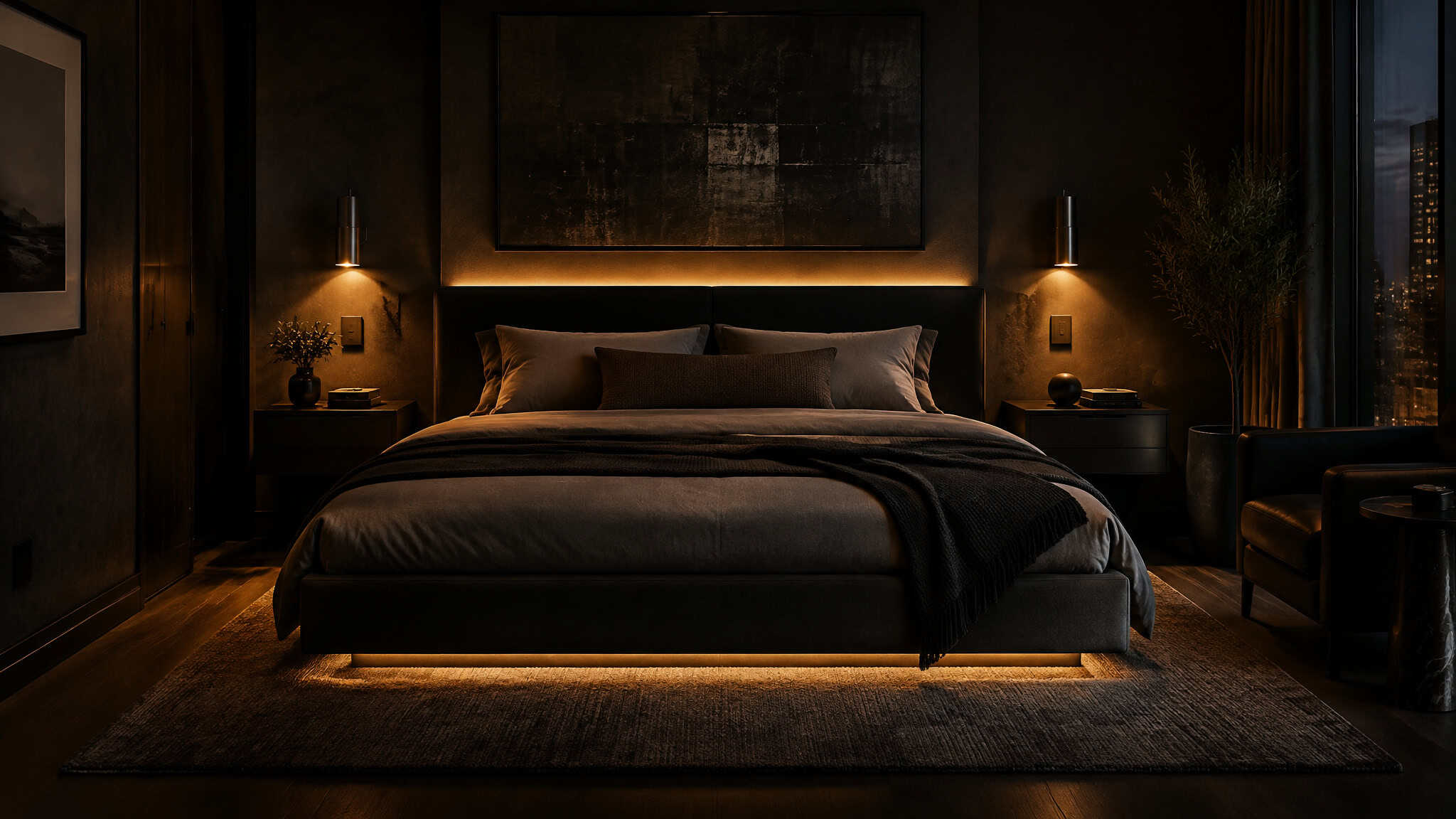
The layers, with specs. Ambient is an edge-lit ceiling fixture or cove LEDs. Task is aimable sconces at 3000K; the full night-mode setup is two pivoting sconce arms at 2700-3000K plus a discrete LED wash behind the headboard. Accent is a low-lumen underbed LED strip on a foot-level motion sensor, which gets you 2 a.m. navigation without retina shock.
Control it with scenes: Focus (bright, cool), Neutral (everyday), Night (dim, warm), all saved to a single paddle with haptic feedback. Add a 30-minute gradual warm sunrise wake scene and getting up stops being a crime against yourself.
Two lamps worth naming. The Concrete Core Table Lamp from Shades of Light is 20.5″ H x 8.25″ W x 11.5″ D, with a natural concrete base that has a small storage divot and a glass shade showing off a decorative bulb. It’s got weight and grit, not another generic drum shade, and the height works with a standard mattress top. Two caveats: it’s heavy, and the look depends entirely on the bulb, so don’t cheap out and put an ugly one in.
The Warner Table Lamp by VUUE is 22.25″ H x 13″ diameter, brushed bronze, one continuous linen shade swoop, white marble base. It looks like sculpture first, light source second, and it’s the lamp that makes a nightstand look intentional. Check the height against your headboard before buying.
Storage that visually vanishes
Storage works when it’s dimensionally planned, not when it’s a tidiness problem. Nightstands 20-24 inches tall, built-ins color-matched to the walls, floating pieces that reveal floor. Get those numbers right and the storage stops registering as storage.
Built-in wardrobes are the big move: flat, push-to-open fronts color-matched to the walls so the bulk visually erases. Inside is where the work happens: a valet rod, an EDC tray, felted bins, pull-out shoe racks. Outside stays quiet, inside does the job.
A floating dresser mounted 8 to 10 inches off the floor reveals floor area and makes the room feel lighter. Skip open bins, though. Visible clutter undoes the entire effect.
The pro moves: a bedside valet tray with a watch dish, ring cone, and wireless charger so the nightstand never becomes a junk drawer, exactly the kind of thinking behind well-planned simple bachelor bedroom ideas, where fewer, better objects make a room feel more mature. A slat wall with pegs near the entry holds tomorrow’s outfit, gym bag, or headphones, keeping that stuff out of the closet and speeding up mornings. And those edge-banded shelves with continuous grain from the bed wall build read as craftsmanship to everyone who can’t articulate why.
Bedding chosen by performance, not looks
Designing a modern masculine bedroom without it feeling cold comes down to minimalism balanced with comfort: warm lighting, layered textiles, contrast discipline. Bedding is where that balance actually gets bought, and it’s the first piece of a planned bachelor bedroom worth mapping out end to end.
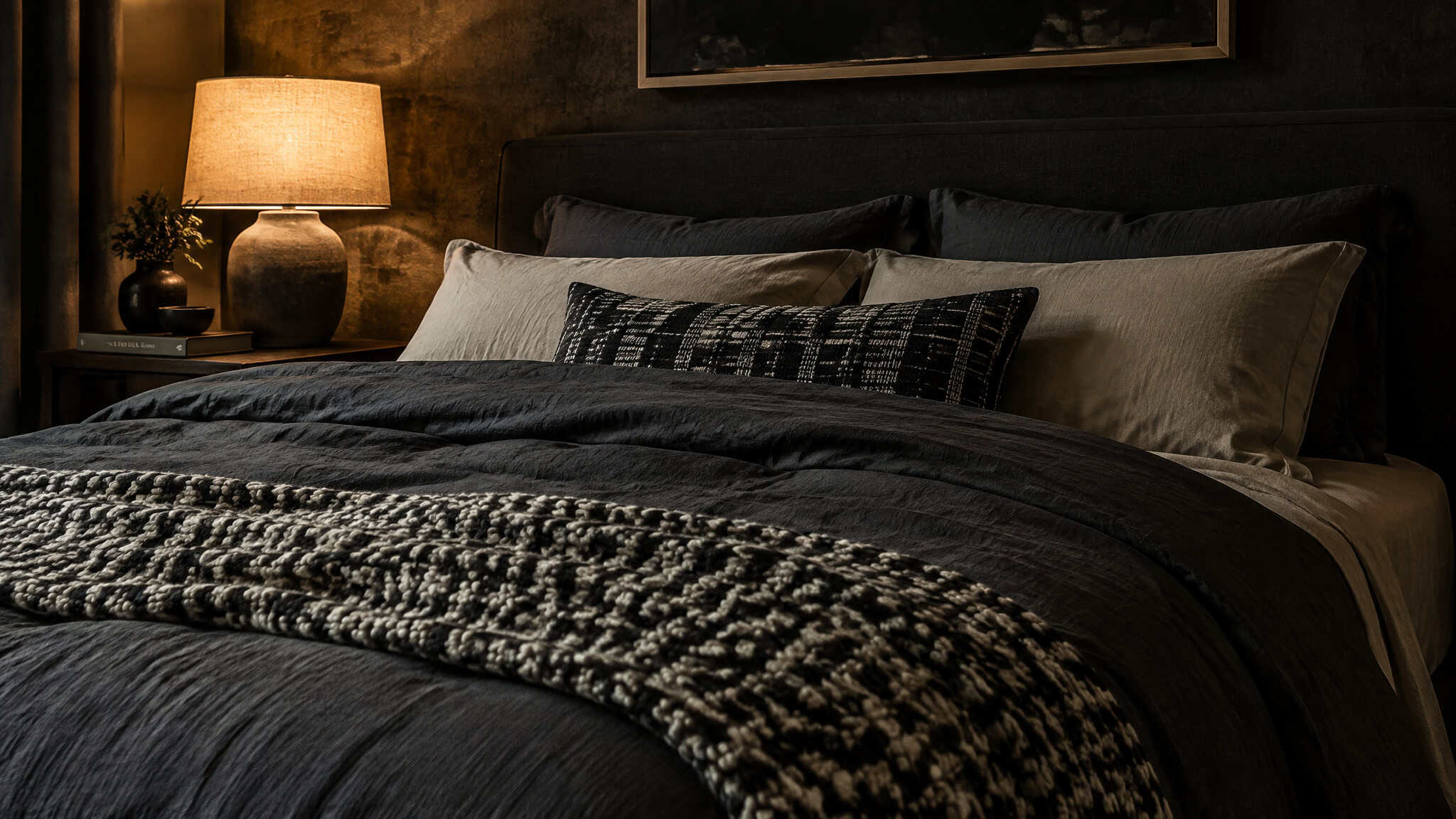
The common allocation mistake is buying statement decor first and cheap textiles you replace within a year. Backwards. The sleep surface is the thing you use every single night, so it gets the money first.
The performance picks. The Hatchmark Charcoal Duvet Cover is 88″ x 92″, so check it against your mattress size before ordering, because a too-small duvet is an annoying return. It’s a crisscross, slightly open weave of cotton and polyester backed in solid natural cotton, and that open weave breathes, which matters if you run hot. Charcoal also hides everything, which is its own argument.
The Black and White Chunky Blanket is 90″ x 90″, 100% cotton, and it’s the texture piece that makes a made bed look styled in ten seconds. Cotton means it washes without drama. The Luxury Bamboo Bed Sheets come in queen at 80″ x 60″, an extra-plush bamboo blend that’s breathable and claimed to be cooler than cotton and thermally regulating. If you wake up sweaty, this is the fix. The wrinkle, odor, stain, and pilling resistance is the manufacturer’s claim, not a guarantee, so read it that way.
The full sleep stack: a medium-firm hybrid mattress, percale or stonewashed linen as the sheet alternative, an 18-20°C night temperature, and a blackout roller shade with chain clutch for total light control. The shade stops at any level, is made in USA, and has a child-safety chain hold down. It’s sold as a quantity of 2, so count your windows. Add blackout ripple-fold drapes with magnetic side channels, a PM2.5 purifier tucked into a ventilated nightstand bay, and a solid core door for noise.
The MinkaAire Vital LED fan has a 44″ blade sweep, 3 speeds, sits 14.75″ from the ceiling, and a 21-degree blade pitch. That 44″ sweep is the number that matters for smaller rooms; bigger rooms need more blade. And notice what happened here: the charcoal palette just earned its keep functionally, not just aesthetically.
Art and objects with a story
One large-scale work with a story beats a wall of small frames. That’s the whole rule.
The big swing is EDWARD VIEW’s limited-edition Moonscape painting, via Mitchell Gold + Bob Williams: basic forms in an earthy palette inspired by urbanism and city life, by the Montreal-based artist. It’s offered one time only in a small reserve, so if you want it, move on it. No investment talk, just a decision.
If black and white fits your palette better, Kamala Nahas’s Obsidian Sea is an 18″w x 2″d x 24″h seascape photograph contrasting calmness and chaos, via the Minted x West Elm collaboration. At 2 inches deep, it’s slim enough for a narrow wall gap or beside a door. For something smaller and warmer, the Ocean Wave Gold Sunrise Framed Print comes in 10×12″ plus six sizes with white, black, or red frames. Good above a nightstand or in a gallery set, not a statement piece. The frame changes the whole read: black for the moody room, red if you want one loud thing.
For objects with provenance, the Kintsugi Vase is 12″ H x 4″ diameter, handmade stoneware honoring the Japanese kintsugi repair tradition, watertight, and unique piece to piece. You’re buying character, not uniformity. It’s a CB2 exclusive. The Petrified Wood Object, also CB2, is 4″ L x 4.5″ W x 3.25″ H, fossilized trees turned to stone via mineral-rich water, handcrafted, each one different. A no-effort accent that reads expensive.
Styling-wise, large-scale black-and-white photography or graphite abstracts in slim, consistent frames is the safest high-impact wall move. And the Colusa Large Square Mirror, rough-cast brass-finished aluminum with rounded corners for an antique feel, is marketed for mantel or entryway but works in a bedroom too. It adds light and makes a small room feel bigger.
Zones, hidden tech, and the 10-minute close-down
The bachelor pad aesthetic fails when the room performs indulgence: clutter, visible consoles, tech on display. The 2026 sources explicitly reject that, as do proven bachelor bedroom ideas, which lean on sleek modern silhouettes in lighting and fixtures instead. The fix is concealment, purposeful zones, and a room that signals adulthood instead of a dorm room with a budget.
The zone plan: a fold-down work nook with a concealed cable bay and matte screen, a fitness corner with a bench, adjustable dumbbells, and an anti-fog mirror, and a reading lounge with a low-slung chair, small round table, and dimmable sconce. Split the room by what happens where, not wall by wall.
Hidden tech: USBC-compatible outlets behind each nightstand plus a recessed cable trough so nothing dangles. A Samsung Frame TV blends into the wall and shows art when it’s off, which answers the I want a TV but not a black rectangle over the bed problem. The smart hub lives in the closet with ventilation, which is the detail guys skip and then wonder why it runs hot. Matter-compatible where possible, labels inside never outside. Every element earns its spot, that’s why Samsung and LG make design-forward tech in the first place.
The sensory layer: a Bamboo Palm runs 44″ to 58″ tall, native to Mexico and Central American forests and adapted to lower light, which is why it survives a bedroom with mediocre sun. It rates highly on NASA’s air-purifying plant list, though I wouldn’t fire your purifier over it. Check ceiling and corner space before ordering one this size. Cedar blocks in the drawers, a vetiver or bergamot diffuser, a discrete speaker for morning playlists.
Then the ritual: a 10-minute close-down. Collect cups, reset pillows, clear surfaces, set the night scene, press the single all-off button by the door. The sensory layer does its part too: cedar blocks in the drawers, a vetiver or bergamot diffuser, and a discrete speaker for morning playlists. Acoustic felt panels in charcoal or olive lining the headboard niche absorb sound, so the room reads calmer and more refined.
As for statement objects, the Bang & Olufsen A9 speaker starts at $4,300, an art deco three-leg disc with genuinely impressive sound. It’s absurd money for a speaker, and that’s part of the appeal. The KAWS Share Companion figure is 30cm, from $1,000, plastic, rare and hard to get. A grand for plastic. Scarcity is the whole price driver.
Small rooms and where to spend vs save
Bachelor bedroom ideas on a budget work by spending first on the sleep surface, flagging the genuine splurges, and price-tiering everything else when you design your dream bachelor pad. That’s the order. Not the poster, not the lamp, the mattress.
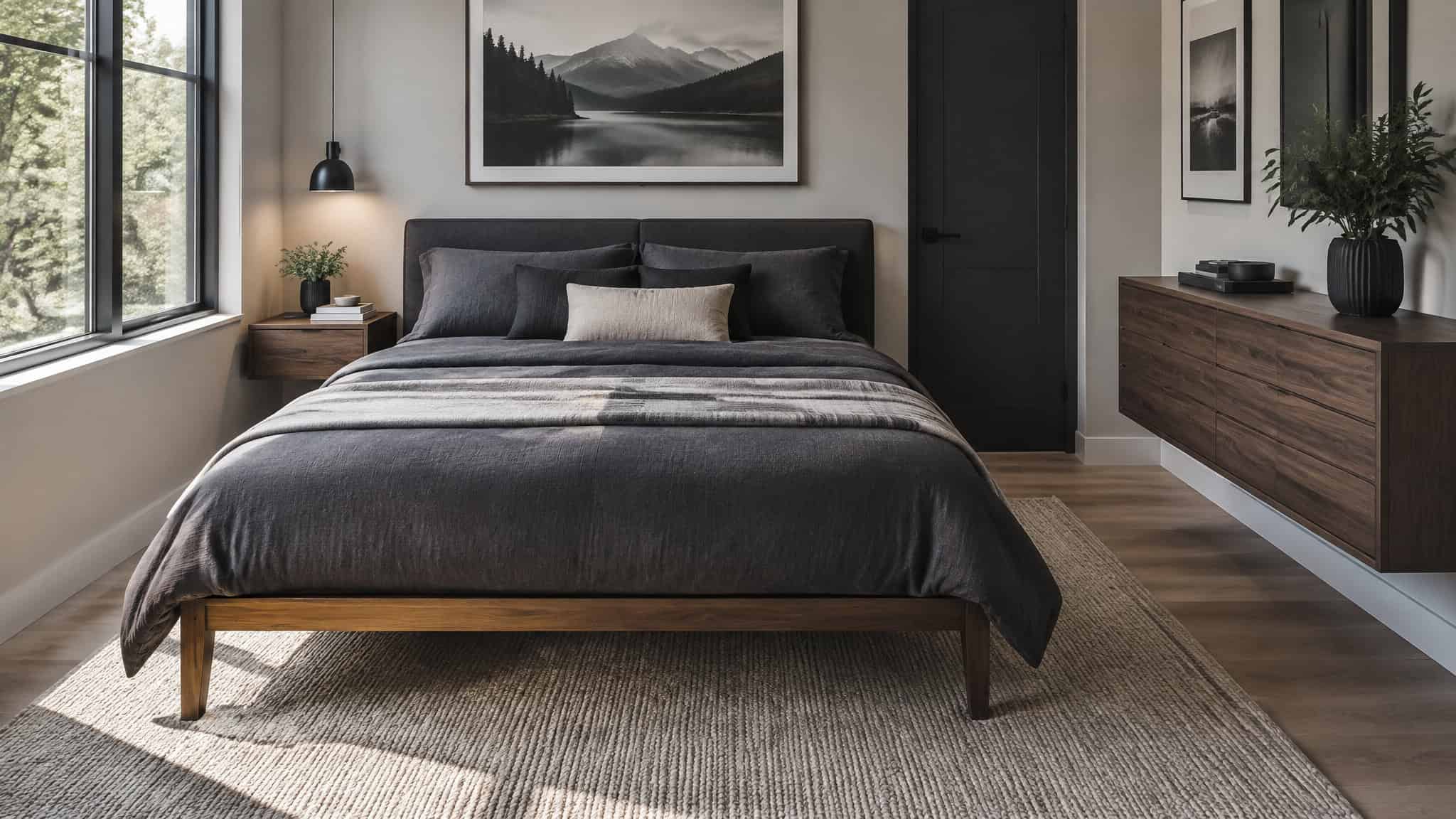
Small rooms get specific spec moves. The Pilsen wall-mounted nightstand is 12″ x 22″ x 8″ with hardware included and made for space-challenged bedrooms. There’s a drill involved, and check studs first. A floating dresser 8 to 10 inches off the floor shows more floor and reads lighter. Rug minimums stay the same regardless of room size: 8×10 for a queen, 9×12 for a king. Restraint, not clutter, is what makes a small room read mature.
On bed size, the honest framing: the queen is the fully worked example here, the Flange/Batten queen with an 8×10 rug. A king needs a 9×12 rug minimum and more floor around it. The tradeoff comes down to room scale, and the sourced build supports the queen example most completely, so that’s the one I can spec for you end to end.
The budget logic comes from a real listing: a designer’s budget-friendly neutral board for an actual master bedroom, Kevin’s, flagged the Solay mattress, wood plank bed, sconces, and nightstands as the splurges while keeping most pieces affordable. The mattress is the one worth spending on. The rest can be phased over months without the room looking unfinished.
For accessories, here’s the price ladder, and note that prices are “from” figures and may vary:
| Item | Price | The honest read |
|---|---|---|
| AYTM Unity Tray (35cm, solid walnut) | from $100 | Corrals keys, wallet, watch, and it’s built for serving meals, drinks, or cigars. The most functional item here. |
| Supreme Stars Incense Burner (100% black bamboo) | from $100 | It’s a $100 incense holder. Now you know. |
| Off-White Notebook Cube (800 pages, 95 x 95mm, 90 GSM) | from $100 | A cube of paper that costs $100. Own the absurdity. |
| Tom Dixon Tank Whiskey Decanter (mouth-blown glass) | from $200 | Color can shift over time, not dishwasher safe. Hand-wash it, period. |
| LSA City Glass Bowl (glass, walnut base) | from $250 | Pricey for a bowl. The walnut base justifies it, barely. |
| Hay No. 8 Merino Blanket (100% merino) | from $300 | Merino doesn’t itch. That’s the line. |
| Hay Tulou Table (100% steel) | $358 | Dark green pairs best with earthy tones and woods. Green steel next to walnut looks intentional. |
| AYTM Curva Magazine Holder (iron, matte powder-coated) | from $360 | Expensive for a magazine rack. The design is the justification or it isn’t. |
| Magis 360-Degree Container (black aluminium, five drawers) | from $700 | The wheels make it genuinely handy. |
| KAWS Share Companion Figure (30cm, plastic) | from $1,000 | A grand for plastic. Scarcity is the price driver. |
| Vitra Butterfly Stool (100% wood) | from $1,400 | A grail piece most guys will admire from afar. |
| L’Objet Shell Tic-Tac-Toe Set (brass and shell) | from $1,400 | Absurd money for tic-tac-toe. Say it, own it. |
| Bang & Olufsen A9 speaker | from $4,300 | The ceiling. |
One last note from that same designer: eDesign services are capped at 4 designs per month with an email waitlist. If you want a pro’s eye and aren’t in a rush, waiting costs nothing.
From 1950s bachelor pad to 2026 quiet luxury
The masculine room as a bachelorhood marker dates to the 1950s, when it was a TV- and dinner-free domain of its own, and the line between “bachelor pad” and “a grown man’s bedroom” has blurred ever since. In 2026, design explicitly rejects the pad cliches for quiet luxury and hidden tech: restraint, concealment, and adulthood now mark status, not indulgence. The compressed playbook: balance comfort with class, pick one focal point, stay in black/grey/navy and metal/stone/wood/leather, fill gaps with lamps, sculpture, plants, or books, use the window view, keep lines clean, and turn the bar shelf into a bedside valet and water station.
modern bachelor bedroom ideas for 2026
Men’s bachelor bedroom ideas in 2026 favor moody olive, navy, and charcoal palettes with layered textures and hidden lighting. Quiet luxury over stark minimalism, rich textures over empty rooms, clean lines balanced with comfort. Entries 13 through 27 come from a companion source and lean on dark, green, olive, navy, black, and wood palettes that balance boldness and calm. Each entry below is a recipe: what’s on the walls, what’s on the bed, what the lighting does. And if you want to see one in your actual room, you can upload a photo of your space to preview a style using AI, free.
Moody Olive Retreat
Olive walls, dark wood furniture, charcoal bedding, abstract art, and some greenery. The olive does the warming so the charcoal doesn’t go cold. Low risk, high payoff.
Casual Cool Layers
Slate blue walls, gray throws, tan pillows, a guitar, open shelving, and a salt lamp. The guitar on the wall does more personality work than any decor purchase you’ll make.
Desert Modern Edge
Black paneled wall, graphic textiles, carved wood, patterned rug, sculptural wall decor. Fair warning: this one needs confidence, because half-committing looks worse than not trying.
Tailored Neutral Balance
Upholstered bed, soft grays, clean lines, symmetry. Symmetry is what makes it look deliberate instead of default. The safe-but-sharp option.
Warm Minimal with a View
Deep burgundy walls, plaid bedding, natural light doing the heavy lifting. Burgundy is gutsy; the natural light is what keeps it from going cave.
Soft Industrial Glow
Dark walls, linear details, soft bedding, warm lighting, one dramatic overhead fixture. One statement light does the work of five decor buys.
Understated Luxe Layers
Warm woods, soft upholstery, layered neutrals, a woven bench, subtle pattern. The bench at the foot of the bed is the underrated piece.
Classic Contrast Comfort
Black and white, dark curtains, crisp bedding, greenery, sculptural light. The plant keeps the palette from feeling like a hotel.
Refined European Calm
Paneled walls, soft lighting, curved headboard, restful palette. The curved headboard softens all those straight lines. That’s the note.
Light Linen Simplicity
Soft linen tones, layered bedding, natural light. Minimal doesn’t mean empty; the layers are what keep it from feeling bare.
Earthy Panel Calm
Vertical wood paneling in deep olive-brown, cream bedding, chocolate-tone pillows. The dark-panel/light-bedding contrast is the whole look.
Structured Modern Focus
Clean lines, low-profile wood bed, graphic rug, built-in workspace and shelving. The built-in work area kills the daily setup-and-teardown ritual, which is time back every day.
Deep Green Comfort
Green wall, tufted headboard, soft gray layers, chunky knit throw, symmetry. The chunky knit is what makes it feel finished.
Black Accent Drama
Dark accent wall, lighter furniture around it, a velvet/wood/metal mix. The material mix keeps one black wall from flattening the room, and it’s the cheapest big visual upgrade on this list.
Olive and Neutrals Blend
Olive tones with warm neutrals and simple styling. The low-effort version of the olive look: few pieces, chosen well.
Sculptural Dark Minimal
Vertical slats, dark palette, matte walls, hidden lighting glow. The hidden lighting is what makes it sculptural instead of just dark, and it’s the accent layer from the three-layer system doing exactly its job.
Classic Moody Layers
Deep walls, layered neutrals, vintage-inspired rug, artwork as the focal point. One strong artwork above the bed beats a gallery scatter.
Rustic Industrial Edge
Wood-paneled wall, dark tones, gray bedding, open wardrobe. The open wardrobe is a tradeoff: looks great, demands tidiness.
Tailored Modern Luxe
Clean paneling, neutral palette, subtle lighting, precision alignment. Panels and fixtures have to actually line up, measured and matched, or the whole look falls apart.
Warm Contemporary Layers
Wood tones, soft lighting, layered textiles, artwork above the bed. Nothing exotic here; it’s about getting the warm-light temperature right.
Soft Glow Slat Wall
Vertical slat wall with warm backlighting, hanging bulbs, tonal palette, upholstered headboard. The glow behind the slats is the detail people notice first. High impact, moderate DIY effort.
Cityscape Neutrals
Oversized city artwork anchoring muted tones. One large piece beats several small ones, full stop.
Cozy Contrast Corner
Dark accent wall, cream layers, mirrors and warm lighting bouncing the glow. Mirrors opposite the light source is the trick.
Sculpted Beige Luxe
Tall upholstered panels, clean lines, chandelier drama, muted palette. Beige done with height and drama, not beige done boring.
Warm Wood Retreat
Wood-paneled wall with lighting aimed to highlight the grain, creamy bedding. Aimed light at wood is a cheap upgrade that looks custom.
Classic Navy Framed
Deep navy walls, crisp white bedding, warm wood tones, symmetry, framed pieces. Navy plus white is nearly foolproof.
Moody Modern Balance
Deep green walls, warm metallic lighting, soft textiles, tight palette. Pick a lane and stay in it. The tight palette is what separates this from a color mess.
Keep the palette disciplined, the textures honest, and the lighting layered. Hide the cables, label the tech, and ritualize the last 10 minutes of the night. A few precise upgrades turn the room into a personal HQ for daily restoration. Not a furniture arrangement. A system.
Frequently Asked Questions
What are the 2026 bedroom trends?
The 2026 look is quiet luxury over stark minimalism: moody olive, navy, and charcoal palettes, layered textures, hidden lighting, and tech you can’t see. Restraint, concealment, and clean lines now mark a grown man’s room — not the indulgent bachelor pad cliches.
What color is most suitable for a bachelor bedroom?
Use the three-role formula: anchor with charcoal, espresso brown, or midnight navy; soften with sand, taupe, or mushroom so the room doesn’t read as a cave; then pick exactly one accent — olive, tobacco, rust, or slate blue. Two accents is a mess. Keep the high contrast at the headboard wall only.
What is the latest trend in bedrooms?
The current shift is away from visible indulgence toward restraint: dark tones, honest materials like wood, stone, and leather, layered lighting on dimmers, and concealed tech. A ceiling taken two shades darker than the walls is a small move that lowers visual noise in a way you feel more than see.
What are the bachelor bedroom furniture essentials?
The whole formula is a low-profile platform bed, wall-mounted nightstands aligned to the mattress top, and a low dresser. Everything else is decoration. Wall-mounted nightstands should hang 20-24 inches up so the top lines up with your mattress, and locate the studs before you drill.