
No adult can actually grow two inches of new bone, and that’s the first thing you deserve to hear. Once your growth plates fuse after puberty, the game is over; genetics locked in 60 to 80% of your height before you were born. But here’s the part most articles bury: the remaining margin is yours to play for, and it’s bigger than you’d think. Posture work, spinal decompression, even just smarter clothes can buy back one to three inches of height you already own but have stopped showing.
There are three routes, and they stack. The posture reveal is the headline act: sources put it at up to 3 inches, though an honest attributed range is 2 to 3. Footwear is the most direct: ordinary shoes already add half an inch to an inch and a half, and dedicated lifts or insoles push that to a discreet 3 inches max. Styling is pure perception, but perception is what people actually see. Stack a 1.5-inch posture fix, an inch of smart shoe choice, and clothes that don’t chop you in half at the waist, and two visible inches is a realistic goal, not a fantasy.
What follows is each route with its ceiling and its failure mode named. No miracle promises. Just the stuff that’s worth money and the stuff that’s worth five minutes a day.
Key Takeaways
Adults can’t grow new bone, but posture work can reveal 1 to 3 inches of height you already have; Ed Latimore measured a flat 6’0″ for years, then nearly 6’2″ at 29 after 26 weeks of daily military standing drills.
Footwear is the fastest route: ordinary shoes add 0.5 to 1.5 inches already, and insoles or dedicated height shoes add 1 to 3 inches discreetly, though chunky soles can visually shorten you even while adding literal height.
Clothing controls perceived height through one mechanic: pull the eye vertically and eliminate horizontal breaks, via monochrome outfits, high-rise trousers, matched belts, and jackets with the waist button above the navel.
Table of Contents
| Exact model | Decisive documented advantage |
|---|---|
| Wear height-increasing shoes or insoles | Delivers a discreet height gain of 1-3 inches from lifts, insoles, or platforms without anyone noticing the assist. |
| Lose excess body fat | Weight loss decompresses the spine and can restore up to an inch of height, with significant disc height restoration measured after weight reduction. |
| Improve your posture | Correcting bad posture can add 1-2 inches of visible height immediately, with 1-2 cm achievable within just 7 days. |
Model details below derive from the cited sources; check the brand pages for current pricing.
Can an adult grow taller after 18? The honest ceiling
No, your bones won’t lengthen after 18, or after 21, or ever, once the growth plates have fused. Anyone selling “grow taller after 25” is selling clicks. What’s actually on the table is the height you already own: the roughly 20% lifestyle margin that controls your posture, how compressed your spine sits on a given day, and where your soft tissue hangs. That margin doesn’t create new inches.
It reveals buried ones. Framed honestly, exercises and drills don’t grow you taller, they uncover the height a desk job and ten years of slouching have been hiding.
Height-enhancing insoles and elevator shoes
Footwear is the most direct route in this piece because it’s the only one you can buy outright. Ordinary shoes are already doing some of the work, and dedicated insoles or elevator shoes stack on top of that. The ceiling is a discreet few inches, and nobody can tell where it’s coming from unless you tell them. Here’s what’s actually on the shelf and what each option adds.
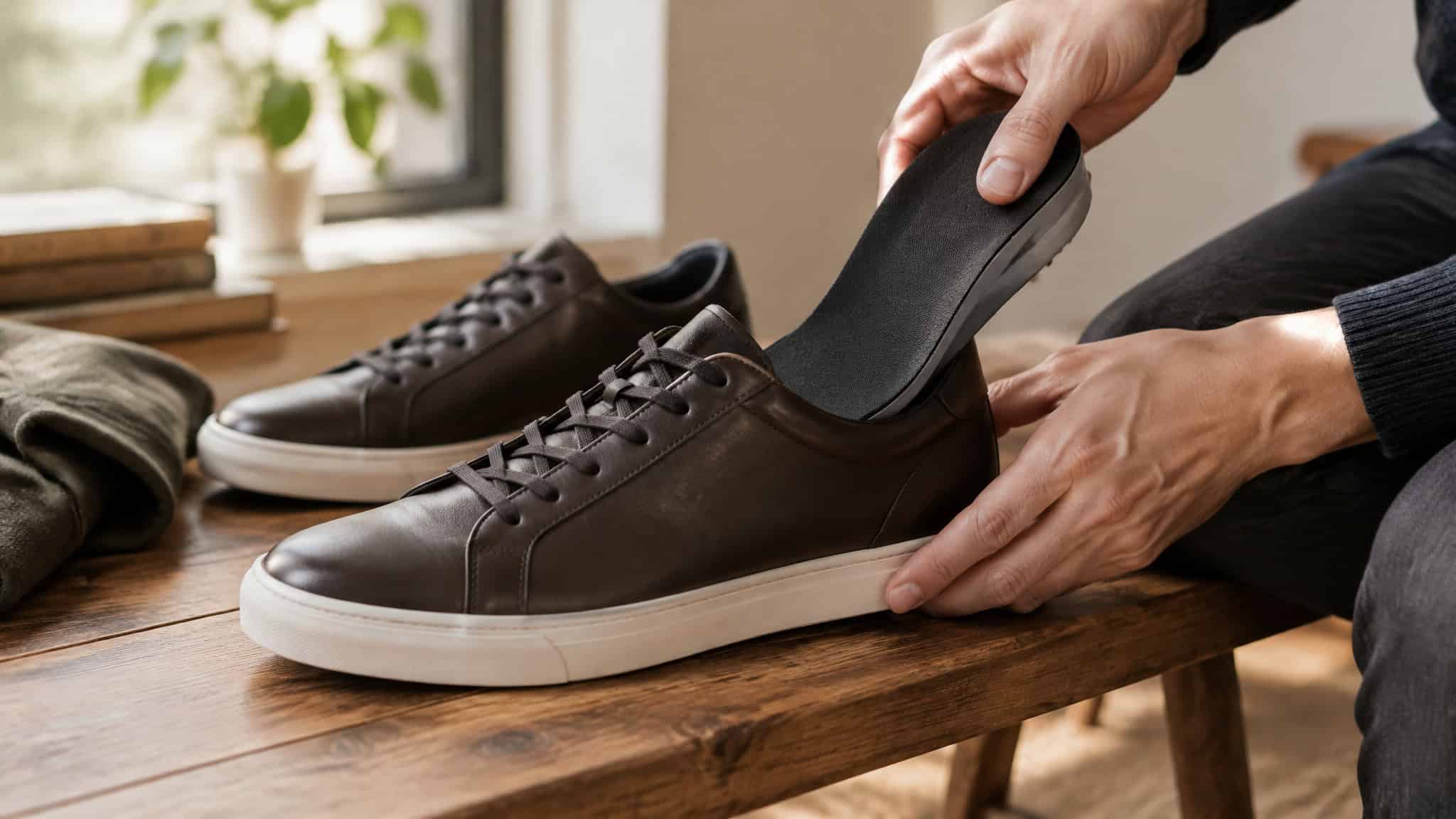
What you can buy, and what it adds
This is the most direct route in the whole piece, and there’s no shame in just buying it. Your everyday shoes are already adding 0.5 to 1.5 inches; you’ve been “wearing” height gains every day without thinking about it. Dedicated insoles or elevator shoes push that to 2 or 3 inches. The insole slides into the heel, and you can grab a pair on Amazon cheap or have a podiatrist make custom ones.
Conzuri makes purpose-built height shoes claiming up to 2.5 inches, and full disclosure: links to those are usually affiliate deals with a discount code, so the writer gets a cut. Use the code, wait for a sale, just know what you’re looking at.
If you’re weighing insoles against elevator shoes against sneakers that make you taller, insoles win on discretion since they hide inside normal shoes; if that comparison deserves its own deep dive, there’s a fuller guide to height increase insoles worth a look.
The catch: maximum lift can make you look shorter
Maxing out the lift is the classic mistake. The shoes feel awful after an hour, and then guys pair them with chunky sneakers that add visual bulk at the bottom and cut the leg line. Net result, the mirror says shorter. Lift amount and shoe bulk are two separate decisions. A sleek dark shoe with a modest lift reads taller than a platform monster.
The exposure worry? Mostly moot. Shoes stay on in nearly every social setting, and the lift only has to survive first impressions anyway.
One honest gap: the sources here don’t say much about long-term foot comfort with lifts, and I’m not going to invent reassurance. If that’s your sticking point, start low and see how a full day on your feet treats you.
Lose excess body fat: the measured-height evidence
This is the one route with actual measured-height data behind it, not just optics. Carrying less load on your spine means less compression, potentially up to an inch of real measured height back. An Israeli neurosurgeon, Zvi Lidar, looked at disc height after weight reduction and called the restoration significant, about 2mm recovered at a single disc (L4-L5). Run the back-of-napkin math across half your discs and you get a plausible swing of 1 to 3 inches.
To be clear, that’s extrapolation, not a measured outcome, and how much applies to you depends on your starting weight. The side benefits are real regardless: a slimmer waist makes good posture easier to hold, and your limbs read longer when they’re not wrapped in a bigger frame. The word for all of this is “slightly.” It nudges the tape measure. It doesn’t rewrite it.
Improve your posture: the 1-2 inch height reveal
Fixing a slouch can add 1 to 2 inches immediately, and sources put the ceiling at up to 3, so treat that range as attributed, not promised. The proof point is Ed Latimore, best-selling author, heavyweight boxer, physicist, who measured a flat 6’0″ through most of his adult life. At 29, after 26 weeks of daily standing-at-attention drills in Army basic training and AIT, he measured nearly 6’2″. Over an inch and a half from standing straight, no shoes involved. If you do stack footwear on top, shoes that make you taller add 2-4 inches in elevator styles, 1-3 on platforms. Not growing, standing.

Jeremy Ethier’s viewers report similar things: Alex and Abdullah each gained 3cm on his routine, Gautam got 1.5 inches instantly, which is the unrolled-slouch effect, not new bone. One viewer’s parents noticed his height change before he mentioned it, which is about as believable as anecdotal proof gets.
The failure mode is relapse, and it’s a pattern people report constantly: drills start, you feel taller, desk habits re-lock the slouch within days, and the thumb test (more on that below) fails again after a long sitting day. Posture trainers can act as training wheels for holding the gains while you rebuild the habit. Standing tall also sharpens the neckline and makes the whole upper body read better, which nobody complains about.
What exercises fix forward head posture and rounded shoulders?
Two protocols do the heavy lifting: Jeremy Ethier’s 5-minute routine and the Beauty Within stretch set. Pick one, or run both, they’re complementary.
Jeremy Ethier’s 5-minute routine
Jeremy Ethier’s 5-minute routine hits the three problem areas, back, shoulders, and neck: thoracic rotation on all fours (shifting your hips and knees targets different spots), prone back extension driven by the mid-back muscles with your arms just stabilizing, shoulder dislocates with a band, towel, or broomstick (start wide, narrow your grip over time), reverse wall angels, and chin tucks. About a minute each, once or twice a day. That’s it. The framing matters too: exercises can only reveal your natural height, not create new growth, prolonged sitting is what buries it, locking you into that hunched, head-forward position every desk worker knows.
The evidence backs it up. A 2020 study checked 200 university students for forward head posture and found 146 of them had a cranial vertebral angle under 53 degrees, meaning most of us carrying a laptop around are walking crooked. And in a 2021 review, every study that strengthened the deep neck flexors helped reverse forward head posture. Every one.
The Beauty Within stretch set
The zero-equipment option, doable tonight: wall angels for about 5 reps, downward dog for around 8 breath cycles done 5 times, shoulders stretch for 30 seconds, hip flexor stretch 15 to 20 seconds per side (a towel under the knee helps), toe lifts of 30 seconds done 8 to 10 times through the day, and the Y stretch, reaching for the sky, 3 to 4 times a week. These strengthen the back and spine muscles so you can hit your actual max height. One source titles this “grow taller,” but that’s clickbait framing; what it really does is reveal what you’ve got.
The 10-second self-check
Stand relaxed and let your arms hang. If your thumbs rotate toward each other, your shoulders are rounded and you’re slouching. That’s the whole test.
Posture walking: train your alignment with every step
Building this into a habit is what makes the gains stick, and the honest timeline is weeks to months, not days. The form is simple: head tall, eyes forward, shoulders back, core gently switched on, heel-to-toe stride without overstriding. The mental image that actually works is a string pulling from the crown of your head. Quality beats distance or speed here; recheck your alignment every few minutes, and start with 20 to 30 minute walks before building up.

This isn’t me talking from experience, it’s a trial run by Lucy Miller, a journalist and Level 3 personal trainer who’s a former elite gymnast and marathoner with bylines including Men’s Fitness. She spent a week doing it, using station commutes and resets after long stretches of sitting, and reported feeling taller and more upright. The side benefits are what sell the habit long-term: better balance, easier breathing because a slouch compresses your chest, better digestion because it compresses your gut too, core work without a single crunch, and a mood lift that’s worth more than it sounds.
What clothes make a man look 2 inches taller?
The clothes that work are the ones controlling where the eye travels and where horizontal lines cut your body. That’s the entire mechanic. Every rule below is the same principle wearing a different outfit: pull the eye vertically, kill the breaks that slice you into segments.
Fit comes first. Sleeves ending at the wrist bone, trousers barely kissing the shoes, close but not tight, snug, not sausage. Fit does more for perceived height than any single garment choice. Baggy clothes widen your outline and, bluntly, read low-status; that’s an observation about silhouettes, not a judgment of anyone’s comfy jeans. The shortlist of what shortens you: oversized shirts, long jackets, baggy jeans, high-contrast shirt-and-pants combos, thick belts, horizontal stripes, bulky shoes. Most of those are one shopping trip from fixed.
Monochrome. One color head to toe removes every horizontal break line and stretches the frame. Navy chinos with a navy shirt. Charcoal jeans with a dark grey jacket. If you do break the color, keep the transition subtle, because a hard break at the waist shortens the outline.
High-waisted pants. The biggest win in the trouser drawer. A high rise lengthens the leg line and, as a bonus package, reads taller, in shape, younger, and healthier. Low rise does the opposite, dragging your apparent height down with the waistline. Tuck or crop the shirt, go slim or straight, and don’t let fabric bunch at the ankles.
Cropped trousers. A hem ending just above the shoe top stretches the lower leg visually. That’s why the no-socks look works on guys who pull it off. The enemy is stacked, bunched fabric pooling at the ankle.
Jackets. Keep the waist button above the navel; it pulls the eye up and makes your legs look like they start higher. Length at mid-seat, structured shoulders, since broader up top reads taller overall. A cropped bomber or fitted blazer balances proportions. Skip longline coats unless your proportions are dead-on.
Belts. Skip them when you can, because a belt draws a line across you and the eye stops where the belt starts. If you need one, match it to your pants so the line stays continuous, and go slim. A wide high-contrast belt slices you in half visually.
Pattern. Thin, closely spaced vertical stripes, micro-checks, subtle textures, anything that keeps the eye moving up. Horizontal stripes widen and shorten, and big prints or oversized graphics spread attention sideways until the shirt is wearing you. If you insist on a graphic tee, put the print higher on the chest to lift where people look.
The military tuck. A 10-second skill worth learning once: pinch the excess fabric at your sides, fold it backwards, tuck it smooth. Defines the waist, emphasizes the legs, cuts perceived torso bulk.
Fabric and necklines. Thin lightweight layers work on smaller frames; structured cotton or linen holds its shape while drapey fabric slumps and drags the eye down. A firm collar lifts the shoulder line. And necklines matter more than guys think: a V-neck elongates the neck and pulls the eye upward, while a crewneck visually flattens the chest.
Every piece, one job: pull the eye vertically.
Outfit formulas by dress code
Copyable recipes, shoes up. Casual: slim dark jeans, a fitted V-neck Henley, ankle boots, and a matching belt. Smart casual: navy chinos, a crisp white shirt tucked in, loafers, and a short blazer. Office: high-rise trousers, a tailored shirt, a subtle pinstripe jacket, and polished leather shoes. Date or interview, the logic holds either way, and if footwear is where you want to push further, there’s a whole breakdown of shoes that make you taller to work from.
Hats, hair, and finishing touches
Hats are the oldest height hack nobody counts: they extend the top of your head, and people’s eyeball math just assumes that’s you, good for 1 to 2 inches of immediate apparent height depending on the style. Panama hats and driver’s caps are one writer’s taste, not a rule. Hair runs the same play: volume on top, a textured quiff or pompadour, elongates the face and upper body. Skip flat or heavy sides. That’s the barber conversation.
How can I get 2 inches taller in a week? Honest timelines
In a week, yes, you can get visible inches: insoles in the shoes, an outfit that stops chopping you at the waist, a posture release from the drills above. What you can’t get in a week, or overnight, is durable growth. Actual bone growth in seven days is biologically impossible, so everything fast is reveal, not growth. Durable postural change tracks months: Latimore’s gain showed up after 26 weeks of daily drills, and Ethier’s routine works on a minute per exercise, once or twice a day, sustained.
Watch the relapse too, because the desk chair is patient and will take the progress back if you let it. Week one is about walking in looking two inches taller. Keeping it is a months-long project.
Stature beyond inches
Latimore’s own kicker is the right way to end this: appearance gains only get you past first impressions. Once people actually know you, confidence, competence, and character decide your stature, inches or no inches. Ballerinas prove the mechanics, shorter people presenting tall through technique alone. And for the fun of it, Harry Styles reportedly stands an inch taller after 18 months of pilates he started for a bad back, one leg about half an inch shorter than the other, with his bandmates blaming the injury on a “demanding paper round.”
Tabloid anecdote, not evidence. But the two inches you’re chasing? Those are yours to take.
How this article was built
- Built from 10 successfully scraped sources, checked Tuesday, September 15, 2026; numbers below trace to those sources.
- Comparisons state only differences the sources support; gaps render as “Not published” rather than guesses.
Frequently Asked Questions
Is it possible to add 2 inches to your height?
Not as new bone once your growth plates fuse after puberty, but two visible inches are absolutely on the table. Stack a 1.5-inch posture fix, an inch of smart shoe choice, and clothes that don’t cut you at the waist, and two apparent inches is realistic. You’re not growing, you’re revealing height you already own.
Is 2 inches noticeable in height?
Yes, especially because the gains come from multiple angles at once. A straighter spine sharpens your neckline and upper body, footwear adds literal height, and monochrome outfits with high-rise trousers pull the eye vertically. One anecdote worth noting: one posture-routine viewer’s parents noticed his height change before he even mentioned it.
How long does it take to add 2 inches to height?
For visible inches, a week is enough: insoles, a better outfit, and an initial posture release can all land immediately. For durable postural change, think months — Ed Latimore’s near-2-inch gain showed up after 26 weeks of daily standing drills. What’s biologically impossible in a week is actual bone growth.
Can you actually get 2 inches taller as an adult?
You can’t grow new bone after your growth plates fuse, but you can absolutely show up two inches taller. Posture work reveals 1 to 3 inches of buried height, footwear adds up to 3 discreet inches on top of the 0.5 to 1.5 your shoes already give you, and body-fat reduction may return up to an inch of measured height through less spinal compression.
What clothes make a man look 2 inches taller?
One mechanic rules everything: pull the eye vertically and kill horizontal breaks. Monochrome outfits, high-rise trousers, cropped hems, matched slim belts, V-necks, and jackets with the waist button above the navel all stretch the frame. The shortlist of what shortens you: baggy clothes, long jackets, high-contrast waist breaks, thick belts, and horizontal stripes — most fixable in one shopping trip.
How can I get 2 inches taller in a week or overnight?
In a week, yes: insoles, an outfit that stops chopping you at the waist, and a posture release add visible inches fast. Overnight, not really — and actual bone growth in seven days is biologically impossible. Everything fast is reveal, not growth; keeping it is a months-long project of daily drills and walking alignment.