
Segway announced the MUXI Pro Cargo e-Bike on September 15, 2026, out of Plano, Texas, with a September 22 on-sale date and a $1,999.99 sticker. It’s an upgraded version of Segway’s popular MUXI short-tail cargo e-bike, not a new platform: nine-speed auto-shifting, a 70mm suspension fork, turn signals, standard fenders, and Class 3’s 28-mph assist. That’s the pitch. One thing to get out of the way up front: everything here comes from Segway’s official announcement. Nobody has ridden this bike yet, including us.
Key Takeaways
The MUXI Pro costs $1,999.99 and goes on sale in the US on September 22, 2026 at authorized Segway dealers and store.segway.com.
Budget about $2,460 for a realistic build. Passenger Kit, both baskets, radar, mirror, before the $229.99 dropper post. The smart features? Free for one year, then subscription-only at a price Segway hasn’t announced.
It’s an 82.2-lb bike with 418 lbs of payload, a 750W motor, up to 73 miles of claimed range, and Class 3’s 28-mph assist, which depends on your state’s law.
Table of Contents
Segway MUXI Pro price and release date
The MUXI Pro costs $1,999.99 and will be available on September 22 through authorized Segway dealers and store.segway.com in the US. All pricing here comes from the September 15 announcement, so treat it as the launch number.

That’s not cheap, but it’s not crazy for this segment either. Cargo e-bikes tend to run well above standard commuters, and Segway’s number at least tells you the floor up front instead of making you dig.
Where you buy matters more than usual. A dealer gets you assembled, adjusted, and someone to call when the hydraulic brakes need bleeding. Ordering direct from Segway’s site means the bike shows up in a box and it’s on you. Neither is wrong, but if you’ve never wrenched on an 82-lb e-bike, the dealer option has real value.
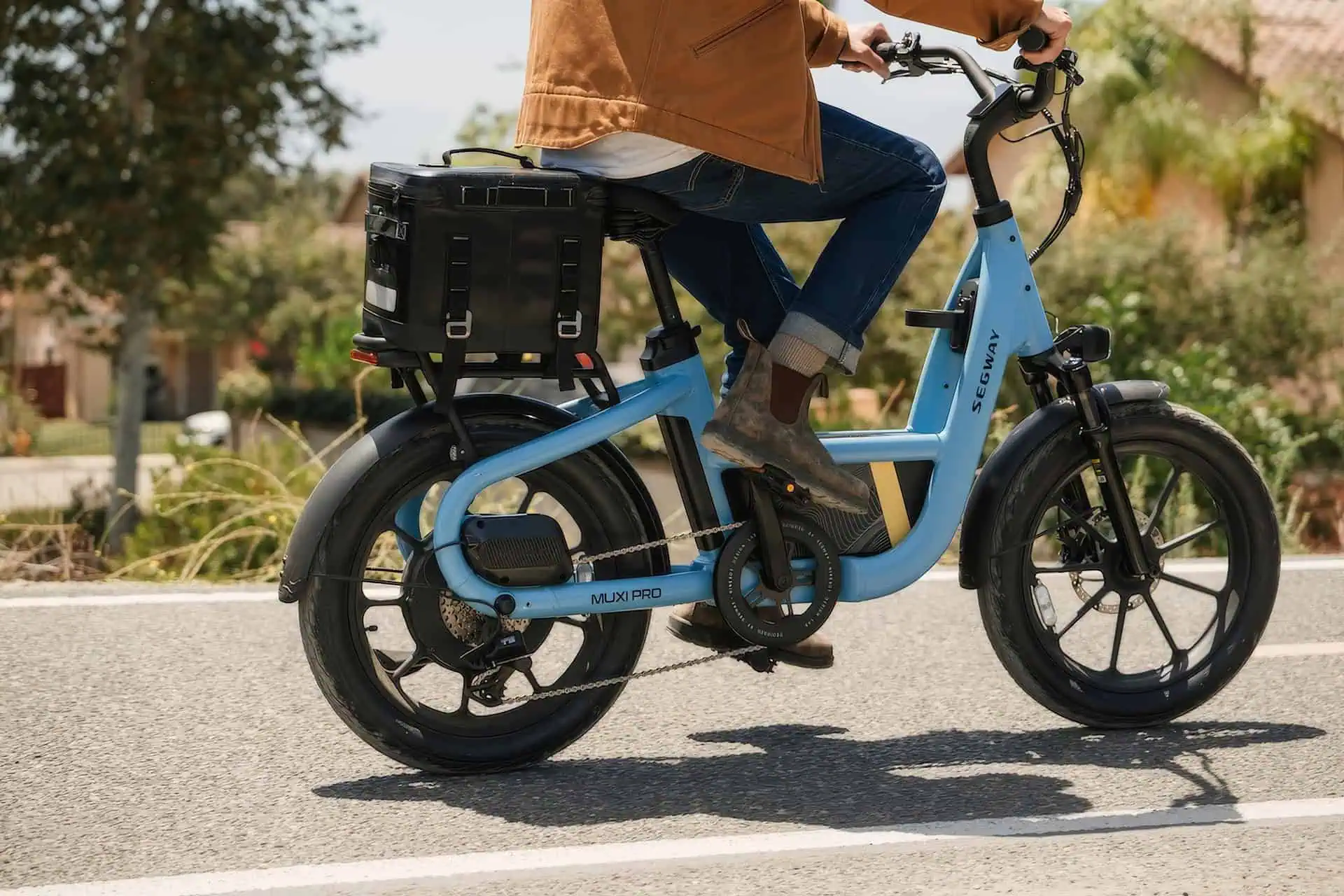
Two colorways: Anthracite, which is basically dark gray and the safe pick, and Reef Blue, the one you pick if you want drivers to see you coming.
One more thing, said plainly: if you were about to panic-buy a different cargo bike this week, the 22nd is six days away. Waiting costs you almost nothing and gets you the bike with the better spec sheet.
What the MUXI Pro adds over the original MUXI
The Pro adds a 9-speed electronic auto-shifting drivetrain, a 70mm front suspension fork, turn signals, standard front and rear fenders, and Class 3’s 28-mph capability, selectable from Class 1/2/3 in the app. Five changes, and each one maps to something a cargo rider deals with.
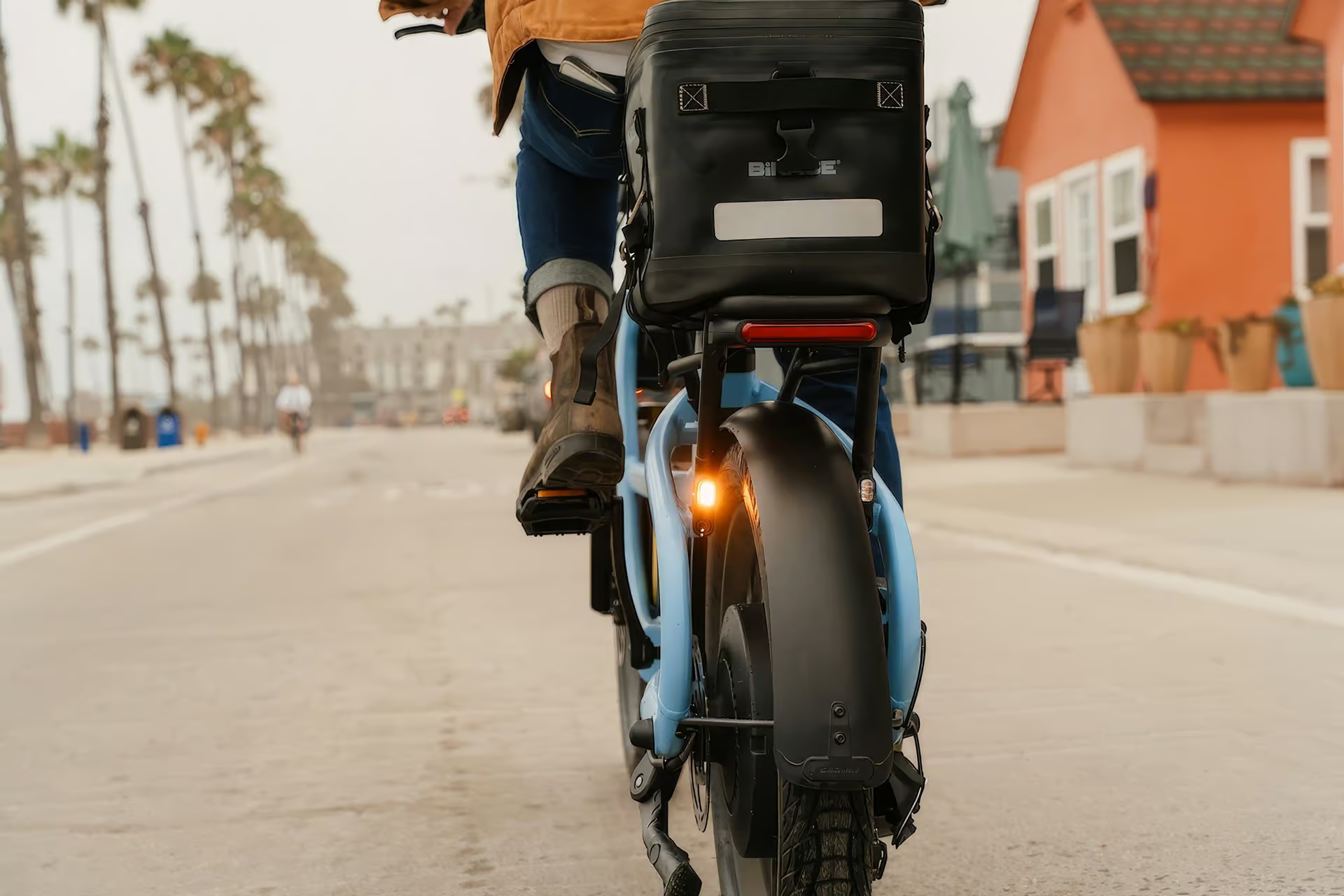
Auto-shifting. The bike picks its own nine gears, so you watch traffic and cargo instead of cadence. That’s the whole appeal on a utility bike. The obvious question: does “auto” mean it shifts sensibly under load? Segway’s announcement doesn’t fully define the behavior, and nobody’s ridden it yet, so that stays an open question until real reviews land.
70mm suspension fork. Modest travel, and it won’t turn this into a trail bike. But the original MUXI had zero front cushioning, and 70mm is enough to take the edge off potholes when you’re loaded. Less rattled hands, more control with weight up front.
Turn signals. These fold into the lighting package, alongside an auto headlight and taillights that run without you touching switches. The payoff is simple: cars know what you’re doing instead of guessing. Riding home after dark with a load, that matters.
Standard fenders. Quietly the best upgrade here. They save your pants in the first rain, they used to be an add-on cost, and their inclusion reads like Segway assuming you’ll commute in weather. Because you will.
Class 3. 28 mph pedal assist is commuter-traffic speed, not moped speed. It’s the difference between keeping up and getting passed. The class setting switches in the app, no tools, no dealer visit. One caveat: class availability and top speed depend on federal, state, and local law.
Segway’s own framing, via senior brand manager Heather Henderson, is that the Pro is the next evolution of one of its most popular e-bikes, built to make every ride more comfortable and confident. Marketing language, sure, but it signals they see this as a flagship, not a refresh. Segway has already opened pre-orders for the MAX G3 Plus, which tells you how seriously they’re treating the new lineup. The verifiable design anchors carry over too: the swooping double-tube frame, and that “moo-shee” pronunciation.
Motor, range, and the drivetrain that makes 28 mph possible
Up to 73 miles of range, per Segway, delivered through Adaptive Assist and Algorithm 2.0. That’s the Pro’s claim; the announcement doesn’t state the original MUXI’s range. Underneath: a 750W motor with 80 Nm of peak torque, enough grunt to get a loaded bike moving without fussing with it.

Here’s the part most coverage will get backwards. The motor is the muscle, but the 9-speed drivetrain is what makes 28 mph usable. Its 11t-36t cassette, with 170mm cranks and a 48t chainring, keeps your cadence in the efficient band at speed instead of spinning out. Segway credits that drivetrain with enabling Class 3, and that tracks.
Algorithm 2.0 is the range story. A cadence sensor plus an inertial measurement unit, with 0.5-degree tolerance, reads climbing, braking, and tilt, and boosts uphill while holding back on flats. It even notices a foot off the pedal at a stop and doesn’t lurch. Withholding power you don’t need is how a 73-mile number exists at all. Hills and cargo discount it.
Cargo capacity and direct-drive control features
The numbers: 82.2-lb bike, 418 lbs total payload, 265 lbs max rider, and the Passenger Kit carries a second passenger up to 120 pounds. Do the subtraction the press release skips: 418 minus a 265-lb rider leaves roughly 150 lbs for passenger plus cargo. The 120-lb passenger limit only makes sense inside that math. And 82.2 lbs is two-hand lift territory, maybe two-person. Normal for the category, but worth knowing before you imagine carrying it up stairs.
What the direct-drive motor unlocks. Because the motor lives in the hub, you get car-style assists most mid-drive cargo bikes can’t offer: Hill Descent Control holds your speed downhill so you’re not riding the brakes, Regenerative Brating claws back a little energy (nice, not a game-changer), Hill-Start Assist means no rollback on a grade, and Traction Control catches wheelspin on wet gravel. They matter most loaded, which is exactly when losing grip or brake fade hurts worst.
Stopping and rolling. Two-piston hydraulic discs on 180mm rotors, which is the brake spec you should insist on at this weight. Tires are 20″×3″: chunky enough for grip and cushion, small enough to keep the bike compact.
Is it worth the upgrade for hilly cities? The hill case is supported here. But the announcement gives no original-vs-Pro price delta and no independent verdict exists yet, so that call is yours to make on your local hills, not mine to fabricate.
Design and ergonomics
The swooping double-tube frame carries over from the original unchanged, which is fine. It was already the best part, and it’s why this doesn’t look like a delivery vehicle. The cargo argument is geometry, not styling: low standover means swinging a leg over with groceries in the way, the upright position keeps your head up in traffic, and the low center of gravity keeps a loaded bike from getting tippy. The design and the stability claims are the same engineering story told twice. Also worth a line: the footprint is sleek and compact, so it doesn’t eat a whole garage.
Accessories and the real cost of a full build
Six accessories, all priced, and the sticker is a floor, not the purchase. The Passenger Kit runs $119.99, the Middle Basket $129.99, the Front Basket $99.99, the Xiro Automatic Dropper Post $229.99, the Rearview Radar $99.99, and the e-Bike Rearview Mirror $29.99.
Passenger Kit, $119.99. Seat, foot pegs, and wheel guards designed around the Pro’s drivetrain, not a generic strap-on. Carries a second rider up to 120 lbs. Sold separately, so budget for it if hauling a kid is the plan.
Middle Basket, $129.99. The haul-everything add-on. Carried over from the original MUXI, so it fits directly.
Front Basket, $99.99. Smaller, for stuff you want in reach. Also a carryover, which means existing MUXI owners’ gear still fits.
Xiro Automatic Dropper Post, $229.99. Pricey, but useful if multiple-height riders share the bike or you’re mounting and dismounting all day.
Rearview Radar, $99.99. Integrates with the lighting system so the bike can flag cars approaching from behind. That integration is why it beats a standalone unit.
Rearview Mirror, $29.99. Cheap, obvious, and the first thing most riders should add.
Now the money paragraph. Base plus Passenger Kit, both baskets, radar, and mirror comes to roughly $2,460, and that’s before the dropper post. That’s the number to budget.
Cost check: The sticker is $1,999.99, but the full setup with kit, baskets, radar, and mirror lands around $2,460. Budget for the second number.
Intelligent Ride System: security, display, and connectivity
Segway’s Intelligent Ride System, carried over from the MUXI platform, bundles the connected stuff: AirLock secures the bike automatically as you leave and disarms as you come back, an escalating alarm pings your phone, Apple Find My plus Segway’s own GPS track it, and Lost Mode remotely kills the bike or battery (reversible if recovered). Over-the-air updates hit six systems over 4G or Bluetooth, the 2.4-inch color display handles navigation and calls, the 600-lumen headlight turns itself on, and health apps sync through the Segway Mobility app. Cloud binding means a stolen battery can’t just be reused. One asterisk: all of this is free for year one only.
Battery, charging, and safety certifications
A full charge takes 5.5 hours on the 48V/716Wh battery, using the 1.3A standard charger (3.9A max). That’s an overnight or workday habit, no drama. And yes, it’s UL 2271 and UL 2849 certified, which is the peace-of-mind line if you’re charging indoors. The bike manages the battery for you, so there’s nothing to babysit.
Weather-wise: IPX7 on the battery and display, IPX5 on the body. Rain is fine, pressure-washing isn’t.
If you’ve read warnings about which e-bikes to avoid, flip it into a checklist you can use on any cargo bike you cross-shop: UL certification, an IPX7-rated battery, hydraulic discs, traction control. This one checks all four.
Fine print: subscriptions, legality, and what’s still unverified
The honest downsides are the 82.2-lb weight, a year-two subscription on the smart features, and a range figure that’s a manufacturer claim, not a tested one.
The subscription. Free for year one. After that, AirLock, GPS tracking, Lost Mode, the remote app, real-time alerts, navigation, maintenance prompts, and 4G all require a subscription. Segway hasn’t said what it costs.
Class 3 legality. Depends where you live. The 28-mph mode is subject to federal, state, and local law, and some states restrict Class 3. Verify locally before counting on that speed.
What’s unverified. No hands-on review or loaded-range testing exists yet, and the owner’s manual may not be live before launch; official Segway support and the Segway Mobility app are the places to check. The verifiable signals are decent. Segway’s been doing self-balancing vehicles since the 1999 Personal Transporter, yes, the one everyone mocked, and it now sells scooters, GoKarts, e-bikes, all with UL certs behind the safety story.
But a solid paper record isn’t a ride report. Wait for both.
Should you buy it?
The fit test: if your commute is loaded or hilly, you want a passenger seat, and a year-two subscription doesn’t kill the deal, the math works. Budget the real number, about $2,460 built out, not the $1,999.99 sticker. Three things should gate an order: hands-on reviews once they exist, Segway’s actual subscription pricing, and your local Class 3 rules. Full details live at segway.com.
Frequently Asked Questions
What are the full specs of the Segway MUXI Pro, including motor, battery, brakes, and tires?
It’s an 82.2-lb short-tail cargo bike with a 750W hub motor (80 Nm peak torque), a 48V/716Wh battery charging in 5.5 hours, and up to 73 miles of claimed range. Braking is two-piston hydraulic discs on 180mm rotors, rolling on 20″×3″ tires, with a 70mm suspension fork and nine-speed electronic auto-shifting. It carries 418 lbs total payload, with a 265-lb max rider.
What does the MUXI Pro add over the original Segway MUXI?
Five upgrades: a 9-speed electronic auto-shifting drivetrain, a 70mm front suspension fork (the original had none), turn signals, standard front and rear fenders, and Class 3’s 28-mph assist, selectable from Class 1/2/3 in the app. Each maps to a real cargo-riding pain point, from potholes under load to keeping up with commuter traffic.
What is the range of the Segway MUXI eBike?
The MUXI Pro claims up to 73 miles via its Adaptive Assist system and Algorithm 2.0, which uses a cadence sensor and inertial measurement unit to boost uphill and withhold power on flats — that restraint is how the big number exists. Treat it as a manufacturer claim: hills and cargo discount it, and no independent loaded-range testing exists yet.